Chapter 14
GAME THEORY AND COMPETITIVE STRATEGY
QUESTIONS & ANSWERS
Q14.1 From a game theory perspective, how would you characterize the bargaining between a
customer and a used car dealer?
Q14.1 ANSWER
This type of bargaining situation can be characterized as a cooperative zero-sum game.
In a zero-sum game, one player’s gain is another player’s loss. In the options market,
Q14.2 Suppose Exxon Mobil Corp. independently reduced the price of gasoline, and that this
price cut was quickly matched by competitors. Could these actions be described as
reflective of a cooperative game?
Q14.2 ANSWER
Q14.3 Characterize the essential difference between a sequential game and a simultaneous–
move game.
Q14.3 ANSWER
In a sequential game, each player moves in succession, and each player is aware of all
440 Chapter 14
Q14.4 Explain how the Prisoner’s Dilemma example shows that rational self-interested play
does not always result in the best solution for all parties.
Q14.4 ANSWER
In the classic prisoner’s dilemma, if either prisoner knew the other prisoner would
Q14.5 Does game theory offer a strategy appropriate for situations in which no strategy results
in the highest payoff to a player regardless of the opposing player’s decision?
Q14.5 ANSWER
Q14.6 Define the Nash equilibrium concept.
Q14.6 ANSWER
A set of strategies constitute a Nash equilibrium if no player can unilaterally increase his
Q14.7 Instructors sometimes use quizzes to motivate students to adequately prepare for class.
However, preparing and grading quizzes can become time-consuming and tedious.
Moreover, if students prepare adequately for class, there is no need for quizzes. What
does game theory prescribe for instructors facing the problem of needing to motivate
class preparation among students?
Game Theory and Competitive Strategy 441
Q14.7 ANSWER
The on-going battle between instructors and their students concerning class preparation
is a classic game theory problem. Instructors sometimes use quizzes to motivate
Q14.8 The typical CEO of a major U. S. corporation is 56-58 years old and gets paid $3-5
million per year. From a game-theory perspective, explain why corporate governance
experts advise that such executives be required to hold common stock worth 7-10 years
of total compensation.
Q14.8 ANSWER
Boards of directors and stockholders face a classic end-of-game problem when it comes
to the employment of top executives. To guard against shirking or malfeasance in the
period just prior to retirement, savvy employers solve the end-of-game problem by using
442 Chapter 14
Q14.9 Describe the difference between limit pricing and predatory pricing strategies.
Q14.9 ANSWER
Limit pricing and predatory pricing strategies have significant similarities, but important
differences as well. Both pricing strategies have the potential to be used as means for
Q14.10 Explain why the establishment and exploitation of network effects are key elements in
the competitive strategy of computer software provider Microsoft Corp.
Q14.10 ANSWER
There are strong network effects in computer software. Take Microsoft Office, for
SELF-TEST PROBLEMS AND SOLUTIONS
ST14.1 Game Theory Strategies. Suppose two local suppliers are seeking to win the right to
upgrade the communications capability of the internal “intranets” that link a number of
customers with their suppliers. The system quality decision facing each competitor, and
potential profit payoffs, are illustrated in the table. The first number listed in each cell
is the profit earned by U.S. Equipment Supply; the second number indicates the profit
earned by Business Systems, Inc. For example, if both competitors, U.S. Equipment
Supply and Business Systems, Inc., pursue a high-quality strategy, U.S. Equipment
Supply will earn $25,000 and Business Systems, Inc., will earn $50,000. If U.S.
Game Theory and Competitive Strategy 443
Equipment Supply pursues a high-quality strategy while Business Systems, Inc., offers
low-quality goods and services, U.S. Equipment Supply will earn $40,000; Business
$25,000.
Business Systems, Inc.
U.S. Equipment Supply
Quality Strategy
High Quality
(“Left”)
Low Quality
(“Right”)
High Quality
(“Up”)
$25,000, $50,000
$40,000, $22,000
Low Quality
(“Down”)
-$25,000, $20,000
$25,000, $25,000
A. Does U.S. Equipment Supply and/or Business Systems, Inc., have a dominant
strategy? If so, what is it?
ST14.1 SOLUTION
A. The dominant strategy for U.S. Equipment Supply is to provide high-quality goods.
Irrespective of the quality strategy chosen by Business Systems, Inc., U.S. Equipment
444 Chapter 14
B. The secure strategy for U.S. Equipment Supply is to provide high-quality goods. By
C. A set of strategies constitute a Nash equilibrium if, given the strategies of other players,
no player can improve its payoff through a unilateral change in strategy. The concept of
Nash equilibrium is very important because it represents a situation where every player
ST14.2 Nash Equilibrium. Assume that Hewlett-Packard (H-P) and Dell Computer have a
large inventory of personal computers that they would like to sell before a new
generation of faster, cheaper machines is introduced. Assume that the question facing
each competitor is whether or not they should widely advertise a “close out” sale on
these discontinued items, or instead let excess inventory work itself off over the next few
months. If both aggressively promote their products with a nationwide advertising
Game Theory and Competitive Strategy 445
campaign, each will earn profits of $5 million. If one advertises while the other does
not, the firm that advertises will earn $20 million, while the one that does not advertise
will earn $2 million. If neither advertises, both will earn $10 million. Assume this is a
one-shot game, and both firms seek to maximize profits.
Dell Computer
Promotion Strategy
Advertise
(“Left”)
Don’t Advertise
(“Right”)
A. What is the dominant strategy for each firm? Are these also secure strategies?
B. What is the Nash equilibrium?
C. Would collusion work in this case?
ST14.2 SOLUTION
A. The dominant strategy for both H-P and Dell is to advertise. Neither could earn higher
profits with a “don’t advertise” strategy, irrespective of what the other party chooses to
do.
B. A set of strategies constitute a Nash equilibrium if, given the strategies of other players,
446 Chapter 14
C. Collusion will not work in this case because this is a “one shot” game where moves are
PROBLEMS & SOLUTIONS
P14.1 Game Theory Concepts. Recognize each of the following statements as being true or
false and explain why.
A. A set of strategies constitutes a Nash equilibrium if no player can improve their
position given the strategies chosen by other players.
B. A secure strategy is very conservative and should only be considered if the rival’s
optimal strategy is identical.
C. A dominant strategy is also a secure strategy, but every secure strategy is not
necessarily a dominant strategy.
D. In a one-shot game, the Nash equilibrium is also the best outcome that can be
achieved under collusion.
E. If a player has no dominant strategy, it pays to look at the game from the rival’s
perspective and anticipate the rival choosing its dominant strategy.
P14.1 SOLUTION
account the optimal decision of the rival and may thereby result in significant lost
profits.
Game Theory and Competitive Strategy 447
from the viewpoint of the competitors to the collusion or cartel profit-maximizing
outcome.
P14.2 Prisoner’s Dilemma. The classic prisoner’s dilemma involves two suspects, A and B,
who are arrested by the police. Because the police have insufficient evidence for
conviction on a key charge, they place the prisoners in isolation and offer each of them
the following deal: If one testifies for the prosecution against the other and the other
remains silent, the betrayer goes free and the silent accomplice receives a 20-year
sentence. If both stay silent, both prisoners are sentenced to only six months in jail on a
minor charge. If each betrays the other, each receives a five-year sentence. Each
prisoner must make the choice of whether to betray the other or to remain silent. Neither
prisoner knows for sure what choice the other prisoner will make. The dilemma is
summarized as follows:
Prisoner B Stays Silent
Prisoner B Betrays
Prisoner A Stays Silent
Each gets six months
Prisoner B goes free
Prisoner A goes free
Prisoner B gets 20 years
Prisoner A gets 20 years
B. What is the paradox of the situation?
P14.2 SOLUTION
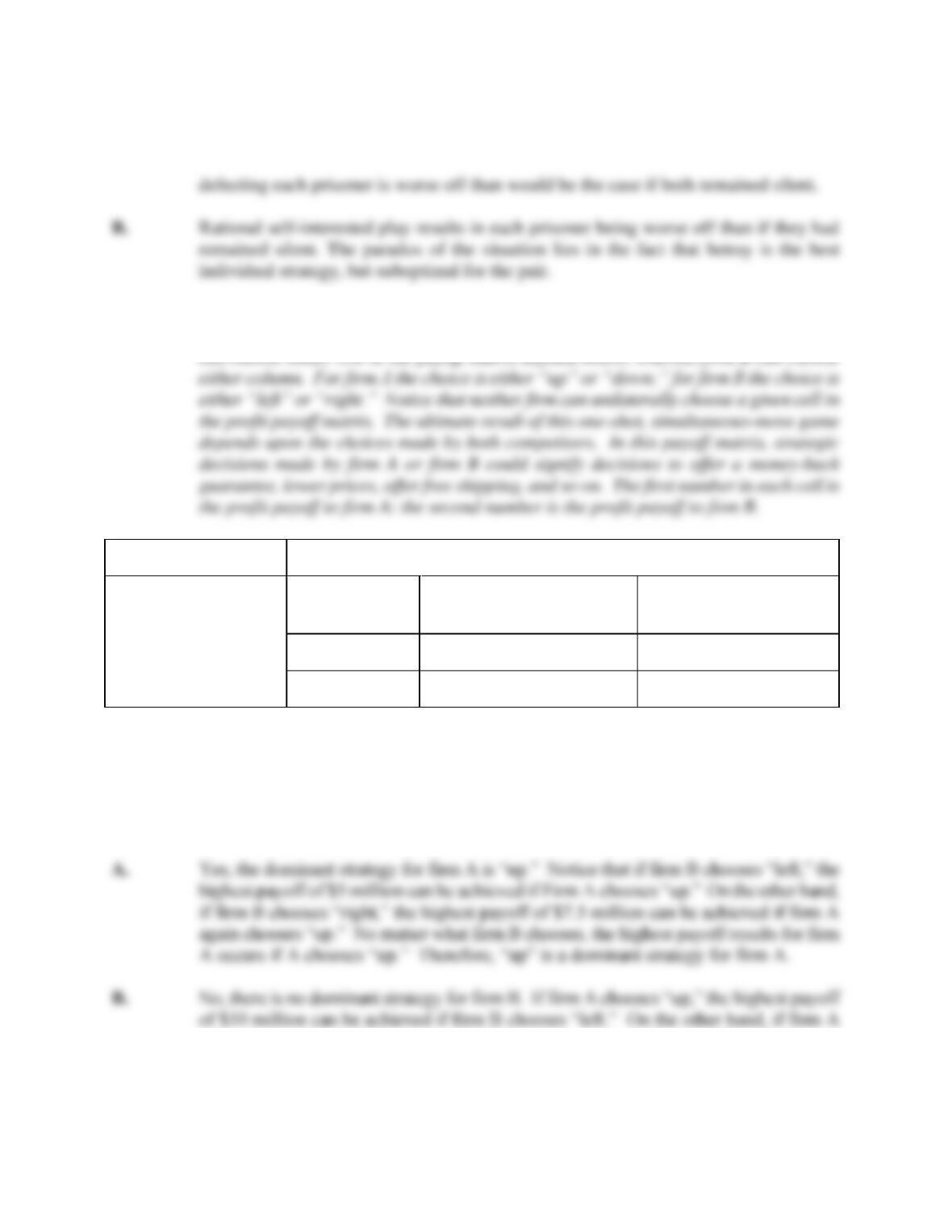
A. If either prisoner knew the other prisoner would stay silent, their best move would be to
448 Chapter 14
P14.3 Dominant Strategies. Conceive of two competitors facing important strategic decisions
where the payoff to each decision depends upon the reactions of the competitor. Firm A
Firm B
Firm A
Competitive
Strategy
Left
Right
Up
$5 million, $10 million
$7.5 million, $4 million
Down
$1 million, $3.5 million
$5 million, $5 million
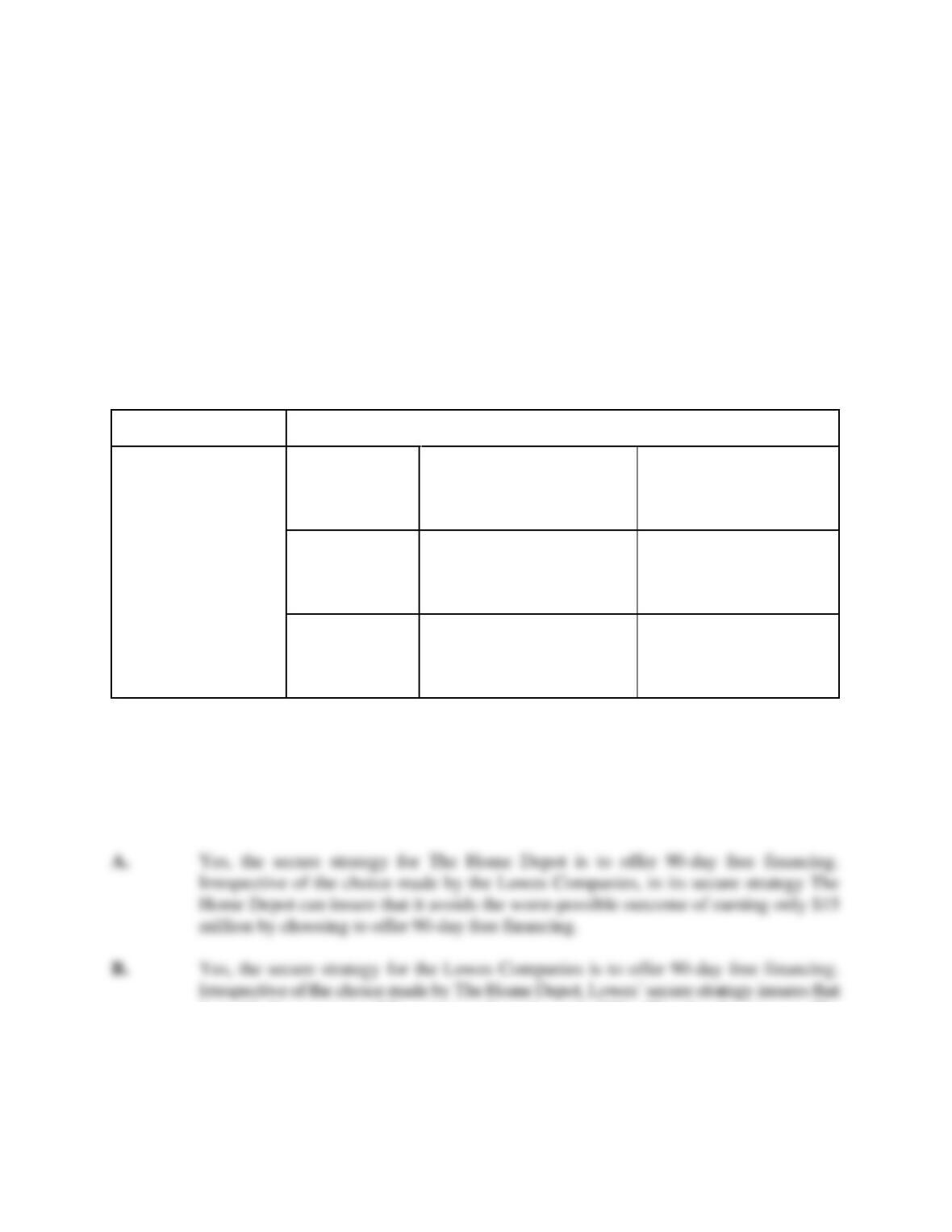
A. Is there a dominant strategy for firm A? If so, what is it?
B. Is there a dominant strategy for firm B? If so, what is it?
P14.3 SOLUTION
chooses “down” the highest payoff of $5 million can be achieved if firm B chooses
“right.” Therefore, there is no dominant strategy for firm B. The profit-maximizing
choice by firm B depends upon the choice made by firm A.
Game Theory and Competitive Strategy 449
P14.4 Secure Strategies. The Home Depot, Inc., and the Lowes Companies are locked in a
vicious struggle for market share in the home improvement market. Suppose each
competitor is considering the advisability of offering 90-day free financing as a means
for boosting sales during the important spring season. The Home Depot can choose
either row in the payoff matrix defined below, whereas the Lowes Companies can
choose either column. Neither firm can unilaterally choose a give cell in the payoff
matrix. The ultimate result of this one-shot, simultaneous-move game depends upon the
choices made by both competitors. The first number in each cell is the profit payoff to
the Home Depot; the second number is the profit payoff to the Lowes Companies.
Lowes Companies
The Home Depot
Competitive
Strategy
90-day free financing
(“Left)
No free financing
(“Right”)
90-day free
financing
(“Up”)
$20 million, $20 million
$40 million, $10 million
No free
financing
(“Down”)
$15 million, $35 million
$25 million, $25 million
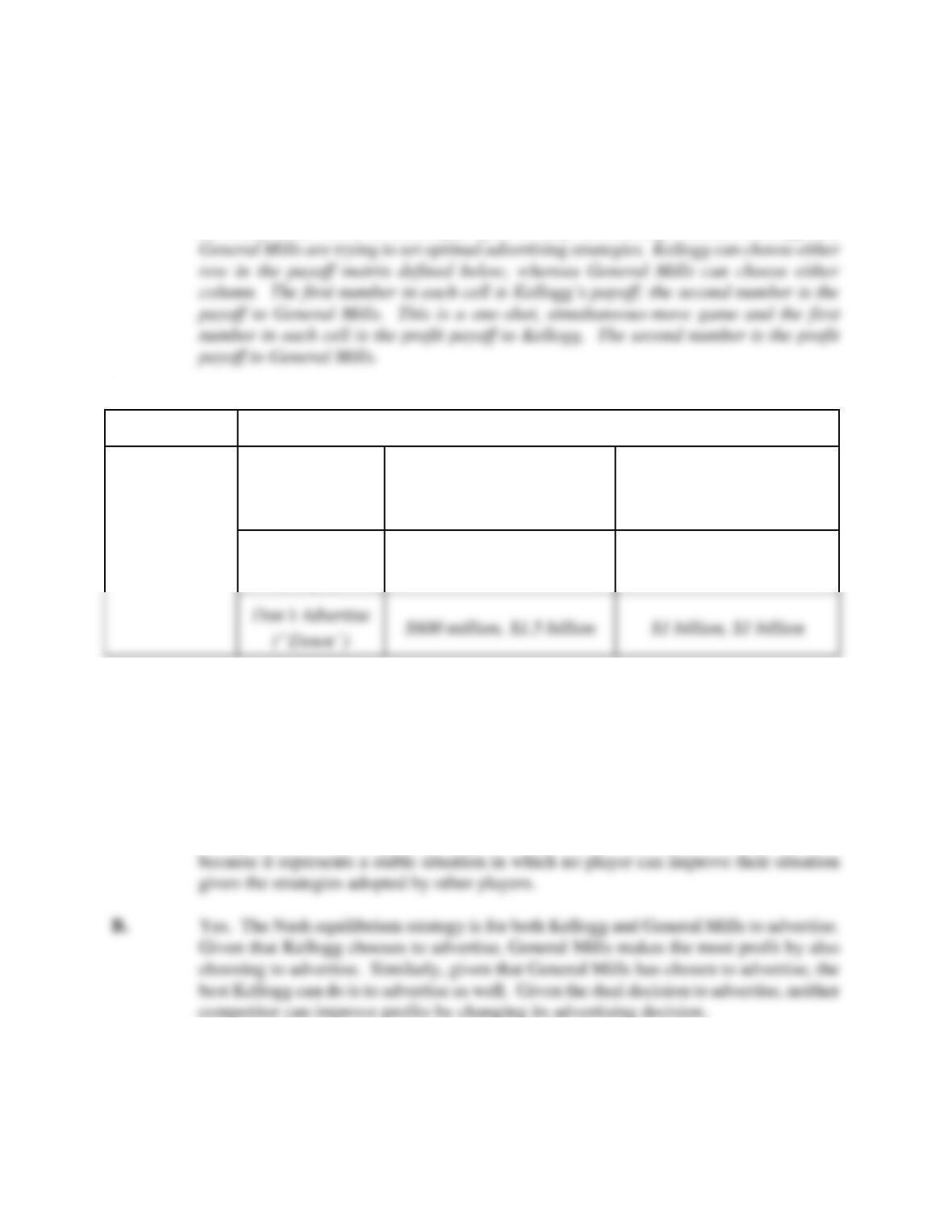
A. Is there a secure strategy for The Home Depot? If so, what is it?
B. Is there a secure strategy for The Lowes Companies? If so, what is it?
P14.4 SOLUTION
it avoids the worst-possible outcome of earning only $10 million by choosing to offer
90-day free financing.
P14.5 Nash Equilibrium. The breakfast cereal industry is heavily concentrated. Kellogg,
General Mills, General Foods (Post) and Ralcorp account for over 85 per cent of
450 Chapter 14
industry sales. Advertising by individual firms does not convince more people to eat
breakfast. Effective advertising simply steals sales from rivals. Big profit gains could
be had if these rivals could simply agree to stop advertising. Assume Kellogg and
.
General Mills
Kellogg
Competitive
Strategy
Advertise
(“Left”)
Don’t Advertise
(“Right”)
Advertise
(“Up”)
$800 million, $800 million
$1.5 billion, $600 million
A. Briefly describe the Nash equilibrium concept.
B. Is there a Nash equilibrium strategy for each firm? If so, what is it?
P14.5 SOLUTION
A. A set of strategies constitutes a Nash equilibrium if no player can improve their payoff
through a unilateral change in strategy. The concept of Nash equilibrium is important
P14.6 Collusion. In the United States any contract, combination or conspiracy in restraint of
trade is illegal. In practice, this means it is against the law to control or attempt to
control the quantity, price or exchange of goods and services. In addition to this legal