Game Theory and Competitive Strategy 451
prohibition, potential conspirators face practical problems in any overt or tacit attempt
at collusion. To illustrate the problems encountered, consider the following profit
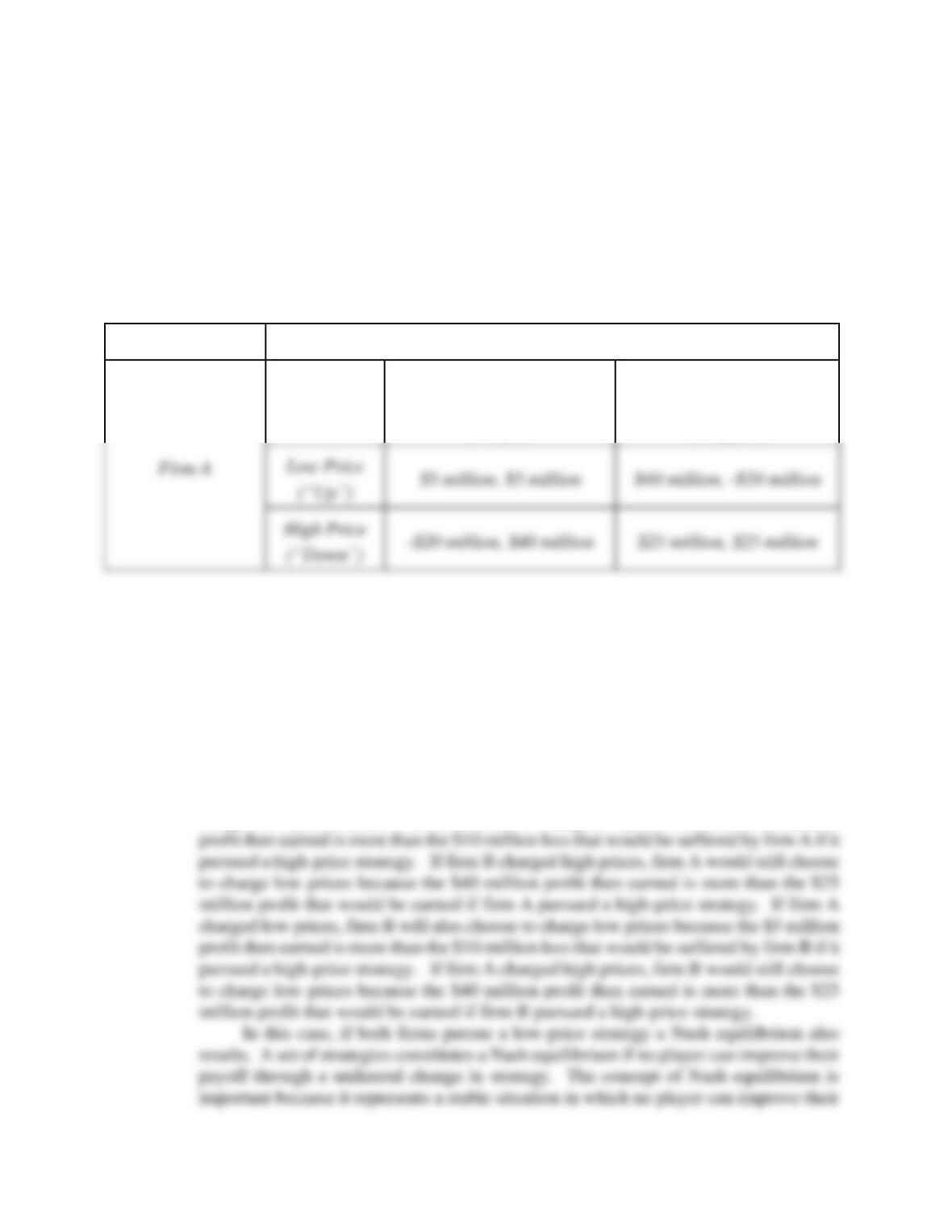
payoff matrix faced by two potential conspirators in a one-shot, simultaneous-move
game. The first number in each cell is firm A’s profit payoff; the second number is the
profit payoff to firm B.
Firm B
Pricing
Strategy
Low Price
(“Left”)
High Price
(“Right”)
A. Is there a dominant strategy and a Nash equilibrium strategy for each firm? If so,
what are they?
B. If the firms agreed to collude and charge high prices, both would earn $25 million
and joint profits of $50 million would be maximized. However, the joint high-
price strategy is not a stable equilibrium. Explain.
P14.6 SOLUTION
A. In this problem, the low-price strategy is a dominant strategy for both firms. If firm B
charged low prices, firm A will also choose to charge low prices because the $5 million
452 Chapter 14
B. If the firms agreed to collude and charge high prices, both would earn $25 million and
P14.7 Randomized Strategies. Game theory can be used to analyze conflicts that arise
between managers and workers. Managers can choose to monitor worker performance,
or not monitor worker performance. For their part, workers can choose to perform the
requested task within the time frame requested, or fail to perform as requested. The
resulting payoff matrix for this one-shot, simultaneous move game shows the payoff to
managers (first number) and workers (second number).
Workers
Work
Strategy
Perform
(Left”)
Fail to Perform
(“Right”)
A. Document the fact that there is no Nash equilibrium strategy for each player.
B. Explain how each player will have a preference for secrecy in the absence of a
Nash equilibrium and how randomized strategies might be favored in such
circumstances.
P14.7 SOLUTION
A. In this game, if the manager monitors performance while the worker performs as
Game Theory and Competitive Strategy 453
B. In the absence of Nash equilibrium, each player will have a preference for secrecy to
mask moves and preferences. In the absence of a Nash equilibrium, workers might
P14.8 Predatory Pricing. Prohibitions against predatory pricing stem from big business
conspiracy theories popularized in the late nineteenth century by journalists such as Ida
Tarbell, author of an influential book titled History of the Standard Oil Company. In
that book, Tarbell condemned Standard Oil’s allegedly predatory price cutting.
Business historians assert that Tarbell vilified John D. Rockefeller because of personal
reasons, and not only because of an interest in reshaping public policy. Standard Oil’s
low prices had driven the employer of Tarbell’s brother, the Pure Oil Company, out of
the petroleum-refining business.
According to predatory pricing theory, the predatory firm sets price below
marginal cost, the relevant cost of production. Competitors must then lower their price
below marginal cost, thereby losing money on each unit sold. If competitors failed to
match the predatory firm’s price cuts, they would continue to lose market share until
they were driven out of business. If competitors follow the lead of the predatory pricing
firm and cut price below marginal cost, they will incur devastating losses, and
eventually go bankrupt. Either way, the “deep pockets” of the predatory firm give it the
financial muscle and staying power necessary to drive smaller, weaker competitors out
of business. After competition has been eliminated from the market, the predatory firm
raises prices to compensate for money lost during its price war against smaller
competitors, and earns monopoly profits forever thereafter.
A. The ban against predatory pricing is one of the most controversial U. S. antitrust
454 Chapter 14
policies. Explain why this ban is risky from a public policy perspective, and why
predatory pricing strategy can be criticized as irrational from a game theory
perspective.
B. Explain why the prohibition against predatory pricing might be politically popular
even if predatory pricing is implausible from an economic perspective.
P14.8 SOLUTION
A. The antitrust ban on predatory pricing is risky from a public policy perspective because,
like any limit on price competition, a ban on predatory pricing can retard beneficial price
competition among firms. The theory of predatory pricing has long held appeal for
From a game theory perspective, predatory pricing strategy seems irrational
because it is based upon output and pricing assumptions that are not credible. For
B. Predatory pricing theory gets virtually no respect from economists, but is still a popular
legal and political theory for several reasons. Huge sums of money are involved in
predatory pricing litigation and that fact guarantees that the antitrust bar will be fond of
Game Theory and Competitive Strategy 455
P14.9 Non-price Competition. General Cereals, Inc. (GCI), produces and markets Sweeties!,
a popular ready-to-eat breakfast cereal. In an effort to expand sales in the Secaucus,
New Jersey, market, the company is considering a one-month promotion whereby GCI
would distribute a coupon for a free daily pass to a local amusement park in exchange
for three box tops, as sent in by retail customers. A 25% boost in demand is anticipated,
even though only 15% of all eligible customers are expected to redeem their coupons.
Each redeemed coupon costs GCI $6, so the expected cost of this promotion is 30¢ (=
0.15 × $6 ÷ 3) per unit sold. Other marginal costs for cereal production and
distribution are constant at $1 per unit.
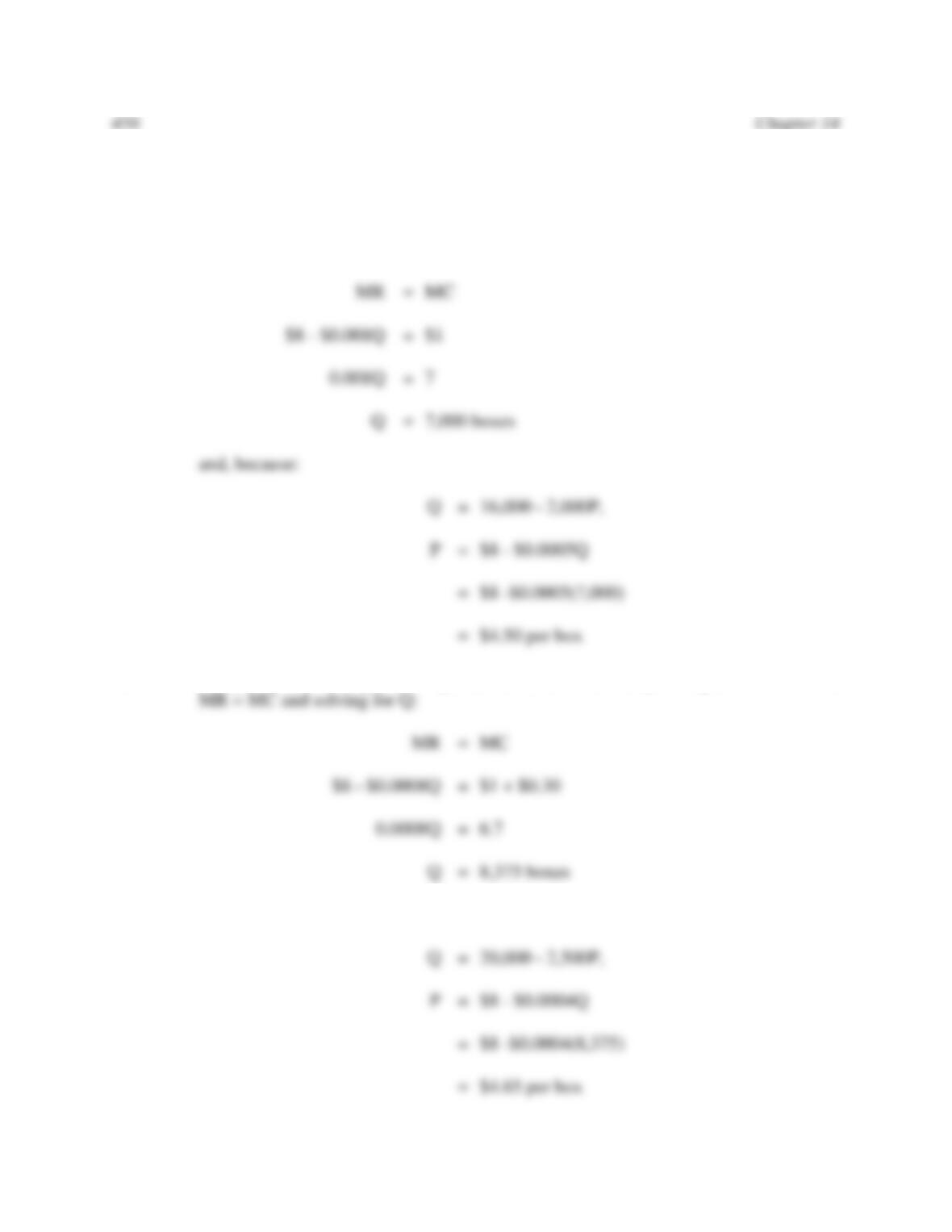
Current demand and marginal revenue relations for Sweeties! are
A. Calculate the profit-maximizing price/output and profit levels for Sweeties! prior
to the coupon promotion.
B. Calculate these same values subsequent to the Sweeties! coupon promotion and
following the expected 25% boost in demand.
P14.9 SOLUTION
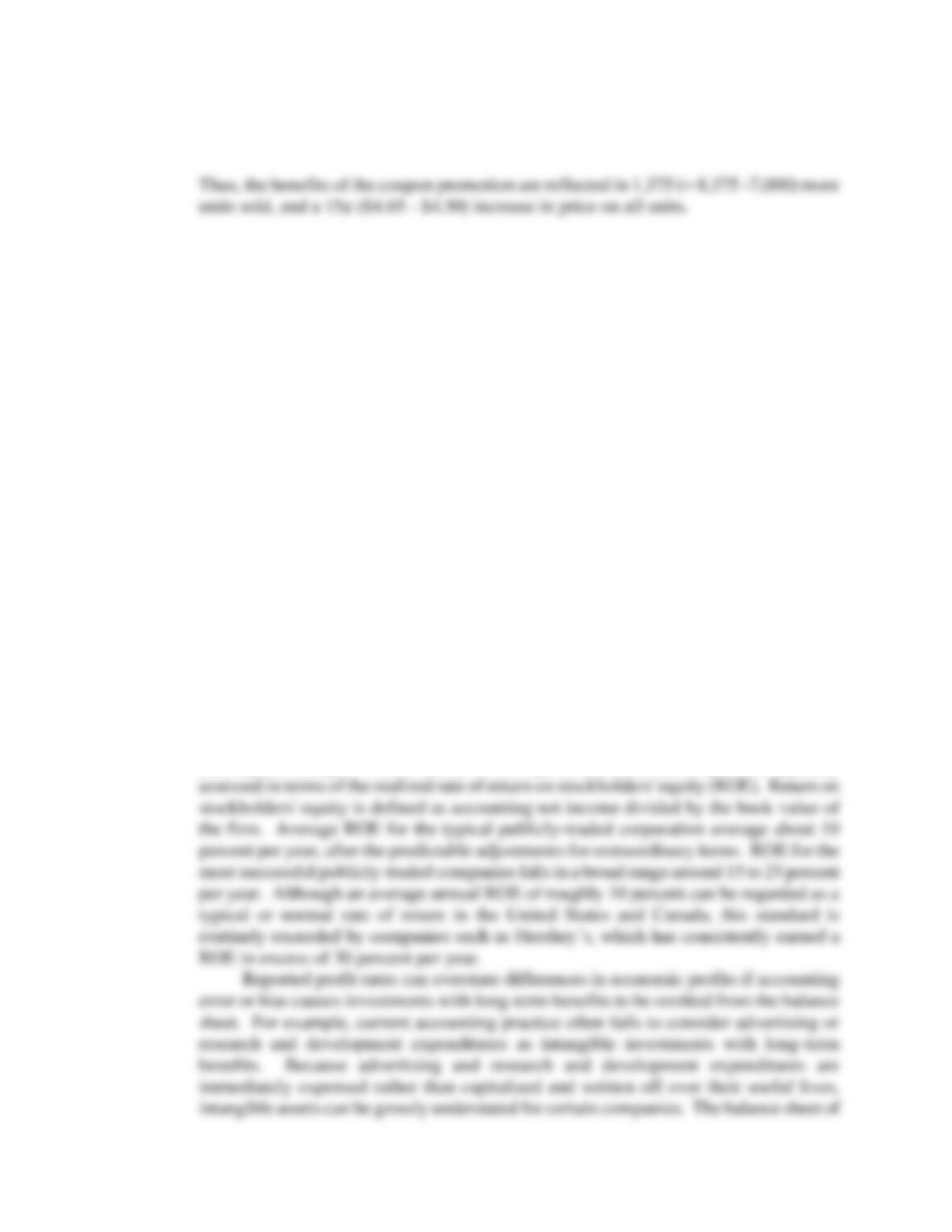
A. The profit-maximizing price/output combination is found by setting MR = MC and
solving for Q:
B. The profit-maximizing price/output combination is found by setting the new relevant
and, because:
Game Theory and Competitive Strategy 457
P14.10 Variability of Business Profits. Near the checkout stand, grocery stores and
convenience stores prominently display low-price impulse items like candy, gum and
soda that customers crave. Despite low prices, such products generate enviable profit
margins for retailers and for the companies that produce them. For example, Hershey
Foods Corp. is the largest U.S. producer of chocolate and nonchocolate confectionary
(sugared) products. Major brands include Hershey’s, Reese’s, Kit Kat, Almond Joy, and
Milk Duds. While Hershey’s faces increasing competition from other candy companies
and snack-food producers of energy bars, the company is extremely profitable.
Hershey’s rate of return on stockholder’s equity, or net income divided by book value
per share, routinely exceeds 30% per year, or about three times the publicly-traded
company average. Profit margins, or net income per dollar of sales revenue, generally
exceed 13%, and earnings grow in a predictable fashion by more than 10 percent per
year.
A. Explain how the failure to reflect intangible assets, like the value of brand names,
might cause Hershey’s accounting profits to overstate Hershey’s economic profits.
B. Explain why high economic profit rates are a necessary but not sufficient
condition for the presence of monopoly profits.
P14.10 SOLUTION
A. Business profit is often measured in dollar terms or as a percentage of sales revenue,
called profit margin. The economist’s concept of a normal rate of profit is typically
458 Chapter 14
B. In economic terms, monopoly profits are the unwarranted payoff received by firms for
the raw exercise of pricing power. Implicit in the concept of monopoly profits is the
business, the economic value of brand name advertising is not reflected in accounting
value of the firm. In an economic sense, advertisers like Hershey’s have a right to
expect to earn a fair return on risky intangible assets derived from advertising and
product promotion. Accounting rates of return for advertising-intensive firms should be
higher than average to compensate brand name leaders for high-risk promotional
Game Theory and Competitive Strategy 459
CASE STUDY FOR CHAPTER 14
Time Warner, Inc., Is Playing Games with Stockholders
Time Warner, Inc., the world’s largest media and entertainment company, is best known as the
publisher of magazines such as Fortune, Time, People, and Sports Illustrated. The Company is a
media powerhouse comprised of Internet technologies and electronic commerce (America Online),
cable television systems, filmed entertainment and television production, cable and broadcast
television, recorded music and music publishing, magazine publishing, book publishing and direct
marketing. Time Warner has the potential to profit whether people go to theaters, buy or rent
videos, watch cable or broadcast TV, or listen to records.
Time Warner is also famous for introducing common stockholders to the practical use of
game theory concepts. In 1991, the company introduced a controversial plan to raise new equity
capital through use of a complex “contingent” rights offering. After months of assuring Wall Street
that it was close to raising new equity from other firms through strategic alliances, Time Warner
instead asked its shareholders to ante up more cash. Under the plan, the company granted holders
of its 57.8 million shares of common stock the rights to 34.5 million shares of new common, or 0.6
rights per share. Each right enabled a shareholder to pay Time Warner $105 for an unspecified
number of new common shares. Because the number of new shares that might be purchased for
$105 was unspecified, so too was the price per share. Time Warner’s Wall Street advisers
structured the offer so that the new stock would be offered at cheaper prices if fewer shareholders
chose to exercise their rights.
In an unusual arrangement, the rights from all participating shareholders were to be
460 Chapter 14
exercise their rights.
The terms of the offer were designed to make Time Warner shareholders feel compelled
ground in terms of Wall Street experience. Disgruntled shareholders noted that a similar contingent
rights offering by Bass PLC of Britain involved a fee of only 2.125% of the proceeds to the company,
despite the fact that the lead underwriter Schroders PLC agreed to buy and resell any new stock that
wasn’t claimed by rights holders. This led to charges that Time Warner’s advisers were charging
underwriters’ fees without risking any of their own capital.
Proceeds from the offering were earmarked to help pay down the $11.3 billion debt Time
Inc. took on to buy Warner Communications Inc. Time Warner maintained that it was in intensive
Stockholder reaction to the Time Warner offering was immediate and overwhelmingly
negative. On the day the offering was announced, Time Warner shares closed at $99.50, down
$11.25, in New York Stock Exchange composite trading. This is in addition to a decline of $6
suffered the previous day on the basis of a report in The Wall Street Journal that some form of equity
offering was being considered. After trading above $120 per share in the days prior to the first
reports of a pending offer, Time Warner shares plummeted by more than 25% to $88 per share
within a matter of days. This is yet one more disappointment for the company’s long-suffering
A. Was Paramount’s above-market offer for Time, Inc. consistent with the notion that the
prevailing market price for common stock is an accurate reflection of the discounted net
Game Theory and Competitive Strategy 461
present value of future cash flows? Was management’s rejection of Paramount’s above–
market offer for Time, Inc. consistent with the value-maximization concept?
B. Assume that a Time Warner shareholder could buy additional shares at a market price
of $90 or participate in the company’s rights offering. Construct the payoff matrix that
correspond to a $90 per share purchase decision versus a decision to participate in the
rights offering with subsequent 100%, 80%, and 60% participation by all Time Warner
shareholders.
CASE STUDY SOLUTION
A. These are, of course, controversial questions designed to spur debate on the issues of
capital market efficiency and the convergence or divergence between shareholder and
managerial interests. Paramount’s 1989 above-market offer for Time, Inc. is consistent
with the notion that the prevailing market price for common stock is an accurate
B. The payoff matrix that corresponds to a $90 per share purchase decision versus a
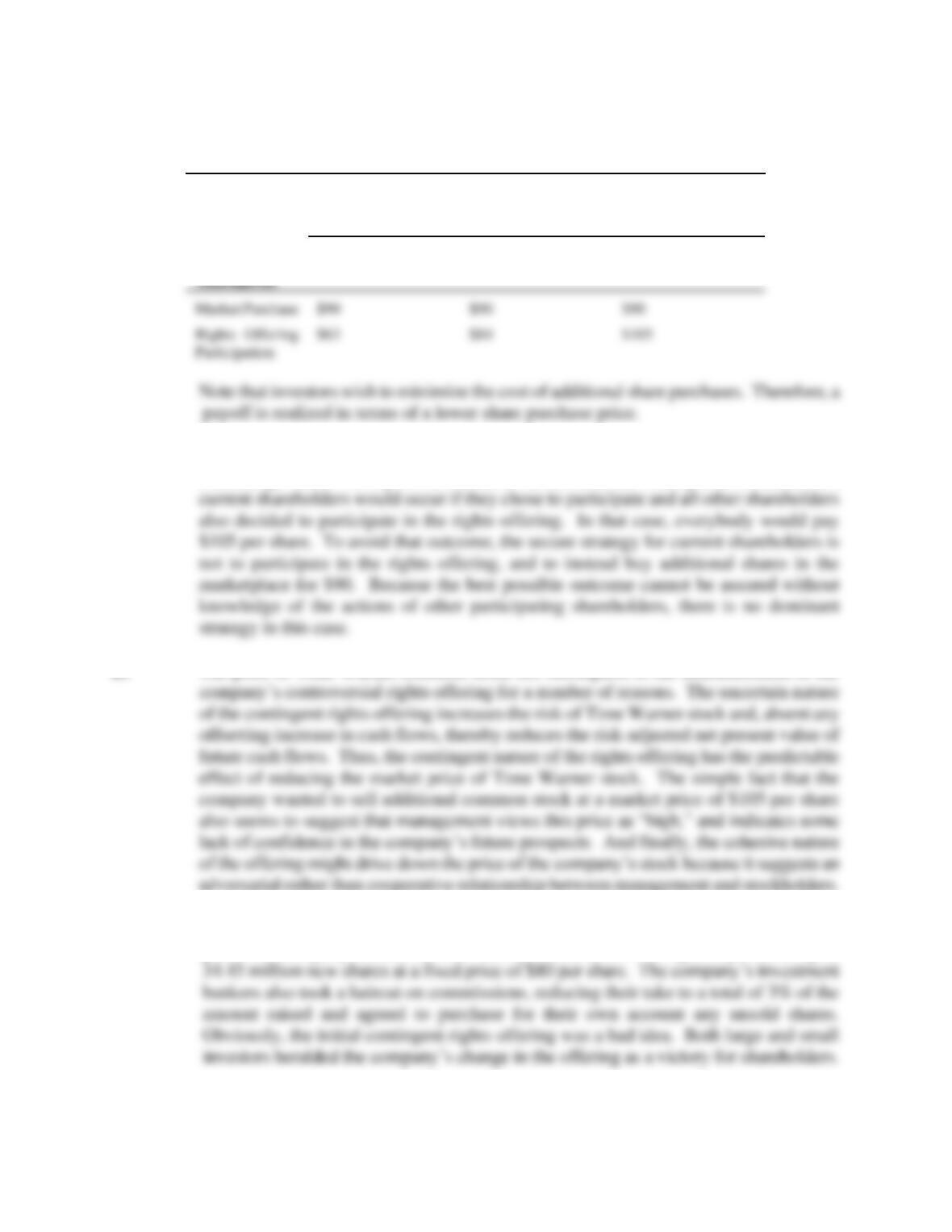
462 Chapter 14
Decision
States of Nature
60% Participation
80% Participation
100% Participation
C. A secure strategy, sometimes called the maximin strategy, guarantees the best possible
outcome given the worst possible scenario. In this case, the worst possible scenario for
D. The price of Time Warner common stock fell subsequent to the announcement of the
adversarial rather than cooperative relationship between management and stockholders.
Interestingly, in light of the furor caused by its contingent rights offering, Time
Warner decided to withdraw the offer a few weeks after it had been announced. In its
place, the company decided to offer current shareholders the right to purchase up to