interactive activity
Appendix
13
Taxes and
the Multiplier
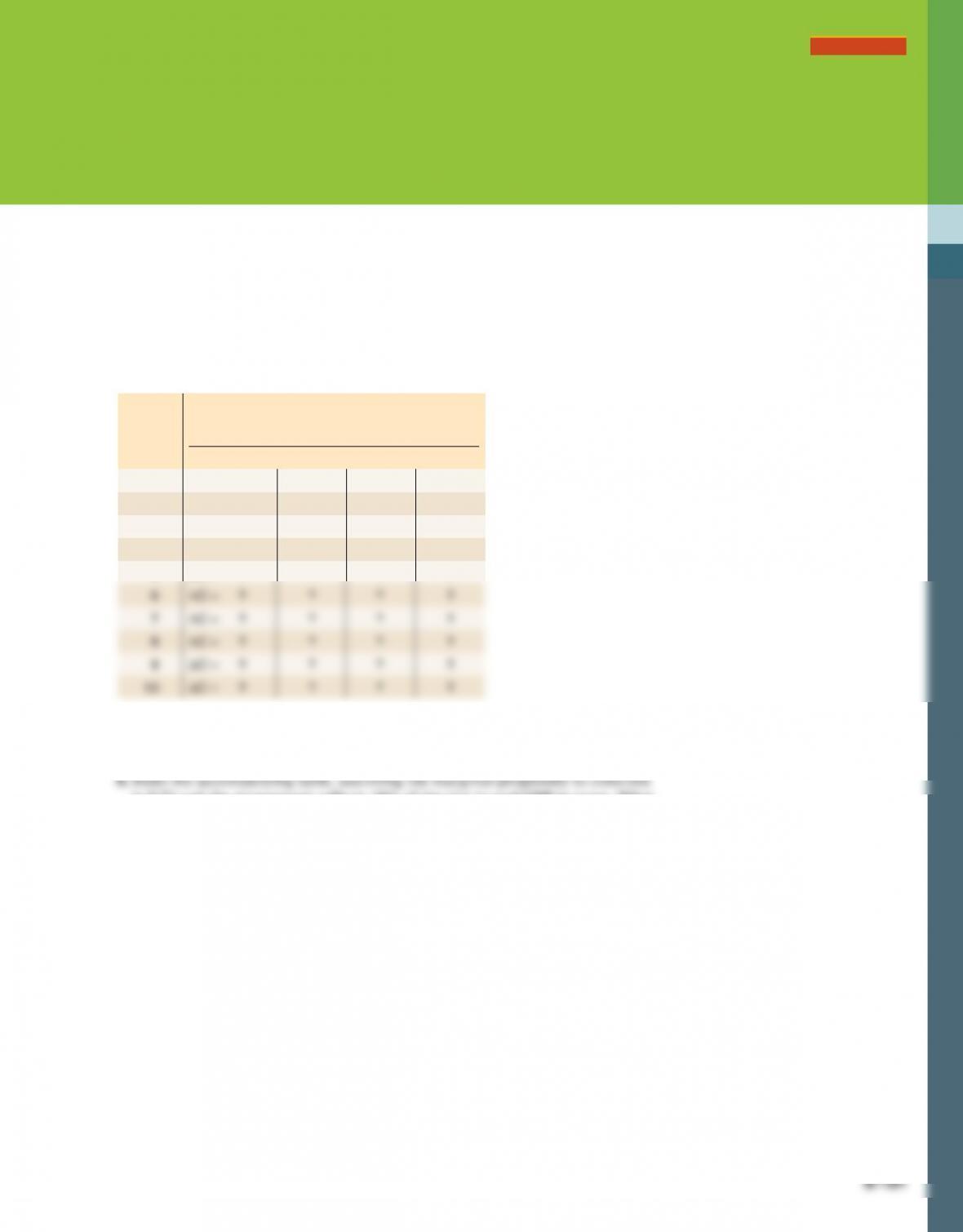
1. An economy has a marginal propensity to consume of 0.6, real GDP equals
$500billion, and the government collects 20% of GDP in taxes. If government
purchases increase by $10 billion, show the rounds of increased spending that
take place by completing the accompanying table. The first and second rows
are filled in for you. In the first row, the increase in government purchases
of $10 billion raises real GDP by $10 billion, taxes increase by $2 billion, and
YD increases by $8 billion; in the second row, the increase in YD of $8 billion
increases consumer spending by $4.80 billion (MPC × change in disposable
income).
Rounds
Change
in G
or C
Change
in real
GDP
Change
in
taxes
Change
in YD
(billions of dollars)
1DG = $10.00 $10.00 $2.00 $8.00
2DC = 4.80 4.80 0.96 3.84
3DC = ?? ? ?
4DC = ?? ? ?
5DC = ?? ? ?
a. What is the total change in real GDP after the 10 rounds? What is the value
of the multiplier? What would you expect the total change in real GDP to be,
based on the multiplier formula? How do your two answers compare?
is 0.75 and the government collects 10% of the rise in real GDP in taxes. What
is the total change in real GDP after 10 rounds? What is the value of the
multiplier? How do your two answers compare?
S-192 13 APPENDIX Taxes and The MulTiplier
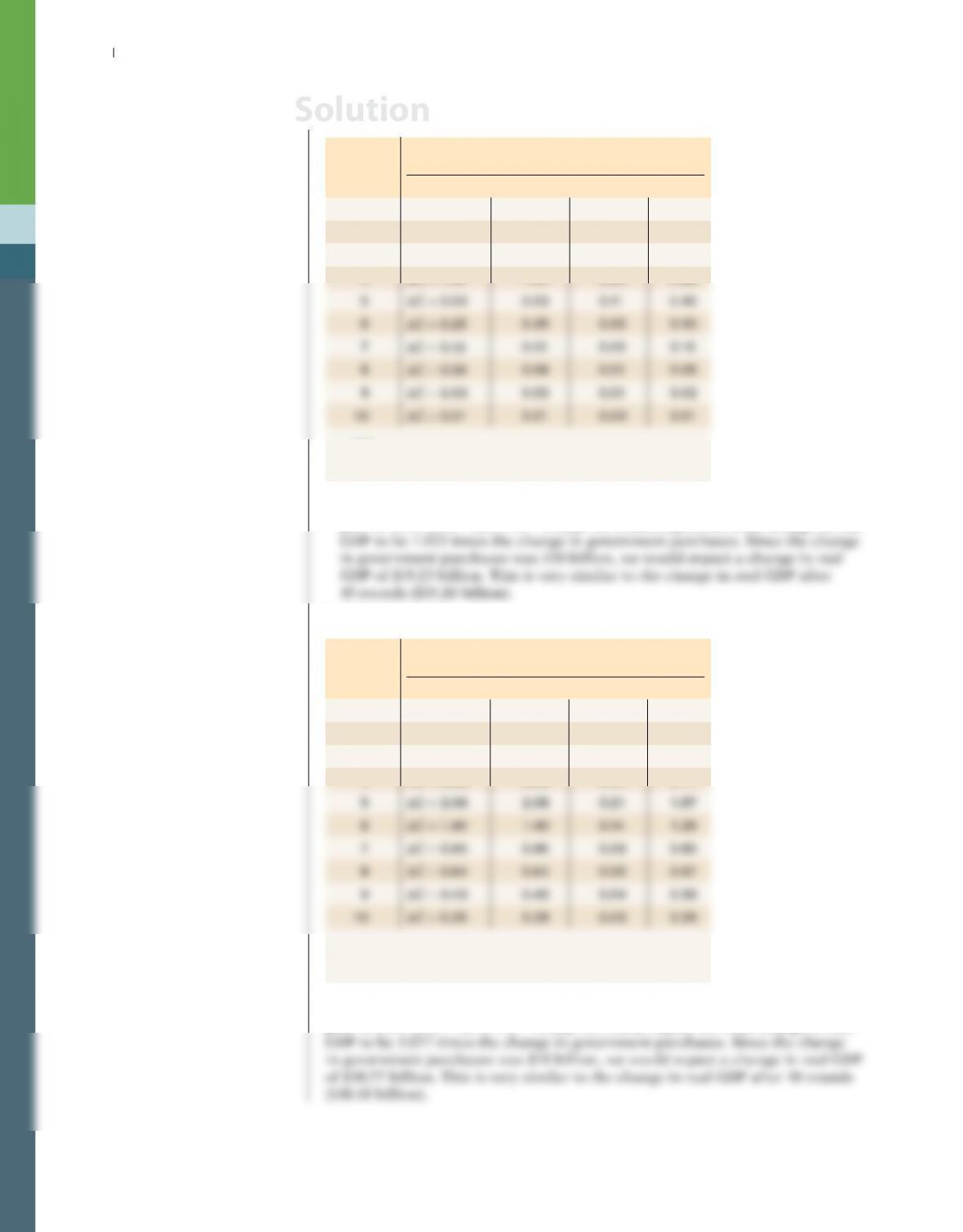
1. Here is the completed table:
Change in
G or C
Change in
real GDP
Change in
taxes
Change
in YD
Rounds (billions of dollars)
1DG = $10.00 $10.00 $2.00 $8.00
2DC = 4.80 4.80 0.96 3.84
3DC = 2.30 2.30 0.46 1.84
4DC = 1.10 1.10 0.22 0.88
. . .
Sum for
10 rounds
$19.20
a. The total change in real GDP after the 10 rounds is $19.20 billion. The multi-
plier is 1.923 [1/(1 − (0.6 × (1 − 0.2)))]. We would expect the total change in real
b. Here is the table redone:
Change in
G or C
Change in
real GDP
Change in
taxes
Change
in YD
Rounds (billions of dollars)
1DG = $10.00 $10.00 $1.00 $9.00
2DC = 6.75 6.75 0.68 6.08
3DC = 4.56 4.56 0.46 4.10
4DC = 3.08 3.08 0.31 2.77
. . .
Sum for
10 rounds
$30.18
The total change in real GDP after the 10 rounds is $30.18 billion. The multi-
plier is 3.077 [1/(1 − (0.75 × (1 − 0.1)))]. We would expect the total change in real
Solution
13 APPENDIX Taxes and The MulTiplier S-193
Solution
WORK IT OUT Interactive step-by-step help with solving this
problem can be found online.
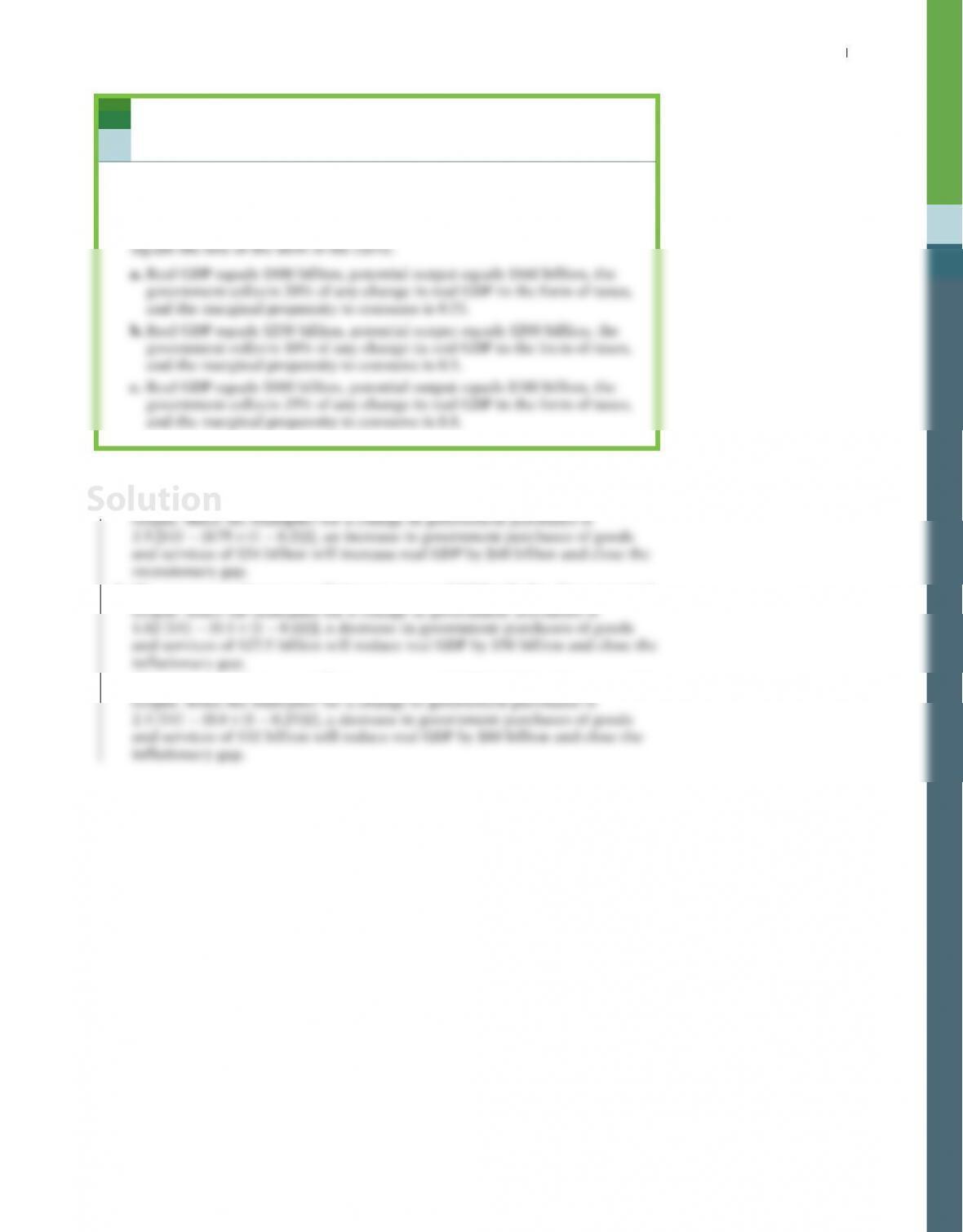
2. Calculate the change in government purchases of goods and services neces–
sary to close the recessionary or inflationary gaps in the following cases.
Assume that the short-run aggregate supply curve is horizontal, so that the
change in real GDP arising from a shift of the aggregate demand curve
2. a. The economy is facing a recessionary gap; real GDP is less than potential
b. The economy is facing an inflationary gap; real GDP is higher than potential
c. The economy is facing an inflationary gap; real GDP is higher than potential