Chapter 13
Exchange Rates, Business Cycles, and
Macroeconomic Policy in the Open Economy
◼ Learning Objectives
I. Goals of Chapter 13
A. Describe real and nominal exchange rates, how they are related, and how they change over time
(Sec. 13.1)
II. Notes to Eighth Edition Users
A. We introduce the concept of an optimum currency area and discuss whether either the United
298 Abel/Bernanke/Croushore • Macroeconomics, Ninth Edition
◼ Teaching Notes
I. Exchange Rates (Sec. 13.1)
A. Nominal exchange rates
1. The nominal exchange rate tells you how much foreign currency you can obtain with one
unit of the domestic currency
2. Under a flexible-exchange-rate system or floating-exchange-rate system, exchange rates are
determined by supply and demand and may change every day; this is the current system for
major currencies
3. In the past, many currencies operated under a fixed-exchange-rate system, in which
governments determined exchange rates
a. The exchange rates were fixed because the central banks in those countries offered to
B. In touch with data and research: Exchange rates
1. Trading in currencies occurs around-the-clock, since some market is open in some country
C. Real exchange rates
1. The real exchange rate tells you how much of a foreign good you can get in exchange for
one unit of a domestic good
5. In reality, countries produce many goods, so we must use price indexes to get P and PFor
6. If a country’s real exchange rate is rising, its goods are becoming more expensive relative to
the goods of the other country
D. Appreciation and depreciation
1. In a flexible-exchange-rate system, when enom falls, the domestic currency has undergone a
nominal depreciation (or it has become weaker); when enom rises, the domestic currency has
Chapter 13 Exchange Rates, Business Cycles, and Macroeconomic Policy in the Open Economy 299
Numerical Problem 1 is a simple example of appreciation and depreciation.
E. Purchasing power parity
1. To examine the relationship between the nominal exchange rate and the real exchange rate,
think first about a simple case in which all countries produce the same goods, which are
2. When PPP doesn’t hold, using Eq. (13.1), we can decompose changes in the real exchange
rate into parts
e/e = enom/enom + P/P − PFor/PFor
3. This can be rearranged as
4. Thus a nominal appreciation is due to a real appreciation or a lower rate of inflation than
in the foreign country
5. In the special case in which the real exchange rate doesn’t change, so that e/e = 0, the
resulting equation in Eq. (13.3) is called relative purchasing power parity, since nominal
6. In touch with data and research: McParity
a. As a test of the PPP hypothesis, the Economist magazine periodically reports on the
300 Abel/Bernanke/Croushore • Macroeconomics, Ninth Edition
1. The real exchange rate (also called the terms of trade) is important because it represents the
2. The real exchange rate also affects a country’s net exports (exports minus imports)
a. Changes in net exports have a direct impact on export and import industries in the country
3. The real exchange rate affects net exports through its effect on the demand for goods
a. A high real exchange rate makes foreign goods cheap relative to domestic goods, so
Data Application
How sensitive are U.S. manufacturing firms to changes in the value of the dollar? Linda
4. The J curve
a. The effect of a change in the real exchange rate may be weak in the short run and can
even go the “wrong” way
b. Although a rise in the real exchange rate will reduce net exports in the long run, in the
Chapter 13 Exchange Rates, Business Cycles, and Macroeconomic Policy in the Open Economy 301
5. The analysis in this chapter assumes a time period long enough that the movements along
Numerical Problem 2 gives an example of how a real depreciation can cause net exports to fall.
G. Application: The value of the dollar and U.S. net exports
1. Our theory suggests that the value of the dollar and U.S. net exports should be inversely
related
2. Looking at data since the early 1970s, when the world switched to floating exchange rates,
confirms the theory, at least in the 1980s (text Figure 13.2)
a. From 1980 to 1985 the dollar appreciated and net exports declined sharply
b. The dollar began depreciating in 1985, but it wasn’t until late 1987 that net exports
began to rise
(1) Initially, economists relied on the J curve to explain the continued decline in net
(4) The U.S. real exchange rate and net exports moved in opposite directions from
1997 to 2001
(a) The strong dollar reduced net exports
(b) But a bigger factor was weak growth in foreign economies
II. How Exchange Rates Are Determined: A Supply-and-Demand Analysis (Sec. 13.2)
A. What causes changes in the exchange rate?
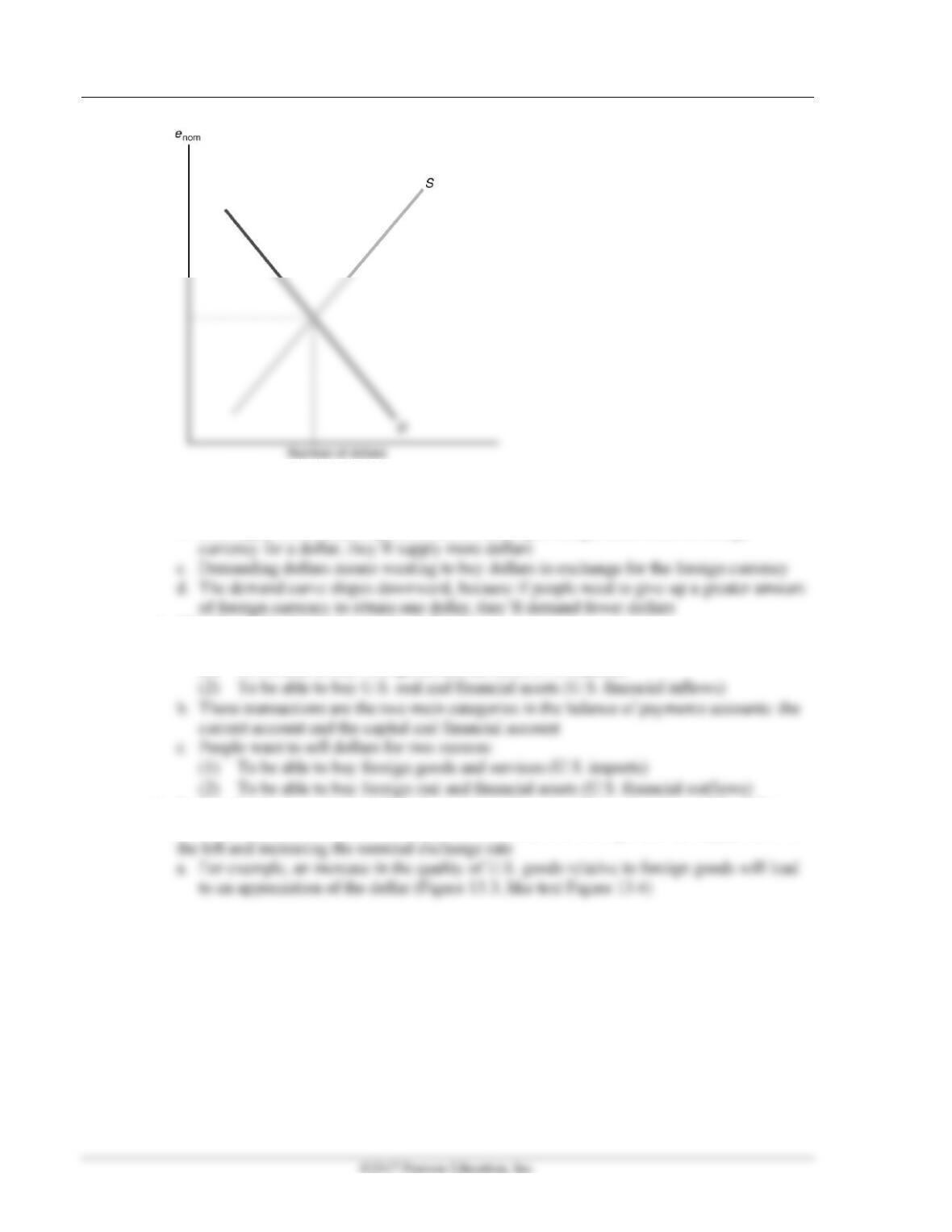
1. To analyze this, we’ll use supply-and-demand analysis, assuming a fixed price level
2. Holding prices fixed means that changes in the real exchange rate are matched by changes
302 Abel/Bernanke/Croushore • Macroeconomics, Ninth Edition
Figure 13.2
a. Supplying dollars means offering dollars in exchange for the foreign currency
b. The supply curve slopes upward, because if people can get more units of foreign
5. Why do people demand or supply dollars?
a. People need dollars for two reasons:
(1) To be able to buy U.S. goods and services (U.S. exports)
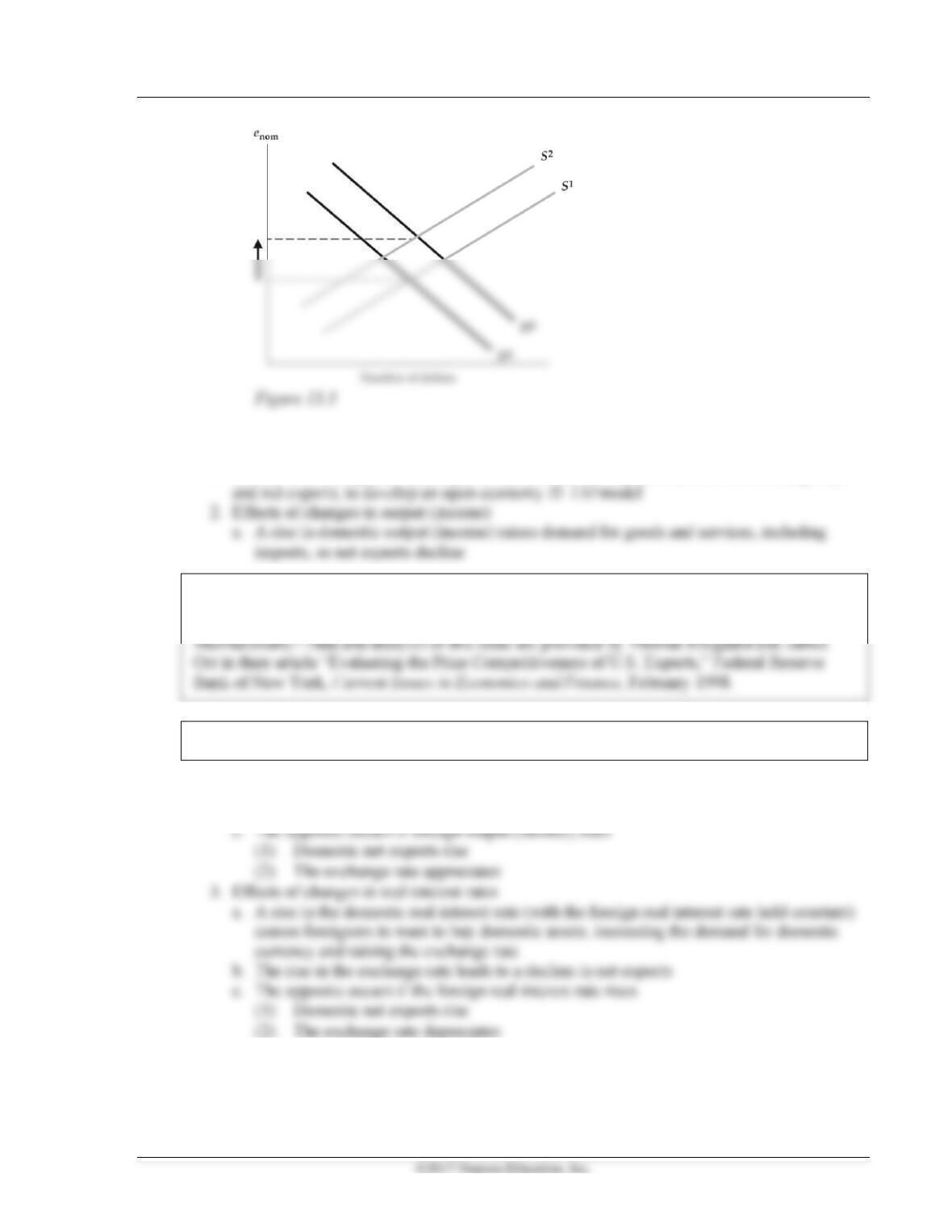
6. Factors that increase demand for U.S. exports and assets will increase demand for dollars
and reduce supply of dollars, shifting the demand curve to the right and the supply curve to
Chapter 13 Exchange Rates, Business Cycles, and Macroeconomic Policy in the Open Economy 303
C. Macroeconomic determinants of the exchange rate and net export demand
1. Look at how changes in real output or the real interest rate are linked to the exchange rate
Data Application
How do movements in the value of the dollar affect U.S. firms’ ability to compete
Analytical Problem 4 looks at the effects of a supply shock on net exports.
b. To increase purchases of imports, people must sell the domestic currency to buy foreign
currency, increasing the supply of foreign currency, which reduces the exchange rate
D. Summary Table 16: Determinants of the exchange rate (real or nominal)
1. A rise in domestic output (income) or the foreign real interest rate causes the exchange rate
to fall
304 Abel/Bernanke/Croushore • Macroeconomics, Ninth Edition
2. A rise in foreign output (income), the domestic real interest rate, or the world demand for
domestic goods causes the exchange rate to rise
E. Summary Table 17: Determinants of net exports
III. The IS–LM Model for an Open Economy (Sec. 13.3)
A. Only the IS curve is affected by having an open economy instead of a closed economy; the LM
curve and FE line are the same
1. Note that we don’t use the AD–AS model because we need to know what happens to the real
interest rate, which has an important impact on the exchange rate
B. The open-economy IS curve
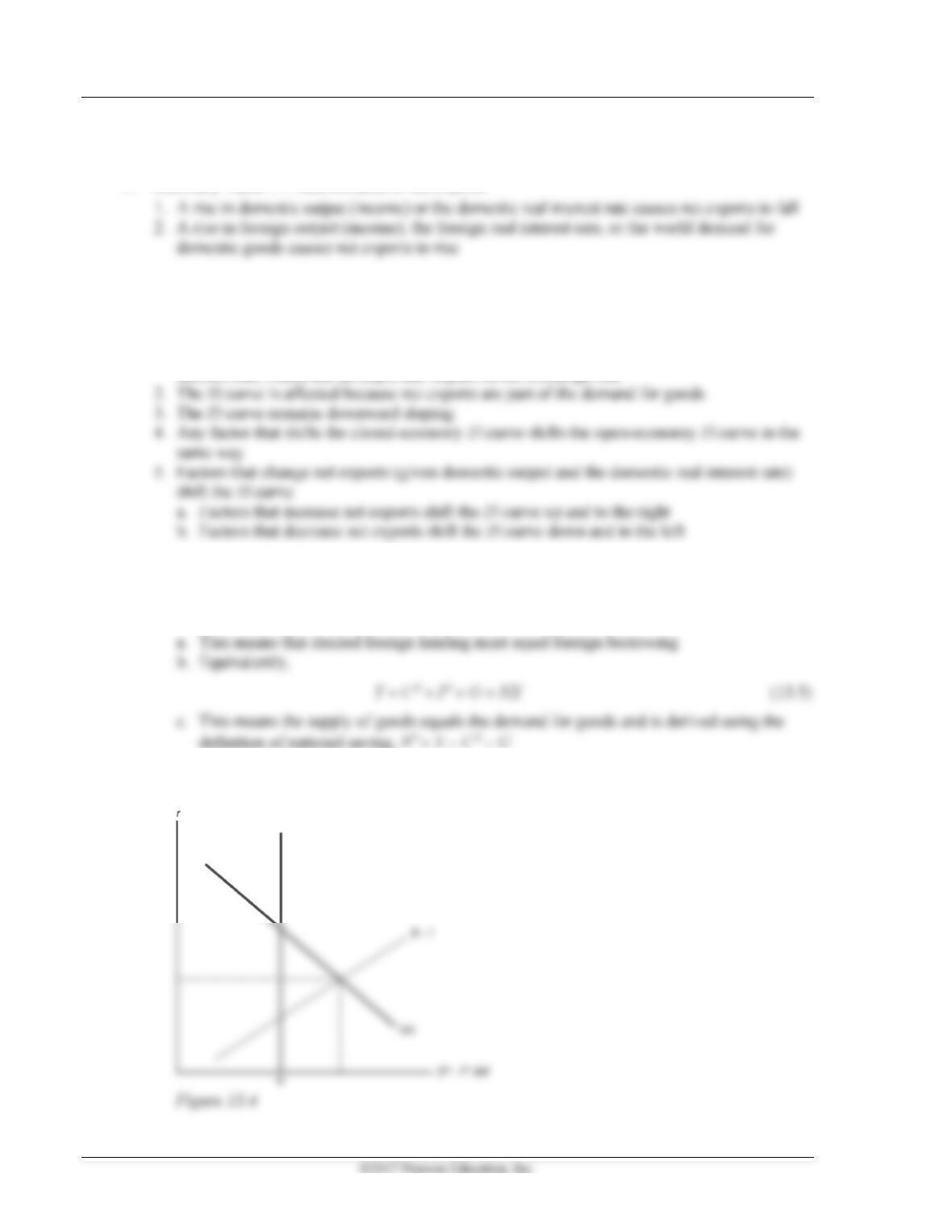
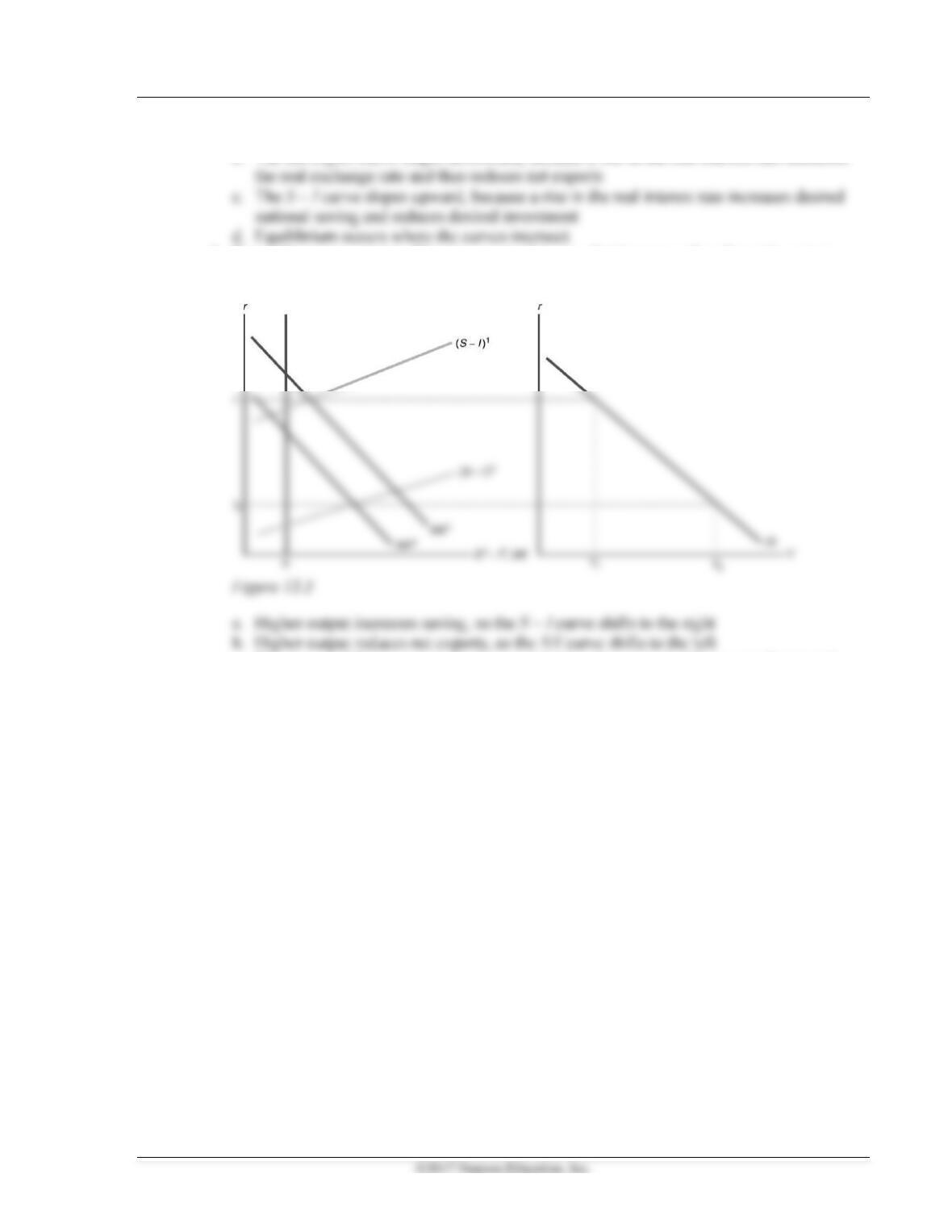
1. The goods-market equilibrium condition is
Sd − Id = NX (13.4)
2. Plotting Sd − Id and NX illustrates goods-market equilibrium (Figure 13.4; like text
Figure 13.5)
Chapter 13 Exchange Rates, Business Cycles, and Macroeconomic Policy in the Open Economy 305
a. Net exports can be positive or negative
b. The net export curve slopes downward, because a rise in the real interest rate increases
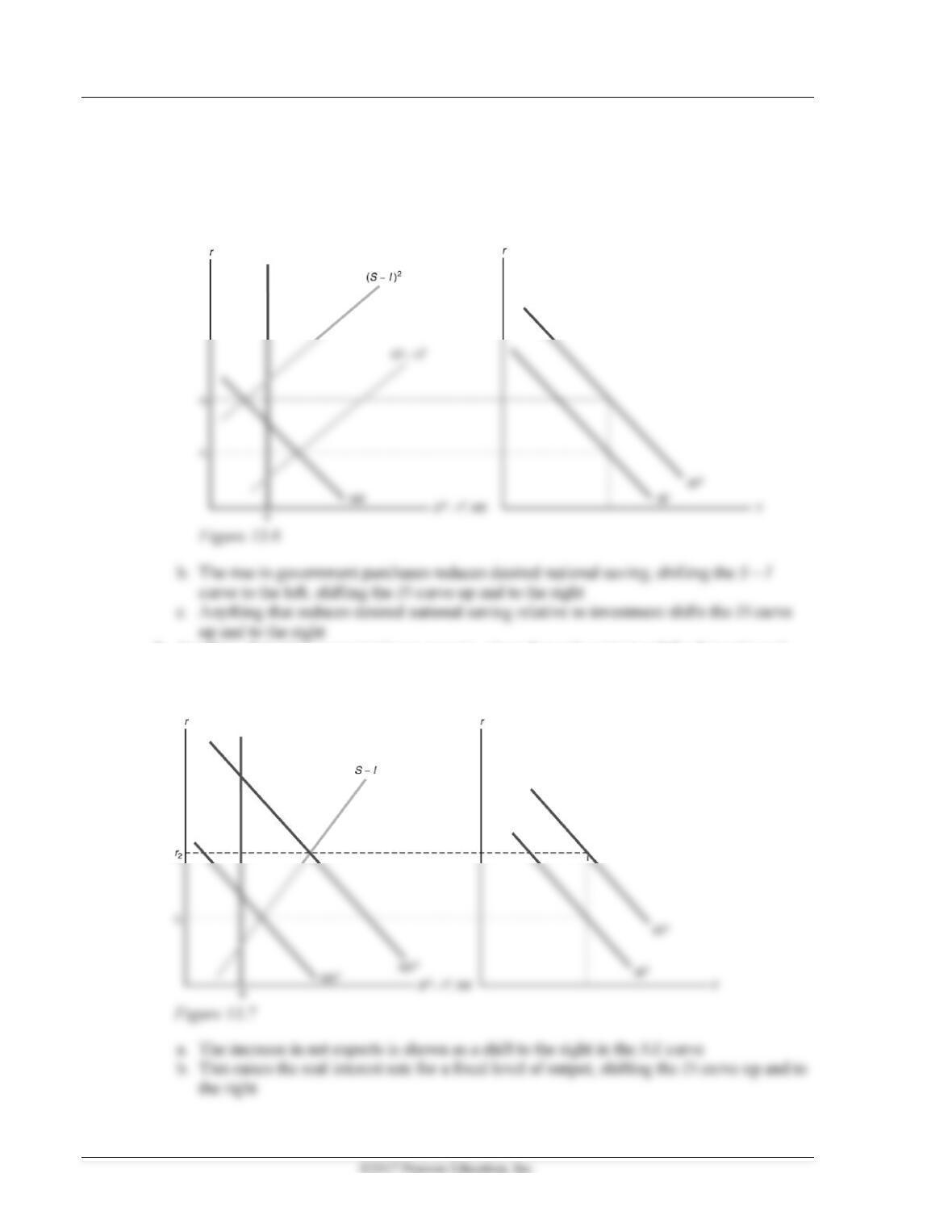
3. To get the open-economy IS curve, we need to see what happens when domestic output
changes (Figure 13.5; like text Figure 13.6)
c. The new equilibrium occurs at a lower real interest rate, so the IS curve is downward
sloping
306 Abel/Bernanke/Croushore • Macroeconomics, Ninth Edition
C. Factors that shift the open-economy IS curve
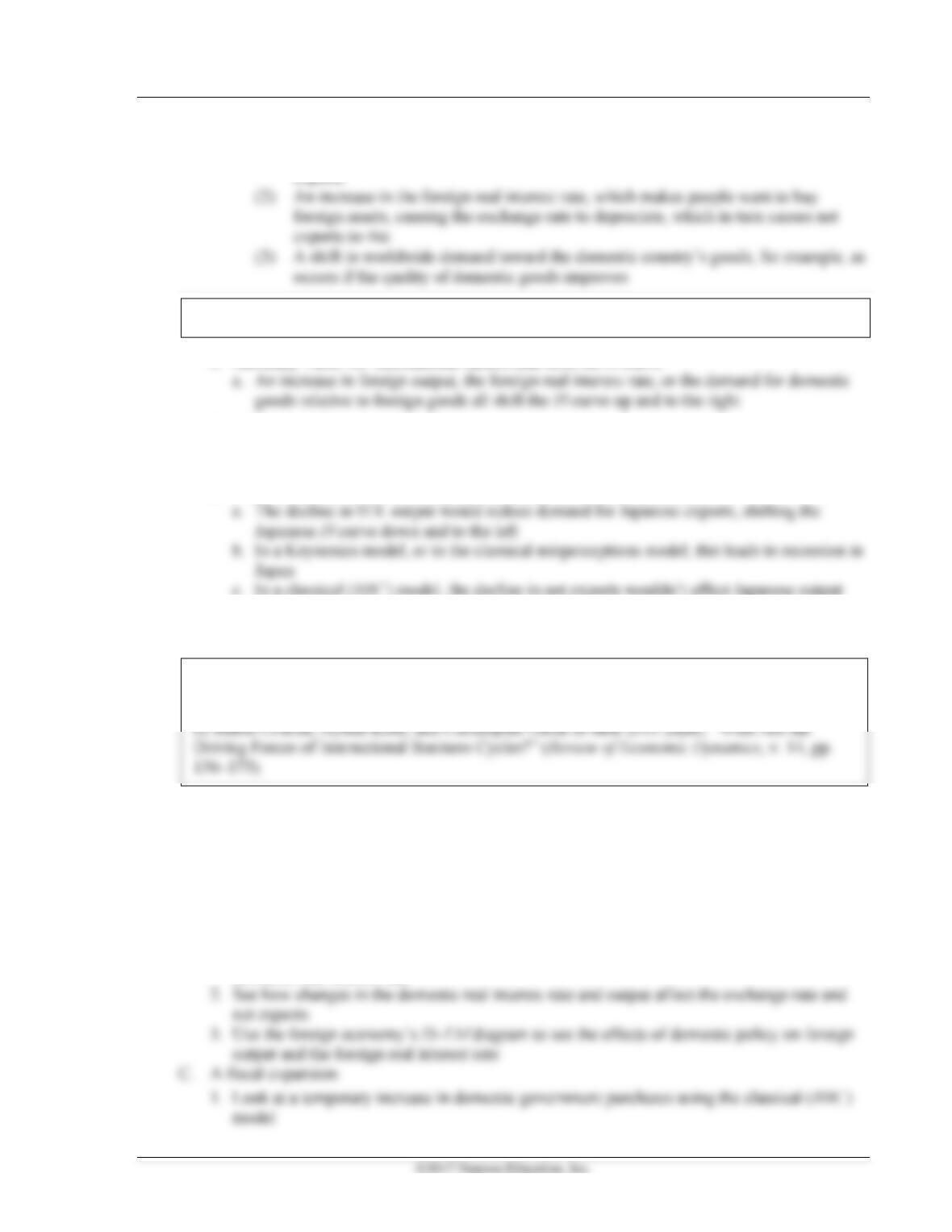
1. Any factor that raises the real interest rate that clears the goods market at a constant level of
output shifts the IS curve up and to the right
a. An example is a temporary increase in government purchases (Figure 13.6; like text
Figure 13.7)
2. Anything that raises a country’s net exports, given domestic output and the domestic real
interest rate, will shift the open-economy IS curve up and to the right (Figure 13.7; like text
Figure 13.8)
Chapter 13 Exchange Rates, Business Cycles, and Macroeconomic Policy in the Open Economy 307
c. Three things could increase net exports for a given level of output and real interest rate
(1) An increase in foreign output, which increases foreigners’ demand for domestic
exports
Analytical Problem 1 looks at the effect of trade barriers that reduce imports.
3. Summary Table 18: International factors that shift the IS curve
D. The international transmission of business cycles
1. The impact of foreign economic conditions on the real exchange rate and net exports is one
of the principal ways by which cycles are transmitted internationally
2. What would be the effect on Japan of a recession in the United States?
3. A similar effect could occur because of a shift in preferences (or trade restrictions) for
Japanese goods
Data Application
Some very interesting evidence on the international transmission of business cycles is provided
IV. Macroeconomic Policy in an Open Economy with Flexible Exchange Rates (Sec. 13.4)
A. Two key questions
1. How do fiscal and monetary policies affect a country’s real exchange rate and net exports?
2. How do the macroeconomic policies of one country affect the economies of other countries?
B. Three steps in analyzing these questions
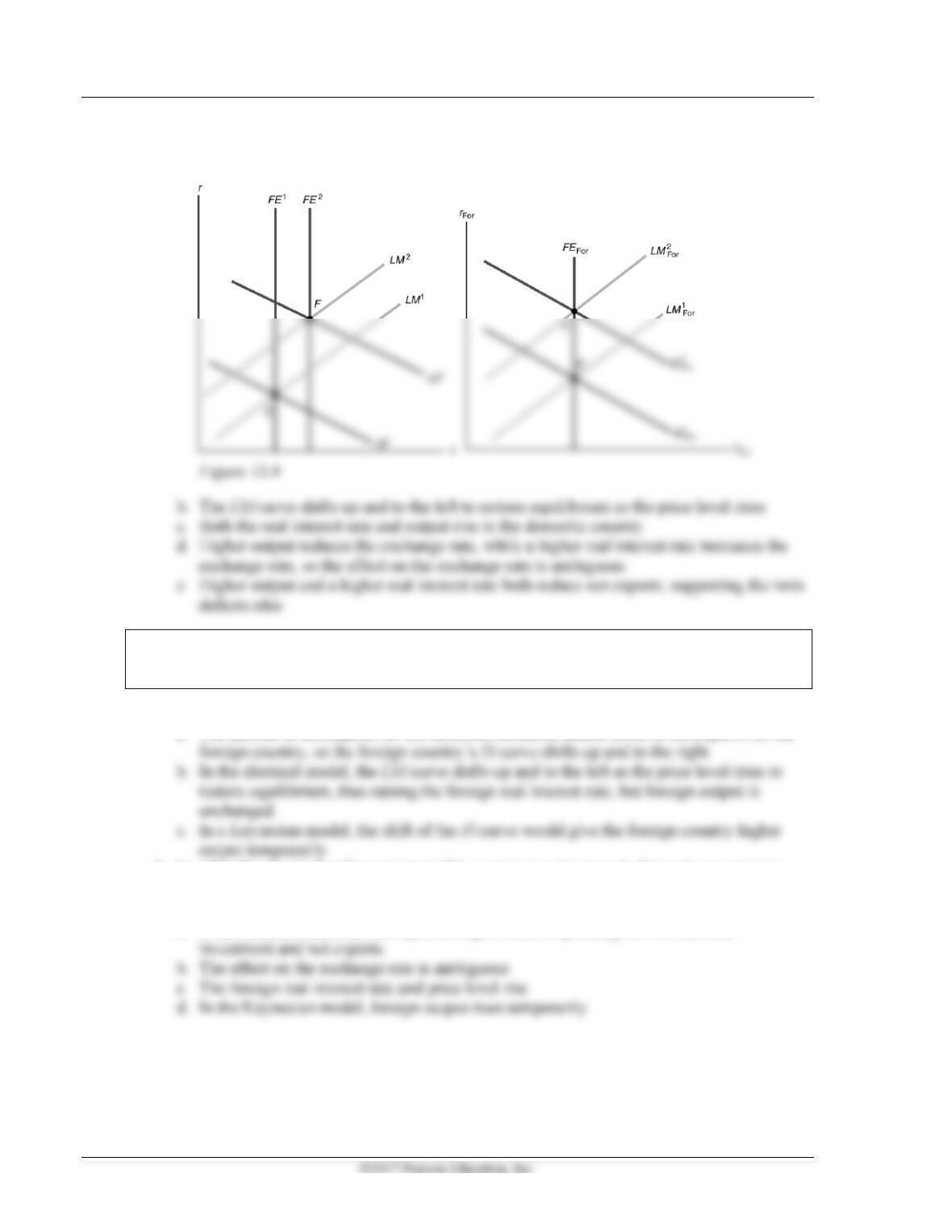
1. Use the domestic economy’s IS–LM diagram to see the effects on domestic output and the
domestic real interest rate
308 Abel/Bernanke/Croushore • Macroeconomics, Ninth Edition
a. The rise in government purchases shifts the IS curve up and to the right and the FE line
to the right (Figure 13.8; like text Figure 13.9)
Numerical Problems 3 and 4 illustrate the effects of an increase in government purchases on the
exchange rate and net exports.
2. How do these changes affect a foreign country’s economy?
a. The decline in net exports for the domestic economy means a rise in net exports for the
3. In either the classical or Keynesian model, a temporary increase in domestic government
purchases raises domestic income (temporarily) and the domestic real interest rate, as in a
closed economy
a. It also reduces domestic net exports, so government spending crowds out both
Chapter 13 Exchange Rates, Business Cycles, and Macroeconomic Policy in the Open Economy 309
D. A monetary contraction
1. Look at a reduction in the domestic money supply in a Keynesian model
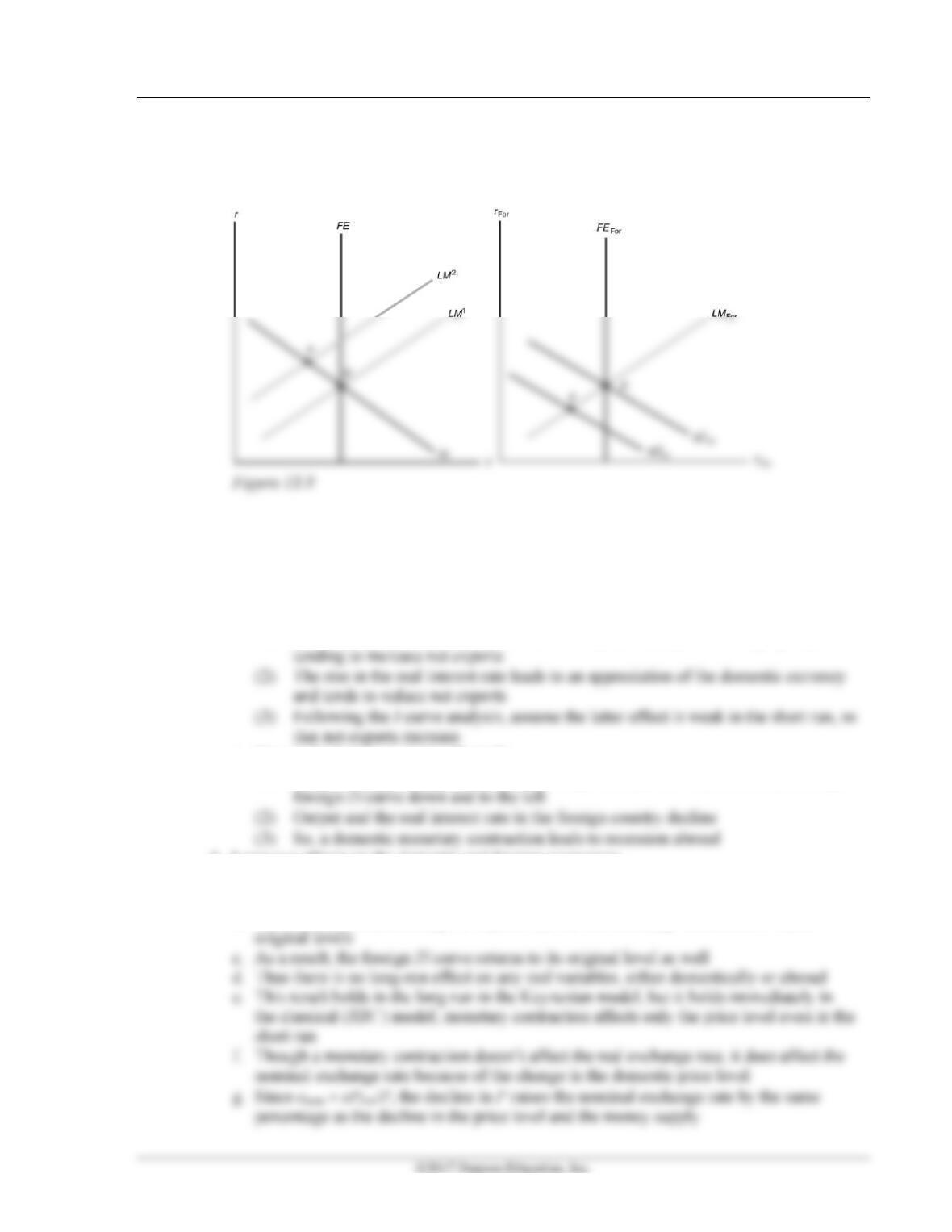
2. Short-run effects on the domestic and foreign economies (Figure 13.9; like text Figure 13.10)
a. The domestic LM curve shifts up and to the left
b. In the short run, domestic output is lower and the real interest rate is higher
c. The exchange rate appreciates, because lower output reduces demand for imports, thus
reducing the supply of the domestic currency to the foreign exchange market, and
because a higher real interest rate increases demand for the domestic currency
d. How are net exports affected?
(1) The decline in domestic income reduces domestic demand for foreign goods,
e. How is the foreign country affected?
(1) Since domestic net exports increase, foreign net exports must decrease, shifting the
3. Long-run effects on the domestic and foreign economies
a. In the long run, wages and prices in the domestic economy decline and the LM curve
returns to its original position
b. All real variables, including net exports and the real exchange rate, return to their
310 Abel/Bernanke/Croushore • Macroeconomics, Ninth Edition
Analytical Problem 2 uses a classical model to show what happens to capital flows in a classical
model with circumstances similar to those of the United States in the 1980s.
V. Fixed Exchange Rates (Sec. 13.5)
A. Fixed-exchange-rate systems are important historically
1. The United States has been on a flexible-exchange-rate system since the early 1970s
B. Fixing the exchange rate
1. The government sets the exchange rate, perhaps in agreement with other countries
2. What happens if the official rate differs from the rate determined by supply and demand?
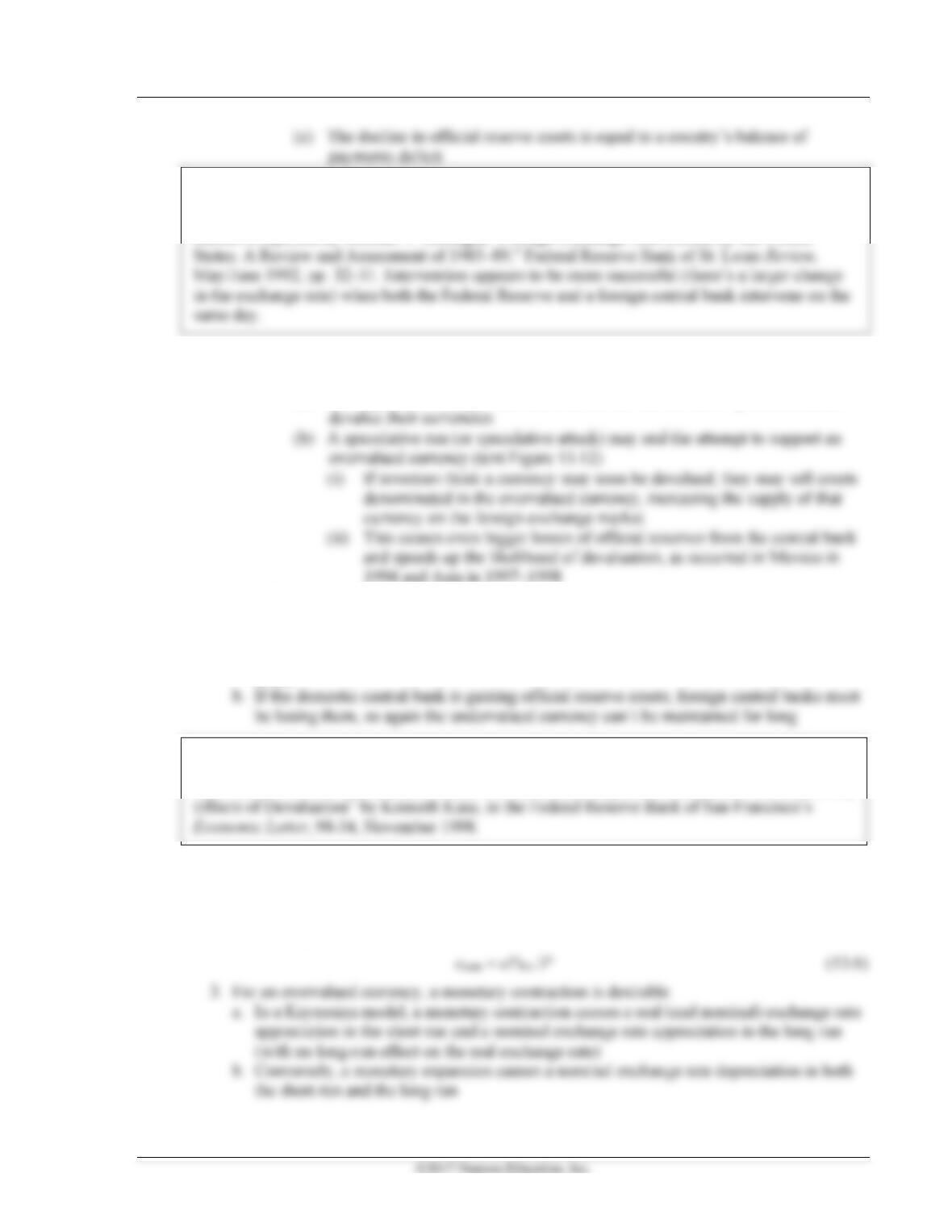
a. Supply and demand determine the fundamental value of the exchange rate (Figure 13.10;
like text Figure 13.11)
b. When the official rate is above its fundamental value, the currency is said to be overvalued
c. The country could devalue the currency, reducing the official rate to the fundamental value
d. The country could restrict international transactions to reduce the supply of its currency
to the foreign exchange market, thus raising the fundamental value of the exchange rate
(1) If a country prohibits people from trading the currency at all, the currency is said to
be inconvertible
e. The government can supply or demand the currency to make the fundamental value
Chapter 13 Exchange Rates, Business Cycles, and Macroeconomic Policy in the Open Economy 311
Data Application
An interesting examination of intervention by the U.S. government in the foreign exchange
market is reported by Michael T. Belongia, “Foreign Exchange Intervention by the United
(2) A country can’t maintain an overvalued currency forever, as it will run out of
official reserve assets
(a) In the gold standard period, countries sometimes ran out of gold and had to
(3) Thus an overvalued currency can’t be maintained for very long
3. Similarly, in the case of an undervalued currency, the official rate is below the fundamental
value (text Figure 13.13)
a. In this case, a central bank trying to maintain the official rate will acquire official reserve
assets
Policy Application
The manner in which a devaluation leads to a recession is explored in the article “Contractionary
C. Monetary policy and the fixed exchange rate
1. The best way for a country to make the fundamental value of a currency equal the official
rate is through the use of monetary policy
2. Rewrite Eq. (13.1) as
312 Abel/Bernanke/Croushore • Macroeconomics, Ninth Edition
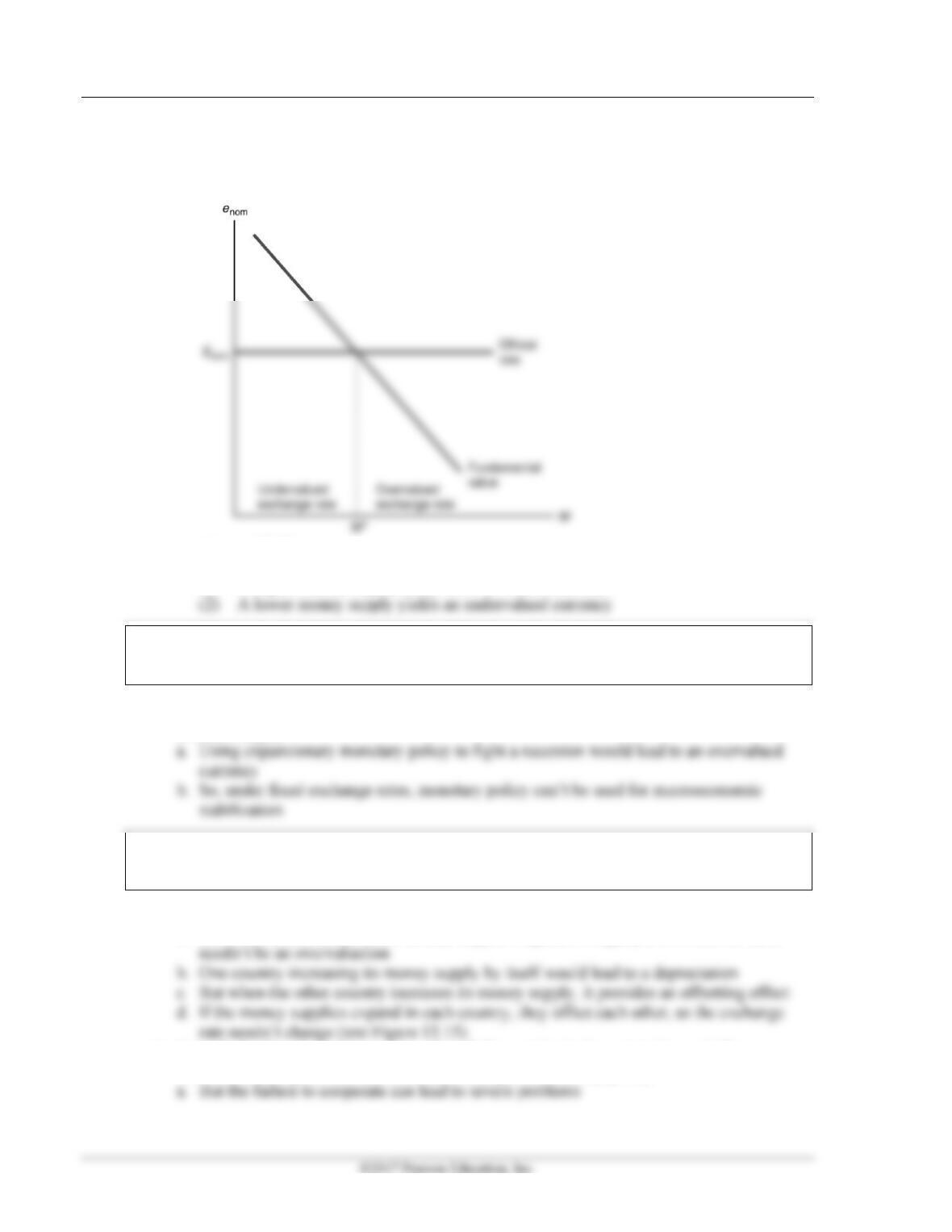
c. Plotting the relationship between the money supply and the nominal exchange rate shows
the level of the money supply for which the fundamental value of the exchange rate
equals the official rate (Figure 13.11; like text Figure 13.14)
Figure 13.11
(1) A higher money supply yields an overvalued currency
Numerical Problem 5 is an exercise in finding the level of the nominal money supply that fixes
the exchange rate at a sustainable level.
4. This implies that countries can’t both maintain the exchange rate and use monetary policy
to affect output
Analytical Problem 3 looks at the effects of different macroeconomic policies when exchange
rates are fixed.
5. However, a group of countries may be able to coordinate their use of monetary policy
a. If two countries increase their money supplies together to fight joint recessions, there
6. Overall, fixed exchange rates can work well if countries in the system have similar
macroeconomic goals and can coordinate changes in monetary policy
Chapter 13 Exchange Rates, Business Cycles, and Macroeconomic Policy in the Open Economy 313
D. Fixed versus flexible exchange rates
Data Application
A very detailed and comprehensive review of the world’s experience under flexible exchange
2. There are two major benefits of fixed exchange rates
a. Stable exchange rates make international trades easier and less costly
Policy Application
Some prominent economists have called for a return to fixed exchange rates. Ronald I.
McKinnon puts forth his suggestion that the major industrial countries return to a system of
3. But there are some disadvantages to fixed exchange rates
a. They take away a country’s ability to use expansionary monetary policy to combat
recessions
b. Disagreement among countries about the conduct of monetary policy may lead to the
breakdown of the system
Policy Application
Michael T. Belongia and K. Alec Chrystal point out that maintaining fixed exchange rates is
difficult because of changes in underlying real economic conditions, in their article “The Pitfalls
4. Which system is better may thus depend on the circumstances
a. If large benefits can be gained from increased trade and integration, and when countries
can coordinate their monetary policies closely, then fixed exchange rates may be
desirable
314 Abel/Bernanke/Croushore • Macroeconomics, Ninth Edition
Policy Application
A detailed discussion of the pros and cons of having flexible exchange rates is provided by
Joseph A. Whitt, Jr., “Flexible Exchange Rates: An Idea Whose Time Has Passed?” Federal
E. Currency unions
1. Under a currency union, countries agree to share a common currency
2. To work effectively, a currency union must have just one central bank
a. Since countries don’t usually want to give up control over monetary policy by not having
3. But the major disadvantage of a currency union is that all countries share a common
monetary policy, a problem that also arises with fixed exchange rates
4. A currency union makes sense if a region is an optimum currency area
a. Four criteria
(1) Extensive trade
5. Application: Is either the United States or Europe an optimum currency area?
a. The United States meets all four criteria
4. Application: European monetary unification
a. In 1991, countries in the European Community adopted the Maastricht treaty, which
provides for a common currency
(1) The currency, called the euro, came into being on January 1, 1999
(2) The motivation was to increase economic growth and to help end nationalism
Chapter 13 Exchange Rates, Business Cycles, and Macroeconomic Policy in the Open Economy 315
each country regulated banks differently
(2) Weakness at European banks cause the financial crisis to have a more prolonged
effect on the European economy than the U.S. economy
f. European countries had violated the requirement to keep their government budget
deficits low prior to the crisis
(1) In the crisis, the countries lent to their banks, which increased the government
316 Abel/Bernanke/Croushore • Macroeconomics, Ninth Edition
◼ Additional Issues for Classroom Discussion
1. What Other Relationships Are There Between Currencies?
In financial markets, there are many relationships between the returns on different assets. In international
financial markets, these relationships depend a lot on the exchange rate. Ask your students how they
would determine how much money to invest in foreign countries. What are the returns to such investment,
translated into U.S. dollars? What risks are there? What happens to the value of your investment when the
exchange rate changes?
To help organize the discussion, you might wish to introduce another parity notion—interest rate parity.
For example, suppose you could invest in a U.S. one-year government bond, earning 5% interest over the
2. How Predictable Are Exchange Rates?
Economists’ theories of exchange rates are very well developed, especially after hundreds of years of
experience. How precisely do you think financial market participants, such as currency traders, can
forecast exchange rates?
It turns out that despite all our economic theories and extensive empirical work, forecasts of exchange
rates are notoriously bad over short horizons. For long time periods, like two years or more, exchange-