Chapter 13 Exchange Rates, Business Cycles, and Macroeconomic Policy in the Open Economy 329
Eq. (13.6) requires the present value of net exports to equal zero.]
The Intertemporal External Balance Curve
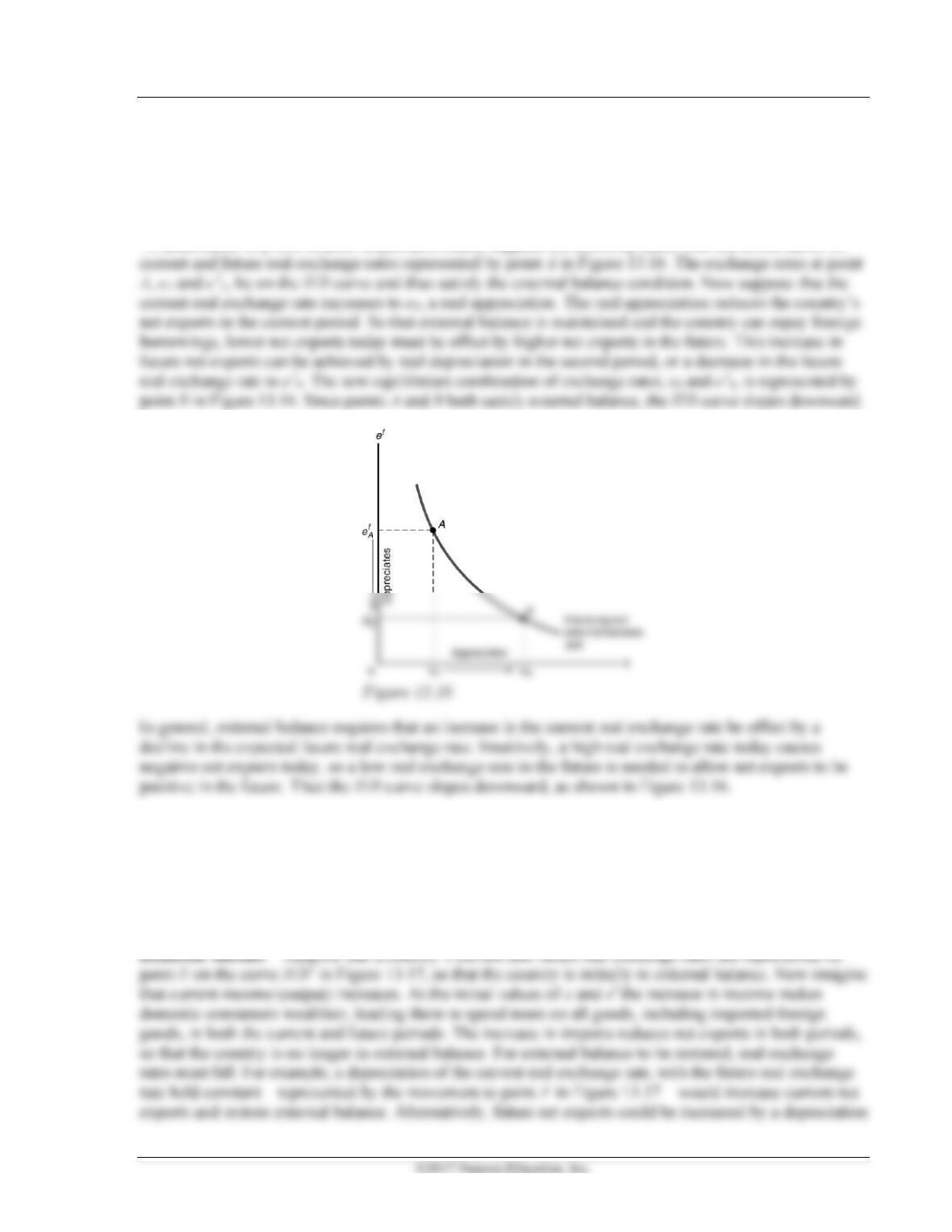
The intertemporal external balance curve IEB in Figure 13.16 shows the combinations of the current real
exchange rate e and the future real exchange rate ef that satisfy the external balance condition, Eq. (13.6).
To understand why this relation slopes downward, suppose the economy starts with the combination of
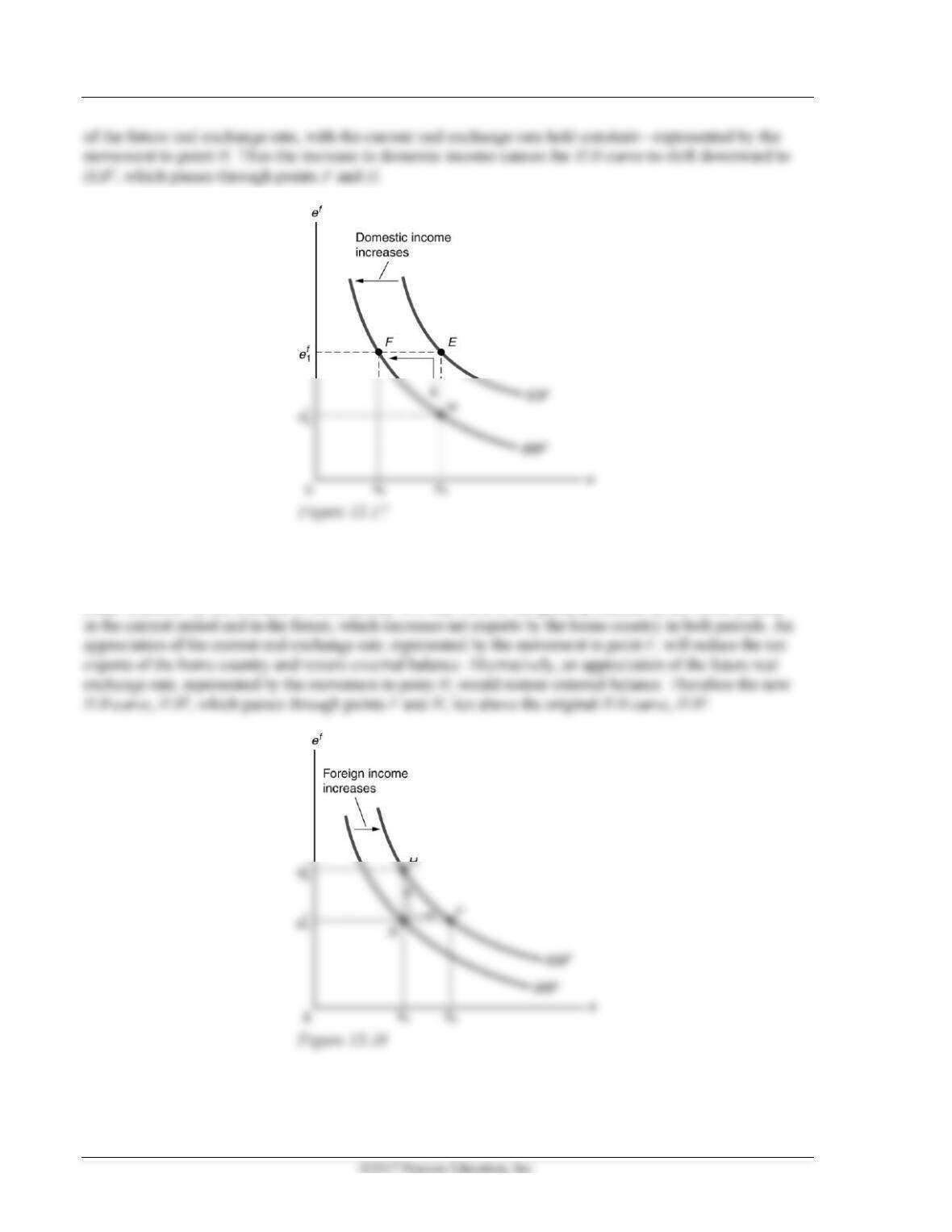
Factors That Shift the IEB Curve
The IEB curve shows the combinations of current and future real exchange rates that lead to external
balance. Factors other than real exchange rates that affect current net exports or future net exports will
shift the IEB curve. We discuss three important IEB curve shifters: a change in domestic income, a
change in foreign income, and shifts in demand. Table 13.1 gives a summary of these shifters.
330 Abel/Bernanke/Croushore • Macroeconomics, Ninth Edition
Foreign Income The effect of an increase in foreign income on the IEB curve is just the opposite of the
effect of an increase in domestic income. Suppose that before the increase in foreign income the current and
future real exchange rates are represented by point E on IEB1 in Figure 13.18. Because foreign consumers are
made wealthier by the increase in income, they will buy more of the goods produced by the home country
Shifts in Demand A shift in demand away from foreign goods toward goods produced by the home
country shifts the IEB curve upward, just as an increase in foreign income does. The reason is that, like an
increase in foreign income, a shift in demand toward domestic goods increases both current and future net
Chapter 13 Exchange Rates, Business Cycles, and Macroeconomic Policy in the Open Economy 331
exports by the home country. For external balance to be restored, the current real exchange rate or the
future real exchange rate must appreciate; so the IEB curve shifts upward.
The International Asset Market: Interest Rate Parity
Besides affecting the international flow of goods, the real exchange rate also plays a key role in
Returns on Domestic and Foreign Assets
To illustrate the role of the real exchange rate in international asset markets, we again use a numerical
example. Imagine that you want to invest $10,000 in a financial asset for one year, and suppose that you
Table 13.1 Summary: Factors That Shift the IEB Curve
An Increase in
Shifts the IEB Curve
Reason
Domestic income (output) Y
Down
Foreign income (output) YFor
Higher foreign income raises demand
Higher domestic income raises import
demand and reduces net exports, so
real exchange rates must fall to
At first glance, the answer seems obvious: Buy the U.S. government bonds, because they offer a higher
interest rate. But this answer may not be right. The correct answer depends on what you think is going to
happen to the exchange rate between the U.S. dollar and the euro over the next year.
We can compare the financial returns on the two assets by calculating the value in dollars one year from
now of $10,000 invested in each asset. For the U.S. government bond the answer is easy. At a nominal
interest rate of 8% per year, the bond will earn $800 in interest and will be worth $10,800 in one year. For
332 Abel/Bernanke/Croushore • Macroeconomics, Ninth Edition
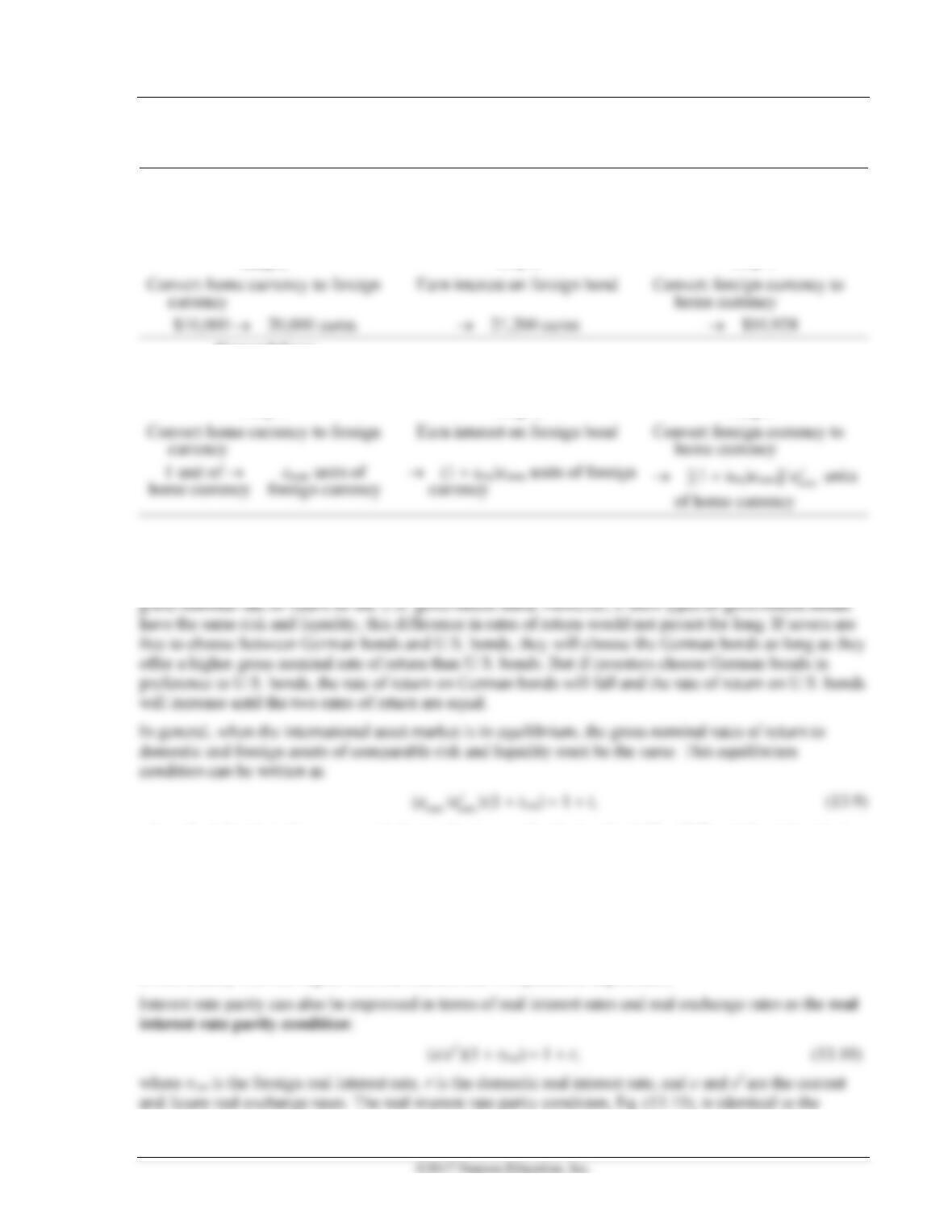
(step 3)—which is higher than the $10,800 that would be obtained from investing in a U.S. bond! Thus
the German bonds have a higher expected rate of return in this case, even though they pay a lower
nominal interest rate.
The German bonds have a higher rate of return in this example because, relative to the dollar asset,
the German bonds have two sources of return. The first source is the nominal interest paid on the bonds
gross nominal rate of return from investing in the German government bond is
gross nominal rate of return on foreign bond = (1 + iFor)
nom nom
/f
ee
= (1.06) (2 euros per dollar)/1.94 euros per dollar
= 1.0928. (13.7)
With a gross nominal rate of return equal to 1.0928, a $10,000 investment grows to a value of $10,928 at
the end of one year, just as we calculated previously.
Equation (13.7) is an exact expression for the gross nominal rate of return. A simple approximation () to
Chapter 13 Exchange Rates, Business Cycles, and Macroeconomic Policy in the Open Economy 333
Table 13.2 Calculating the Gross Nominal Rate of Return for a Foreign Asset
Example
Today: enom = 2 euros/dollar
iFor = 0.06
Future:
nom 1.94
f
e=
euros/dollar
Step 1
Step 2
Step 3
General Case
Today
Future
Step 1
Step 2
Step 3
Interest Rate Parity
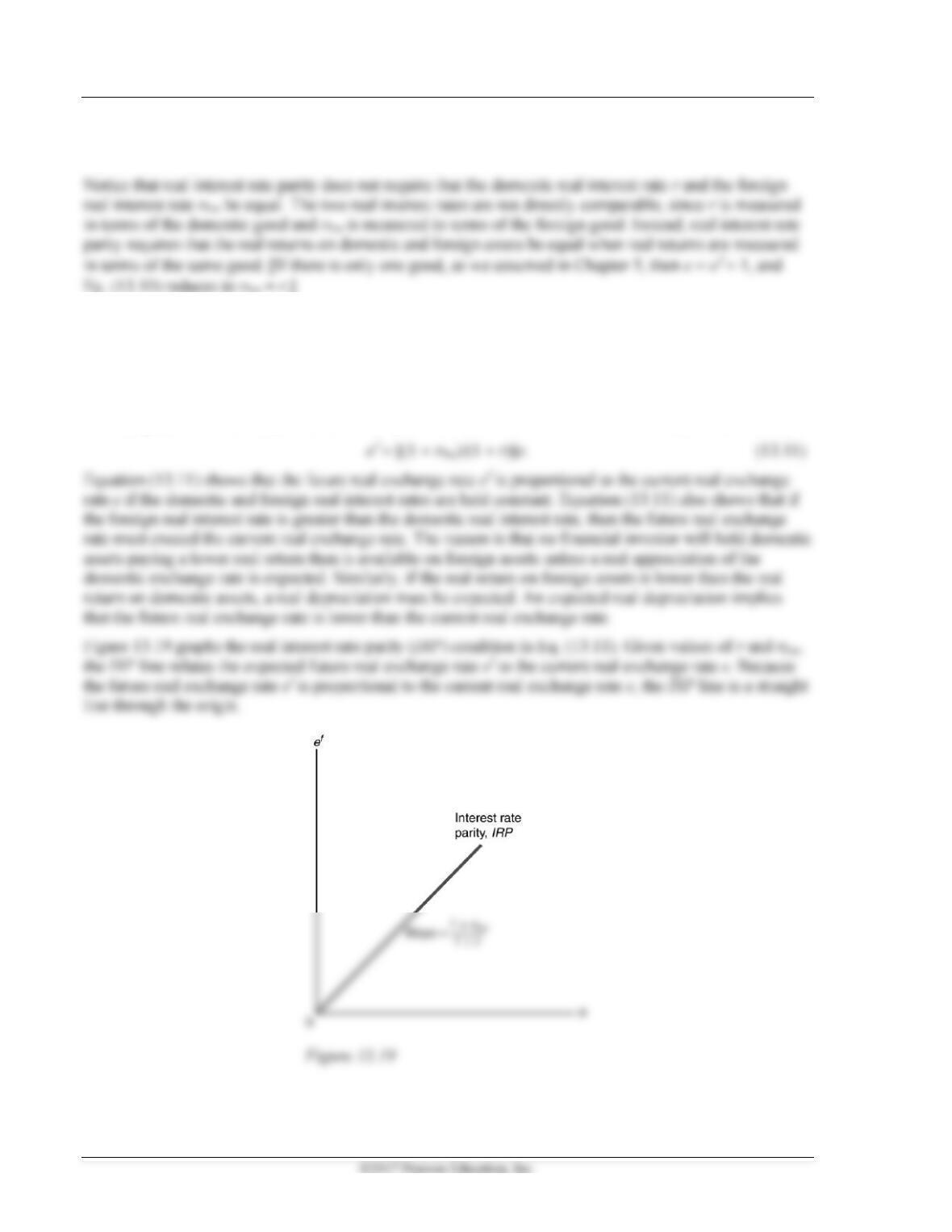
In our example the gross nominal rate of return expected on the German government bond exceeded the
where the left side is the gross nominal rate of return on the foreign bond (Eq. 13.7) and the right side is
the gross nominal rate of return on the domestic bond. The equilibrium condition in Eq. (13.9) is the
nominal interest rate parity condition, which says that the nominal returns on foreign and domestic
financial investments with equal risk and liquidity, when measured in a common currency, must be the
same. [With the approximation in Eq. (13.8) the nominal interest rate parity condition can also be
expressed more simply as iFor − enom/enom i. According to this approximate formula for interest rate
parity, the difference between nominal interest rates in two countries equals the rate at which the currency
of the country with the higher nominal interest rate is expected to depreciate.]
334 Abel/Bernanke/Croushore • Macroeconomics, Ninth Edition
nominal interest parity condition, Eq. (13.9), except that the nominal interest and exchange rates in
Eq. (13.9) are replaced by real interest and exchange rates in Eq. (13.10).
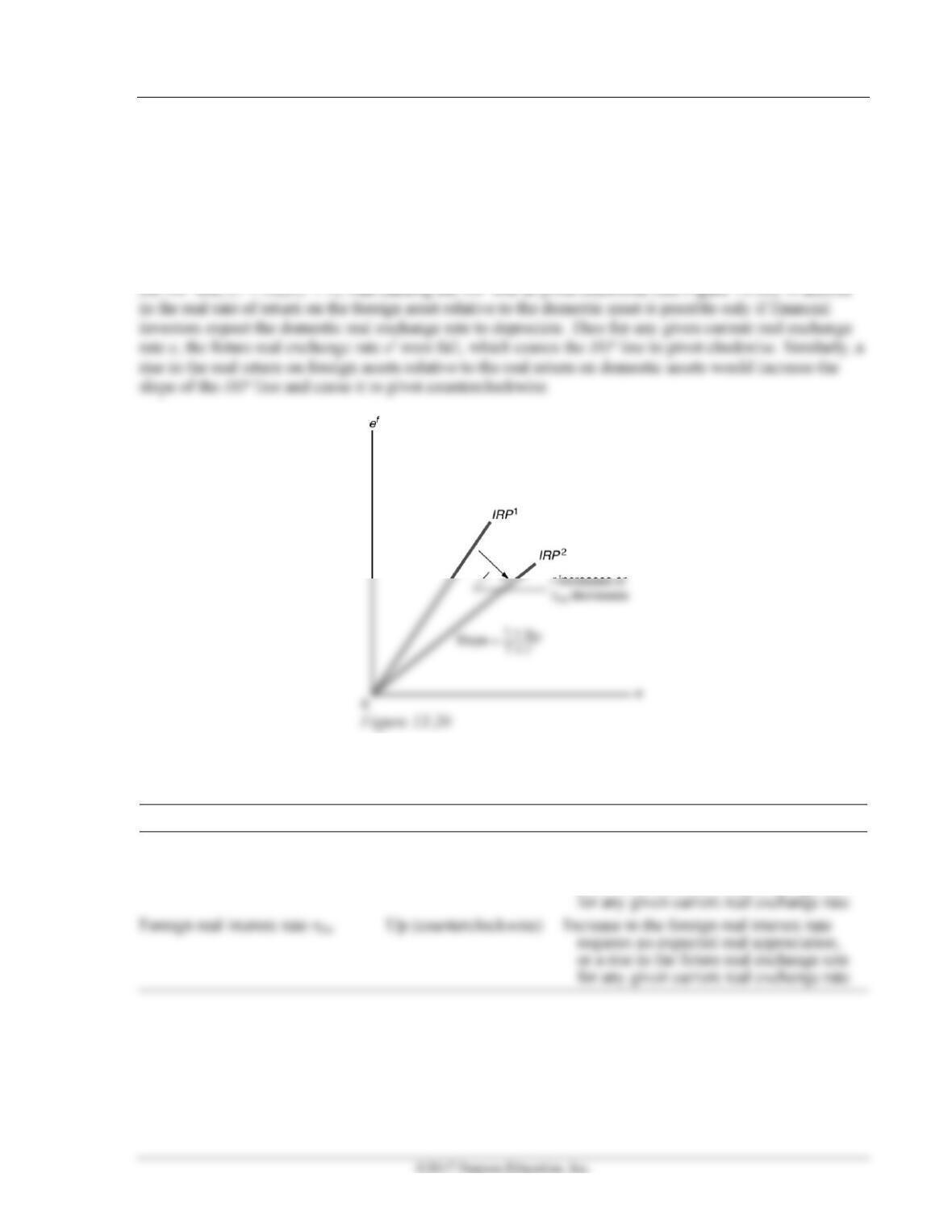
The Interest Rate Parity Line
Like the intertemporal external balance condition in the international goods market, the real interest rate
parity condition in the international asset market can be shown graphically as a relationship between the
current and future real exchange rates, e and ef. To write the real interest rate parity condition in a form that
is easily graphed, we multiply both sides of Eq. (13.10) by ef and then divide both sides by 1 + r, to obtain
Chapter 13 Exchange Rates, Business Cycles, and Macroeconomic Policy in the Open Economy 335
Factors That Shift the IRP Line
The position of the IRP line depends on only two factors: the domestic real interest rate r and the foreign
real interest rate rFor. As you can see in Eq. (13.11), the slope of the IRP line is (1 + rFor)/(1 + r). So, if we
are given the values of r and rFor, the IRP line is completely determined.
A fall in the foreign real interest rate rFor or a rise in the domestic real interest rate r reduces the slope of
Table 13.3 summarizes the effects of domestic and foreign real interest rates on the IRP line.
Table 13.3 Summary: Factors That Shift the IRP Line
An Increase in
Shifts the IRP Line
Reason
Domestic real interest rate r
Down (clockwise)
Increase in the domestic real interest rate
requires an expected real depreciation,
or a fall in the future real exchange rate
336 Abel/Bernanke/Croushore • Macroeconomics, Ninth Edition
The Determination of the Real Exchange Rate
In the previous two sections we focused on the role of real exchange rates in the international markets for
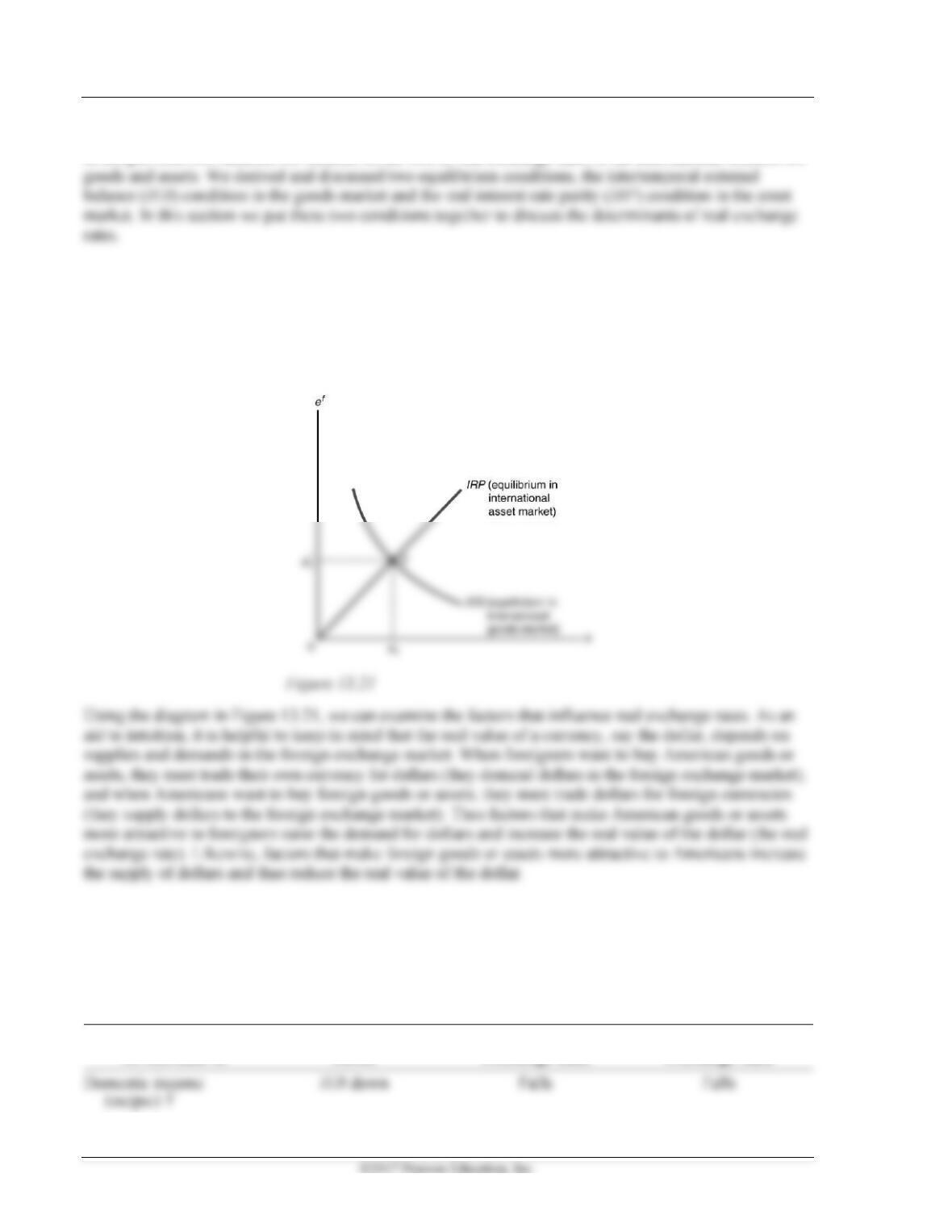
The determination of the current and future real exchange rates is shown in Figure 13.21, which graphs
both the intertemporal external balance (IEB) curve and the interest rate parity (IRP) line. As you can see
in the figure, the only combination of e and ef that simultaneously satisfies both the intertemporal external
balance condition and the real interest rate parity condition is represented by point E, the intersection of
the IEB curve and the IRP line. The values of the current and future real exchange rates that correspond to
point E are the values that will occur in equilibrium.
Factors That Change the Real Exchange Rate
Any factor that shifts the IEB curve or the IRP line will change the equilibrium combination of current
and future real exchange rates. Table 13.4 summarizes the effects of several factors on the real exchange
rate, which we discuss below.
Table 13.4 Summary: The Determination of Real Exchange Rates
An Increase in
Shifts
Current Real
Exchange Rate
Future Real
Exchange Rate
Chapter 13 Exchange Rates, Business Cycles, and Macroeconomic Policy in the Open Economy 337
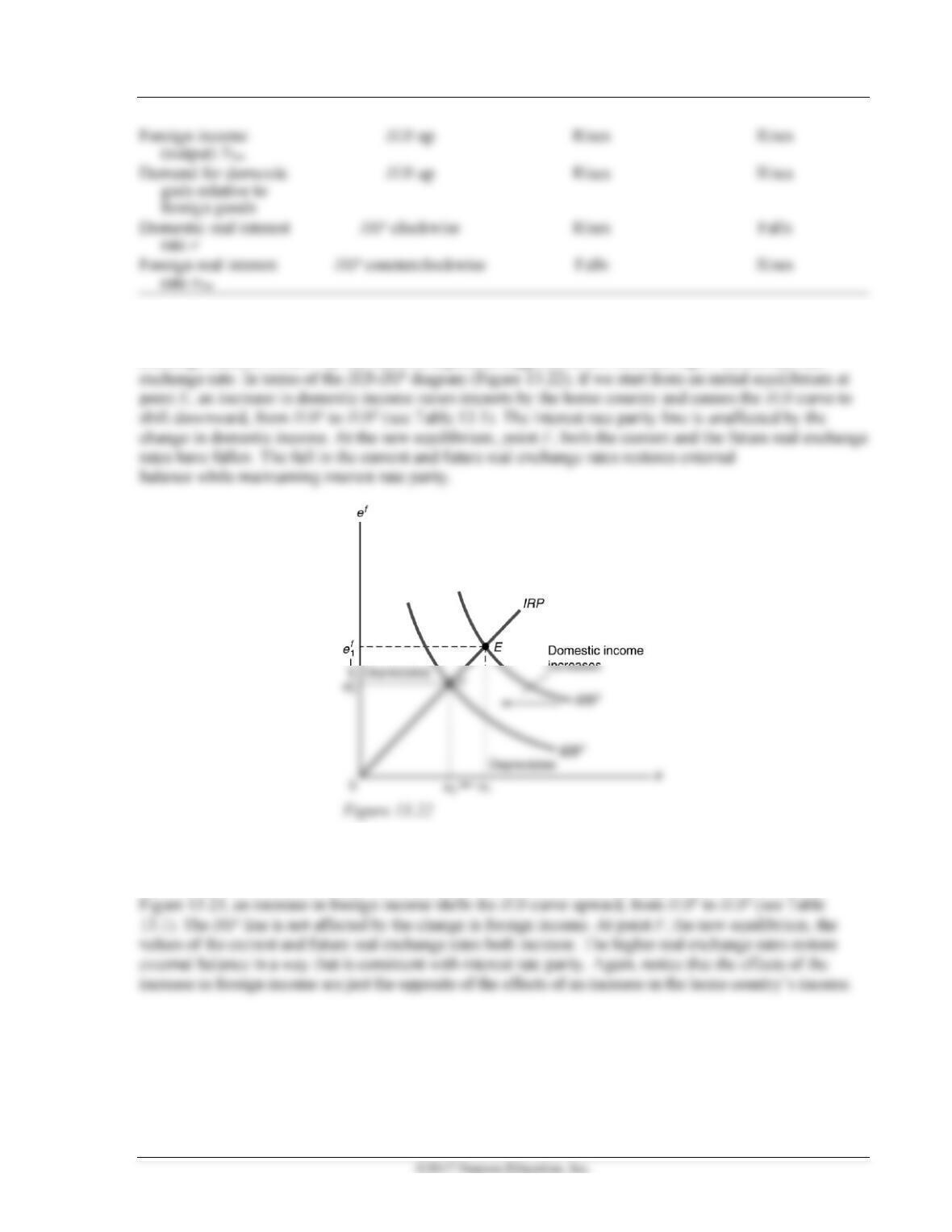
Domestic Income (Output) An increase in domestic income raises the home country’s demand
for foreign goods. To buy foreign goods, domestic residents supply their own currency to the foreign
exchange market, which—by the intuitive argument suggested a few moments ago—lowers the real
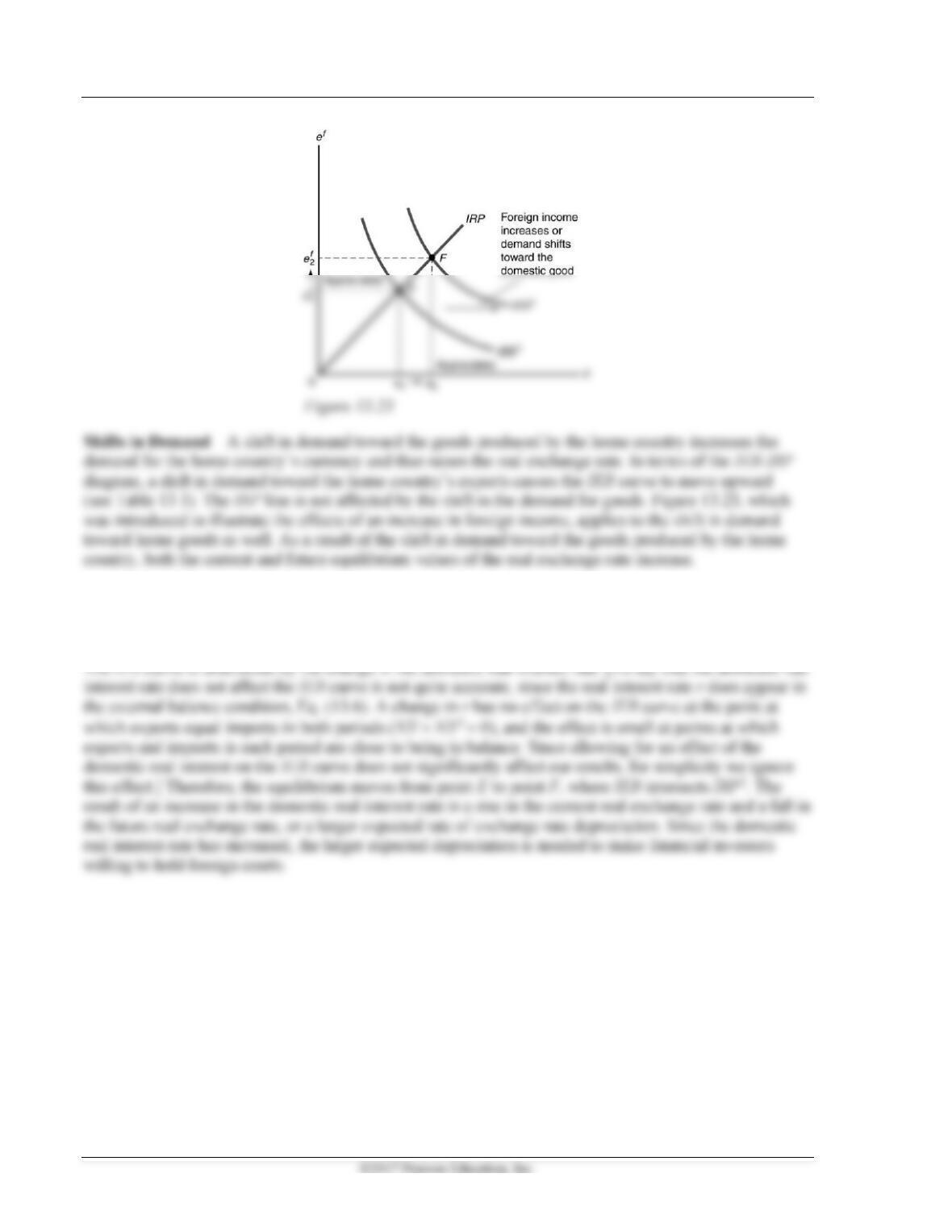
Foreign Income (Output) An increase in foreign income has exactly the opposite effect of an increase in
domestic income. Intuitively, higher foreign income increases the demand for home country exports, raises
the demand for the home country’s currency, and thus causes the real exchange rate to rise. In terms of
338 Abel/Bernanke/Croushore • Macroeconomics, Ninth Edition
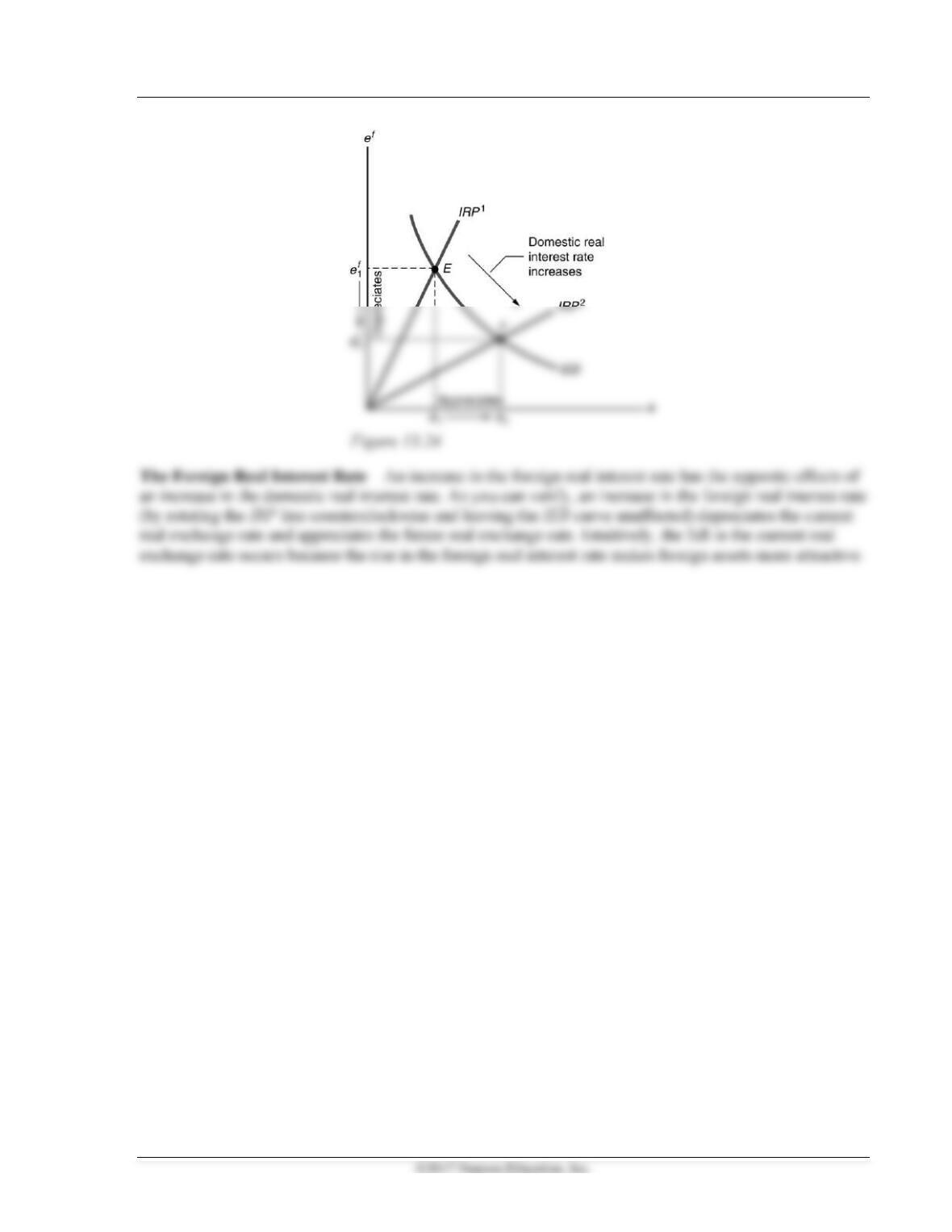
The Domestic Real Interest Rate An increase in the domestic real interest rate makes domestic assets
more attractive, which increases the demand for the home country’s currency and thus causes the current
real exchange rate to appreciate. Diagrammatically, an increase in the domestic real interest rate reduces the
slope of the IRP line and causes it to pivot clockwise, from IRP1 to IRP2 in Figure 13.24 (see Table 13.3).
Chapter 13 Exchange Rates, Business Cycles, and Macroeconomic Policy in the Open Economy 339