Chapter 13 (2)
National Income Accounting and
the Balance of Payments
◼ Chapter Organization
The National Income Accounts
National Product and National Income
Capital Depreciation and International Transfers
Gross Domestic Product
National Income Accounting for an Open Economy
Consumption
Investment
The Balance of Payments Accounts
Examples of Paired Transactions
The Fundamental Balance of Payments Identity
The Current Account, Once Again
70 Krugman/Obstfeld/Melitz • International Economics: Theory & Policy, Tenth Edition
◼ Chapter Overview
This chapter introduces the international macroeconomics section of the text. The chapter begins with
a brief discussion of the focus of international macroeconomics. You may want to contrast the type of
topics studied in international trade, such as the determinants of the patterns of trade and the gains from
trade, with the issues studied in international finance, which include unemployment, savings, trade
imbalances, and money and the price level. You can then “preview” the manner in which the theory taught
in this section of the course will enable students to better understand important and timely issues such as
the U.S. trade deficit, the experience with international economic coordination, the European Economic
and Monetary Union, and the financial crises in Asia and other developing countries.
The relationships among the current account, savings, investment, and the government budget deficit
should be emphasized. It may be useful to draw an analogy between the net savings of an individual and
the net savings of a country to reinforce the concept of the current account as the net savings of an
economy. Extending this analogy, you may compare the net dissavings of many students when they are
of these accounts.
Note that the book uses the new current/financial/capital account definitions. The old capital account is
now the financial account. The current account is the same except that unilateral asset transfers (debt
forgiveness or immigrants moving wealth with them) are now in the new capital account. Credits and
debits are marked in the same manner; if money comes into a country, it is a credit. A description of the
changes along with revised estimates for 1982–1998 can be found in the article by Christopher Bach
(see references). These changes were made in conjunction with the IMF’s new standards. A description
of these new standards can be found in the Survey of Current Business article listed at the end of the
references.
Chapter 13(2) National Income Accounting and the Balance of Payments 71
discussion of how the value of a nation’s foreign debt may be affected by exchange rate changes, a nice
segue into the next chapter relating exchange rates and the asset market.
◼ Answers to Textbook Problems
1. The reason for including only the value of final goods and services in GNP, as stated in the question,
is to avoid the problem of double counting. Double counting will not occur if intermediate imports
are subtracted and intermediate exported goods are added to GNP accounts. Consider the sale of U.S.
and foreign production.
2. Equation 13(2)-2 can be written as CA = (Sp – I) + (T – G). Higher U.S. barriers to imports may have
little or no impact upon private savings, investment, and the budget deficit. If there were no effect on
3. a. The purchase of the German stock is a debit in the U.S. financial account. There is a
corresponding credit in the U.S. financial account when the American pays with a check on
his Swiss bank account because his claims on Switzerland fall by the amount of the check.
This is a case in which an American trades one foreign asset for another.
b. Again, there is a U.S. financial account debit as a result of the purchase of a German stock by an
American. The corresponding credit in this case occurs when the German seller deposits the U.S.
check in his German bank and that bank lends the money to a German importer (in which case
72 Krugman/Obstfeld/Melitz • International Economics: Theory & Policy, Tenth Edition
4. The purchase of the answering machine is a current account debit for New York and a current
account credit for New Jersey. When the New Jersey Company deposits the money in its New York
5. a. Because noncentral bank financial inflows fell short of the current account deficit by
$500 million, the balance of payments of Pecunia (official settlements balance) was
–$500 million. The country as a whole somehow had to finance its $1 billion current account
deficit, so Pecunia’s net foreign assets fell by $1 billion.
b. By dipping into its foreign reserves, the central bank of Pecunia financed the portion of the
6. A current account deficit or surplus is a situation that may be unsustainable in the long run.
There are instances in which a deficit may be warranted, for example to borrow today to improve
productive capacity in order to have a higher national income tomorrow. But for any period of
current account deficit, there must be a corresponding period in which spending falls short of income
Chapter 13(2) National Income Accounting and the Balance of Payments 73
7. The official settlements balance, also called the balance of payments, shows the net change in
international reserves held by U.S. government agencies, such as the Federal Reserve and the
8. A country could have a current account deficit and a balance of payments surplus at the same time
if the financial and capital account surpluses exceeded the current account deficit. Recall that the
balance of payments surplus equals the current account surplus plus the financial account surplus plus
the capital account surplus. If, for example, there is a current account deficit of $100 million, but
9. If both assets and liabilities pay 5 percent, then the net payments on the net foreign debt would be
10. The United States receives a substantially higher rate of return on its assets held abroad than
foreigners are earning on U.S. assets. One reason is that a substantial amount of foreign assets are in
low-interest-rate Treasury bills.
11. The case study states that U.S. foreign assets are equal to 129 percent of GDP and foreign liabilities
12. To incorporate capital gains or losses, one would have to consider these valuation changes as part of
national income. We would thus change Equation 13(2)-1 to read:
74 Krugman/Obstfeld/Melitz • International Economics: Theory & Policy, Tenth Edition
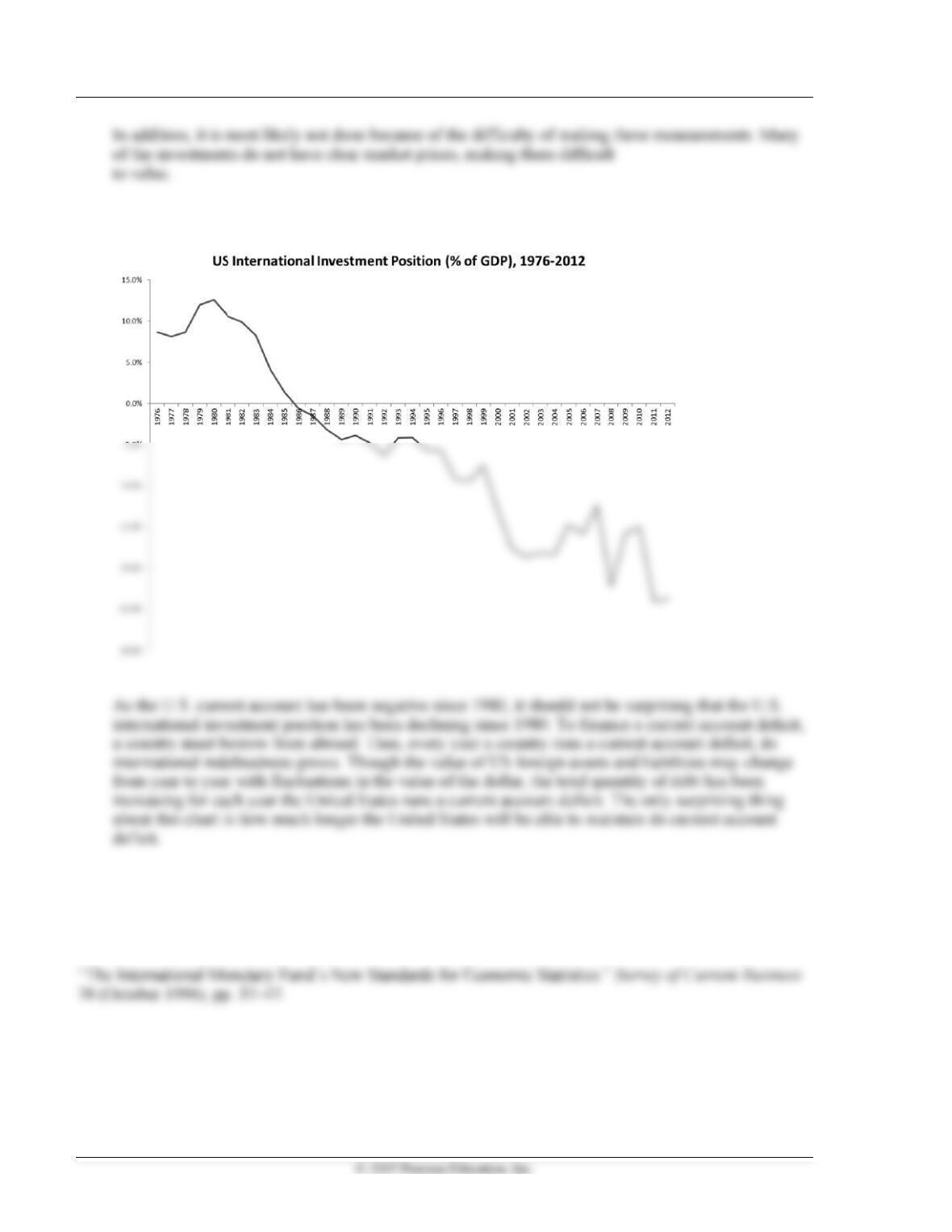
13. Collecting data on the U.S. international investment position and nominal GDP over the period 1976–
2012 allows us to generate the following chart:
◼ References
Christopher Bach. “U.S. International Transactions, Revised Estimates for 1982–1998.” Survey of Current
Business 79 (July 1999), pp. 60–74.