Chapter 13
MONOPOLISTIC COMPETITION AND OLIGOPOLY
QUESTIONS AND ANSWERS
Q13.1 Describe the monopolistically competitive market structure and give some examples.
Q13.1 ANSWER
Monopolistic competition is a market structure quite similar to perfect competition in
that vigorous price competition among a large number of firms and individuals is
present. The major difference between these two market structures is that at least some
Q13.2 Describe the oligopoly market structure and give some examples.
Q13.2 ANSWER
Oligopoly is a market structure where only a few large rivals are responsible for the
bulk, if not all, industry output. As in the case of monopoly, high to very high barriers
to entry are typical. Under oligopoly, the price/output decisions of firms are interrelated
Q13.3 Explain the process by which economic profits are eliminated in a monopolistically
competitive market as compared to a perfectly competitive market.
408 Chapter 13
Q13.3 ANSWER
In a monopolistically competitive industry, excess profits are eliminated in the long-run
Q13.4 Would you expect the demand curve for a firm in a monopolistically competitive industry
to be more or less elastic in the long run after competitor entry has eliminated economic
profits?
Q13.4 ANSWER
In most instances, demand will be more elastic in monopolistically competitive
industries after excess profits have been eliminated. The effect of increased competition
Q13.5 “One might expect firms in a monopolistically competitive market to experience greater
swings in the price of their products over the business cycle than those in an oligopoly
market. However, fluctuations in profits do not necessarily follow the same pattern.”
Discuss this statement.
Q13.5 ANSWER
Oligopoly prices are expected to be more stable than those in a monopolistically
Monopolistic Competition and Oligopoly 409
Q13.6 What is the essential difference between the Cournot and Stackelberg models?
Q13.6 ANSWER
In the Cournot model, oligopoly firms make output decisions simultaneously. In the
Q13.7 Which oligopoly model(s) result in long-run oligopoly market equilibrium that is
identical to a competitive market price/output solution?
Q13.7 ANSWER
In markets where competitors produce identical products, the Bertrand model and
contestable markets theory result in a long-run oligopoly market equilibrium
Q13.8 Why is the four-firm concentration ratio only an imperfect measure of market power?
Q13.8 ANSWER
The four firm concentration ratio measures the share of domestic output produced by the
410 Chapter 13
Q13.9 The statement “You get what you pay for” reflects the common perception that high
prices indicate high product quality and low prices indicate low quality. Irrespective of
market structure considerations, is this statement always correct?
Q13.9 ANSWER
Q13.10 “Economic profits result whenever only a few large competitors are active in a given
market.” Discuss this statement.
Q13.10 ANSWER
This statement is not true, and reflects a simplistic view of the link between the number
of competitors and the vigor of competition. Holding buyer power constant, competition
can sometimes be fierce in markets that involve only a handful of competitors.
Monopolistic Competition and Oligopoly 411
SELF-TEST PROBLEMS AND SOLUTIONS
ST13.1 Price Leadership. Over the last century, The Boeing Co. has become the largest
aerospace company in the world. Boeing’s principal global competitor is Airbus, a
company that has its roots in a European consortium of French, German and later,
Spanish and U.K companies. Though dominated by Boeing and Airbus, smaller firms
have recently entered the commercial aircraft industry. Notable among these is
Embraer, a Brazilian aircraft manufacturer. Embraer makes smaller commercial
aircraft that offer excellent reliability and cost effectiveness.
To illustrate the price leadership concept, assume that total and marginal cost
functions for Airbus (A) and Embraer (E) aircraft are as follows:
TCA = $10,000,000 + $35,000,000QA + $250,000QA2
The industry demand curve for this type of jet aircraft is
Q = 910 – 0.000017P
For simplicity, assume that Airbus and Embraer aircraft are perfect substitutes for
Boeing aircraft, and that each total cost function includes a risk-adjusted normal rate of
return on investment.
A. Determine the supply curves for Airbus and Embraer aircraft, assuming that the
firms operate as price takers.
B. What is the demand curve faced by Boeing?
ST13.1 SOLUTION
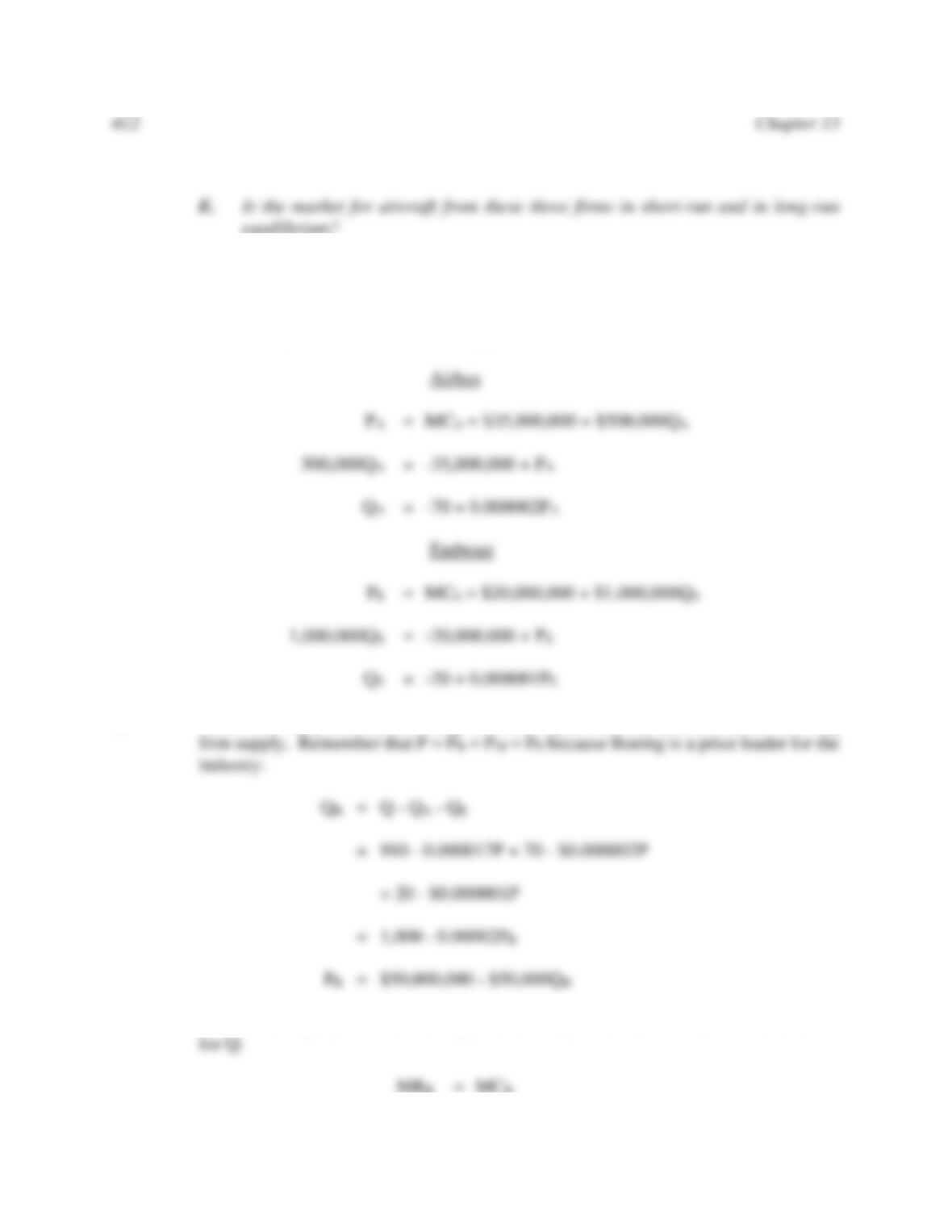
A. Because price followers take prices as given, they operate where individual marginal
cost equals price. Therefore, the supply curves for Airbus and Embraer aircraft are:
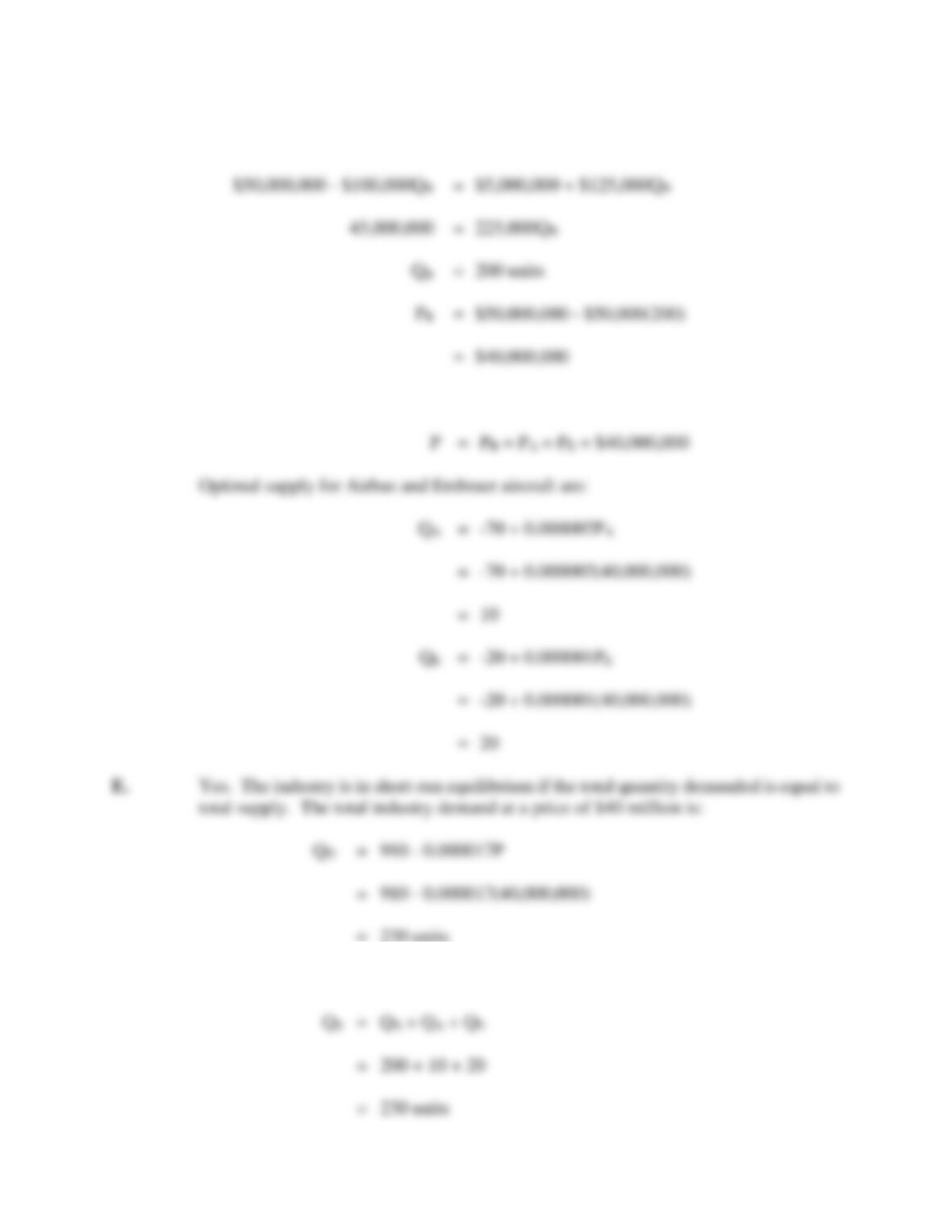
B. As the industry price leader, Boeing’s demand equals industry demand minus following
C. To find Boeing’s profit maximizing price and output level, set MRB = MCB and solve
Monopolistic Competition and Oligopoly 413
D. Because Boeing is a price leader for the industry,
= 230 units
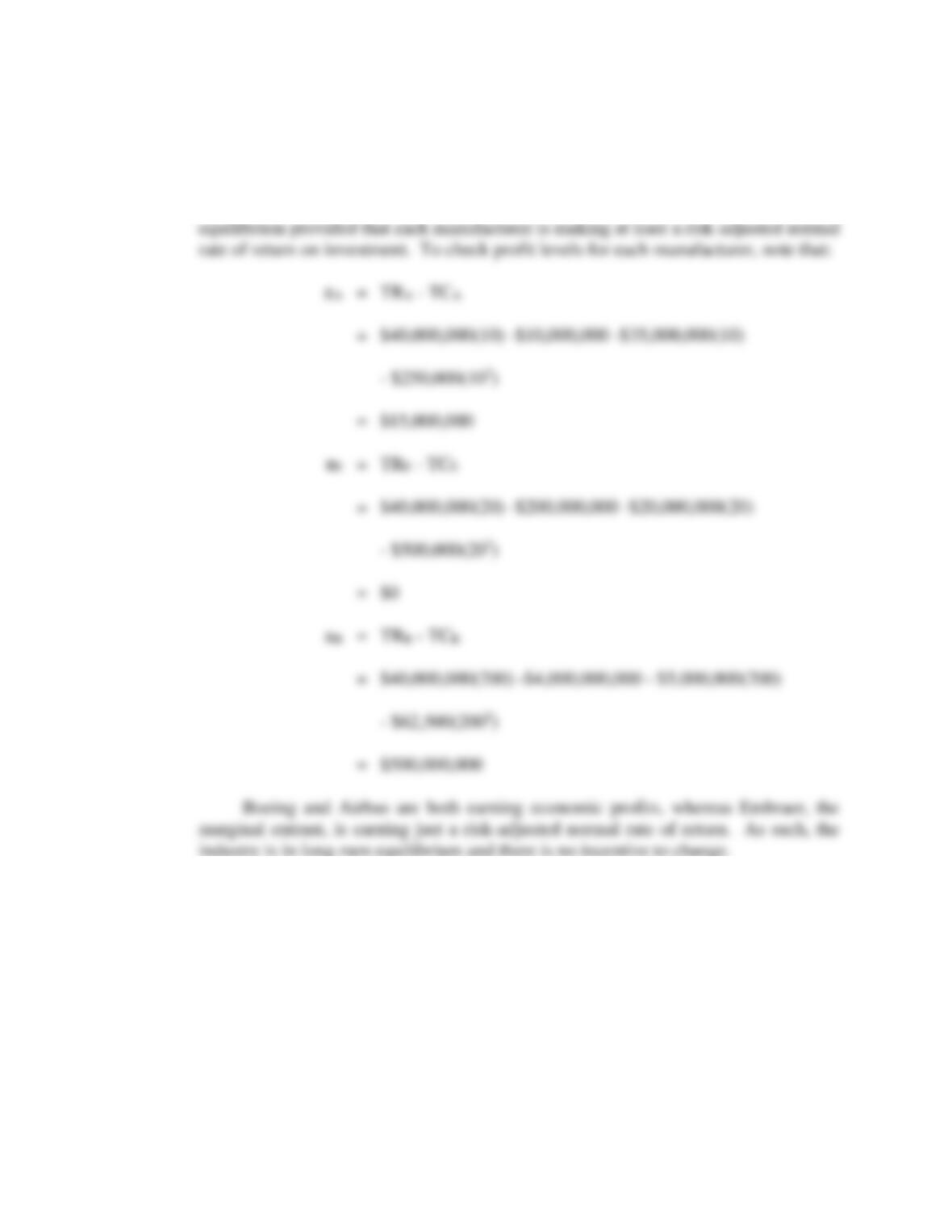
The total industry supply is:
414 Chapter 13
Thus, the industry is in short-run equilibrium. The industry is also in long-run
ST13.2 Monopolistically Competitive Equilibrium. Soft Lens, Inc., has enjoyed rapid growth in
sales and high operating profits on its innovative extended-wear soft contact lenses.
However, the company faces potentially fierce competition from a host of new
competitors as some important basic patents expire during the coming year. Unless the
company is able to thwart such competition, severe downward pressure on prices and
profit margins is anticipated.
A. Use Soft Lens’s current price, output, and total cost data to complete the table:
Monopolistic Competition and Oligopoly 415
Price
($)
Monthly
Output
(million)
Total
Revenue
($million)
Marginal
Revenue
($million)
Total
Cost
($million)
Marginal
Cost
($million)
Average
Cost
($million)
Total
Profit
($million)
$20
0
$0
19
1
12
(Note: Total costs include a risk-adjusted normal rate of return.)
B. If cost conditions remain constant, what is the monopolistically competitive high–
price/low-output long-run equilibrium in this industry? What are industry profits?
C. Under these same cost conditions, what is the monopolistically competitive low-
price/high-output equilibrium in this industry? What are industry profits?
ST13.2 SOLUTION
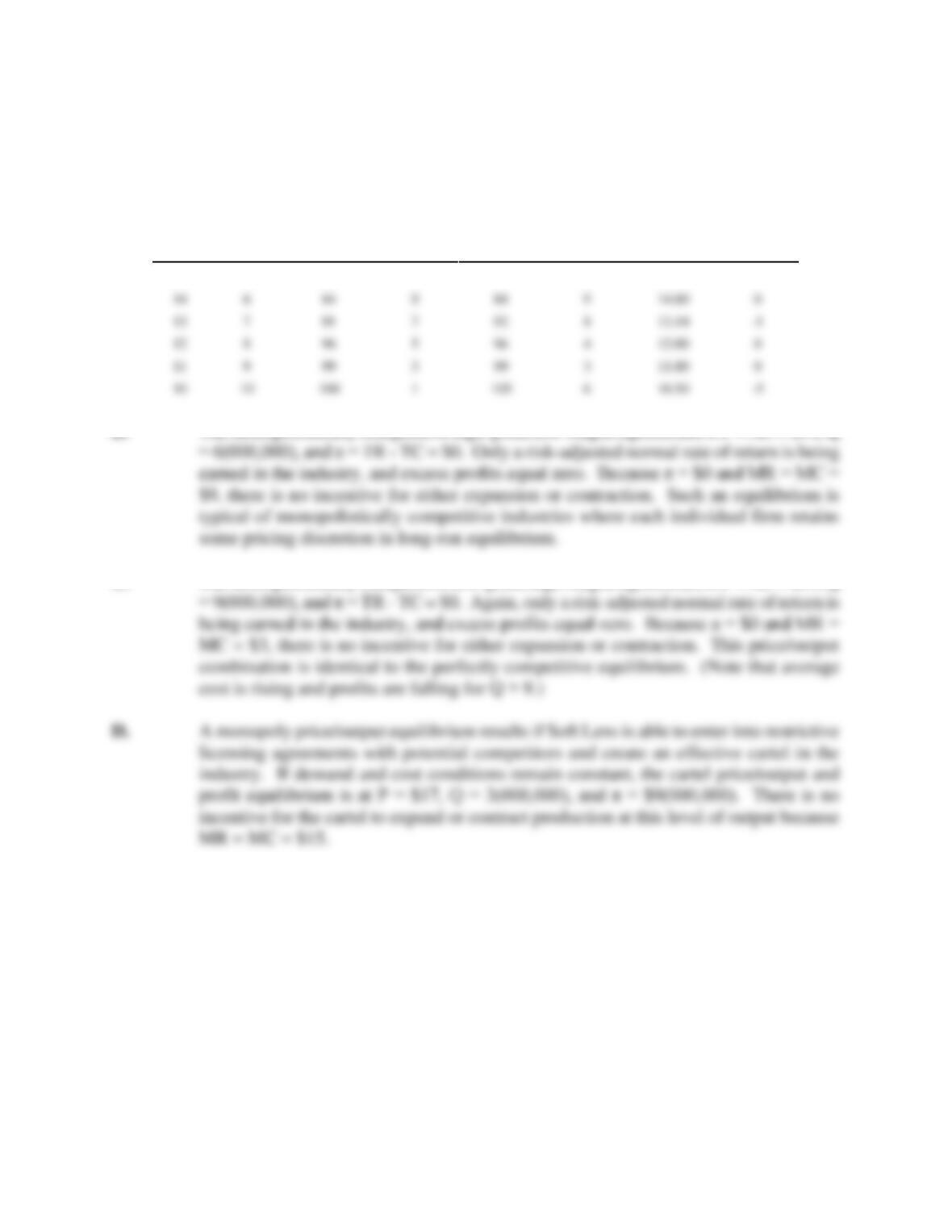
A.
Price
($)
Monthly
Output
(million)
Total
Revenue
($million)
Marginal
Revenue
($million)
Total
Cost
($million)
Marginal
Cost
($million)
Average
Cost
($million)
Total
Profit
($million)
18
2
27
17
3
42
4
58
6
84
13
7
92
8
96
11
9
99
416 Chapter 13
Price
($)
Monthly
Output
(million)
Total
Revenue
($million)
Marginal
Revenue
($million)
Total
Cost
($million)
Marginal
Cost
($million)
Average
Cost
($million)
Total
Profit
($million)
15
5
75
11
75
17
15.00
0
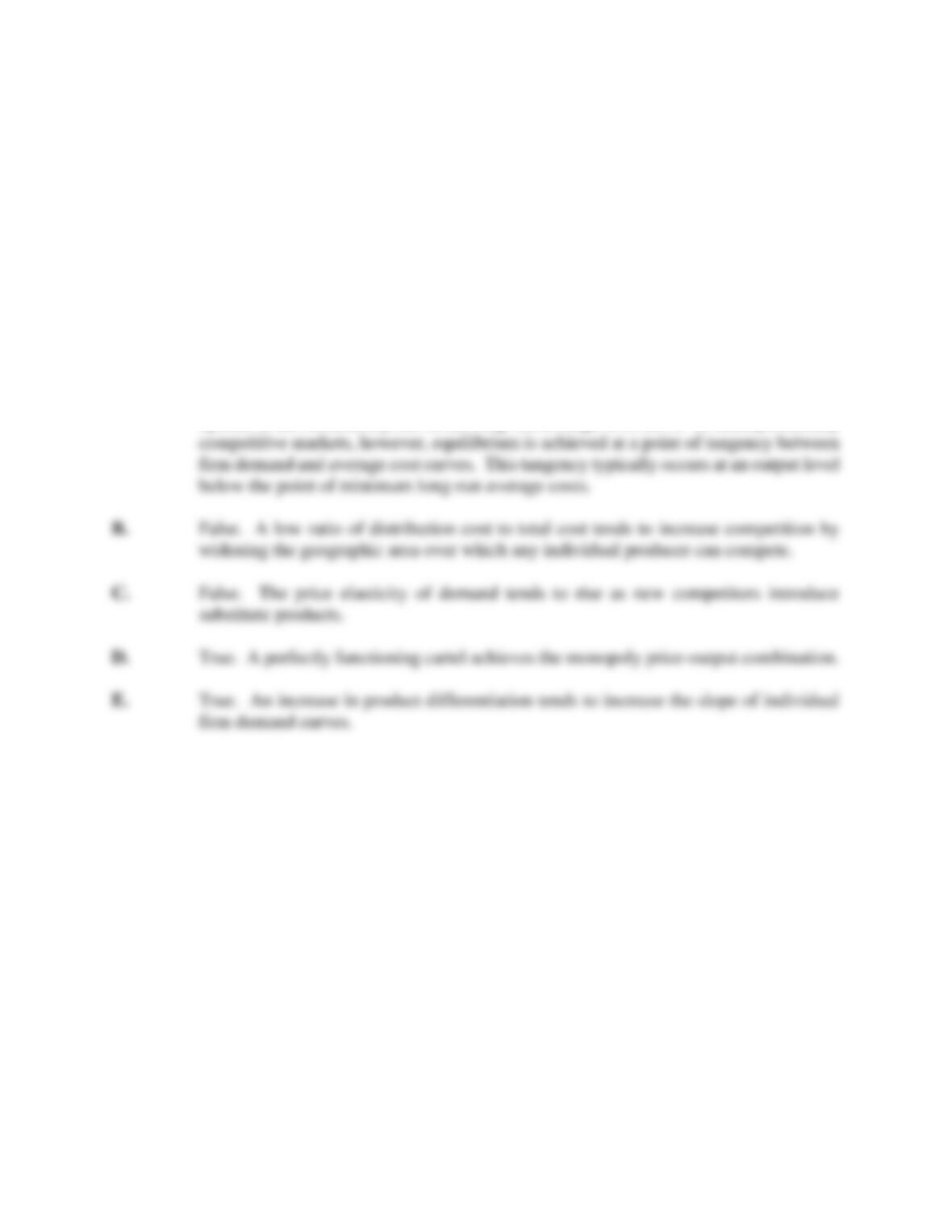
B. The monopolistically competitive high-price/low-output equilibrium is P = AC = $14, Q
C. The monopolistically competitive low-price/high-output equilibrium is P = AC = $11, Q
PROBLEMS AND SOLUTIONS
P13.1 Market Structure Concepts. Indicate whether each of the following statements is true
or false and explain why.
A. Equilibrium in monopolistically competitive markets requires that firms be
operating at the minimum point on the long-run average cost curve.
B. A high ratio of distribution cost to total cost tends to increase competition by
widening the geographic area over which any individual producer can compete.
14
6
84
84
14.00
0
13
7
91
92
13.14
12
8
96
96
12.00
0
11
9
99
99
11.00
0
Monopolistic Competition and Oligopoly 417
C. The price elasticity of demand tends to fall as new competitors introduce substitute
products.
D. An efficiently functioning cartel achieves a monopoly price/output combination.
E. An increase in product differentiation tends to increase the slope of firm demand
curves.
P13.1 SOLUTION
A. False. Stable equilibrium in perfectly competitive markets requires that firms must
operate at the minimum point on the long-run average cost curve. In monopolistically
P13.2 Monopolistically Competitive Demand. Would the following factors increase or
decrease the ability of domestic auto manufacturers to raise prices and profit margins?
Why?
A. Decreased import quotas
B. Elimination of uniform emission standards
C. Increased automobile price advertising
D. Increased import tariffs (taxes)
E. A rising value of the dollar, which has the effect of lowering import car prices
418 Chapter 13
P13.2 SOLUTION
A. Increase. As import quotas are decreased, fewer substitutes for domestic automobiles
become available. This will decrease competition in the industry, and ease pressure on
profit margins.
P13.3 Competitive Markets v. Cartels. Suppose the City of Columbus, Ohio, is considering
two proposals to privatize municipal garbage collection. First, a handful of leading
waste disposal firms have offered to purchase the city’s plant and equipment at an
attractive price in return for exclusive franchises on residential service in various parts
of the city. A second proposal would allow several individual workers and small
companies to enter the business without any exclusive franchise agreements or
competitive restrictions. Under this plan, individual companies would bid for the right
to provide service in a given residential area. The City would then allocate business to
the lowest bidder.
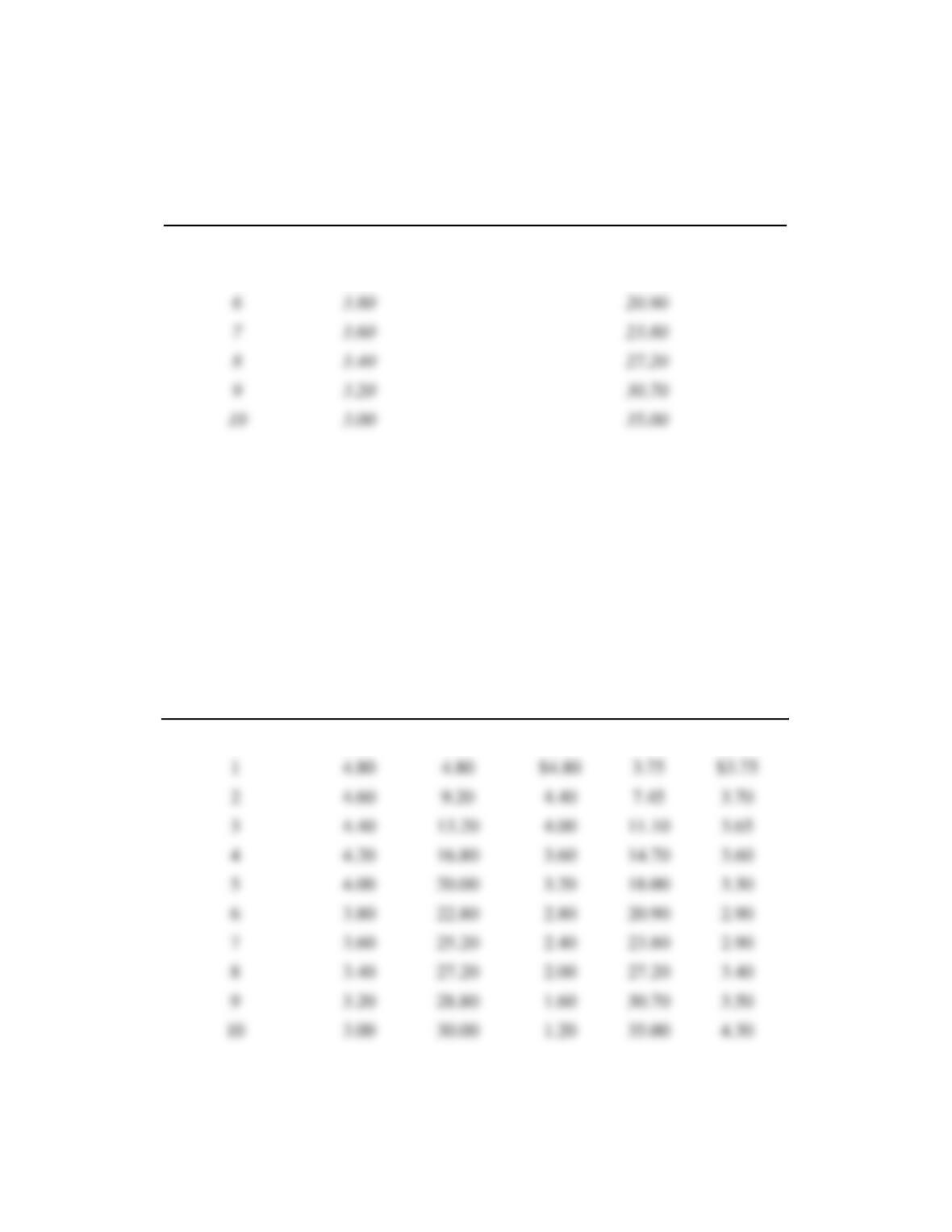
A. Complete the following table.
Trash Pickups
per Month
Price per
Pickup
Total
Revenue
Marginal
Revenue
Total
Cost
Marginal
Cost
0
$5.00
$0.00
1
4.80
3.75
2
4.60
7.45
3
4.40
11.10
Monopolistic Competition and Oligopoly 419
Trash Pickups
per Month
Price per
Pickup
Total
Revenue
Marginal
Revenue
Total
Cost
Marginal
Cost
4
4.20
14.70
5
4.00
18.00
B. Determine price and service level if competitive bidding results in a
perfectly competitive price/output combination.
C. Determine price and the level of service if local regulation results in a
cartel.
P13.3 SOLUTION
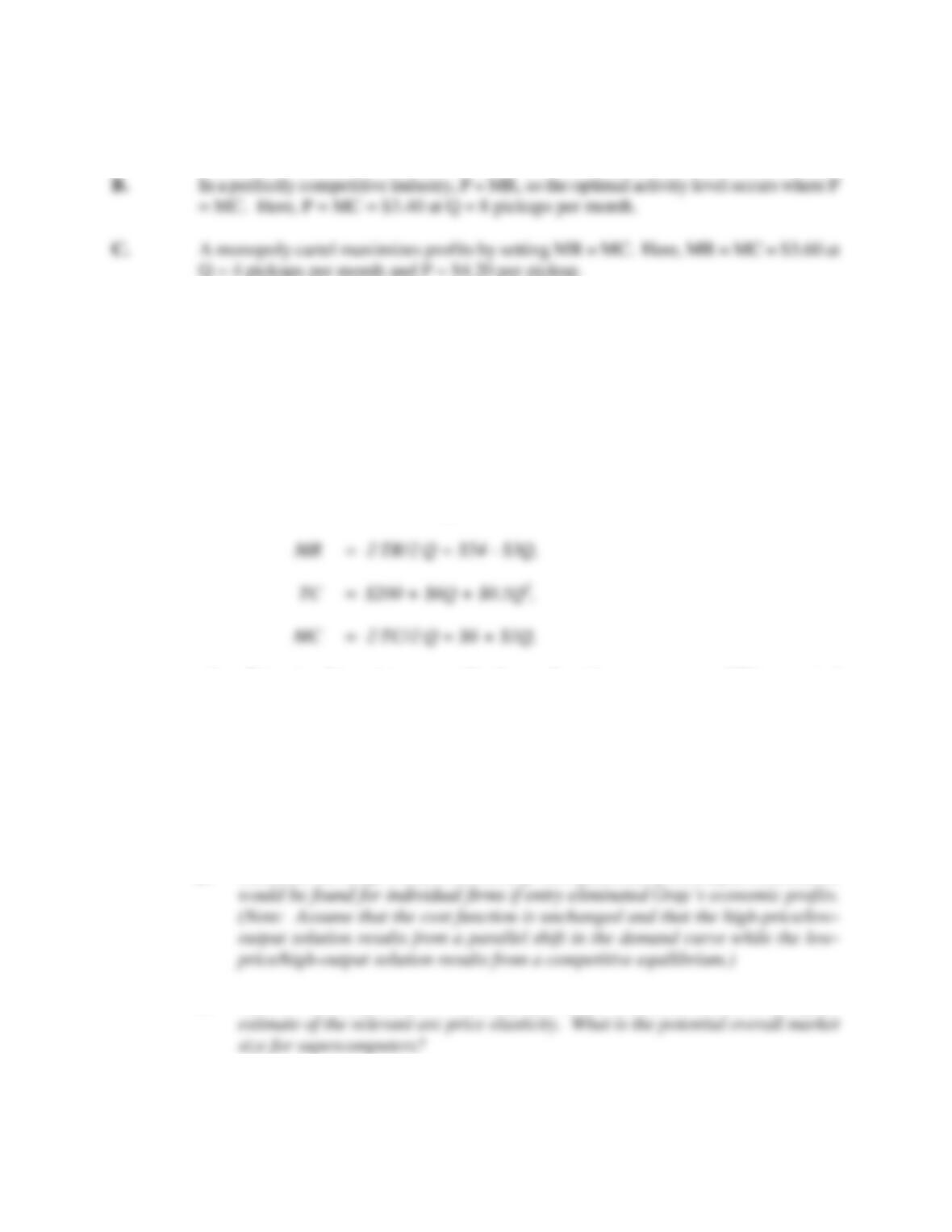
A.
Trash Pickups
per Month
Price per
Pickup
Total
Revenue
Marginal
Revenue
Total
Cost
Marginal
Cost
0
$5.00
$0.00
—
$0.00
—
2
3
13.20
11.10
4
16.80
14.70
5
20.00
18.00
7
25.20
23.80
8
27.20
27.20
9
28.80
30.70
30.00
35.00
6
3.80
20.90
7
3.60
23.80
8
3.40
27.20
3.00
35.00
420 Chapter 13
P13.4 Monopolistic Competition. Gray Computer, Inc., located in Colorado Springs,
Colorado, is a privately held producer of high-speed electronic computers with immense
storage capacity and computing capability. Although Gray’s market is restricted to
industrial users and a few large government agencies (e.g., Department of Health,
NASA, National Weather Service, etc.), the company has profitably exploited its market
niche. Suppose a potential entrant into the market for supercomputers has asked you to
evaluate the short– and long-run potential of this market. The following market demand
and cost information has been developed:
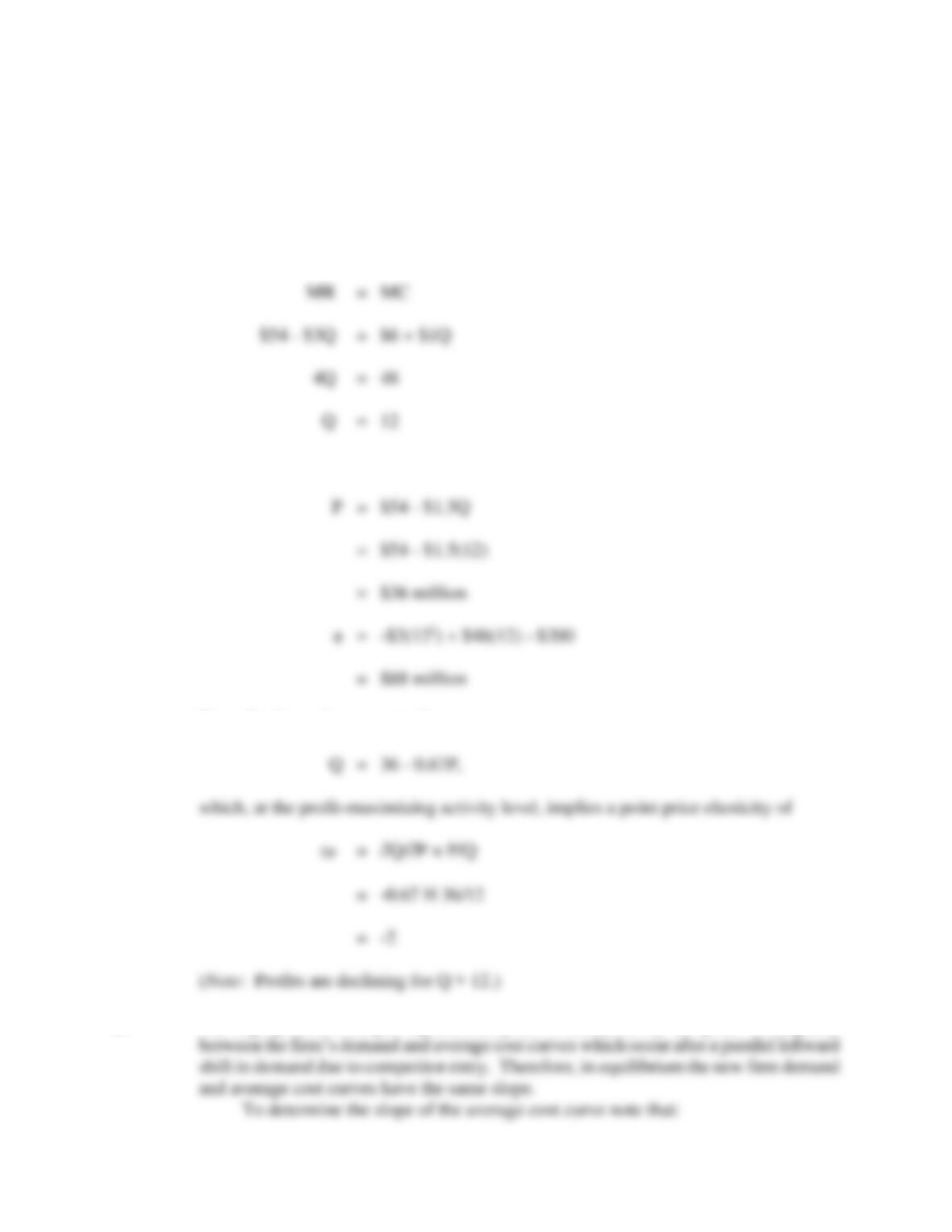
P = $54 – $1.5Q,
where P is price, Q is units measured by the number of supercomputers, MR is marginal
revenue, TC is total costs including a normal rate of return, MC is marginal cost, and all
figures are in millions of dollars.
A. Assume that these demand and cost data are descriptive of Gray’s historical
experience. Calculate output, price, and economic profits earned by Gray
Computer as a monopolist. What is the point price elasticity of demand at this
output level?
B. Calculate the range within which a long-run equilibrium price/output combination
C. Assume that the point price elasticity of demand calculated in Part A is a good
D. If no other near-term entrants are anticipated, should your company enter the
market for supercomputers? Why or why not?
Monopolistic Competition and Oligopoly 421
P13.4 SOLUTION
A. Set MR = MC to determine the profit-maximizing activity level.
and
From the demand curve note that:
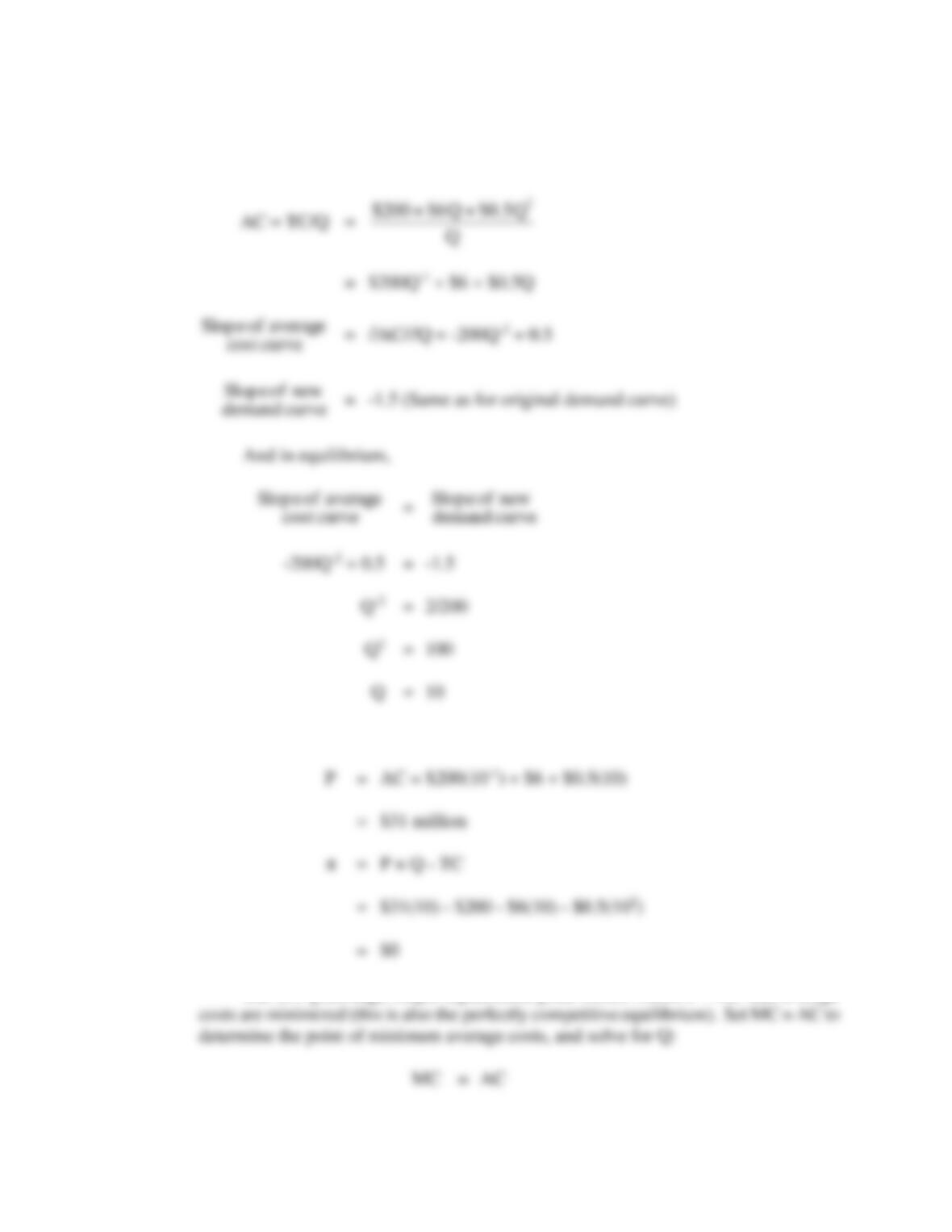
B. The high-price/low-output equilibrium point is identified by the point of tangency
422 Chapter 13
and
The low-price/high-output equilibrium point occurs where P = AC and average