CHAPTER 13
(MACRO CHAPTER 13)
Monetary Policy
FUNDAMENTAL QUESTIONS
1. What does the Federal Reserve do?
2. How is monetary policy set?
OVERVIEW AND OBJECTIVES
The primary purpose of this chapter is to describe the principles of monetary policy, which is the
second major tool of macroeconomic policy.
The unique feature of this chapter is the presentation of a money supply and demand model. Through
After reading and reviewing this chapter, the student should be able to:
1. Discuss the structure of the Federal Reserve System.
2. List the functions of the Federal Reserve.
KEY TERM REVIEW
Federal Open Market Committee (FOMC)
intermediate target
equation of exchange
92 Chapter 13: Monetary Policy
velocity of money
quantity theory of money
transactions demand for money
precautionary demand for money
speculative demand for money
LECTURE OUTLINE AND TEACHING STRATEGIES
I. The Federal Reserve System
A. Structure of the Fed
1. Board of Governors
2. District banks
II. Implementing Monetary Policy
A. Policy goals: The ultimate goal of monetary policy is economic growth with stable prices.
Teaching Strategy: The goals of monetary policy are often in conflict and you may wish to
point this out to your students. For example, as we will see in Chapter 14, low
B. Operating procedures
1. Tools of monetary policy: The Fed can use the reserve requirement, the discount rate,
and open market operations to change reserves and thereby control the money supply.
Teaching Strategy: Point out that because it has such a powerful effect on the
multiplier, the reserve requirement is seldom used as a policy tool.
Chapter 13: Monetary Policy 93
C. Foreign exchange market intervention
1. Mechanics of intervention: Foreign exchange market intervention is the buying and
III. Monetary Policy and Equilibrium Income
To understand the workings of monetary policy, we use the money supply and demand
framework.
A. Money demand: There are three broad categories of demand for money—transactions
demand for money, precautionary demand for money, and speculative demand for money.
1. The money demand function: Changes in the interest rate cause changes in the quantity
B. Money and equilibrium income: Monetary policy affects both investment and consumption
spending, thus affecting equilibrium income.
OPPORTUNITIES FOR DISCUSSION
1. Visit the web site for the Federal Reserve. Read the minutes of the FOMC and discuss with the
class.
2. What is the main theme behind the structure of the Federal Reserve?
3. To what extent is the Federal Reserve independent of political pressures? Is this independence
appropriate?
94 Chapter 13: Monetary Policy
ANSWERS TO EXERCISES
1.
2. The Federal Reserve provides three basic services to banks: (a) it provides banks with currency;
(b) it is the banker’s bank in the sense that it holds bank reserves; and (c) it clears checks. The Federal
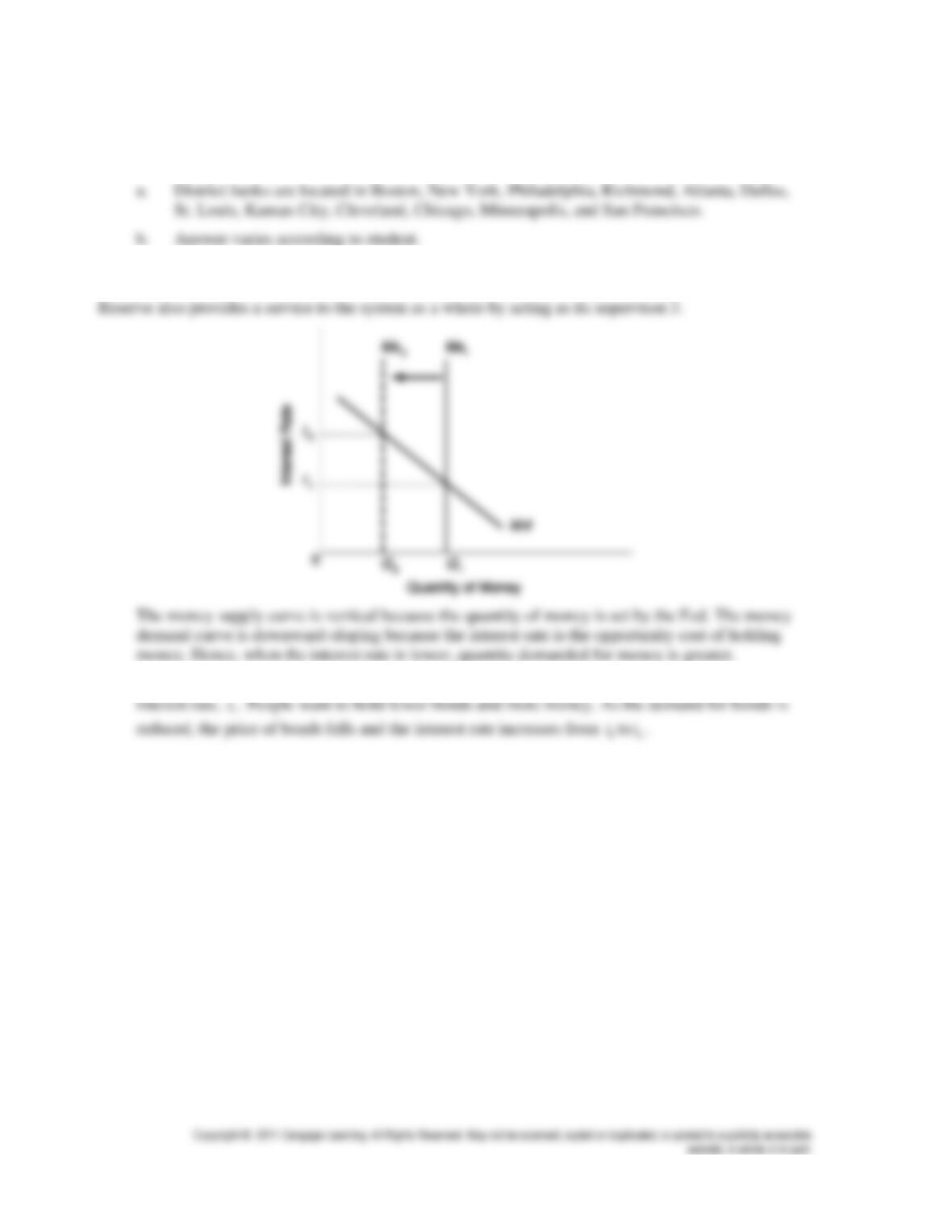
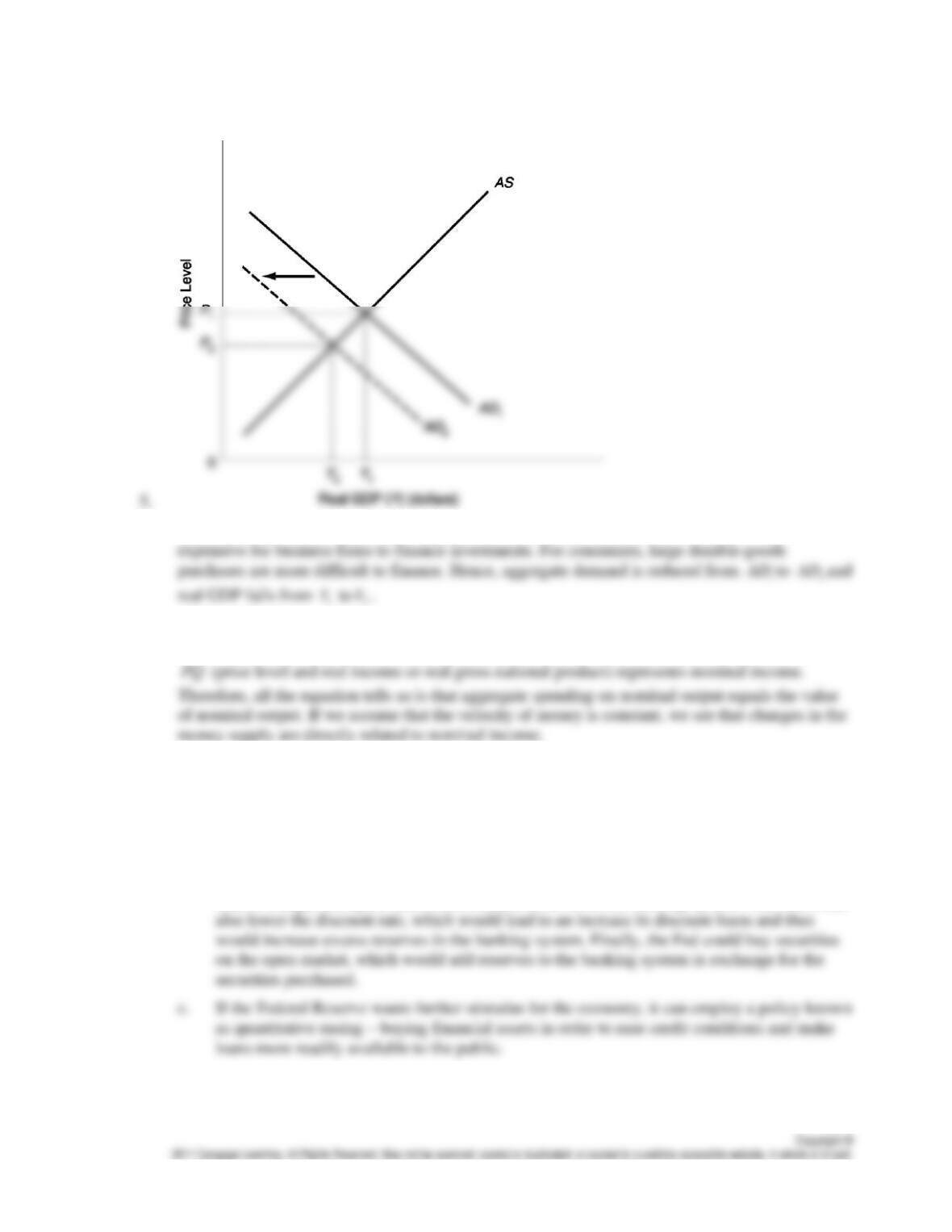
4. When the Fed decreases the supply of money, there is an excess demand for money at the original
Chapter 13: Monetary Policy 95
When the Fed reduces the money supply, the rate of interest increases. Thus, it becomes more
6. The quantity theory of money is understood best by first recognizing that the basic identity
MV PQ=
.
MV
(quantity and velocity of money) is another way of writing aggregate spending.
7.
a. The reserve requirement is the proportion of total deposits that banks must hold in reserve.
The discount rate is the interest rate that the Fed charges banks for discount loans. When the
Fed buys or sells government securities in financial markets, it is conducting open market
operations.
b. To increase the money supply, the Fed could reduce the reserve requirement, which would
lead to a larger multiplier and to more excess reserves in the banking system. The Fed could
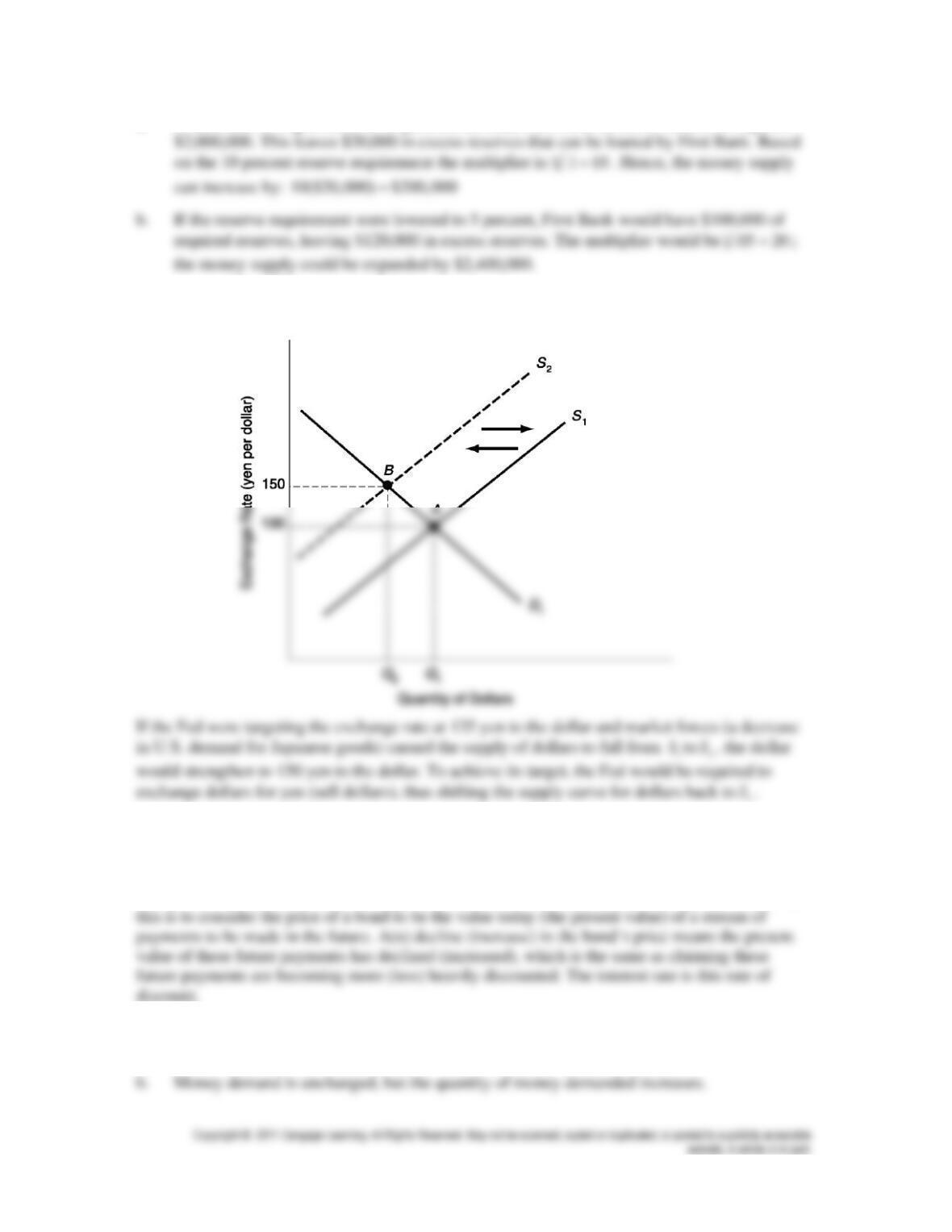
8.
96 Chapter 13: Monetary Policy
a. With a reserve requirement at 10 percent, the bank must hold $200,000 in reserves against
9. This question is open ended and has no unique answer.
10.
11. We demand money for transaction, precautionary, and speculative purposes. The amount of
money we hold is mostly determined by income, but interest rates also play a role.
12.
Current yield annual interest payment/bond price.=
When bond prices change, the denominator
changes so the value of the ratio changes (the numerator is constant). Another way to think about
13.
a. Interest rates fall.
Chapter 13: Monetary Policy 97
14. The governors of the Federal Reserve System are appointed for 14-year terms, with one position
15.
a.
5($1,000) $5,000=
b.
Excess reserves = $1,400
. The money supply can increase by
5($1,400) $7,000=
.
16. ECB stands for European Central Bank. It is located in Frankfurt, Germany. Monetary policy for
ANSWERS TO STUDY GUIDE HOMEWORK
1. Federal Reserve; accepts deposits from and makes loans to financial institutions, acts as a banker
for the federal government, supervises the banking system, and controls the money supply.
2. Federal Open Market Committee (FOMC).
6. Transactions demand, speculative demand, precautionary demand.
7.
a. Decrease the money supply.
b. Selling bonds moves money from the economy into the Fed.
ACTIVE LEARNING EXERCISE
In this exercise, students will explore the monetary tools available to the FOMC in order to create an
impact on the money supply. It is important that students can explain how the monetary tool they have
chosen can impact the supply of money.
98 Chapter 13: Monetary Policy
Divide the class into groups of three. Each group should construct a directive to increase the money
supply in order to stimulate the economy. The members of each group will have a particular tool of