
Chapter 13 – Wage Determination
13-1
Chapter 13 Wage Determination
QUESTIONS
1. Explain why the general level of wages is high in the United States and other industrially
advanced countries. What is the single most important factor underlying the long‐run increase in
average real‐wage rates in the United States? LO1
Answer: The general level of wages is higher in the United States and other industrially
advanced nations because of the high demand for labor in relation to supply. Labor
2. Why is a firm in a purely competitive labor market a wage taker? What would happen if it
decided to pay less than the going market wage rate? LO2
Answer: A firm in a purely competitive labor market is a wage taker because there are a
3. Describe wage determination in a labor market in which workers are unorganized and many
firms actively compete for the services of labor. Show this situation graphically, using W1 to
indicate the equilibrium wage rate and Q1 to show the number of workers hired by the firms as a
group. Show the labor supply curve of the individual firm, and compare it with that of the total
market. Why the differences? In the diagram representing the firm, identify total revenue, total
wage cost, and revenue available for the payment of non-labor resources. LO2
Answer: The labor market is made up of many firms desiring to purchase a particular
labor service and of many workers with that labor service. The market demand curve is
Chapter 13 – Wage Determination
13-2
4. Suppose the formerly competing firms in question 3 form an employers’ association that hires
labor as a monopsonist would. Describe verbally the effect on wage rates and employment.
Adjust the graph you drew for question 3, showing the monopsonistic wage rate and employment
level as W2 and Q2, respectively. Using this monopsony model, explain why hospital
administrators sometimes complain about a “shortage” of nurses. How might such a shortage be
corrected? LO3
Answer: The equilibrium wage in the monopsonistic market declines from the
5. Assume a monopsonistic employer is paying a wage rate of Wm and hiring Qm workers, as
indicated in Figure 13.8. Now suppose an industrial union is formed that forces the employer to
accept a wage rate of Wc. Explain verbally and graphically why in this instance the higher wage
rate will be accompanied by an increase in the number of workers hired. LO4
Answer: The union wage rate Wc becomes the firm’s MRC, which would be shown as a
horizontal line to the left of the labor supply curve. Each unit of labor now adds only its
6. Have you ever worked for the minimum wage? If so, for how long? Would you favor
increasing the minimum wage by a dollar? By two dollars? By five dollars? Explain your
reasoning. LO5
Answer: Student answers will vary. Those students that have worked for minimum wage
probably didn’t stay at that job for long, and would probably describe their performance
Chapter 13 – Wage Determination
13-3
7. “Many of the lowest‐paid people in society—for example, short‐order cooks— also have
relatively poor working conditions. Hence, the notion of compensating wage differentials is
disproved.” Do you agree? Explain. LO5
Answer: Short-order cooks generally need few specific skills, i.e., practically anyone is
8. What is meant by investment in human capital? Use this concept to explain (a) wage
differentials and (b) the long‐run rise of real wage rates in the United States. LO5
Answer: Investment in human capital is educational activity that improves individual
productivity
(a) Wage differentials are explainable to some extent through the concept of human
capital investment. There is a strong positive correlation between time spent
9. What is the principal‐agent problem? Have you ever worked in a setting where this problem
has arisen? If so, do you think increased monitoring would have eliminated the problem? Why
don’t firms simply hire more supervisors to eliminate shirking? LO6
Answer: Business owners who hire workers because they are needed to help produce the
goods or services of the firm face the dilemma of the principal-agent problem. Workers
Chapter 13 – Wage Determination
13-4
10. LAST WORD Do you think exceptionally high pay to CEOs is economically justified? Why
or why not?
Answer: Student answers will vary. Supporters will point to the important decisions
made by CEOs and their effect on overall firm productivity. High pay provides an
PROBLEMS
1. Workers are compensated by firms with “benefits” in addition to wages and salaries. The most
prominent benefit offered by many firms is health insurance. Suppose that in 2000 workers at one
steel plant were paid $20 per hour and in addition received health benefits at the rate of $4 per
hour. Also suppose that by 2010 workers at that plant were paid $21 per hour but received $9 in
health insurance benefits. LO1
a. By what percentage did total compensation (wages plus benefits) change at this plant from
2000 to 2010? What was the approximate average annual percentage change in total
compensation?
b. By what percentage did wages change at this plant from 2000 to 2010? What was the
approximate average annual percentage change in wages?
c. If workers value a dollar of health benefits as much as they value a dollar of wages, by what
total percentage will they feel that their incomes have risen over this time period? What if they
only consider wages when calculating their incomes?
d. Is it possible for workers to feel as though their wages are stagnating even if total
compensation is rising?
Feedback: Consider the following example: Suppose that in 2000 workers at one steel
plant were paid $20 per hour and in addition received health benefits at the rate of $4 per
hour. Also suppose that by 2010 workers at that plant were paid $21 per hour but
received $9 in health insurance benefits.
Part a:
Total compensation in 2000 was $24 (=$20 (wage rate) + $4 (health benefits)) and in
Chapter 13 – Wage Determination
13-5
Part b:
Part c:
If workers value a dollar of health benefits as much as they value a dollar of wages, they
feel that their incomes have risen by 25% (part a) over this time period.
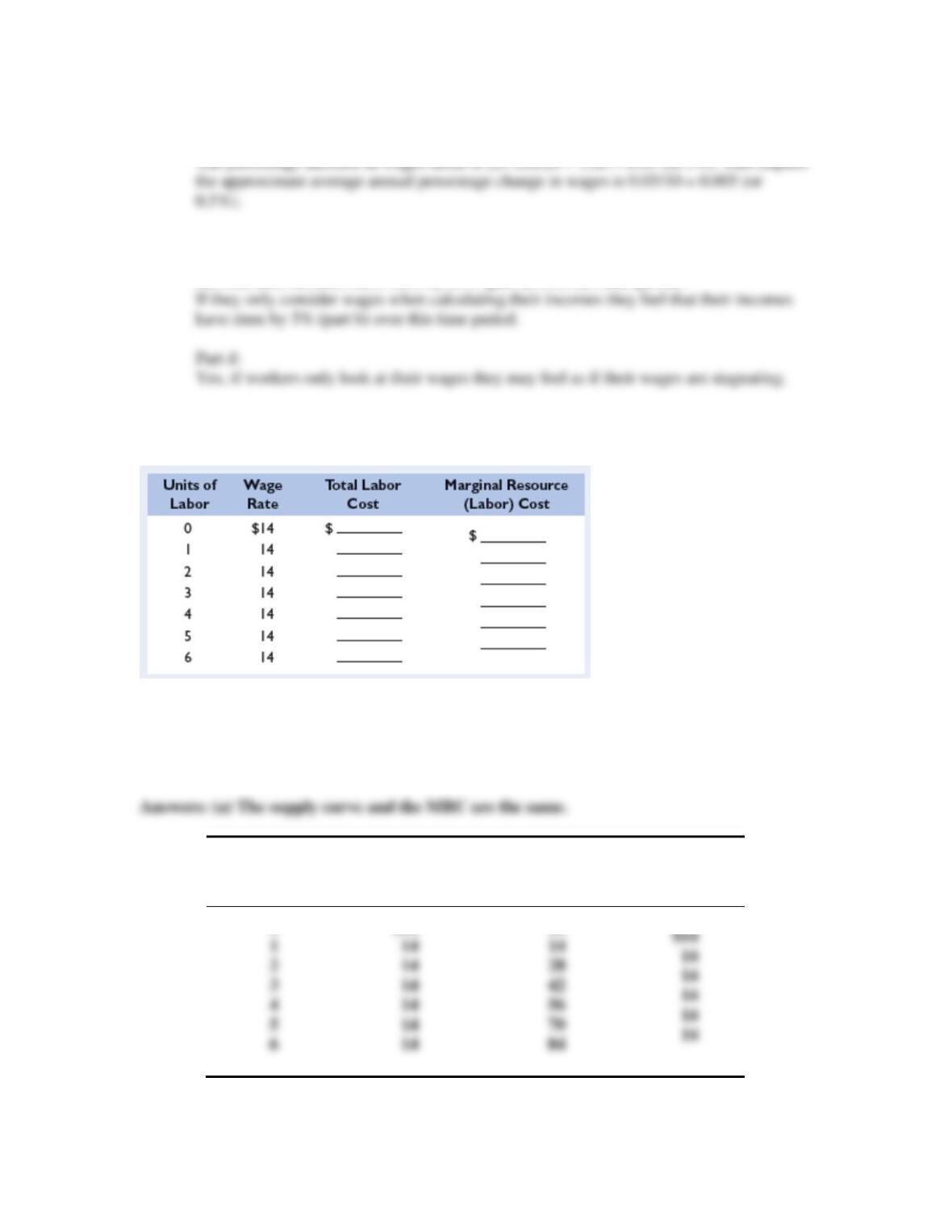
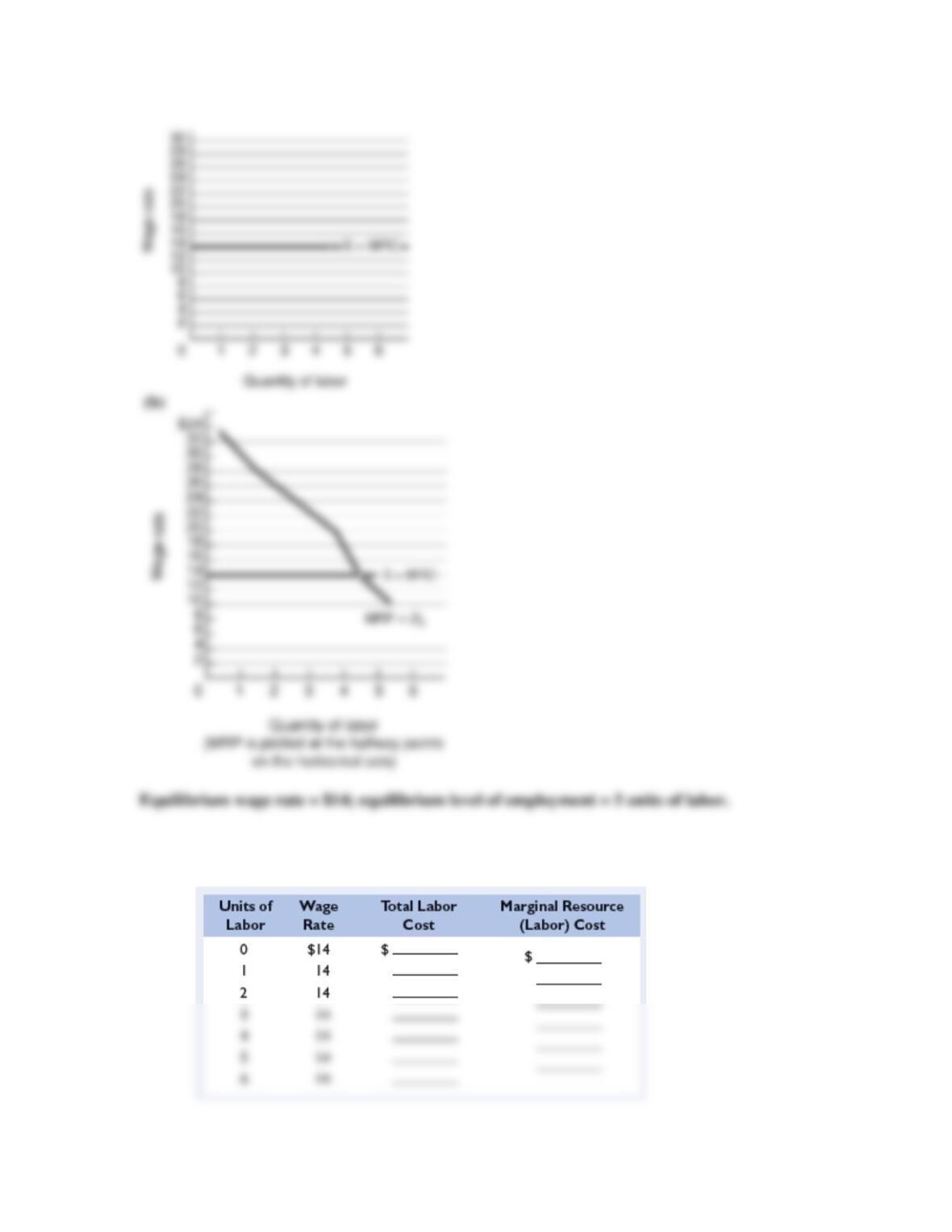
2. Complete the following labor supply table for a firm hiring labor competitively:
LO2
a. Show graphically the labor supply and marginal resource (labor) cost curves for this firm. Are
the curves the same or different? If they are different, which one is higher?
b. Plot the labor demand data of question 2 in Chapter 12 on the graph used in part a above. What
are the equilibrium wage rate and level of employment?
Units
of labor
Wage
Rate
Total
labor cost
Marginal
resource
(labor) cost
0
$14
$0
Chapter 13 – Wage Determination
13-6
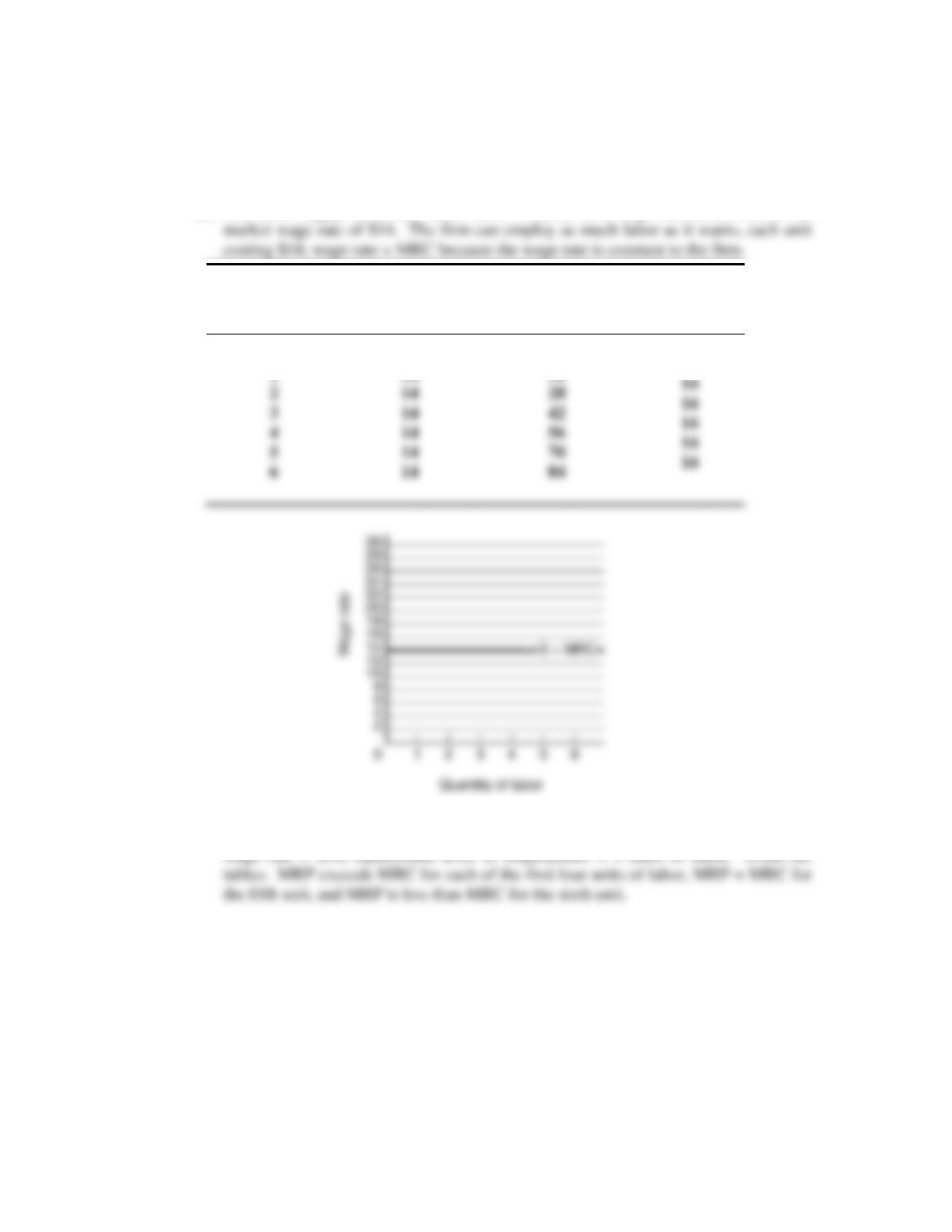
Feedback: Consider the following example (Table):
Chapter 13 – Wage Determination
13-7
(a) The labor supply curve and MRC curve coincide as a single horizontal line at the
Units
of labor
Wage
Rate
Total
labor cost
Marginal
resource
(labor) cost
0
1
$14
14
$0
14
$14
(b) Graph: equilibrium is at the intersection of the MRP and MRC curves. Equilibrium
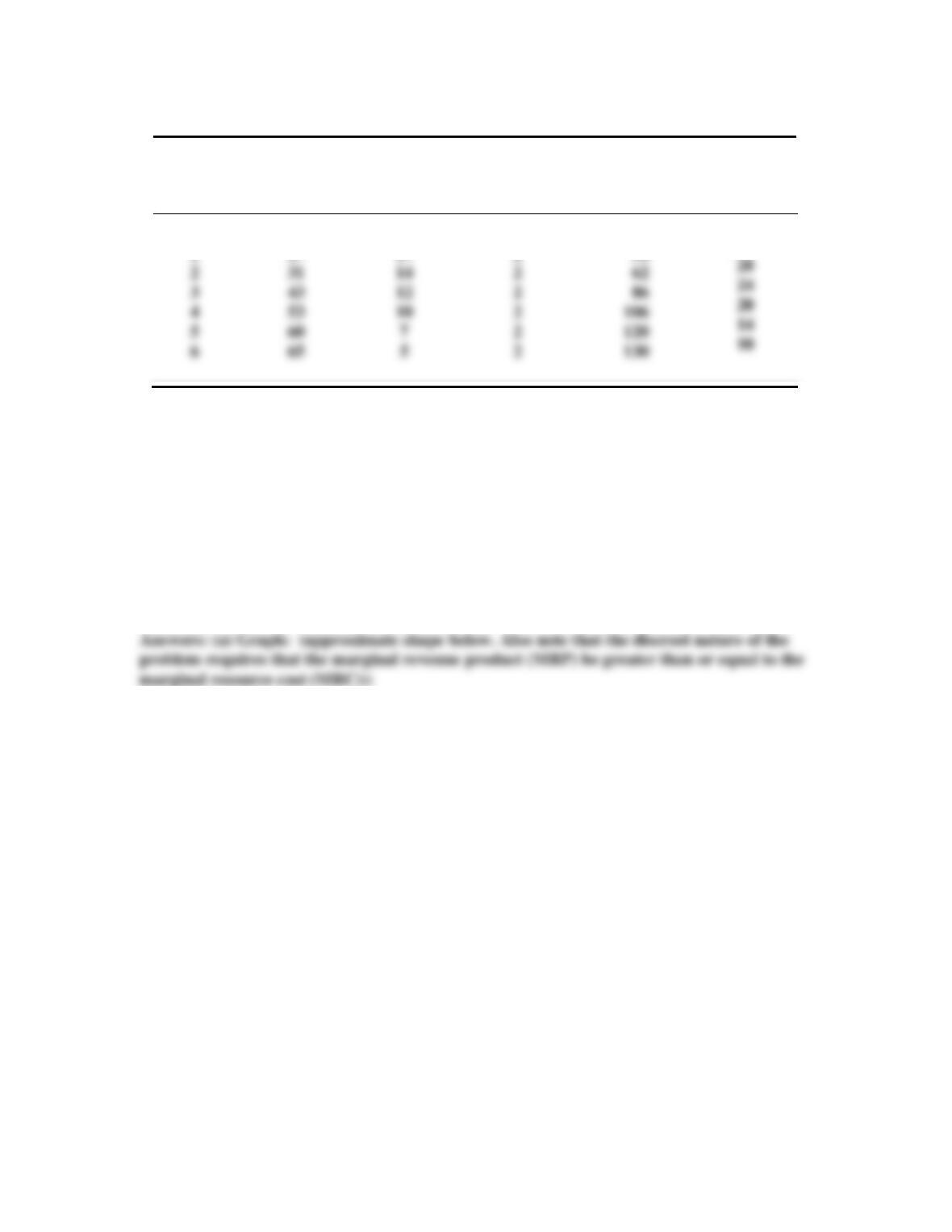
Table from question 2, Chapter 12:
Chapter 13 – Wage Determination
13-8
Units
of
labor
Total
product
Marginal
product
Product
price
Total
revenue
Marginal
revenue
product
0
1
0
17
17
$2
2
$0
34
$34
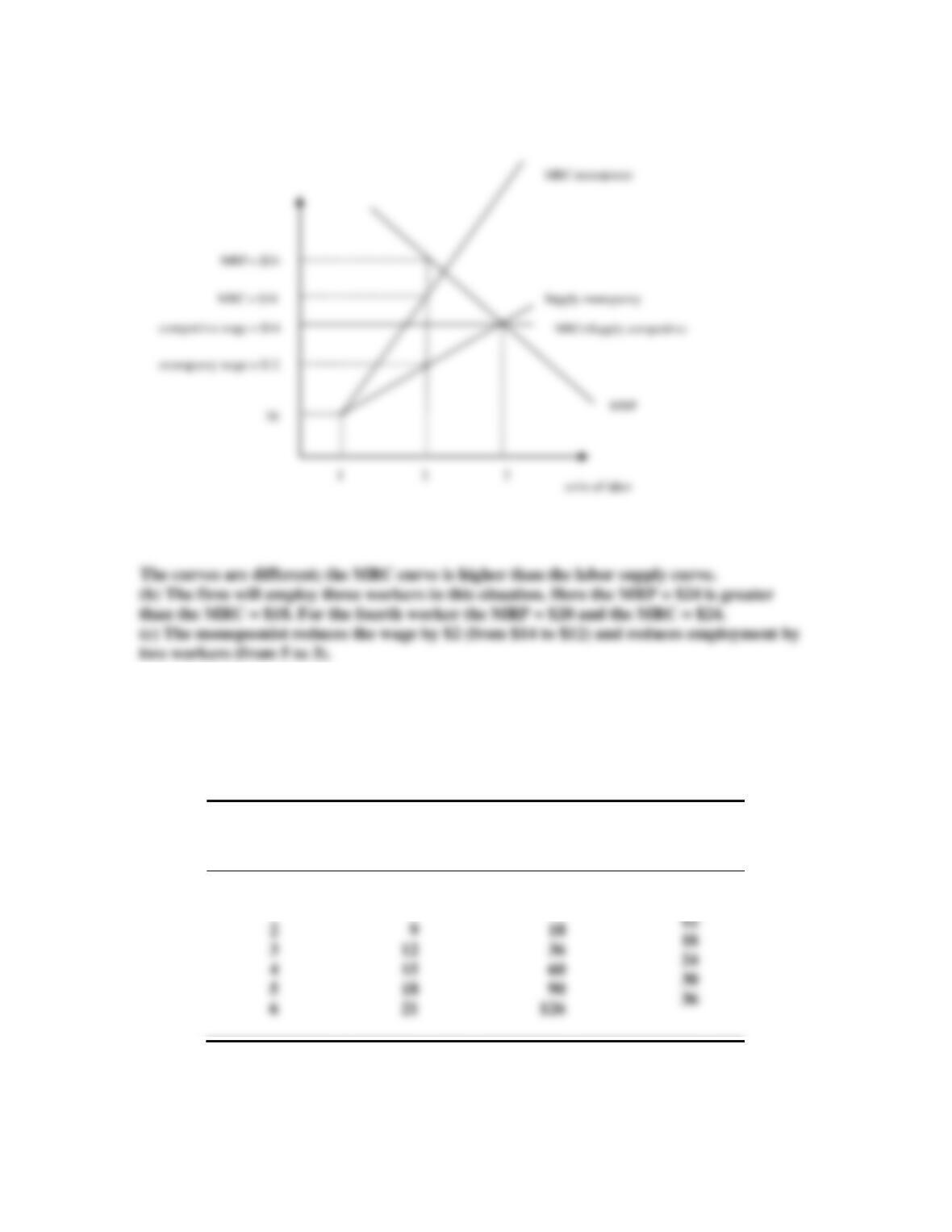
3. Assume a firm is a monopsonist that can hire its first worker for $6 but must increase the wage
rate by $3 to attract each successive worker (so that the second worker must be paid $9, the third
$12, and so on). LO3
a. Draw the firm’s labor supply and marginal resource cost curves. Are the curves the same or
different? If they are different, which one is higher?
b. On the same graph, plot the labor demand data of question 2 in Chapter 12. What are the
equilibrium wage rate and level of employment?
c. Compare these answers with those you found in problem 2. By how much does the
monoposonist reduce wages below the competitive wage? By how much does the monopsonist
reduce employment below the competitive level?
Chapter 13 – Wage Determination
13-9
Feedback: Consider the following example: Assume a firm is a monopsonist that can
hire its first worker for $6 but must increase the wage rate by $3 to attract each
successive worker (so that the second worker must be paid $9, the third $12, and so on).
Parts a and b:
Table for part a and table for part b (from question 2 in Chapter 12 and problem 2 above).
Units
of labor
Wage
Rate
Total
labor cost
(wage bill)
Marginal
resource
(labor) cost
0
1
$NA
6
$0
6
$6
Chapter 13 – Wage Determination
13–10
Units
of
labor
Total
product
Marginal
product
Product
price
Total
revenue
Marginal
revenue
product
0
1
2
0
17
31
17
14
$2
2
2
$0
34
62
$34
28
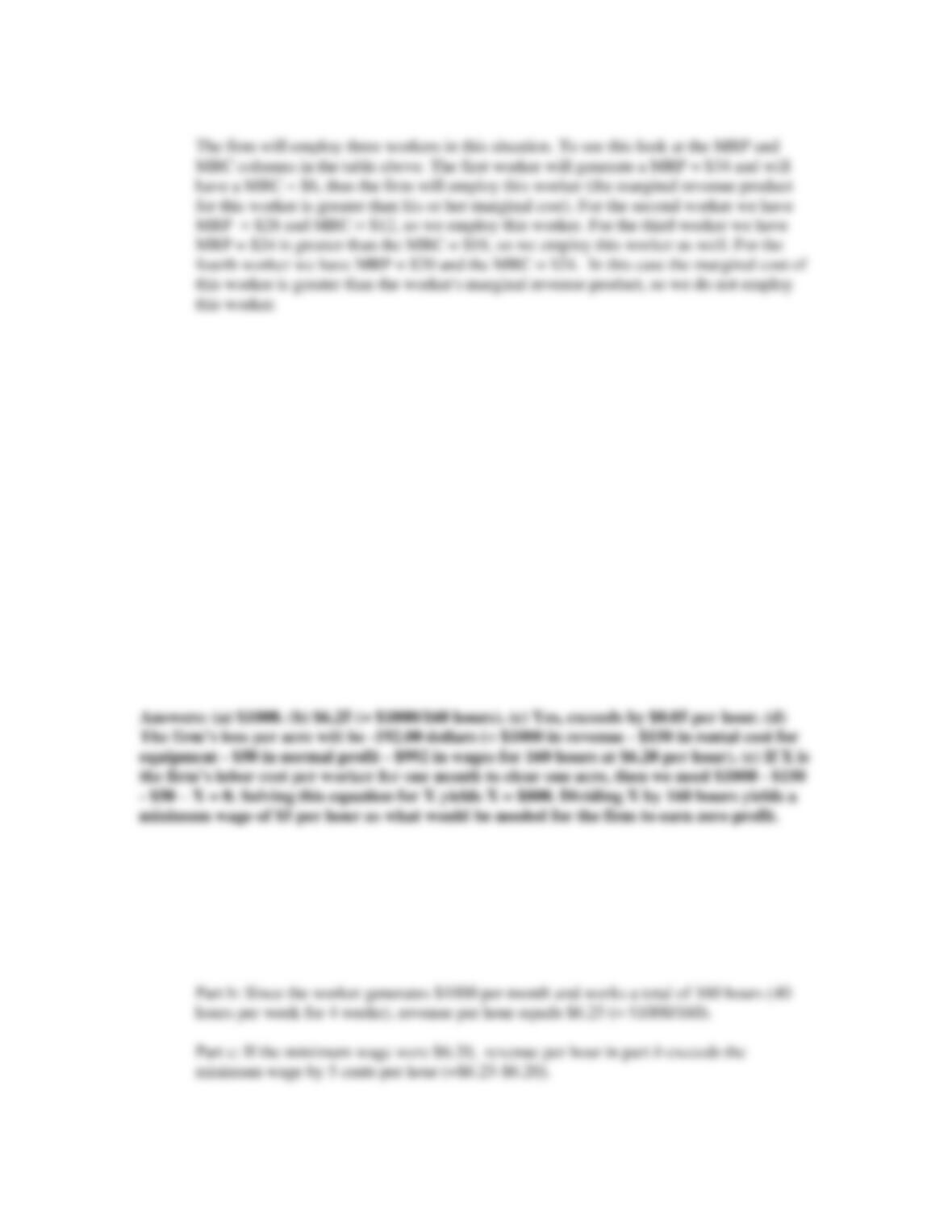
Graph: (approximate shape below. Also note that the discreet nature of the problem
requires that the marginal revenue product (MRP) be greater than or equal to the marginal
resource cost (MRC)).
Chapter 13 – Wage Determination
13–11
Part c: The monopsonist decreases employment by 2 units and the equilibrium wage rate
is $2 less than the competitive wage.
4. Suppose that low‐skilled workers employed in clearing woodland can each clear one acre per
month if they are each equipped with a shovel, a machete, and a chainsaw. Clearing one acre
brings in $1000 in revenue. Each worker’s equipment costs the worker’s employer $150 per
month to rent and each worker toils 40 hours per week for four weeks each month. LO4
a. What is the marginal revenue product of hiring one low‐skilled worker to clear woodland for
one month?
b. How much revenue per hour does each worker bring in?
c. If the minimum wage were $6.20, would the revenue per hour in part b exceed the minimum
wage? If so, by how much per hour?
d. Now consider the employer’s total costs. These include the equipment costs as well as a normal
profit of $50 per acre. If the firm pays workers the minimum wage of $6.20 per hour, what will
the firm’s economic profit or loss be per acre?
e. At what value would the minimum wage have to be set so that the firm would make zero
economic profit from employing an additional low‐skilled worker to clear woodland?
Feedback: Consider the following example. Clearing one acre brings in $1000 in
revenue. Each worker’s equipment costs the worker’s employer $150 per month to rent
and each worker toils 40 hours per week for four weeks each month.
Part a: The marginal revenue is $1000. This is the revenue each worker can generate for
the firm by clearing one acre.

Chapter 13 – Wage Determination
13–12
Part d: Now consider the employer’s total costs. These include the equipment costs as
well as a normal profit of $50 per acre. The total explicit cost for the firm per acre equals
Part e: To determine the minimum wage necessary for the firm to break-even (earn zero
economic profit, we first calculate the revenue left over for labor after accounting for
5. Suppose that a car dealership wishes to see if efficiency wages will help improve its
salespeople’s productivity. Currently, each salesperson sells an average of one car per day while
being paid $20 per hour for an eight‐hour day. LO6
a. What is the current labor cost per car sold?
b. Suppose that when the dealer raises the price of labor to $30 per hour the average number of
cars sold by a salesperson increases to two per day. What is now the labor cost per car sold? By
how much is it higher or lower than it was before? Has the efficiency of labor expenditures by the
firm (cars sold per dollar of wages paid to salespeople) increased or decreased?
c. Suppose that if the wage is raised a second time to $40 per hour the number of cars sold rises to
an average of 2.5 per day. What is now the labor cost per car sold?
d. If the firm’s goal is to maximize the efficiency of its labor expenditures, which of the three
hourly salary rates should it use: $20 per hour, $30 per hour, or $40 per hour?
e. By contrast, which salary maximizes the productivity of the car dealer’s workers (cars sold per
worker per day)?
Feedback: The current labor cost per car is $160 (= $20 per hour times eight hours per
day divided by 1 car sold per day on average). (b) The labor cost per hour falls to $120
per vehicle. It is now $40 less per vehicle. Efficiency has increased. (c) The labor cost per
car is now $128 per vehicle. (d) The dealer should pay $30 per hour if it wants to
maximize the efficiency of labor expenditures. (e) If the dealer wants to maximize output
per worker per day, it should pay $40 per hour.