2 (13) Introduction to Exchange Rates and the Foreign Exchange Market
1. Discovering Data Not all pegs are created equal! In this question you will explore
trends in exchange rates. Go to the St. Louis Federal Reserve’s Economic Data (FRED)
website at https://research.stlouisfed.org/fred2/ and download the daily United States
exchange rates with Venezuela, India, and Hong Kong from 1990 to present. These can
be found most easily by searching for the country names and “daily exchange rate.”
a. Plot the Indian rupee to U.S. dollar exchange rate over this period. For what years
does the rupee appear to be pegged to the dollar? Does this peg break? If so, how
many times?
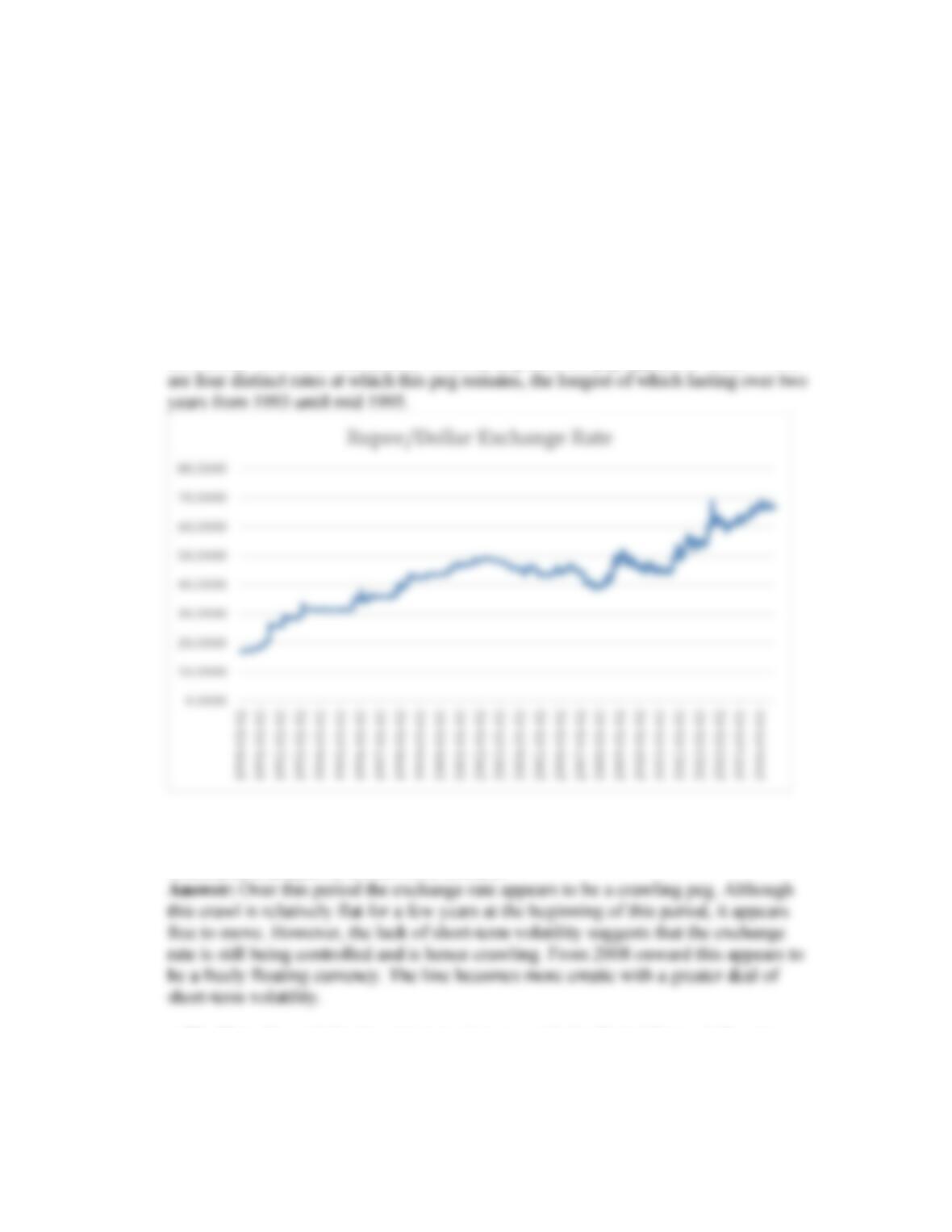
Answer: The rupee appears to be pegged to the U.S. dollar at various rates from 1991
until about 1998 with intermittent volatility at places the peg appears to break. There
b. How would you characterize the relationship between the rupee and the dollar from
1998–2008? Does it appear to be fixed, crawling, or floating during this period? How
would you characterize it from 2008 onward?
c. The Hong Kong dollar has maintained its peg with the United States dollar since
1983. Over the course of the period that you have downloaded what are the highest
and lowest values for this exchange rate?
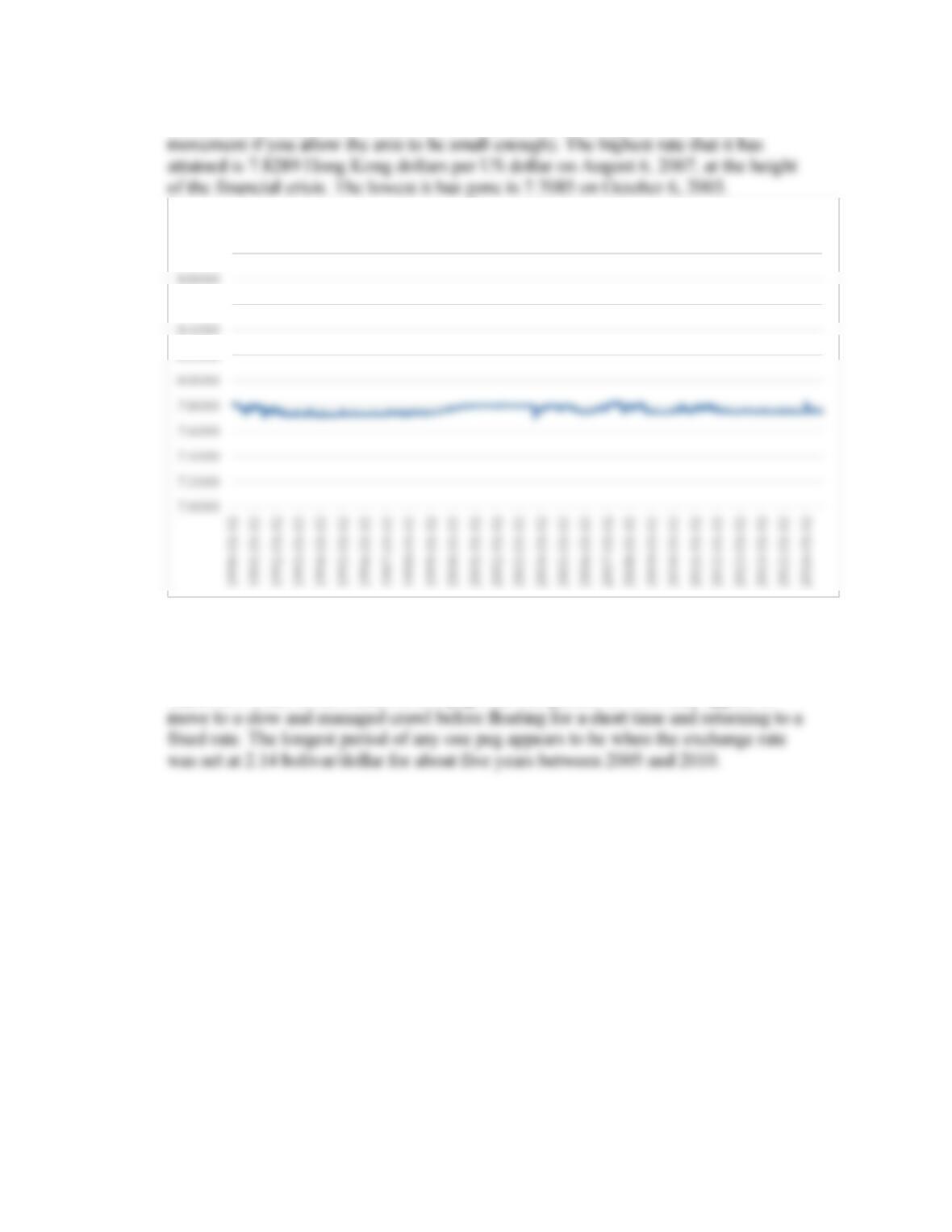
Answer: This peg has never broken over this period (although there is some
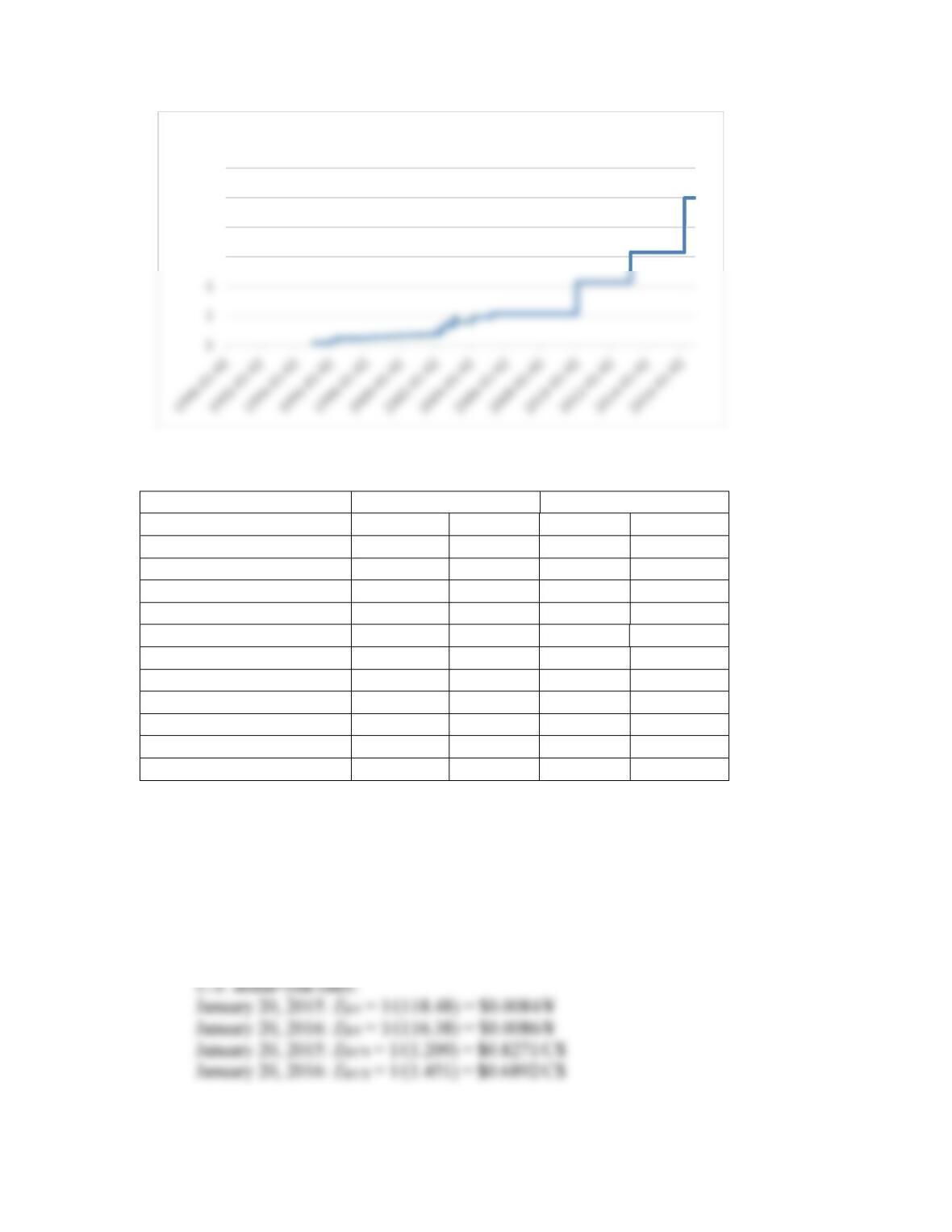
d. Venezuela has been less successful in its attempts to fix against the dollar. Since
1995 how many times has the Venezuelan bolívar peg to the dollar broken? What is
the average length of a peg? What is the average size of a devaluation?
Answer: I count seven breaks in this peg over this period. In 1998 they appear to
8.6000
9.0000
Hong Kong/US Exchange Rate
2. Refer to the exchange rates given in the following table:
January 20, 2016
January 20, 2015
Country (currency)
FX per $
FX per £
FX per €
FX per $
Australia (dollar)
1.459
2.067
1.414
1.223
Canada (dollar)
1.451
2.056
1.398
1.209
Denmark (krone)
6.844
9.694
7.434
6.430
Eurozone (euro)
0.917
1.299
1.000
0.865
Hong Kong (dollar)
7.827
11.086
8.962
7.752
India (rupee)
68.05
96.39
71.60
61.64
Japan (yen)
116.38
164.84
136.97
118.48
Mexico (peso)
18.60
26.346
16.933
14.647
Sweden (krona)
8.583
12.157
9.458
8.181
United Kingdom (pound)
0.706
1.000
0.763
0.600
United States (dollar)
1.000
1.416
1.156
1.000
Data from: U.S. Federal Reserve Board of Governors, H.10 release: Foreign Exchange
Rates.
Based on the table provided, answer the following questions:
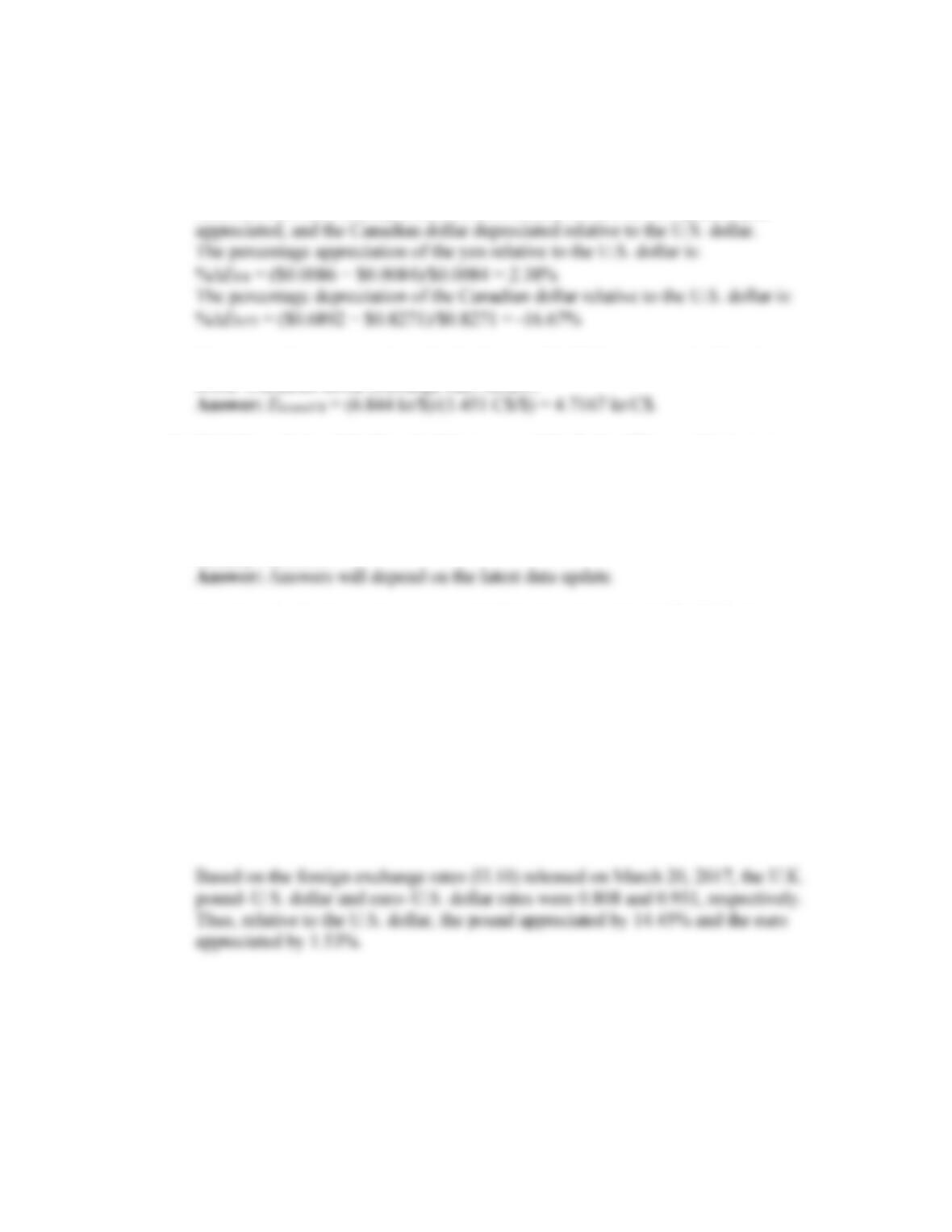
a. Compute the U.S. dollar–yen exchange rate E$/¥ and the U.S. dollar–Canadian
dollar exchange rate E$/C$ on January 20, 2016, and January 20, 2015.
Answer:
6
8
10
12
Venezuela/US Exchange Rate
b. What happened to the value of the U.S. dollar relative to the Japanese yen and
Canadian dollar between January 20, 2015, and January 20, 2016? Compute the
percentage change in the value of the U.S. dollar relative to each currency using
the U.S. dollar–foreign currency exchange rates you computed in (a).
Answer: Between January 20, 2015, and January 20, 2016, the Japanese yen
c. Using the information in the table for January 20, 2016, compute the Danish
krone–Canadian dollar exchange rate Ekrone/C$.
d. Visit the website of the Board of Governors of the Federal Reserve System at
http://www.federalreserve.gov/. Click on “Economic Research and Data” and
then “Data Download Program (DDP)” Download the H.10 release Foreign
Exchange Rates (weekly data available). What has happened to the value of the
U.S. dollar relative to the Canadian dollar, Japanese yen, and Danish krone since
January 20, 2016?
Based on the foreign exchange rates (H.10) released on March 20, 2017, the
exchange rate for the Canadian dollar, yen, and krone was 1.3366, 112.67, and
6.9207, respectively. Thus, while the Canadian dollar–U.S. dollar and the yen–
dollar exchange rates have depreciated by about 7.88% and 3.19%, respectively.
The krone has appreciated by about 1.12%.
e. Using the information from (d), what has happened to the value of the U.S. dollar
relative to the British pound and the euro? Note: The H.10 release quotes these
exchange rates as U.S. dollars per unit of foreign currency in line with long–
standing market conventions.
Answer: Answers will depend on the latest data update.
3. Consider the United States and the countries it trades with the most (measured in
trade volume): Canada, Mexico, China, and Japan. For simplicity, assume these are
the only four countries with which the United States trades. Trade shares (trade
weights) and U.S. nominal exchange rates for these four countries are as follows:
Country (currency)
Share of Trade
$ per FX in 2015
$ per FX in 2016
Canada (dollar)
36%
0.8271
0.6892
Mexico (peso)
28%
0.0683
0.0538
China (yuan)
20%
0.1608
0.1522
Japan (yen)
16%
0.0080
0.0086
a. Compute the percentage change from 2015 to 2016 in the four U.S. bilateral
exchange rates (defined as U.S. dollars per unit of foreign exchange, or FX) in the
table provided.
Answer:
b. Use the trade shares as weights to compute the percentage change in the nominal
effective exchange rate for the United States between 2015 and 2016 (in U.S.
dollars per foreign currency basket).
c. Based on your answer to (b), what happened to the value of the U.S. dollar against
this basket between 2015 and 2016? How does this compare with the change in
the value of the U.S. dollar relative to the Mexican peso? Explain your answer.
4. Go to the FRED website: http://research.stlouisfed.org/fred2/. Locate the monthly
exchange rate data for the following:
Look at the graphs and make your own judgment as to whether each currency was
fixed (peg or band), crawling (peg or band), or floating relative to the U.S. dollar
during each time frame given.
a. Canada (dollar), 1980–2012
b. China (yuan), 1999–2004, 2005–09, and 2009–10
c. Mexico (peso), 1993–95 and 1995–2012
float)
d. Thailand (baht), 1986–97 and 1997–2012
e. Venezuela (bolívar), 2003–12
5. Describe the different ways in which the government may intervene in the forex
market. Why does the government have the ability to intervene in this way, while
private actors do not?
Answer: The government may participate in the forex market in a number of ways:
Work it out. Consider a Dutch investor with 1,000 euros to place in a bank deposit in
either the Netherlands or Great Britain. The (one-year) interest rate on bank deposits
is 1% in Britain and 5% in the Netherlands. The (one-year) forward euro–pound
exchange rate is 1.65 euros per pound and the spot rate is 1.5 euros per pound.
Answer the following questions, using the exact equations for uncovered interest
parity (UIP) and covered interest parity (CIP) as necessary.
a. What is the euro-denominated return on Dutch deposits for this investor?
b. What is the (riskless) euro-denominated return on British deposits for this investor
using forward cover?
c. Is there an arbitrage opportunity here? Explain why or why not. Is this an
equilibrium in the forward exchange rate market?
d. If the spot rate is 1.5 euros per pound, and interest rates are as stated previously,
e. Suppose the forward rate takes the value given by your answer to (d). Compute
the forward premium on the British pound for the Dutch investor (where
exchange rates are in euros per pound). Is it positive or negative? Why do
investors require this premium/discount in equilibrium?
f. If UIP holds, what is the expected depreciation of the euro (against the pound)
over one year?
g. Based on your answer to (f), what is the expected euro–pound exchange rate one
year ahead?
6. Suppose quotes for the dollar–euro exchange rate E$/€ are as follows: in New York
$1.05 per euro, and in Tokyo $1.15 per euro. Describe how investors use arbitrage to
take advantage of the difference in exchange rates. Explain how this process will
affect the dollar price of the euro in New York and Tokyo.
7. You are a financial adviser to a U.S. corporation that expects to receive a payment of
60 million Japanese yen in 180 days for goods exported to Japan. The current spot
rate is 100 yen per U.S. dollar (E$/¥ = 0.01000). You are concerned that the U.S.
dollar is going to appreciate against the yen over the next six months.
a. Assuming the exchange rate remains unchanged, how much does your firm expect
to receive in U.S. dollars?
b. How much would your firm receive (in U.S. dollars) if the dollar appreciated to
110 yen per U.S. dollar (E$/¥ = 0.00909)?
c. Describe how you could use an options contract to hedge against the risk of losses
associated with the potential appreciation in the U.S. dollar.
8. Consider how transactions costs affect foreign currency exchange. Rank each of the
following foreign exchanges according to their probable spread (between the “buy at”
and “sell for” bilateral exchange rates) and justify your ranking.
a. An American returning from a trip to Turkey wants to exchange his Turkish lira
for U.S. dollars at the airport.
b. Citigroup and HSBC, both large commercial banks located in the United States
and United Kingdom, respectively, need to clear several large checks drawn on
accounts held by each bank.
c. Honda Motor Company needs to exchange yen for U.S. dollars to pay American
workers at its Ohio manufacturing plant.
d. A Canadian tourist in Germany pays for her hotel room using a credit card.