Chapter 13
Fiscal Policy
◼ Overview
Fiscal policy as a tool for economic stabilization was first proposed by Keynes, who argued that
government tax and spending policies can have a significant impact on our national economy. How
government can change nominal and real GDP by the use of discretionary fiscal policy is examined.
◼ Learning Objectives
After studying this chapter, students should be able to:
• 13.1 Use traditional Keynesian analysis to evaluate the effects of discretionary fiscal policies
• 13.2 Discuss ways in which indirect crowding out and direct expenditure offsets can reduce the
effectiveness of fiscal policy actions
• 13.3 List and define fiscal policy time lags and explain why they complicate efforts to engage in fiscal
“fine–tuning”
• 13.4 Describe how certain aspects of fiscal policy function as automatic stabilizers for the economy
◼ Outline
I. Discretionary Fiscal Policy: The discretionary changing of government expenditures and/or taxes
in order to achieve national economic goals, such as high employment with price stability. It is a
deliberate attempt to cause the economy to move to full employment and price stability more
quickly than it otherwise might.
A. Changes in Government Spending
1. When There Is a Recessionary Gap: An expansionary fiscal policy, which would cause
2. When There Is an Inflationary Gap: A contractionary fiscal policy, which would cause
Chapter 13 Fiscal Policy 189
B. Changes in Taxes: Holding all other things held constant, a rise in taxes creates a reduction in
AD for one of three reasons: (1) it reduces consumption, (2) it reduces investment, or (3) it
reduces net exports.
II. Possible Offsets to Fiscal Policy: Fiscal policy does not operate in a vacuum, so offsets can occur.
A. Indirect Crowding Out: An increase in government spending without raising taxes creates
additional government borrowing from the private sector or from foreigners.
1. Induced Interest Rate Changes: Deficit spending tends to crowd out private spending,
2. The Firm’s Investment Decision: The rise in interest rates causes monthly loan payments
to go up and discourages some firms from making investments.
3. Graphical Analysis (See Figure 13-4.)
B. Planning for the Future: Ricardian Equivalence: The proposition that an increase in the
government budget deficit has no effect on aggregate demand. (See Figure 13-4.)
1. Current Tax Cuts and Future Debts: The idea is that people’s horizons extend beyond
this year, and they take into account the effects of today’s government policies on the
2. The Ricardian Equivalence Theorem: In the extreme case, there is no long-run effect
on AD.
C. Restrained Consumption Effects of Temporary Tax Changes: The permanent income
D. Direct Expenditure Offsets: Actions on the part of the private sector in spending income
that offset fiscal policy actions. Any increase in government spending that competes with the
private sector will have some offset effect.
1. The Extreme Case: In this case, the offset is dollar for dollar, so we merely end up with a
E. The Supply-Side Effects of Changes in Taxes
1. Altering Marginal Tax Rates: The government will not necessarily lose tax revenues by
2. Supply-side economics: The notion that creating incentives for individuals and firms to
190 Miller • Economics Today, Nineteenth Edition
III. Discretionary Fiscal Policy in Practice: Coping with Time Lags: The political process of fiscal
policy and the various time lags involved in conducting fiscal policy create problems of achieving
the policymakers’ goals.
A. Policy Time Lags: A recognition time lag is the time required to gather information about
the current state of the economy. An action time lag is the time required between recognizing
IV. Automatic Stabilizers: Types of automatic (or nondiscretionary) fiscal policies that do not require
new legislation on the part of Congress are provisions of the tax laws and certain entitlement
programs that cause changes in desired aggregate demand. (See Figure 13-6.)
A. The Tax System as an Automatic Stabilizer: As taxable income rises, marginal tax rates rise.
B. Unemployment Compensation and Income Transfer Payments: As the economy contracts,
C. Stabilizing Impact: The automatic stabilizers mitigate undesirable changes in disposable income,
D. What Do We Really Know about Fiscal Policy?
1. Fiscal Policy during Normal Times: Discretionary fiscal policy probably is not very
effective at these times. Automatic stabilizers are probably the most useful.
2. Fiscal Policy during Abnormal Times: Fiscal policy can be important during these times.
Consider some classic examples: the Great Depression and war periods.
a. The Great Depression: When there is a substantial drop in GDP, such as in the Great
3. The “Soothing” Effect of Keynesian Fiscal Policy: The knowledge by consumers and
investors that the federal government can use fiscal policy to prevent another great depression
may induce more buoyant and stable expectations, thereby smoothing investment decisions.
◼ Points to Emphasize
Fiscal Policy Perspectives
It is often helpful to give students some background into the origins of the idea that an important function
of government is to stabilize the economy. The classical model, discussed in Chapter 11, argued that the
Chapter 13 Fiscal Policy 191
Automatic Stabilizers
Automatic stabilizers stabilize planned spending by increasing government transfer payments and
reducing tax receipts during recessions and decreasing government transfer payments and increasing tax
◼ For Those Who Wish to Stress Theory
Crowding Out
The crowding-out effect due to the interest rate effect is more likely to be significant in the case of a
structural deficit rather than a deficit due to a recession. During a recession, the demand for money will
decrease as the level of economic activity declines. The increase in government borrowing to finance
192 Miller • Economics Today, Nineteenth Edition
Limitations of Fiscal Policy
Government expenditures made on goods or services that consumers would have purchased anyway will
not cause any net change in total planned expenditures. Similarly, if the government makes investment in
such areas as parks, mail service, and education that compete with the private sector, autonomous net
Fiscal Policy: Long Run versus the Short Run
In the AS–AD model of fiscal policy presented in the chapter, there are significantly different effects of
fiscal policy in the short run as compared to the long run insofar as the level of real GDP and employment
are concerned. In the long run, the only effect of fiscal policy (or any other change in AD) is a change in
the price level, other things being equal. Regardless of whether AD is increased or decreased, real GDP
◼ Paul Samuelson—1915–2009—Economist
Paul Samuelson was the first American to win the Nobel Prize in economics; he was awarded the prize
in 1970 for his extensive work in applying mathematics to questions of static and dynamic equilibrium
Chapter 13 Fiscal Policy 193
◼ Further Questions for Class Discussion
1. If time lags associated with the use of fiscal policy are significant, should discretionary fiscal policy
be used to counter recessions? Although this is a normative question, it is possible to examine the
2. Suppose the government wished to combat a deflationary gap by the use of fiscal policy. In which
case would planned expenditures increase by more and why? (a) Tax decreases lower taxes by
3. What effect would tax increases on business profits have on aggregate demand? Firms look at
4. During the period 2007–2009, the U.S. deficit increased dramatically, largely as a result of tax cuts
and large-scale federal expansionary spending policy. Yet, interest rates did not increase. How
might the fact that the worst recession since the Great Depression was going on help explain why
massive bond sales by the U.S. government did not result in crowding out? In a major recession,
5. The federal government enacted a prescription drug benefit for Medicare recipients during the first
term of the second Bush administration. Would you predict that total spending on prescription drugs
would increase by the amount of increased spending by Medicare? It would be unlikely that total
6. In the 2010 off-year election, Republican candidates for Congress promised to lower taxes and
lower government spending, while the Democratic candidates promised to repeal some of the Bush
tax cuts, that is, raise taxes, and increase government spending. Both parties’ candidates argued that
their planned fiscal policy would stimulate the economy. Which party, if either, was right? Assume
that each of the parties’ tax and spending changes would be roughly equal in the size of their
◼ Answers to Questions for Critical Analysis
Higher Government Research and Development Generates Offsetting
Spending Cuts (p. 288)
If a government agency decided to fund construction of a private hospital in an area in which other
private hospitals already are just breaking even why might one of the other private hospitals cancel
plans to expend the size of its facility?
If the existing private hospitals are just breaking even, the prospect of making losses among hospitals in
Bounded Rationality and Variations in the Effects of Fiscal Policy on Real
GDP? (p. 291)
Based on Schwinn’s conclusions, is the government likely to be able to boost real GDP with an
increase in government spending if it has raised and lowered its expenditures a number of times in
previous months? Explain your reasoning.
◼ You Are There
Why Are Several States Cutting the Duration of Unemployment Compensation?
(pp. 292–293)
1. How does unemployment compensation function as an automatic stabilizer?
2. Why do you suppose that many economists perceive a trade-off between short-term
stabilization benefits of unemployment compensation and a contribution to a higher
unemployment rate in the long run?
◼ Issues and Applications
Which Governments Conduct Fiscal Stabilization Most Effectively?
(pp. 293–294)
1. Other things being equal, what features of a nation’s economy do you think would tend to
contribute to a higher value for its stabilization coefficient? (Hint: Consider the chapter’s
discussion of the reasons fiscal policy actions tend to have larger effects on real GDP.)
2. Why do you suppose that some economist have argued that a key determinant of a nation’s
stabilization coefficient value is whether its government relies to a greater extent on
automatic fiscal stabilizers instead of discretionary policy actions?
◼ Research Project
1. To learn more about the stabilization coefficient, see the Web Links in MyEconLab.
2. To read about whether values of stabilization coefficients might be related to nations’ economic
growth rates, see the Web Links in MyEconLab.
Appendix D—Fiscal Policy: A Keynesian Perspective
The Keynesian approach to fiscal policy emphasizes the underpinnings of the components of aggregate
demand; it assumes that government expenditures are not substitutes for private expenditures and that
current taxes are the only taxes taken into account by consumers and firms; and it focuses on the short
run, so the price level is constant.
III. The Balanced-Budget Multiplier: The balanced-budget multiplier is equal to 1 because an
196 Miller • Economics Today, Nineteenth Edition
◼ Answers to Problems
13-1. Suppose that Congress and the president decide that the nation’s economic performance is
weakening and that the government should “do something” about the situation. They make
no tax changes but do enact new laws increasing government spending on a variety of
programs.
a. Prior to the congressional and presidential action, careful studies by government economists
indicated that the Keynesian multiplier effect of a rise in government expenditures on
equilibrium real GDP per year is equal to 3. In the 12 months since the increase in
government spending, however, it has become clear that the actual ultimate effect on real
GDP will be less than half of that amount. What factors might account for this?
b. Another year and a half elapses following passage of the government spending boost.
The government has undertaken no additional policy actions, nor have there been any
other events of significance. Nevertheless, by the end of the second year, real GDP has
returned to its original level, and the price level has increased sharply. Provide a
possible explanation for this outcome.
a. A key factor that could help explain why the actual effect may have turned out to be lower
is the crowding-out effect. Also, some government spending may have entailed direct
13-2. Suppose that Congress enacts a significant tax cut with the expectation that this action will
stimulate aggregate demand and push up real GDP in the short run. In fact, however,
neither real GDP nor the price level changes significantly as a result of the tax cut. What
might account for this outcome?
13-3. Explain how time lags in discretionary fiscal policymaking could thwart the efforts of
Congress and the president to stabilize real GDP in the face of an economic downturn.
Is it possible that these time lags could actually cause discretionary fiscal policy to
destabilize real GDP?
13-4. Determine whether each of the following is an example of a situation in which a direct
expenditure offset to fiscal policy occurs.
a. In an effort to help rejuvenate the nation’s railroad system, a new government agency
buys unused track, locomotives, and passenger and freight cars, many of which private
companies would otherwise have purchased and put into regular use.
b. The government increases its expenditures without raising taxes. To cover the resulting
budget deficit, it borrows more funds from the private sector, thereby pushing up the
market interest rate and discouraging private planned investment spending.
c. The government finances the construction of a classical music museum that otherwise
would never have received private funding.
13-5. Determine whether each of the following is an example of a situation in which there is
indirect crowding out resulting from an expansionary fiscal policy action.
a. The government provides a subsidy to help keep an existing firm operating, even though
a group of investors otherwise would have provided a cash infusion that would have
kept the company in business.
b. The government reduces its taxes without decreasing its expenditures. To cover the
resulting budget deficit, it borrows more funds from the private sector, thereby pushing
up the market interest rate and discouraging private planned investment spending.
c. Government expenditures fund construction of a high-rise office building on a plot of
land where a private company otherwise would have constructed an essentially identical
building.
13-6. The U.S. government is in the midst of spending more than $1 billion on seven buildings
containing more than 100,000 square feet of space to be used for study of infectious diseases.
Prior to the government’s decision to construct these buildings, a few universities had been
planning to build essentially the same facilities using privately obtained funds. After
198 Miller • Economics Today, Nineteenth Edition
construction on the government buildings began, however, the universities dropped their
plans. Evaluate whether the government’s $1 billion expenditure is actually likely to push
U.S. real GDP above the level it would have reached in the absence of the government’s
construction spree.
13-7. Determine whether each of the following is an example of a discretionary fiscal policy
action.
a. A recession occurs, and government-funded unemployment compensation is paid to
laid-off workers.
b. Congress votes to fund a new jobs program designed to put unemployed workers to
work.
c. The Federal Reserve decides to reduce the quantity of money in circulation in an effort
to slow inflation.
d. Under powers authorized by an act of Congress, the president decides to authorize
an emergency release of funds for spending programs intended to head off economic
crises.
13-8. Determine whether each of the following is an example of an automatic fiscal stabilizer.
a. A federal agency must extend loans to businesses whenever an economic downturn
begins.
b. As the economy heats up, the resulting increase in equilibrium real GDP per year
immediately results in higher income tax payments, which dampen consumption
spending somewhat.
c. As the economy starts to recover from a severe recession and more people go back to
work, government-funded unemployment compensation payments begin to decline.
d. To stem an overheated economy, the president, using special powers granted by
Congress, authorizes emergency impoundment of funds that Congress had previously
authorized for spending on government programs.
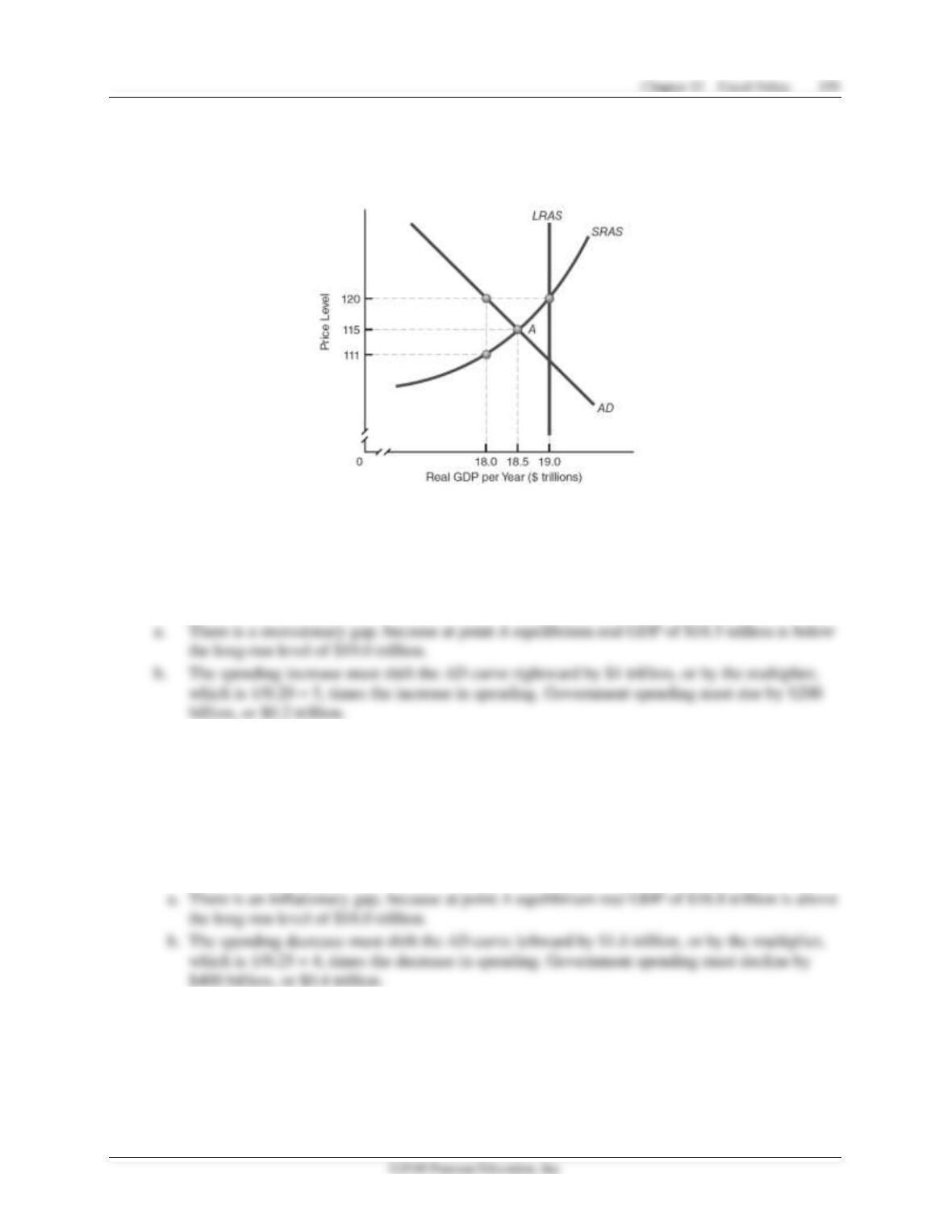
13-9. Consider the diagram below, in which the current short-run equilibrium is at point A, and
answer the questions that follow.
a. What type of gap exists at point A?
b. If the marginal propensity to save equals 0.20, what change in government spending
financed by borrowing from the private sector could eliminate the gap identified in
part (a)? Explain.
13-10. Consider the accompanying diagram, in which the current short-run equilibrium is at point
A, and answer the questions that follow.
a. What type of gap exists at point A?
b. If the marginal propensity to consume equals 0.75, what change in government
spending financed by borrowing from the private sector could eliminate the gap
identified in part (a)? Explain.
13-11. Currently, a government’s budget is balanced. The marginal propensity to consume is 0.80.
The government has determined that each additional $10 billion it borrows to finance a
budget deficit pushes up the market interest rate by 0.1 percentage point. It has also
determined that every 0.1-percentage-point change in the market interest rate generates a
change in planned investment expenditures equal to $2 billion. Finally, the government
200 Miller • Economics Today, Nineteenth Edition
knows that to close a recessionary gap and take into account the resulting change in the
price level, it must generate a net rightward shift in the aggregate demand curve equal to
$200 billion. Assuming that there are no direct expenditure offsets to fiscal policy, how
much should the government increase its expenditures? (Hint: How much private
investment spending will each $10 billion increase in government spending crowd out?)
Because the MPC is 0.80, the multiplier equals 1/(1 − MPC) = 1/0.2 = 5. Recall that the aggregate
13-12. A government is currently operating with an annual budget deficit of $40 billion. The
government has determined that every $10 billion reduction in the amount it borrows each
year would reduce the market interest rate by 0.1 percentage point. Furthermore, it has
determined that every 0.1-percentage-point change in the market interest rate generates a
change in planned investment expenditures in the opposite direction equal to $5 billion. The
marginal propensity to consume is 0.75. Finally, the government knows that to eliminate an
inflationary gap and take into account the resulting change in the price level, it must
generate a net leftward shift in the aggregate demand curve equal to $40 billion. Assuming
that there are no direct expenditure offsets to fiscal policy, how much should the
government increase taxes? (Hint: How much new private investment spending is induced
by each $10 billion decrease in government spending?)
13-13. Assume that the Ricardian equivalence theorem is not relevant. Explain why an income-tax-
rate cut should affect short-run equilibrium real GDP.
13-14. Suppose that Congress enacts a lump-sum tax cut of $750 billion. The marginal propensity
to consume is equal to 0.75. Assuming that Ricardian equivalence holds true, what is the
effect on equilibrium real GDP? On saving?
13-15. In May and June of 2008, the federal government issued one-time tax rebates—checks
returning a small portion of taxes previously paid—to millions of U.S residents, and
U.S. real disposable income temporarily jumped by nearly $500 billion. Household real
consumption spending did not increase in response to the short-lived increase in real
disposable income. Explain how the logic of the permanent income hypothesis might help
to account for this apparent non-relationship between real consumption and real disposable
income in the late spring of 2008.
13-16. It is late 2019, and the U.S. economy is showing signs of slipping into a potentially deep
recession. Government policymakers are searching for income-tax-policy changes that will
bring about a significant and lasting boost to real consumption spending. According to the
logic of the permanent income hypothesis, should the proposed income-tax-policy changes
involve tax increases or tax reductions, and should the policy changes be short-lived or
long-lasting?
13-17. Recall that the Keynesian spending multiplier equals 1/ (1 – MPC). Suppose that in panel
(a) of Figure 13-1, the government determined that the amount by which the AD curve had
to be shifted directly rightward from point E 1 was equal to $1.0 trillion. If the government
decided that a $0.2 trillion increase in real government spending was required to generate
this shift, what must be the value of the MPC?
13-18. Recall that the Keynesian spending multiplier equals 1/ (1 – MPC). Suppose that in panel
(b) of Figure 13-1, the government knows that the MPC is equal to 0.75 and that the amount
of the horizontal distance that the AD curve had to be shifted directly leftward from point
E1 was equal to $1.0 trillion. What is the reduction in real government spending required to
have generated this shift?
13-19. Recall that the Keynesian spending multiplier equals 1/ (1 – MPC). Suppose that in Figure
13-4, the MPC is equal to 0.9. In addition, the amount of the horizontal leftward shift from
AD2 to AD3 caused by a crowding-out effect on planned investment spending was $0.5
trillion, or $500 billion. How much investment spending was crowded out?
13-20. Every 1-percentage-point increase in the marginal income tax rate induces some workers to
supply less labor, which cuts real GDP by $0.2 trillion. At the same time, each 1-percentage-
point increase in the marginal income tax rate causes spendable income to drop, which
induces some workers to supply labor that yields $0.1 trillion more in real GDP. Is the net
outcome consistent with the supply-side view? Why?
13-21. A government has found that 2 months elapse before it can identify a problem to address
with a policy action. It has found that 1 month is required to determine the appropriate
policy action. Finally, it has concluded that the total time required between the initial
presence of the problem and the effects of a policy action to be realized is 12 months. What
is the remaining policy time lag and its duration?
13-22. In Figure 13-6, explain why a budget deficit naturally tends to arise at a real GDP level such
as Y2 to the left of Yf?
Appendix D
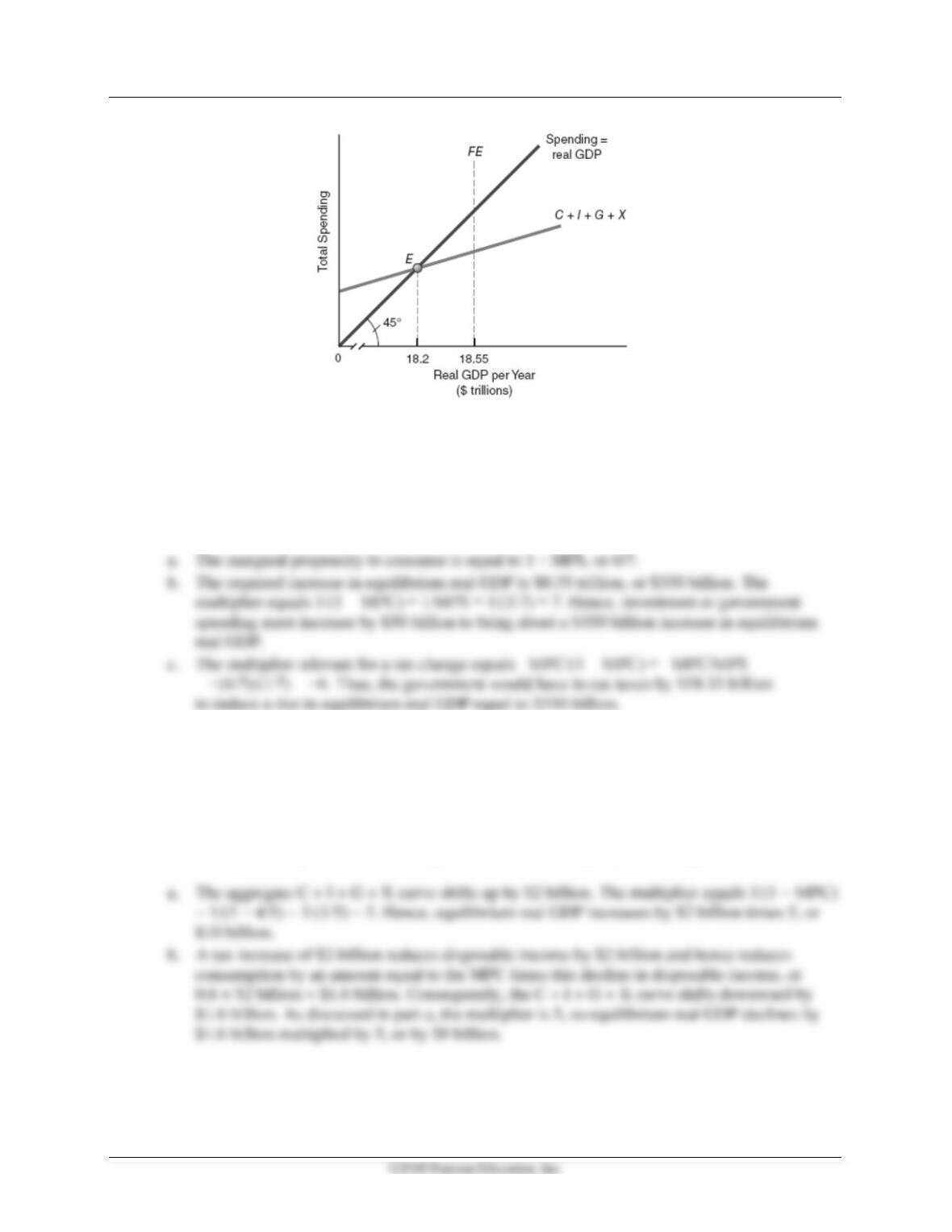
D-1. Assume that equilibrium real GDP is $18.2 trillion and full-employment equilibrium (FE) is
$18.55 trillion. The marginal propensity to save is 1/7. Answer the questions using the data
in the following graph.
Chapter 13 Fiscal Policy 203
a. What is the marginal propensity to consume?
b. By how much must new investment or government spending increase to bring the
economy up to full employment?
c. By how much must government cut personal taxes to stimulate the economy to the full–
employment equilibrium?
D-2. Assume that MPC = 4/5 when answering the following questions.
a. If government expenditures rise by $2 billion, by how much will the aggregate
expenditure curve shift upward? By how much will equilibrium real GDP per year
change?
b. If taxes increase by $2 billion, by how much will the aggregate expenditure curve shift
downward? By how much will equilibrium real GDP per year change?
204 Miller • Economics Today, Nineteenth Edition
D-3. Assume that MPC = 4/5 when answering the following questions.
a. If government expenditures rise by $1 billion, by how much will the aggregate
expenditure curve shift upward?
b. If taxes rise by $1 billion, by how much will the aggregate expenditure curve shift
downward?
c. If both taxes and government expenditures rise by $1 billion, by how much will the
aggregate expenditure curve shift? What will happen to the equilibrium level of real
GDP?
d. How does your response to the second question in part (c) change if MPC = 3/4? If
MPC = 1/2?
◼ Selected References
Barro, Robert J., Macroeconomics, 3rd ed., New York: John Wiley and Sons, 1990.
Buchanan, James and R.E. Wagner, Democracy in Deficit, New York: Academic Press, 1977.
Hanse, Alvin H. Hansen, A Guide to Keynes, New York: McGraw-Hill, 1953.
Klein, Lawrence R., The Keynesian Revolution, 2nd ed., New York: Macmillan, 1966.