382
Integrated Case
Chapter 13: Capital Structure and Leverage
A. (1) What is business risk? What factors influence a firm’s business
risk?
Answer: [Show S13-1 through S13-4 here.] Business risk is the riskiness
inherent in the firm’s operations if it uses no debt. A firm’s
business risk is affected by many factors, including these: (1)
A. (2) What is operating leverage, and how does it affect a firm’s
business risk?
Answer: [Show S13-5 through S13-7 here.] Operating leverage is the
extent to which fixed costs are used in a firm’s operations. If a
A. (3) What is the firm’s return on invested capital (ROIC)?
Answer: [Show S13-8 here.]
ROIC =
capital invested Total
)T 1(EBIT −

Chapter 13: Capital Structure and Leverage
Integrated Case
383
B. (1) What do the terms financial leverage and financial risk mean?
Answer: [Show S13-9 here.] Financial leverage refers to the firm’s decision
to finance with fixed-income securities, such as debt and preferred
B. (2) How does financial risk differ from business risk?
Answer: [Show S13-10 here.] As we discussed above, business risk
depends on a number of factors such as sales and cost variability
C. To develop an example that can be presented to CD’s management
as an illustration, consider two small hypothetical firms: Firm U
with zero debt financing and Firm L with $10,000 of 12% debt.
Both firms have $20,000 in invested capital and a 25% federal-
plus-state tax rate, and they have the following EBIT probability
distribution for next year:
Probability EBIT
0.50 3,000
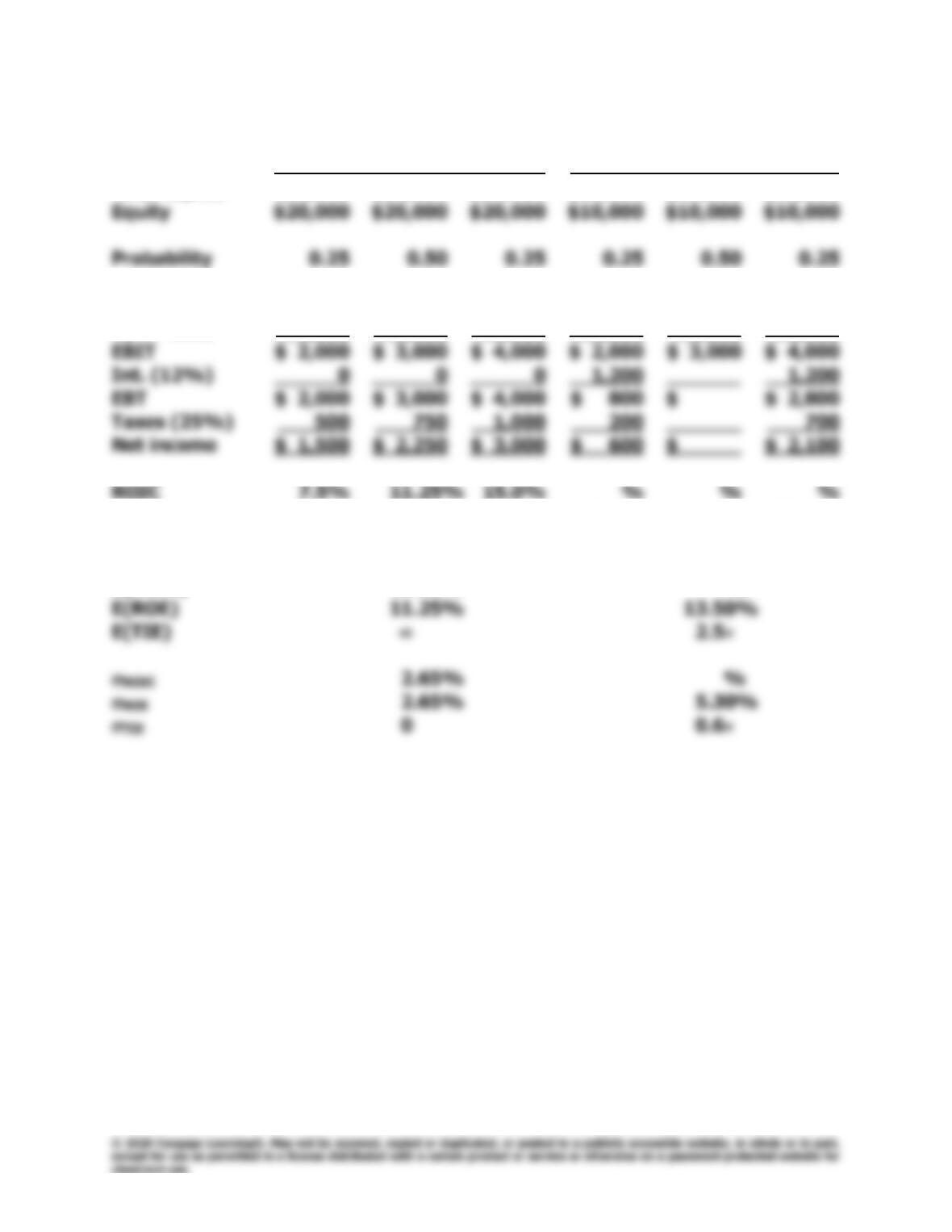
(1) Complete the partial income statements and the firms’ ratios in
Table IC 13.1.
384
Integrated Case
Chapter 13: Capital Structure and Leverage
Table IC 13.1. Income Statements and Ratios
Firm U Firm L
Total capital $20,000 $20,000 $20,000 $20,000 $20,000 $20,000
Sales $ 6,000 $ 9,000 $12,000 $ 6,000 $ 9,000 $12,000
Oper. costs 4,000 6,000 8,000 4,000 6,000 8,000
ROE 7.5% 11.25% 15.0% 6.0% % 21.0%
TIE 1.7 3.3
E(ROIC) 11.25% %
Chapter 13: Capital Structure and Leverage
Integrated Case
385
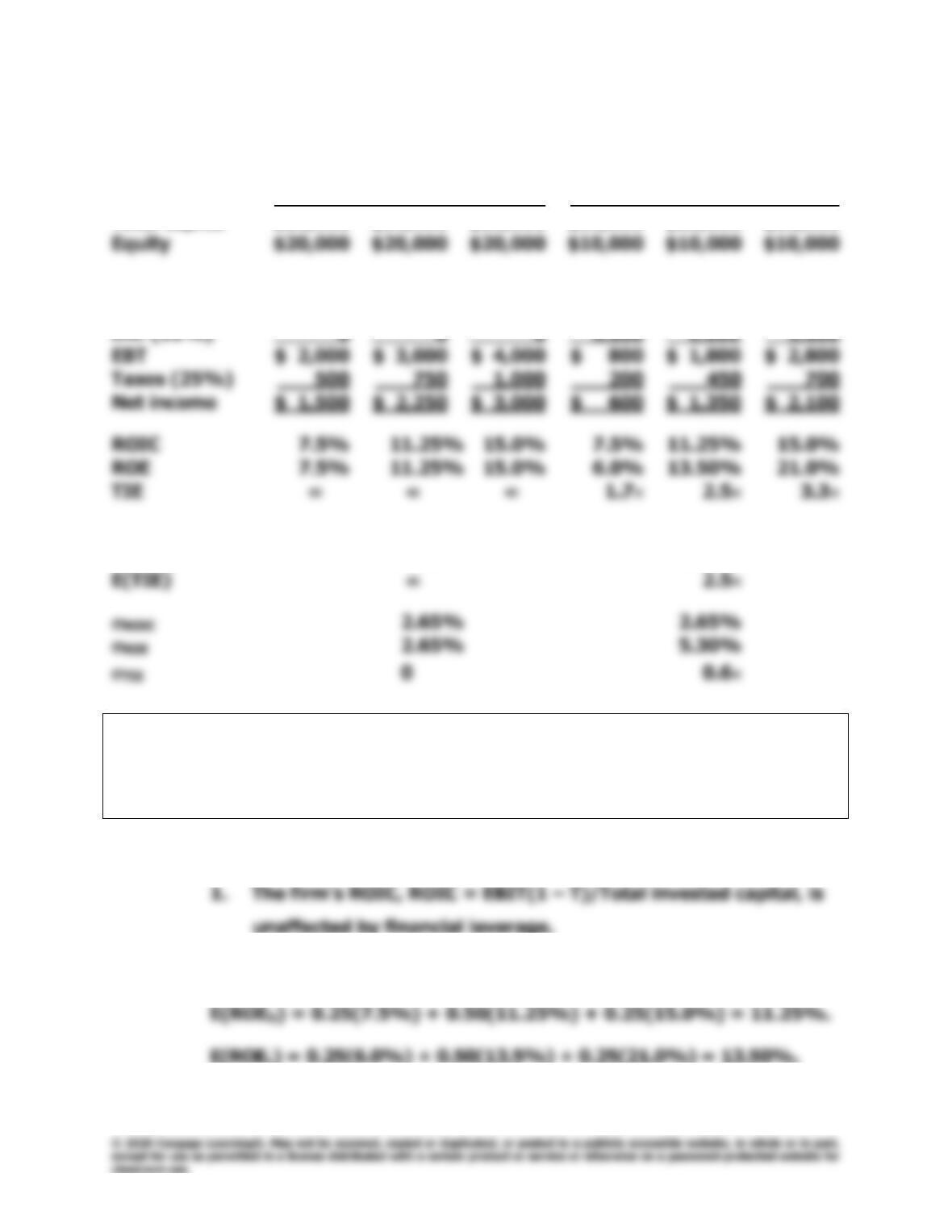
Answer: [Show S13-11 through S13-15 here.] Here are the fully completed
statements:
Firm U Firm L
Total capital $20,000 $20,000 $20,000 $20,000 $20,000 $20,000
Probability 0.25 0.50 0.25 0.25 0.50 0.25
EBIT $ 2,000 $ 3,000 $ 4,000 $ 2,000 $ 3,000 $ 4,000
E(ROIC) 11.25% 11.25%
E(ROE) 11.25% 13.50%
C. (2) Be prepared to discuss each entry in the table and to explain how
this example illustrates the effect of financial leverage on expected
rate of return and risk.
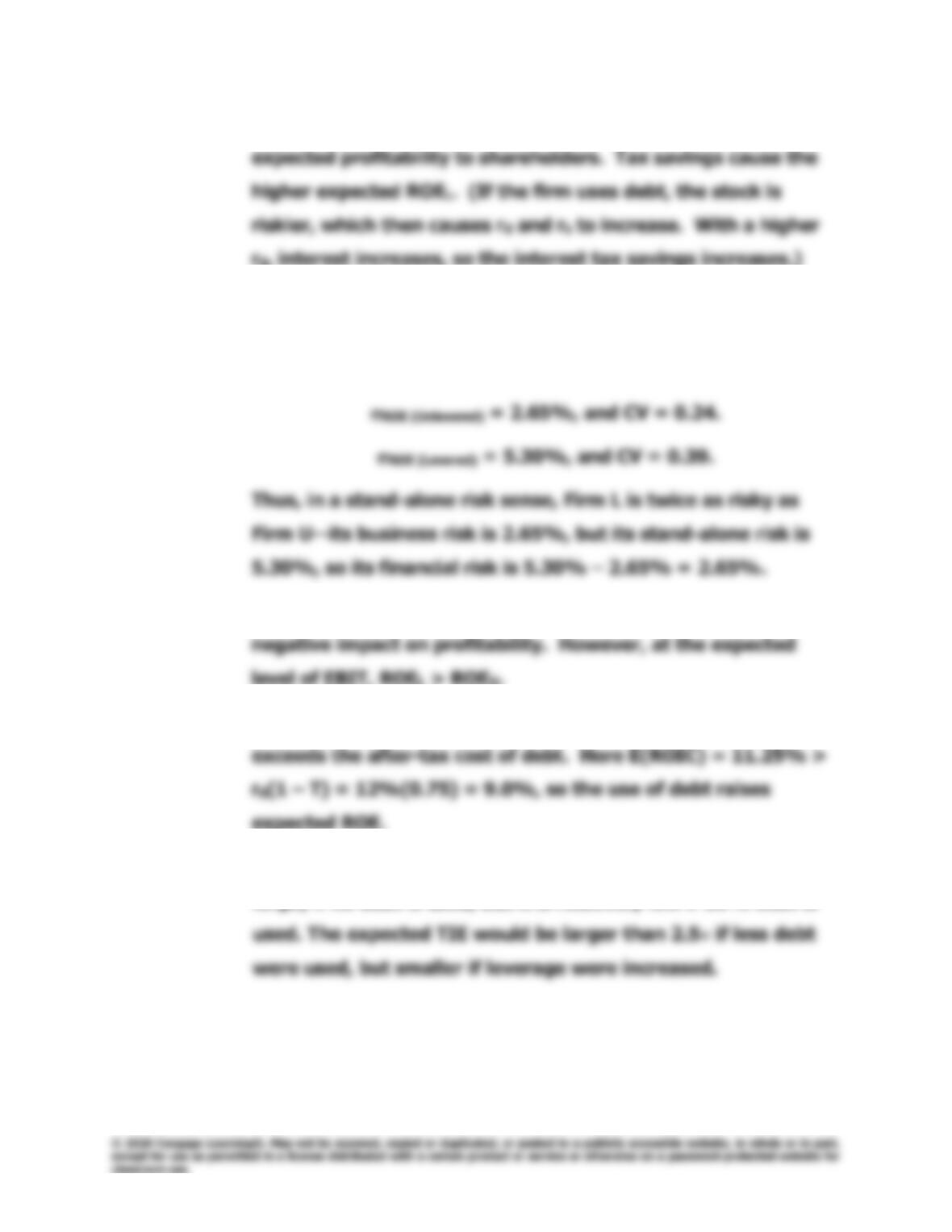
Answer: [Show S13–16 and S13-17 here.] Conclusions from the analysis:
2. Firm L has the higher expected ROE:
386
Integrated Case
Chapter 13: Capital Structure and Leverage
Therefore, the use of financial leverage has increased the
3. Firm L has a wider range of ROEs, and a higher standard
deviation of ROE, indicating that its higher expected return is
accompanied by higher risk. To be precise:
4. When EBIT = $2,000, ROEU > ROEL, and leverage has a
5. Leverage will always boost expected ROE if expected ROIC
6. Finally, note that the TIE ratio is huge (undefined, or infinitely
large) if no debt is used, but it is relatively low if 50% debt is

Chapter 13: Capital Structure and Leverage
Integrated Case
387
D. After speaking with a local investment banker, you obtain the
following estimates of the cost of debt at different debt levels (in
thousands of dollars):
Amount Debt/Capital Debt/Equity Bond
Borrowed Ratio Ratio Rating rd
$ 0 0.000 0.0000 — —
250 0.125 0.1429 AA 8.0%
500 0.250 0.3333 A 9.0
750 0.375 0.6000 BBB 11.5
1,000 0.500 1.0000 BB 14.0
Now consider the optimal capital structure for CD.
(1) To begin, define the terms optimal capital structure and target
capital structure.
Answer: [Show S13-18 here.] The optimal capital structure is the capital
structure at which the tax-related benefits of leverage are exactly
offset by debt’s risk–related costs. At the optimal capital structure,
D. (2) Why does CD’s bond rating and cost of debt depend on the amount
of money borrowed?
Answer: [Show S13-19 here.] Financial risk is the additional risk placed on the
common stockholders as a result of the decision to finance with debt.

388
Integrated Case
Chapter 13: Capital Structure and Leverage
D. (3) Assume that shares could be repurchased at the current market price
of $25 per share. Calculate CD’s expected EPS and TIE at debt levels
of $0, $250,000, $500,000, $750,000, and $1,000,000. How many
shares would remain after recapitalization under each scenario?
Answer: [Show S13–20 through S13-26 here.] The analysis for the debt
levels being considered (in thousands of dollars and shares) is
shown below:
At D = $0:
EPS =
goutstandin Shares
)T1)](D(rEBIT[ d−−
= [$400,000(0.75)]/80,000 = $3.75.

Chapter 13: Capital Structure and Leverage
Integrated Case
389
At D = $500,000:
Shares repurchased = $500,000/$25 = 20,000.
At D = $750,000:
Shares repurchased = $750,000/$25 = 30,000.
At D = $1,000,000:
Shares repurchased = $1,000,000/$25 = 40,000.
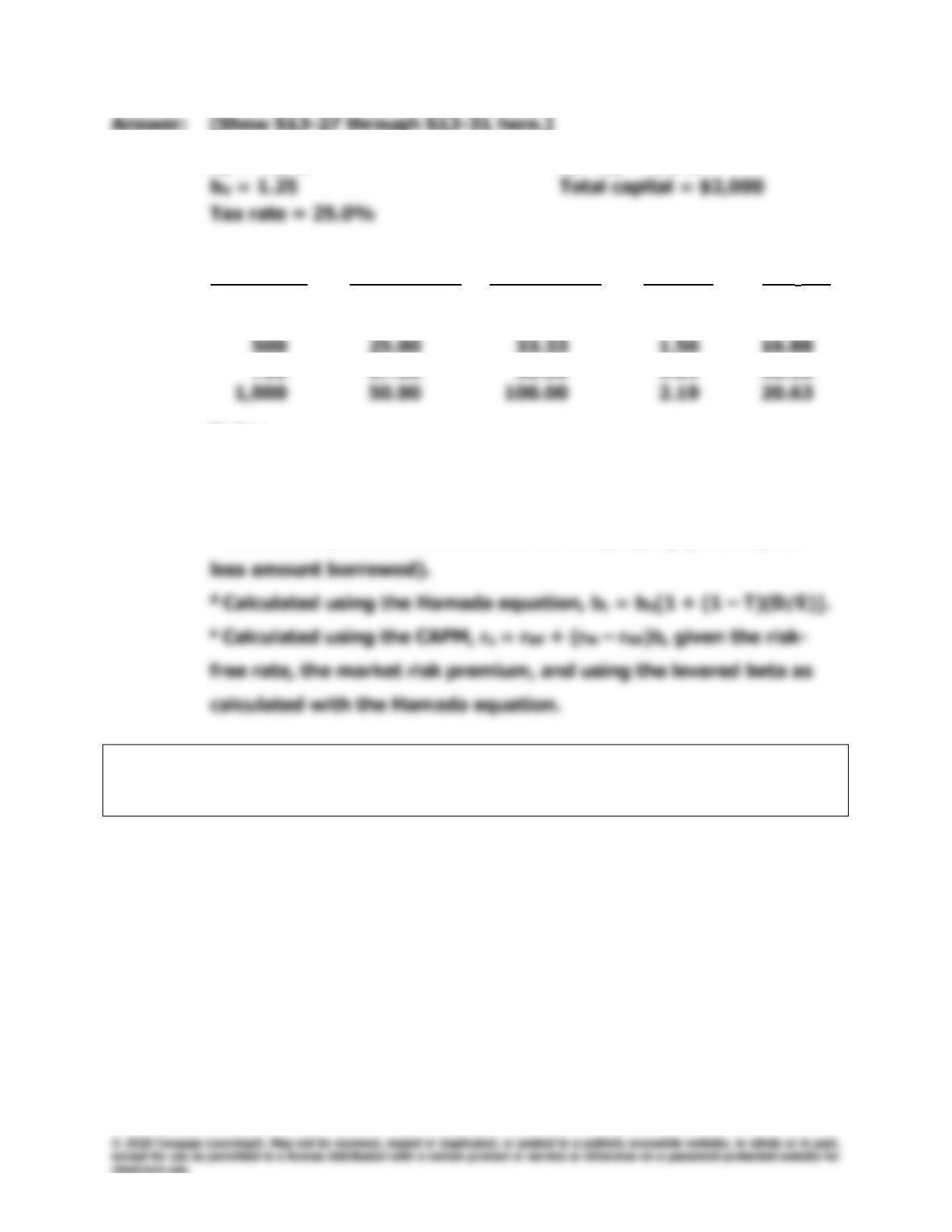
D. (4) Using the Hamada equation, what is the cost of equity if CD
recapitalizes with $250,000 of debt? $500,000? $750,000?
$1,000,000?
390
Integrated Case
Chapter 13: Capital Structure and Leverage
rRF = 7.5% rM – rRF = 6.0%
Amount Debt/Capital Debt/Equity Levered
Borroweda Ratiob Ratioc Betad rse
$ 0 0.00% 0.00% 1.25 15.00%
250 12.50 14.29 1.38 15.80
Notes:
a Data given in problem.
b Calculated as amount borrowed divided by total capital.
c Calculated as amount borrowed divided by equity (total capital
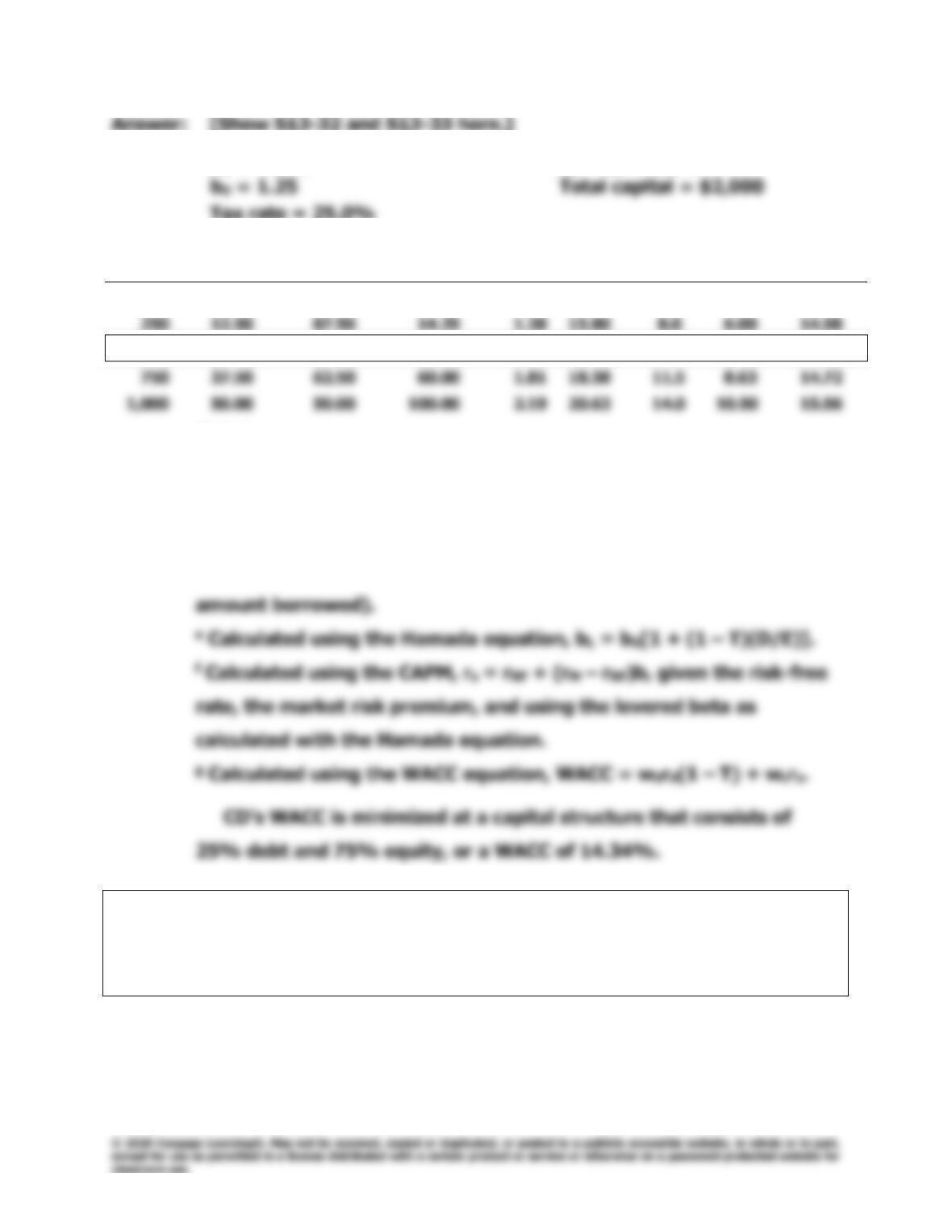
D. (5) Considering only the levels of debt discussed, what is the capital
structure that minimizes CD’s WACC?
Chapter 13: Capital Structure and Leverage
Integrated Case
391
rRF = 7.5% rM – rRF = 6.0%
Tax rate = 25.0%
Amount
Borroweda
Debt/Capital
Ratiob
Equity/Capital
Ratioc
Debt/Equity
Ratiod
Levered
Betae
rsf
rda
rd(1 – T)
WACCg
$ 0
0.00%
100.00%
0.00%
1.25
15.00%
0.0%
0.00%
15.00%
250
87.50
14.29
1.38
15.80
8.0
6.00
14.58
500
25.00
75.00
33.33
1.56
16.88
9.0
6.75
14.34
750
62.50
60.00
1.81
18.38
8.63
14.72
50.00
2.19
15.56
Notes:
a Data given in problem.
b Calculated as amount borrowed divided by total capital.
c Calculated as 1 – D/(D + E).
d Calculated as amount borrowed divided by equity (total capital less
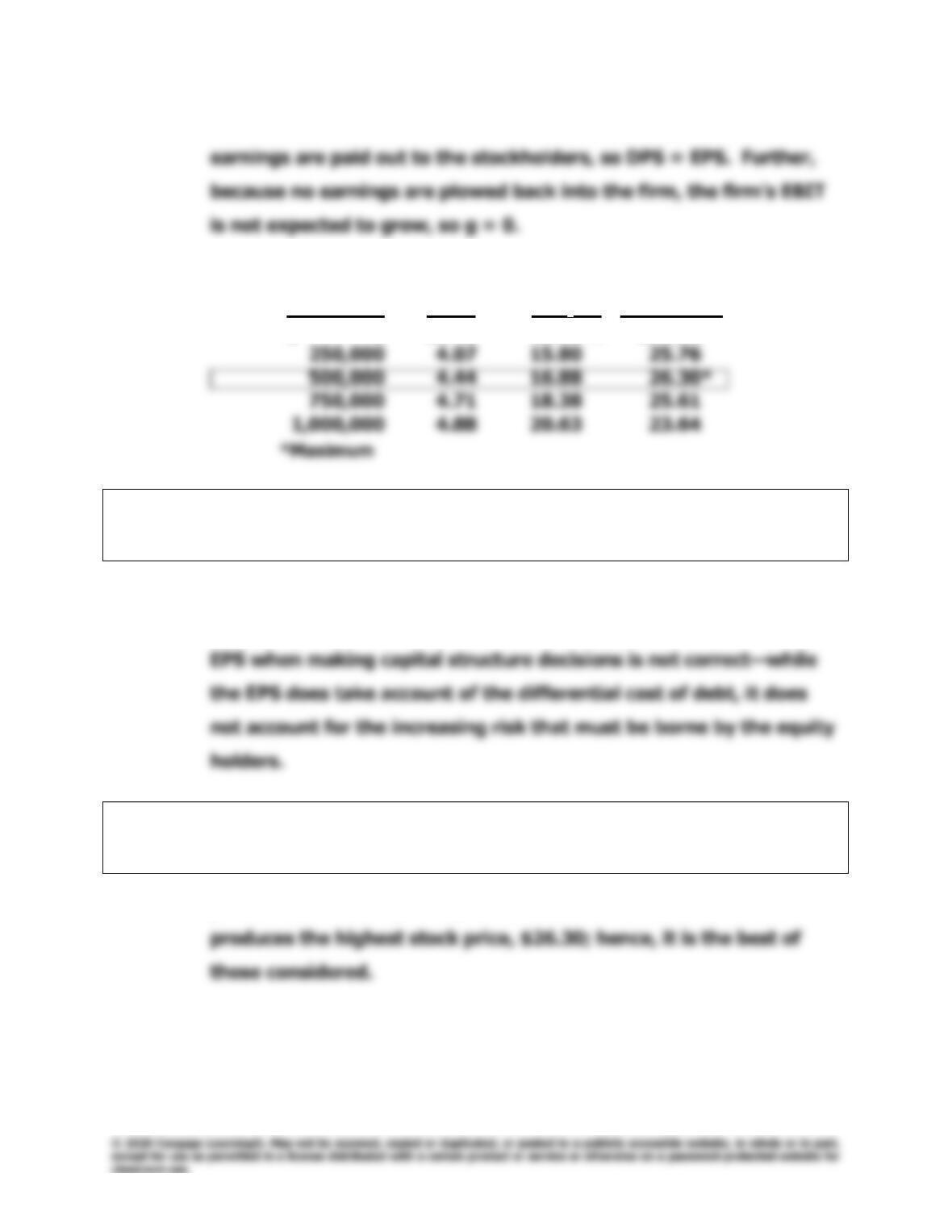
D. (6) What would be the new stock price if CD recapitalizes with
$250,000 of debt? $500,000? $750,000? $1,000,000? Recall that
the payout ratio is 100%, so g = 0.
Answer: [Show S13-34 and 13-35 here.] We can calculate the price of a
constant growth stock as DPS divided by rs minus g, where g is the
392
Integrated Case
Chapter 13: Capital Structure and Leverage
expected growth rate in dividends: P0 = D1/(rs – g). In this case all
Here are the results:
Debt Level DPS rs Stock Price
$ 0 $3.75 15.00% $25.00
D. (7) Is EPS maximized at the debt level that maximizes share price?
Why or why not?
Answer: [Show S13-36 here.] We have seen that EPS continues to increase
beyond the $500,000 optimal level of debt. Therefore, focusing on
D. (8) Considering only the levels of debt discussed, what is CD’s optimal
capital structure?
Answer: [Show S13-37 here.] A capital structure with $500,000 of debt
Chapter 13: Capital Structure and Leverage
Integrated Case
393
D. (9) What is the WACC at the optimal capital structure?
Answer: Initial debt level:
Debt/Total capital = 0%, so Total capital = Initial equity = $25
80,000 shares = $2,000,000.
E. Suppose you discovered that CD had more business risk than you
originally estimated. Describe how this would affect the analysis.
How would the analysis be affected if the firm had less business
risk than originally estimated?
Answer: [Show S13–38 here.] If the firm had higher business risk, then, at any
debt level, its probability of financial distress would be higher. Investors
F. What are some factors a manager should consider when
establishing his or her firm’s target capital structure?

394
Integrated Case
Chapter 13: Capital Structure and Leverage
Answer: [Show S13-39 here.] Since it is difficult to quantify the capital
structure decision, managers consider the following judgmental
factors when making capital structure decisions:
2. Pro forma TIE ratios at different capital structures under
different scenarios.
4. Reserve borrowing capacity.
6. Asset structure.
8. Management attitudes.
10. Firm’s internal conditions.
12. Firm’s growth rate.
Chapter 13: Capital Structure and Leverage
Integrated Case
395
Optional Question
Modigliani and Miller proved, under a very restrictive set of assumptions, that
the value of a firm will be maximized by financing almost entirely with debt.
Why, according to MM, is debt beneficial?
Answer: MM argued that using debt increases the value of the firm because
interest is tax deductible. The government, in effect, pays part of the
interest, and this lowers the cost of debt relative to the cost of
396
Integrated Case
Chapter 13: Capital Structure and Leverage
Optional Question
What assumptions underlie the MM theory? Are these assumptions realistic?
Answer: MM’s key assumptions are as follows:
2. There are no taxes.
4. Investors have the same information as managers about the
firm’s future investment opportunities.
6. EBIT is not affected by the use of debt.
These assumptions are obviously unrealistic—investors do incur
Chapter 13: Capital Structure and Leverage
Integrated Case
397
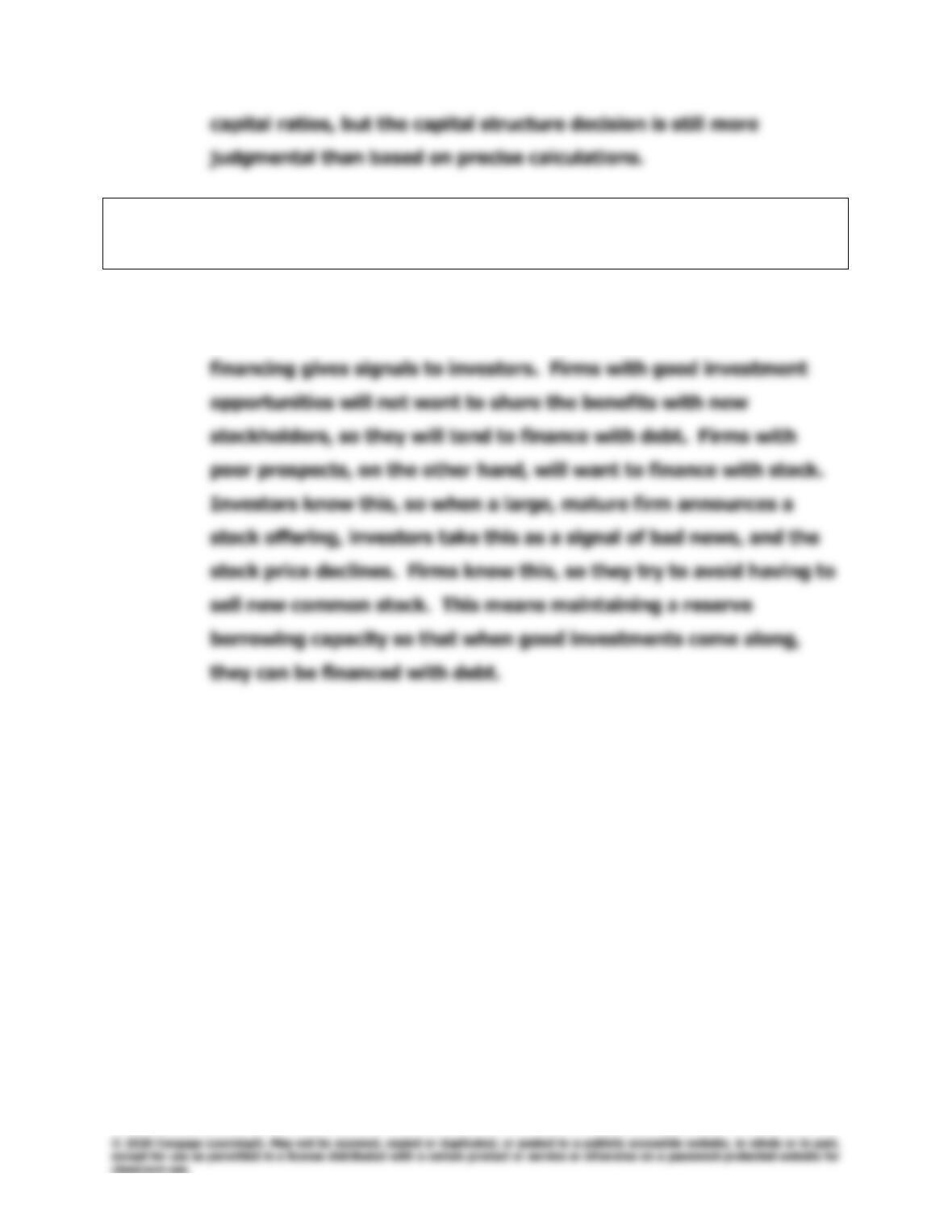
Figure IC 14.1. Relationship Between Capital Structure and Stock Price
G. Put labels on Figure IC 13.1 and then discuss the graph as you might
use it to explain to your boss why CD might want to use some debt.
Answer: [Show S13–40 and S13-41 here.] The use of debt permits a firm to
obtain tax savings from the deductibility of interest. So the use of
398
Integrated Case
Chapter 13: Capital Structure and Leverage
H. How does the existence of asymmetric information and signaling
affect capital structure?
Answer: [Show S13-42 through S13-45 here.] The asymmetric information
concept is based on the premise that management’s choice of

Chapter 13: Capital Structure and Leverage
Integrated Case
399
Optional Question
You might expect the price of a mature firm’s stock to decline if it announces a
stock offering. Would you expect the same reaction if the issuing firm were a
young, rapidly growing company?
Answer: If a mature firm sells stock, the price of its stock would probably
decline. A mature firm should have other financing alternatives, so