Chapter 13:
1. Which of the following could be considered a monopoly?
a. Kate Hudson (an actress)
b. DeBeers diamond company
Answer: The diamond market is not a pure monopoly. However, the DeBeers company
diamonds.
c. the only doctor in a small town
Answer: The only doctor in a small town has a local monopoly over physician services.
d. Ford Motor Company
2. Barriers to entry are important in the creation of monopolies because they keep competitors out of the
industry. Although many types of barriers exist, historically, ownership of an essential resource,
government patents and licenses, and large entry costs have served as the primary barriers to entry. For
each of the following cases, indicate which type of barrier created the monopoly.
a.
b. The local cable TV company has the only government issued license to supply services in the area.
c. The pharmaceutical company, MAXCO, invented and patented a new baldness drug.
d. In the 1950s, AT&T provided long-distance telephone service by stringing millions of miles of copper
wiring across the United States.
Answers:
See Exhibit 10.1
3. Is it optimal for the monopolist to operate on the inelastic portion of the demand curve? Why or why
not?
Answer: It is not optimal for a monopolist to operate on the inelastic portion of the
4. Fill in the missing data in the following table for a monopolist.
Answer:
Total Marginal Demand Elastic
Qty Price Revenue Revenue or Inelastic?
1 11 11 11 elastic
5. Assume that the monopolist in problem 4 had fixed costs of $10 and a constant marginal cost of $4 per
unit. Add columns to the above table for Total Cost, Marginal Cost, and Profit.
Answer:
Total Marginal Demand Elastic Total Marginal
Qty Price Revenue Revenue or Inelastic? Cost Cost Profit
1 11 11 11 elastic 14 4 – 3
6. The Mobile Phone Company has served Mobile, Alabama, since the 1930s as a government–
authorized natural monopoly. The following table describes a portion of the demand curve for long–
distance service facing Mobile Phone Company.
a. Complete the table.
MOBILE PHONE COMPANY DEMAND FOR PHONE HOURS
Quantity Price Total Revenue Marginal Revenue Elastic or Inelastic?
30 $3.65 __________ __________ __________
31 3.58 __________ __________ __________
32 3.50 __________ __________ __________
33 3.43 __________ __________ __________
34 3.35 __________ __________ __________
35 3.27 __________ __________ __________
36 3.20 __________ __________ __________
37 3.12 __________ __________ __________
38 3.05 __________ __________ __________
39 2.97 __________ __________ __________
40 2.89 __________ __________ __________
41 2.82 __________ __________ __________
42 2.74 __________ __________ __________
43 2.67 __________ __________ __________
44 2.59 __________ __________ __________
45 2.51 __________ __________ __________
46 2.44 __________ __________ __________
47 2.36 __________ __________ __________
48 2.29 __________ __________ __________
49 2.21 __________ __________ __________
50 2.13 __________ __________ __________
b.
between marginal revenue and price?
c. At what price does demand become inelastic?
d. What will happen to the elasticity of demand when a new company, Mobile Phones of Mobile, starts a
competing wireless phone company?
Answers:
a. Total Marginal Elastic or
Quantity Price Revenue Revenue Inelastic?
30 $3.65 $109.62
31 3.58 110.92 $ 1.30 Elastic
50 2.13 106.70 (1.59) Inelastic
b. At first marginal revenue is positive as the price declines. After the price falls below $2.97,
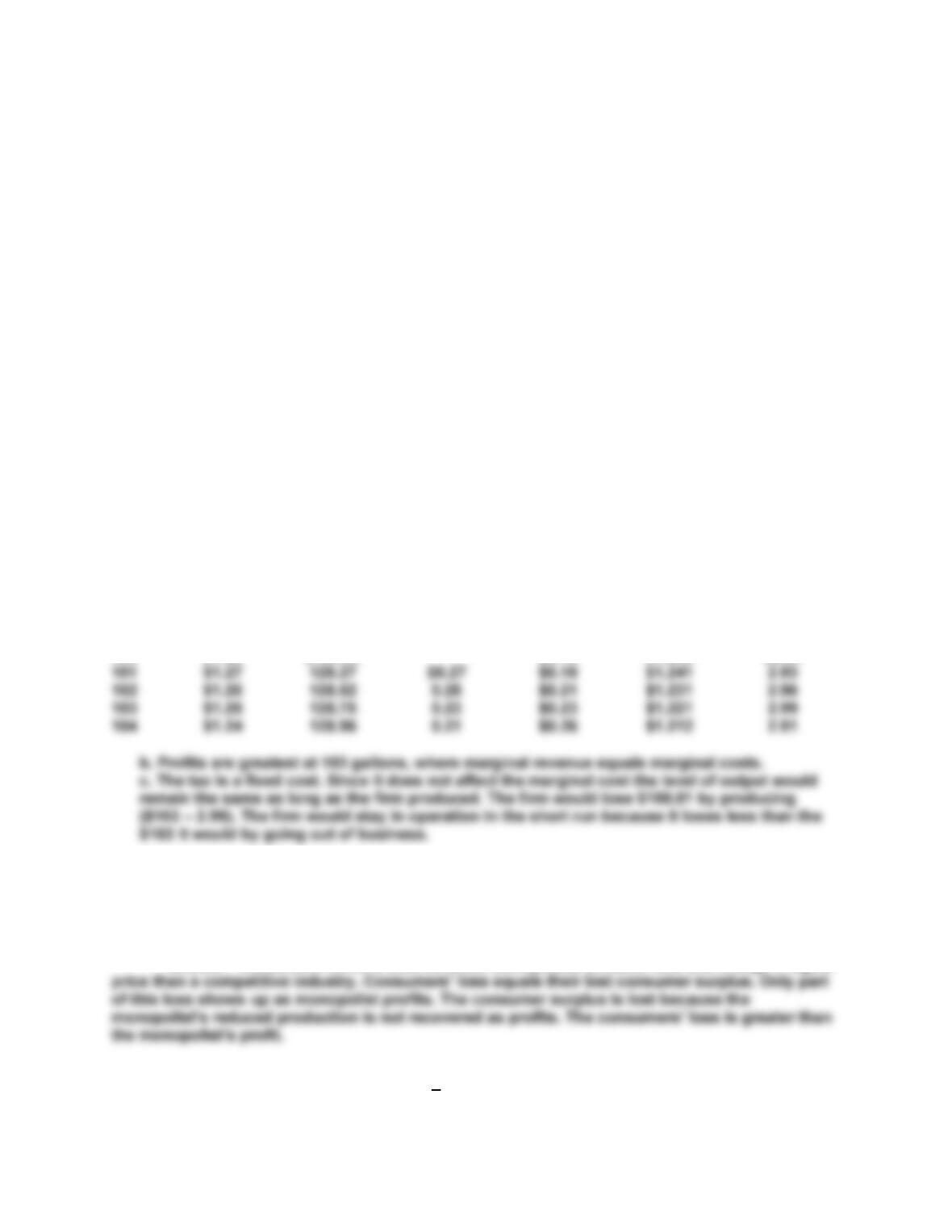
7. The following table shows the demand for water and cost conditions for the New South Springdale
Water Utility, a pure monopoly.
a. Complete the table.
Quantity Price Total Marginal Marginal Average
(gallons) (per gallon) Revenue Revenue Costs Total Costs Profit
100 $1.28 ________ ________ $0.15 $1.252 ________
101 $1.27 ________ ________ $0.18 $1.241 ________
102 $1.26 ________ ________ $0.21 $1.231 ________
103 $1.25 ________ ________ $0.23 $1.221 ________
104 $1.24 ________ ________ $0.26 $1.212 ________
b. What is true about the relationship between marginal revenue and marginal costs when profit is the
greatest?
c. Suppose the government imposed a tax on the firm of $103, which the firm had to pay even if it went
out of business. What would be the profit-maximizing level of output? What would happen to profits?
Would the firm stay in business?
Answers:
a.
Quantity Price Total Marginal Marginal Average
(gallons) (per gallon) Revenue Revenue Costs Total Costs Profit
100 $1.28 $128.00 $0.15 $1.252 $2.80
8. A patent gives a firm a monopoly in production of the patented good. While the monopoly profits
provide an incentive for firms to innovate, the monopoly power imposes a cost on consumers. Why do
consumers suffer a cost? Is it greater than the profits earned by the monopolist?
Answer: Consumers suffer a cost because monopolists produce less and charge a higher
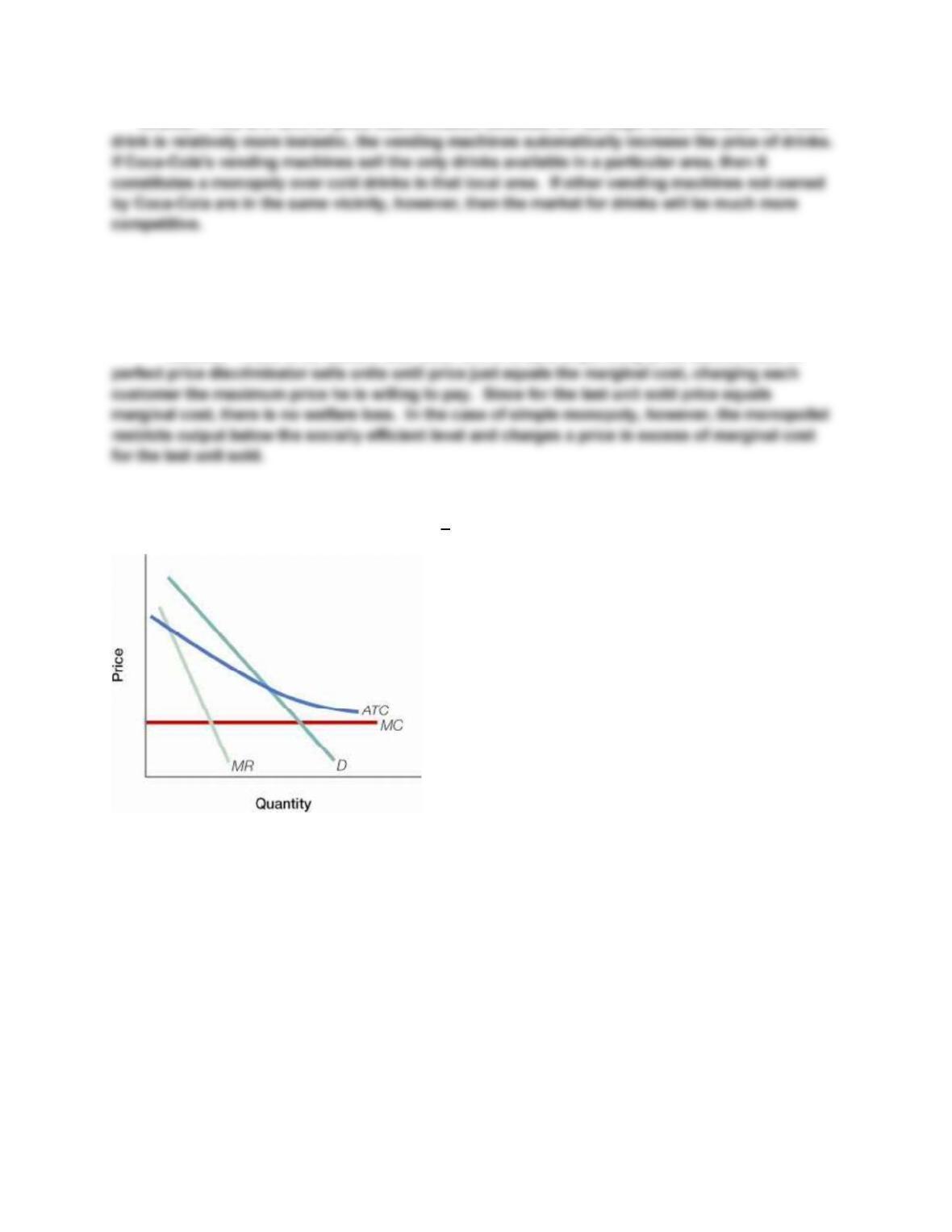
9. Use the accompanying diagram to answer a c.
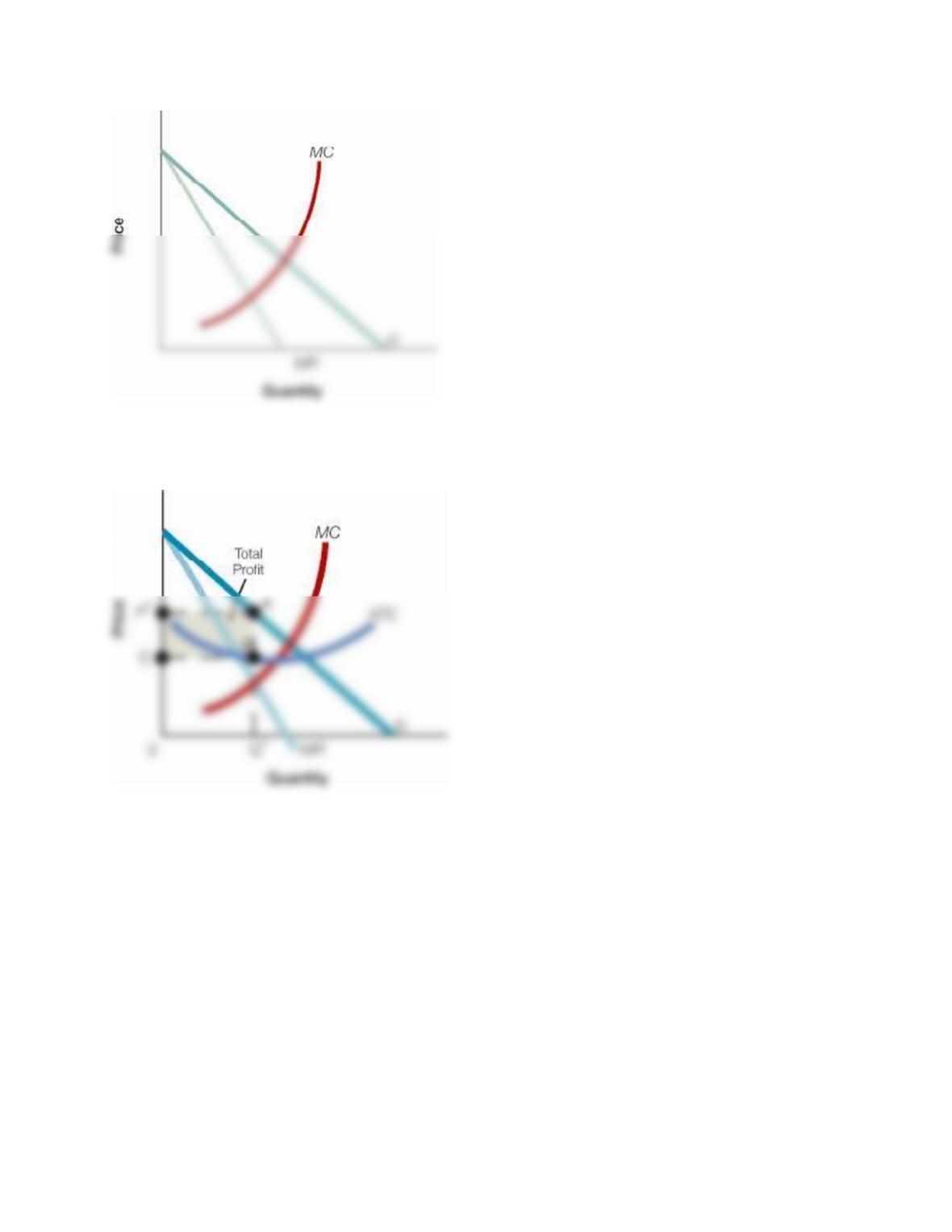
a. Assuming the monopolist indicated in the diagram produced at all, indicate its profit-maximizing
quantity and price.
Answer:
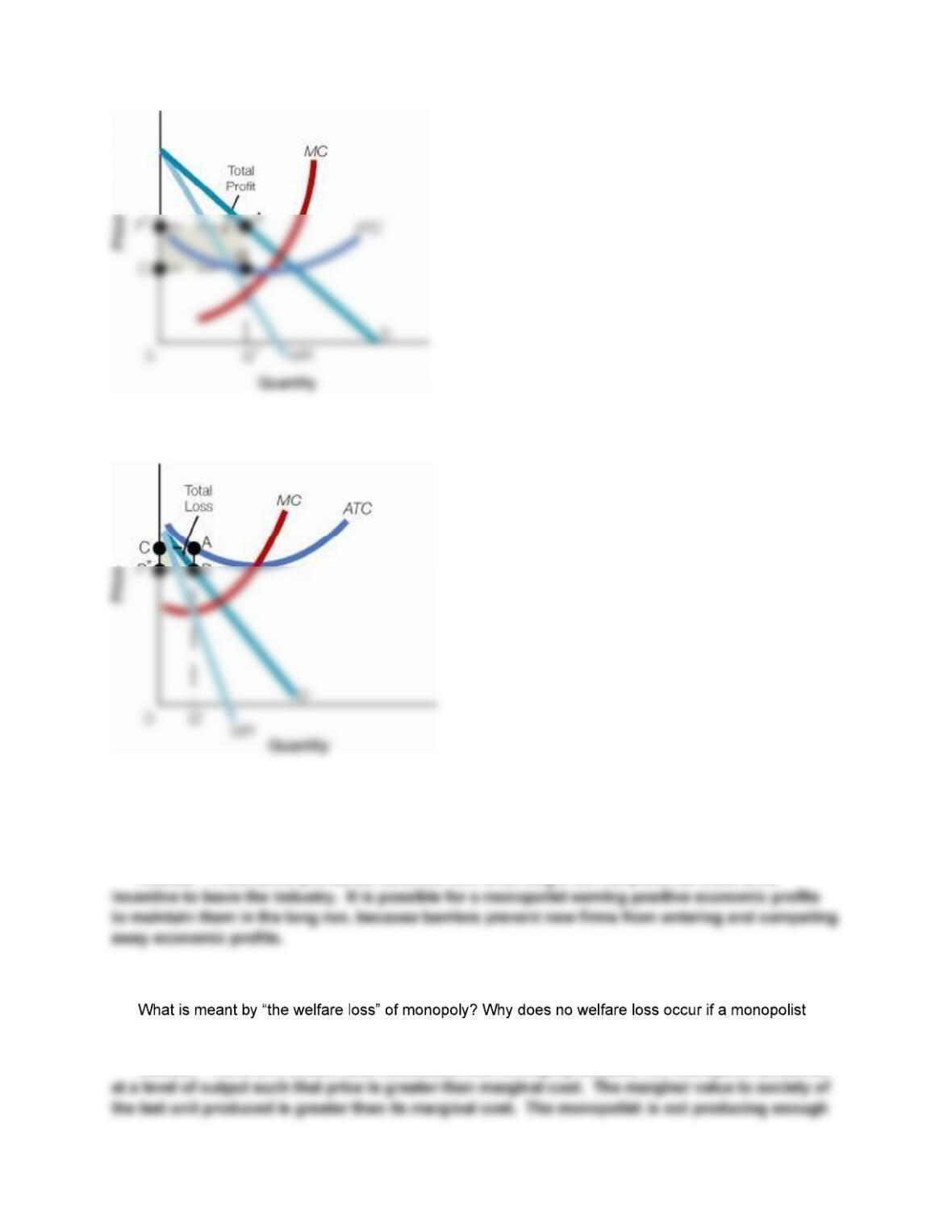
b. Add an ATC curve that would show this monopolist earning an economic profit.
Answer:
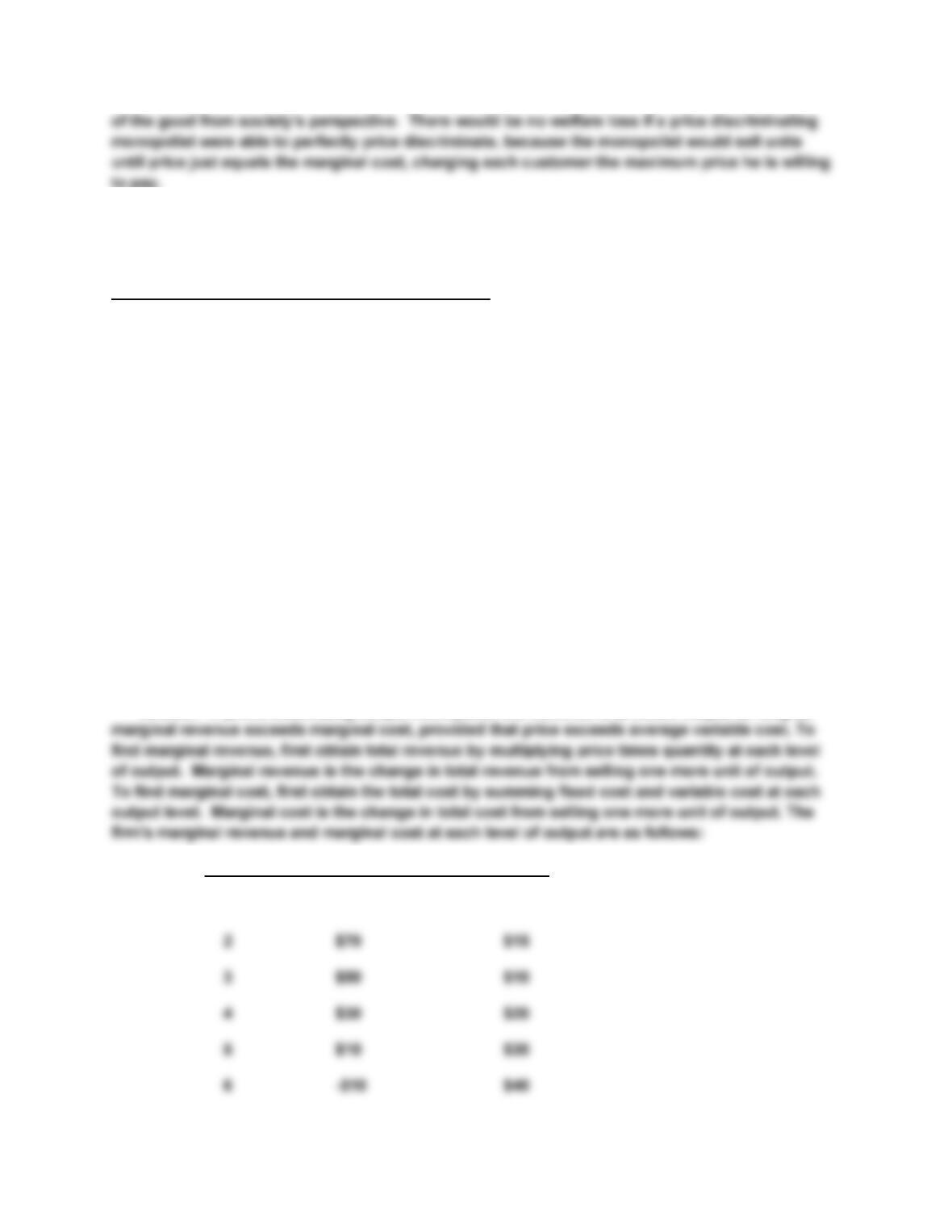
c. Add an ATC curve that would show this monopolist experiencing an economic loss.
Answer:
10. If economic profits were zero, would a monopolist ever stay in business? Why might it be possible for
a monopolist to earn positive economic profits in the long run?
Answer: If economic profits are zero, the firm is earning a normal profit, so there is no
11.
successfully practices perfect price discrimination?
Answer: There is a welfare loss associated with monopoly because the monopolist produces
12. Consider the data in the following table:
Price Quantity Fixed Cost Variable Cost
$100 0 $60 $ 0
90 1 60 25
80 2 60 40
70 3 60 50
60 4 60 70
50 5 60 100
40 6 60 140
30 7 60 190
20 8 60 250
A simple monopolist with these fixed and variable cost schedules maximizes profits at what level of
output?
Answer: A profit-maximizing simple monopolist will continue to produce output as long as
Output Marginal Revenue Marginal Cost
1 $90 $25
13. Explain how each of the following is a form of price discrimination.
a. a student discount at the movie theater
Answer: Students demand for movie tickets tends to be more elastic than for the average
b. long-distance phone service that costs 15 cents per minute for the first 10 minutes and 5 cents per
minute after 10 minutes
Answer: The long distance service is practicing price discrimination by offering lower
c. a psychic who charges each customer his or her maximum reservation price for palm readings
Answer: The psychic attempts to perfectly price discriminate by charging individuals the
d. a senior citizen breakfast discount at a local restaurant
Answer: Seniors, who often live on fixed incomes and have more “free time” to search for
e. coupon discounts on laundry detergent
Answer: Coupon discounts are only offered to those individuals who are willing to take
14. In October of 1999, Coca-Cola announced that it was considering testing a new vending machine that
was temperature sensitive. The price of the soft drinks in the machines would be higher on hot days. The
Miami Herald story read ation? How can the
placement of the vending machines create a monopoly? What if other vending machines are close by and
are not owned by Coca-Cola?
Answer: This is a form of price discrimination because, on hot days when demand for a cold
15. Compare the size of the welfare (deadweight) loss under monopoly in the case of perfect price
discrimination and under the standard case of simple monopoly. Explain.
Answer: There is no welfare loss when a firm is able to perfectly price discriminate. A
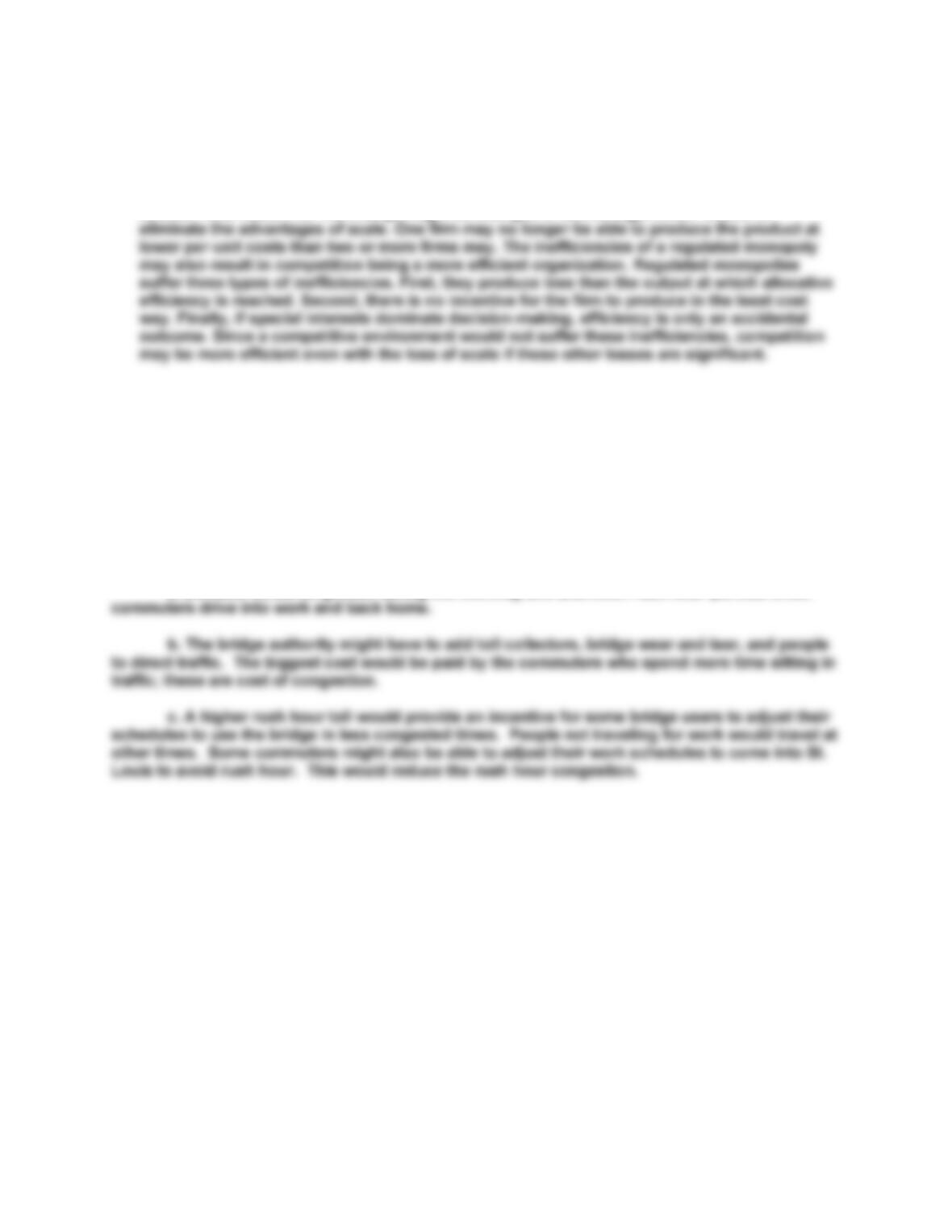
16. Use the accompanying diagram to answer a c.
a. Indicate the efficient result on the graph.
Answer:
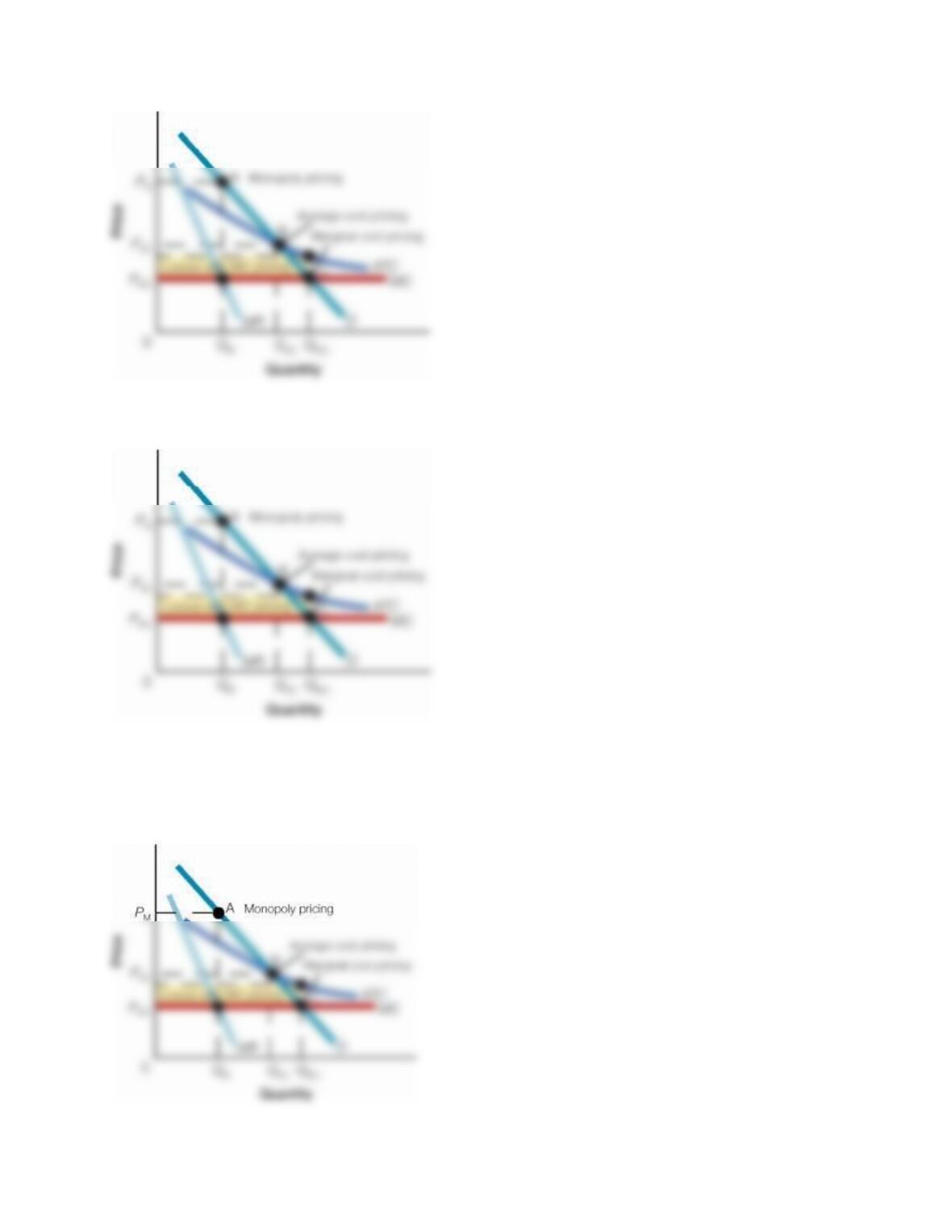
b. Illustrate the profits or losses from the efficient result in a.
Answer:
c. Show the average cost-pricing solution. What profits are earned with that approach?
Answer:
17. Governments around the world are allowing competition in the production of goods and services that
have historically been considered natural monopolies. Competition has been introduced in industries such
as the local telephone service and electricity provision. Why might the introduction of competition
increase the efficiency of these industries?
Answer: One reason for the change might be changes in technology, which reduce or
18. The Mississippi Bridge Authority operates a toll bridge that crosses the river near St. Louis. Traffic
over the bridge includes tourist traffic and commercial traffic. It also includes commuters who work in St.
Louis but live on the Illinois side of the river.
a. Would you expect demand for bridge use to differ at different times during the day? Why?
b. How might costs differ in these time periods?
c. What would be the effects of charging a higher toll to cross the bridge during busy times?
Answers:
a. Demand would be greater during the morning and afternoon rush hour periods when