S-201
interactive activity
Chapter 13
Monopoly
1. Each of the following firms possesses market power. Explain its source.
a. Merck, the producer of the patented cholesterol-lowering drug Zetia
1. a. Merck has a patent for Zetia. This is an example of a government-created
barrier to entry, which gives Merck market power.
b. There are increasing returns to scale in the provision of piped water. There is
a large fixed cost associated with building a network of water pipes to each
household; the more water delivered, the lower its average total cost becomes.
2. Skyscraper City has a subway system, for which a one-way fare is $1.50. There
is pressure on the mayor to reduce the fare by one-third, to $1.00. The mayor
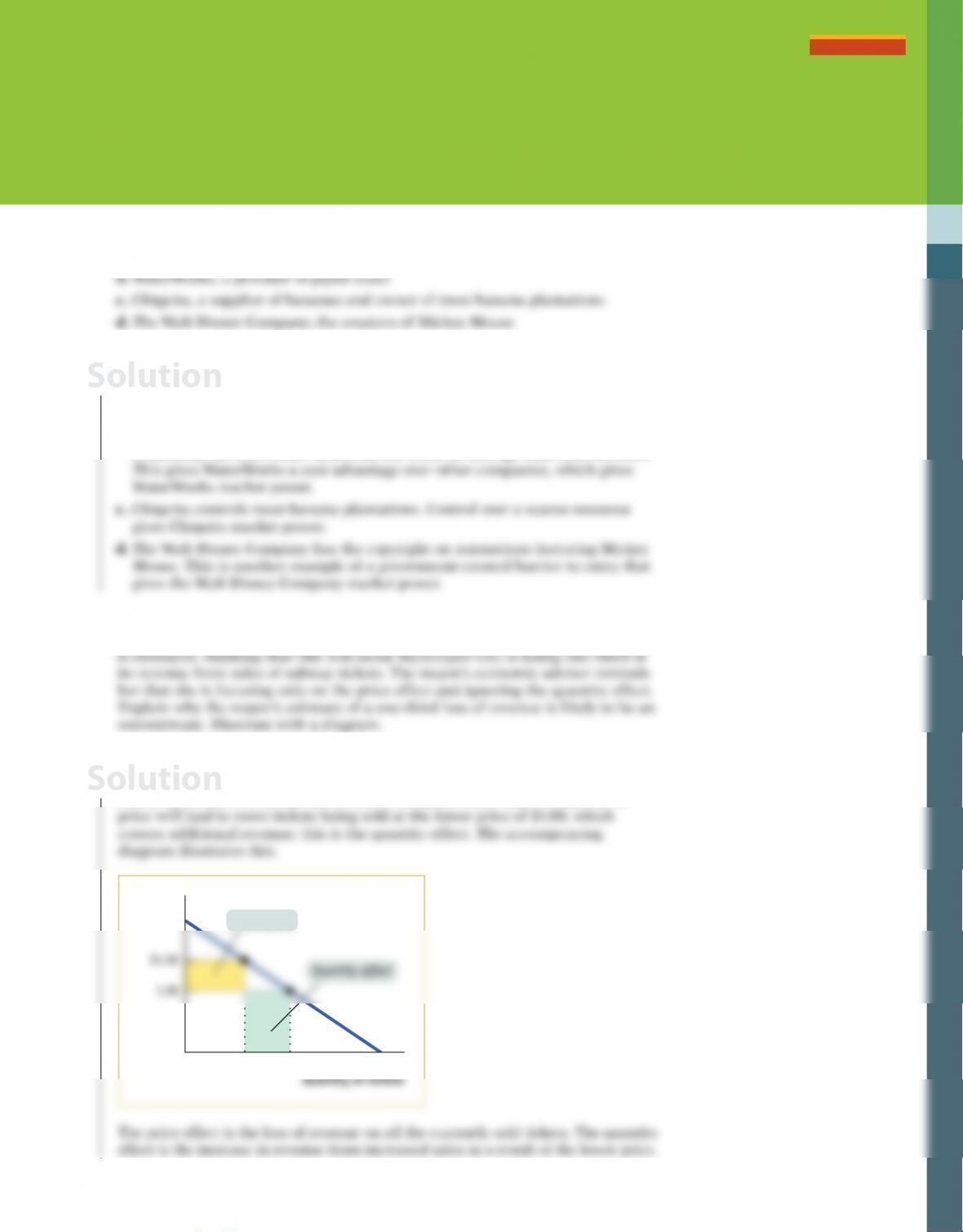
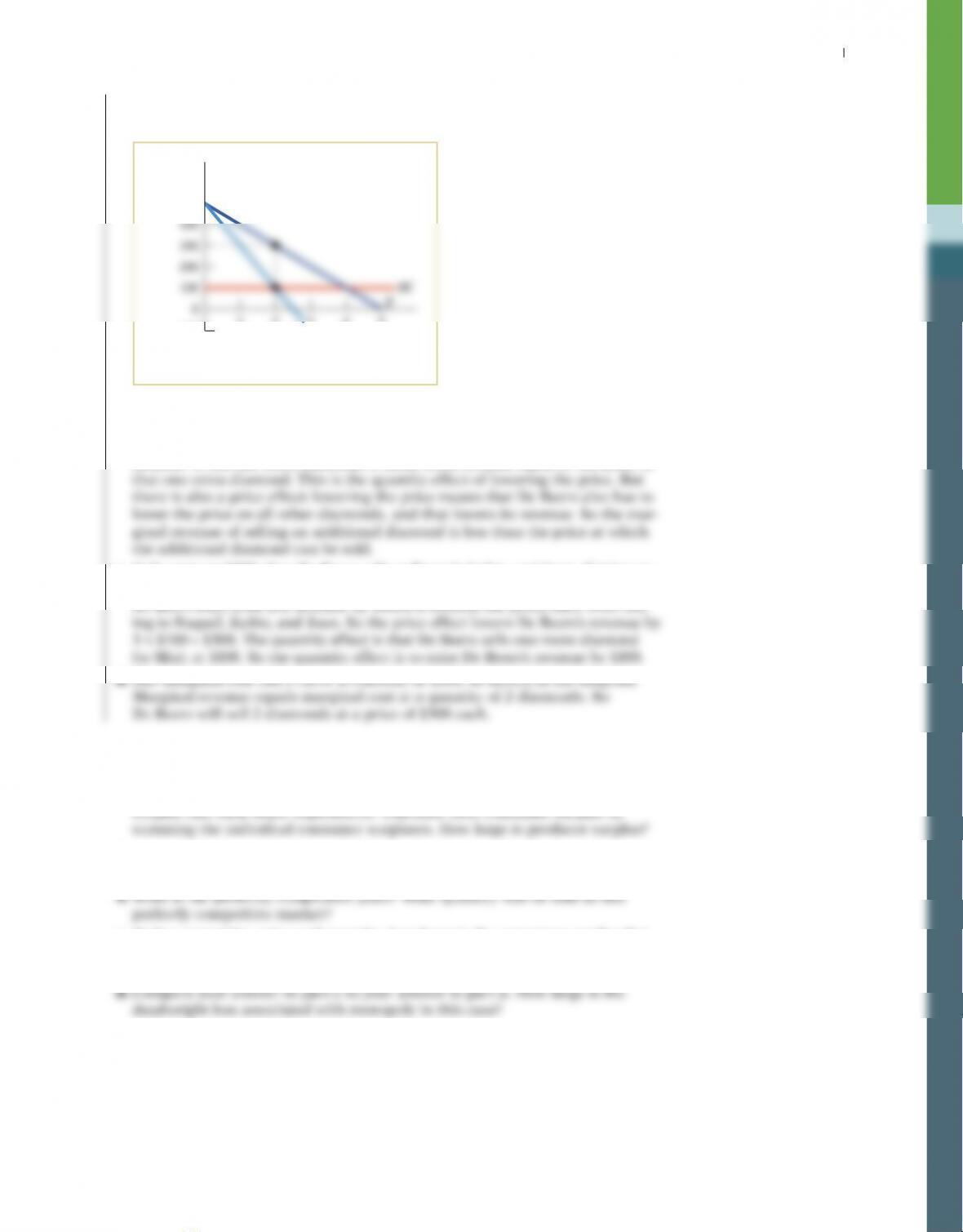
2. A reduction in fares from $1.50 to $1.00 will reduce the revenue on each ticket
that is currently sold by one-third; this is the price effect. But a reduction in
Price of
ticket
$1.50
Price effect
Solution
Solution
3. Bob, Bill, Ben, and Brad Baxter have just made a documentary movie about
their basketball team. They are thinking about making the movie available for
download on the internet, and they can act as a single–price monopolist if they
choose to. Each time the movie is downloaded, their internet service provider
charges them a fee of $4. The Baxter brothers are arguing about which price to
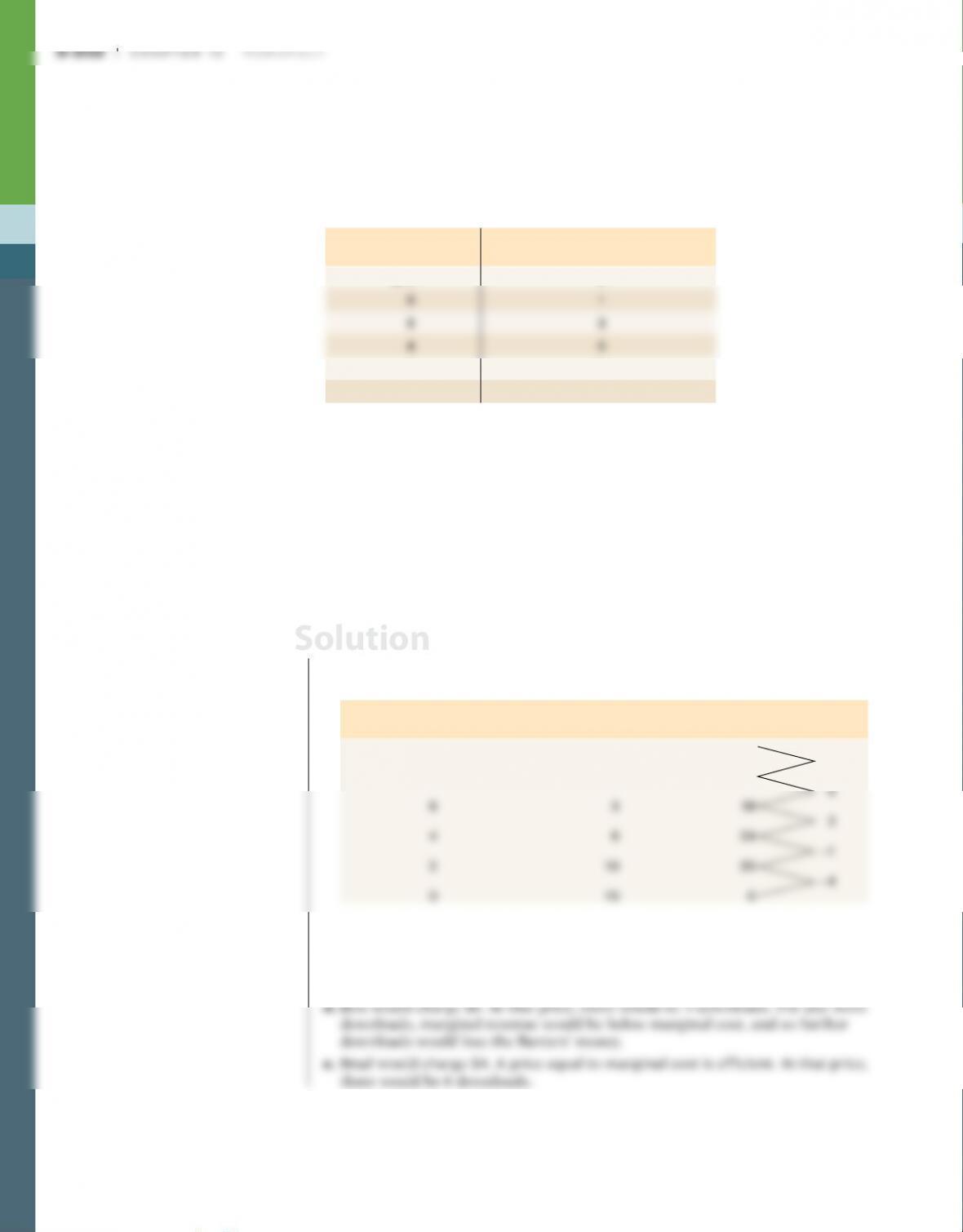
charge customers per download. The accompanying table shows the demand
schedule for their film.
Price of
download
Quantity of downloads
demanded
$10 0
210
015
a. Calculate the total revenue and the marginal revenue per download.
b. Bob is proud of the film and wants as many people as possible to download it.
Which price would he choose? How many downloads would be sold?
c. Bill wants as much total revenue as possible. Which price would he choose?
How many downloads would be sold?
d. Ben wants to maximize profit. Which price would he choose? How many
downloads would be sold?
e. Brad wants to charge the efficient price. Which price would he choose? How
many downloads would be sold?
3. a. The accompanying table calculates total revenue (TR) and marginal revenue
(MR). Recall that marginal revenue is the additional revenue per unit of output,
that is, ∆TR/∆Q.
Price of download
Quantity of
downloads demanded TR MR
$10 0$0
$8
8 1 8
b. Bob would charge $0. At that price, there would be 15 downloads, the largest
quantity they can sell.
c. Bill would charge $4. At that price, total revenue is greatest ($24). At that
price, there would be 6 downloads.
Solution
4. Mateo’s room overlooks, from some distance, a major league baseball stadium.
He decides to rent a telescope for $50.00 a week and charge his friends and class–
mates to use it to peep at the game for 30 seconds. He can act as a single-price
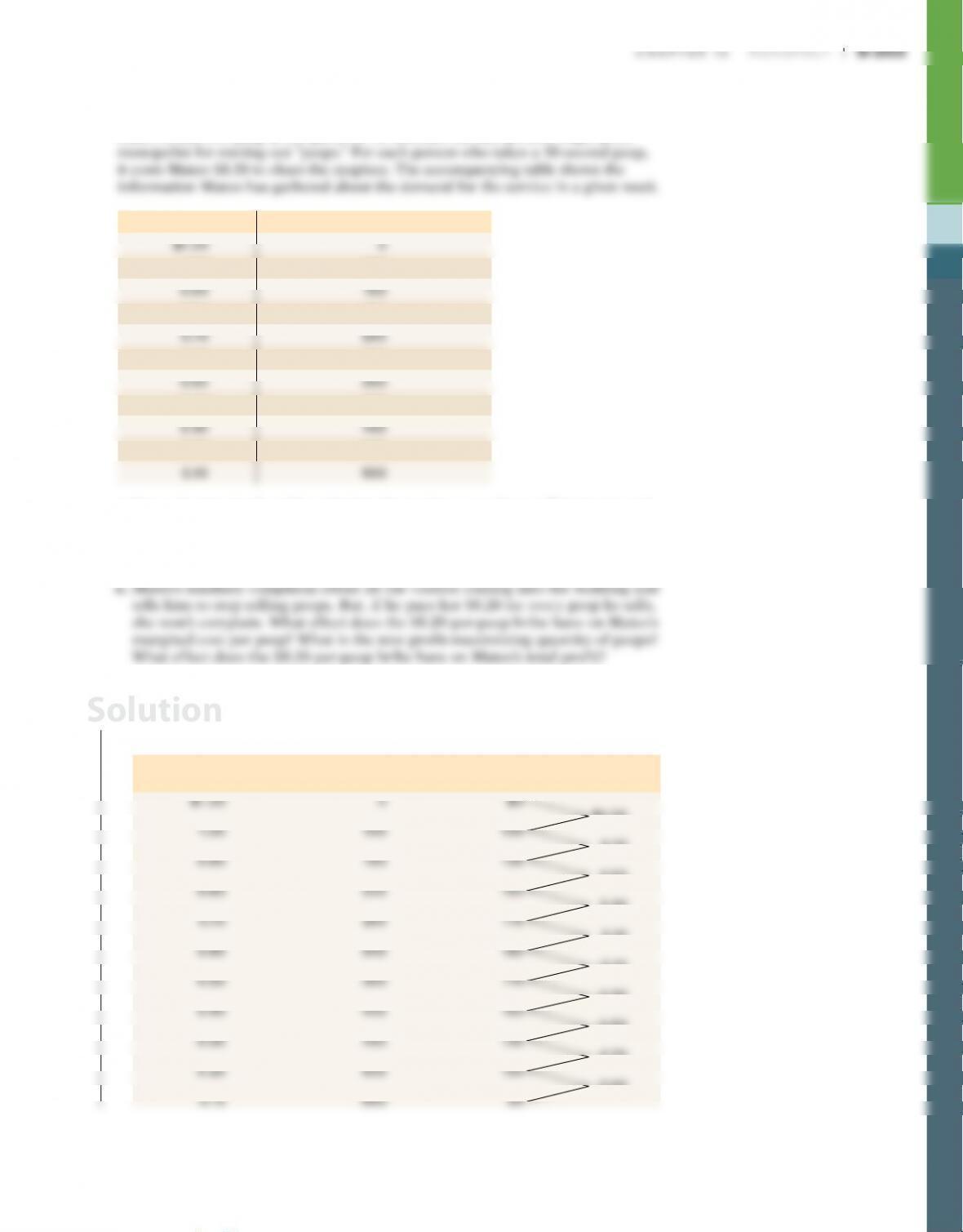
Price of peep Quantity of peeps demanded
1.00 100
0.80 200
0.60 300
0.40 400
0.20 500
a. For each price in the table, calculate the total revenue from selling peeps and
the marginal revenue per peep.
b. At what quantity will Mateo’s profit be maximized? What price will he charge?
What will his total profit be?
4. a. Total revenue (TR) and marginal revenue (MR) are given in the accompanying
table.
Price of peep
Quantity of peeps
demanded TR MR
$1.00
0.70
0.50
0.30
0.10
–0.10
–0.30
–0.50
–0.70
–0.90
Solution
S-204 Chapter 13 Monopoly
$75.00.
c. When Mateo pays the landlady $0.20 per peep, his marginal cost increases
to $0.40 per peep, so the profit-maximizing quantity decreases to 200 and
5. Suppose that De Beers is a single-price monopolist in the market for diamonds.
De Beers has five potential customers: Raquel, Jackie, Joan, Mia, and Sophia.
Each of these customers will buy at most one diamond—and only if the price is
just equal to, or lower than, her willingness to pay. Raquel’s willingness to pay is
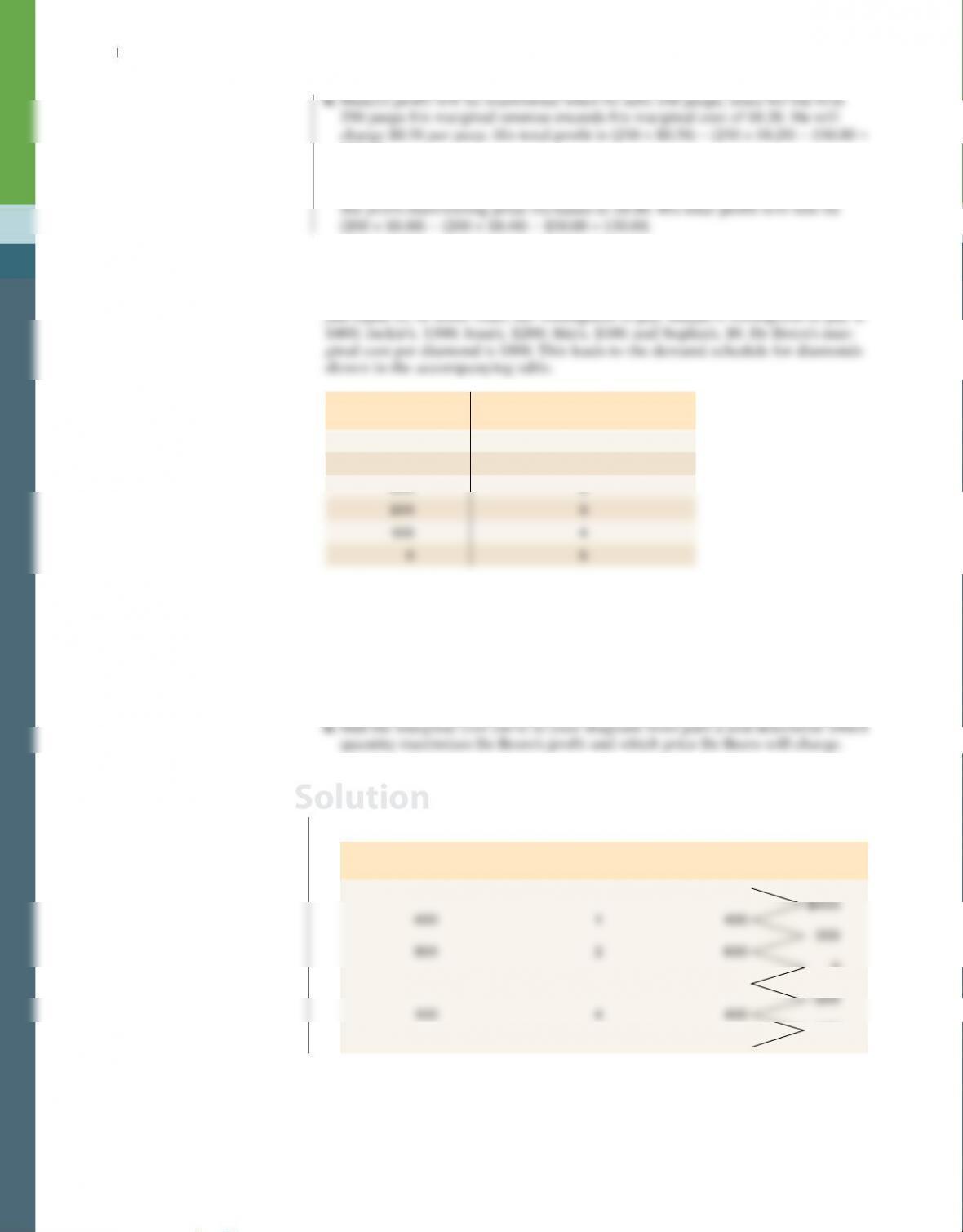
Price of
diamond
Quantity of diamonds
demanded
$500 0
400 1
300 2
a. Calculate De Beers’s total revenue and its marginal revenue. From your calcu-
lation, draw the demand curve and the marginal revenue curve.
b. Explain why De Beers faces a downward-sloping demand curve and why the
marginal revenue from an additional diamond sale is less than the price of the
diamond.
c. Suppose De Beers currently charges $200 for its diamonds. If it lowers the
price to $100, how large is the price effect? How large is the quantity effect?
5. a. Total revenue (TR) and marginal revenue (MR) are given in the accompanying
table.
Price of diamond
Quantity of diamonds
demanded TR MR
$500 0$0
0
200 3600
–400
0 5 0
Solution
Chapter 13 Monopoly S-205
The accompanying diagram illustrates De Beers’s demand curve and marginal
revenue (MR) curve.
12345
$500
–100
Price of
diamond
Quantity of diamonds
MR
b. De Beers is the only producer of diamonds, so its demand curve is the market
demand curve. And the market demand curve slopes downward: the lower the
price, the more customers will buy diamonds. If De Beers lowers the price suf-
ficiently to sell one more diamond, it earns extra revenue equal to the price of
c. If the price is $200, then De Beers sells to Raquel, Jackie, and Joan. If it lowers
the price to $100, it will also sell a diamond to Mia. The price effect is that
6. Use the demand schedule for diamonds given in Problem 5. The marginal cost of
producing diamonds is constant at $100. There is no fixed cost.
a. If De Beers charges the monopoly price, how large is the individual consumer
surplus that each buyer experiences? Calculate total consumer surplus by
Suppose that upstart Russian and Asian producers enter the market and it
becomes perfectly competitive.
c. At the competitive price and quantity, how large is the consumer surplus that
each buyer experiences? How large is total consumer surplus? How large is
producer surplus?
S-206 Chapter 13 Monopoly
6. a. The monopoly price is $300. At that price Raquel and Jackie buy diamonds.
b. In a perfectly competitive market, P = MC. That is, the perfectly competitive
price is $100, and at that price 4 diamonds will be sold—to Raquel, Jackie,
Joan, and Mia.
c. At the competitive price, Raquel’s consumer surplus is $400 – $100 = $300;
Jackie’s, $300 – $100 = $200; Joan’s, $200 – $100 = $100; and Mia’s, $100 –
d. Under perfect competition, the sum of consumer and producer surplus is
$600 + $0 = $600. Under monopoly, the sum of consumer and producer sur-
plus is $100 + $400 = $500. So the loss of surplus to society from monopoly—
the deadweight loss—is $600 – $500 = $100.
7. Use the demand schedule for diamonds given in Problem 5. De Beers is a
monopolist, but it can now price–discriminate perfectly among all five of its
potential customers. De Beers’s marginal cost is constant at $100. There is no
fixed cost.
a. If De Beers can price–discriminate perfectly, to which customers will it sell
diamonds and at what prices?
b. How large is each individual consumer surplus? How large is total consumer
surplus? Calculate producer surplus by summing the producer surplus gener-
8. Download Records decides to release an album by the group Mary and the Little
Lamb. It produces the album with no fixed cost, but the total cost of creating a
digital album and paying Mary her royalty is $6 per album. Download Records
can act as a single-price monopolist. Its marketing division finds that the
demand schedule for the album is as shown in the accompanying table.
Price of album Quantity of albums demanded
$22 0
20 1,000
18 2,000
16 3,000
Solution
Chapter 13 Monopoly S-207
a. Calculate the total revenue and the marginal revenue per album.
b. The marginal cost of producing each album is constant at $6. To maximize
profit, what level of output should Download Records choose, and which price
should it charge for each album?
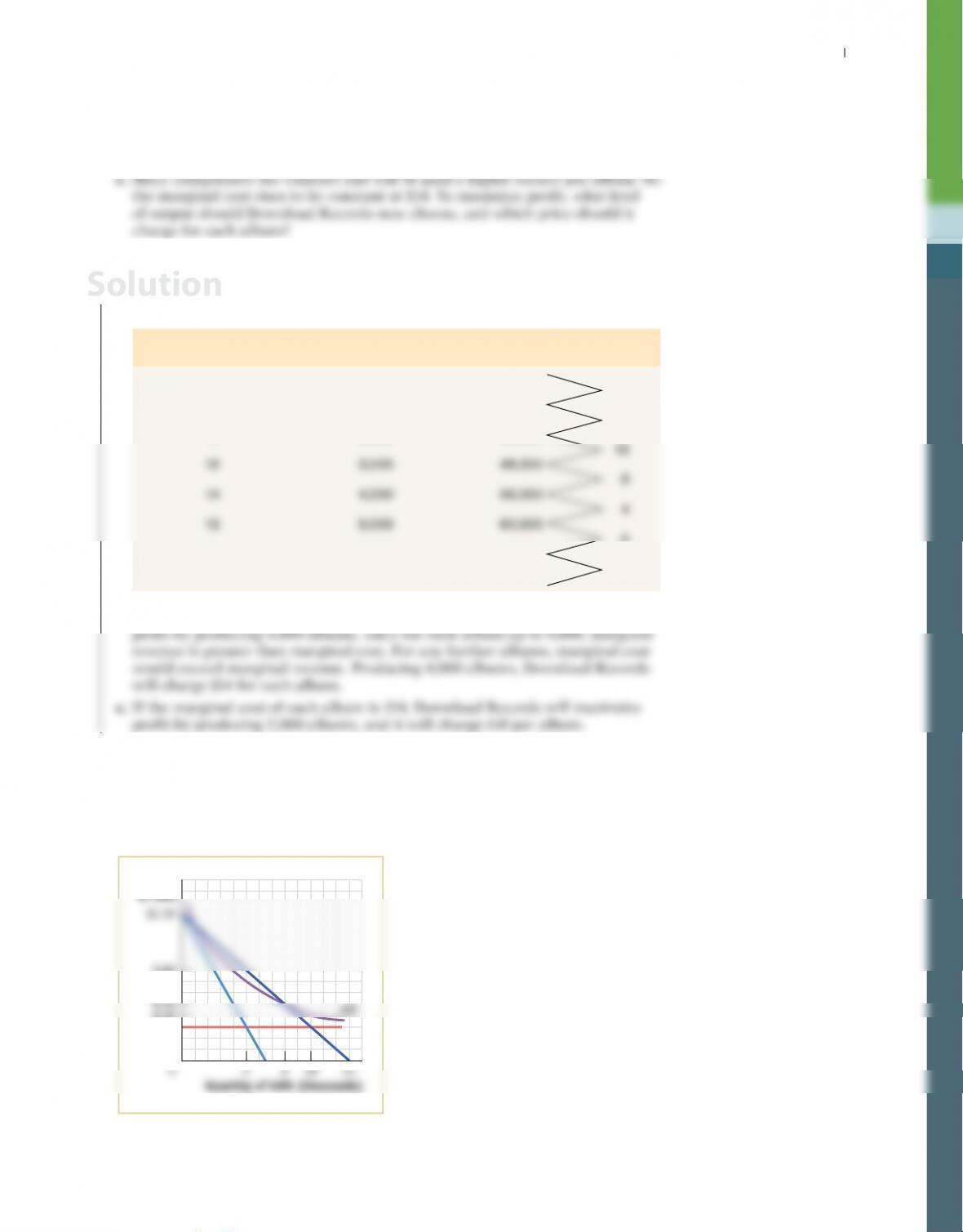
8. a. Total revenue (TR) and marginal revenue per album (MR) is shown in the
accompanying table.
Price of album
Quantity of albums
demanded TR MR
$22 0$0
$20
20 1,000 20,000
16
18 2,000 36,000
0
10 6,000 60,000
–4
87,000 56,000
b. If the marginal cost of each album is $6, Download Records will maximize
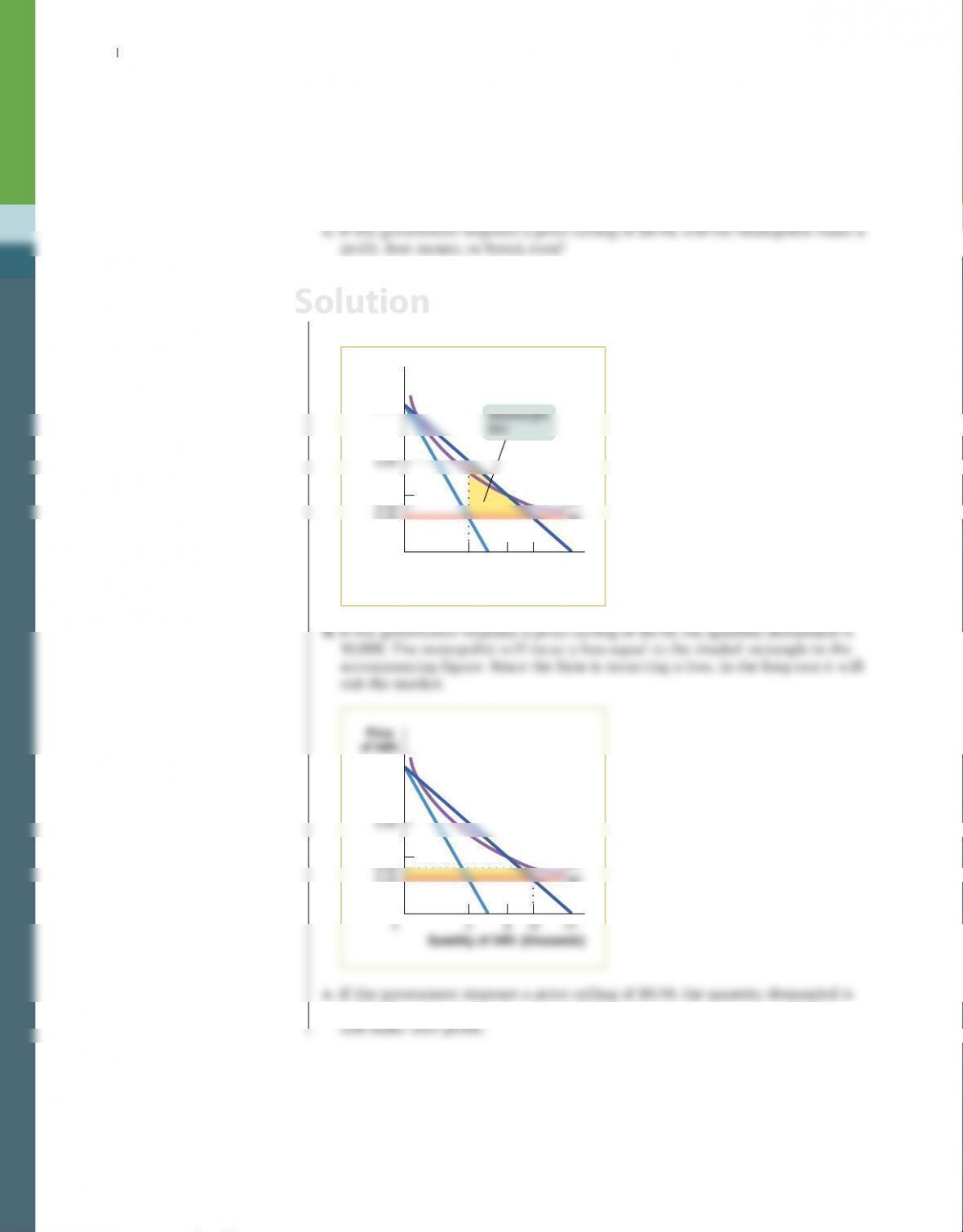
9. This diagram illustrates your local electricity company’s natural monopoly. It
shows the demand curve for kilowatt-hours (kWh) of electricity, the company’s
marginal revenue (MR) curve, its marginal cost (MC) curve, and its average total
cost (ATC) curve. The government wants to regulate the monopolist by imposing
a price ceiling.
Price
Solution
S-208 Chapter 13 Monopoly
a. If the government does not regulate this monopolist, which price will it
charge? Illustrate the inefficiency this creates by shading the deadweight loss
from monopoly.
b. If the government imposes a price ceiling equal to the marginal cost, $0.30,
will the monopolist make profits or lose money? Shade the area of profit (or
loss) for the monopolist. If the government does impose this price ceiling, do
you think the firm will continue to produce in the long run?
9. a. The monopolist would choose a price of $0.80. Deadweight loss is shaded and
labeled in the accompanying figure.
MC
ATC
D
MR
5810
$1.30
Price
of kWh
Quantity of kWh (thousands)
0.50
0.30
0
13
MC
ATC
D
MR
0.50
0.30
8,000. The price equals the monopolist’s average total cost, and so the firm
Solution
10. The Collegetown movie theater serves 900 students and 100 professors in town.
Each student’s willingness to pay for a movie ticket is $5. Each professor’s will-
ingness to pay for a movie ticket is $10. Each will buy only one ticket. The movie
theater’s marginal cost per ticket is constant at $3, and there is no fixed cost.
a. Suppose the movie theater cannot price–discriminate and charges both
students and professors the same price per ticket. If the movie theater charges
$5, who will buy tickets and what will the movie theater’s profit be? How large
is consumer surplus?
b. If the movie theater charges $10, who will buy movie tickets and what will the
movie theater’s profit be? How large is consumer surplus?
10. a. If the movie theater charges $5 per ticket, both students and professors will
buy tickets. The movie theater will sell to 1,000 customers (students and pro–
fessors), at a price of $5 each. Since the movie theater’s cost per ticket is $3,
its profit is $2 per ticket for a total profit of 1,000 × $2 = $2,000. Students
b. If the movie theater charges $10 per ticket, only professors will buy tickets.
The movie theater will sell to 100 customers (professors) at a price of $10 each.
Since the movie theater’s cost per ticket is $3, its profit is $7 per ticket for a
c. If the movie theater charges students a price of $5, it sells 900 tickets at a
profit of $5 – $3 = $2 each for a profit from selling to students of 900 × $2 =
$1,800. Charging professors $10, it sells 100 tickets at a profit of $10 – $3 = $7
11. A monopolist knows that in order to expand the quantity of output it produces
from 8 to 9 units it must lower the price of its output from $2 to $1. Calculate
the quantity effect and the price effect. Use these results to calculate the monop–
olist’s marginal revenue of producing the 9th unit. The marginal cost of produc-
ing the 9th unit is positive. Is it a good idea for the monopolist to produce the
9th unit?
11. The quantity effect is $1 (the increase in total revenue from selling the 9th unit
at $1). The price effect is 8 × (–$1) = –$8 (the decrease in total revenue from hav-
ing to lower the price of 8 units by $1 each). So the marginal revenue of produc–
Solution
Solution
S-210 Chapter 13 Monopoly
12. In the United States, the Federal Trade Commission (FTC) is charged with pro–
moting competition and challenging mergers that would likely lead to higher
prices. Several years ago, Staples and Office Depot, two of the largest office sup–
ply superstores, announced their agreement to merge.
a. Some critics of the merger argued that, in many parts of the country, a merger
between the two companies would create a monopoly in the office supply super–
store market. Based on the FTC’s argument and its mission to challenge merg–
ers that would likely lead to higher prices, do you think it allowed the merger?
12. a. If Staples and Office Depot create a monopoly, they will be able to reduce the
quantity of output and raise prices, which would create inefficiency in the
form of deadweight loss. Since the FTC is charged with challenging mergers
that would likely lead to higher prices, you should think that the FTC would
not allow this merger. And, in fact, in a court ruling in 1997, the FTC was able
to prevent the merger.
b. If the relevant market is the market for all office supplies, the merger between
Staples and Office Depot would not create a monopoly, and the companies
13. Prior to the late 1990s, the same company that generated your electricity also
distributed it to you over high-voltage lines. Since then, 16 states and the District
of Columbia have begun separating the generation from the distribution of elec-
tricity, allowing competition between electricity generators and between electric-
ity distributors.
a. Assume that the market for electricity distribution was and remains a natural
monopoly. Use a graph to illustrate the market for electricity distribution if the
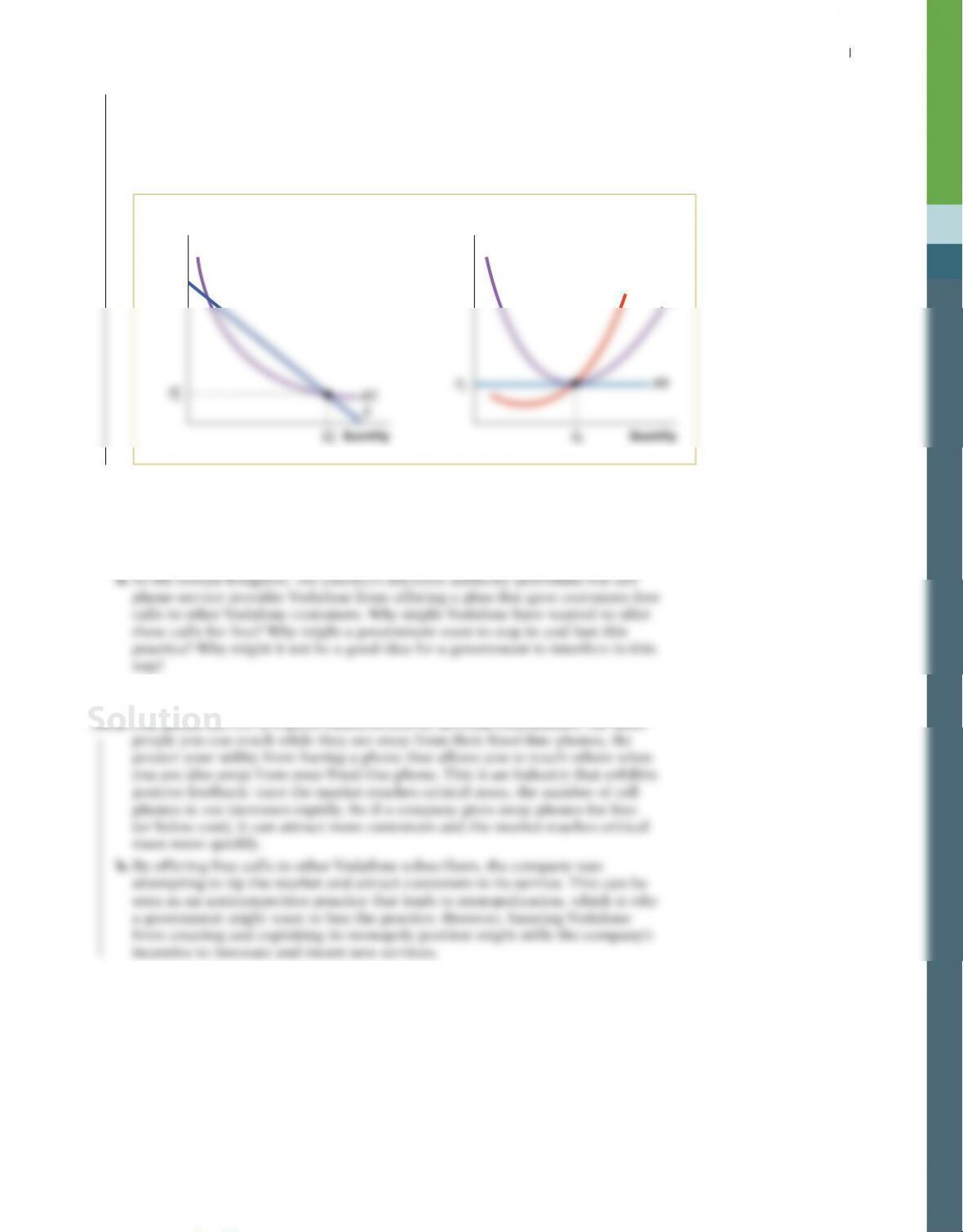
13. a. The market for electricity distribution is shown in panel (a) of the accompa–
nying diagram. Electricity distribution has the characteristics of a natural
Solution
Solution
Chapter 13 Monopoly S-211
b. The cost curves of an individual electricity generator are shown in panel (b).
Since the market is perfectly competitive, in the long run, price, PC, will be
equal to minimum average total cost, and the individual generator will pro–
duce electricity at the quantity QC, where marginal cost is just equal to the
market price.
Price,
cost
Price,
cost
D
MC
ATC
(b) Perfectly Competitive Firm(a) Regulated Natural Monopolist
14. Explain the following situations.
a. In Europe, many cell phone service providers give away for free what would
otherwise be very expensive cell phones when a service contract is purchased.
Why might a company want to do that?
14. a. Cell phone service is a good characterized by network externalities: the more
Solution
15. In 2014, Time Warner and Comcast announced their intention to merge. This
prompted questions of monopoly because the combined company would supply
cable access to an overwhelming majority of Americans. It also raised ques–
tions of monopsony since the combined company would be virtually the only
16. Walmart is the world’s largest retailer. As a consequence, it has sufficient
bargaining power to push its suppliers to lower their prices so it can honor its
slogan of “Save Money—Live Better” for its customers.
a. Is Walmart acting like a monopolist or monopsonist when purchasing goods
from suppliers? Explain.
b. How does Walmart affect the consumer surplus of its customers? The pro–
ducer surplus of its suppliers?
16. a . Walmart is acting like a monopsonist. It behaves like a sole buyer with its
suppliers, compelling them to lower their prices to Walmart.
Solution
17. For people with life-threatening allergies, carrying a device that can automati-
cally inject epinephrine (called an autoinjector) is a necessity. In the summer of
2016, Mylan, the maker of the widely used autoinjector EpiPen, found itself with
a virtual monopoly. A year earlier its primary competitor, Auvi-Q, had its prod–
uct recalled amid fears that it would malfunction and deliver the wrong dose. In
addition, the FDA denied the drug producer, Teva, from releasing a generic auto–
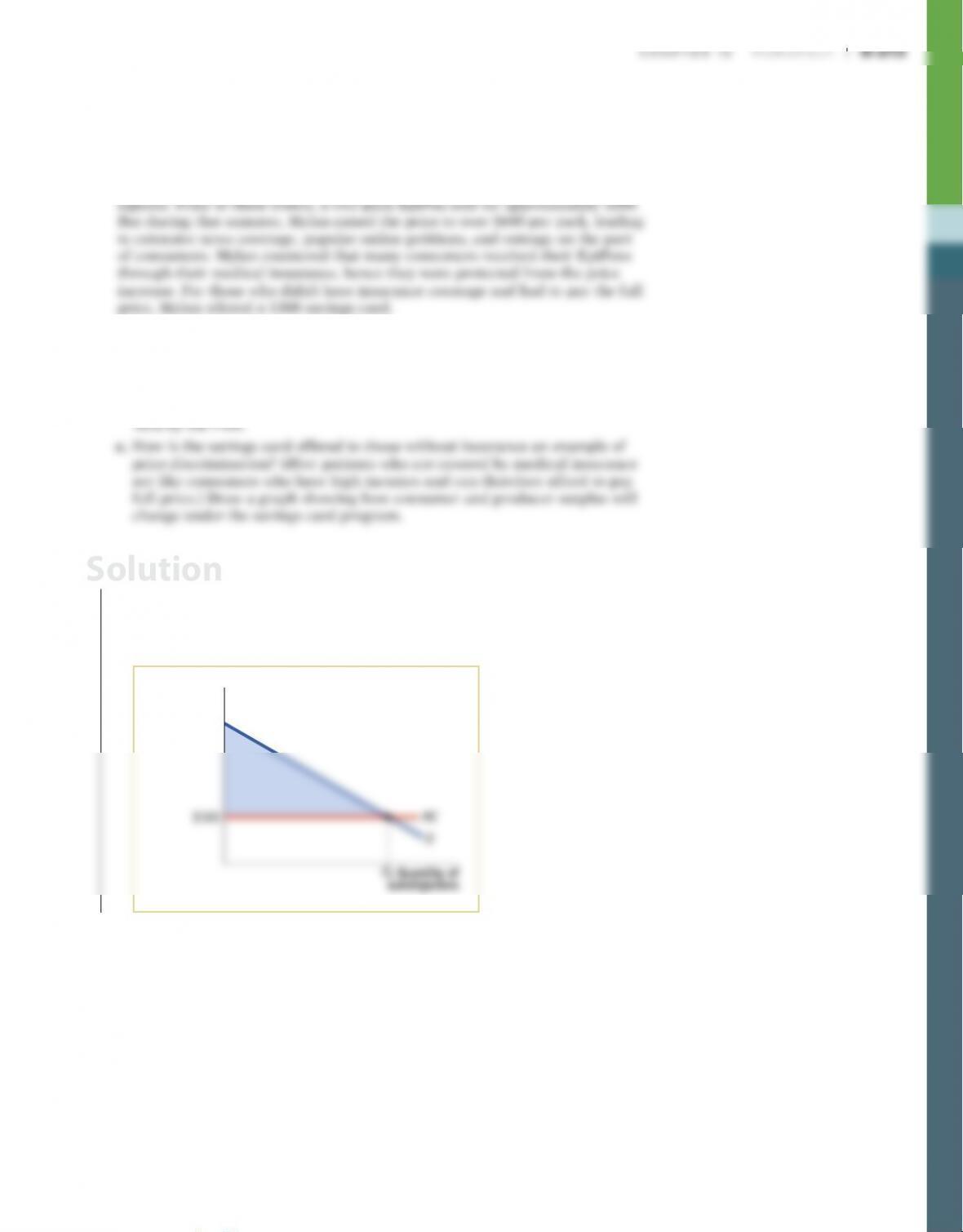
a. Draw a graph that shows consumer and producer surplus in a competitive
market for epinephrine autoinjectors. Assume firms have a constant marginal
cost of $100 per pack.
b. Next, using that graph, show how much consumer surplus, producer surplus,
and deadweight loss change after the Auvi-Q recall and the denied entry of
17. a. The accompanying diagram illustrates the competitive market for epinephrine
autoinjectors. With a constant marginal cost, firms will supply QC autoinjectors,
where marginal cost intersects demand. Consumer surplus is equal to the blue
shaded area above the marginal cost line and below the demand line. Since
price is set equal to marginal cost, firms will have zero producer surplus.
D
MC
autoinjectors
$100
Price,
cost of
autoinjector
Solution
S-214 Chapter 13 Monopoly
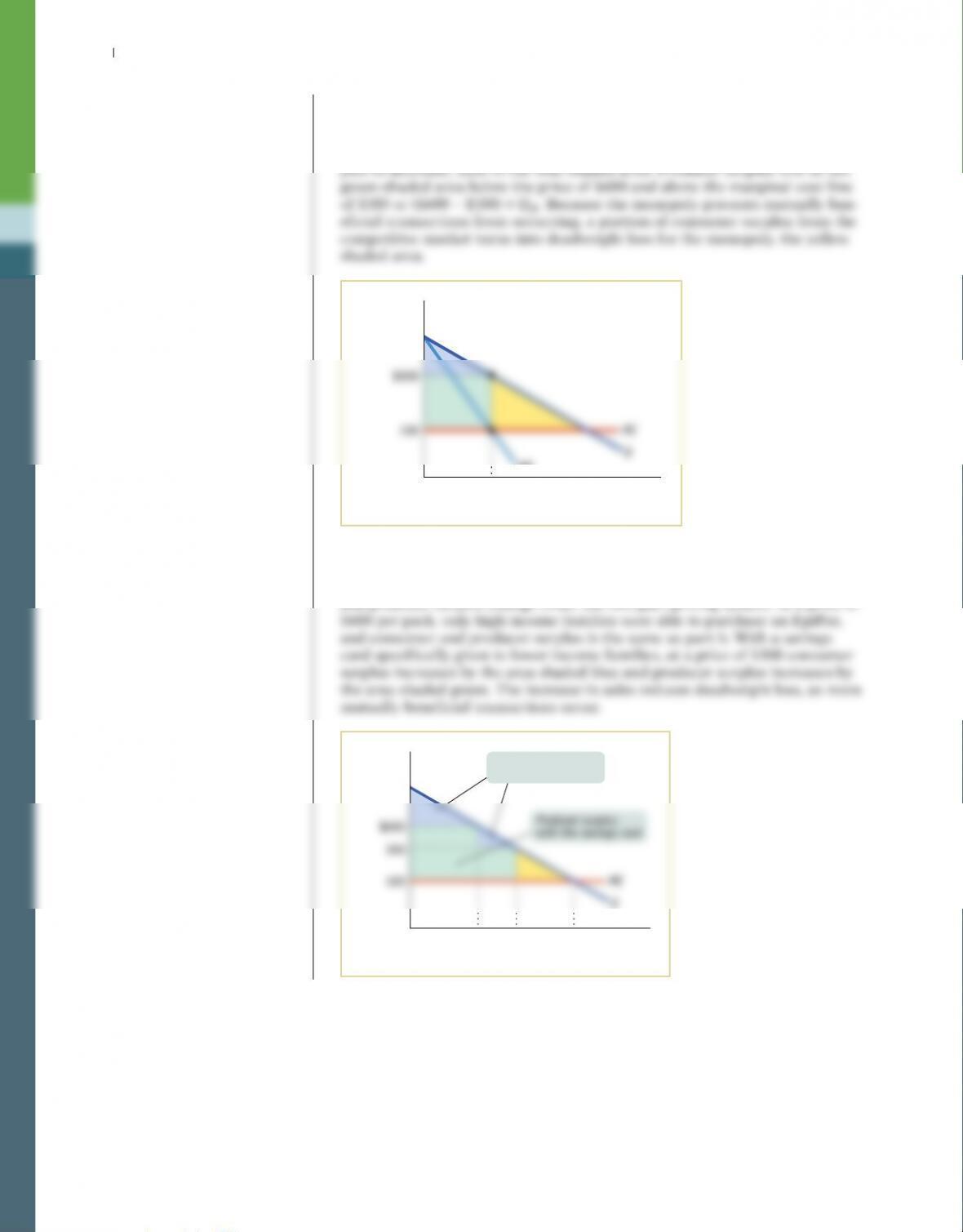
b. As Mylan is able to capture most of the market, the company will have a
downward sloping marginal revenue line. This is seen in the accompanying
diagram. As a result, Mylan will reduce quantity to QM and increase price to
$600 per pack. A higher price and lower quantity will cause consumer sur–
QM
MR
Quantity
of EpiPens
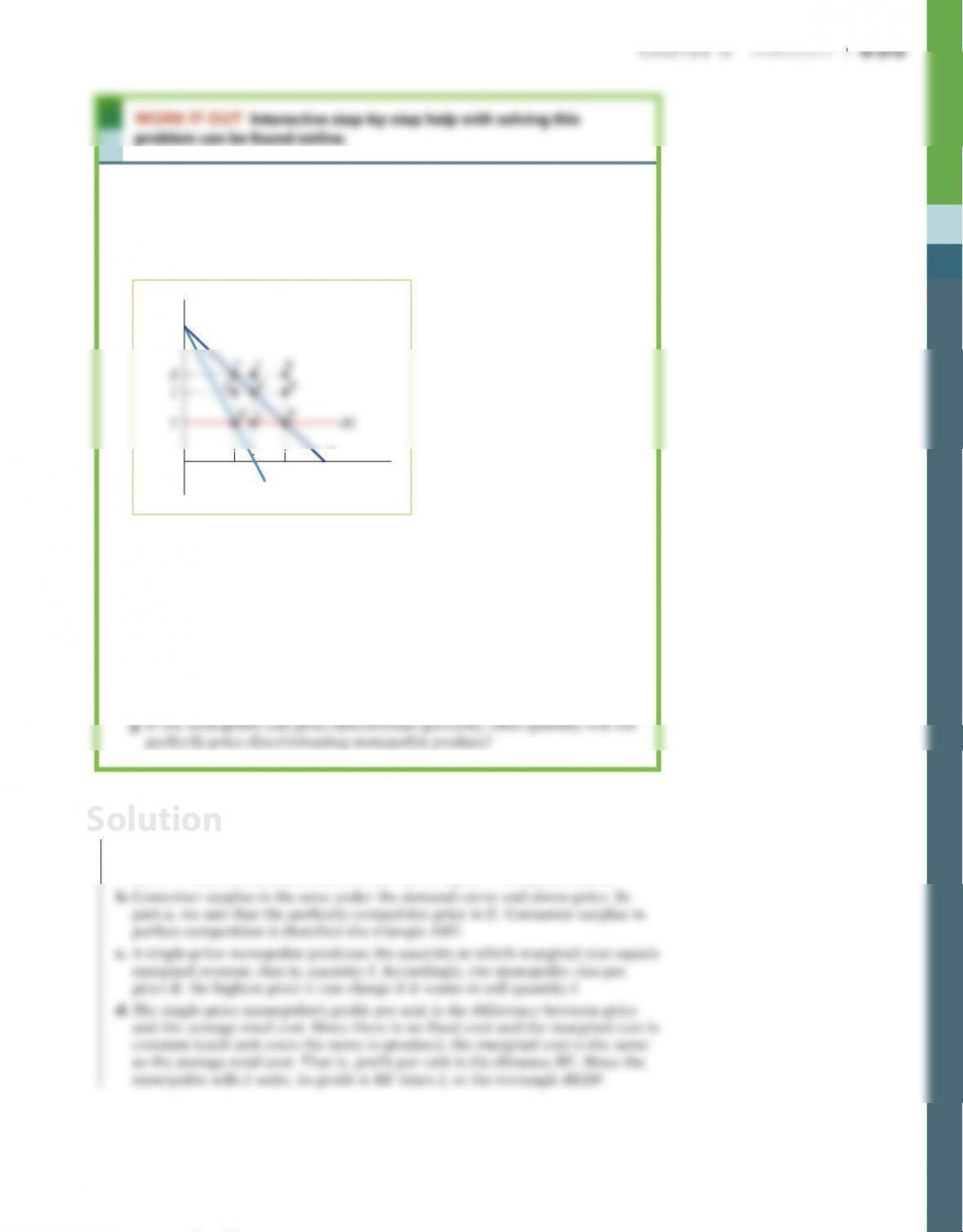
c. The savings card allows Mylan the ability to charge lower income families
a lower price. Mylan is price discriminating because they are charging two
prices for the same product. The accompanying graph shows how consumer
and producer surplus change under the two-part pricing system. At a price of
QC
QSC
QM
D
Quantity
of EpiPens
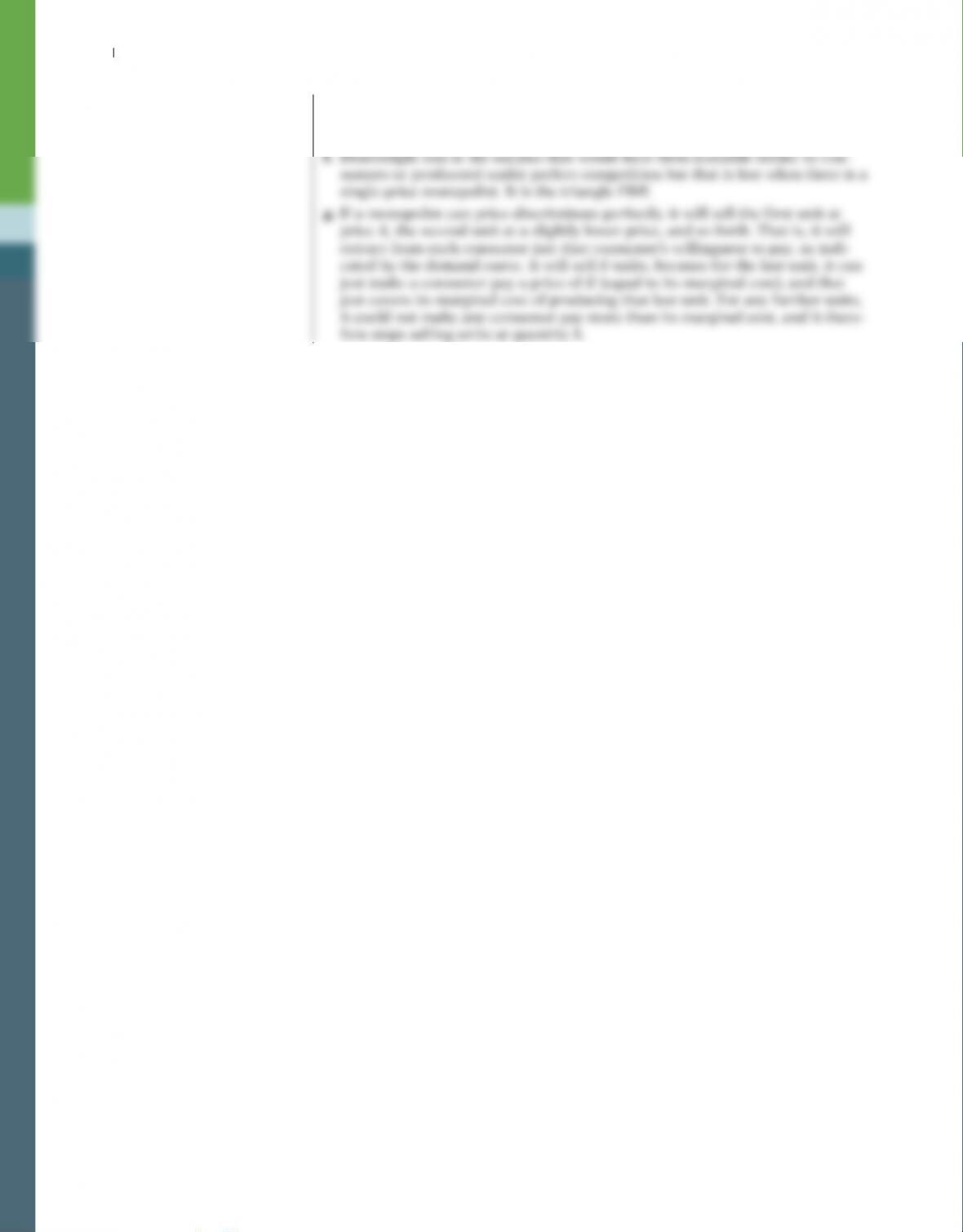
18. a. In a perfectly competitive industry, each firm maximizes profit by producing
the quantity at which price equals marginal cost. That is, all firms together
produce the quantity S, corresponding to point R, where the marginal cost
curve crosses the demand curve. Price will be equal to marginal cost, E.
18. Consider an industry with the demand curve (D) and marginal cost curve
(MC) shown in the accompanying diagram. There is no fixed cost. If the
industry is a single-price monopoly, the monopolist’s marginal revenue curve
would be MR. Answer the following questions by naming the
appropriate points or areas.
M
Price
A
MR
D
IST
JN
Quantity
a. If the industry is perfectly competitive, what will be the total quantity
produced? At what price?
b. Which area reflects consumer surplus under perfect competition?
c. If the industry is a single-price monopoly, what quantity will the monopo–
list produce? Which price will it charge?
d. Which area reflects the single-price monopolist’s profit?
e. Which area reflects consumer surplus under single-price monopoly?
f. Which area reflects the deadweight loss to society from single-price
monopoly?
Solution
S-216 Chapter 13 Monopoly
e. Consumer surplus is the area under the demand curve and above the price. In
part c, we saw that the monopoly price is B. Consumer surplus in monopoly is
therefore the triangle AFB.