Chapter 12:
1. Which of the following are most likely to be perfectly competitive?
a. Chicago Board of Trade
b. fast-food industry
c. computer software industry
d. New York Stock Exchange
e. clothing industry
Answer: A perfectly competitive market is approximated most closely by a highly
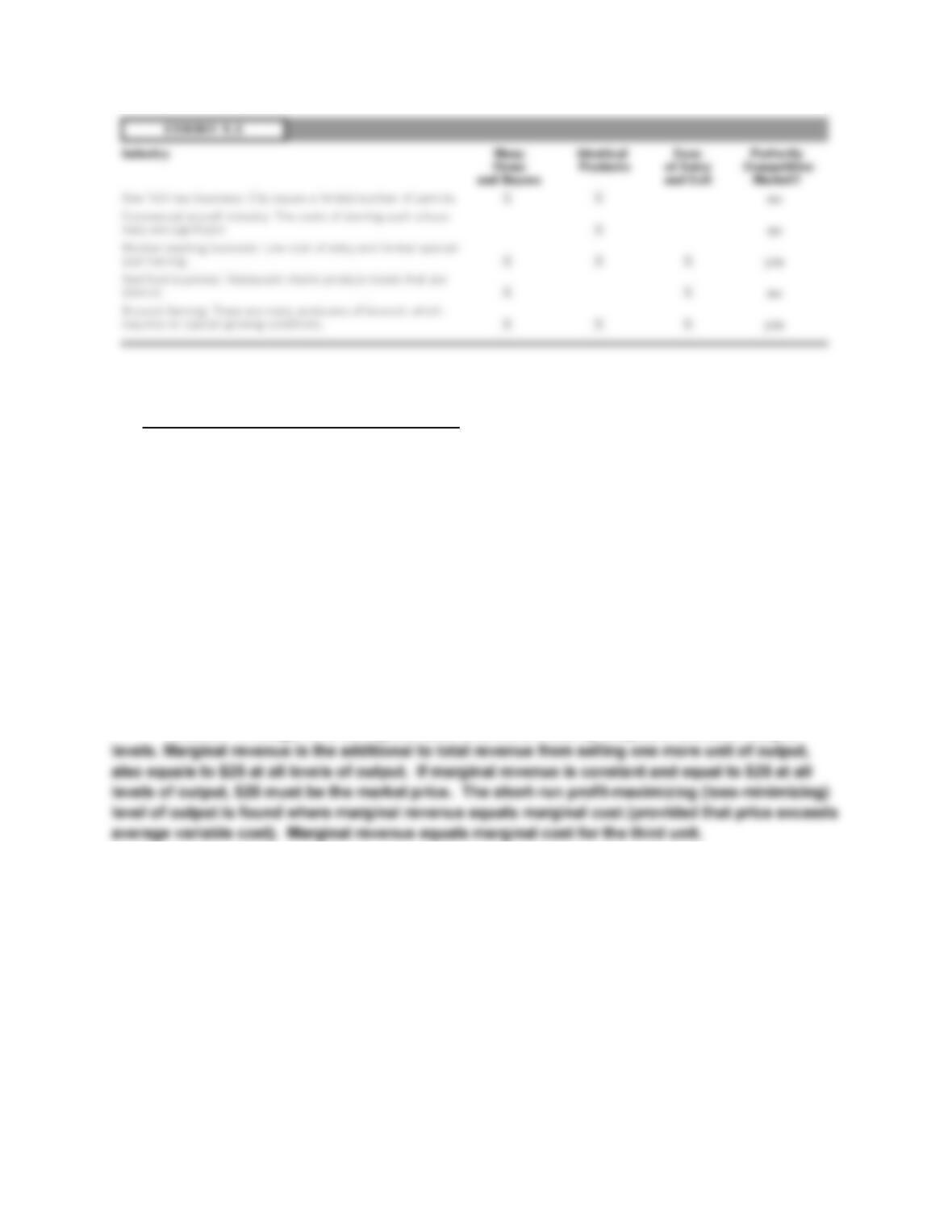
2. Using the following information, which of the industries described below are perfectly competitive?
Check the perfectly competitive market characteristics each industry possesses and determine whether it
is a perfectly competitive industry.
Perfectly
Many Firms Identical Ease of Entry Competitive
Industry and Buyers Products and Exit Market?
New York taxi business: City issues a limited
number of permits. ____
Commercial aircraft industry: The costs of starting
such a business are significant. ____
Window washing business: Low cost of entry and
limited specialized training. ____
Fast-food business: Restaurant chains produce
meals that are distinct. ____
Broccoli farming: There are many producers of
broccoli, which requires no special growing conditions. ____
Answer:
See Exhibit 9.1
3. Output Total Cost Total Revenue
0 $30 $ 0
1 45 25
2 65 50
3 90 75
4 120 100
5 155 125
Given these data, determine AR, MR, P, and the short-run profit-maximizing (loss-minimizing) level of
output.
Answer: Average revenue equals total revenue divided by output, or $25 at all output
4. Illustrate the SRATC, AVC, MC, and MR curves for a perfectly competitive firm that is operating at a
loss. What is the output level that minimizes losses? Why is it more profitable to continue producing in the
short run rather than shut down?
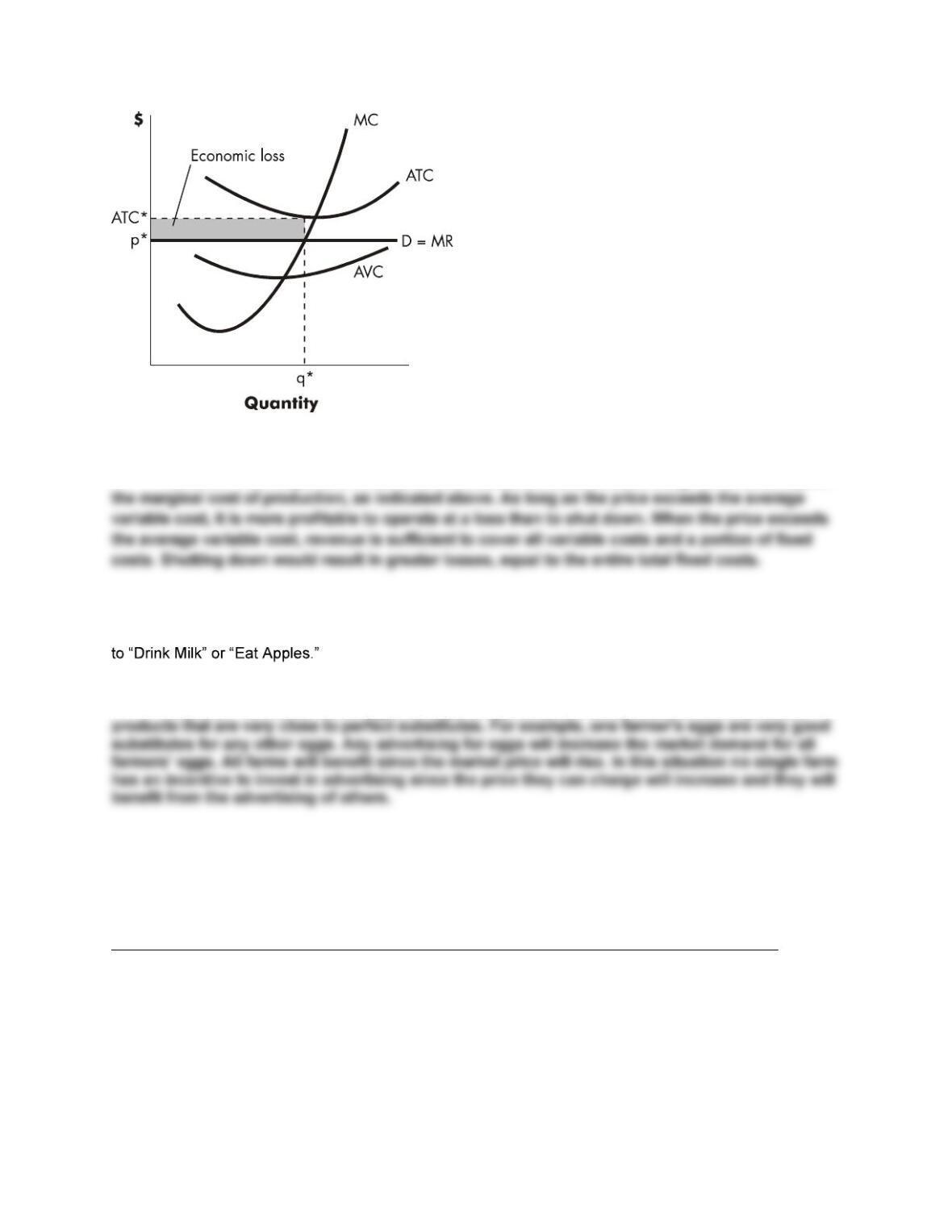
Answer: The output level that minimizes losses is located where marginal revenue equals
5. Industry councils promote the consumption of particular types of farm products. These groups urge us
Very little advertising is done by individual farmers. Using your
understanding of the perfectly competitive market, explain this advertising strategy.
Answer: Farms can be thought of as perfectly competitive businesses, which produce
6. Complete the following table and identify the profit-maximizing output.
a.
Total Marginal Marginal Total
Quantity Price Revenue Revenue Cost Profit
10 $12 $120 $12 $ 8 $25
11 12 ______ ______ 9 ______
12 12 ______ ______ 11 ______
13 12 ______ ______ 12 ______
14 12 ______ ______ 14 ______
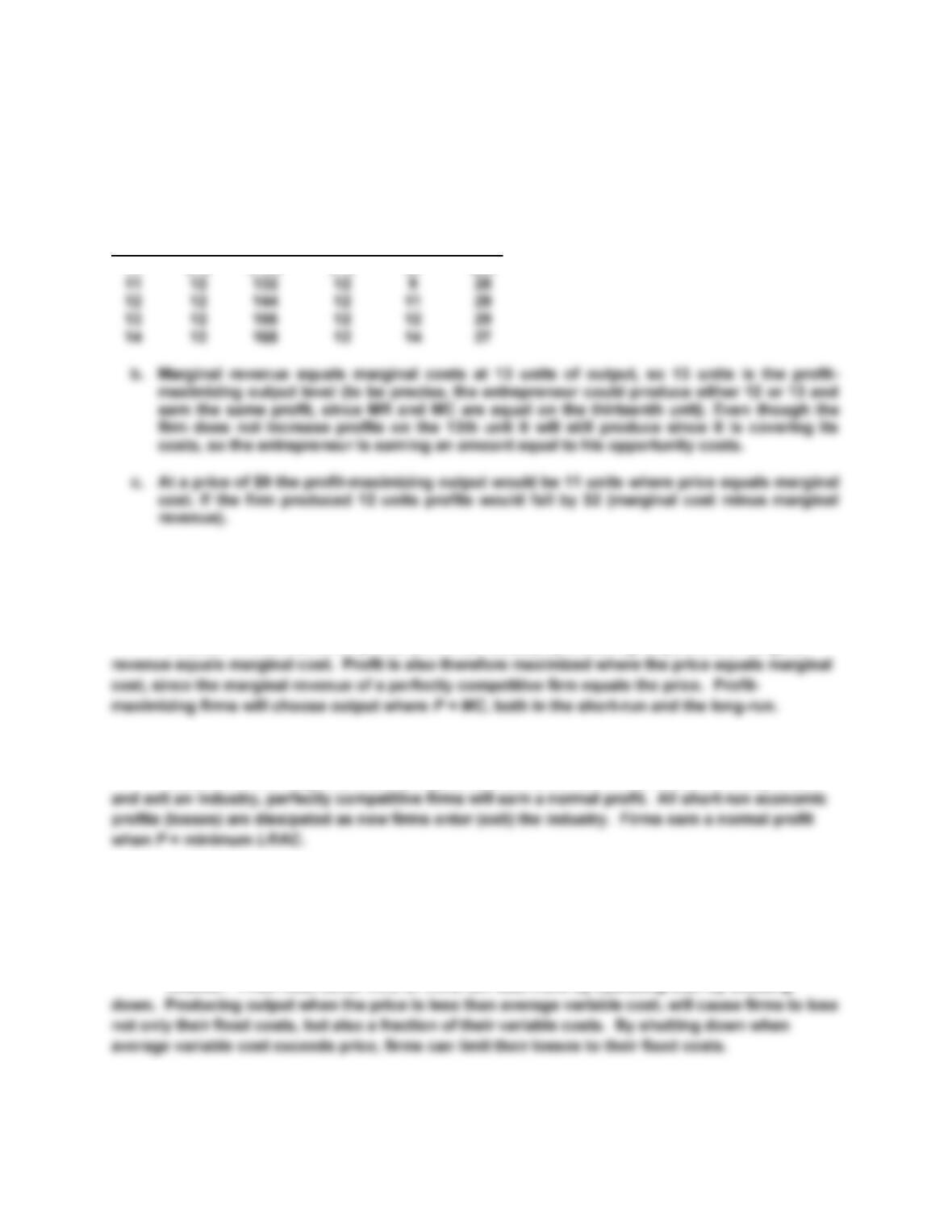
b.What is true about marginal revenue and marginal costs when profit is maximized?
c. What would be the profit-maximizing level of output if price fell to $9?
Answers:
a.
Total Marginal Marginal Total
Quantity Price Revenue Revenue Cost Profit
10 $12 $120 $12 $8 $25
7. Explain why the following conditions are typical under perfect competition in the long run.
a. P = MC
Answer: Firms maximize profits (minimize losses) by choosing output where marginal
b. P = minimum ATC
Answer: In the long run, when all inputs can be varied and firms are able to freely enter
8. Discuss the following questions.
a. Why must price cover AVC if firms are to continue to operate?
Answer: Price must cover AVC or firms will lose more by operating than by shutting
b. If the firm is covering its AVC but not all its fixed costs, will it continue to operate in the short run? Why
or why not?
Answer: Loss-minimizing (profit-maximizing) firms will continue to operate in the short–
c. Why is it possible for price to remain above the average total cost in the short run but not in the long
run?
Answer: In the short-run, when not all factors of production can be varied, a firm can
9. At a price of $5 the profit-maximizing output for a perfectly competitive firm is 1,000 units per year. If
What is the relationship between profit, price, and average total cost?
Answer: When average total cost is $3, profit will be total revenue (1000 times $5= $5000) minus
10. Use the following diagram to answer a, b, and c.
a.
and demand curve.
Answer:
b. Illustrate the effects of an
Answer:
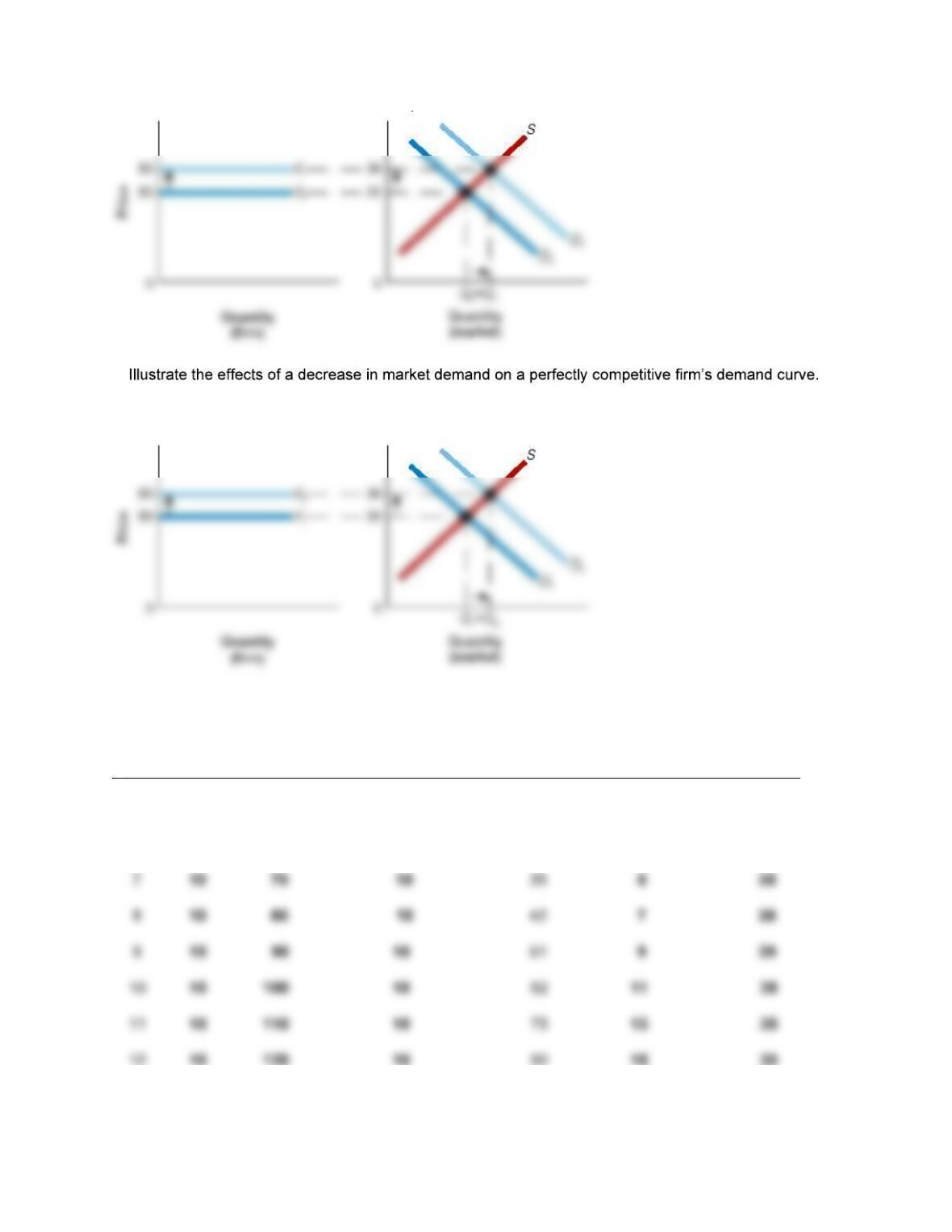
c.
Answer:
11. Complete the following table for a perfectly competitive firm, and indicate its profit-maximizing output.
Quantity Price Total Revenue Marginal Revenue Total Cost Marginal Cost Total Profit
6 $10 60 10 $30 $3 $30
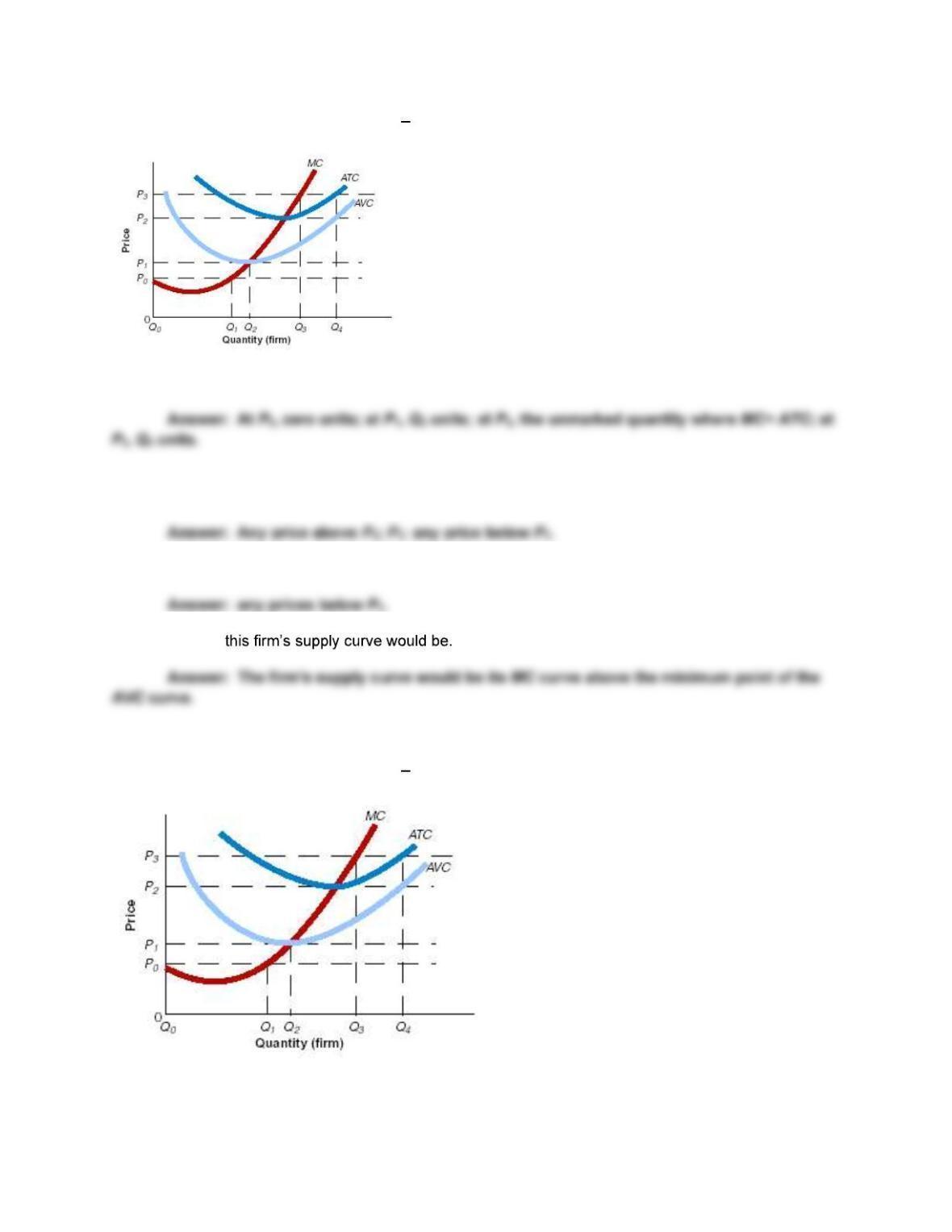
12. Use the following diagram to answer a d.
a. How much would a perfectly competitive firm produce at each of the indicated prices?
b. At which prices is the firm earning economic profits? Zero economic profits? Negative economic
profits?
c. At which prices would the firm shut down?
d. Indicate what
13. Use the following diagram to answer a d.
a. How much would a perfectly competitive firm produce at each of the indicated prices?
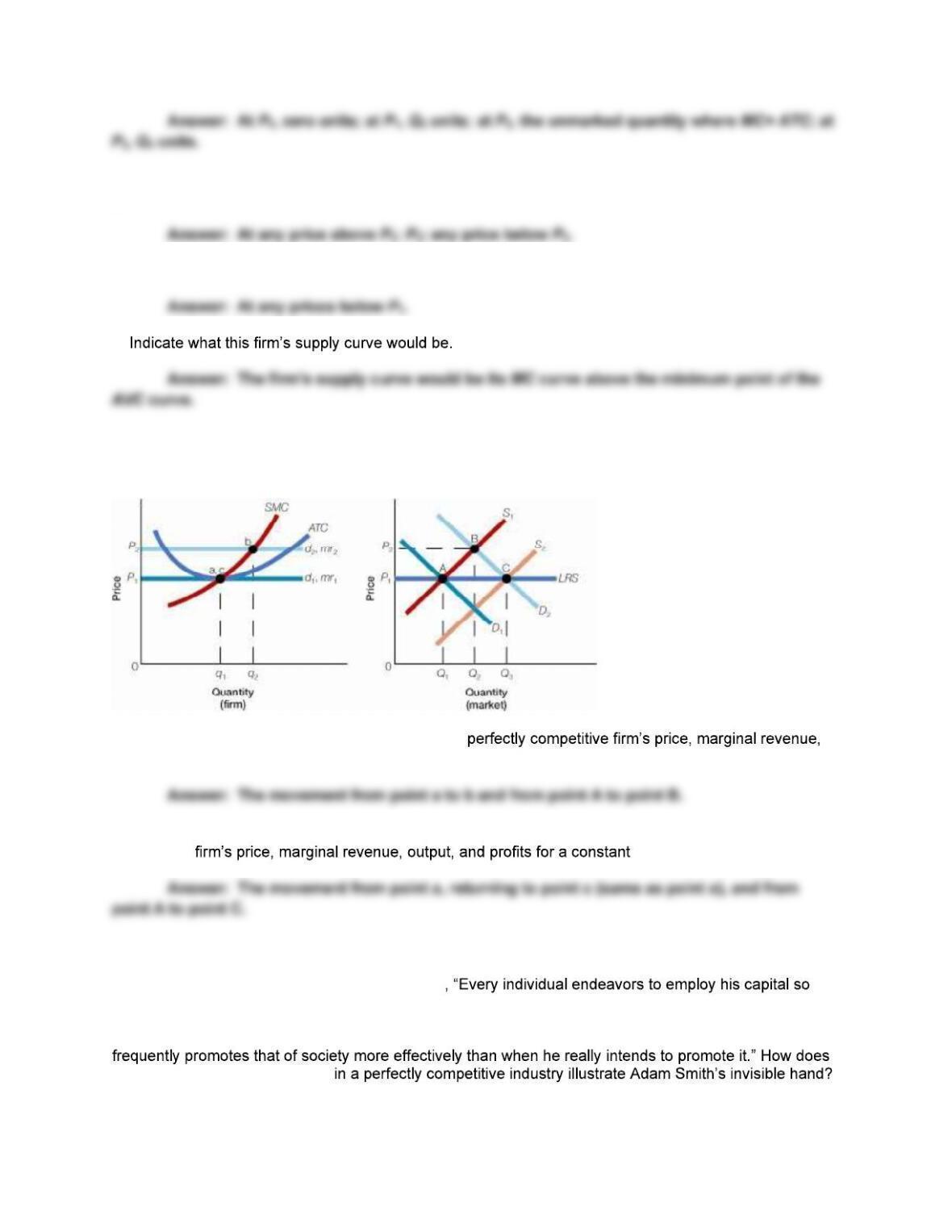
b. At which prices is the firm earning economic profits? Zero economic profits? Negative economic
profits?
c. At which prices would the firm shut down?
d.
14. Use the following diagrams to answer a and b.
a. Show the effect of an increase in demand on the
output, and profits in the short run.
b. Show the long-run effects of an increase in demand for the industry, and the effects on a perfectly
competitive -cost industry.
15. In The Wealth of Nations, Adam Smith wrote
that its produce may be of greatest value. He generally neither intends to promote the public interest, nor
knows how much he is promoting it. He intends only his own security, only his own gain. And he is led by
an invisible hand to promote an end which was no part of his intention. By pursuing his own interest he
the story of long-run equilibrium
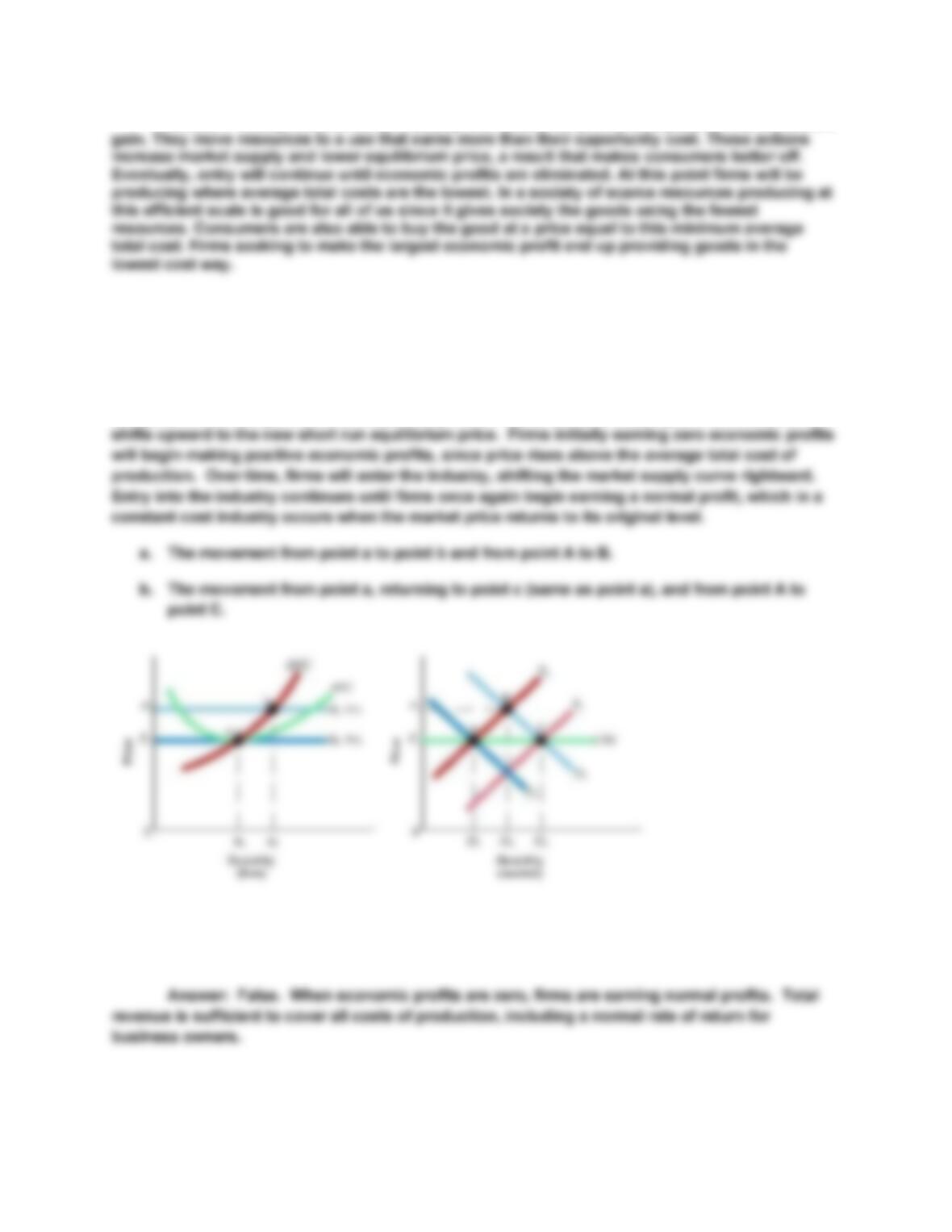
Answer: Entrepreneurs see an industry with economic profits as a place to maximize their
16. Graph and explain the adjustments to long-run equilibrium when market demand decreases in a
constant-cost industry.
Answer: An increase in market demand causes the market price to rise. Since a perfectly
competitive firm is a price taker, the perfectly elastic demand curve faced by an individual firm
17. Evaluate the following statements. Determine whether each is true or false and explain your answer.
a. If economic profits are zero, firms will exit the industry in the long run.
b. A firm cannot maximize profits without minimizing costs.
Answer: False. In the long run, a perfectly competitive firm maximizes profit at a level of
marginal cost.
c. If a firm is minimizing costs, it must be maximizing profits.
18. Describe what would happen to the industry supply curve and the economic profits of the firms in a
competitive industry if those firms were currently earning economic profits. What if they were currently
earning economic losses?
Answer: If firms are currently earning economic profits, that will attract entry into the
19. Given the industry description, identify each of the following as an increasing– or constant-cost
industry.
a. Major League Baseball: Uses the majority of pitchers. As the number of pitchers used increased, the
quality declines.
Answer: Increasing costs since more teams will bid up the price of good pitchers and
b. Fast-food restaurants: Uses a relatively small share of land and unskilled labor in most cities.
c. Trucking industry: Uses a large portion of the trained and experienced drivers, especially long-distance
drivers.