CHAPTER 12
FEDERAL BUDGETS AND PUBLIC POLICY
In this chapter, you will find:
Learning Outcomes
Chapter Outline with PowerPoint Script
INTRODUCTION
The first part of this chapter explains the federal budget process and the problems associated with
budgeting. The remainder focuses on the sources and effects of the relatively large peacetime deficits that
LEARNING OUTCOMES
12-1 Summarize how federal spending priorities have changed since the 1960s.
The federal budget is a plan of outlays and revenues for a specified period, usually a year. As you can
12-2 Explain why the federal budget has been in deficit in most years since the Great Depression. The
federal budget has been in deficit for all but 14 years since 1929, when the Great Depression began.
12-3 Outline what has happened to the federal debt in recent decades and how it compares with debt
levels in other countries.
12-4 Describe how a giant federal debt could have a negative impact on the economy.
Chapter 13 Federal Budgets and Public Policy 176
The Great Recession and policy responses to it have rocketed the federal deficit above $1 trillion and
sharply increased the national debt to a level that is not sustainable. Federal deficits of one generation
can affect the standard of living of the next generation, as a larger share of the budget goes toward
CHAPTER OUTLINE WITH POWERPOINT SCRIPT
USE POWERPOINT SLIDES 2-3 FOR THE FOLLOWING SECTION
The Federal Budget Process
• Federal budget: A plan for government outlays and revenues for a specified period, usually a year.
• Federal outlays: In 2013, 18% to national defense, 50% to Social Security, Medicare, and welfare, 6%
to pay interest on national debt; the remaining 26% covers everything else.
USE POWERPOINT SLIDES 4-6 FOR THE FOLLOWING SECTION
The Presidential Role in the Budget Process
• Begins a year before the budget is submitted to Congress.
• Early in the calendar year, the president submits The Budget of the United States Government to
the long run.
USE POWERPOINT SLIDE 7 FOR THE FOLLOWING SECTION
Problems with the Budget Process
• Continuing resolutions instead of budget decisions: agreements to allow agencies, in the absence of an
approved budget, to spend at the rate of the previous year’s budget
USE POWERPOINT SLIDE 8 FOR THE FOLLOWING SECTION
Possible Budget Reforms
Chapter 13 Federal Budgets and Public Policy 177
USE POWERPOINT SLIDES 9-11 FOR THE FOLLOWING SECTION
The Fiscal Impact of the Federal Budget
Rationale for Deficits:
• Justified for outlays that increase the economy’s productivity.
USE POWERPOINT SLIDES 12-16 FOR THE FOLLOWING SECTION
Federal Deficits Since the Birth of the Nation:
• Between 1789 and 1930 (the first full year of the Great Depression), the federal budget was in deficit
33% of the years.
• Since the Great Depression, federal budgets have been in deficit 85% of the years.
Why Have Deficits Persisted? Since 1930, the federal budget has been in deficit for all but twelve years.
USE POWERPOINT SLIDES 17-18 FOR THE FOLLOWING SECTION
Deficits, Surpluses, Crowding Out, and Crowding In: Impact of government deficits and surpluses on
interest rates.
• Crowding out: Deficit spending reduces the supply of national saving, thus raising interest rates
which discourage some private investment, thereby reducing the expansionary effects of the deficit.
USE POWERPOINT SLIDES 19-24 FOR THE FOLLOWING SECTION
Chapter 13 Federal Budgets and Public Policy 178
The Short-lived Budget Surplus: In 1990 the deficit was 3.8% of GDP; by 1998 there was a surplus
which lasted through 2001.
• Tax Increases: 1990 President George H.W. Bush agreed to a package of spending cuts and tax
increases. This may have cost him reelection; it laid the foundation for erasing the budget deficit.
USE POWERPOINT SLIDES 25-26 FOR THE FOLLOWING SECTION
The Relative Size of the Public Sector
USE POWERPOINT SLIDES 27-31 FOR THE FOLLOWING SECTION
The National Debt: Measures the net accumulation of past deficits; the amount owed by the federal
government.
Measuring the National Debt
• Gross debt: Includes U.S. Treasury securities purchased by various federal agencies.
USE POWERPOINT SLIDES 32-33 FOR THE FOLLOWING SECTION
Interest on the National Debt: Most government securities are short term. An increase in nominal
interest rates increases annual interest costs.
USE POWERPOINT SLIDES 34-36 FOR THE FOLLOWING SECTION
Are Persistent Deficits Sustainable?
• At some point chronic deficits may accumulate into such a debt that lenders demand an extremely
Chapter 13 Federal Budgets and Public Policy 179
USE POWERPOINT SLIDES 37-38 FOR THE FOLLOWING SECTION
Who Bears the Burden of the Debt? Deficit spending is a way of billing future taxpayers for current
spending. To what extent do deficits and debt shift the burden to future generations?
USE POWERPOINT SLIDES 39-41 FOR THE FOLLOWING SECTION
Crowding Out and Capital Formation: The long-run effect of deficit spending depends on how the
government spends the borrowed funds.
CHAPTER SUMMARY
The federal budget process suffers from a variety of problems, including overlapping committee
jurisdictions, lengthy budget deliberations, budgeting by continuing resolutions, budgeting in too much
detail, failure to distinguish between operating costs and capital costs, and a lack of control over most of
the budget. Suggested improvements include instituting a biennial budget, budgeting in less detail, and
distinguishing between an operating budget and a capital budget.
After peaking at $290 billion in 1992, the federal deficit turned into a surplus by 1998 because of higher
tax rates, reduced outlays especially for defense, declining interest rates, and a strengthening economy
fueled by growing labor productivity.
The recession of 2001 and terrorist attacks prompted tax cuts to “get the economy moving again.” The
weak recovery plus the tax cuts and federal spending increases all contributed to a growing federal deficit,
which topped $400 billion in 2004. But by 2007 the economy added more than 8 million jobs which
helped cut the federal deficit by more than 50 percent. The deficit is projected to grow again because of
the deep recession of 2008–2009 and increased government spending on stimulus and bailout programs.
The longer term looks even bleaker as baby boomers begin retiring.
Chapter 13 Federal Budgets and Public Policy 180
TEACHING POINTS
1. The potential consequences of the budget deficits should be of considerable interest to students.
You may want to have students compare the experience of the Japanese since 1993 (deficit spending
2. This chapter contains sections that deal with the practical aspects of budget making. Most people
are unfamiliar with this process, although it is of great importance. In fact, the process itself is some-
3. A question that often arises in class is why deficits rose so much during the 1980s. There is no sin-
gle answer to this question, but here are some key points to stress:
a. Taxes were cut in the early 1980s, the so-called Kemp-Roth cuts.
SOLUTIONS TO PROBLEMS APPENDIX
1. (Changing Budget Priorities) What spending category claimed the largest share of federal
outlays during the 1960s? How about during the most recent decade?
National defense accounted for about half of all federal outlays in 1960. That share declined
Chapter 13 Federal Budgets and Public Policy 181
2. (The Federal Budget Process) The federal budget passed by Congress and signed by the
president shows the relationship between budgeted expenditures and projected revenues. Why
does the budget require a forecast of the economy? Under what circumstances would actual
government spending and tax revenue fail to match the budget as approved?
Certain expenditure items are not under congressional control, they are set by existing laws.
Entitlement programs provide benefits for anyone meeting the eligibility guidelines. Budgeted
3. (Budget Philosophies) Explain the differences among an annually balanced budget, a cyclically
balanced budget, and functional finance. How does each affect economic fluctuations?
An annually balanced budget has government revenues matching government spending in each
4. (Chronic Deficits) Why has the federal budget been in deficit in all but 14 years since 1929?
The federal budget has been in deficit for all but 14 years since 1929, when the Great De-
Chapter 13 Federal Budgets and Public Policy 182
5. (Federal Debt) What has happened to the federal debt since 2008 as measured relative to
GDP?
The recession of 2009–2010 and policy responses to it have rocketed the federal deficit above
6. (Net Public Debt) What’s the level of net public debt (for federal, state, and local govern-
ments) relative to U.S. GDP? How does the U.S. measure compare with that of other major
economies?
The federal or national debt is a stock variable measuring the net accumulation of past defi-
7. (Debt Measures) What’s the difference between gross federal debt and federal debt held by
the public?
In talking about the national debt, we should distinguish between the gross debt and debt
8. (The National Debt) Try the following exercises to better understand how the national debt is
related to the government’s budget deficit.
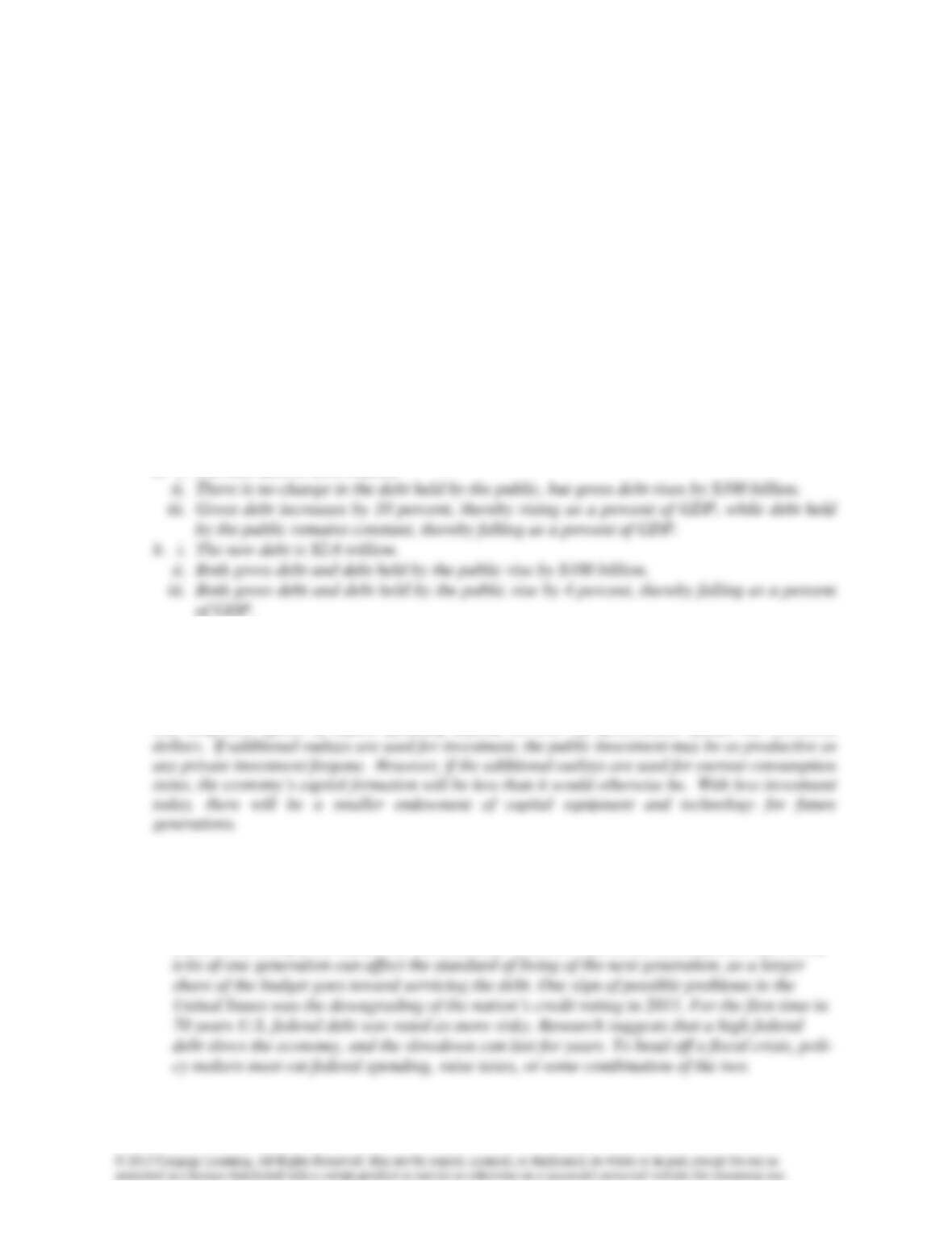
a. Assume that the gross national debt initially is equal to $3 trillion and the federal govern-
ment then runs a deficit of $300 billion:
Chapter 13 Federal Budgets and Public Policy 183
i. What is the new level of gross national debt?
ii. If 100 percent of the deficit is financed by the sale of securities to federal agencies, what
happens to the amount of debt held by the public? What happens to the level of gross
debt?
iii. If GDP increased by 5 percent in the same year that the deficit is run, what happens to
gross debt as a percentage of GDP? What happens to the level of debt held by the public
as a percentage of GDP?
b. Now suppose that the gross national debt initially is equal to $2.5 trillion and the federal
government then runs a deficit of $100 billion:
i. What is the new level of gross national debt?
ii. If 100 percent of the deficit is financed by the sale of securities to the public, what happens
to the level of debt held by the public? What happens to the level of gross debt?
iii. If GDP increases by 6 percent in the same year as the deficit is run, what happens to gross
debt as a percentage of GDP? What happens to the level of debt held by the public as a
percent of GDP?
a. i. The new debt is $3.3 trillion.
9. (Crowding Out and Capital Formation) In earlier chapters, we’ve seen that the government can
increase GDP in the short run by running a budget deficit. What are some long-term effects of
deficit spending?
The long-term effects of deficit spending depend on how the government spends the borrowed
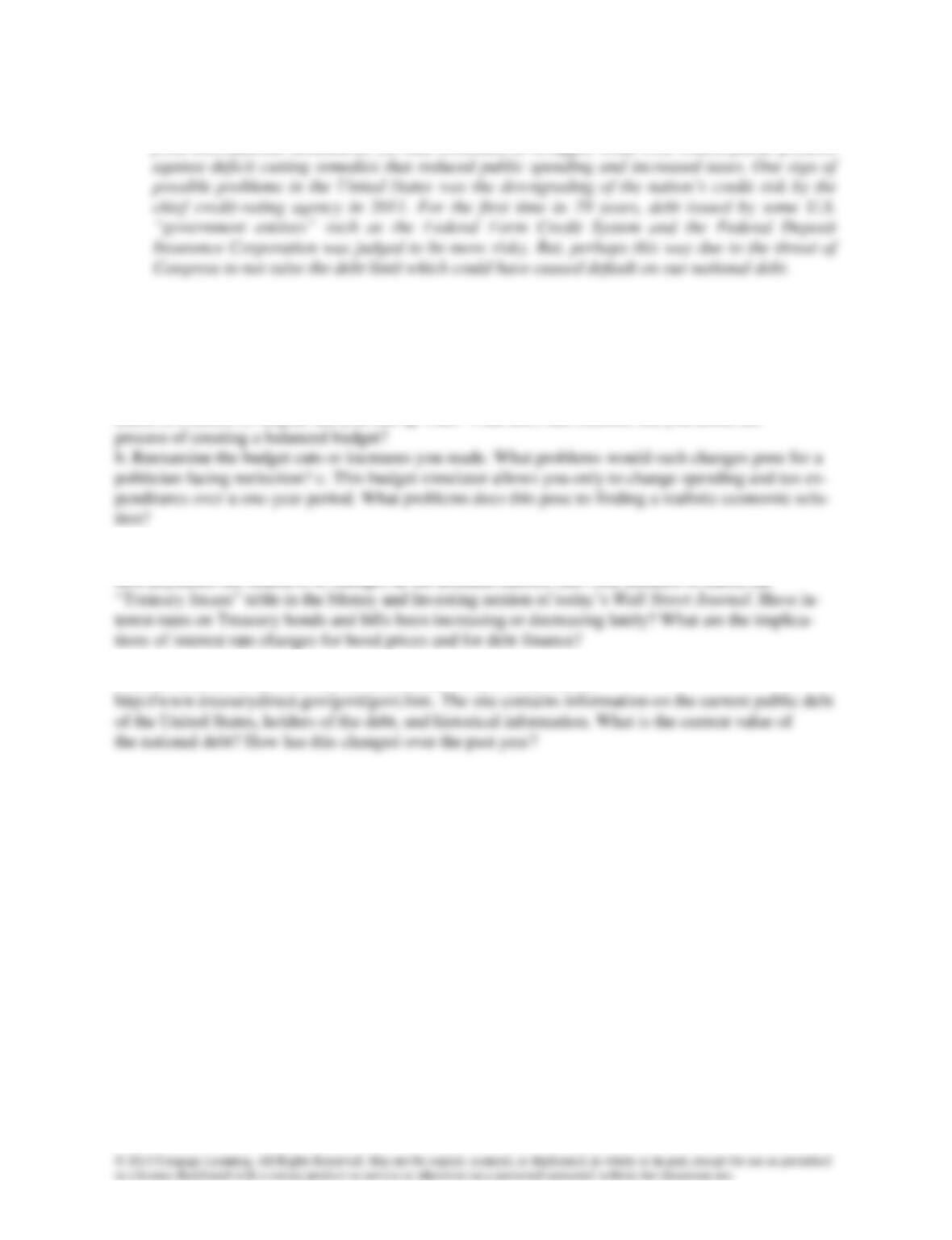
10. (Sustainability of Federal Debt) Are large federal deficits and a growing federal debt sustain-
able? What can be learned from the experiences of other countries?
The Great Recession and policy responses to it have rocketed the federal deficit above $1
trillion and sharply increased the national debt to a level that is not sustainable. Federal def-
Chapter 13 Federal Budgets and Public Policy 184
Indebted countries such as Greece, Ireland, Spain, and Portugal all received rescue packages
from international institutions, yet they continued to struggle, some with violent public protests
Experiential Assignments
1. Have students try their hand at balancing the federal budget by using Nathan Newman’s National
Budget Simulation at http://www.nathannewman.org/nbs/. Questions for students:
a. Develop a budget and see what happens. Were you successful in balancing the budget? If not, how
much of a deficit or surplus did you end up with? What does this exercise tell you about the
2. The government pays billions of dollars in interest each year to finance the national debt. Those
debt payments are sensitive to changes in the nominal interest rate. Ask students to check the
3. Send students to the Web site for the Bureau of the Public Debt at