Chapter 12
MONOPOLY AND MONOPSONY
QUESTIONS AND ANSWERS
Q12.1 Describe the monopoly market structure and provide some examples.
Q12.1 ANSWER
Monopoly is a market structure characterized by a single seller of a highly differentiated
product. Because a monopolist is the sole provider of a desired commodity, the
monopolist is the industry. Although the producer of every product faces at least some
Q12.2 From a social standpoint, what is the problem with monopoly?
Q12.2 ANSWER
The problem with monopoly from a social standpoint is that it leads to an inefficient
Q12.3 Why are both industry and firm demand curves downward sloping in monopoly
markets?
Q12.3 ANSWER
In monopoly, the firm is the industry. Thus, firm and industry demand and supply
Monopoly and Monopsony 371
Q12.4 Give an example of monopoly in the labor market. Discuss such a monopoly’s effect on
wage rates and on inflation.
Q12.4 ANSWER
With industrialization came a growing concentration on the purchase of labor services,
Q12.5 Given the difficulties encountered with utility regulation, it has been suggested that
nationalization might lead to a more socially optimal allocation of resources. Do you
agree? Why or why not?
Q12.5 ANSWER
This question is, of course, very subjective. However, experience suggests that
economic efficiency is best served by vigorous competition in the marketplace. With
Q12.6 Antitrust statutes in the United States have been used to attack monopolization by big
business. Does labor monopolization by giant unions have the same potential for the
misallocation of economic resources?
Q12.6 ANSWER
Economically speaking, the monopolization of labor can be as harmful as is the
372 Chapter 12
Q12.7 When will an increase in the minimum wage increase employment income for unskilled
laborers? When will it cause this income to fall? Based on your experience, which is
more likely?
Q12.7 ANSWER
Demand analysis indicates that an increase in price will increase total revenue so long as
demand is inelastic (|εP| < 1). Similarly, an increase in the minimum wage will increase
Q12.8 Explain why state tax rates on personal income vary more on a state-by-state basis than
do corresponding tax rates on corporate income.
Q12.8 ANSWER
In considering state tax rates, it is interesting to note a greater variance from state to state
in personal as opposed to corporate tax rates. This phenomena can be explained by the
Q12.9 Do the U.S. antitrust statutes protect competition or competitors? What is the
difference?
Q12.9 ANSWER
U.S. antitrust statutes are meant to protect competition (the “fight”), rather than currently
active competitors (the “fighters”). Vigorous competition sometimes results in
Monopoly and Monopsony 373
Q12.10 Describe the economic effects of countervailing power, and cite examples of markets in
which countervailing power is observed.
Q12.10 ANSWER
Countervailing power exists in a market when buyer market power is used to offset the
SELF-TEST PROBLEMS AND SOLUTIONS
ST12.1 Capture Problem. It remains a widely held belief that regulation is in the public interest
and influences firm behavior toward socially desirable ends. However, in the early
1970s, Nobel laureate George Stigler and his colleague Sam Peltzman at the University
of Chicago introduced an alternative capture theory of economic regulation. According
Types of state favors commonly sought by regulated industries include direct
money subsidies, control over entry by new rivals, control over substitutes and
complements, and price fixing. Domestic “air mail” subsidies, Federal Deposit
Insurance Corporation (FDIC) regulation that reduces the rate of entry into commercial
banking, suppression of margarine sales by butter producers, price fixing in motor
carrier (trucking) regulation, and American Medical Association control of medical
training and licensing can be interpreted as historical examples of control by regulated
industries.
performance. Unlike capture theory, a traditional view has been that the public can
trust regulators to make a good-faith effort to establish regulatory policy in the public
interest.
A. The aim of antitrust and regulatory policy is to protect competition, not to protect
competitors. Explain the difference.
B. Starting in the 1970s, growing dissatisfaction with traditional approaches to
government regulation led to a global deregulation movement that spurred
competition, lowered prices, and resulted in more efficient production. Explain
how this experience is consistent with the capture theory of regulation.
ST12.1 SOLUTION
A. Entry and exit are common facts of life in competitive markets. Firms that efficiently
produce goods and services that consumers crave are able to boost market share and
enjoy growing revenues and profits. Firms that fail to measure up in the eyes of
Monopoly and Monopsony 375
B. Although it is difficult to pinpoint a single catalyst for the deregulation movement, it is
hard to overlook the role played by George Stigler, Sam Peltzman, Alfred E. Kahn, and
other economists who documented how government regulation can sometimes harm
consumer interests. A study by the Brookings Institution documented important benefits
deregulation offers benefits in the sense of permitting greater customer choice.
Although many industries have felt the effects of changing state and local
regulation, changing federal regulation has been most pronounced in the financial,
telecommunications, and transportation sectors. Since 1975, for example, it has been
illegal for securities dealers to fix commission rates. This broke a 182-year tradition
In Canada, the deregulation movement led to privatization of government-owned
Air Canada. Trucking, historically a regulated industry, also was deregulated.
C. A significant problem with regulation is that regulators seldom have the information or
expertise to specify, for example, the correct level of utility investment, minimum
transportation costs, or the optimum method of pollution control. Because technology
changes rapidly in most regulated industries, only industry personnel working at the
Although some think that there is simply a question of regulation versus
deregulation, this is seldom the case. On grounds of economic and political feasibility, it
ST12.2 Deadweight Loss From Monopoly. The Las Vegas Valley Water District (LVVWD) is a
not-for-profit agency that began providing water to the Las Vegas Valley in 1954. The
District helped build the city’s water delivery system and now provides water to more
than one million people in Southern Nevada. District water rates are regulated by law
and can cover only the costs of water delivery, maintenance, and facilities. District
water rates are based on a four-tier system to encourage conservation. The first tier
represents indoor usage for most residential customers. Rate for remaining tiers
becomes increasingly higher with the amount of water usage.
To document the deadweight loss from monopoly problem, allow the monthly
market supply and demand conditions for water in the Las Vegas Water District to be:
QS = 10P (Market Supply)
Monopoly and Monopsony 377
QD = 120 – 40P (Market Demand)
where Q is water and P is the market price of water. Water is sold in units of one
thousand gallons, so a $2 price implies a user cost of 0.2 cents per gallon. Water
demand and supply relations are expressed in terms of millions of units.
A. Graph and calculate the equilibrium price/output solution. How much consumer
surplus, producer surplus, and social welfare is produced at this activity level?
B. Use the graph to help you calculate the quantity demanded and quantity supplied
if the market is run by a profit-maximizing monopolist. (Note: If monopoly market
demand is P = $3 – $0.025Q, then the monopolist’s MR = $3 – $0.05Q)
C. Use the graph to help you determine the deadweight loss for consumers and the
producer if LVVWD is run as an unregulated profit-maximizing monopoly.
D. Use the graph to help you ascertain the amount of consumer surplus transferred to
producers following a change from a competitive market to a monopoly market.
How much is the net gain in producer surplus?
ST12.2 SOLUTION
A. The market supply curve is given by the equation
or, solving for price,
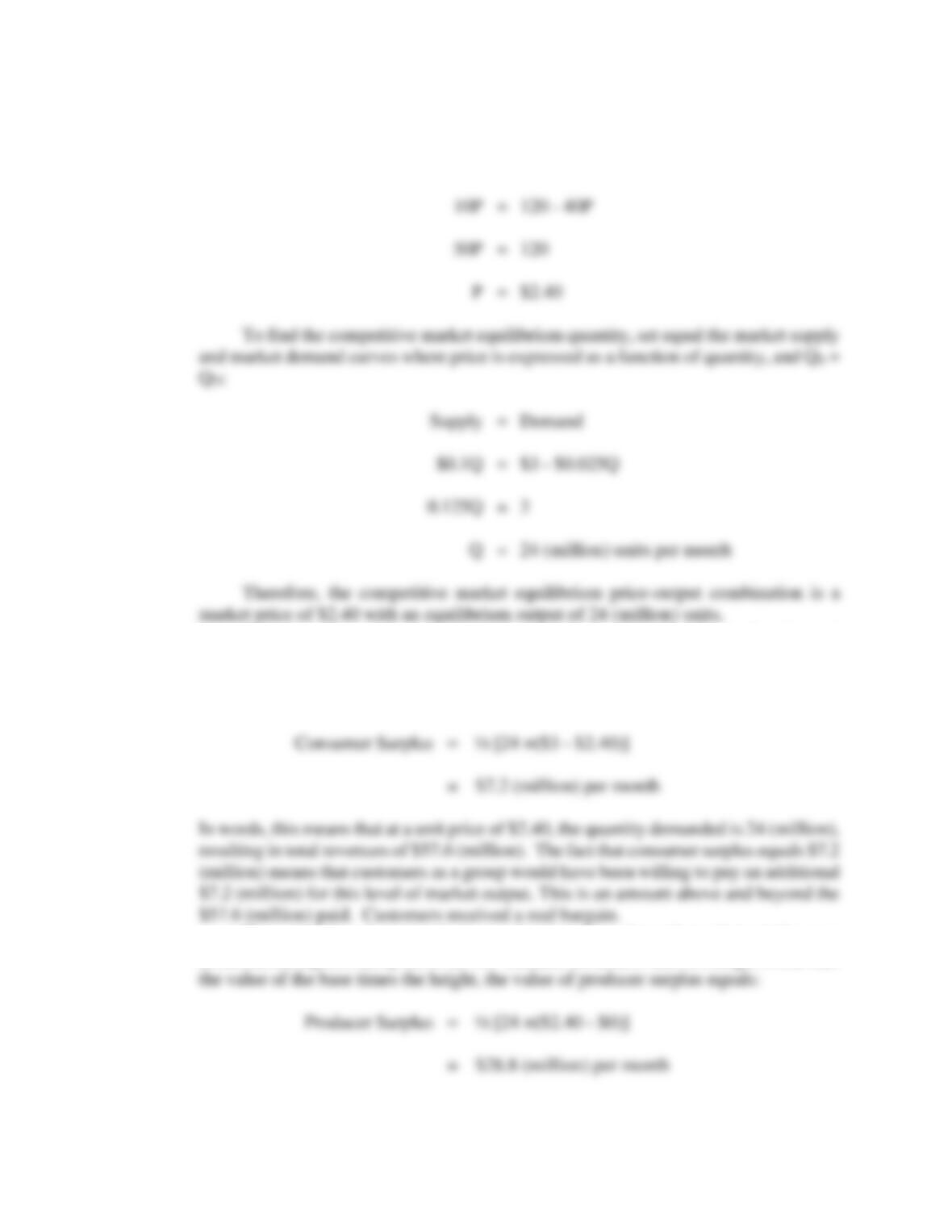
378 Chapter 12
The value of consumer surplus is equal to the region under the market demand
curve that lies above the market equilibrium price of $2.40. Because the area of such a
triangle is one-half the value of the base times the height, the value of consumer surplus
equals:
The value of producer surplus is equal to the region above the market supply curve
at the market equilibrium price of $2.40. Because the area of such a triangle is one-half
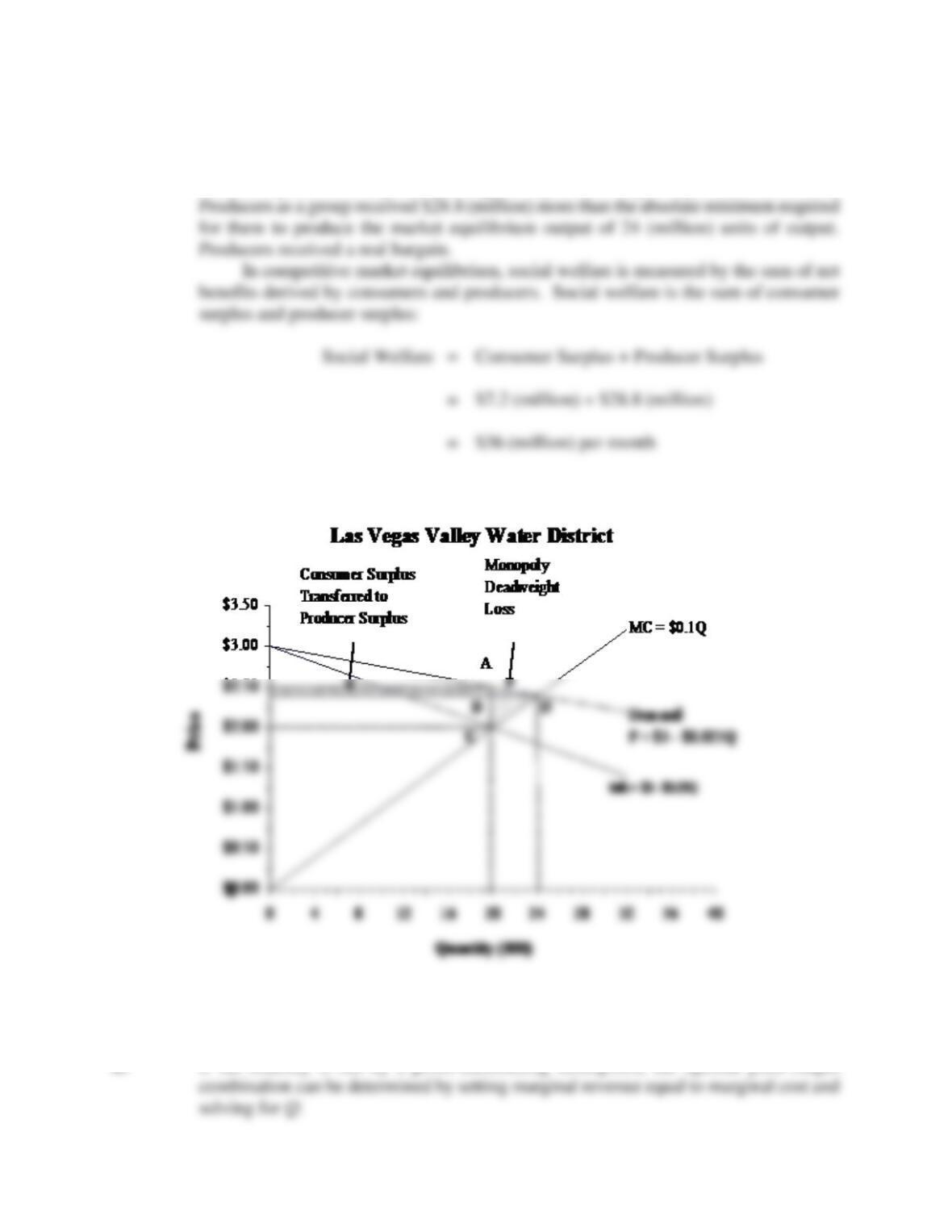
Monopoly and Monopsony 379
At a water price of $2.40 per thousand gallons, producer surplus equals $28.8 (million).
B. If the industry is run by a profit-maximizing monopolist, the optimal price-output
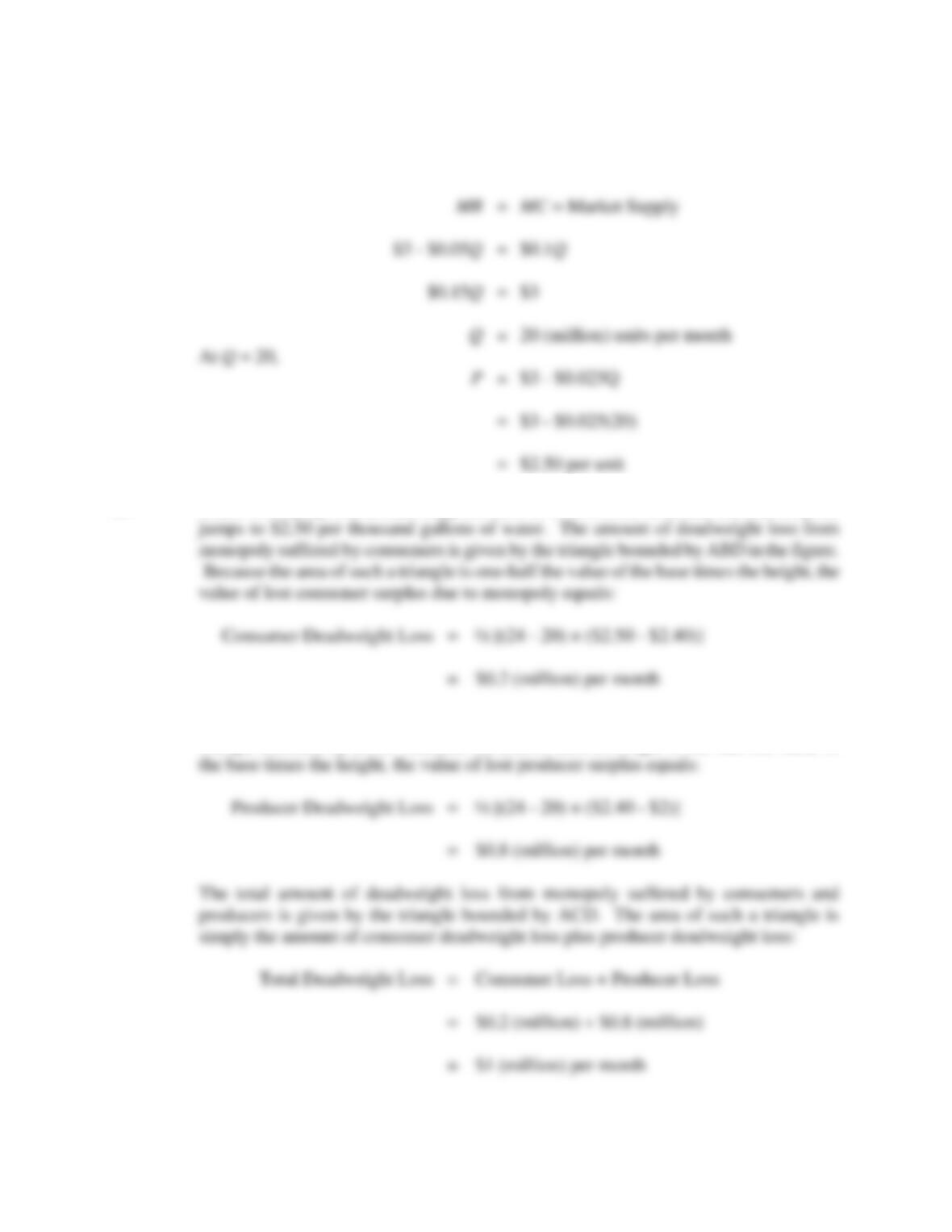
380 Chapter 12
C. Under monopoly, the amount supplied falls to 20 (million) units and the market price
The amount of deadweight loss from monopoly suffered by producers is given by the
triangle bounded by BCD. Because the area of such a triangle is one-half the value of
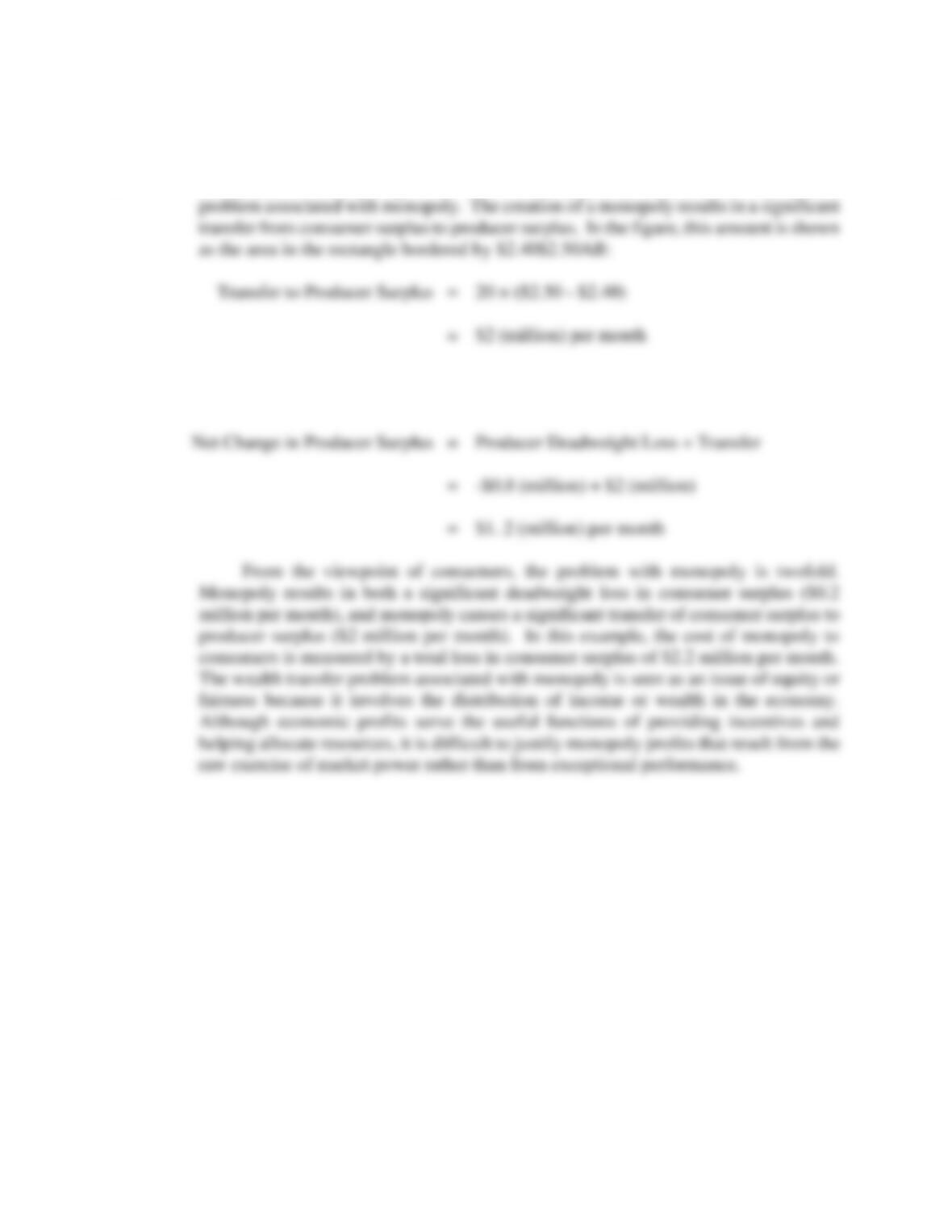
Monopoly and Monopsony 381
D. In addition to the deadweight loss from monopoly problem, there is a wealth transfer
Therefore, from the viewpoint of the producer, the change to monopoly results in a very
favorable net increase in producer surplus:
PROBLEMS AND SOLUTIONS
P12.1 Monopoly Concepts. Indicate whether each of the following statements is true or false,
and explain why.
A. The Justice Department generally concerns itself with significant or flagrant
offenses under the Sherman Act, as well as with mergers for monopoly covered by
Section 7 of the Clayton Act.
B. When a single seller is confronted in a market by many small buyers, monopsony
power enables the buyers to obtain lower prices than those that would prevail in a
competitive market.
C. A natural monopoly results when the profit-maximizing output level occurs at a
point where long-run average costs are declining.
382 Chapter 12
D. Downward-sloping industry demand curves characterize both perfectly
competitive and monopoly markets.
E. A decrease in the price elasticity of demand would follow an increase in monopoly
power.
P12.1 SOLUTION
monopsony power enables the buyer to obtain lower prices than those that would prevail
in competitive markets.
P12.2 Natural Monopoly. On May 12, 2000, the two daily newspapers in Denver, Colorado,
filed an application with the U.S. Department of Justice for approval of a joint operating
agreement. The application was filed by The E.W. Scripps Company, whose subsidiary,
the Denver Publishing Company, published the Rocky Mountain News, and the
MediaNews Group, Inc., whose subsidiary, the Denver Post Corporation, published the
Denver Post. Under the proposed arrangement, printing and commercial operations of
both newspapers were to be handled by a new entity, the “Denver Newspaper Agency”,
owned by the parties in equal shares. This type of joint operating agreement provides
Scripps initiated discussions for a joint operating agreement after determining that
the News would probably fail without such an arrangement. In their petition to the
Monopoly and Monopsony 383
Justice department, the newspapers argued that the News had sustained $123 million in
net operating losses while the financially stronger Post had reaped $200 million in
profits during the 1990s. This was a crucial point in favor of the joint operating
agreement application because the Attorney General must find that one of the
A. Use the natural monopoly concept to explain why there is not a single city in the
U.S. that still supports two independently owned and evenly matched, high-quality
newspapers that vie for the same broad base of readership.
B. On Friday January 5, 2001, Attorney General Reno gave the green light to a 50-
year joint operating agreement between News and its longtime rival, the Post.
P12.2 SOLUTION
A. Economies of scale in production explain why few cities can support more than one
local newspaper. Local newspapers are the classic example of natural monopoly.
Almost all production and distribution costs are fixed. Marginal production and
distribution costs are almost nil. Once the local news stories and local advertising copy
384 Chapter 12
B. Starting January 22, 2001, the publishing operations of the News and the Post were
consolidated. The Denver Newspaper Agency, owned 50/50 by the owners of the News
At the time the joint operating agreement was formed, neither news organization
would speculate on job losses or advertising and circulation rate increases from the deal.
Both proclaimed that neither job losses nor rate increases would be substantial. In fact,
The circulations of the Post and the News fell sharply after the two newspapers
dropped deep discounts on subscription rates. In the first two months after the two
papers combined business operations and began sharing profits, the News lost 17.9
percent of its Monday through Saturday circulation and the Post lost 11.9 percent. The
P12.3 Price Fixing. An antitrust case launched more than a decade ago sent tremors
throughout the academic community. Over the 1989 –91 period, the Department of
Monopoly and Monopsony 385
Justice (DOJ) investigated a number of highly selective private colleges for price fixing.
The investigation focused on “overlap group” meetings comprised of about half of the
most selective private colleges and universities in the United States. The group included
23 colleges, from small liberal arts schools like Colby, Vassar, and Middlebury to larger
research universities like Princeton and MIT. DOJ found that when students applied to
more than one of the 23 institutions, school officials met to coordinate the exact
calculation of such students’ financial need.
Although all of the overlap colleges attempted to use the same need formula,
A. How would you determine if the overlap college meetings resulted in price fixing?
B. If price fixing did indeed occur at these meetings, which laws might be violated?
P12.3 SOLUTION
A. The effects of the DOJ overlap group inquiry has become the subject of an interesting
study by the National Bureau of Economic Research, Inc. The NBER study found no
evidence that the overlap colleges were colluding to raise tuition, raise net tuition
386 Chapter 12
P12.4 Tying Contracts. In a celebrated case tried during 1998, The Department of Justice
charged Microsoft Corporation with a wide range of anti-competitive behavior. Among
the charges leveled by the DOJ was the allegation that Microsoft illegally “bundled” the
sale of its Microsoft Explorer Internet browser software with its basic Windows
operating system. DOJ alleged that by offering a free browser program Microsoft was
able to extend its operating system monopoly and “substantially lessen competition and
tend to create a monopoly” in the browser market by undercutting rival Netscape
Communications, Inc. Microsoft retorted that it had the right to innovate and broaden
the capability of its operating system software over time. Moreover, Microsoft noted
that Netscape distributed its rival Internet browser software Netscape Navigator free to
customers, and that it was merely meeting the competition by offering its own free
browser program.
A. Explain how Microsoft’s bundling of free Internet browser software with its
Windows operating system could violate U.S. antitrust laws, and be sure to
mention which laws in particular might be violated.
B. Who was right in this case? In other words, did Microsoft’s bundling of Microsoft
Explorer with Window extend its operating system monopoly and “substantially
lessen competition and tend to create a monopoly” in the browser market?
P12.4 SOLUTION
A. Section 3 of the Clayton Act forbids tying contracts that reduce competition. A firm,
particularly one with a patent on a vital process or a monopoly on a natural resource,
Monopoly and Monopsony 387
B. As stated in part A, if the market for Internet browser software can indeed be seen as
distinct from the market for desktop PC software, then the DOJ would appear to have a
P12.5 Monopoly Price/Output Decision. Calvin’s Barber Shops, Inc. has a monopoly on
barbershop services provided on the south side of Chicago because of restrictive
licensing requirements, and not because of superior operating efficiency. As a
monopoly, Calvin’s provides all industry output. For simplicity, assume that Calvin’s
operates a chain of barbershops and that each shop has an average cost-minimizing
activity level of 750 haircuts per week, with Marginal Cost = Average Total Cost = $20
per haircut.
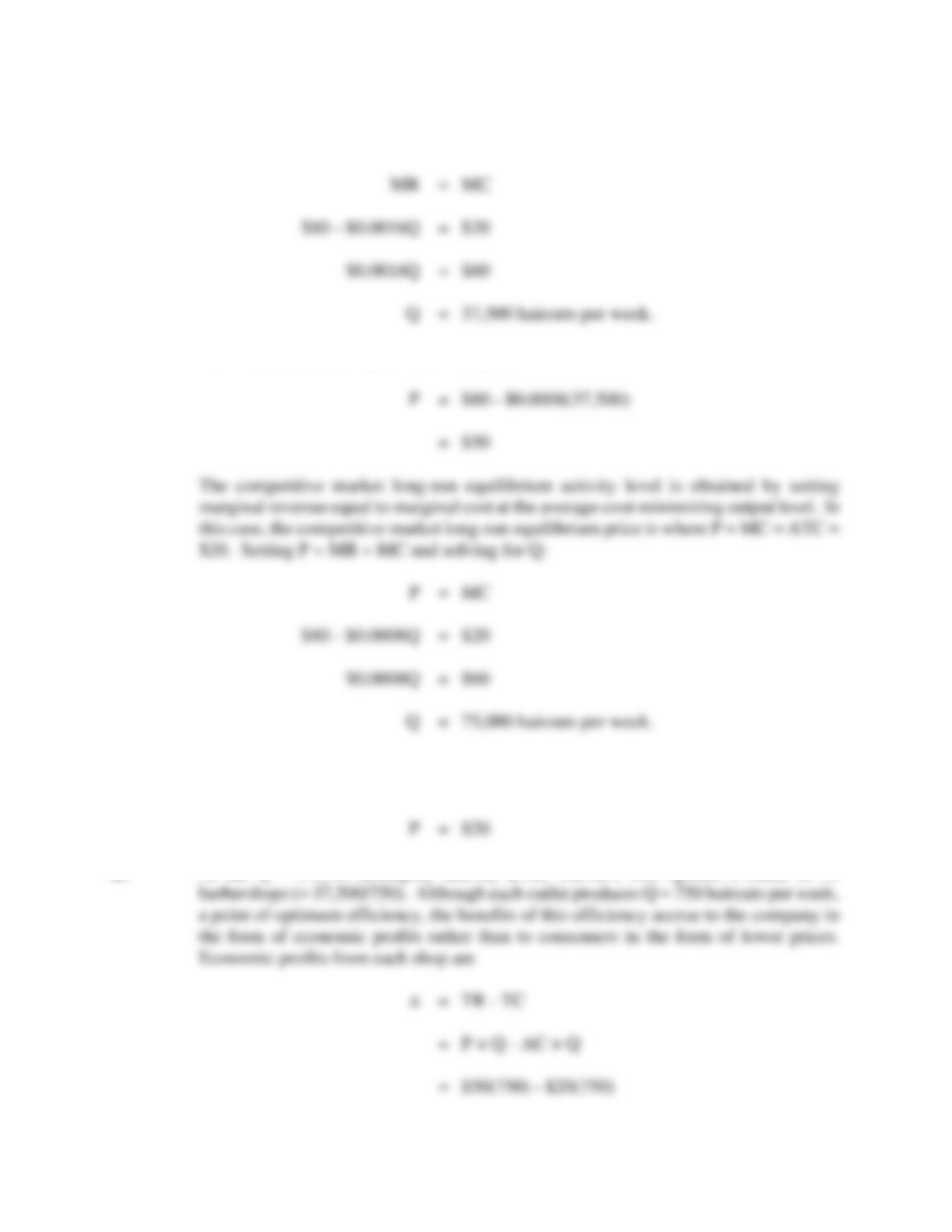
Assume that demand and marginal revenue curves for haircuts in the south side of
Chicago market are
A. Calculate the monopoly profit-maximizing price/output combination, and the
competitive market long-run equilibrium activity level.
B. Calculate monopoly profits, and discusses the “monopoly problem” from a social
perspective in this instance.
P12.5 SOLUTION
A. The monopoly profit-maximizing activity level is obtained by setting marginal revenue
388 Chapter 12
Under monopoly, the optimal market price is
The competitive market long-run equilibrium price is equal to marginal cost at the
average-cost minimizing activity level
B. At the Q = 37,500 monopoly activity level, Calvin’s will operate a chain of 50