
Keynesian Business Cycle Analysis: Non–Market–Clearing Macroeconomics 235
of changing prices may exceed the additional profit earned from doing so. A
5. In the Keynesian model, money is not neutral in the short run, but it is neutral in the
long run. In the short run, an increase in the money supply increases output and
the real interest rate, while the price level and real (efficiency) wage are
unchanged. In the long run, however, only the price level is changed, with no
6. In the Keynesian model in the short run, output and the real interest rate increase
due to an increase in government purchases. In the long run, the real interest rate
is higher, but output returns to its full-employment level. Since the real interest rate
is higher in the long run, investment is lower and consumption is lower.
7. In response to a recession, policymakers can (1) make no change in
macroeconomic policy (2) increase the money supply, or (3) increase government
purchases.
If they make no change in macroeconomic policy, then during the recession output
is below its full-employment level. Over time, the price level will decline to restore
8. Employment is procyclical because a contractionary aggregate demand shock
reduces both output and employment. Money is procyclical because price
stickiness means that an increase in the money supply increases output as the
236 Chapter 12
9. The Keynesian theory assumes that demand shocks cause most cyclical
fluctuations. This means that during expansions when employment rises, average
10. In Keynesian analysis, a supply shock may reduce output in two ways: (1) a
reduction in output, because the supply shock reduces the marginal product of
labour, shifting the FE line to the left; and (2) a further reduction in output if the
Numerical Problems
1. a. Setting w = MPN, w = 10 / . This is the labour demand curve.
b. At W = 20, w = W/P = 20/P. Since labour demand is given by w = 10 / ,
then 20/P = 10 or 2 =
P.
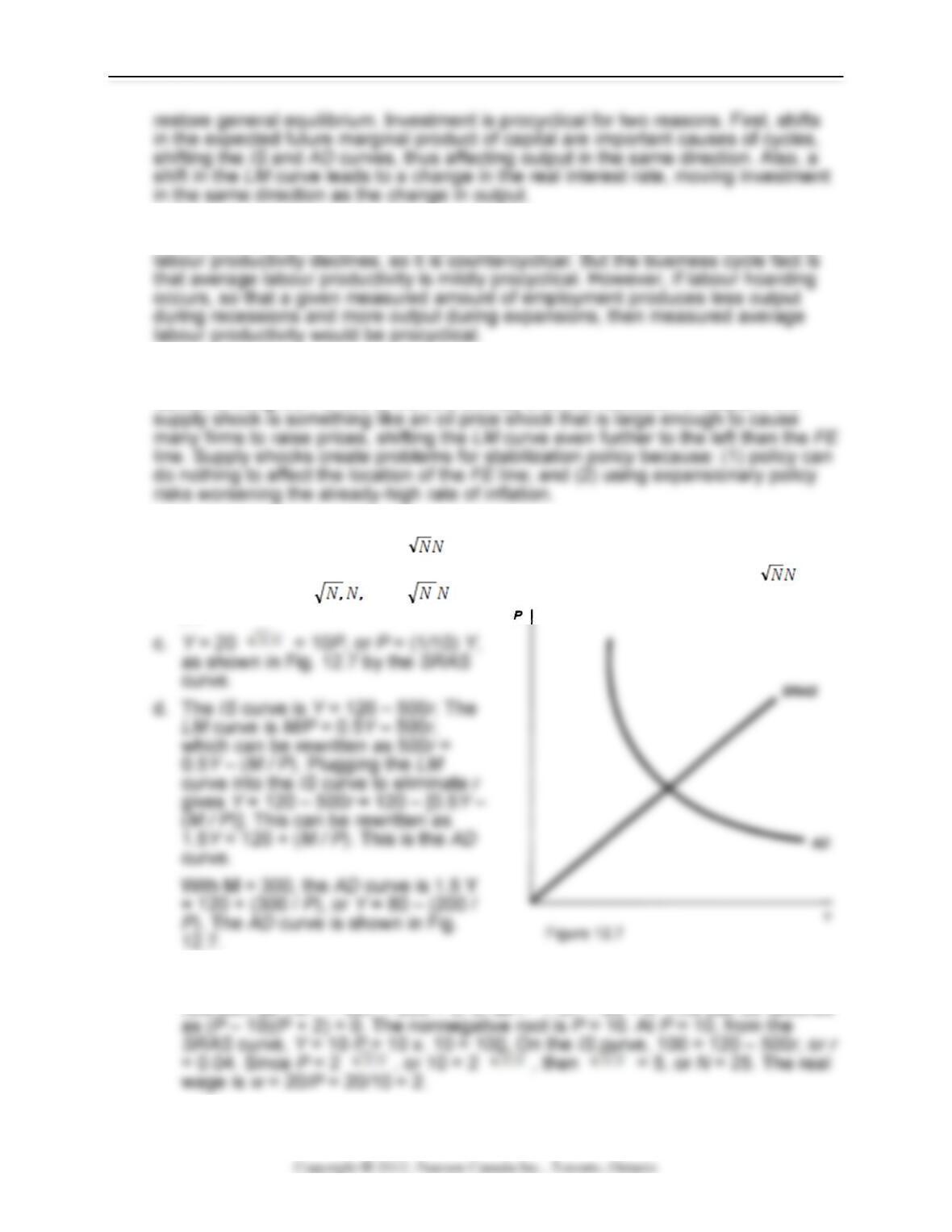
e. To find the intersection of the SRAS curve (Y = 10/P) and the AD curve [Y = 80
+ (200 / P)], find the price level such that 10P = 80 + (200 / P). This can be
rewritten as 10P2 = 80P – 200 = 0, or as P2 – 8P – 20 = 0. This can be factored
Keynesian Business Cycle Analysis: Non–Market–Clearing Macroeconomics 237
f. When the money supply falls to 135, the AD curve becomes 1.5Y = 120 = (135
2. a. The IS curve is found from the equation Y = Cd + Id + G = 130 – 0.5(Y – 100) –
500r – 100 – 500r + 100, or 0.5Y = 280 – 1000r, or Y = 560 – 2000r.
The LM curve comes from the equation M/P = L, which in this case is 1320 / P
= 0.5Y – 1000r, or Y – (2640/P) + 2000r.
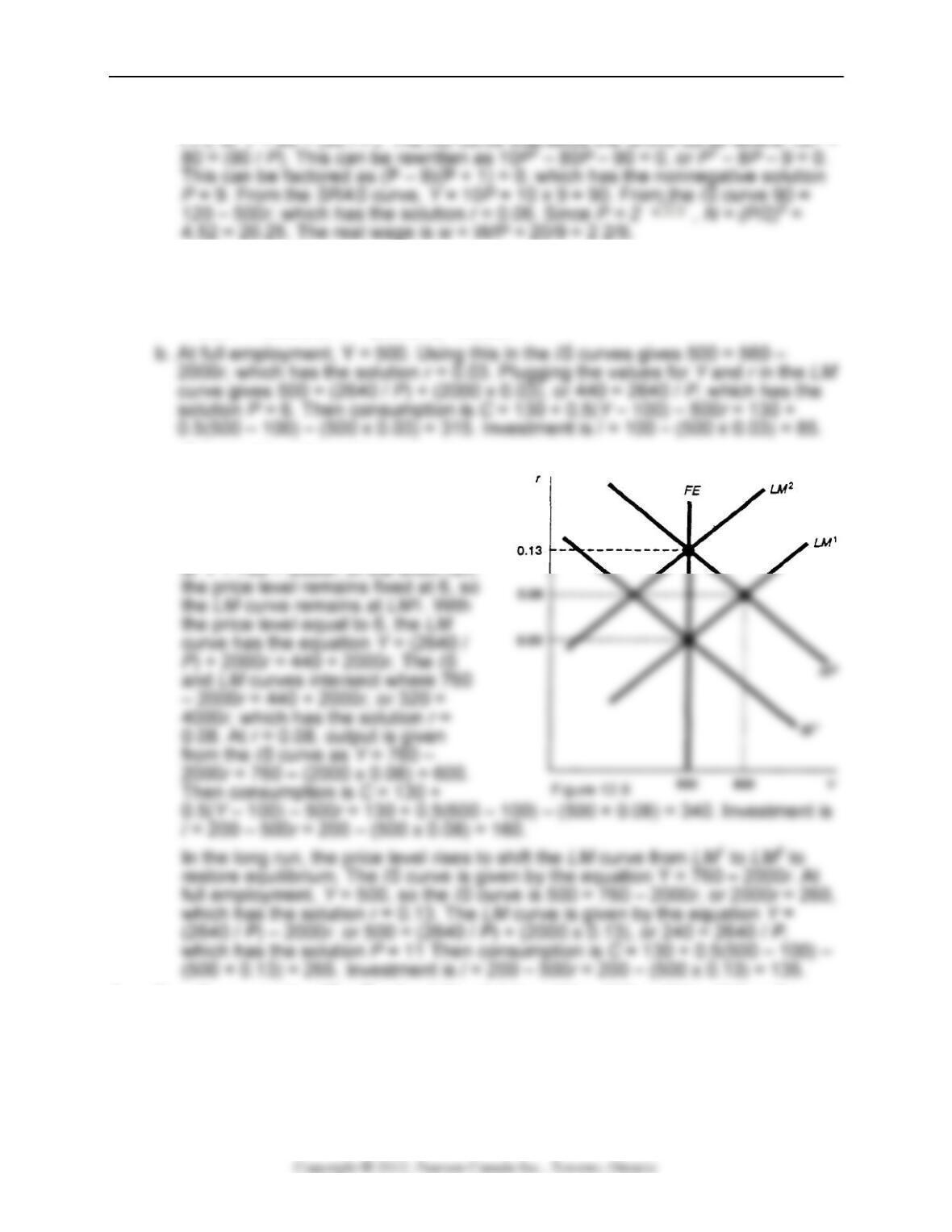
c. If desired investment increases to
200 – 500r, the IS curve shifts from
IS1 to IS2 in Fig. 12.8. This can be
seen in the equation Y = Cd – Id – G
= 130 + 0.5(Y – 100) – 500r + 200 –
500r + 100, or 0.5Y = 380 – 1000r,
3. The IS curve is Y = Cd + Id + G = 325 + 0.5(Y – 150) – 500r + 200 – 500r + G =
450 + 0.5Y – 1000r + G. This can be rewritten as 0.5Y = 450 – 1000r + G, or Y =
900 – 2000r + 2G. The LM curve is M/P = L = 0.5Y – 1000r.
a. When G = 150, the IS curve is Y = 900 – 2000r + (2 x 150) = 1200 – 2000r.
With M = 6000, the LM curve is 6000/P = 0.5Y – 1000r.
238 Chapter 12
b. When G increases to 250, the IS curve shifts from IS1 to IS2 in Fig. 13.11. The
new IS equation is Y = 900 – 2000r + 2G = 900 – 2000r + (2 x 250) = 1400 –
2000r.
In the short run, the price level remains fixed at 15, so the LM curve remains at
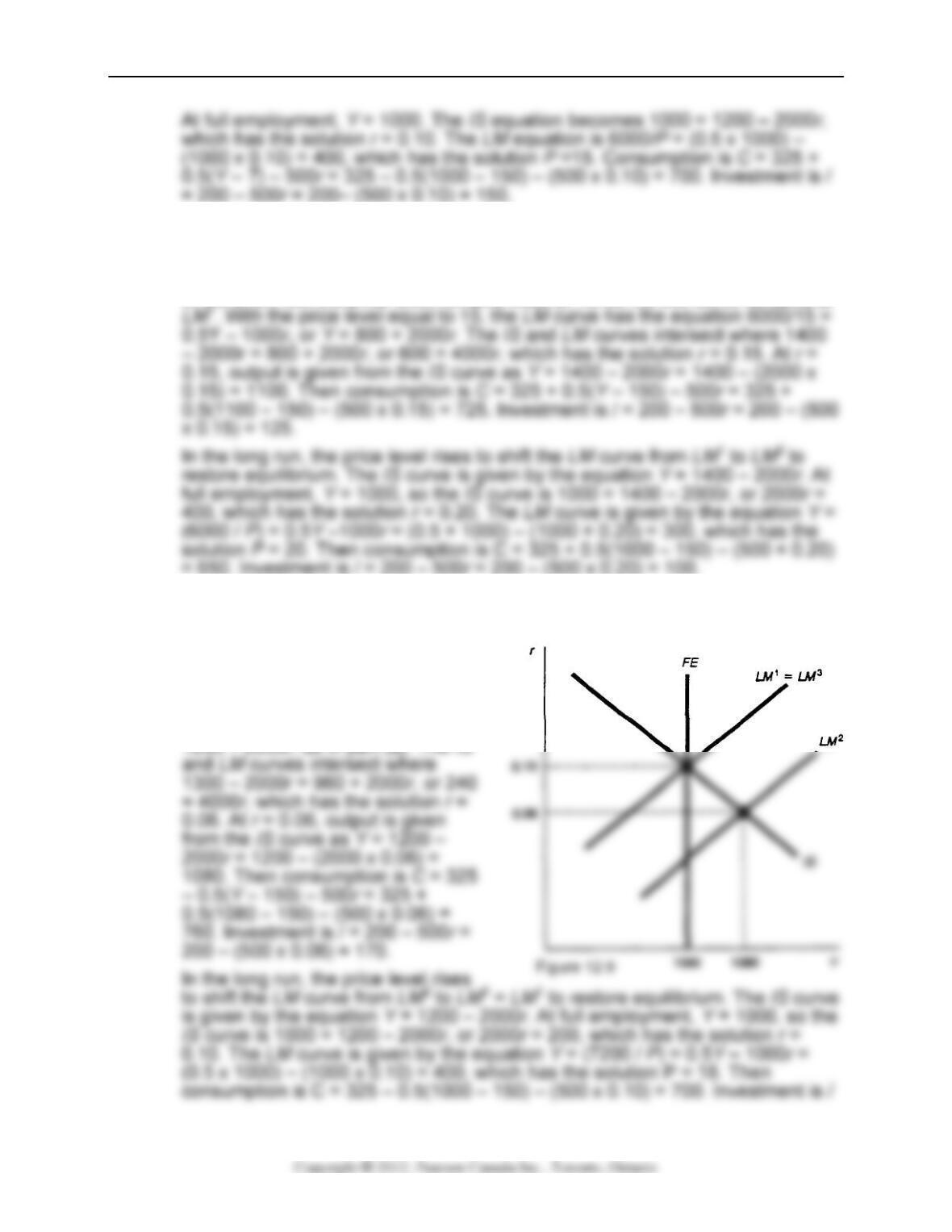
c. When the money supply increases to 7200, the LM curve shifts from LM1 to
LM2 in Fig. 12.9. The LM equation is 7200 / P + 0.5Y – 1000r.
In the short run, the price level
remains fixed at 15, so the LM
curve has the equation 7200 / 15 =
0.5Y – 1000r, or Y = 960 + 2000r.
The IS curve has the equation Y =

Keynesian Business Cycle Analysis: Non–Market–Clearing Macroeconomics 239
4. The IS curve is Y = Cd + Id + G = [600 + 0.8(Y − 1000) − 500r] +[400 − 500r]+
1000, so 0.2Y = 1200 − 1000r.
Since πe= 0, the nominal interest rate (i) equals the real interest rate (r).
a. Can the economy reach full employment? Since full-employment output is Y =
b. To restore full employment while the nominal interest rate is zero clearly
requires a shift in the IS curve. If we return to the original derivation and put G
in the equation instead of using the original value of G = 1000, we get:
5. a. The IS curve is given by Y = Cd + Id + G + NX = 120 + 0.5(Y – 100) + 120 –
200r + 100 + 60 + 0.5YFOR = 100r = 400 + 0.5Y – 500r. This can be rewritten as
b. With P = 18, the AD curve is Y = 160 + (10 800/18) = 760. From the IS curve,
760 = 800 –1000r, which has the solution r = 0.04. Consumption is C = 120 +
0.5(760 – 100) – (200 x 0.04) = 442. Investment is / = 120 – (200 x 0.04) = 112.
c. In the long run, Y = 700. From the IS equation, 700 = 800 – 1000r, which has

240 Chapter 12
6. The following table shows the real wage (w), the effort level (E), and the effort per
unit of real wages (E / w).
w E E / w
8 7 0.875
7. a. Using the definition, in Appendix 9.A, αIS = 0.6, βIS = 0.0005, αLM = 0, βLM =
0.0005, and ℓr = 1000.
Keynesian Business Cycle Analysis: Non–Market–Clearing Macroeconomics 241
Analytical Problems
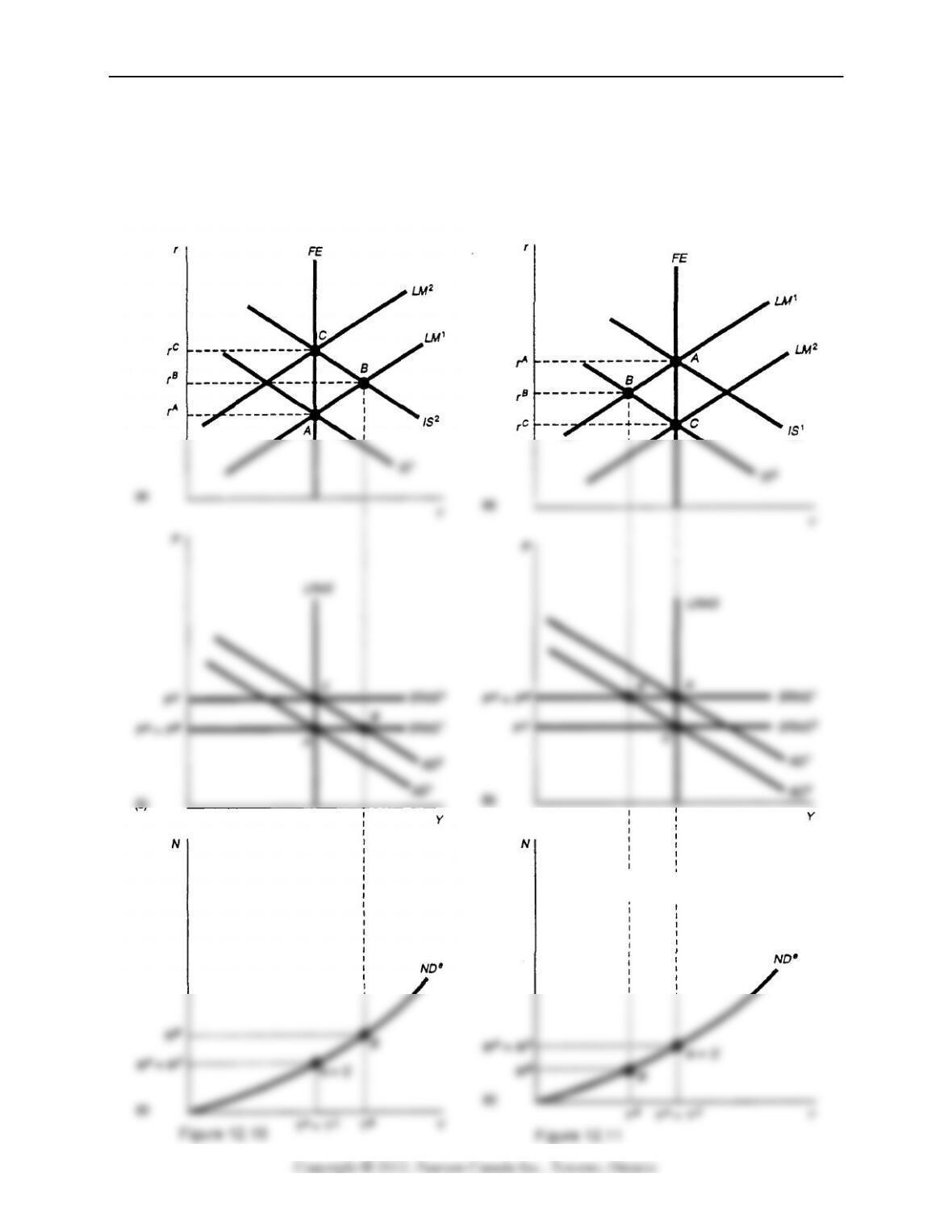
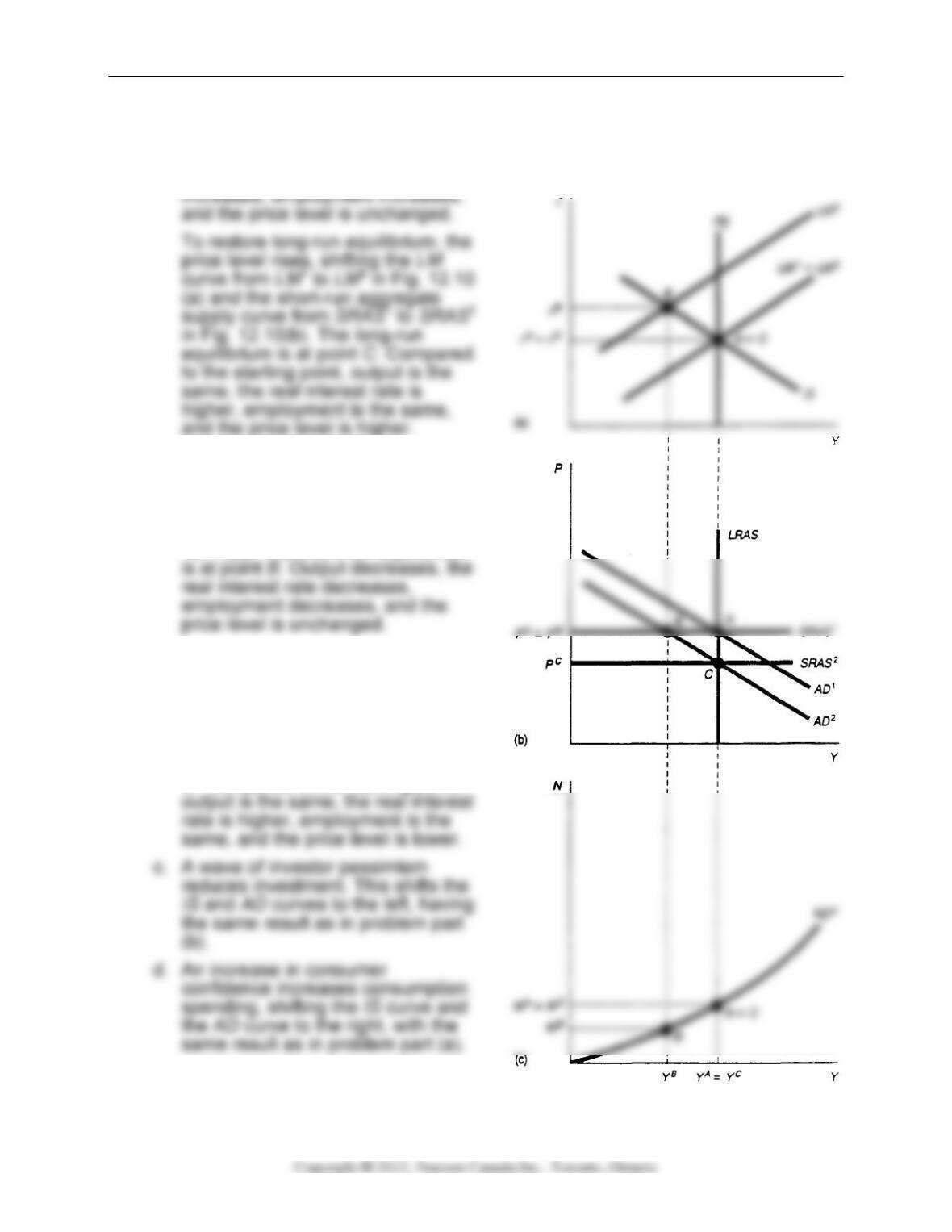
1. In Figs. 12.10 and 12.11, point A is the starting point, point B shows the short-run
equilibrium after the change, and point C shows the long-run equilibrium after the
change.
Figure 12.10
Figure 12.9
242 Chapter 12
a. In Fig. 12.10, the increase in tax incentives increases investment, shifting the IS
curve to the right from IS1 to IS2 in Fig. 12.10(a), and shifting the AD curve from
AD1 to AD2 in Fig. 12.10(b). The short-run equilibrium is at point B. Output
increases, the real interest rate
b. In Fig. 12.11, the increase in tax
incentives increases saving—
shifting the IS curve from IS1 to IS2
in Fig. 12.11(a), and shifting the AD
curve from AD1 to AD2 in Fig.
12.11(b). The short-run equilibrium
To restore long-run equilibrium, the
price level rises, shifting the LM
curve from LM1 to LM2 in Fig.
12.11(a) and the short-run
aggregate supply curve from
SRAS1 to SRAS2 in Fig. 12.11(b).
The long-run equilibrium is at point
C. Compared to the starting point,
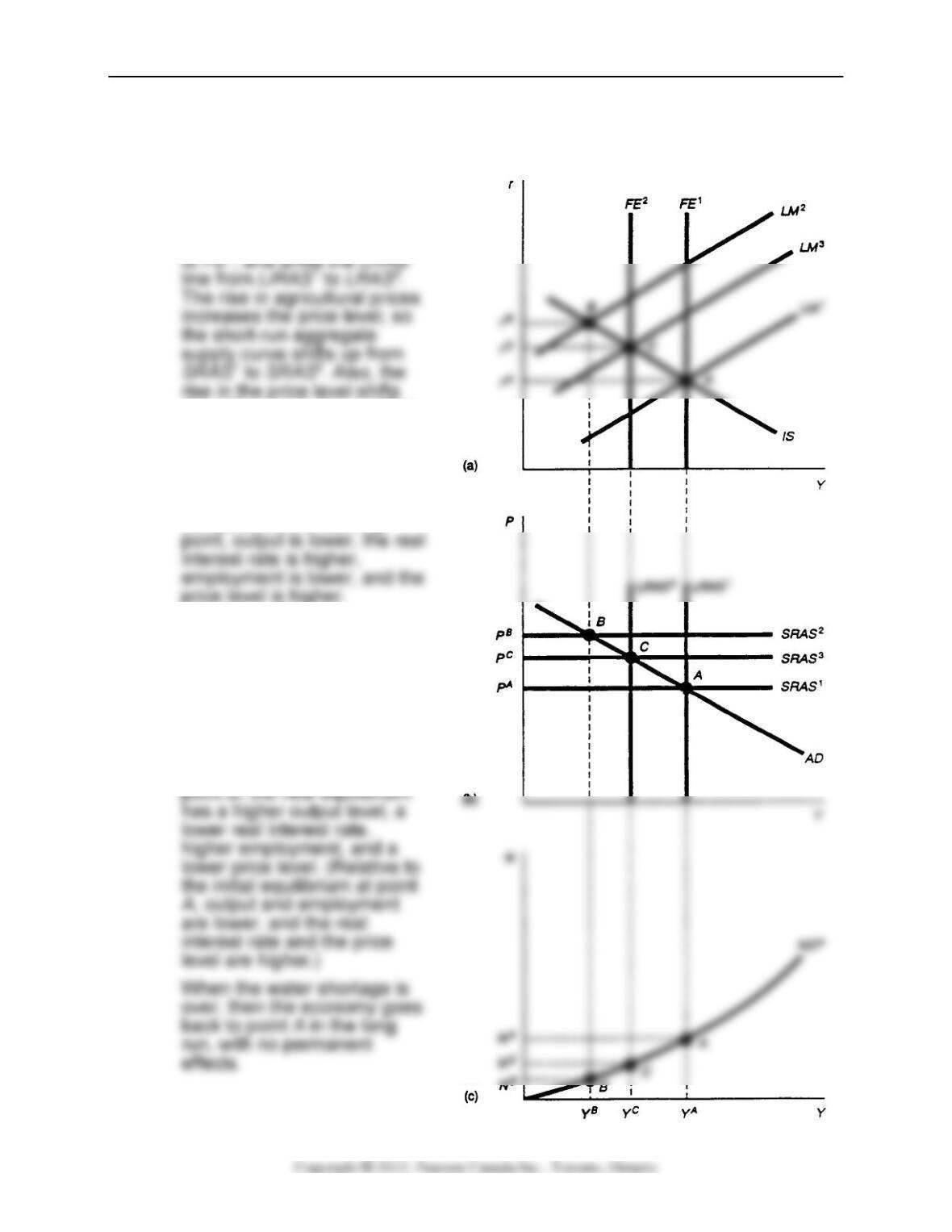
2. In Figs. 12.12–12.15, point A is the
starting point, point B shows the short-
Figure 12.12
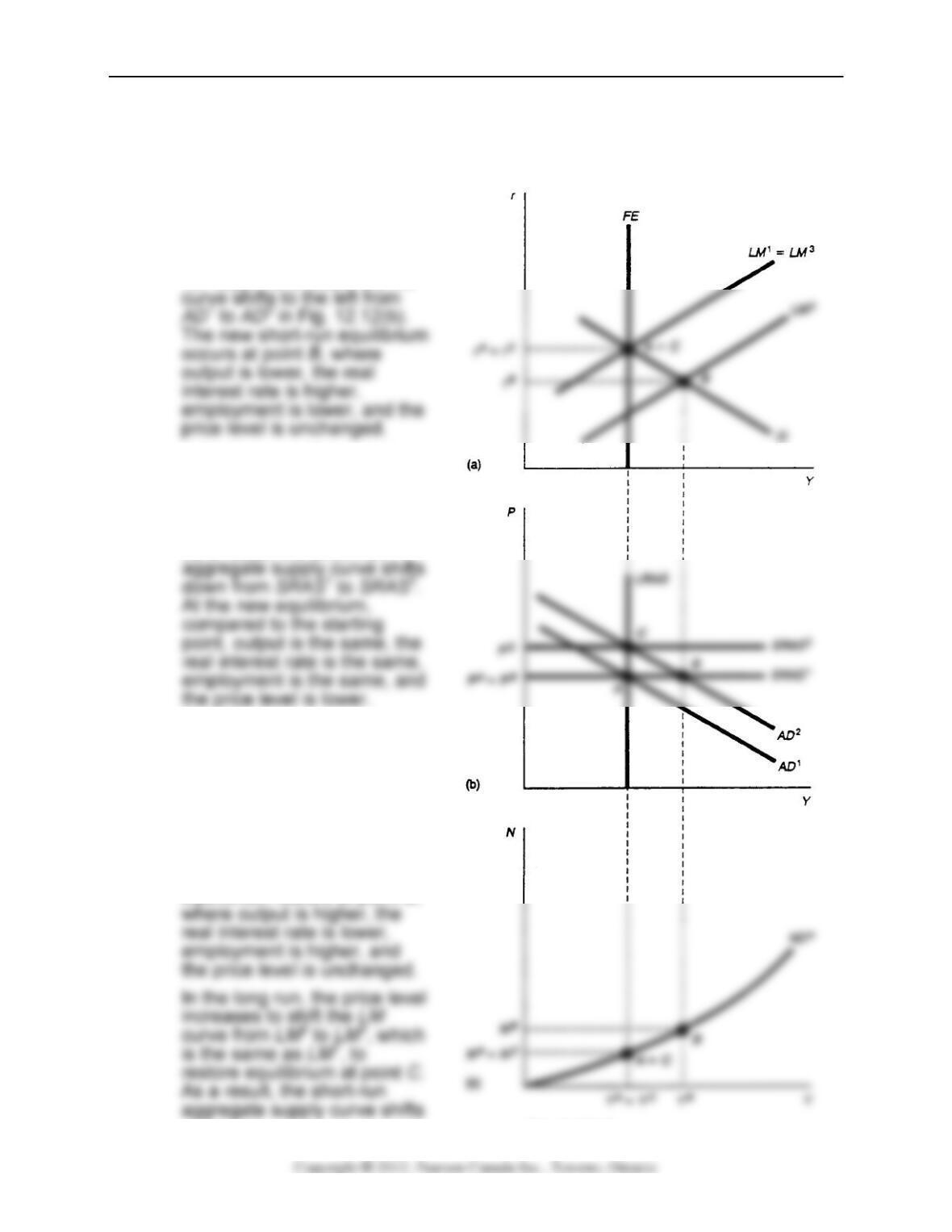
Figure 12.15
Keynesian Business Cycle Analysis: Non–Market–Clearing Macroeconomics 243
run equilibrium after the change, and point C shows the long-run equilibrium after
the change.
a. In Fig. 12.12, when bank
pays a higher interest rate on
chequing accounts, the
demand for money rises,
shifting the LM curve to the
left from LM1 to LM2 in Fig.
12.12(a). As a result, the AD
In the long run, the price level
decreases to shift the LM
curve from LM2 to LM1, which
is the same as LNP, to
restore equilibrium at point C.
As a result, the short-run
b. In Fig. 12.13, the introduction
of credit cards reduces the
demand for money—shifting
the LM curve to the right from
LM1 to LM2 in Fig. 12.13(a).
As a result, the AD curve
shifts from AD1 to AD2 in Fig.
12.13(b). The new short-run
equilibrium occurs at point B,
Figure 12.13
244 Chapter 12
up from SRAS1 to SRAS2. At the new equilibrium, compared to the starting
point, output is the same, the real interest rate is the same, employment is the
same, and the price level is
higher.
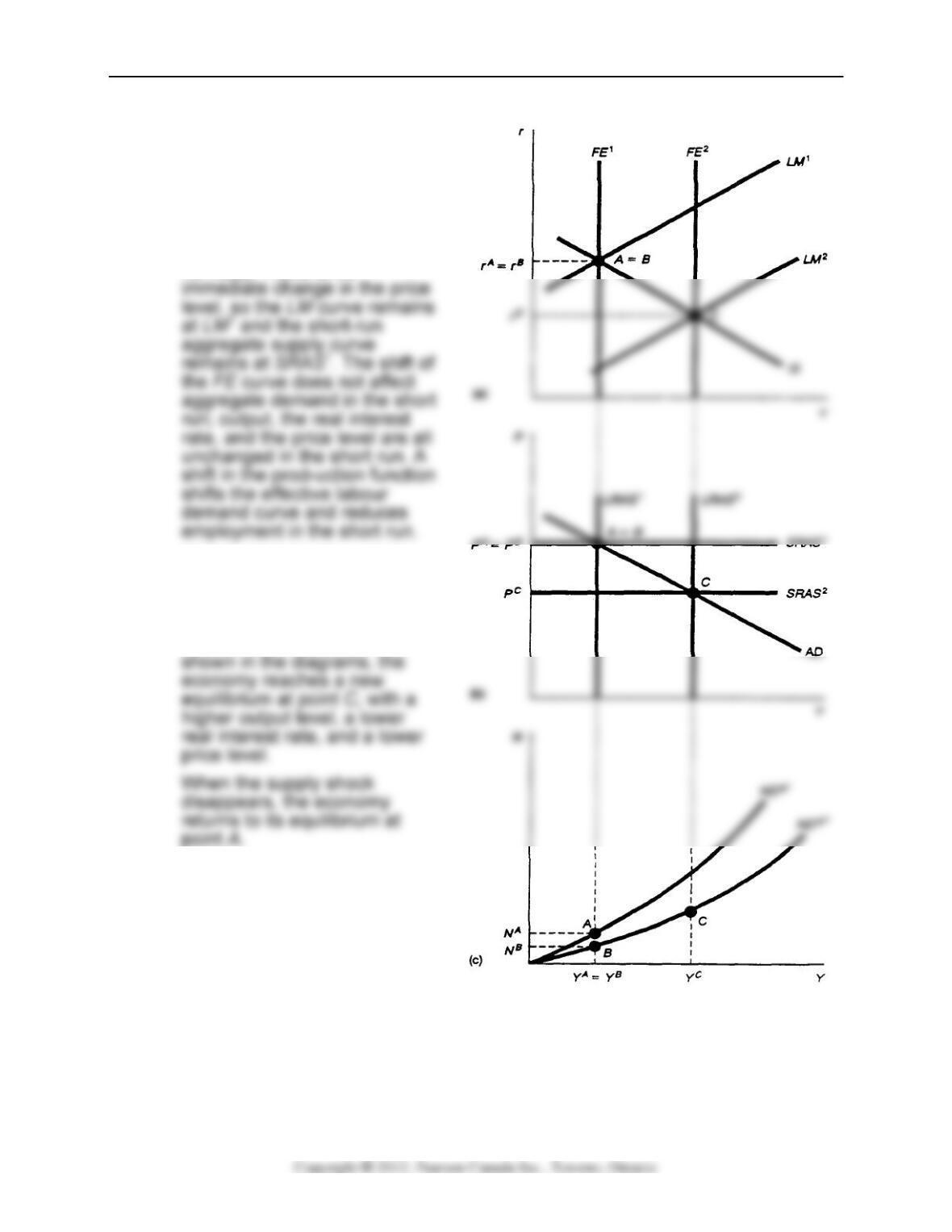
c. In Fig. 12.14, the reduction in
agricultural output shifts the
FE curve to the left from FE1
the LM curve up from LM1 to
LM2. The short-run
equilibrium is at point B,
assuming that the LM curve
shifts to the left more than
the FE line. At point B,
compared to the starting
price level is higher.
If the water shortage persists,
a new long-run equilibrium
occurs at points C. To get to
this equilibrium, the price
level must decline, shifting
the LM curve from LM2 to
LM3, and the short-run
aggregate supply curve from
SRAS2 to SRAS3. Relative to
Figure 12.14
Keynesian Business Cycle Analysis: Non–Market–Clearing Macroeconomics 245
d. In Fig. 12.15, the beneficial
supply shock makes more
production possible at full
employment, so the FE line
shifts to the right in Fig.
12.15(a) from FE1 to FE2, and
the LRAS line shifts from
LRAS1 to LRAS2 in Fig.
12.15(b). There is no
If the supply shock persists,
prices will decline, so the LM
curve will shift from LM1 to LM2
and the SRAS curve will shift
from SRAS1 to SRAS2. As
3. A lag in the impact of policy of six
months, which is about the time it
takes firms to adjust prices, could
cause policy to be destabilizing.
That is, monetary policy may be
pushing the economy away from
equilibrium.
Figure 12.15
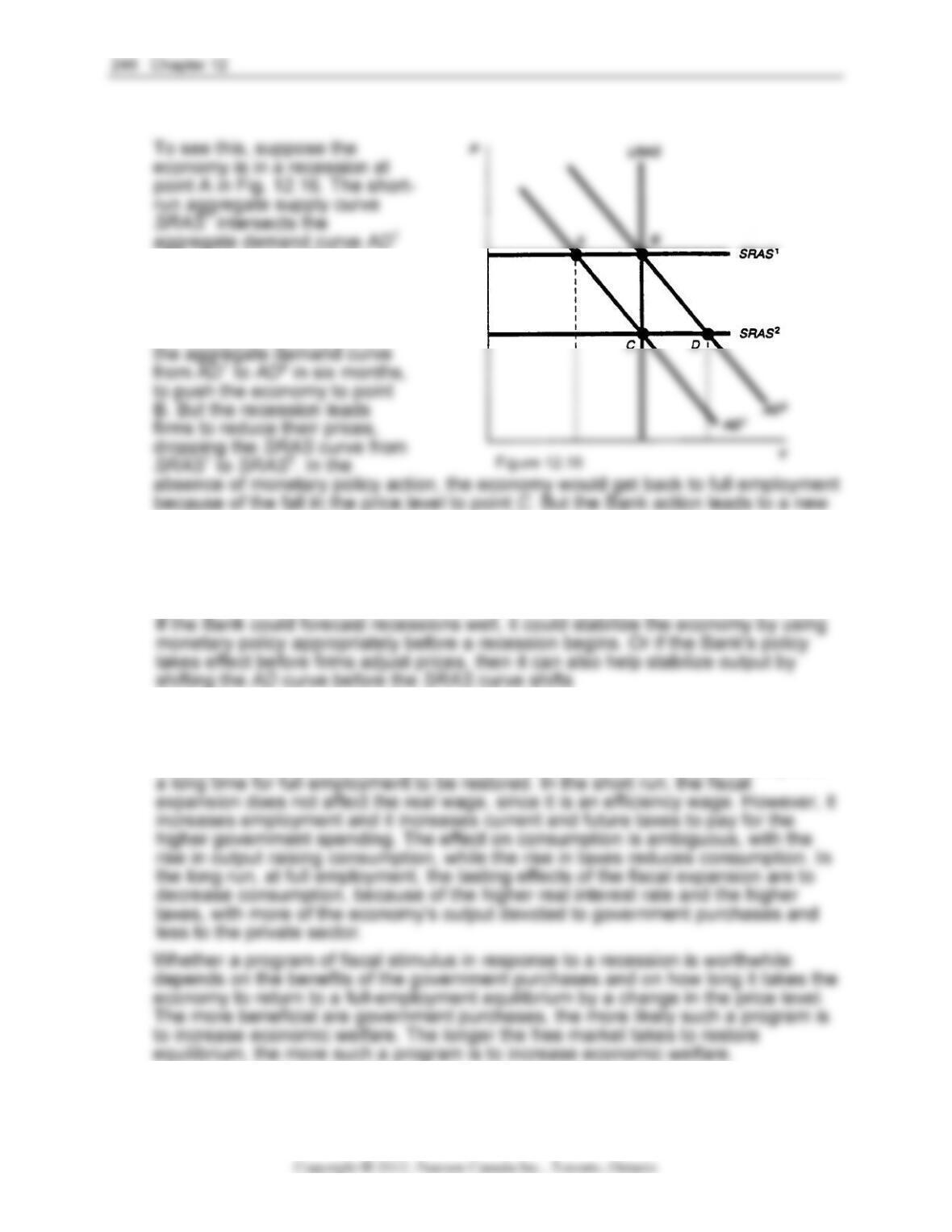
at point A, to the left of the
long-run aggregate supply
curve LRAS. Suppose the
Bank engages in expansionary
monetary policy to try to shift
equilibrium at point D. So the Bank causes the economy to overshoot the
equilibrium point. The result may be to exaggerate the business cycle, pushing
output too high in expansions. Then if the Bank responds to an expansion by using
contractionary monetary policy, it may overshoot on the other side, causing a new
recession.
4. An increase in government purchases shifts the IS and AD curves to the right to
return the economy to full employment, instead of waiting for the price level to fall
to get there. The advantage of doing so, according to Keynesians, is that full
employment is restored quickly, whereas if the price level must adjust, it may take
5. a. In response to expansionary monetary policy, aggregate demand increases,
increasing output and labour demand. This causes the labour demand curve to
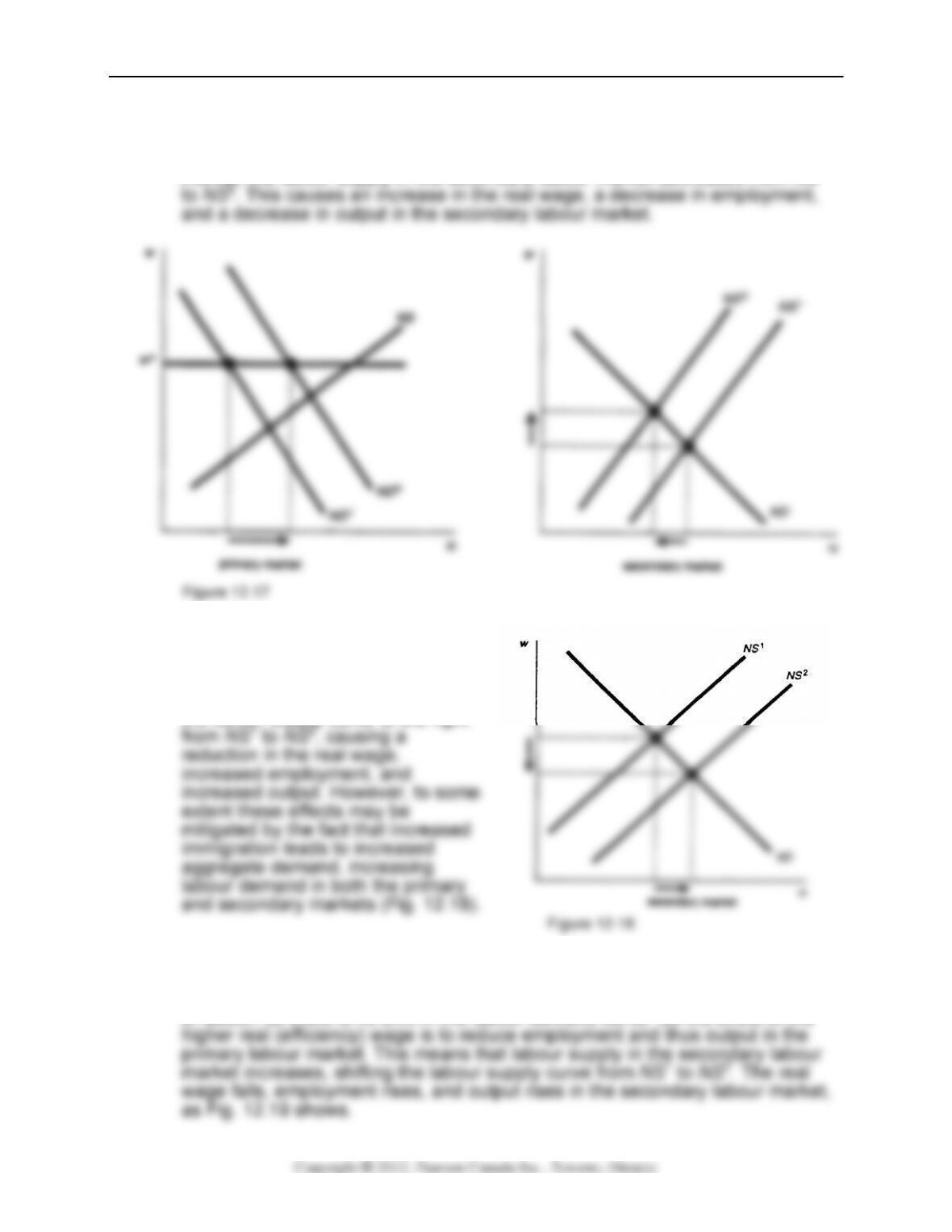
Keynesian Business Cycle Analysis: Non–Market–Clearing Macroeconomics 247
shift from ND1 to ND2 in the primary labour market, shown in Fig. 12.17. The
result is an increase in employment and output with no change in the real wage
in the primary labour market. Since more workers are now in the primary labour
market, the labour supply in the secondary labour market decreases from NS1
b. Increased immigration has no effect
in the primary labour market, since
labour supply changes in general
have no effect. In the secondary
labour market, the immigration shifts
the labour supply curve to the right
c. If there is a shift in the effort curve, the efficiency wage rises in the primary
labour market. Since effort exerted at the higher wage is the same as before
the change, the shift in the effort curve has no impact on the marginal product
of labour, so there is no shift in the labour demand curve. So the effect of the
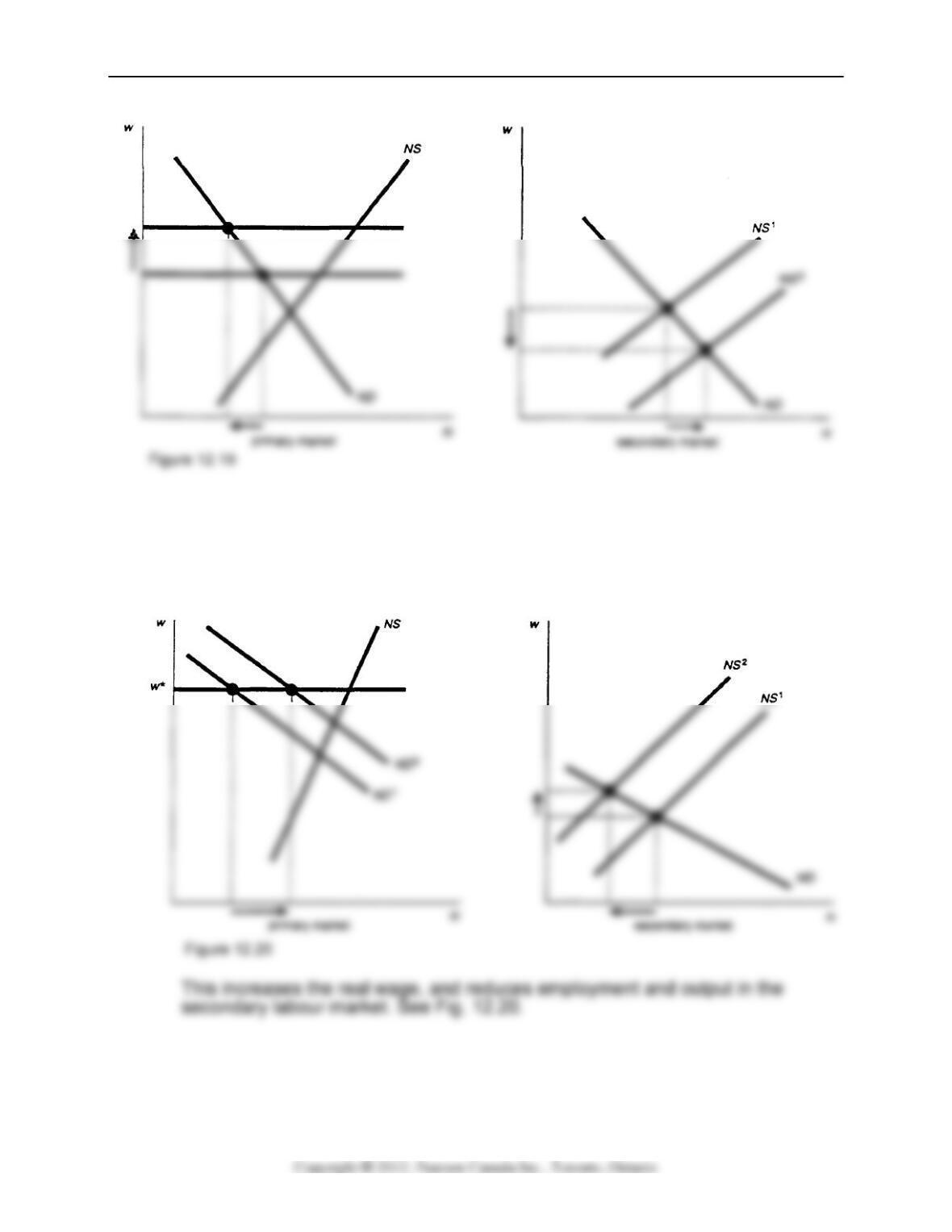
248 Chapter 12
d. The productivity improvement shifts the labour demand curve to the right, so at
the fixed real (efficiency) wage, firms demand more labour. Employment
increases, so output increases in the primary labour market. The increase in
employment in the primary labour market reduces the labour supply in the
secondary labour market, shifting the labour supply curve from NS1 to NS2.

Keynesian Business Cycle Analysis: Non–Market–Clearing Macroeconomics 249
e. The productivity improvement in the secondary labour market has no effect on
the primary labour market. In the secondary labour market, increased