interactive activity
Chapter 12
Perfect Competition
and the Supply Curve
1. For each of the following, is the business a price-taking producer? Explain your
1. a. The cappuccino café is probably a price-taking producer, especially if there
2. For each of the following, is the industry perfectly competitive? Referring to
2. a. Yes, aspirin is produced in a perfectly competitive industry. Many manufac–
Solution
Solution

S-190 Chapter 12 Perfect comPetition and the SuPPly curve
3. Bob produces Blu-ray movies for sale, which requires a building and a machine
that copies the original movie onto a Blu-ray. Bob rents a building for $30,000
per month and rents a machine for $20,000 a month. Those are his fixed costs.
His variable cost per month is given in the accompanying table.
Quantity of Blu-rays VC
0$0
1,000 5,000
2,000 8,000
6,000 33,000
7,000 49,000
8,000 72,000
9,000 99,000
10,000 150,000
a. Calculate Bob’s average variable cost, average total cost, and marginal cost for
each quantity of output.
b. There is free entry into the industry, and anyone who enters will face the same
costs as Bob. Suppose that currently the price of a Blu-ray is $25. What will
Bob’s profit be? Is this a long-run equilibrium? If not, what will the price of
Blu-ray movies be in the long run?
3. a. Bob’s average variable cost, average total cost, and marginal cost are shown in
the accompanying table.
Quantity of
Blu–rays VC MC of Blu-ray AVC of Blu-ray ATC of Blu-ray
$5.00
1,000 5,000.00 $5.00 $55.00
1.00
3,000 9,000.00 3.00 19.67
6.00
5,000 20,000.00 4.00 14.00
16.00
7,000 49,000.00 7.00 14.14
27.00
9,000 99,000.00 11.00 16.56
51.00
10,000 150,000.00 15.00 20.00
Solution
Chapter 12 Perfect comPetition and the SuPPly curve S-191
b. At a price of $25, P = MC at a quantity of 8,000, and ATC = $15.25. Bob makes
a profit of $25 − $15.25 = $9.75 per Blu-ray, for a total profit of 8,000 × $9.75 =
$78,000. If there is free entry into the industry, this profit will attract new firms.
As firms enter, the price of Blu-rays will eventually fall until it is equal to the
minimum average total cost. Here, the average total cost reaches its minimum
be $13.83.
4. Consider Bob’s Blu-ray company described in Problem 3. Assume that Blu-ray
production is a perfectly competitive industry. For each of the following ques-
tions, explain your answers.
a. What is Bob’s break-even price? What is his shut-down price?
b. Suppose the price of a Blu-ray is $2. What should Bob do in the short run?
c. Suppose the price of a Blu-ray is $7. What is the profit-maximizing quantity of
Blu-rays that Bob should produce? What will his total profit be? Will he pro–
duce or shut down in the short run? Will he stay in the industry or exit in the
long run?
4. a. Bob’s break-even price is $13.83 because this is the minimum average total
cost. His shut–down price is $3, the minimum average variable cost, because
below that price his revenue does not even cover his variable cost.
b. If the price of Blu-rays is $2, the price is below Bob’s shut–down price of $3. So
Bob should shut down in the short run.
c. If Blu-rays sell for $7, Bob should produce 5,000 Blu-rays because for any
greater quantity his marginal cost exceeds his marginal revenue (the mar-
ket price). His total profit will be −$35,000, a loss of $35,000, since he loses
d. If Blu-rays sell instead for $20, Bob should produce 7,000 Blu-rays because
at this quantity his marginal cost approximately equals his marginal revenue
(the market price). His profit per Blu-ray is $20 (price) − $14.14(ATC) = $5.86,
5. Consider again Bob’s Blu-ray company described in Problem 3.
a. Draw Bob’s marginal cost curve.
b. Over what range of prices will Bob produce no Blu-rays in the short run?
Solution
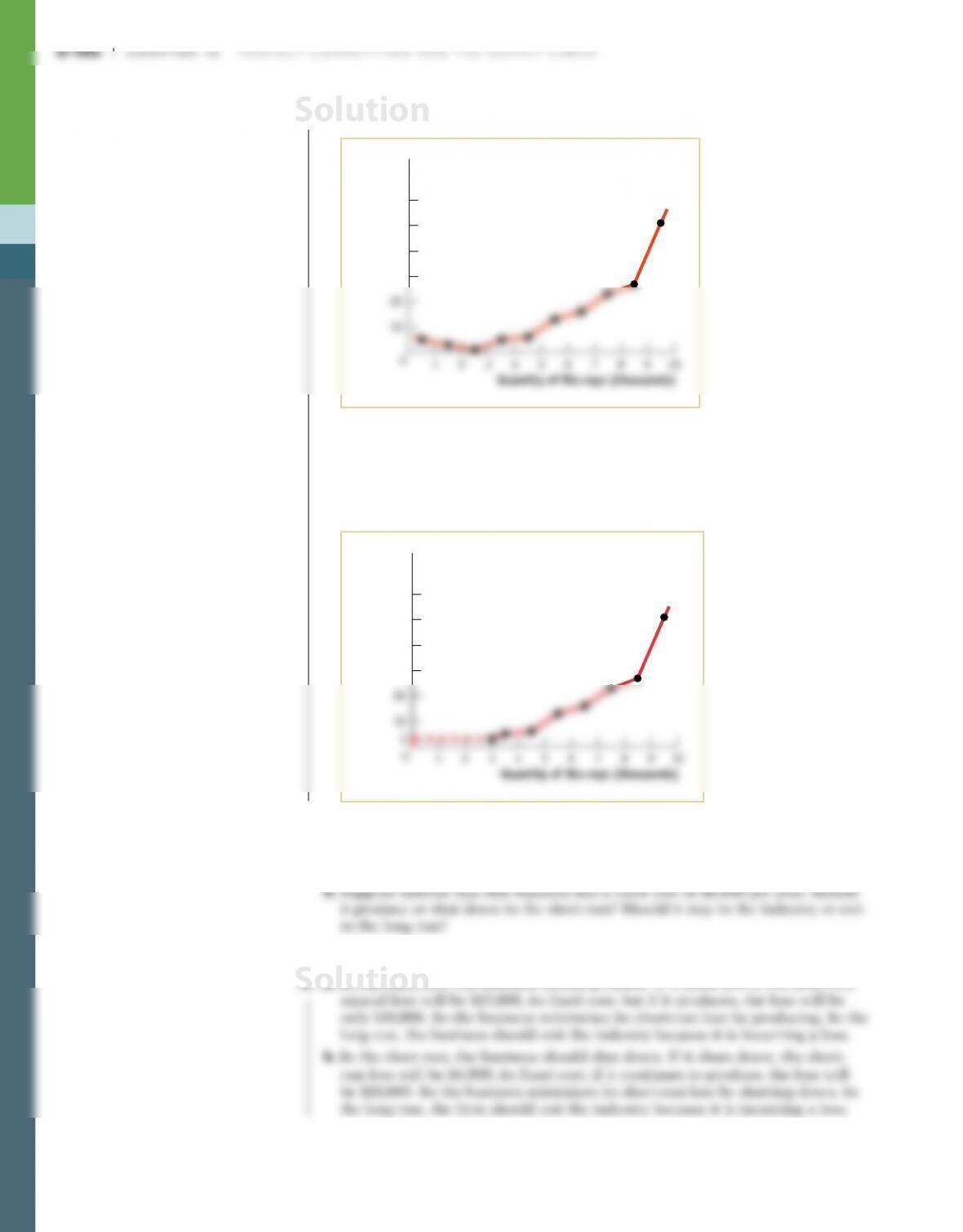
5. a. Bob’s marginal cost curve is shown in the accompanying diagram.
MC
$60
50
40
30
Cost of
Blu-ray
b. Bob will produce no Blu-rays if the price falls below $3 because $3 is the low-
est point on the average variable cost curve—his shut–down price.
c. The individual supply curve is shown in the accompanying diagram. It is his
MC curve above the minimum average variable cost. At a price below $3, out–
put is 0, shown by the solid vertical line at the origin.
S
3
$60
50
40
30
Price of
Blu-ray
6. a. A profit-maximizing business incurs an economic loss of $10,000 per year.
Its fixed cost is $15,000 per year. Should it produce or shut down in the short
run? Should it stay in the industry or exit in the long run?
6. a. In the short run, the business should produce. If it shuts down, the short-run
Solution
Solution
7. The first sushi restaurant opens in town. Initially people are very cautious about
eating tiny portions of raw fish, as this is a town where large portions of grilled
meat have always been popular. Soon, however, an influential health report
warns consumers against grilled meat and suggests that they increase their con-
sumption of fish, especially raw fish. The sushi restaurant becomes very popular
and its profit increases.
a. What will happen to the short-run profit of the sushi restaurant? What will
happen to the number of sushi restaurants in town in the long run? Will the
first sushi restaurant be able to sustain its short-run profit over the long run?
8. A perfectly competitive firm has the following short-run total cost:
Quantity TC
0$5
110
Market demand for the firm’s product is given by the following market demand
schedule:
Price Quantity demanded
$12 300
10 500
a. Calculate this firm’s marginal cost and, for all output levels except zero, the
firm’s average variable cost and average total cost.
b. There are 100 firms in this industry that all have costs identical to those of

S-194 Chapter 12 Perfect comPetition and the SuPPly curve
8. a. This firm’s fixed cost is $5, since even when the firm produces no output, it
incurs a total cost of $5. The marginal cost (MC), average variable cost (AVC),
and average total cost (ATC) are given in the accompanying table.
Quantity TC MC AVC ATC
$5.00
3.00
5.00
7.00
9.00
11. 00
645.00 6.67 7.50
$4. The same is true for all other firms in the industry. That is, if the price is
$4, the quantity supplied by all 100 firms is 200. The quantity supplied by all
100 firms at a price of $6 is 300, and so on. The accompanying diagram illus–
trates this principle.
200 400 600 800 1,000 1,200 2,0001,8001,6001,400
0
$12
4
Price
Quantity
S
D
c. The quantity supplied equals the quantity demanded at a price of $10—the
(short-run) market equilibrium price. So the quantity bought and sold in this
Solution

9. A new vaccine against a deadly disease has just been discovered. Presently, 55
people die from the disease each year. The new vaccine will save lives, but it is
not completely safe. Some recipients of the shots will die from adverse reactions.
The projected effects of the inoculation are given in the accompanying table:
Percent of Total deaths Total deaths Marginal Marginal
population due to due to benefit of cost of “Profit” of
inoculated disease inoculation inoculation inoculation inoculation
055 0
— — —
10 45 0
— — —
20 36 1
— — —
30 28 3
— — —
— — —
70 6 20
— — —
80 3 25
a. What are the interpretations of “marginal benefit” and “marginal cost” here?
Calculate marginal benefit and marginal cost per each 10% increase in the
rate of inoculation. Write your answers in the table.
b. What proportion of the population should optimally be inoculated?
c. What is the interpretation of “profit” here? Calculate the profit for all levels
9. a. The “marginal benefit” is the additional lives saved due to inoculation. The
“marginal cost” is the additional deaths due to inoculation. The values are
given in the accompanying table.
Percent of
population
inoculated
Total deaths
due to
disease
Total deaths
due to
inoculation
Marginal
benefit of
inoculation
Marginal
cost of
inoculation
“Profit” of
inoculation
055 0 0
10 0
10 45 0 10 − 0 = 10
9 1
20 36 1 19 − 1 = 18
8 2
30 28 3 27 − 3 = 24
7 3
Solution
S-196 Chapter 12 Perfect comPetition and the SuPPly curve
b. People should be inoculated until the marginal cost equals the marginal ben–
10. Evaluate each of the following statements. If a statement is true, explain why; if
it is false, identify the mistake and try to correct it.
11. The production of agricultural products like wheat is one of the few examples
of a perfectly competitive industry. In this question, we analyze results from a
study released by the U.S. Department of Agriculture about wheat production in
the United States in 2016.
a. The average variable cost per acre planted with wheat was $115 per acre.
Assuming a yield of 44 bushels per acre, calculate the average variable cost per
bushel of wheat.
b. The average price of wheat received by a farmer in 2016 was $4.89 per bushel.
Do you think the average farm would have exited the industry in the short
run? Explain.
was $7.71 per bushel. The harvested acreage for wheat in the United States
decreased from 48.8 million acres in 2013 to 43.9 million acres in 2016. Using
the information on prices and costs here and in parts a and b, explain why
this might have happened.
d. Using the above information, what do you think will happen to wheat produc-
tion and prices after 2016?
11. a. Since the yield is 44 bushels per acre, we know that producing 44 bushels of
wheat is associated with an average variable cost of $115. So the production
of 1 bushel of wheat is associated with an average variable cost of $115/44
bushels = $2.61 per bushel.
b. We would not expect the average farm to have exited the industry in the short
c. Because wheat production decreased over the period, we would expect the
Solution
Chapter 12 Perfect comPetition and the SuPPly curve S-197
The farm would be experiencing an economic loss by operating. So the
decrease in the harvested acreage of wheat should have been expected after
$4.89 per acre in 2016.
d. Assuming the cost of wheat production remains relatively constant, with cur-
12. The accompanying table presents prices for washing and ironing a man’s shirt
A-1 Cleaners Santa Barbara $1.50
Regal Cleaners Santa Barbara 1.95
St. Paul Cleaners Santa Barbara 1.95
Zip Kleen Dry Cleaners Santa Barbara 1.95
Effie the Tailor Santa Barbara 2.00
Magnolia Too Goleta 2.00
Rockwell Cleaners Carpinteria 2.10
Norvelle Bass Cleaners Santa Barbara 2.15
Ablitt’s Fine Cleaners Santa Barbara 2.25
California Cleaners Goleta 2.25
a. What is the average price per shirt washed and ironed in Goleta? In Santa
Barbara?
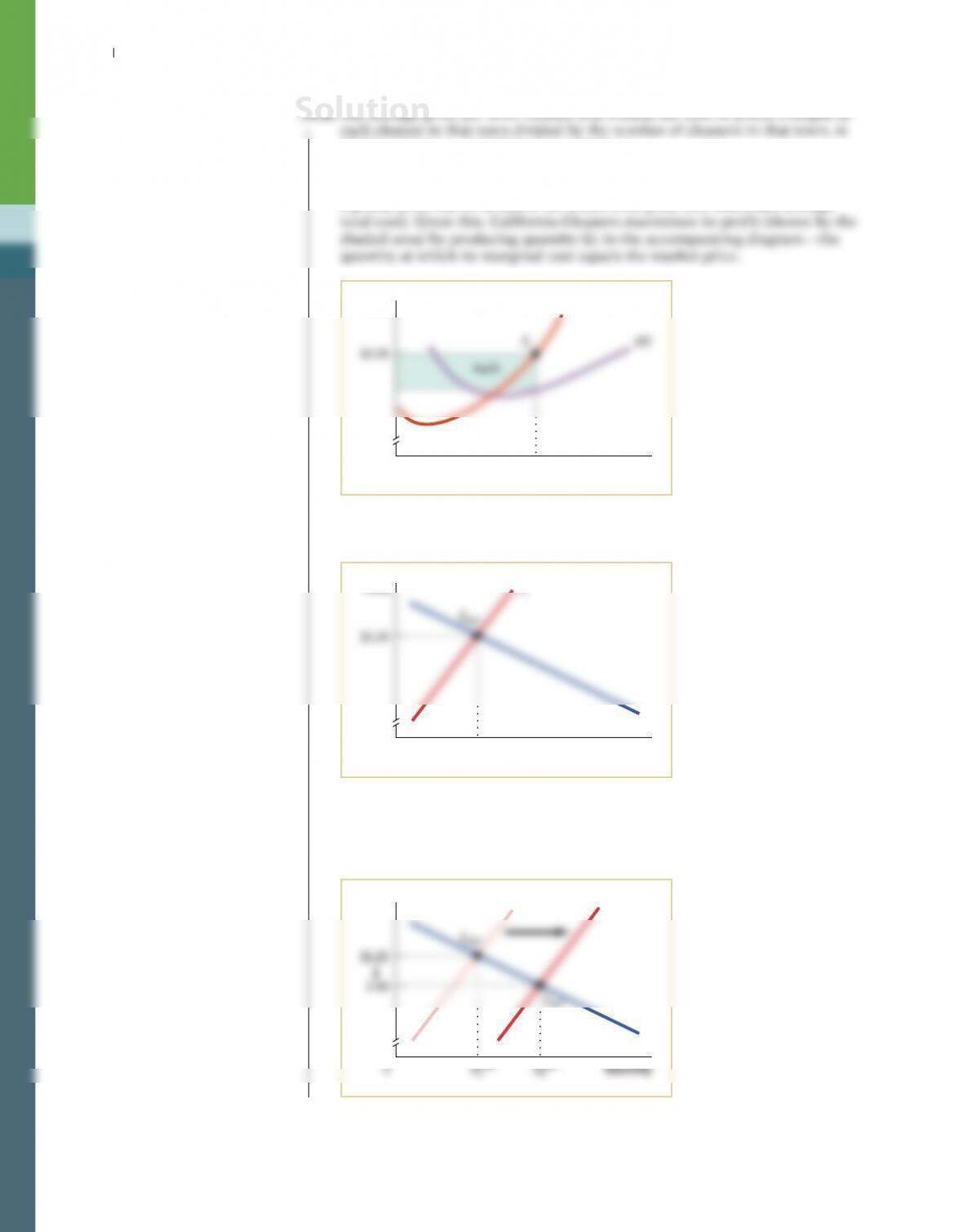
b. Draw typical marginal cost and average total cost curves for California Clean–
c. Assume $2.25 is the short-run equilibrium price in Goleta. Draw a typical short-
run demand and supply curve for the market. Label the equilibrium point.
d. Observing profits in the Goleta area, another dry cleaning service, Diamond
Cleaners, enters the market. It charges $1.95 per shirt. What is the new average
price of washing and ironing a shirt in Goleta? Illustrate the effect of entry on
S-198 Chapter 12 Perfect comPetition and the SuPPly curve
12. a. The average price per shirt washed and ironed, the sum of prices charged by
$2.25 in Goleta and $2.00 in Santa Barbara.
b. The marginal cost curve (MC) cuts through the average total cost curve (ATC)
at the lowest point of the ATC curve. Since California Cleaners is making
a profit, price has to be above the break-even price (the minimum average
Q1
0
Quantity
c. The accompanying diagram shows the short-run market supply curve and the
market demand curve.
S1
D
0
Price
Quantity
Q1
MKT
d. The entry of a new firm increases the quantity supplied at each price and
shifts the supply curve to the right, as indicated by the move from S1 to S2 in
the accompanying diagram. So the new equilibrium corresponds to a lower
equilibrium price, $2.20, and a higher equilibrium quantity.
S1S2
D
Price
$2.25
2.20
EMKT
FMKT
MKT Q2
MKT
Solution

Chapter 12 Perfect comPetition and the SuPPly curve S-199
e. Since California Cleaners breaks even at $2.20 a shirt, it must be operating at
the minimum of its average total cost curve. The likely effect on the diagram
in part b is shown below.
MC
0
Price
Quantity
Q2
f. Since, in the long run, firms break even in a perfectly competitive industry,
costs have to be higher in Goleta than in Santa Barbara.
WORK IT OUT Interactive step-by-step help with solving this
problem can be found online.
13. Kate’s Katering provides catered meals, and the catered meals industry is
perfectly competitive. Kate’s machinery costs $100 per day and is the only
fixed input. Her variable cost consists of the wages paid to the cooks and the
food ingredients. The variable cost per day associated with each level of out–
put is given in the accompanying table.
Quantity of meals VC
0 $0
50 1,000
a. Calculate the total cost, the average variable cost, the average total cost,
and the marginal cost for each quantity of output.
b. What is the break-even price and quantity? What is the shut–down price
and quantity?
c. Suppose that the price at which Kate can sell catered meals is $21 per
meal. In the short run, will Kate earn a profit? In the short run, should
she produce or shut down?
d. Suppose that the price at which Kate can sell catered meals is $17 per
meal. In the short run, will Kate earn a profit? In the short run, should
she produce or shut down?
S-200 Chapter 12 Perfect comPetition and the SuPPly curve
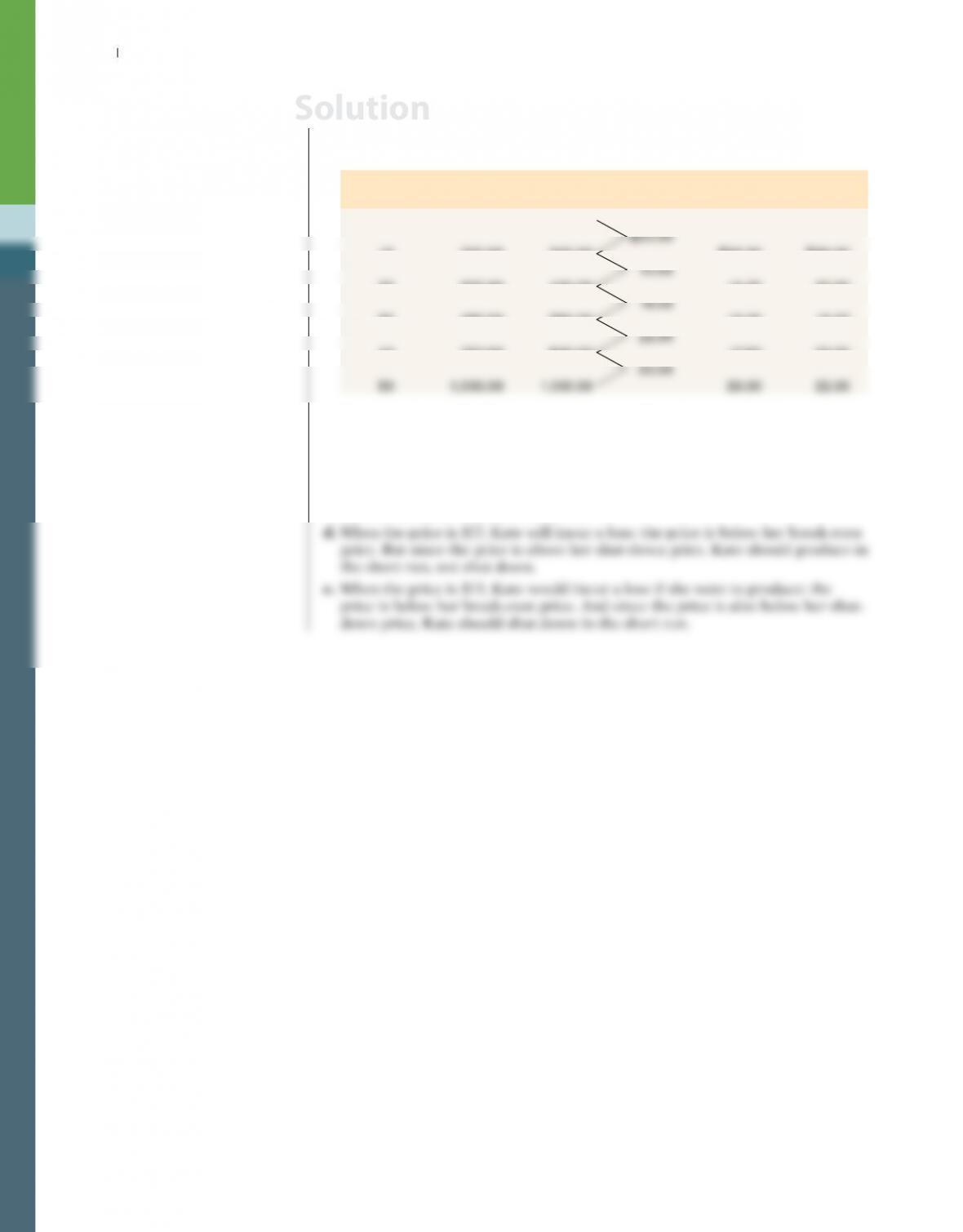
13. a. From Kate’s variable cost (VC), the accompanying table calculates Kate’s total
cost (TC), average variable cost (AVC), average total cost (ATC), and marginal
cost (MC).
Quantity
of meals VC TC
MC
of meal
AVC
of meal
ATC
of meal
0 $0.00 $100.00 — —
10 200.00 300.00 $20.00 $30.00
20 300.00 400.00 15.00 20.00
30 480.00 580.00 16.00 19.33
40 700.00 800.00 17.50 20.00
b. Kate’s break–even price, the minimum average total cost, is $19.33, at an out-
put quantity of 30 meals. Kate’s shut–down price, the minimum average vari-
able cost, is $15, at an output of 20 meals.
c. When the price is $21, Kate will make a profit: the price is above her break-
even price. And since the price is above her shut–down price, Kate should pro–
duce in the short run, not shut down.
Solution