S-161
interactive activity
Chapter 12
Aggregate Demand and
Aggregate Supply
1. A fall in the value of the dollar against other currencies makes U.S. final goods
and services cheaper to foreigners even though the U.S. aggregate price level
stays the same. As a result, foreigners demand more American aggregate output.
Your study partner says that this represents a movement down the aggregate
demand curve because foreigners are demanding more in response to a lower
price. You, however, insist that this represents a rightward shift of the aggregate
demand curve. Who is right? Explain.
1. You are right. When a fall in the value of the dollar against other currencies
2. Your study partner is confused by the upward-sloping short-run aggregate
supply curve and the vertical long–run aggregate supply curve. How would you
explain this?
3. Suppose that in Wageland all workers sign annual wage contracts each year on
January1. No matter what happens to prices of final goods and services dur-
ing the year, all workers earn the wage specified in their annual contract. This
year, prices of final goods and services fall unexpectedly after the contracts are
signed. Answer the following questions using a diagram and assume that the
economy starts at potential output.
a. In the short run, how will the quantity of aggregate output supplied respond
to the fall in prices?
b. What will happen when firms and workers renegotiate their wages?
Solution
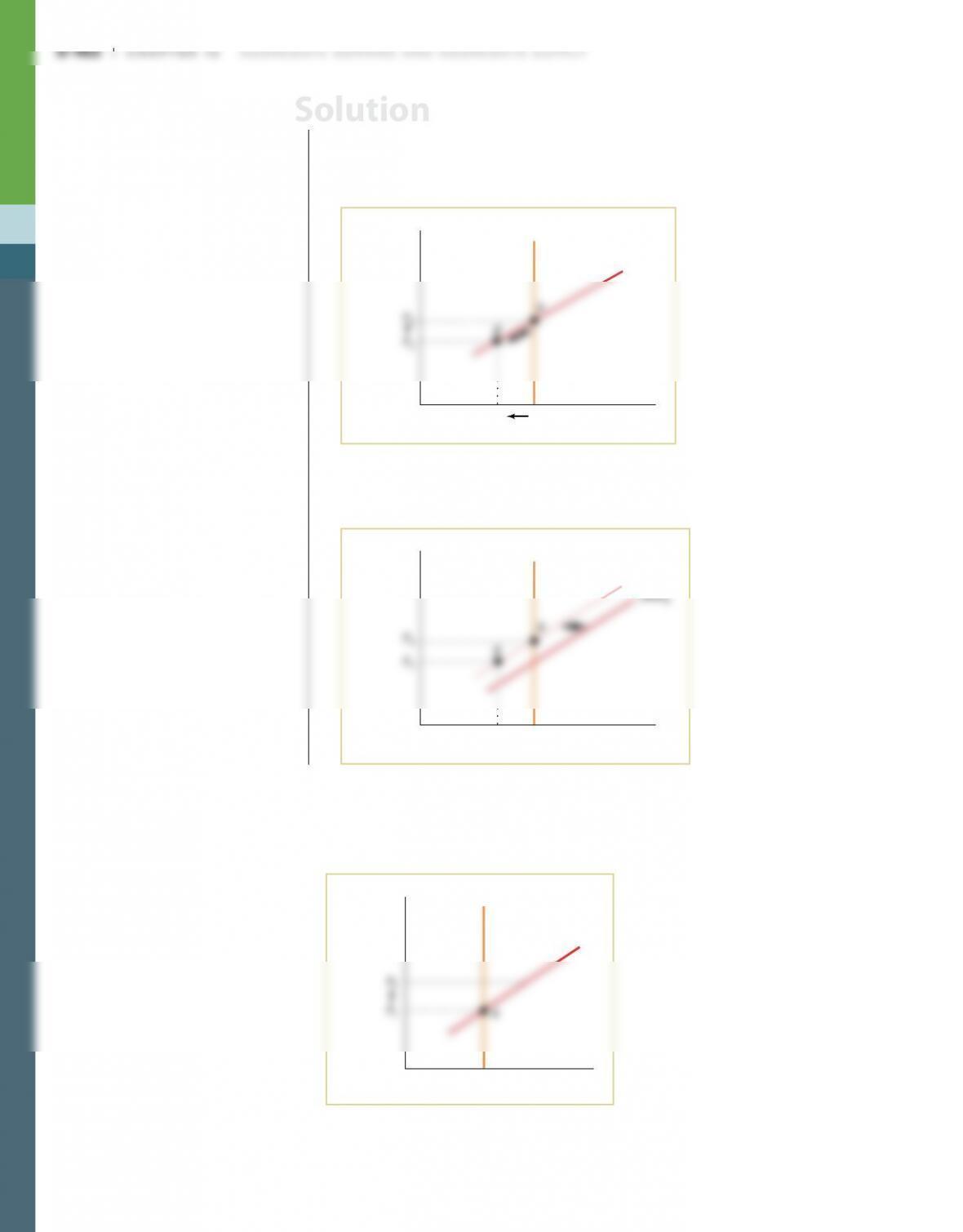
3. a. In the short run, the prices of final goods and services in Wageland fall
unexpectedly but nominal wages don’t change; they are fixed in the short
run by the annual contract. So firms earn a lower profit per unit and reduce
output. In the accompanying diagram, Wageland moves along SRAS1 from
point A on January 1 to point B after the fall in prices.
Aggregate
price
level
Real GDPYP
Y2
LRAS
SRAS
1
b. When firms and workers renegotiate their wages, nominal wages will
decrease, shifting the short–run aggregate supply curve in the accompanying
diagram rightward from SRAS1 to a curve such as SRAS2.
Aggregate
price
level
Real GDPY
P
Y
2
LRAS
SRAS1
4. The economy is at point A in the accompanying diagram. Suppose that the
aggregate price level rises from P1 to P2. How will aggregate supply adjust in the
short run and in the long run to the increase in the aggregate price level? Illus–
trate with a diagram.
Real GDP
A
ggregate
price
level
Y1
LRAS
SRAS1
Solution
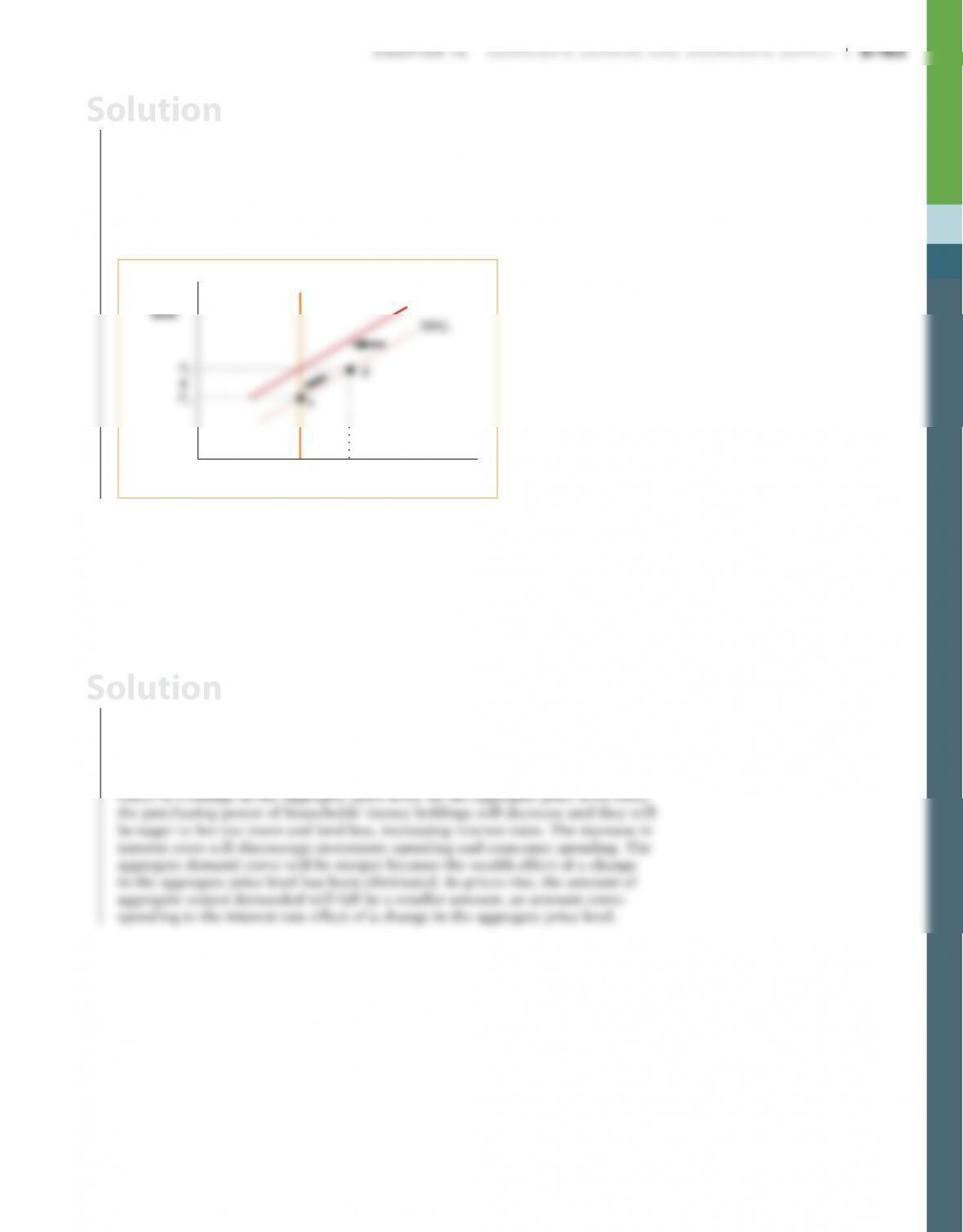
4. In the short run, as the aggregate price level rises from P1 to P2, nominal wages
will not change. So profit per unit will rise, leading to an increase in production
from Y1 to Y2. The economy will move from point A to point B in the accompa-
nying diagram. In the long run, however, nominal wages will be renegotiated
upward in reaction to low unemployment at Y2. As nominal wages increase,
the short–run aggregate supply curve will shift leftward from SRAS1 to a posi-
tion such as SRAS2. The exact position of SRAS2 depends on factors such as the
aggregate demand curve.
Aggregate
price
Real GDPY2
Y1
LRAS
SRAS2
5. Suppose that all households hold all their wealth in assets that automatically
rise in value when the aggregate price level rises (an example of this is what is
called an “inflation–indexed bond”—a bond whose interest rate, among other
things, changes one–for–one with the inflation rate). What happens to the wealth
effect of a change in the aggregate price level as a result of this allocation of
assets? What happens to the slope of the aggregate demand curve? Will it still
slope downward? Explain.
5. If all households hold all their wealth in assets that automatically rise in value
when the aggregate price level rises, this will eliminate the wealth effect of a
change in the aggregate price level. The purchasing power of consumers’ wealth
will not vary with a change in the aggregate price level, so there will be no
change in consumer spending due to the change in the aggregate price level. The
aggregate demand curve will still slope downward because of the interest rate
6. Suppose that the economy is currently at potential output. Also suppose that you
are an economic policy maker and that a college economics student asks you to
rank, if possible, your most preferred to least preferred type of shock: positive
demand shock, negative demand shock, positive supply shock, negative supply
shock. How would you rank them and why?
Solution
Solution

S-164 Chapter 12 AggregAte DemAnD AnD AggregAte Supply
6. The most preferred shock would be a positive supply shock. The economy would
have higher aggregate output without the danger of inflation. The government
would not need to respond with a change in policy. The least preferred shock
would be a negative supply shock. The economy would experience stagflation.
There would be lower aggregate output and higher inflation. There is no good
policy remedy for a negative supply shock: policies to counteract the slump in
7. Explain whether the following government policies affect the aggregate demand
curve or the short–run aggregate supply curve and how.
7. a. If the government reduces the minimum nominal wage, it is similar to a fall
in nominal wages. Aggregate supply will increase, and the short–run aggregate
supply curve will shift to the right.
b. If the government increases TANF, consumer spending will increase because
disposable income increases (disposable income equals income plus govern-
ment transfers, such as TANF payments, less taxes). Aggregate demand will
increase, and the aggregate demand curve will shift to the right.
8. In Wageland, all workers sign annual wage contracts each year on January 1. In
late January, a new computer operating system is introduced that increases labor
Solution
Solution
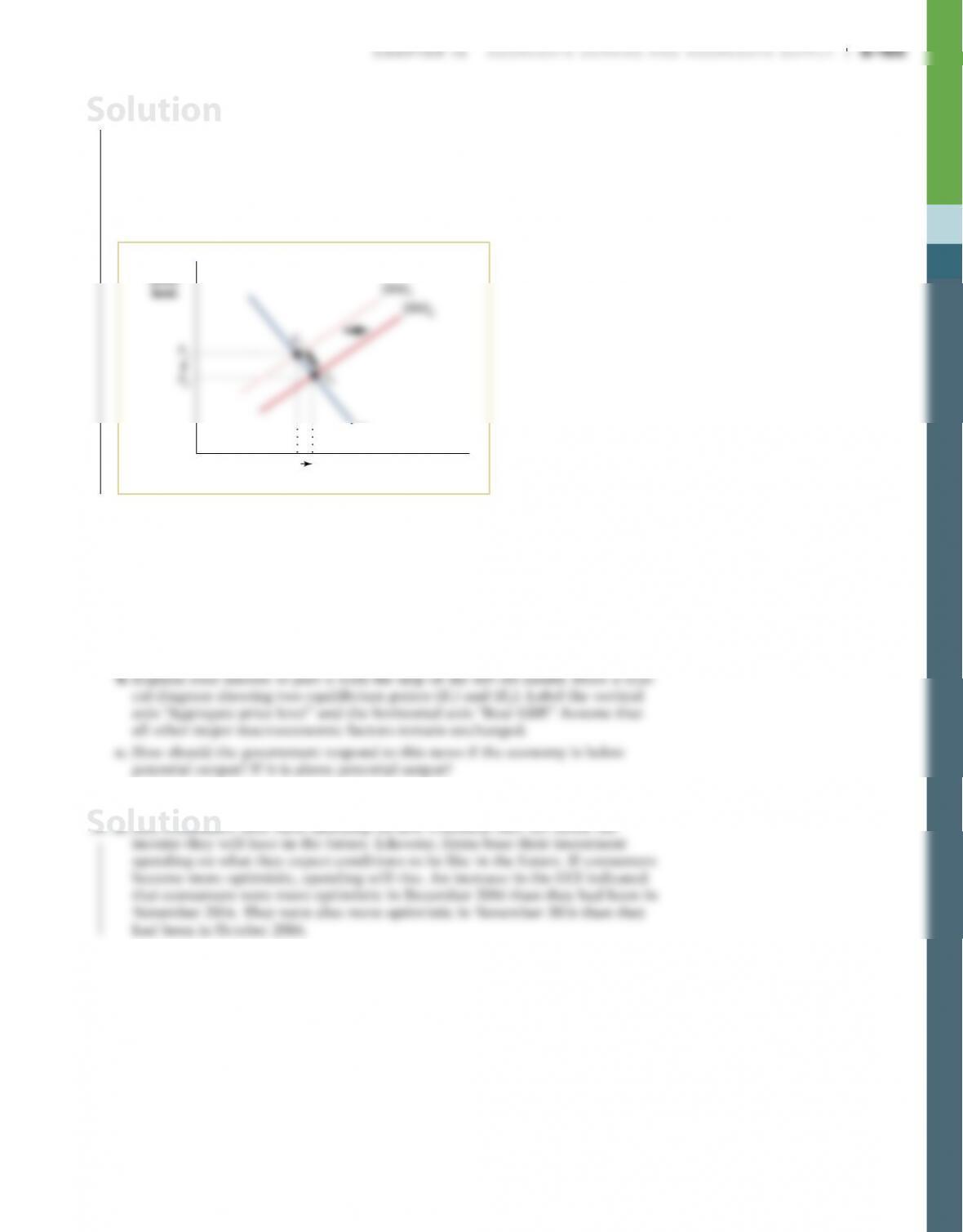
8. As labor productivity increases, producers will experience a reduction in produc-
tion costs and profit per unit of output will increase. Producers will respond by
increasing the quantity of aggregate output supplied at any given aggregate price
level. The short-run aggregate supply curve will shift to the right. Beginning at
short–run equilibrium, E1 in the accompanying diagram, the short-run aggregate
supply curve will shift from SRAS1 to SRAS2. The aggregate price level will fall,
and real GDP will increase in the short run.
Real GDPY2
Y1
AD
Aggregate
price
9. The Conference Board publishes the Consumer Confidence Index (CCI) every
month based on a survey of 5,000 representative U.S. households. It is used
by many economists to track the state of the economy. A press release by the
Board on December 27, 2016, stated: “The Conference Board Consumer Confi-
dence Index®, which had increased considerably in November, posted another
gain in December. The Index now stands at 113.7 (1985 = 100), up from 109.4 in
November.”
a. As an economist, is this news encouraging for economic growth?
9. a. Yes, consumers base their spending on how confident they are about the
Solution
Solution
S-166 Chapter 12 AggregAte DemAnD AnD AggregAte Supply
b. An increase in consumer confidence leads to a rightward shift of the aggre–
gate demand curve. As shown, in the accompanying diagram, other things
equal, this will increase real GDP from Y1 to Y2 and will increase the aggregate
price level from P1 to P2.
Y2
P2
P1
AD1 AD
2
E2
E1
SRAS
Y1Real GDP
Aggregate
price
level
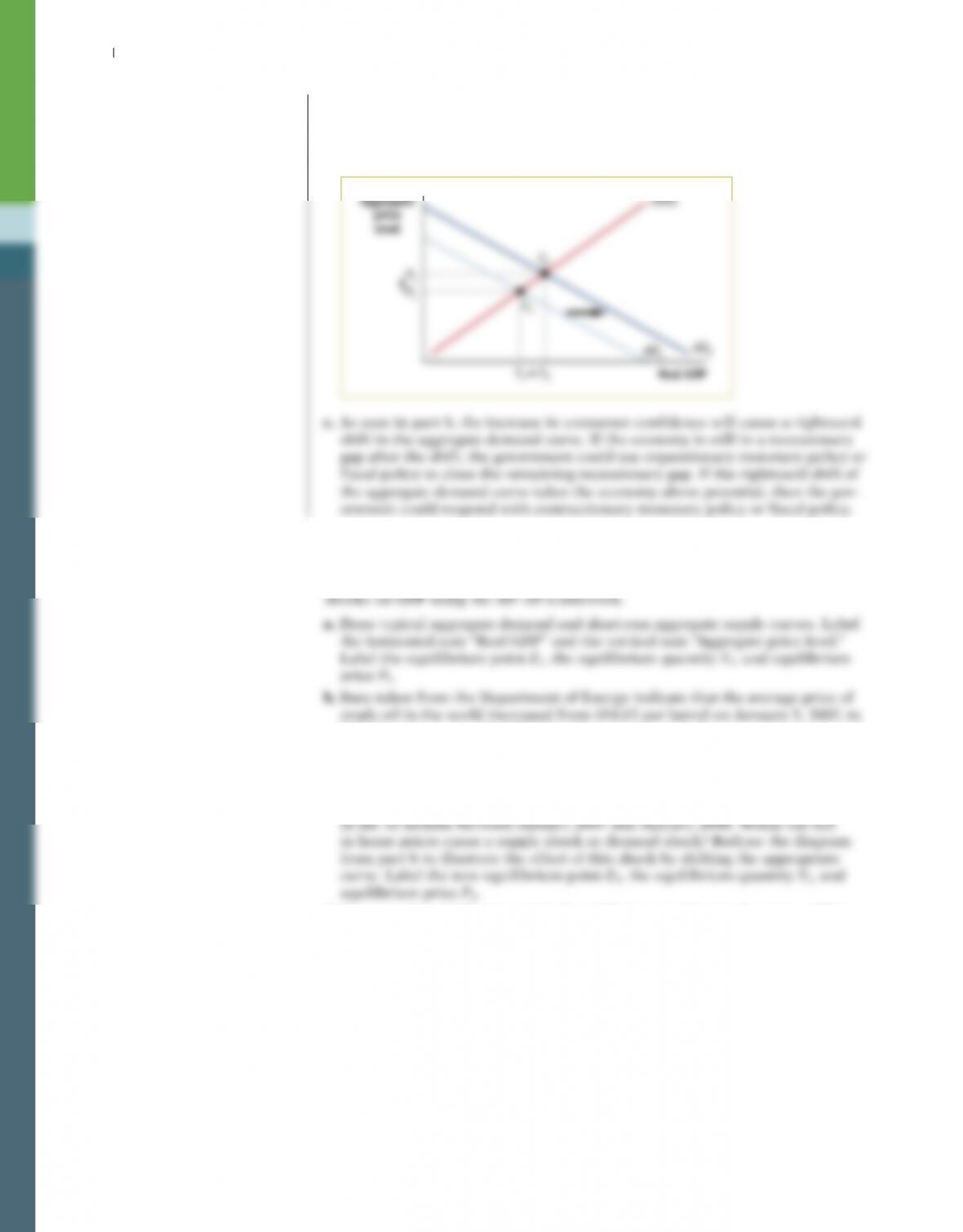
c. As seen in part b, the increase in consumer confidence will cause a rightward
shift in the aggregate demand curve. If the economy is still in a recessionary
gap after the shift, the government could use expansionary monetary policy or
fiscal policy to close the remaining recessionary gap. If the rightward shift of
the aggregate demand curve takes the economy above potential, then the gov-
ernment could respond with contractionary monetary policy or fiscal policy.
10. There were two major shocks to the U.S. economy in 2007, leading to the severe
recession of 2007–2009. One shock was related to oil prices; the other was the
slump in the housing market. This question analyzes the effect of these two
$92.93 on December 28, 2007. Would an increase in oil prices cause a demand
shock or a supply shock? Redraw the diagram from part a to illustrate the
effect of this shock by shifting the appropriate curve.
c. The Housing Price Index, published by the Office of Federal Housing Enter-
prise Oversight, calculates that U.S. home prices fell by an average of 3.0%
d. Compare the equilibrium points E1 and E3 in your diagram for part c. What
was the effect of the two shocks on real GDP and the aggregate price level
(increase, decrease, or indeterminate)?
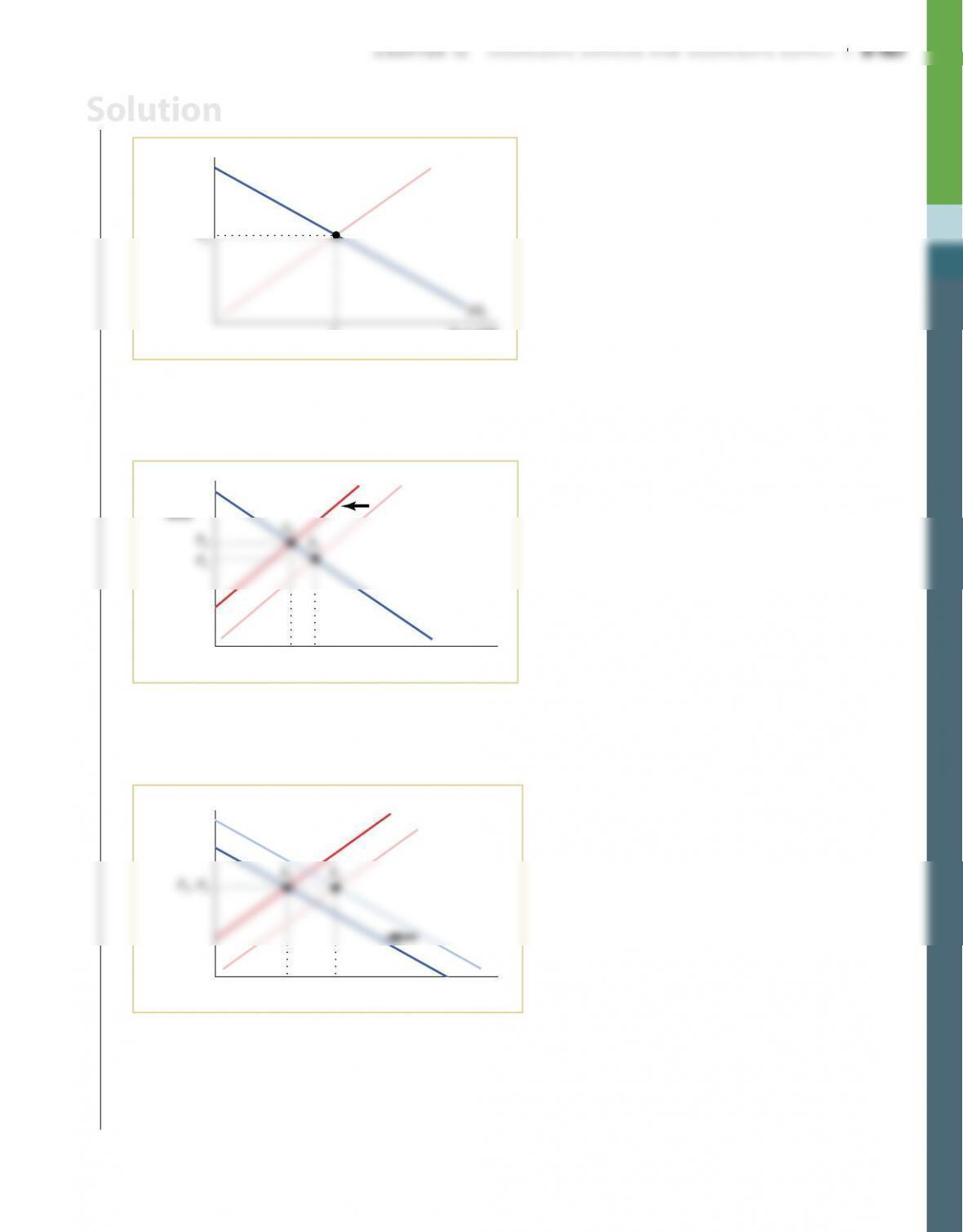
10. a. The graph will look like this:
Y1
E1
SRAS
1
Real GDP
Aggregate
price
level
b. The rise in the price of oil usually causes a supply shock. The short-run aggre–
gate supply (SRAS) curve shifts to the left, from SRAS1 to SRAS2. The economy
settles at a new short-run macroeconomic equilibrium at E2, with a higher
aggregate price level, P2, and lower real GDP, Y2.
SRAS
1
SRAS
2
AD1
Real GDP
Aggregate
price
level
Y1
Y2
P1
P2E1
E2
c. The fall in home prices would cause a demand shock because of the wealth
effect. The aggregate demand (AD) curve shifts leftward, from AD1 to AD2. The
new aggregate price level, P3, could either be equal to, above, or below P1. The
new level of real GDP, Y3, is below the original level, Y1.
SRAS
2
SRAS1
AD2 AD
1
Real GDP
A
ggregate
price
level
Y
3
Y
1
d. The effect on the aggregate price level is indeterminate. As drawn in the
diagram for part c, P1 and P3 coincide because the negative supply and
demand shocks have exactly offsetting price effects. However, prices could
either rise or fall when both a negative demand shock and a negative supply
shock occur. The fall in real GDP is unambiguous because the two shocks
reinforce their negative effects on GDP.
Solution
11. Using aggregate demand, short–run aggregate supply, and long–run aggregate
supply curves, explain the process by which each of the following economic
events will move the economy from one long–run macroeconomic equilibrium
toanother. Illustrate with diagrams. In each case, what are the short–run and
long–run effects on the aggregate price level and aggregate output?
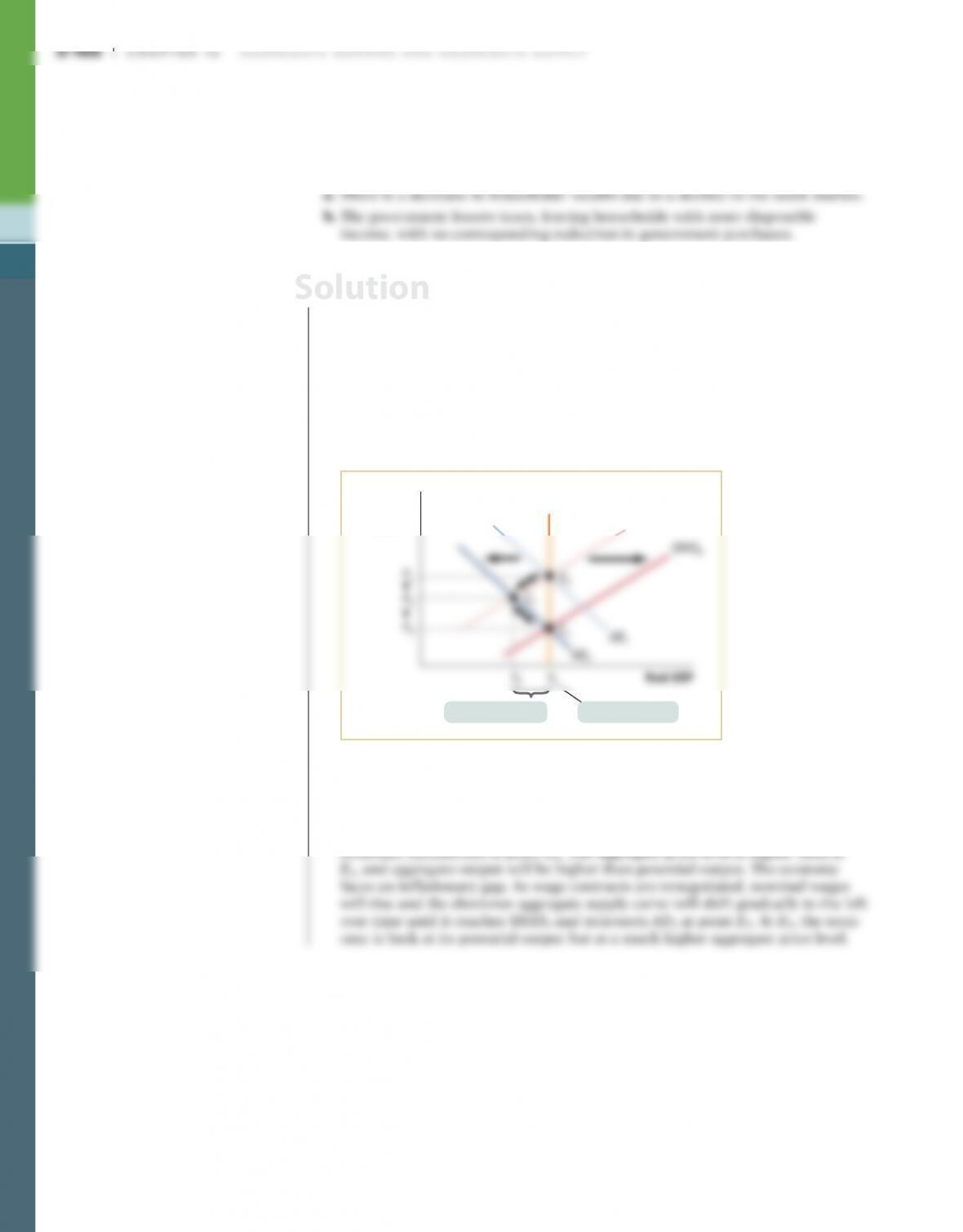
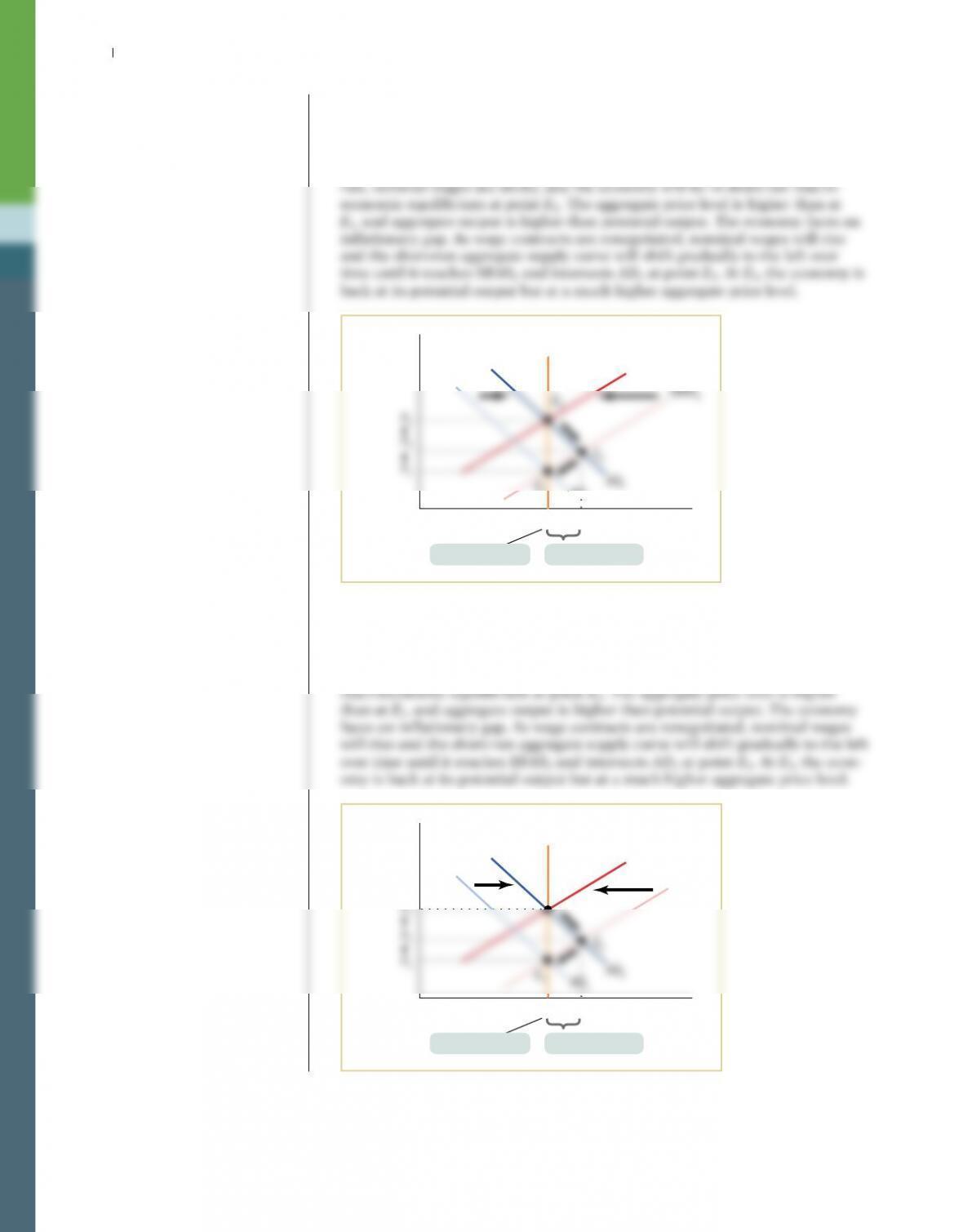
11. a. A decrease in households’ wealth will reduce consumer spending. Beginning
at long–run macroeconomic equilibrium, E1 in the accompanying diagram, the
aggregate demand curve will shift from AD1 to AD2. In the short run, nomi–
nal wages are sticky, and the economy will be in short–run macroeconomic
equilibrium at point E2. The aggregate price level will be lower than at E1, and
aggregate output will be lower than potential output. The economy faces a
recessionary gap. As wage contracts are renegotiated, nominal wages will fall
and the short–run aggregate supply curve will shift gradually to the right over
time until it reaches SRAS2 and intersects AD2 at point E3. At E3, the economy
is back at its potential output but at a much lower aggregate price level.
Aggregate
price
level
LRAS
SRAS1
SRAS
2
Solution
Chapter 12 AggregAte DemAnD AnD AggregAte Supply S-169
Aggregate
price
level
Real GDPY2
Y1
LRAS
SRAS
1
E1
E3
SRAS2
Inflationary gapPotential output
AD1
12. Using aggregate demand, short–run aggregate supply, and long–run aggregate
supply curves, explain the process by which each of the following government
policies will move the economy from one long–run macroeconomic equilibrium
to another. Illustrate with diagrams. In each case, what are the short–run and
long–run effects on the aggregate price level and aggregate output?
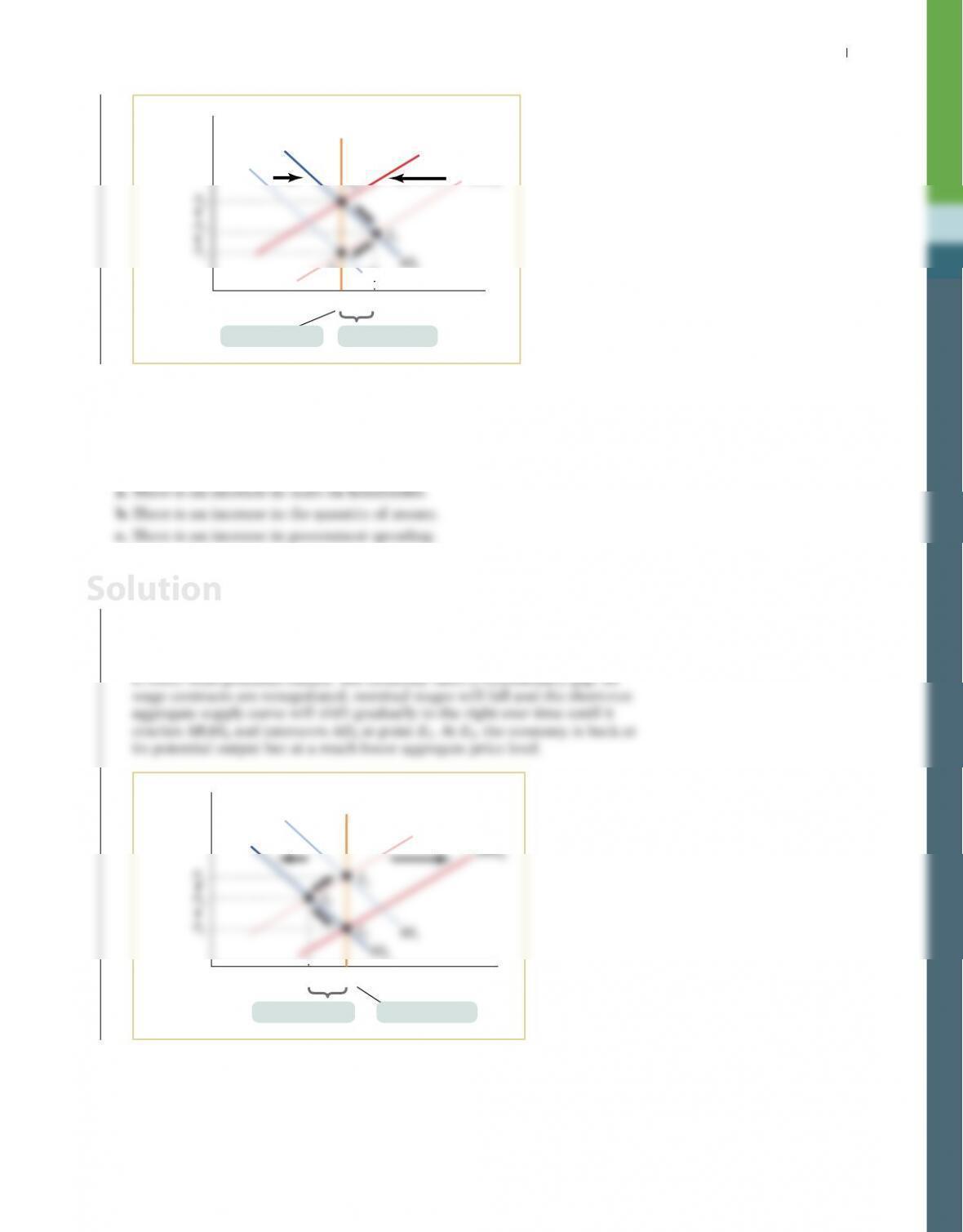
12. a. An increase in taxes will decrease consumer spending by households.
Beginning at E1 in the accompanying diagram, the aggregate demand curve
will shift leftward from AD1 to AD2. In the short run, nominal wages are
sticky, and the economy will be in short–run macroeconomic equilibrium at
point E2. The aggregate price level is lower than at E1, and aggregate output
Aggregate
price
level
LRAS
SRAS1
SRAS
2
Solution
S-170 Chapter 12 AggregAte DemAnD AnD AggregAte Supply
b. An increase in the quantity of money will encourage people to lend, lowering
interest rates and increasing investment and consumer spending; at any given
aggregate price level, the quantity of aggregate output demanded will be higher.
Beginning at long–run macroeconomic equilibrium, E1 in the accompanying
diagram, the aggregate demand curve will shift from AD1 to AD2. In the short
Aggregate
price
level
Real GDPY2
Y1
LRAS
E1
SRAS2
Inflationary gapPotential output
AD1
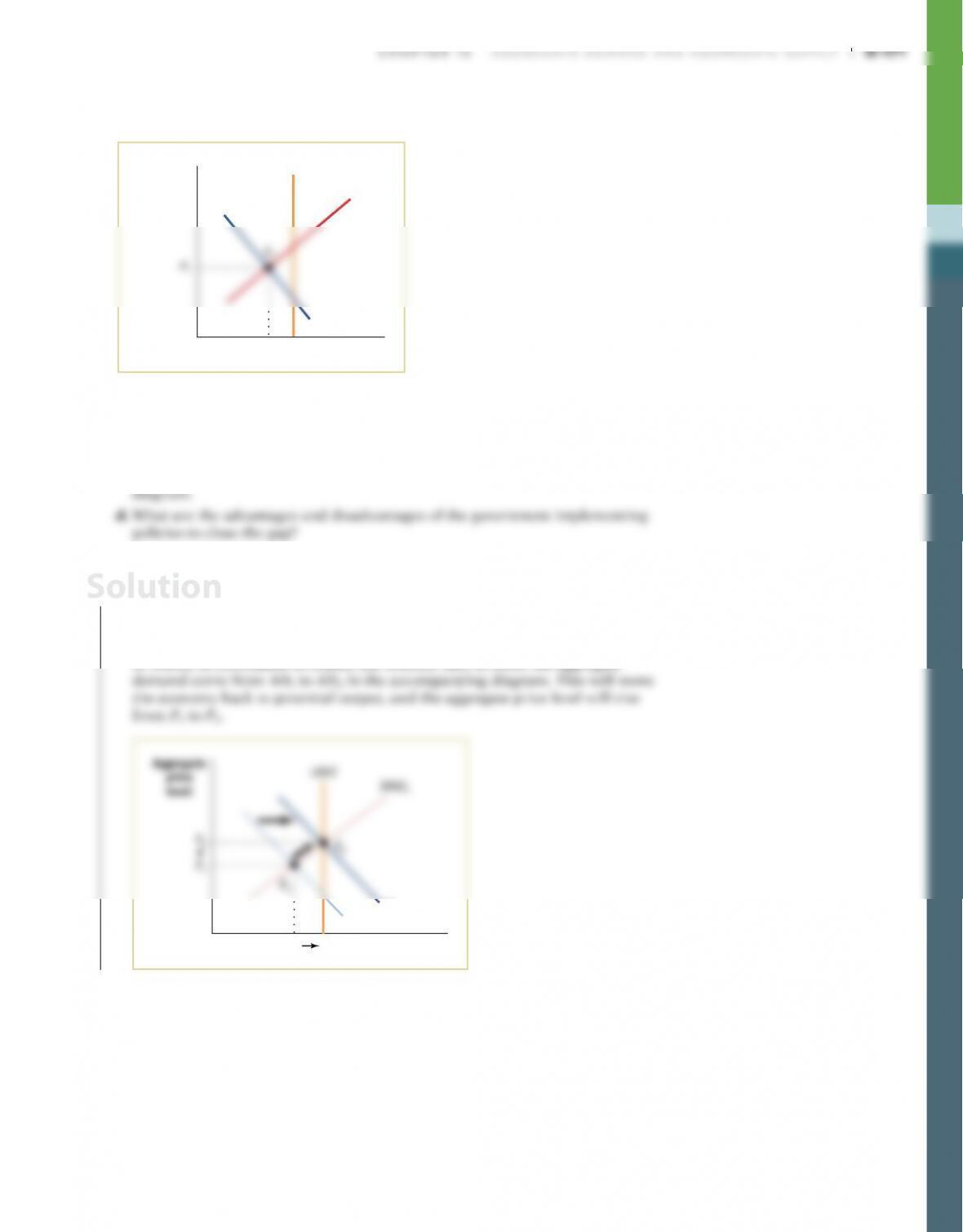
c. An increase in government spending will increase aggregate demand; at any
given aggregate price level, the quantity of aggregate output demanded will be
higher. Beginning at long–run macroeconomic equilibrium, E1 in the accom–
panying diagram, the aggregate demand curve will shift from AD1 to AD2. In
the short run, nominal wages are sticky, and the economy will be in short-run
Aggregate
price
level
Real GDPY2
Y1
LRAS
SRAS
1
E3
SRAS2
Inflationary gapPotential output
13. The economy is in short–run macroeconomic equilibrium at point E1 in the
accompanying diagram. Based on the diagram, answer the following questions.
Real GDP
A
ggregate
price
level
YP
Y1
LRAS
SRAS
1
AD1
a. Is the economy facing an inflationary or a recessionary gap?
b. What policies can the government implement that might bring the economy
back to long–run macroeconomic equilibrium? Illustrate with a diagram.
c. If the government did not intervene to close this gap, would the economy
return to long–run macroeconomic equilibrium? Explain and illustrate with a
13. a. The economy is facing a recessionary gap because Y1 is less than the potential
output of the economy, YP.
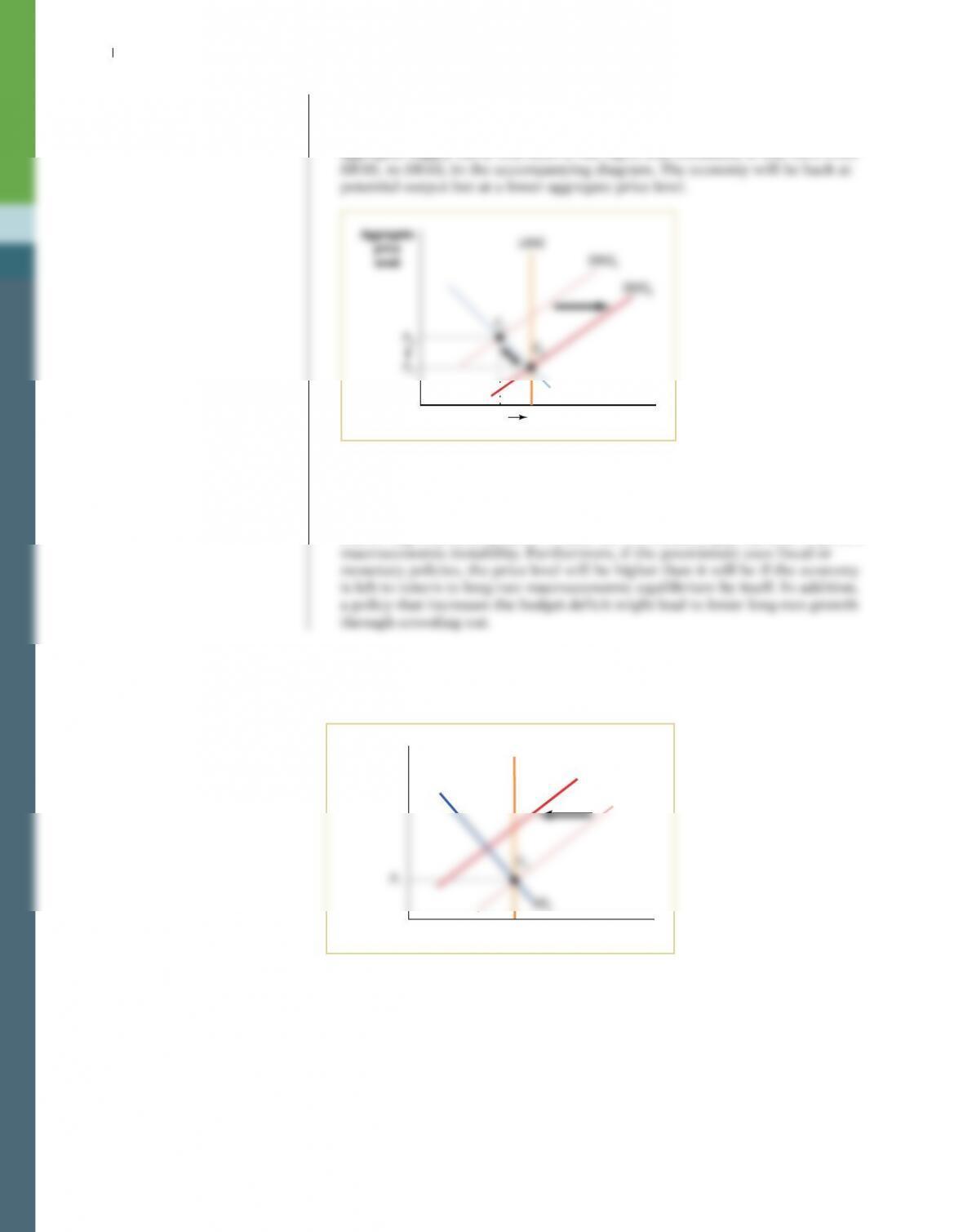
b. The government could use either fiscal policy (increases in government spend-
ing or reductions in taxes) or monetary policy (increases in the quantity
of money in circulation to reduce the interest rate) to move the aggregate
Real GDPYP
Y1
AD2
AD1
Solution
S-172 Chapter 12 AggregAte DemAnD AnD AggregAte Supply
c. If the government did not intervene to close the recessionary gap, the economy
would eventually self–correct and move back to potential output on its own.
Due to unemployment, nominal wages will fall in the long run. The short-run
aggregate supply curve will shift to the right, and eventually it will shift from
Real GDPYP
Y1
AD1
d. If the government implements fiscal or monetary policies to move the econ-
omy back to long–run macroeconomic equilibrium, the recessionary gap
might be eliminated faster than if the economy was left to adjust on its own.
However, because policy makers aren’t perfectly informed and policy effects
can be unpredictable, policies to close the recessionary gap can lead to greater
14. In the accompanying diagram, the economy is in long–run macroeconomic equi–
librium at point E1 when an oil shock shifts the short–run aggregate supply curve
to SRAS2. Based on the diagram, answer the following questions.
Real GDP
A
ggregate
price
level
Y1
LRAS
SRAS2
SRAS1
P1
AD1
E1
a. How do the aggregate price level and aggregate output change in the short run
as a result of the oil shock? What is this phenomenon known as?
b. What fiscal or monetary policies can the government use to address the effects
of the supply shock? Use a diagram that shows the effect of policies chosen
to address the change in real GDP. Use another diagram to show the effect of
policies chosen to address the change in the aggregate price level.
c. Why do supply shocks present a dilemma for government policy makers?
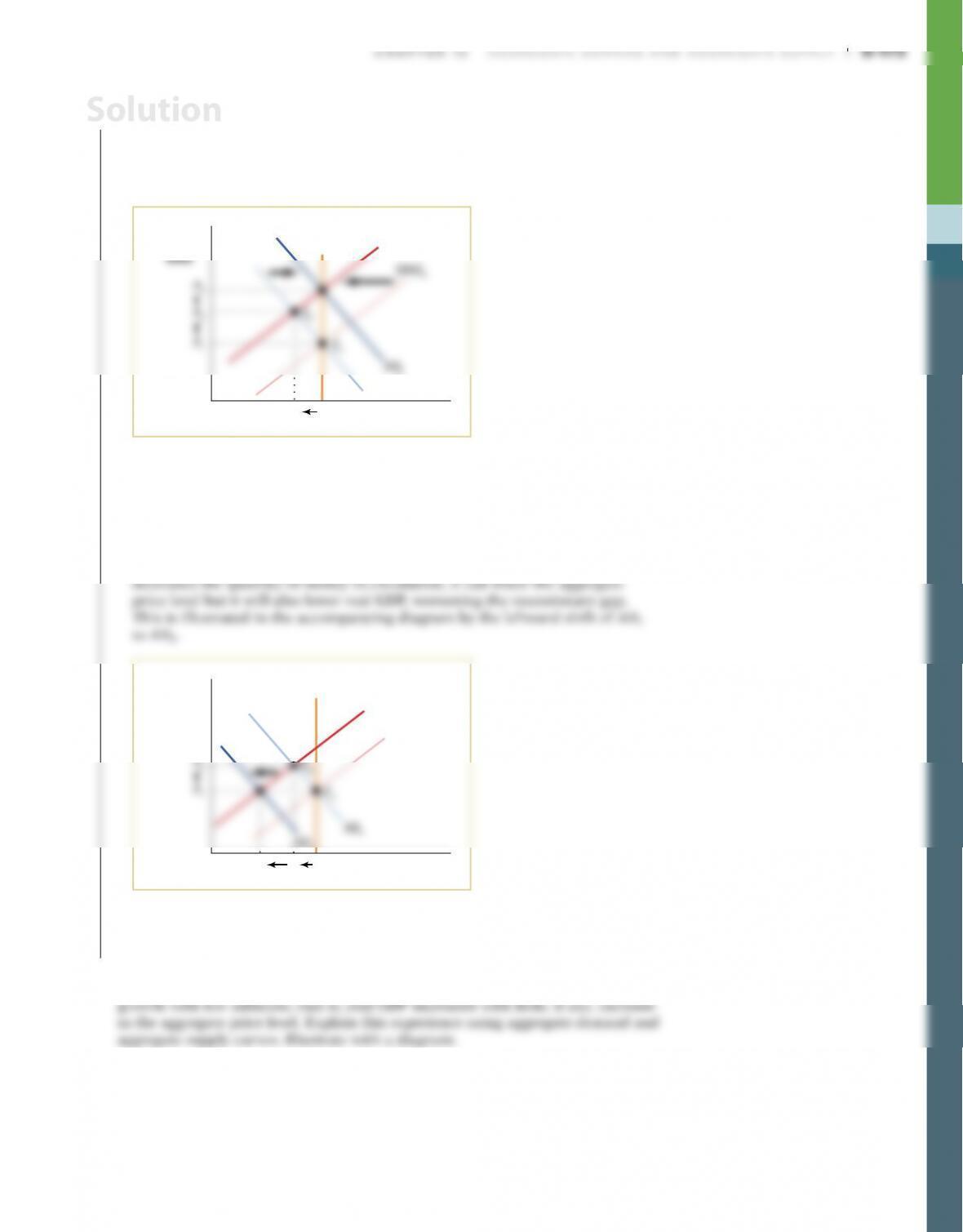
14. a. As a result of the increase in the price of oil and the shift to the left of the
short-run aggregate supply curve, real GDP decreases to Y2 (and with it
unemployment rises) and the aggregate price level increases to P2 as shown
in the accompanying diagram. This combined problem of inflation and
unemployment is known as stagflation.
Aggregate
price
Real GDPY1
Y2
LRAS
SRAS2
AD1
b. The government can use fiscal and monetary policies to either increase
real GDP or lower the aggregate price level, but not both. If the government
increases government spending, decreases taxes, or increases the quantity of
money in circulation, it can raise real GDP but it will also raise the aggregate
price level. This is illustrated in the diagram accompanying part a by the
rightward shift of AD1 to AD2.
If the government decreases government spending, increases taxes, or
Aggregate
price
level
Real GDPY2
Y3
LRAS
SRAS1
AD3
SRAS2
Y1
c. The government cannot use fiscal and monetary policies to correct for the
lower real GDP and higher aggregate price level simultaneously. It can only use
policies to alleviate one problem but at the expense of making the other worse.
15. The late 1990s in the United States were characterized by substantial economic
Solution
S-174 Chapter 12 AggregAte DemAnD AnD AggregAte Supply
15. Increases in both long–run and short-run aggregate supply, along with increases
in aggregate demand, can explain how real GDP grew with little if any increase
in the aggregate price level. The accompanying diagram shows how the economy
could move from one long–run macroeconomic equilibrium, point E1, to another,
point E2, with an increase in real GDP and no increase in the aggregate price
Solution