Chapter 12 – The Demand for Resources
12-1
Chapter 12 The Demand for Resources
QUESTIONS
1. What is the significance of resource pricing? Explain how the factors determining resource
demand differ from those determining product demand. Explain the meaning and significance of
the fact that the demand for a resource is a derived demand. Why do resource demand curves
slope downward? LO1
Answer: All resources that enter into production are owned by someone, including the
most important resource of all for most people, self-owned labor. The most basic
significance of resource pricing is that it largely determines people’s incomes. Resource
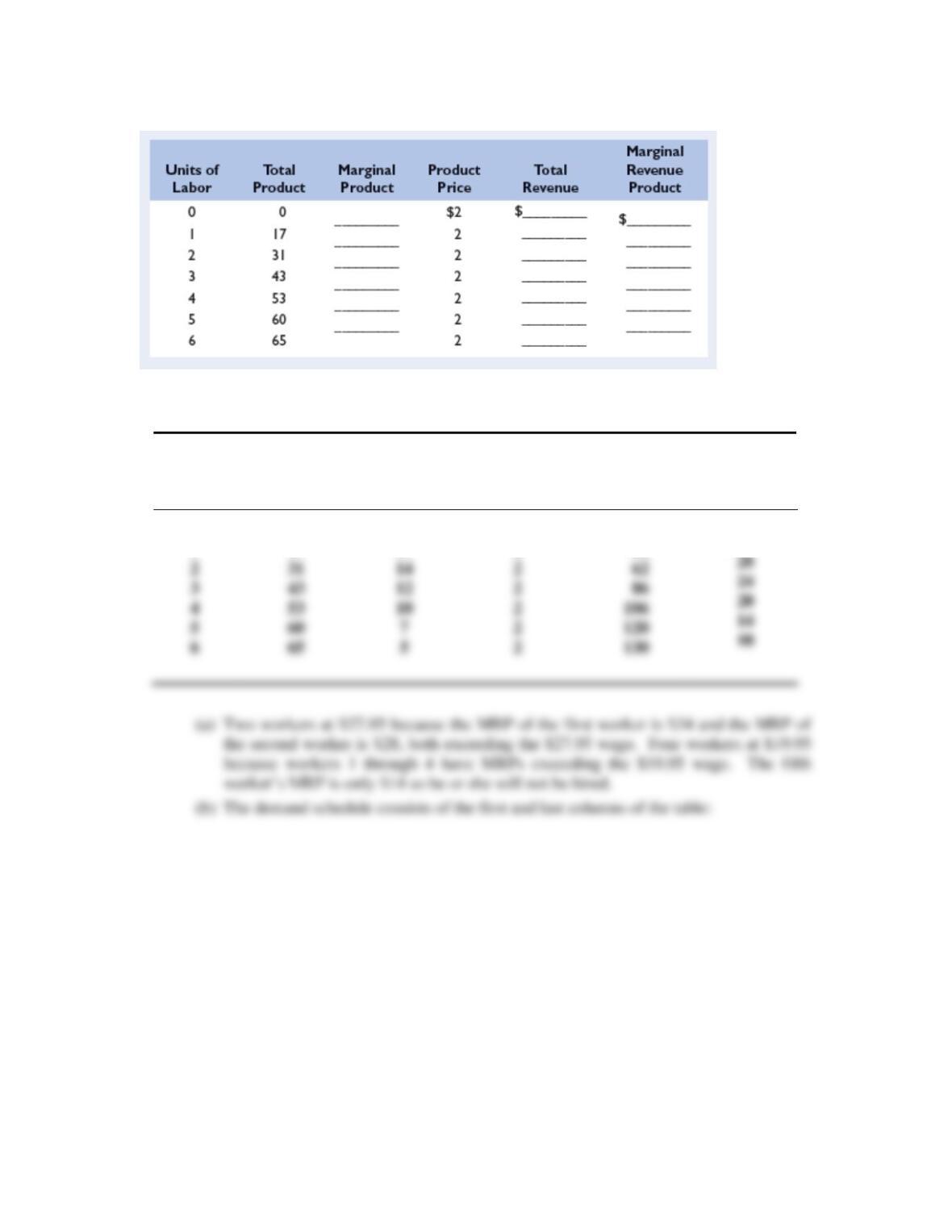
2. At the bottom of the page, complete the labor demand table for a firm that is hiring labor
competitively and selling its product in a competitive market. LO2
a. How many workers will the firm hire if the market wage rate is $27.95? $19.95? Explain why
the firm will not hire a larger or smaller number of units of labor at each of these wage rates.
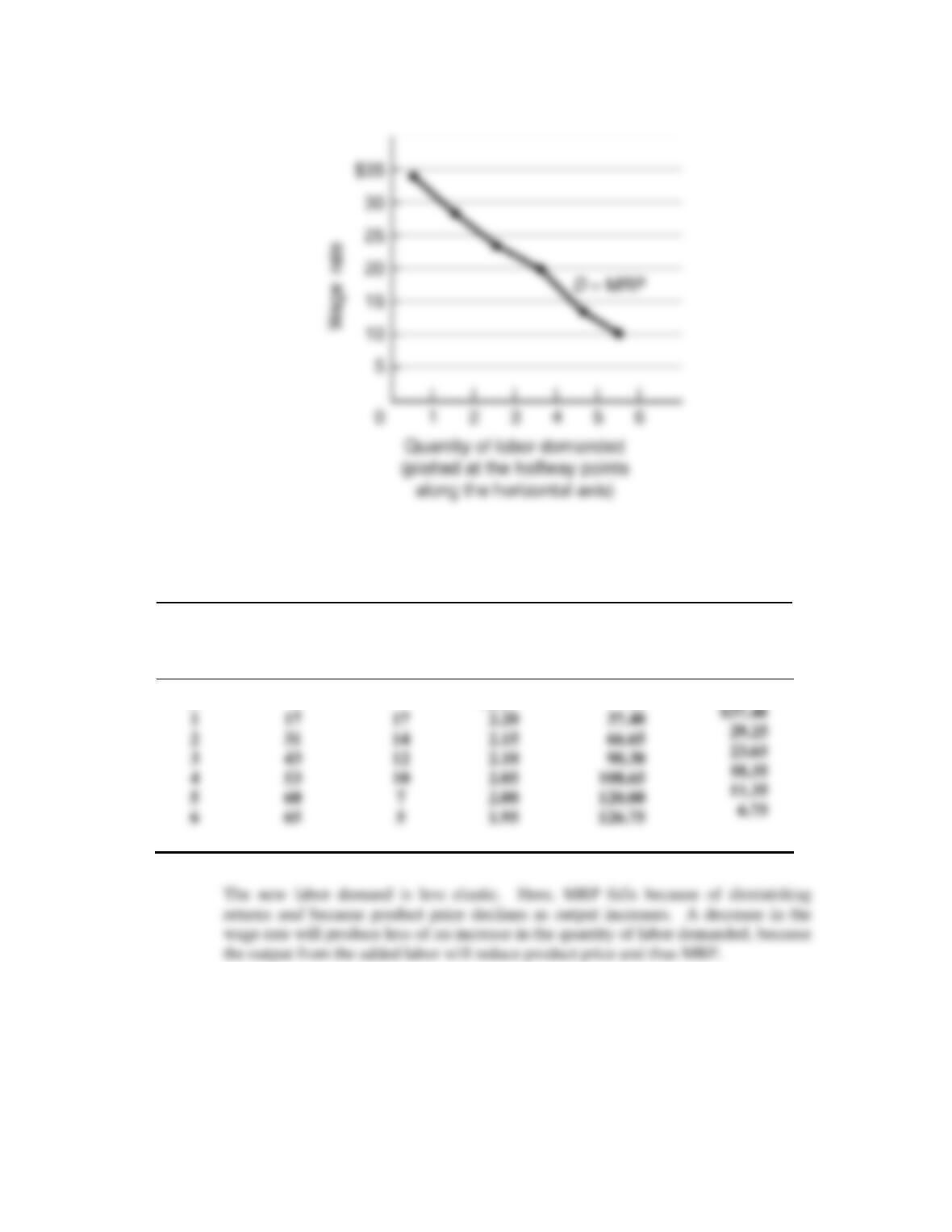
b. Show in schedule form and graphically the labor demand curve of this firm.
c. Now again determine the firm’s demand curve for labor, assuming that it is selling in an
imperfectly competitive market and that, although it can sell 17 units at $2.20 per unit, it must
lower product price by 5 cents in order to sell the marginal product of each successive labor unit.
Compare this demand curve with that derived in question 2b. Which curve is more elastic?
Explain.
Chapter 12 – The Demand for Resources
12-2
Answer: Table:
Units
of
labor
Total
product
Marginal
product
Product
price
Total
revenue
Marginal
revenue
product
0
1
0
17
17
$2
2
$0
34
$34
Chapter 12 – The Demand for Resources
12-3
(c) New Table:
Units
of
labor
Total
product
Marginal
product
Product
price
Total
revenue
Marginal
revenue
product
0
0
____
$2.25
$0
3. In 2009 General Motors (GM) announced that it would reduce employment by 21,000 workers.
What does this decision reveal about how GM viewed its marginal revenue product (MRP) and
marginal resource cost (MRC)? Why didn’t GM reduce employment by more than 21,000
workers? By fewer than 21,000 workers? LO3
Chapter 12 – The Demand for Resources
12-4
Answer: GM’s decision suggests that the MRC of those 21,000 workers was greater than
4. What factors determine the elasticity of resource demand? What effect will each of the
following have on the elasticity or the location of the demand for resource C, which is being used
to produce commodity X? Where there is any uncertainty as to the outcome, specify the causes of
that uncertainty. LO4
a. An increase in the demand for product X.
b. An increase in the price of substitute resource D.
c. An increase in the number of resources substitutable for C in producing X.
d. A technological improvement in the capital equipment with which resource C is combined.
e. A fall in the price of complementary resource E.
f. A decline in the elasticity of demand for product X due to a decline in the competitiveness of
product market X.
Answer: Elasticity of demand for a resource is determined by: (1) ease of resource
substitutability; (2) elasticity of product demand; and (3) ratio of resource costs to total
costs.
(a) Increase in the demand for resource C.
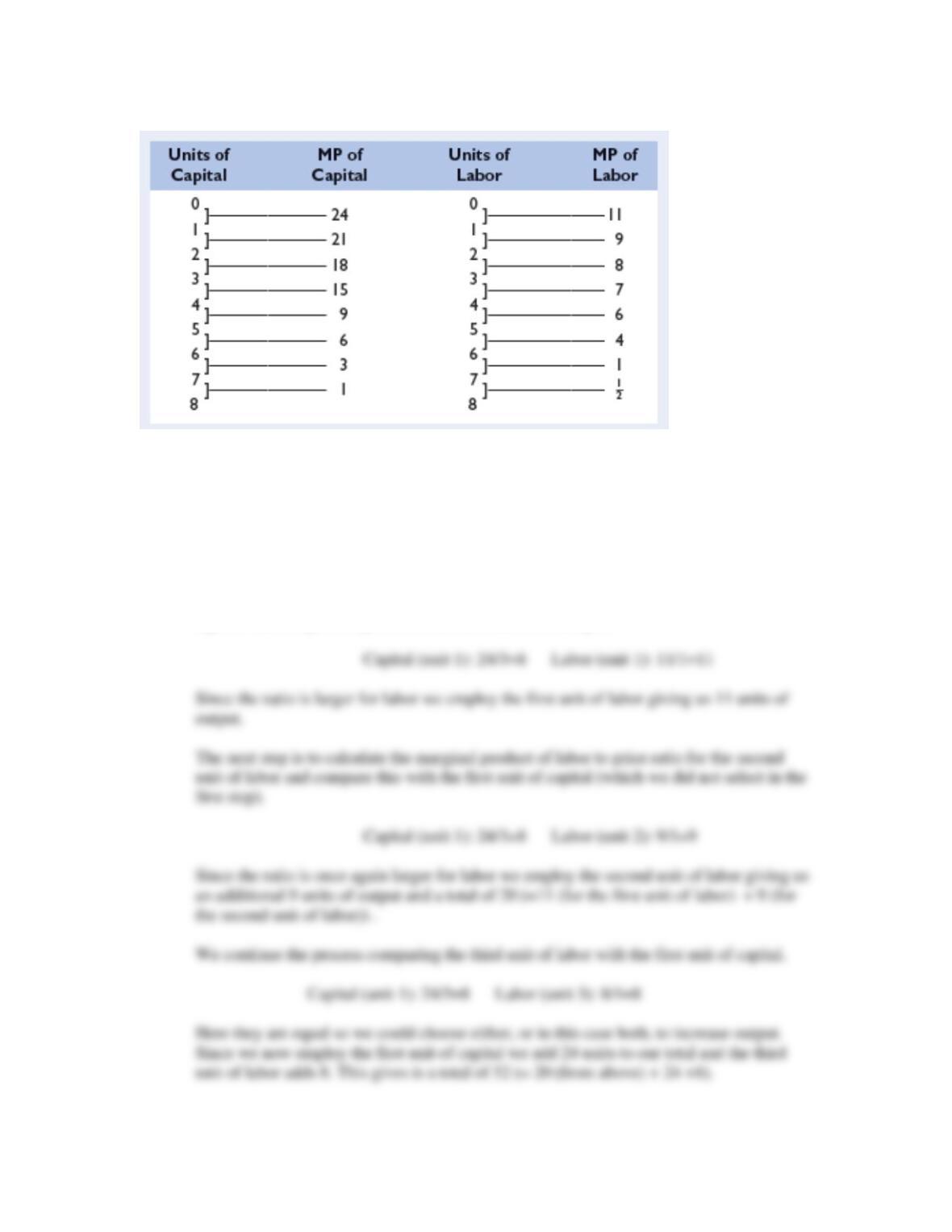
5. Suppose the productivity of capital and labor are as shown in the accompanying table. The
output of these resources sells in a purely competitive market for $1 per unit. Both capital and
labor are hired under purely competitive conditions at $3 and $1, respectively. LO5
Chapter 12 – The Demand for Resources
12-5
a. What is the least‐cost combination of labor and capital the firm should employ in producing 80
units of output? Explain.
b. What is the profit‐maximizing combination of labor and capital the firm should use? Explain.
What is the resulting level of output? What is the economic profit? Is this the least costly way of
producing the profit‐maximizing output?
Answer:
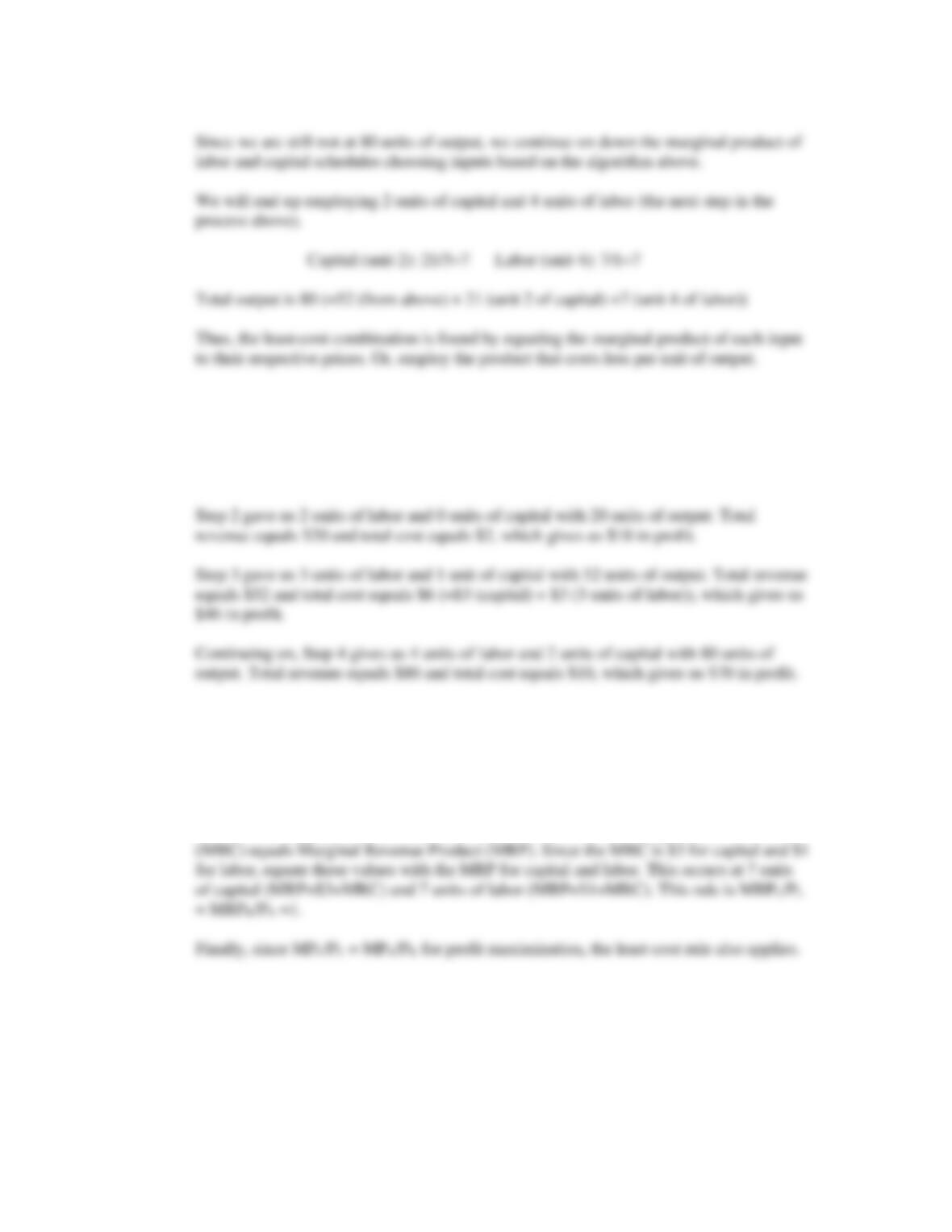
(a) To answer this question we begin by finding the ratios of the marginal product of each
input to their respective prices for the first unit of each input.
Chapter 12 – The Demand for Resources
12-6
(b) To determine the profit maximizing combination of inputs we use the same process
above, except we now need to calculate total cost, total revenue, and profit.
The first step gave us 1 unit of labor and 0 units of capital with 11 units of output. Total
revenue equals $11 and total cost equals $1, which gives us $10 in profit.
This process will continue until we reach 7 units of labor and 7 units of capital with 142
units of output. Total revenue equals $142 and total cost equals $28, with a profit of
$114. You can verify that profit falls adding one more unit of capital or labor.
A less time intensive approach is to recognize that the Marginal Revenue Product (MRP)
for labor and capital equal their respective Marginal Product schedules since the price of
each unit of output is $1. Profit maximization occurs where the Marginal Resource Cost
6. In each of the following four cases, MRPL and MRPC refer to the marginal revenue products
of labor and capital, respectively, and PL and PC refer to their prices. Indicate in each case
whether the conditions are consistent with maximum profits for the firm. If not, state which
resource(s) should be used in larger amounts and which resource(s) should be used in smaller
amounts. LO5
a. MRPL = $8; PL = $4; MRPC = $8; PC = $4
b. MRPL = $10; PL = $12; MRPC = $14; PC = $9
Chapter 12 – The Demand for Resources
12-7
c. MRPL = $6; PL = $6; MRPC = $12; PC = $12
d. MRPL = $22; PL = $26; MRPC = $16; PC = $19
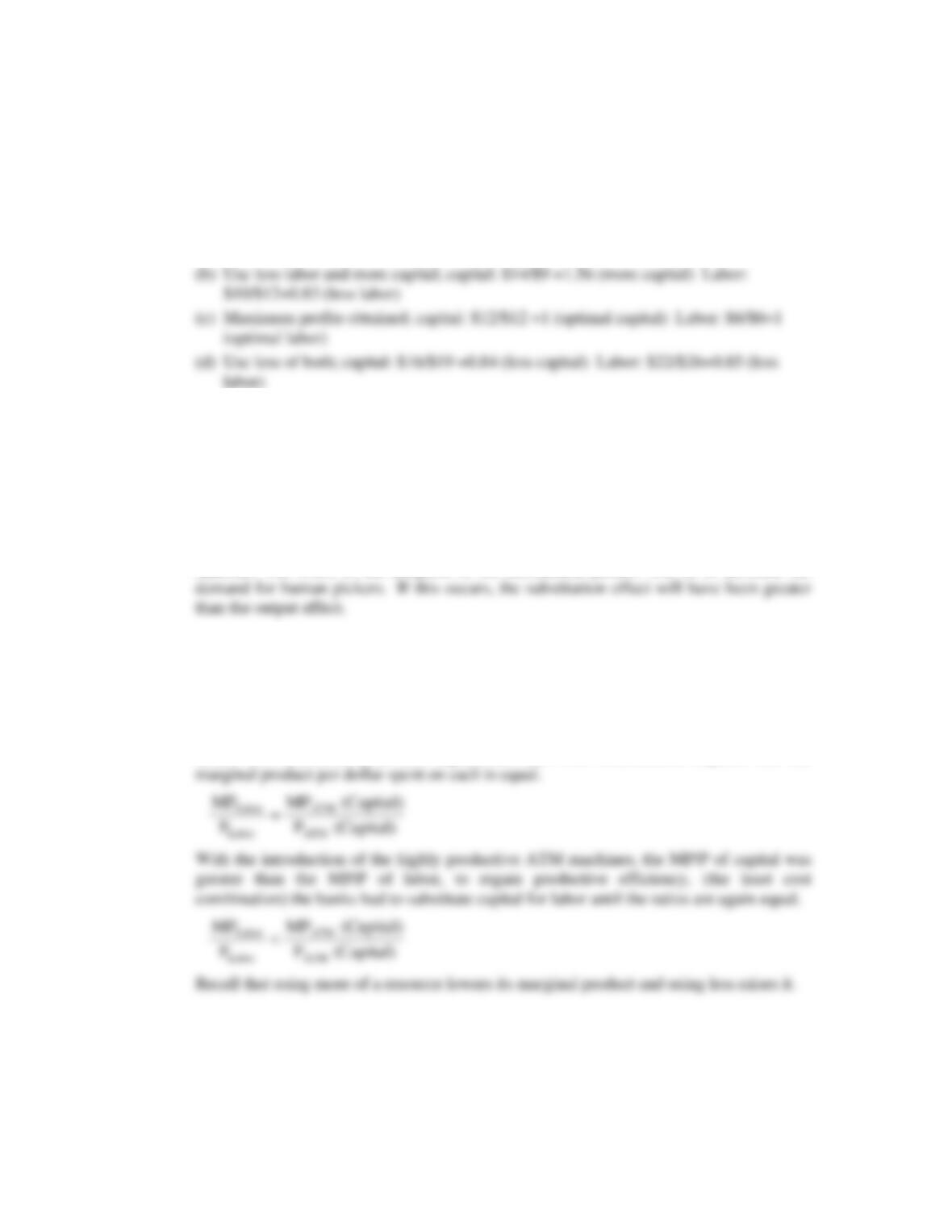
Answer: To answer this question use the profit maximization rule MRPL/PL = MRPK/PK
=1.
(a) Use more of both; capital: $8/$4 =2 (more capital) Labor: $8/$4=2 (more labor)
7. Florida citrus growers say that the recent crackdown on illegal immigration is increasing the
market wage rates necessary to get their oranges picked. Some are turning to $100,000 to
$300,000 mechanical harvesters known as “trunk, shake, and catch” pickers, which vigorously
shake oranges from the trees. If widely adopted, what will be the effect on the demand for human
orange pickers? What does that imply about the relative strengths of the substitution and output
effects? LO5
Answer: The effect of the adoption of the mechanical pickers will be to decrease the
8. LAST WORD Explain the economics of the substitution of ATMs for human tellers. Some
banks are beginning to assess transaction fees when customers use human tellers rather than
ATMs. What are these banks trying to accomplish?
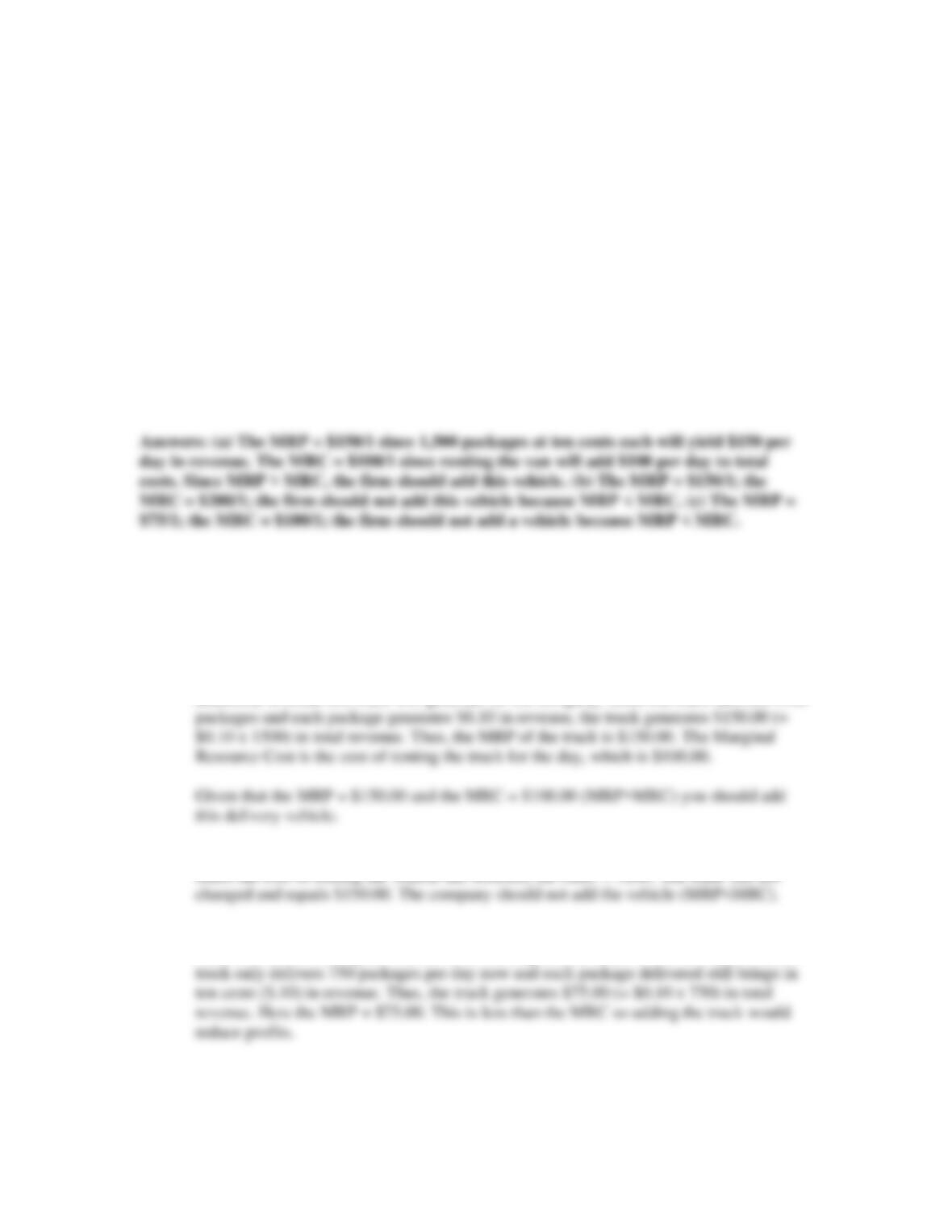
Answer: These banks are trying to produce using the least cost combination of resources.
Given two resources, labor and capital, the least cost combination requires that the
Chapter 12 – The Demand for Resources
12-8
PROBLEMS
1. A delivery company is considering adding another vehicle to its delivery fleet, all the vehicles
of which are rented for $100 per day. Assume that the additional vehicle would be capable of
delivering 1500 packages per day and that each package that is delivered brings in ten cents
($.10) in revenue. Also assume that adding the delivery vehicle would not affect any other costs.
LO2
a. What is the MRP? What is the MRC? Should the firm add this delivery vehicle?
b. Now suppose that the cost of renting a vehicle doubles to $200 per day. What are the MRP and
MRC? Should the firm add a delivery vehicle under these circumstances?
c. Next suppose that the cost of renting a vehicle falls back down to $100 per day but, due to
extremely congested freeways, an additional vehicle would only be able to deliver 750 packages
per day. What are the MRP and MRC in this situation? Would adding a vehicle under these
circumstances increase the firm’s profits?
Feedback: Consider the following example: A delivery company is considering adding
another vehicle to its delivery fleet, all the vehicles of which are rented for $100 per day.
Assume that the additional vehicle would be capable of delivering 1500 packages per day
and that each package that is delivered brings in ten cents ($.10) in revenue.
Part a:
To find the Marginal Revenue Product (MRP) of an additional truck, calculate the
additional revenue this truck will generate for the company. Since the truck delivers 1500
Part b:
Since the cost of renting the vehicle has doubled, the MRC = $200. The MRP has not
Part c:
Since the cost of renting the vehicle is $100.00 again, the MRC = $100.00. However, the
Chapter 12 – The Demand for Resources
12-9
2. Suppose that marginal product tripled while product price fell by one‐half in Table 12.1. What
would be the new MRP values in Table 12.1? What would be the net impact on the location of the
resource demand curve in Figure 12.1? LO2
Feedback: Consider the following scenario: Suppose that marginal product tripled while
product price fell by one‐half in Table 12.1.
New Table:
Units of
Resource
Total Product
(Output)
Marginal
Product (MP)
Product Price
Total
Revenue
Marginal
Revenue
Product
(MRP)
0
0
$1
0
1
21
21
$1
$21
$21
2
39
18
$1
$39
$18
3
54
15
$1
4
66
12
$1
$66
$12
5
75
9
$1
$9
6
81
6
$1
$81
$6
7
84
3
$1
$3
3. Suppose that a monopoly firm finds that its MR is $50 for the first unit sold each day, $49 for
the second unit sold each day, $48 for the third unit sold each day, and so on. Further suppose that
the first worker hired produces 5 units per day, the second 4 units per day, the third 3 units per
day, and so on. LO3
a. What is the firm’s MRP for each of the first five workers?
b. Suppose that the monopolist is subjected to rate regulation and the regulator stipulates that it
must charge exactly $40 per unit for all units sold. At that price, what is the firm’s MRP for each
of the first five workers?
c. If the daily wage paid to workers is $170 per day, how many workers will the unregulated
monopoly demand? How many will the regulated monopoly demand? Looking at those figures,
will the regulated or the unregulated monopoly demand more workers at that wage?
d. If the daily wage paid to workers falls to $77 per day, how many workers will the unregulated
monopoly demand? How many will the regulated monopoly demand? Looking at those figures,
will the regulated or the unregulated monopoly demand more workers at that wage?
e. Comparing your answers to parts c and d, does regulating a monopoly’s output price always
increase its demand for resources?
Chapter 12 – The Demand for Resources
12–10
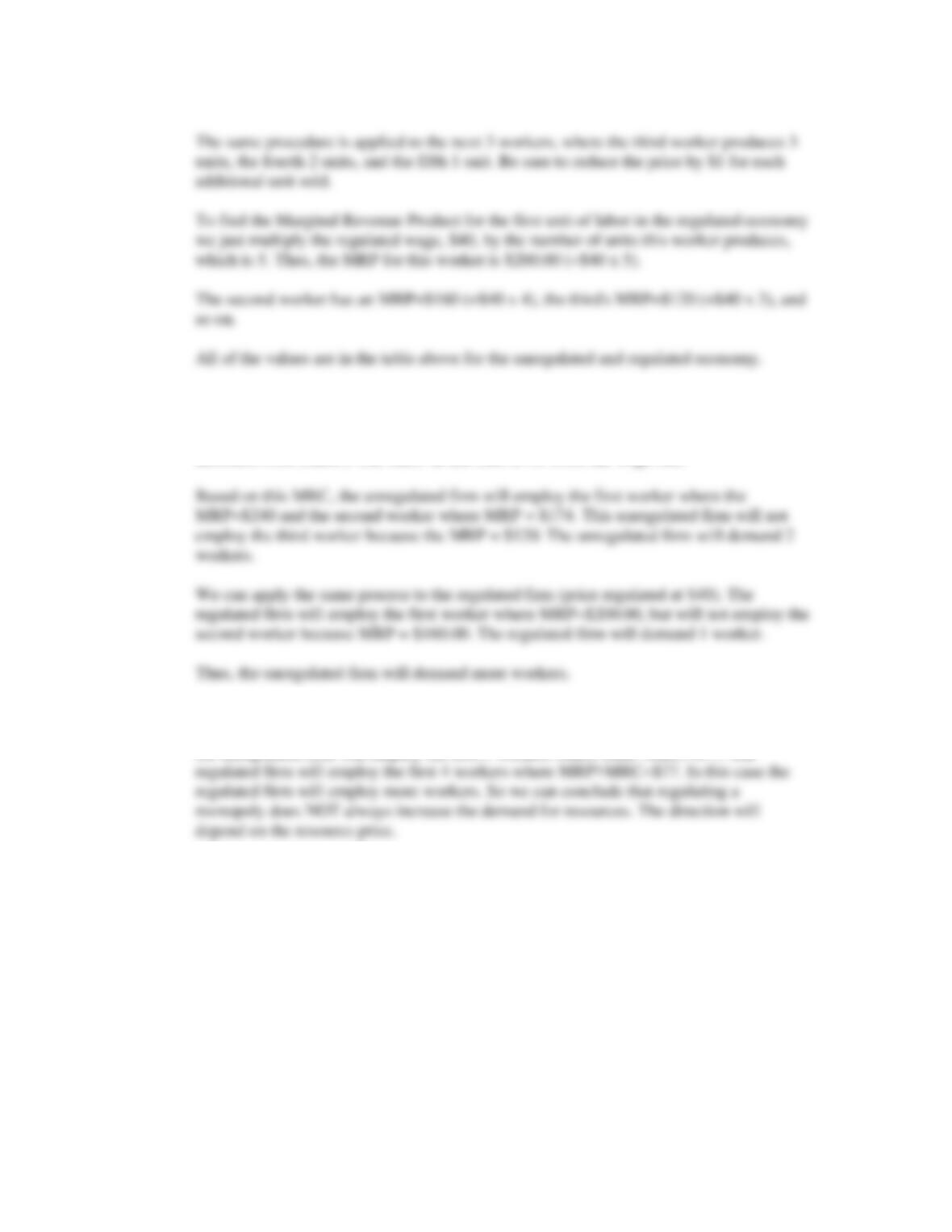
Feedback: Consider the following example. Suppose that a monopoly firm finds that its
MR is $50 for the first unit sold each day, $49 for the second unit sold each day, $48 for
the third unit sold each day, and so on. Further suppose that the first worker hired
produces 5 units per day, the second 4 units per day, the third 3 units per day, and so on.
Parts a and b:
Chapter 12 – The Demand for Resources
12–11
Part c:
Now assume the daily wage rate is $170.00. The firm will employ additional workers as
long as the Marginal Revenue Product (MRP) is greater than or equal to the Marginal
Resource Cost (MRC). The MRC in this case is $170.00, the wage rate.
Parts d and e:
Now assume the daily wage rate is $77. Using the same logic applied in part c we see that
the unregulated firm will employ the first 3 workers where MRP>MRC=$77. The
4. Consider a small landscaping company run by Mr. Viemeister. He is considering increasing his
firm’s capacity. If he adds one more worker, the firm’s total monthly revenue will increase from
$50,000 to $58,000. If he adds one more tractor, monthly revenue will increase from $50,000 to
$62,000. Additional workers each cost $4000 per month while an additional tractor would also
cost $4000 per month. LO5
a. What is the marginal product of labor? The marginal product of capital?
b. What is the ratio of the marginal product of labor to the price of labor (MPL/PL)?
What is the ratio of the marginal product of capital to the price of capital (MPK/PK)?
c. Is the firm using the least‐costly combination of inputs?
d. Does adding an additional worker or adding an additional tractor yield a larger increase in total
revenue for each dollar spent?
Chapter 12 – The Demand for Resources
12–12
Feedback: Consider the following example: If Mr. Viemeister adds one more worker, the
firm’s total monthly revenue will increase from $50,000 to $58,000. If he adds one more
tractor, monthly revenue will increase from $50,000 to $62,000. Additional workers
would cost $4000 per month while an additional tractor would cost $4000 per month.
Part a:
The marginal (revenue) product of labor is $8,000. This is the increase in total revenue
generated by the additional worker (=$58,000-$50,000).
Part b:
The ratio of the Marginal Product of Labor to the price of labor is:
Part c:
Since MPK/PK = 3 > MPL/PL = 2, this is not the least-cost combination of inputs.
Part d: