Chapter 7: Bonds and Their Valuation
Learning Objectives
151
Chapter 7
Bonds and Their Valuation
Learning Objectives
After reading this chapter, students should be able to do the following:
◆ Identify the different features of corporate and government bonds.
152
Lecture Suggestions
Chapter 7: Bonds and Their Valuation
Lecture Suggestions
This chapter serves two purposes. First, it provides important and useful information on bonds per se.
Second, it provides a good example of the use of time value concepts, so it reinforces the topics covered
in Chapter 5.
DAYS ON CHAPTER: 5 OF 56 DAYS (50-minute periods)
Answers to End-of-Chapter Questions
7-1 From the corporation’s viewpoint, one important factor in establishing a sinking fund is that its
own bonds generally have a higher yield than do government bonds; hence, the company saves
more interest by retiring its own bonds than it could earn by buying government bonds. This
factor causes firms to favor the second procedure. Investors also would prefer the annual
7-3 False. Short-term bond prices are less sensitive than long-term bond prices to interest rate
changes because funds invested in short-term bonds can be reinvested at the new interest rate
sooner than funds tied up in long-term bonds.
For example, consider two bonds, both with a 10% annual coupon and a $1,000 par value.
The only difference between them is their maturity. One bond is a 1-year bond, while the other is
a 20-year bond. Consider the values of each at 5%, 10%, 15%, and 20% interest rates.
1-year 20-year
5% $1,047.62 $1,623.11
7-4 The price of the bond will fall and its YTM will rise if interest rates rise. If the bond still has a
long term to maturity, its YTM will reflect long-term rates. Of course, the bond’s price will be less
affected by a change in interest rates if it has been outstanding a long time and matures soon.
While this is true, it should be noted that the YTM will increase only for buyers who purchase the
7-5 The yield to maturity can be viewed as the bond’s
promised
rate of return, which is the return
that investors will receive if all the
promised
payments are made. However, the yield to maturity
7-6 If interest rates decline significantly, the values of callable bonds will not rise by as much as the
7-7 As an investor with a short investment horizon, you would view the 20-year Treasury security as
being riskier than the 1-year Treasury security. If you bought the 20-year security, you would
7-8 a. If a bond’s price increases, its YTM decreases.
b. If a company’s bonds are downgraded by the rating agencies, its YTM increases.
7-9 If a company sold bonds when interest rates were relatively high, and the issue is callable, then
the company could sell a new issue of low-yielding securities if and when interest rates drop. The
7-10 A sinking fund provision facilitates the orderly retirement of the bond issue. Although sinking
funds are designed to protect investors by ensuring that the bonds are retired in an orderly
7-11 A call for sinking fund purposes is quite different from a refunding call. A sinking fund call
requires no call premium, and only a small percentage of the issue is normally callable in a given
7-12 Convertibles and bonds with warrants are offered with lower coupons than similarly-rated straight
bonds because both offer investors the chance for capital gains as compensation for the lower
7-13 This statement is false. Extremely strong companies can use debentures because they simply do
7-14 The yield spread between a corporate bond over a Treasury bond with the same maturity reflects
7-15 Assuming a bond issue is callable, the YTC is a better estimate of a bond’s expected return when
7-16 d. The 15-year zero coupon bonds have the most price risk. Longer-maturity bonds have a high
level of price risk as do lower–coupon bonds. Since the maturities of the bonds in a, b, and c
7-17 b. The 1-year bonds with a 12% coupon have the most reinvestment risk. Shorter-maturity
bonds have more reinvestment risk than longer-maturity bonds, so immediately the bonds in a,
156
Answers and Solutions
Chapter 7: Bonds and Their Valuation
Solutions to End-of-Chapter Problems
7-1 With your financial calculator, enter the following:
N = 23; I/YR = YTM = 11%; PMT = 0.09 1,000 = 90; FV = 1000; PV = VB = ?
7-2 VB = $980; M = $1,000; Int = 0.08 $1,000 = $80.
a. N = 12; PV = –980; PMT = 80; FV = 1000; YTM = ?
7-3 The problem asks you to find the price of a semiannual bond, given the following facts: N = 2 14 =
7-4 With your financial calculator, enter the following to find YTM:
N = 8 2 = 16; PV = -1283.09; PMT = 0.11/2 1,000 = 55; FV = 1000; I/YR = YTM = ?
YTM = 3.21% 2 = 6.42%.
With your financial calculator, enter the following to find YTC:
7-5 a. 1. 6%: Bond L: Input N = 12, I/YR = 6, PMT = 110, FV = 1000, PV = ?, PV = $1,419.19.
Bond S: Change N = 1, PV = ? PV = $1,047.17.
one–month bond’s value because of the difference in the timing of receipts. However, its value
would still be close to $1,000 even if interest rates doubled. A long-term bond paying semiannual
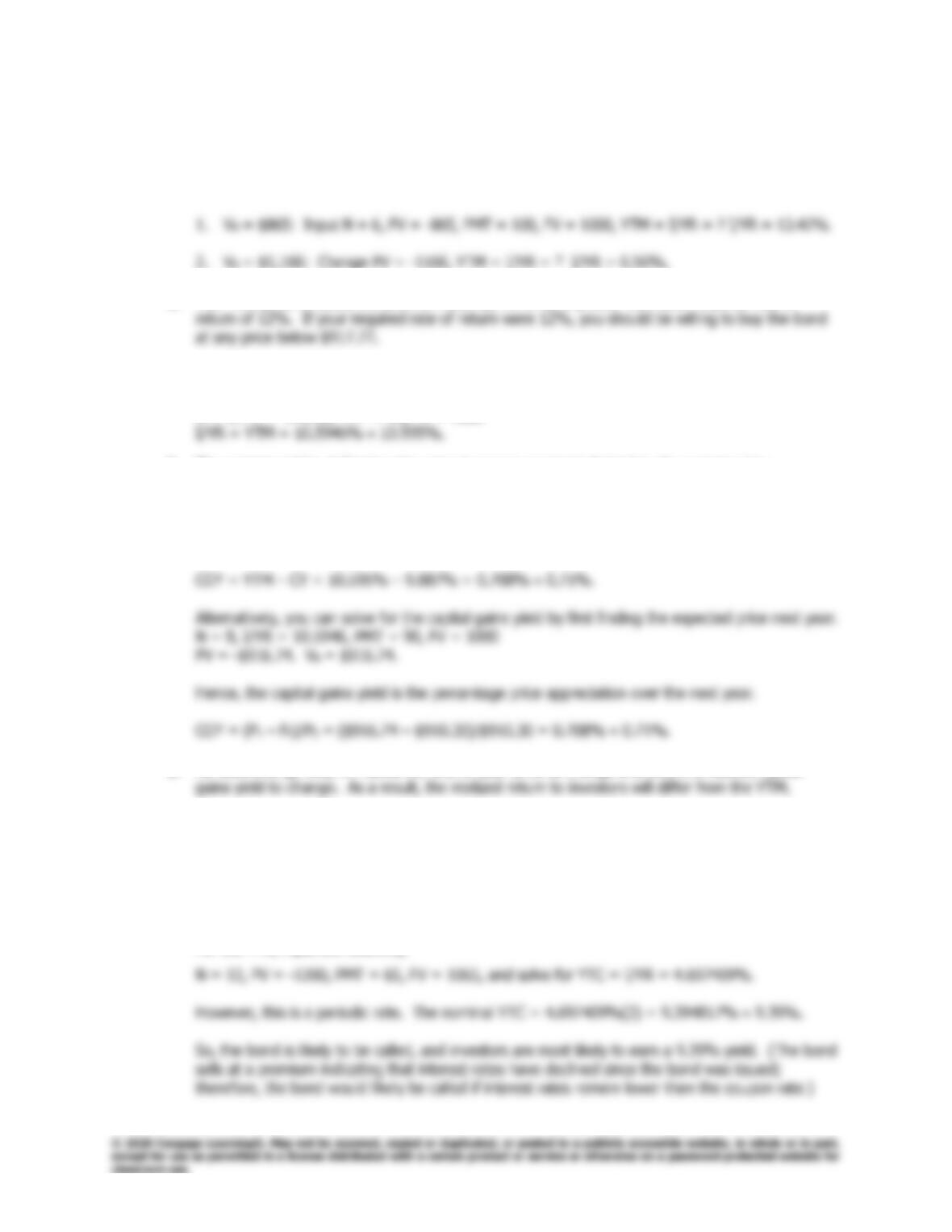
7-6 a. Time Years to Maturity Price of Bond C Price of Bond Z
t = 0 4 $1,108.82 $ 729.61
t = 1 3 1,084.74 789.44
t = 4 0 1,000.00 1,000.00
b.
7-7 Percentage
Price at 8% Price at 7% Change
10-year, 10% annual coupon $1,134.20 $1,210.71 6.75%
10-year zero 463.19 508.35 9.75
7-8 The rate of return is approximately 11.75%, found with a calculator using the following inputs:
N = 7; PV = -1000; PMT = 110; FV = 1075; I/YR = ? Solve for I/YR = 11.75%.
$0.00
$200.00
$600.00
$1,000.00
$1,200.00
Bond Price Paths
Bond C
158
Answers and Solutions
Chapter 7: Bonds and Their Valuation
7-9 a. VB =
=+
+
+
N
1t
N
d
t
d)r1(
M
)r1(
INT
M = $1,000, PMT = 0.10($1,000) = $100, N = 6.
b. Yes. At a price of $865, the yield to maturity, 13.42%, is greater than your required rate of
7-10 a. Solving for YTM:
N = 9, PV = –910.30, PMT = 90, FV = 1000
b. The current yield is defined as the annual coupon payment divided by the current price.
CY = $90/$910.30 = 9.8869% 9.887%.
Expected capital gains yield can be found as the difference between YTM and the current yield.
c. As rates change they will cause the end–of-year price to change and thus the realized capital
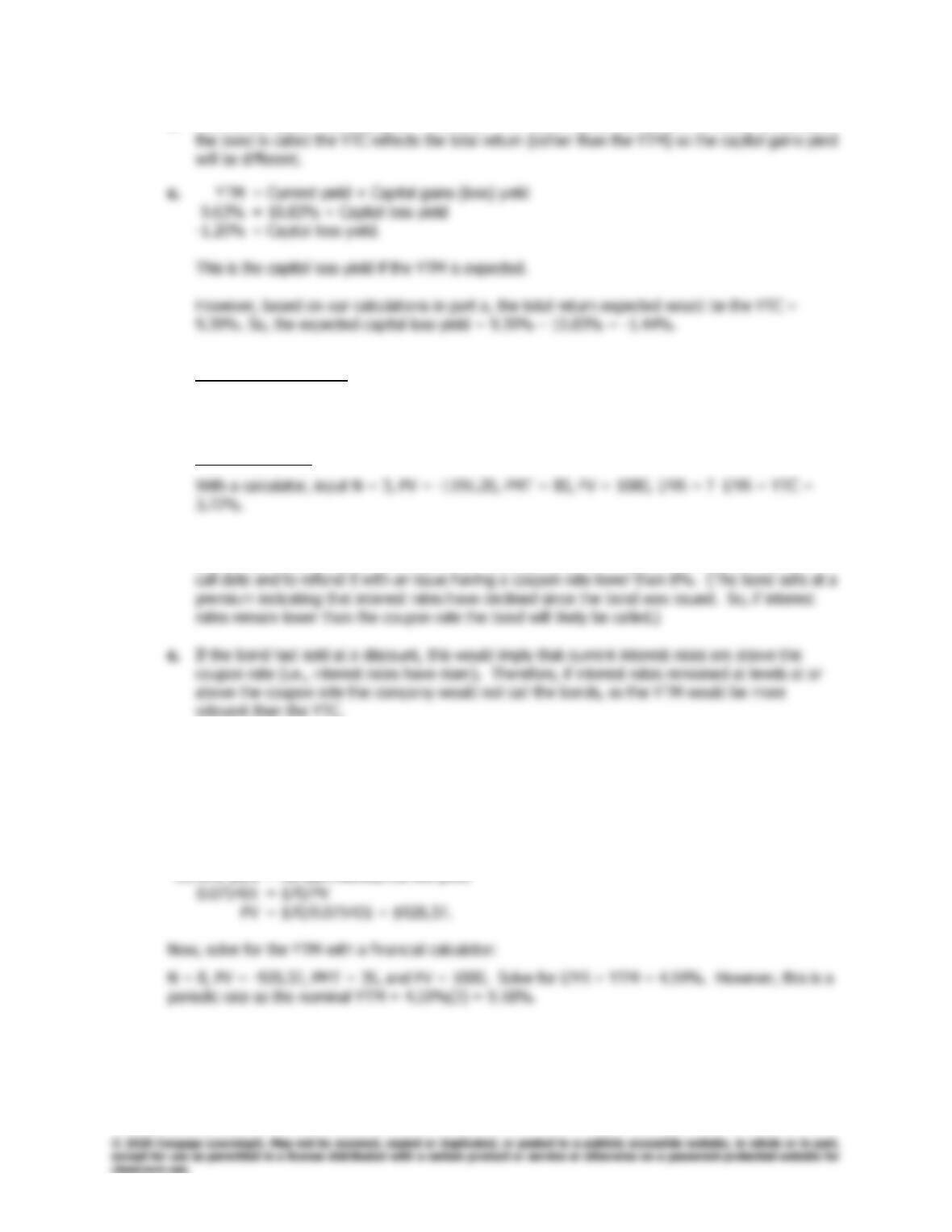
7-11 a. Using a financial calculator, input the following to solve for YTM:
N = 18, PV = –1200, PMT = 65, FV = 1000, and solve for YTM = I/YR = 4.813867%.
However, this is a periodic rate. The nominal YTM = 4.813867%(2) = 9.627733% 9.63%.
For the YTC, input the following:
Chapter 7: Bonds and Their Valuation
Answers and Solutions
159
b. The current yield = $130/$1,200 = 10.83%. The current yield will remain the same; however, if
7-12 a. Yield to maturity (YTM):
With a financial calculator, input N = 28, PV = –1191.20, PMT = 80, FV = 1000, I/YR = ? I/YR =
YTM = 6.50%.
Yield to call (YTC):
b. Knowledgeable investors would expect the return to be closer to 3.7% than to 6.5%. If interest
rates remain substantially lower than 8%, the company can be expected to call the issue at the
7-13 The problem asks you to solve for the YTM and Price, given the following facts:
N = 4 2 = 8, PMT = 70/2 = 35, and FV = 1000. To solve for I/YR we need PV.
However, you are also given that the current yield is equal to 7.5401%. Given this information, we
can find PV (Price).
Current yield = Annual interest/Current price
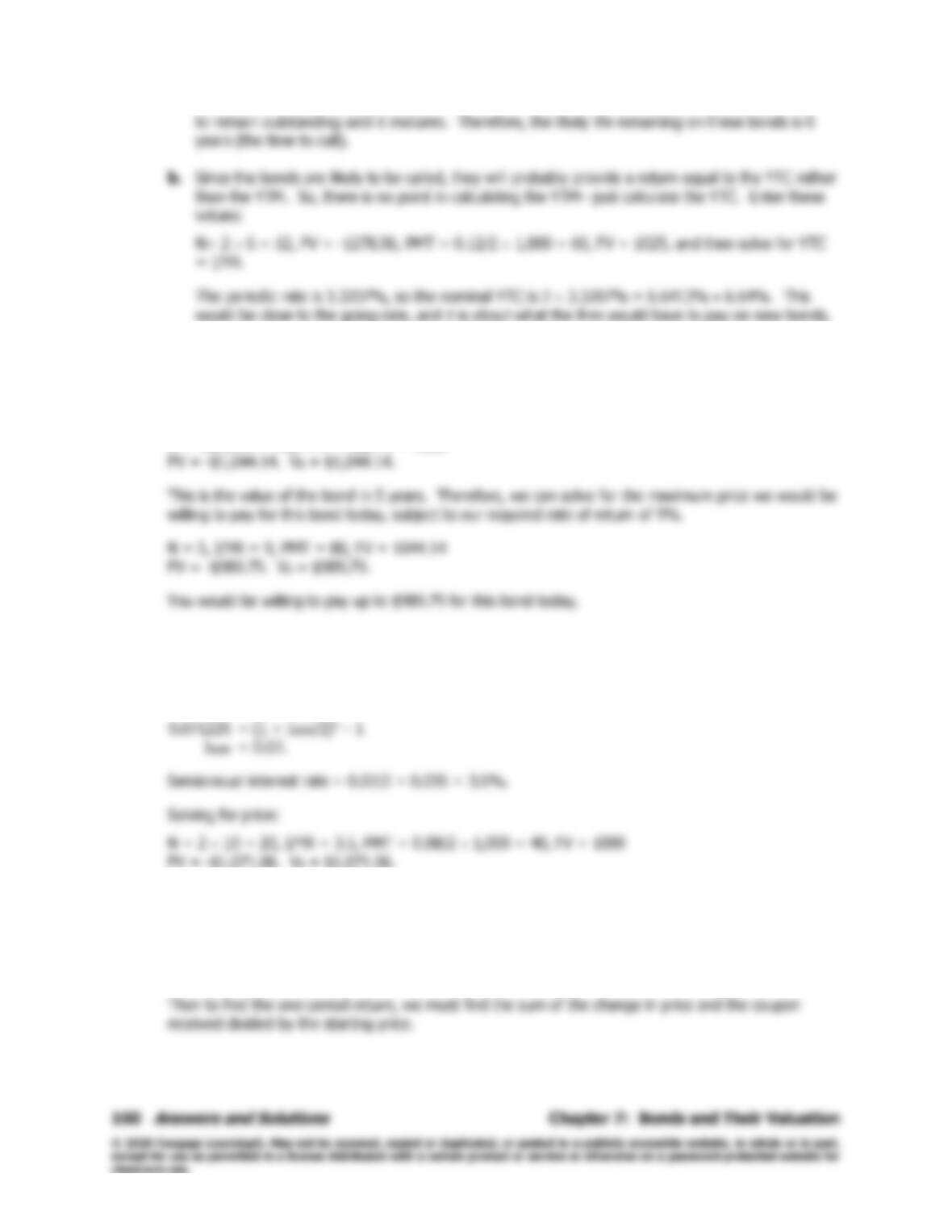
7-14 a. The bond is selling at a large premium, which means that its coupon rate is much higher than the
going rate of interest. Therefore, the bond is likely to be called—it is more likely to be called than
7-15 First, we must find the amount of money we can expect to sell this bond for in 5 years. This is found
using the fact that in five years, there will be 15 years remaining until the bond matures and that the
expected YTM for this bond at that time will be 7.5%.
N = 15, I/YR = 7.5, PMT = 80, FV = 1000
7-16 Before you can solve for the price, we must find the appropriate semiannual rate at which to evaluate
this bond.
EAR = (1 + INOM/2)2 – 1
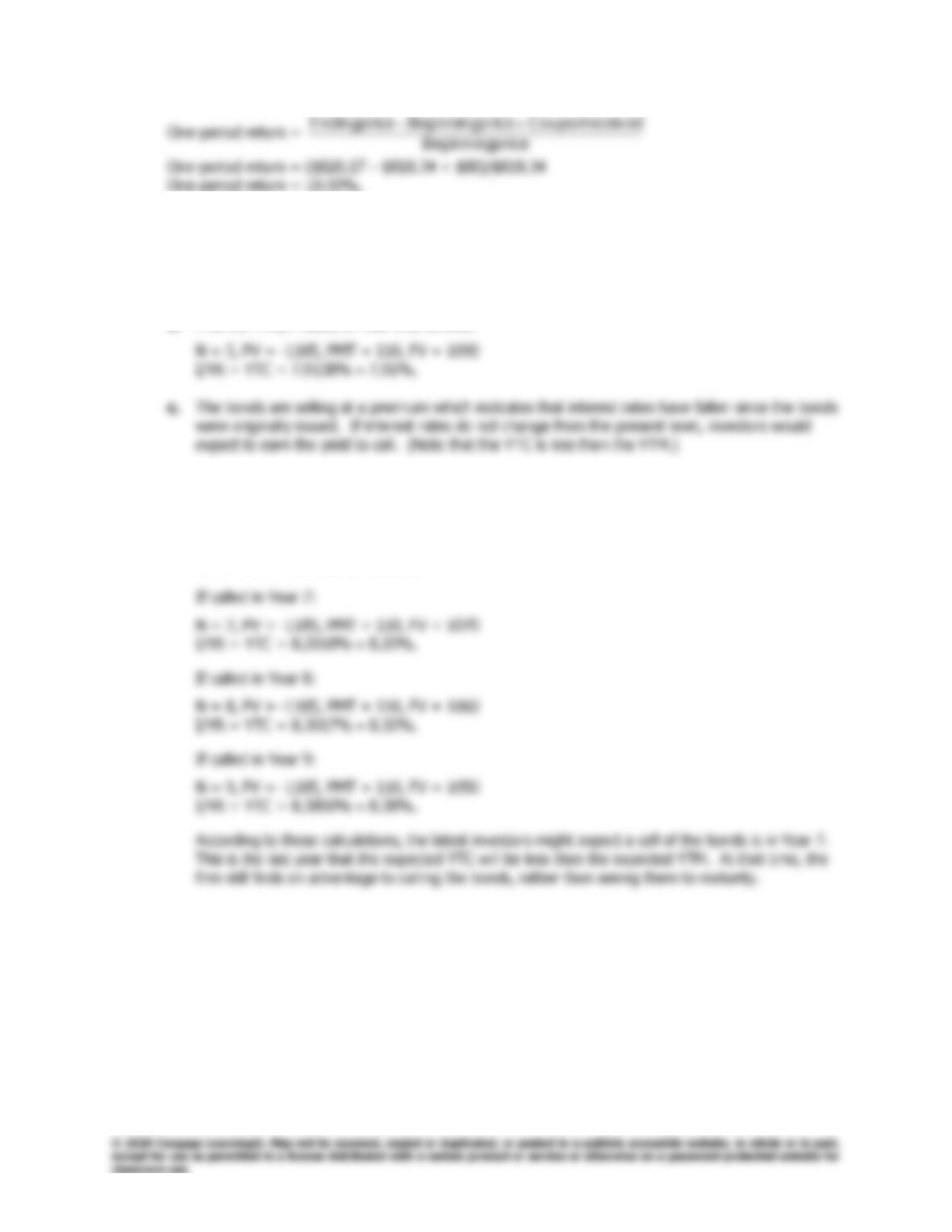
7-17 First, we must find the price Janet paid for this bond.
N = 15, I/YR = 10.45, PMT = 80, FV = 1000
PV = –$818.34. VB = $818.34.
Chapter 7: Bonds and Their Valuation
Answers and Solutions
161
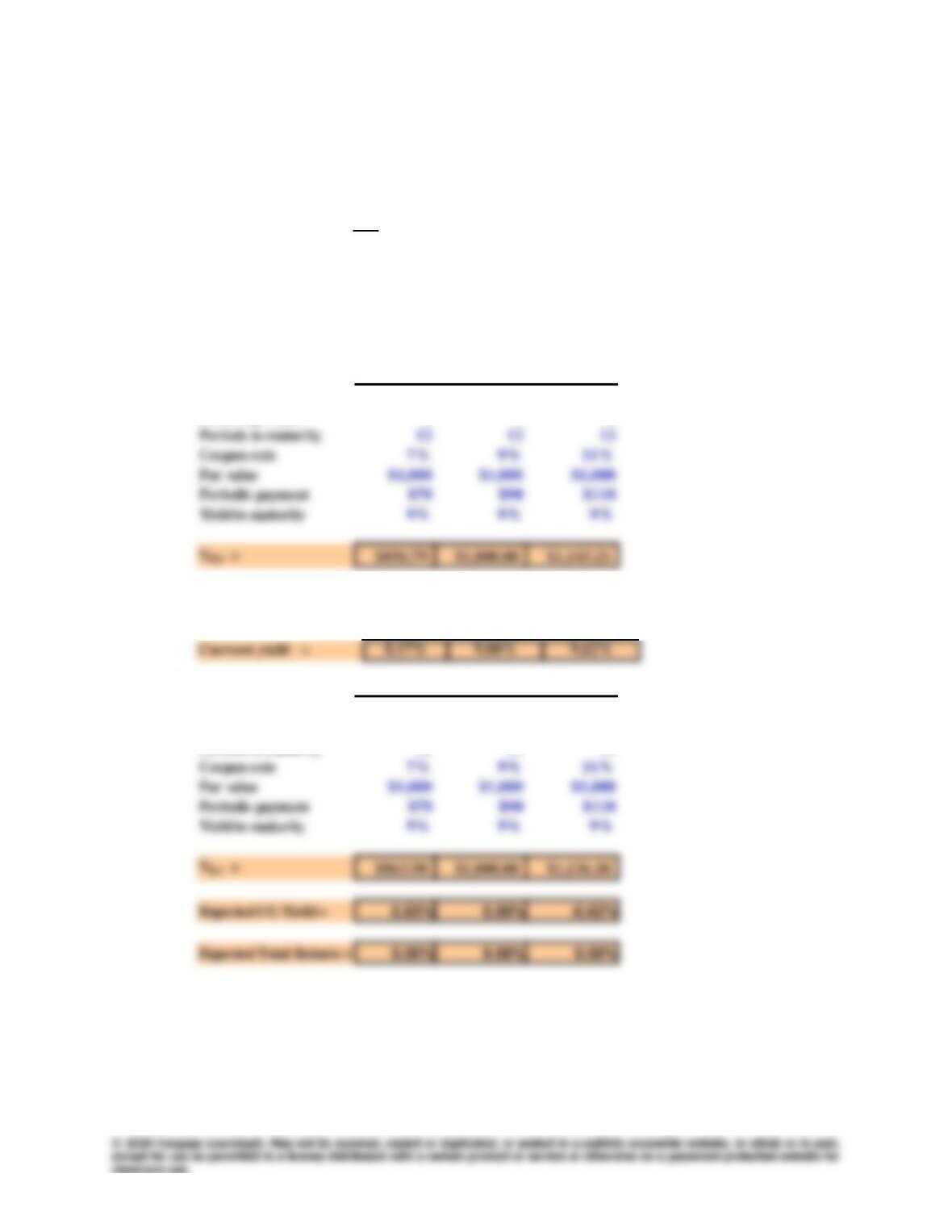
7-18 a. Find the YTM as follows:
N = 10, PV = –1185, PMT = 110, FV = 1000
I/YR = YTM = 8.216% 8.22%.
b. Find the YTC, if called in Year 5 as follows:
d. Similarly, from above, YTC can be found, if called in each subsequent year.
If called in Year 6:
N = 6, PV = –1185, PMT = 110, FV = 1080
I/YR = YTC = 8.0772% 8.08%.
162
Comprehensive/Spreadsheet Problem
Chapter 7: Bonds and Their Valuation
Comprehensive/Spreadsheet Problem
Note to Instructors:
The solution to this problem is not provided to students at the back of their text. Instructors
can access the
Excel
file on the textbook’s website.
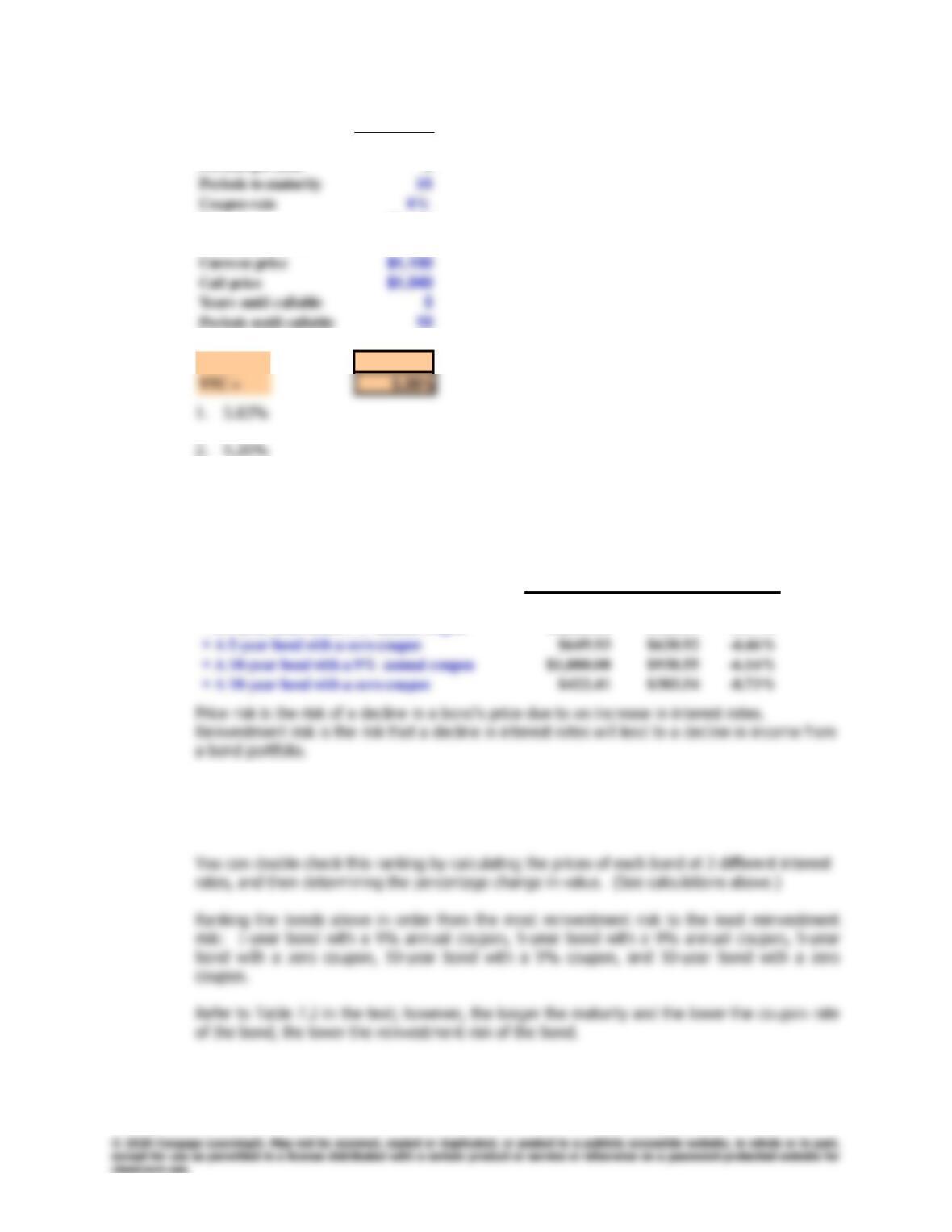
7-19 a. Bond A is selling at a discount because its coupon rate (7%) is less than the going interest rate
(YTM = 9%). Bond B is selling at par because its coupon rate (9%) is equal to the going
interest rate (YTM = 9%). Bond C is selling at a premium because its coupon rate (11%) is
greater than the going interest rate (YTM = 9%).
b.
c.
d.
Current yield = Annual coupon / Price
Bond A Bond B Bond C
Basic Input Data Bond A Bond B Bond C
Years to maturity 12 12 12
Periods per year 1 1 1
Basic Input Data Bond A Bond B Bond C
Years to maturity 11 11 11
Periods per year 1 1 1
Periods to maturity 11 11 11
Chapter 7: Bonds and Their Valuation
Comprehensive/Spreadsheet Problem
163
e.
3. The bond is selling at a premium, which means that interest rates have declined since the
bond was issued. If interest rates remain at current levels, then Mr. Clark should expect
the bond to be called. Consequently, he would earn the YTC not the YTM.
f.
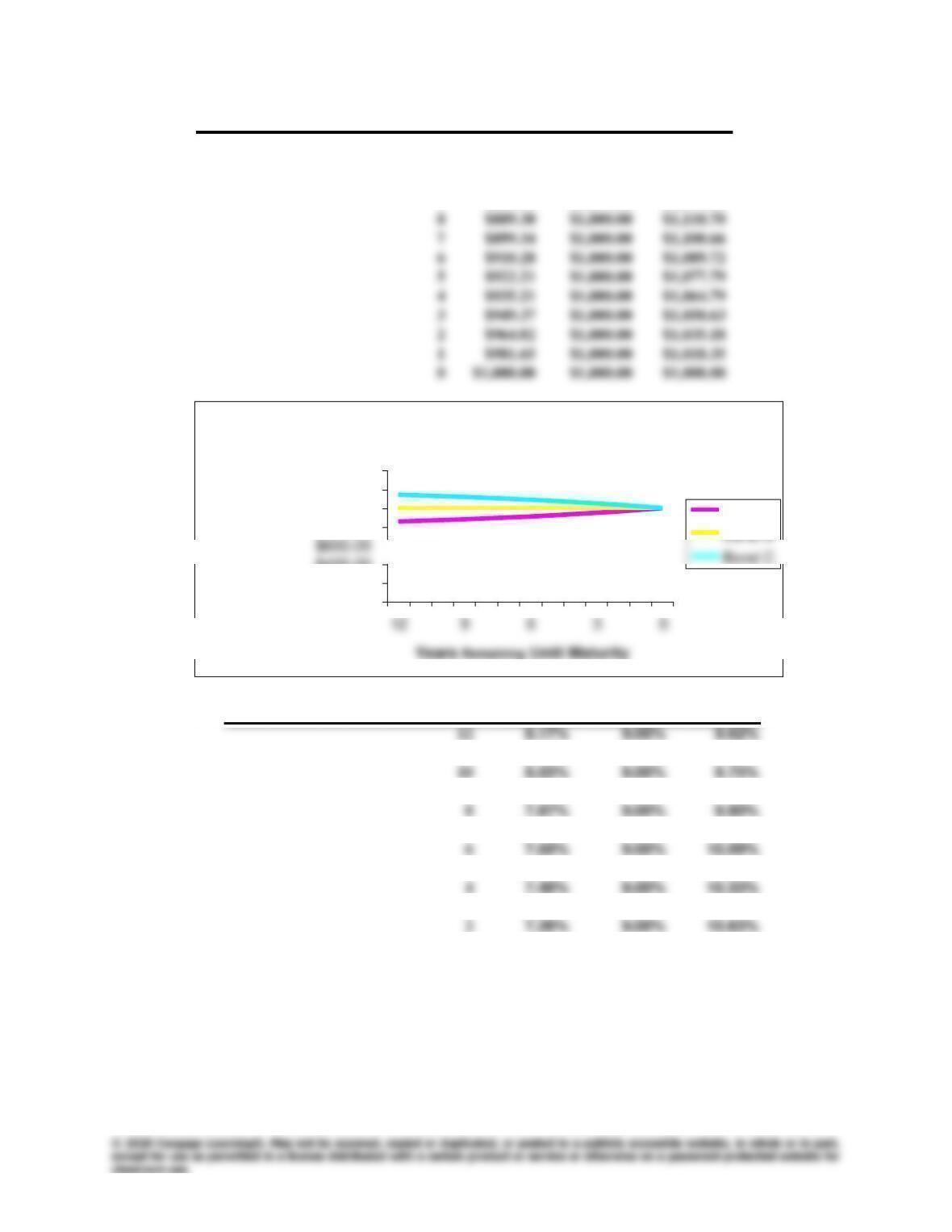
A 5-year bond with a zero coupon $649.93 $620.92 -4.46%
A 10-year bond with a zero coupon
Ranking the bonds above in order from the most price risk to the least price risk: 10-year bond
with a zero coupon, 10-year bond with a 9% annual coupon, 5-year bond with a zero coupon,
5-year bond with a 9% annual coupon, and a 1-year bond with a 9% annual coupon.
Basic Input Data Bond D
Years to maturity 9
Periods per year 2
Par value $1,000
Periodic payment $40
YTM = 5.83%
9% 10%
% Price
Chge
A 1-year bond with a 9% annual coupon $1,000.00 $990.91 -0.91%
A 5-year bond with a 9% annual coupon $1,000.00 $962.09 -3.79%
164
Comprehensive/Spreadsheet Problem
Chapter 7: Bonds and Their Valuation
g.
1.
8.17% 9.00% 9.62%
8.03% 9.00% 9.75%
7.87% 9.00% 9.90%
7.69% 9.00% 10.09%
7.48% 9.00% 10.33%
7.26% 9.00% 10.63%
Years Remaining Until Maturity Bond A Bond B Bond C
12 $856.79 $1,000.00 $1,143.21
11 $863.90 $1,000.00 $1,136.10
10 $871.65 $1,000.00 $1,128.35
9 $880.10 $1,000.00 $1,119.90
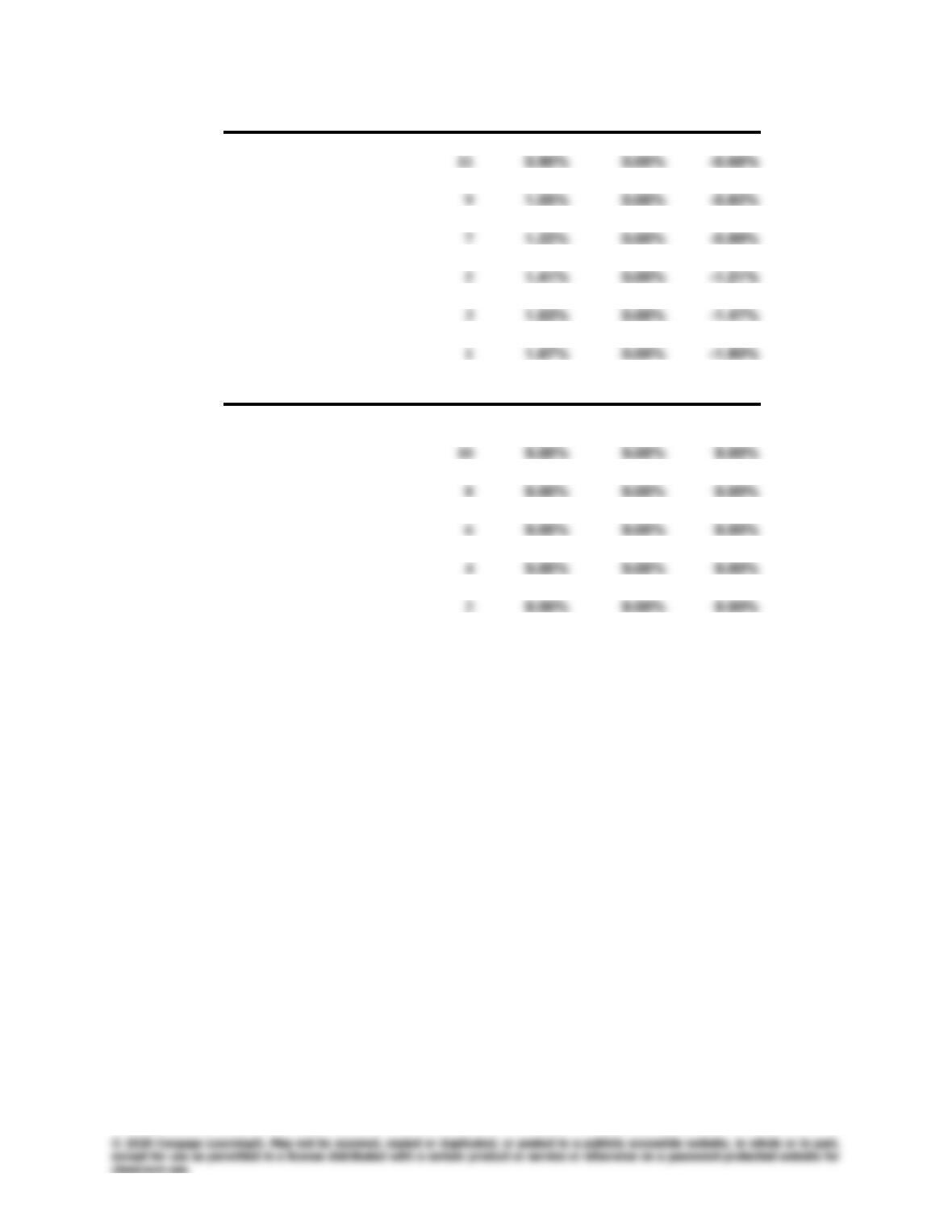
Time Paths of Bonds A, B, and C
$0.00
$200.00
$400.00
$800.00
$1,000.00
$1,200.00
$1,400.00
Bond Value
Bond A
Years Remaining Until Maturity Bond A Bond B Bond C
11
8.10% 9.00% 9.68%
9
7.95% 9.00% 9.82%
7
7.78% 9.00% 9.99%
5
7.59% 9.00% 10.21%
3
7.37% 9.00% 10.47%
1
7.13% 9.00% 10.80%
Chapter 7: Bonds and Their Valuation
Comprehensive/Spreadsheet Problem
165
2.
11
0.90% 0.00% -0.68%
9
7
1.22% 0.00% -0.99%
5
3
1.63% 0.00% -1.47%
1
1.87% 0.00% -1.80%
3.
10
9.00% 9.00% 9.00%
8
9.00% 9.00% 9.00%
6
9.00% 9.00% 9.00%
4
9.00% 9.00% 9.00%
2
9.00% 9.00% 9.00%
Years Remaining Until Maturity Bond A Bond B Bond C
12
0.83% 0.00% -0.62%
10
0.97% 0.00% -0.75%
8
1.13% 0.00% -0.90%
6
1.31% 0.00% -1.09%
4
1.52% 0.00% -1.33%
2
1.74% 0.00% -1.63%
Years Remaining Until Maturity Bond A Bond B Bond C
12
9.00% 9.00% 9.00%
11
9.00% 9.00% 9.00%
9
9.00% 9.00% 9.00%
7
9.00% 9.00% 9.00%
5
9.00% 9.00% 9.00%
3
9.00% 9.00% 9.00%
1
9.00% 9.00% 9.00%
166
Integrated Case
Chapter 7: Bonds and Their Valuation
Integrated Case
7-20
Western Money Management Inc.
Bond Valuation
Robert Black and Carol Alvarez are vice presidents of Western Money
Management and codirectors of the company’s pension fund management
division. A major new client, the California League of Cities, has requested
that Western present an investment seminar to the mayors of the represented
cities. Black and Alvarez, who will make the presentation, have asked you to
help them by answering the following questions.
A. What are a bond’s key features?
Answer: [Show S7-1 through S7-5 here.] Here is a list of key features:
1. Par or face value. We generally assume a $1,000 par value, but
2. Coupon rate. The dollar coupon is the “rent” on the money
borrowed, which is generally the par value of the bond. The
3. Maturity. This is the number of years until the bond matures and
the issuer must repay the loan (return the par value).
4. Call provision. Most bonds (except U.S. Treasury bonds) can be
called and paid off ahead of schedule after some specified “call
Chapter 7: Bonds and Their Valuation
Integrated Case
167
5. Issue date. The date when the bond issue was originally sold.
6. Default risk is inherent in all bonds except Treasury bonds—will
the issuer have the cash to make the promised payments?
7. Special features, such as convertibility and zero coupons, will be
B. What are call provisions and sinking fund provisions? Do these
provisions make bonds more or less risky?
Answer: [Show S7-6 through S7-8 here.] A call provision is a provision in a
bond contract that gives the issuing corporation the right to redeem
the bonds under specified terms prior to the normal maturity date.
168
Integrated Case
Chapter 7: Bonds and Their Valuation
A sinking fund provision is a provision in a bond contract that
requires the issuer to retire a portion of the bond issue each year. A
sinking fund provision facilitates the orderly retirement of the bond
issue.
Although sinking funds are designed to protect bondholders by
ensuring that an issue is retired in an orderly fashion, it must be
recognized that sinking funds will at times work to the detriment of
C. How is the value of any asset whose value is based on expected
future cash flows determined?
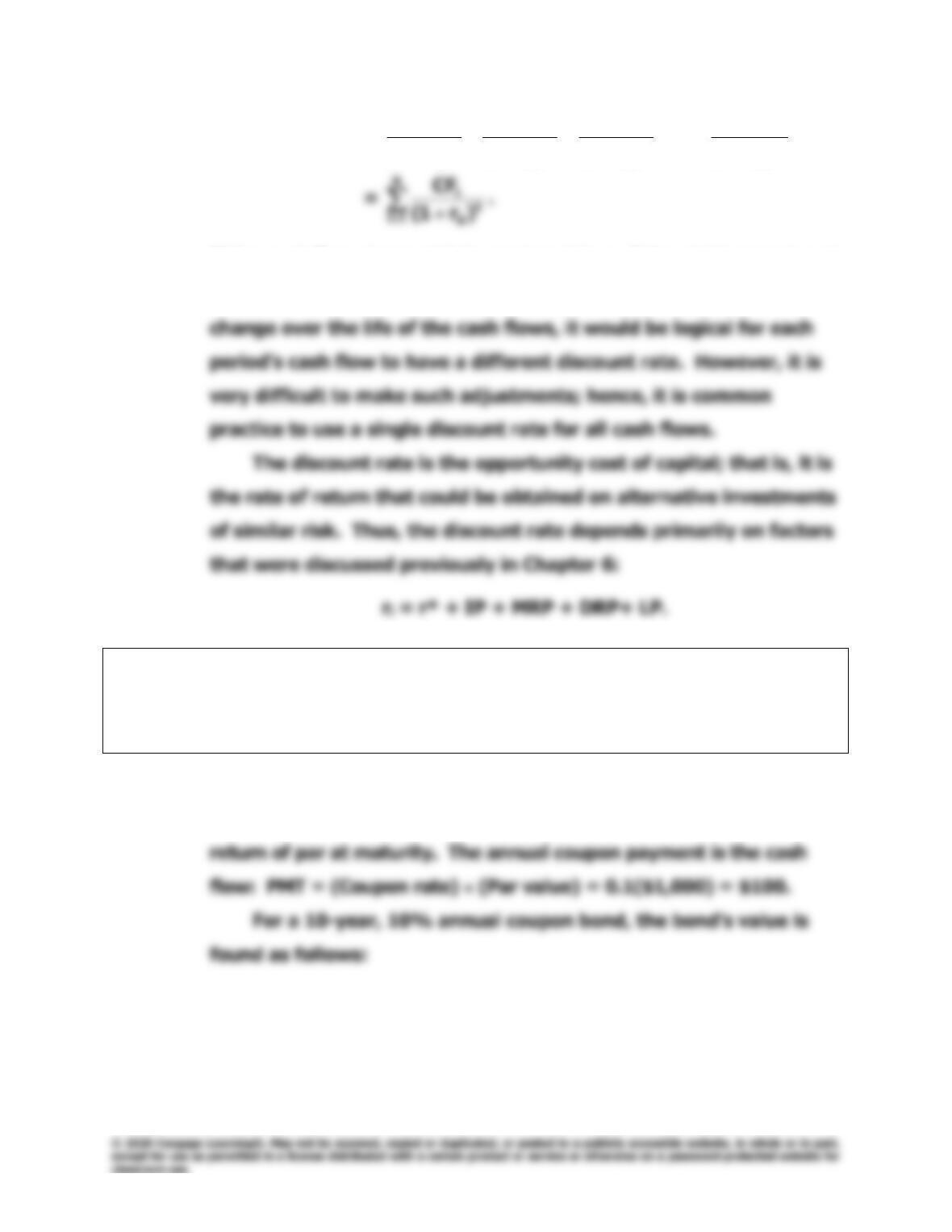
Answer: [Show S7-9 and S7-10 here.]
0 1 2 3 N
| | | | • • • |
CF1 CF2 CF3 CFN
PV CF1
PV CF2
Chapter 7: Bonds and Their Valuation
Integrated Case
169
Value = PV =
N
d
N
3
d
3
2
d
2
1
d
1
)r(1
CF
…
)r1(
CF
)r1(
CF
)r1(
CF
+
++
+
+
+
+
+
If the cash flows have widely varying risk, or if the yield curve is not
horizontal, which signifies that interest rates are expected to
D. How is a bond’s value determined? What is the value of a 10-year,
$1,000 par value bond with a 10% annual coupon if its required
return is 10%?
Answer: [Show S7–11 and S7–12 here.] A bond has a specific cash flow
pattern consisting of a stream of constant interest payments plus the