138
Comprehensive/Spreadsheet Problem
Chapter 6: Interest Rates
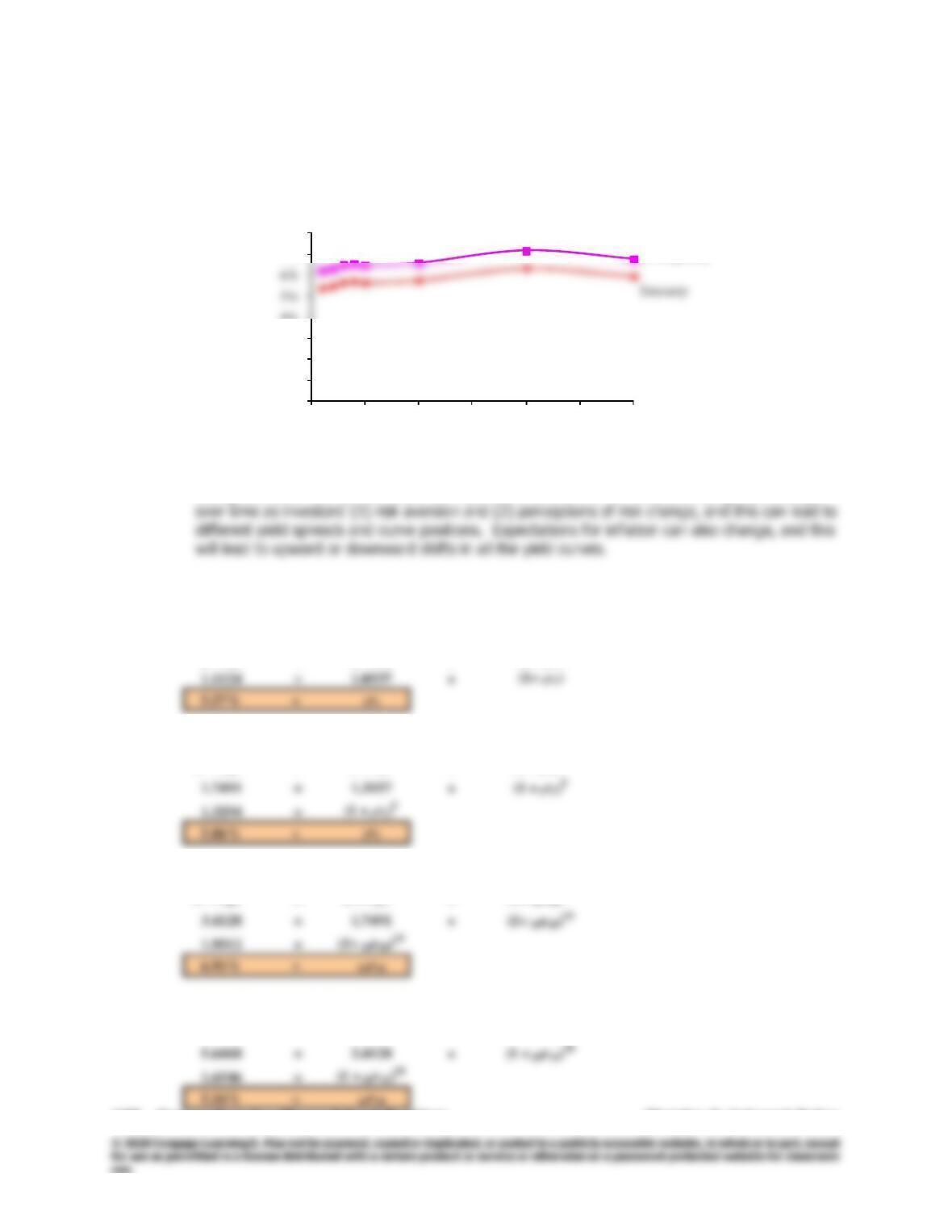
Now we can graph the data in the first 3 columns of the above table to get the Treasury and A-
rated Corporate yield curves:
0%
1%
2%
3%
4%
7%
8%
0 5 10 15 20 25 30
Interest Rate
Years to Maturity
Treasury and A-Rated Corporate Yield Curves
A Corporate
Note that if we constructed yield curves for corporate bonds with other ratings, the higher the
rating, the lower the curves would be. Note too that the DRP for different ratings can change
e. Short-term rates are more volatile than longer-term rates; therefore, the left side of the yield
curve would be most volatile over time.
f.
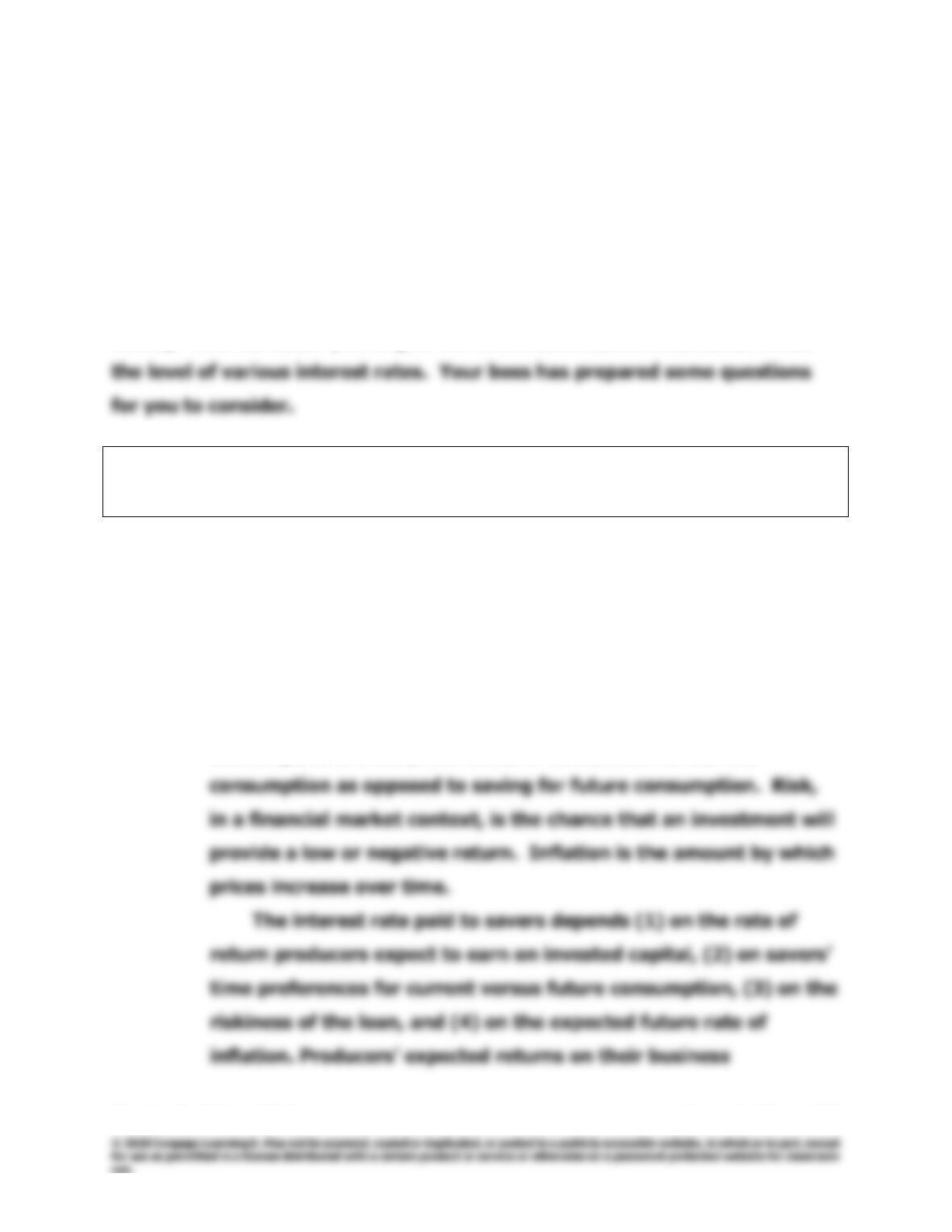
(1) The 1-year rate, 1 year from now
(1 + r2)2 = (1 + r1)×(1+ 1r1)
(2) The 5-year rate, 5 years from now
(1 + r10)10 = (1 + r5)5×(1 + 5r5)5
(3) The 10–year rate, 10 years from now
(1 + r20)20 = (1+ r10)10 ×(1+ 10r10)10
(4) The 10–year rate, 20 years from now
(1+ r30)30 = (1+ r20)20 ×(1 + 20r10)10
Chapter 6: Interest Rates
Integrated Case
139
Integrated Case
6-21
Morton Handley & Company
Interest Rate Determination
Maria Juarez is a professional tennis player, and your firm manages her
money. She has asked you to give her information about what determines
A. What are the four most fundamental factors that affect the cost of
money, or the general level of interest rates, in the economy?
Answer: [Show S6-1 through S6-3 here.] The four most fundamental
factors affecting the cost of money are (1) production
opportunities, (2) time preferences for consumption, (3) risk, and
(4) inflation.
Production opportunities are the investment opportunities in
productive (cash-generating) assets. Time preferences for
consumption are the preferences of consumers for current
140
Integrated Case
Chapter 6: Interest Rates
B. What is the real risk-free rate of interest (r*) and the nominal risk-
free rate (rRF)? How are these two rates measured?
Answer: [Show S6-4 and S6-5 here.] Keep these equations in mind as we
discuss interest rates. We will define the terms as we go along:
r = r* + IP + DRP + LP + MRP.
The nominal risk-free rate, rRF, is equal to the real risk-free
rate plus an inflation premium, which is equal to the average rate
Chapter 6: Interest Rates
Integrated Case
141
C. Define the terms
inflation premium (IP), default risk premium
(DRP), liquidity premium (LP), and maturity risk premium (MRP)
.
Which of these premiums is included in determining the interest
rate on (1) short-term U.S. Treasury securities, (2) long-term U.S.
Treasury securities, (3) short-term corporate securities, and (4)
long-term corporate securities? Explain how the premiums would
vary over time and among the different securities listed.
Answer: [Show S6-6 here.] The inflation premium (IP) is a premium added
to the real risk-free rate of interest to compensate for expected
inflation.
142
Integrated Case
Chapter 6: Interest Rates
3. The rate on short-term corporate securities is equal to the real
risk-free rate plus premiums for inflation, default risk, and
4. The rate for long-term corporate securities also includes a
premium for maturity risk. Thus, long-term corporate
D. What is the term structure of interest rates? What is a yield
curve?
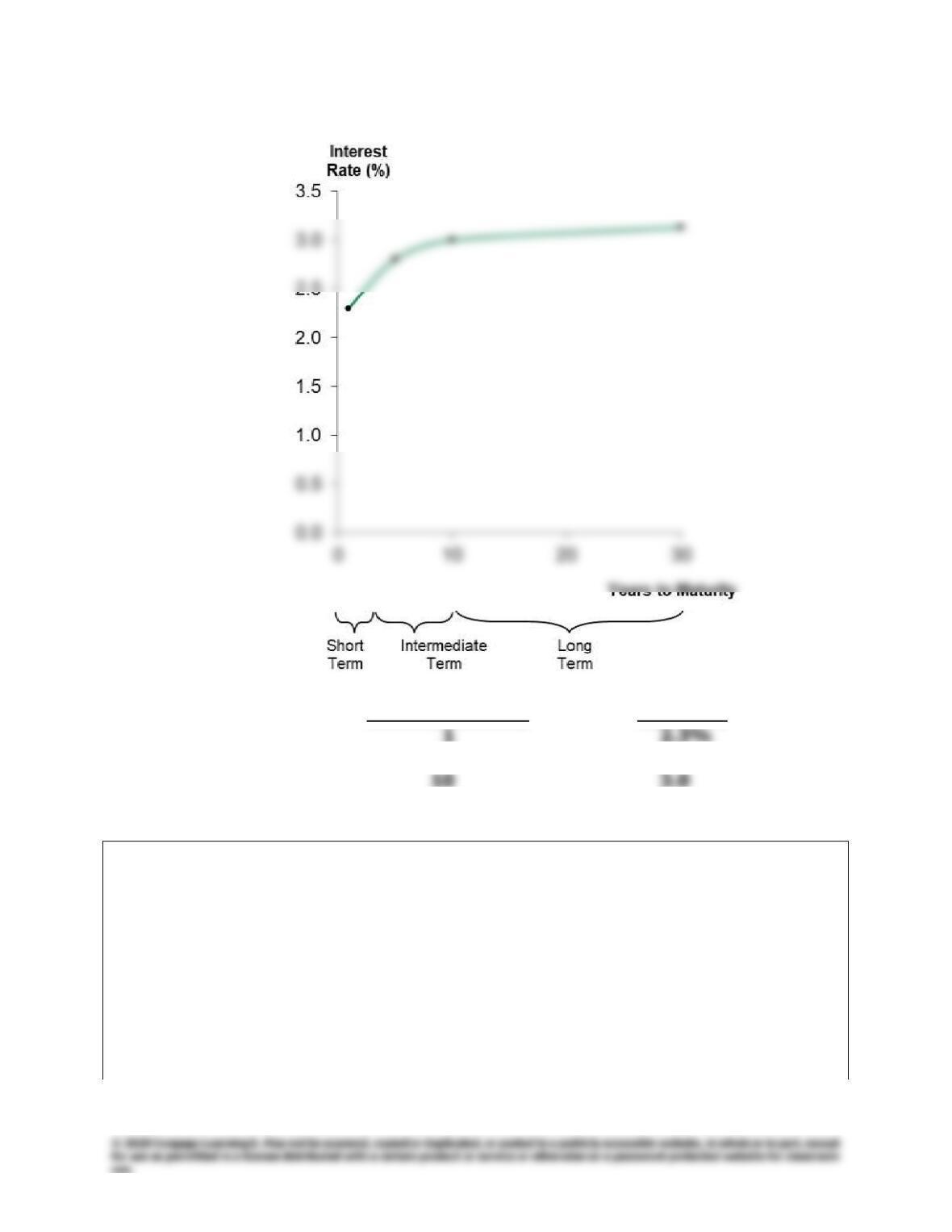
Answer: [Show S6-7 here. S6-7 shows a recent (May 2018) Treasury yield
curve.] The term structure of interest rates is the relationship
Chapter 6: Interest Rates
Integrated Case
143
Yield Curve for May 2018
Years to Maturity Yield
5 2.8
30 3.1
E. Suppose most investors expect the inflation rate to be 5% next
year, 6% the following year, and 8% thereafter. The real risk-free
rate is 3%. The maturity risk premium is zero for bonds that
mature in 1 year or less and 0.1% for 2-year bonds; then the MRP
increases by 0.1% per year thereafter for 20 years, after which it
is stable. What is the interest rate on 1-, 10-, and 20-year
Treasury bonds? Draw a yield curve with these data. What factors
144
Integrated Case
Chapter 6: Interest Rates
can explain why this constructed yield curve is upward-sloping?
Answer: [Show S6-8 through S6-13 here.]
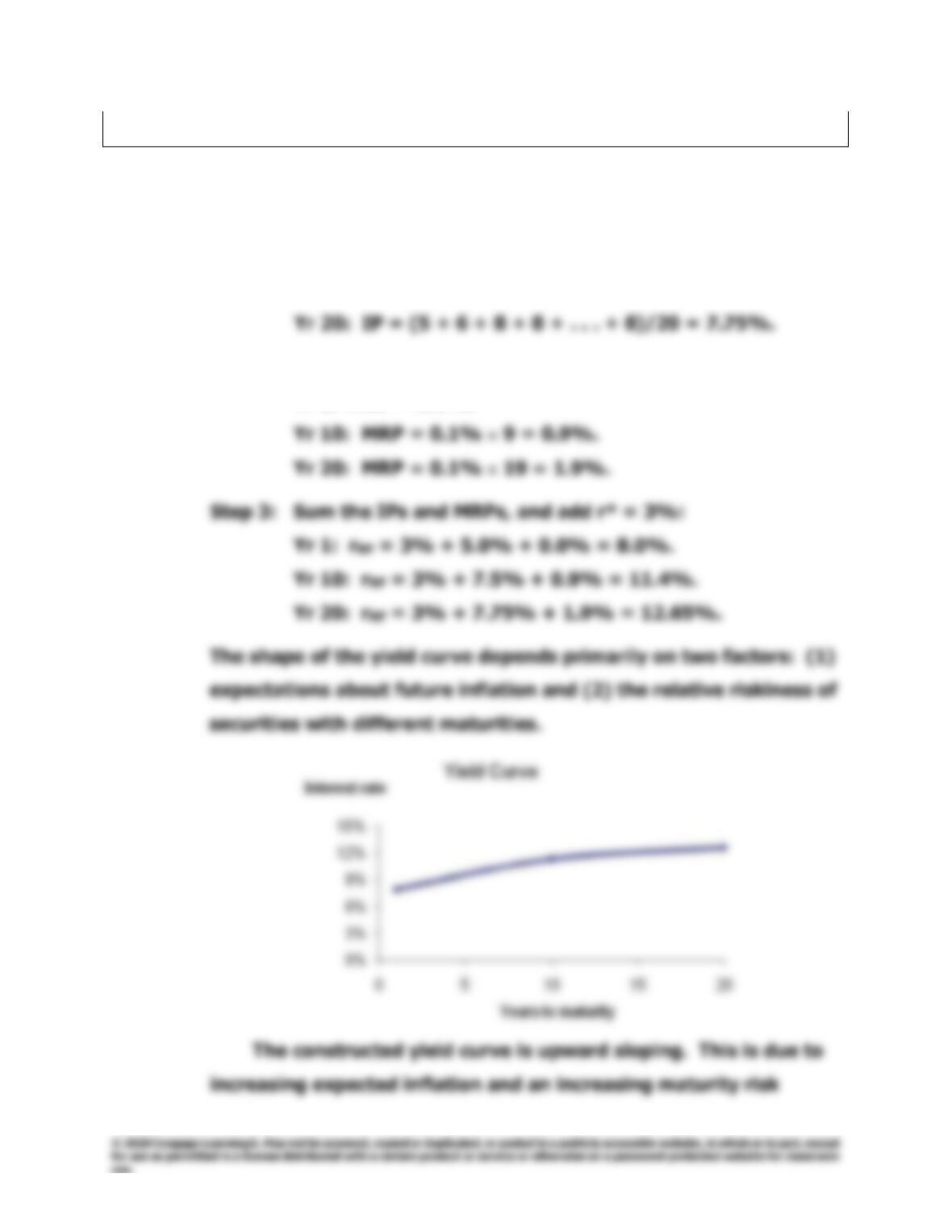
Step 1: Find the average expected inflation rate over Years 1 to 20:
Yr 1: IP = 5.0%.
Yr 10: IP = (5 + 6 + 8 + 8 + 8 + . . . + 8)/10 = 7.5%.
Step 2: Find the maturity risk premium in each year:
Yr 1: MRP = 0.0%.

Chapter 6: Interest Rates
Integrated Case
145
146
Integrated Case
Chapter 6: Interest Rates
F. At any given time, how would the yield curve facing a AAA-rated
company compare with the yield curve for U.S. Treasury
securities? At any given time, how would the yield curve facing a
BB-rated company compare with the yield curve for U.S. Treasury
securities? Draw a graph to illustrate your answer.
Answer: [Show S6-14 and S6-15 here.] (Curves for AAA-rated and BB–
rated securities have been added to an illustrative yield curve to
demonstrate that riskier securities require higher returns.) The
yield curve normally slopes upward, indicating that short-term
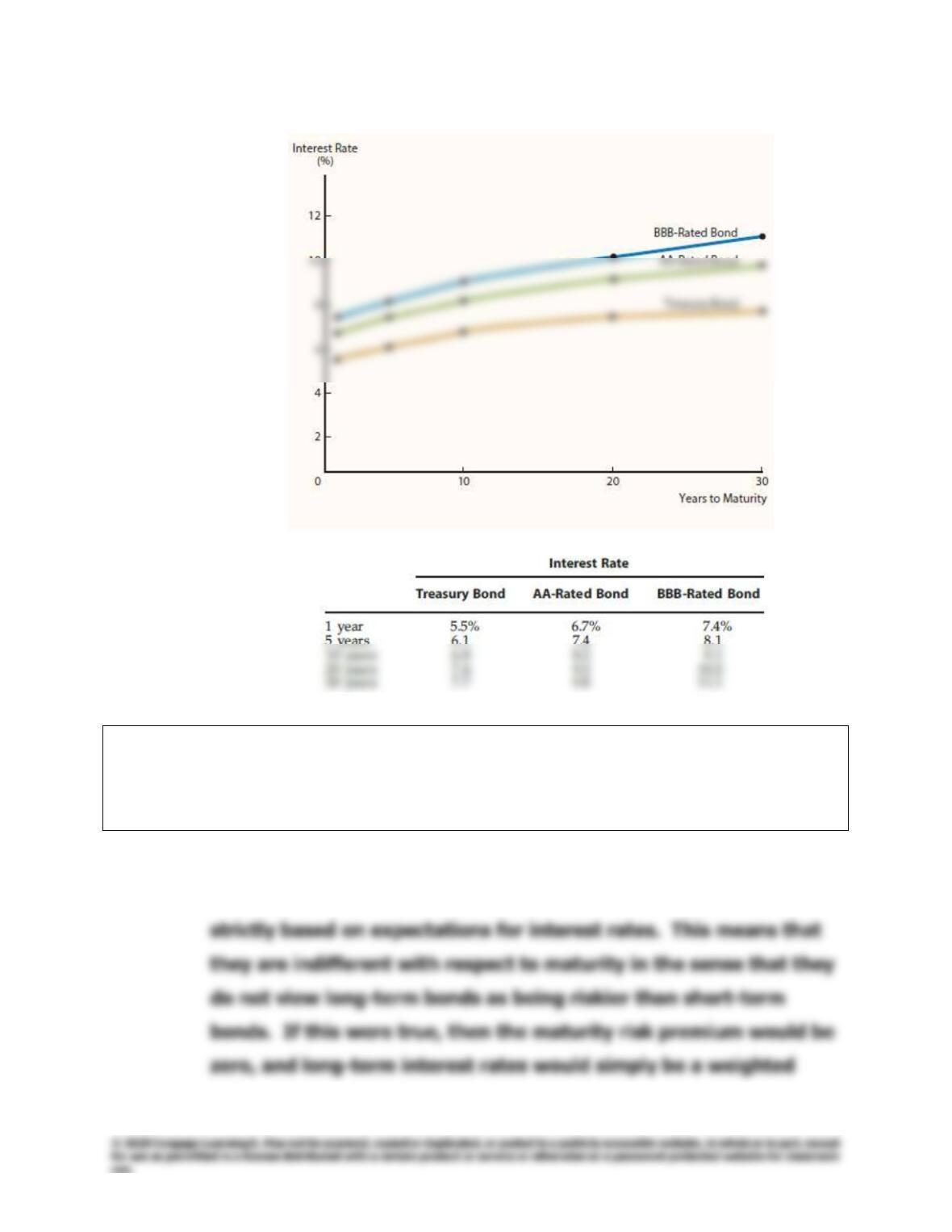
Chapter 6: Interest Rates
Integrated Case
147
Illustrative Corporate and Treasury Yield Curves
G. What is the pure expectations theory? What does the pure
expectations theory imply about the term structure of interest
rates?
Answer: [Show S6-16 and S6-17 here.] The pure expectations theory
assumes that investors establish bond prices and interest rates

H. Suppose you observe the following term structure for Treasury
securities:
Maturity Yield
1 year 6.0%
2 years 6.2
3 years 6.4
4 years 6.5
5 years 6.5
Assume that the pure expectations theory of the term structure is
correct. (This implies that you can use the yield curve provided to
“back out” the market’s expectations about future interest rates.)
What does the market expect will be the interest rate on 1-year
securities, 1 year from now? What does the market expect will be
the interest rate on 3-year securities, 2 years from now? Calculate
these yields using geometric averages.
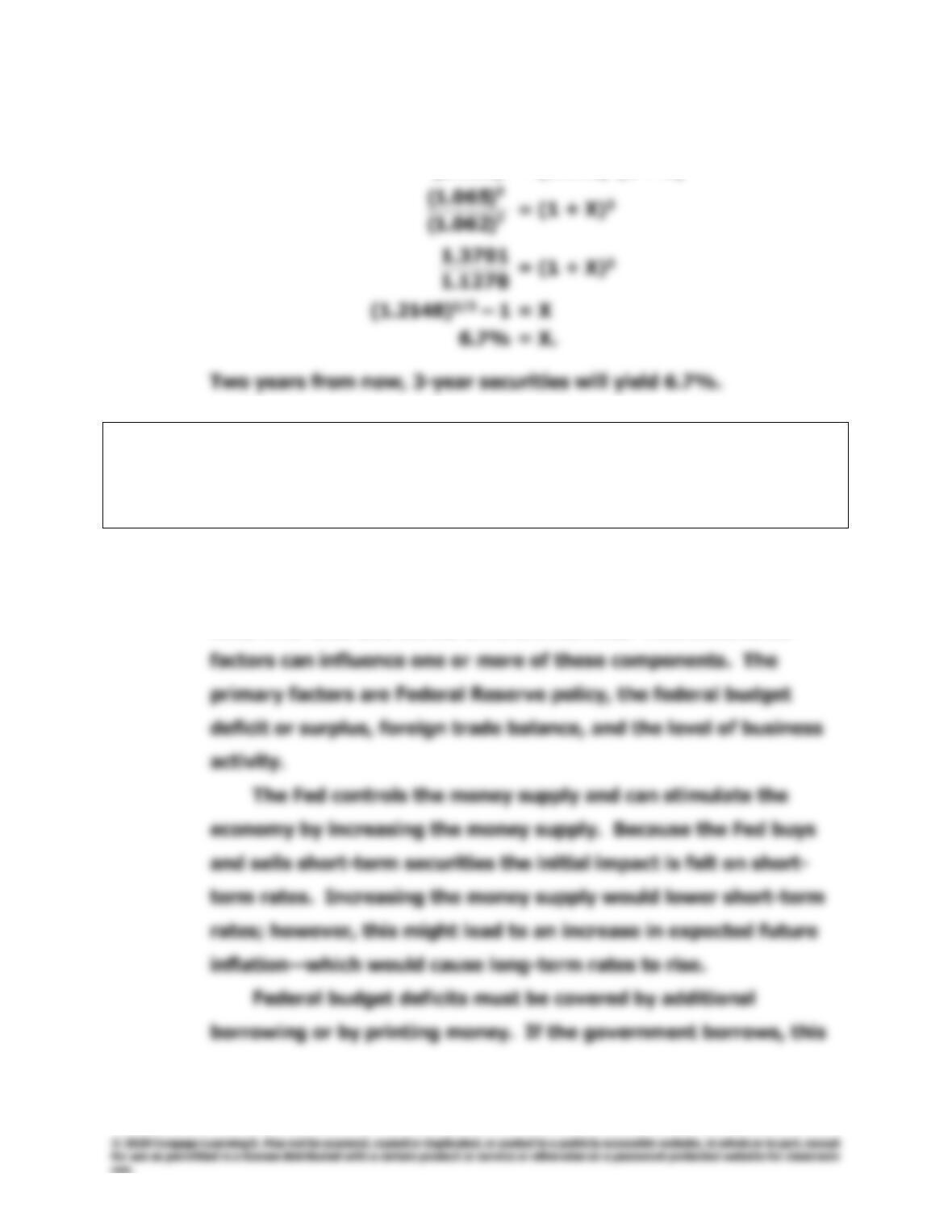
Answer: [Show S6-18 through S6-21 here.] Calculation for r on 1-year
securities one year from now:
(1.062)2 = (1.06)(1 + X)
Chapter 6: Interest Rates
Integrated Case
149
Calculation for r on 3-year securities two years from now:
(1.065)5 = (1.062)2(1 + X)3
I. Describe how macroeconomic factors affect the level of interest
rates. How do these factors explain why interest rates have been
lower in recent years?
Answer: [Show S6-22 and S6-23 here.] Expected inflation, default risk,
maturity risk, and liquidity concerns influence the level of interest
rates over time and across different markets. Macroeconomic
150
Integrated Case
Chapter 6: Interest Rates
increases the demand for funds and pushes interest rates up. If
the government prints money the result will be increased inflation.
The larger the foreign trade deficit, the more money the U.S.
must borrow. Foreigners will only hold U.S. debt if and only if U.S.
The Fed has been printing money—increasing the money
supply. As a result, short-term rates are quite low. However, at
some point, interest rates will rise due to inflationary pressure.
In fact, the Federal Reserve stopped its policy of quantitative