CHAPTER 12
A Monetary Intertemporal Model: Money, Banking,
Prices, and Monetary Policy
KEY IDEAS IN THIS CHAPTER
2. The key measures of money are the monetary aggregates which are the sums of
quantities of assets performing the functions of money.
3. The Fisher relation links the nominal interest rate, the real interest rate, and the
5. Money demand in the model is determined by the demand and supply of credit card
balances, which substitute for currency in transactions.
7. Shifts in money demand may result from changes in financial technology, in
8. Money can be non-neutral in the short run. One approach to thinking about the non-
neutrality of money is the Friedman-Lucas money surprise model.
9. The nominal interest rate cannot go below zero. At the zero lower bound, monetary
NEW IN THE FOURTH EDITION
1. The model has been streamlined.
Chapter 12: A Monetary Intertemporal Model
2. A section has been added on the Friedman-Lucas money surprise model, as a
4. New: “Macroeconomics in Action: Empirical Evidence on Quantitative Easing”
5. All data and graphs have been updated.
TEACHING GOALS
Students should obtain a basic understanding of the role of money in the economy and the
frictions that monetary exchange helps to overcome. The first part of the chapter deals
with traditional roles of money as a unit of account, medium of exchange, and store of
value. Then there is an analysis of the relationship among real and nominal interest rates
and the inflation rate. Students should understand basic Fisherian principles.
This chapter takes a modern approach to money demand. This is different from
traditional Tobin-Baumol approaches to deriving the money demand function, which do
not make much sense given modern transactions technologies. The model includes a
banking sector which provides transactions services that serve as an alternative to
currency. Then, the demand for money is derived from the underlying demand and supply
for “credit card balances” which are a stand-in for all alternatives to currency, including
CLASSROOM DISCUSSION TOPICS
Payments technology has continually advanced over time, but the rate of advance has
accelerated in the era of computer technology. Ask students for examples of advances in
this technology beyond the routine use of cash and the writing of paper cheques. Some
obvious possibilities include the use of ATMs, computer and telephone banking, the use
Instructor’s Manual for Macroeconomics, Fourth Canadian Edition
of pre-paid phone cards, and other forms of smart card technology. Students are also
likely to discuss the existence of credit cards and the ever more sophisticated ways to use
credit cards and protect against fraud. As one example, there is the use of credit cards to
pay for purchases over the Internet. In discussing these possibilities, it is also important to
distinguish payments technology from the proper measurement of the money supply. For
example, it is important to distinguish between payment arrangements that are uses of
credit, like the use of credit cards, from uses of money, like cash and transaction deposits.
In understanding the economy’s transactions demand for money, it might help students to
think of their own demand for money. Most of us carry money. How do you determine
how much to carry with you and how much to invest or save?
The amount of money an individual carries depends on daily expenses, income, the
probability of extra expenses, and the difficulty of obtaining extra money when needed.
The college student who lives in a campus residence and whose meals in the residence
dining room are part of his room payment has few daily cash expenses. The woman who
sits next to him in class may commute to campus and buy her lunch at the local
OUTLINE
1. Functions of Money
2. Measuring the Money Supply
a) The Monetary Base
i) Currency Outside of the Bank of Canada
ii) Deposits of Financial Institutions with the Bank of Canada
Chapter 12: A Monetary Intertemporal Model
b) M1
i) Currency Held by the Public
ii) Personal Chequing Accounts
iii) Current Accounts
c) M2
i) Non-Personal Notice Deposits
ii) Personal Savings Deposits in Chartered Banks
d) M3
i) Chartered Banks’ Non-Personal Term Deposits
ii) Foreign Currency Deposits of Residents of Canada
3. Introduction to the Monetary Intertemporal Model
a) The Need for Money
i) Single Coincidence of Wants
b) Real and Nominal Interest Rates
i) Nominal Bonds
ii) The Nominal Interest Rate
iii) The Fisher Relationship
c) Banks and Alternative Means of Payment
d) Equilibrium in the Market for Credit Card Services and the Demand for Money
e) Government
4. Competitive Equilibrium in the Monetary Intertemporal Model
a) Graphical Apparatus
b) A Change in the Level of the Money Supply
i) Sources of Changes in the Money Supply
(2) Open-Market Operations
(3) Seigniorage
ii) Classical Dichotomy
iii) Neutrality of Money
c) Shifts in Money Demand
5. The Short-Run Nonneutrality of Money: Friedman-Lucas Money Surprise
Model
a) Basic model and nonneutrality of money
b) Implications for monetary policy: money supply and interest rate targeting
c) Segmented markets model
Instructor’s Manual for Macroeconomics, Fourth Canadian Edition
TEXTBOOK QUESTION SOLUTIONS
Problems
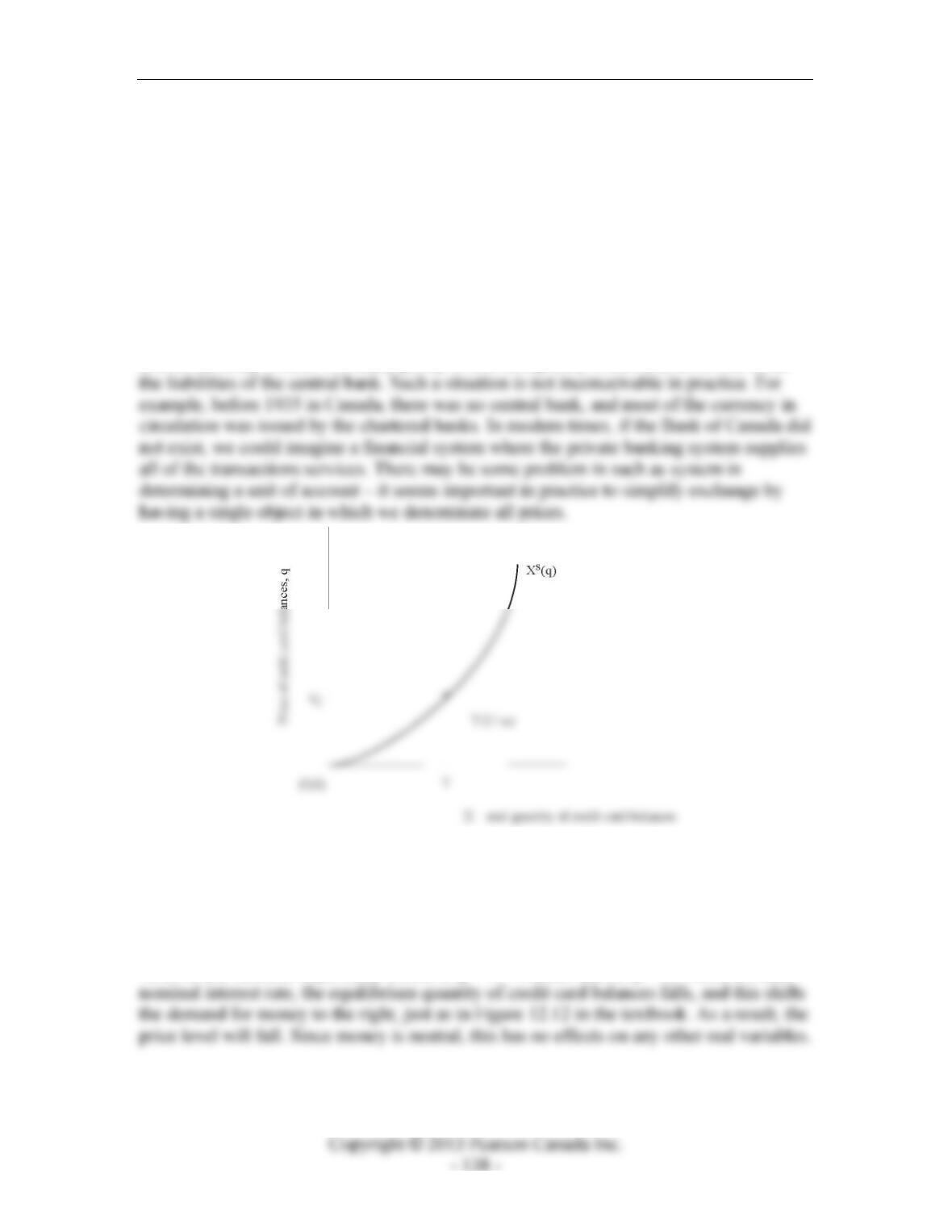
1. It is possible that at the market nominal interest rate, *( )
X
RY> , which would imply
a negative demand for money, which cannot happen in equilibrium. In other words, it is
possible that, if the market nominal interest rate is R, and q = R, that the banking system
would want to supply. Then, in Figure 12.1, there is some price of credit card services
1
qR<, such that, as in Figure 12.1, the equilibrium quantity of credit card services
offered is Y, so that all transactions services are supplied by banks as credit card services,
and no currency is held. Monetary policy is then completely irrelevant, as no one holds
Figure 12.1
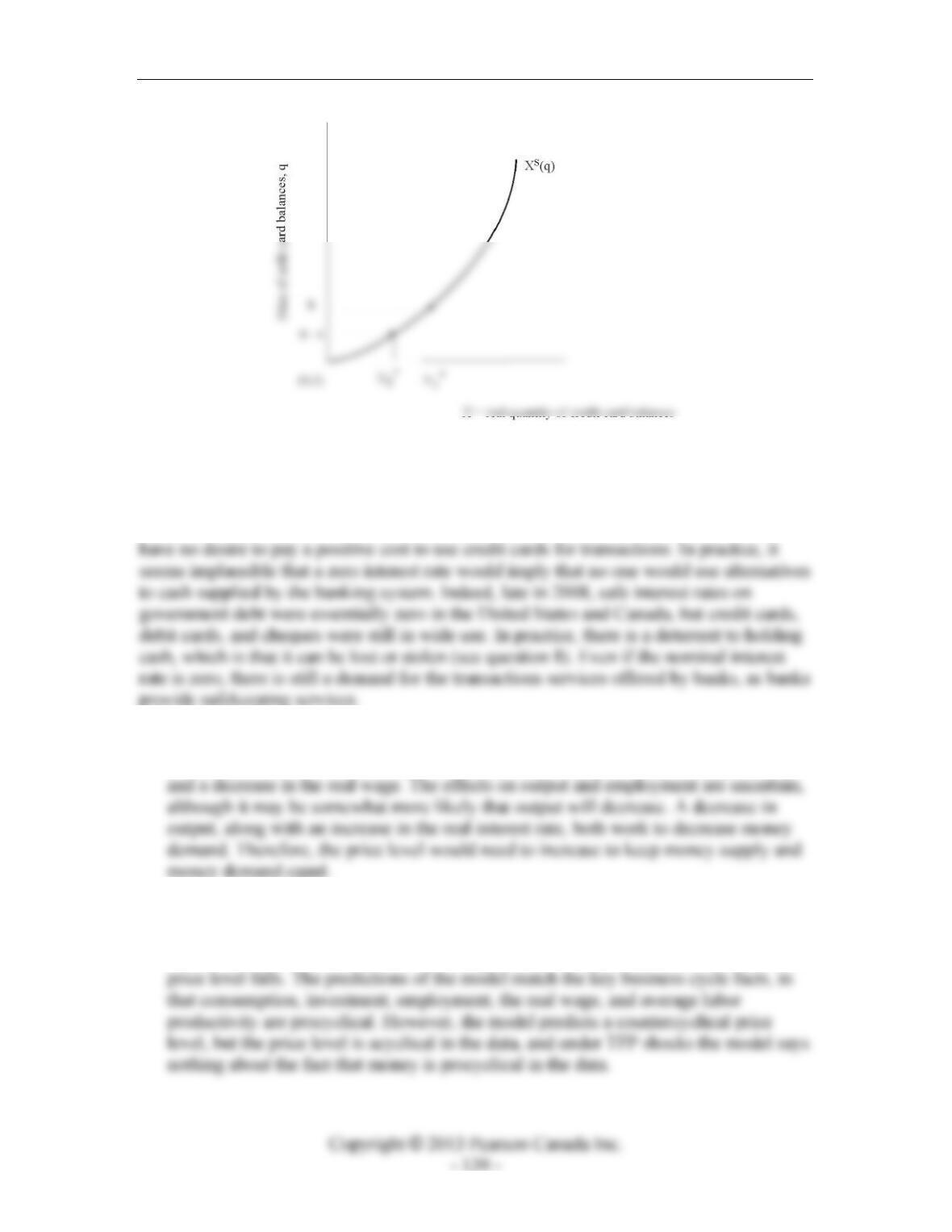
2. A tax on credit card balances shifts the demand for credit card balances in Figure
12.2, so that demand is perfectly elastic at q = R – t rather than at q = R. Then, for each
Chapter 12: A Monetary Intertemporal Model
Figure 12.2
3. If the nominal interest rate is zero, then the demand for credit card balances is zero.
The nominal interest rate represents the opportunity cost of holding currency for use in
transactions, and if this cost is reduced to zero then consumers and firms in the model
4. The real effects of a decrease in the capital stock are the same as those in the real
intertemporal model. The decrease in K leads to an increase in the real interest rate
5. This represents an increase in current total factor productivity (TFP). The real effects
are exactly the same as in Chapter 11. But, since real output increases and the real
interest rate falls, there is an shift to the right in the money demand function, and the
6. The increased presence of ATMs would allow consumers to get by holding less
7. This works like Figure 10.2 above for question 2, in reverse. Roughly, if there is some
chance that currency is stolen, then this increases the opportunity cost of holding
8. What will work in this case to totally eliminate the confusion for private sector
economic agents is the following. First, as long as the central bank does not see a
shock to total factor productivity, it should have an interest rate target. Then, if there
9. There are assumed to be no non-neutralities of money. For part (a), from question #5,
if there is an increase in total factor productivity, then the price level falls, and real
output rises, if the central bank does nothing. Nominal GDP may rise or fall.