
Chapter 6: Interest Rates
Learning Objectives
125
Chapter 6
Interest Rates
Learning Objectives
After reading this chapter, students should be able to do the following:
◆ List the various factors that influence the cost of money.
◆ Discuss how market interest rates are affected by borrowers’ need for capital, expected inflation,
different securities’ risks, and securities’ liquidity.
126
Lecture Suggestions
Chapter 6: Interest Rates
Lecture Suggestions
Chapter 6 is important because it lays the groundwork for the following chapters. Additionally, students
have a curiosity about interest rates, so this chapter stimulates their interest in the course.
DAYS ON CHAPTER: 2 OF 56 DAYS (50-minute periods)
Chapter 6: Interest Rates
Answers and Solutions
127
Answers to End-of-Chapter Questions
6-1 Regional mortgage rate differentials do exist, depending on supply/demand conditions in the
different regions. However, relatively high rates in one region would attract capital from other
regions, and the result would be a differential that was just sufficient to cover the costs of effecting
6-2 Short-term interest rates are more volatile because (1) the Fed operates mainly in the short-term
6-3 Interest rates will fall as the recession takes hold because (1) business borrowings will decrease
and (2) the Fed will increase the money supply to stimulate the economy. Thus, it would be better
6-4 a. If transfers between the two markets are costly, interest rates would be different in the two
areas. Area Y, with the relatively young population, would have less in savings accumulation
and stronger loan demand. Area O, with the relatively old population, would have more
equilibrium would be at a higher rate of interest in Area Y.
b. Yes. Nationwide branching, and so forth, would reduce the cost of financial transfers between
the areas. Thus, funds would flow from Area O with excess relative supply to Area Y with
6-5 A significant increase in productivity would raise the rate of return on producers’ investment, thus
6-6 a. The immediate effect on the yield curve would be to lower interest rates in the short-term end
of the market, since the Fed deals primarily in that market segment. However, people would
6-7 a. S&Ls would have a higher level of net income with a “normal” yield curve. In this situation their
liabilities (deposits), which are short-term, would have a lower cost than the returns being
b. It depends on the situation. A sharp increase in inflation would increase interest rates along
the entire yield curve. If the increase were large, short-term interest rates might be boosted
above the long-term interest rates that prevailed prior to the inflation increase. Then, since the
6-8 Treasury bonds, along with all other bonds, are available to investors as an alternative investment
to common stocks. An increase in the return on Treasury bonds would increase the appeal of these
6-9 A trade deficit occurs when the U.S. buys more than it sells. In other words, a trade deficit occurs
6-10 The yield on corporates is equal to:
rt = r* + IPt + MRPt + DRP + LP.
Chapter 6: Interest Rates
Answers and Solutions
129
Solutions to End-of–Chapter Problems
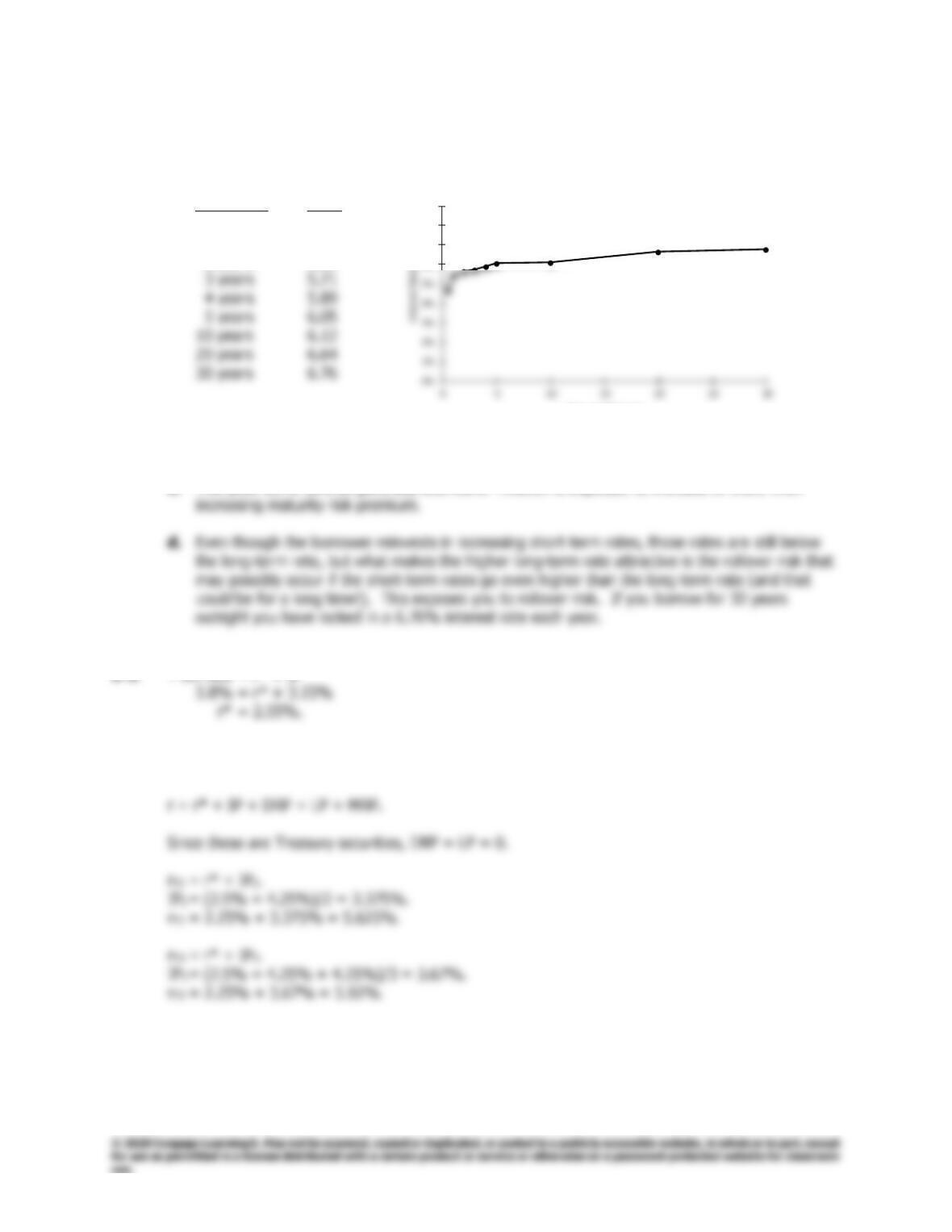
6-1 a. Term Rate
6 months 4.69%
1 year 5.49
2 years 5.66
b. The yield curve shown is an upward sloping yield curve.
c. This yield curve tells us generally that either inflation is expected to increase or there is an
6-2 T-bill rate = r* + IP
6-3 r* = 2.25%; I1 = 2.5%; I2 = 4.25%; I3 = 4.25%; MRP = 0; rT2 = ?; rT3 = ?
6%
7%
8%
9%
Years to Maturity
6-4 rT10 = 5.75%; rC10 = 8.75%; LP = 0.35%; DRP = ?
r = r* + IP + DRP + LP + MRP.
rT10 = 5.75% = r* + IP10 + MRP10; DRP = LP = 0.
6-5 r* = 2.5%; IP2 = 2.75%; rT2 = 5.55%; MRP2 = ?
6-6 r* = 5%; IP4 = 18%; MRP = DRP = LP = 0; rRF4 = ?
6-7 rT1 = 4.85%; 1rT1 = 5.2%; rT2 = ?
6-8 Let X equal the yield on 2-year securities 4 years from now:
(1.067)4(1 + X)2 = (1.0725)6
6-9 r7 = r* + IP7 + MRP7 + DRP + LP.
6-10 Basic relevant equations:
rt = r* + IPt + DRPt + MRPt + IPt.
But here IPt is the only premium, so rt = r* + IPt.
We can set up this table:
r* I IPt r = r* + IPt
1 2.5% 3.25% 3.25%/1 = 3.25% 5.75%
2 2.5% I (3.25% + I)/2 = IP2
6-11 We’re given all the components to determine the yield on the bonds except the default risk
premium (DRP) and MRP. Calculate the MRP as 0.1 x (5 – 1)% = 0.4%. Now, we can solve for
6-12 First, calculate the inflation premiums for the next three and five years, respectively. They are IP3
= (2.1% + 2.7% + 3.65%)/3 = 2.82% and IP5 = (2.1% + 2.7% + 3.65% + 3.65% + 3.65%)/5 =
3.15%. The real risk-free rate is given as 1.95%. Since the default and liquidity premiums are
6-13 rC11 = r* + IP11 + MRP11 + DRP11 + LP11
132
Answers and Solutions
Chapter 6: Interest Rates
6-14 a. (1.041)2 = (1.032)(1 + X)
b. For riskless bonds under the expectations theory, the interest rate for a bond of any maturity is
rN = r* + average inflation over N years. If r* = 1%, we can solve for IPN:
Year 1: r1 = 1% + I1 = 3.2%;
6-15 r* = 2%; MRP = 0%; rT1 = 5%; rT2 = 7%; X = ?
X represents the one-year rate on a bond one year from now (Year 2).
(1.07)2 = (1.05)(1 + X)
1449.1
= 1 + X
6-16 rRF6 = 20.84%; MRP = DRP = LP = 0; r* = 6%; IP6 = ?
rRF6 = (1 + r*)(1 +IP6) – 1
6-17 rT5 = 5.2%; rT10 = 6.4%; rC10 = 8.4%; IP10 = 2.5%; MRP = 0. For Treasury securities, DRP = LP = 0.
DRP5 + LP5 = DRP10 + LP10. rC5 = ?
Chapter 6: Interest Rates
Answers and Solutions
133
rT5 = r* + IP5
rC10 = r* + IP10 + DRP10 + LP10
8.4% = 3.9% + 2.5% + DRP10 + LP10
6-18 a. Years to Real Risk-Free
Maturity Rate (r*) IPt** MRP rT = r* + IPt + MRPt
1 2% 7.00% 0.2% 9.20%
2 2 6.00 0.4 8.40
3 2 5.00 0.6 7.60
**The computation of the inflation premium is as follows:
Expected
Year Inflation IPt
1 7% 7.00%
2 5 6.00
3 3 5.00
For example, the calculation for IP3 is as follows:
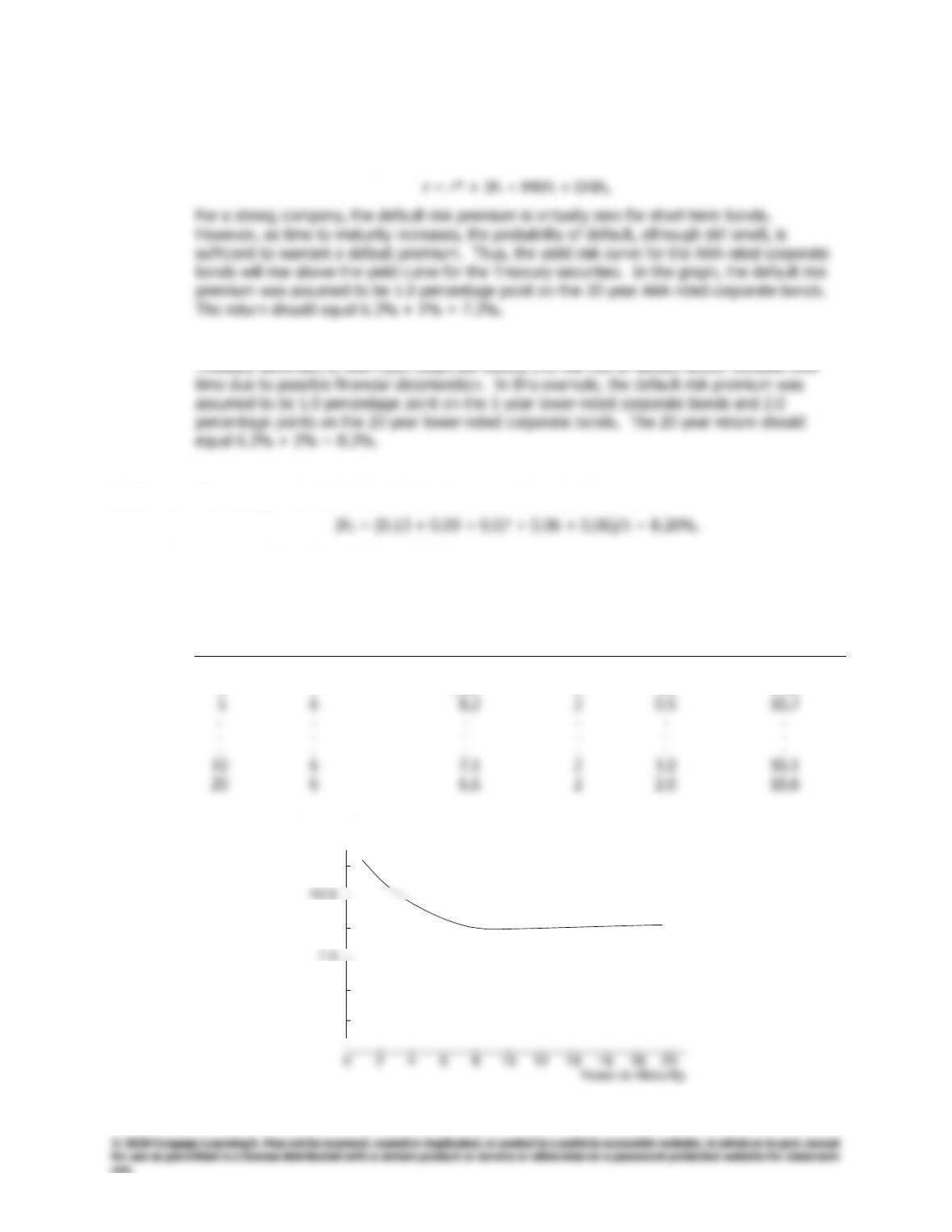
Thus, the yield curve would be as follows:
8.0
7.0
T-bonds
11.0
10.5
10.0
9.5
9.0
8.5
7.5
0
2
4
6
8
10
12
14
16
18
20
Interest Rate
(%)
6.5
Years to
Maturity
134
Answers and Solutions
Chapter 6: Interest Rates
b. The interest rate on the AAA–rated corporate bonds has the same components as the Treasury
securities, except that the AAA–rated corporate bonds have default risk, so a default risk premium
must be included. Therefore,
c. The lower-rated corporate bonds would have significantly more default risk than either
6-19 a. The average rate of inflation for the 5-year period is calculated as:
b. rT5 = r* + IP5 = 2% + 8.2% = 10.20%.
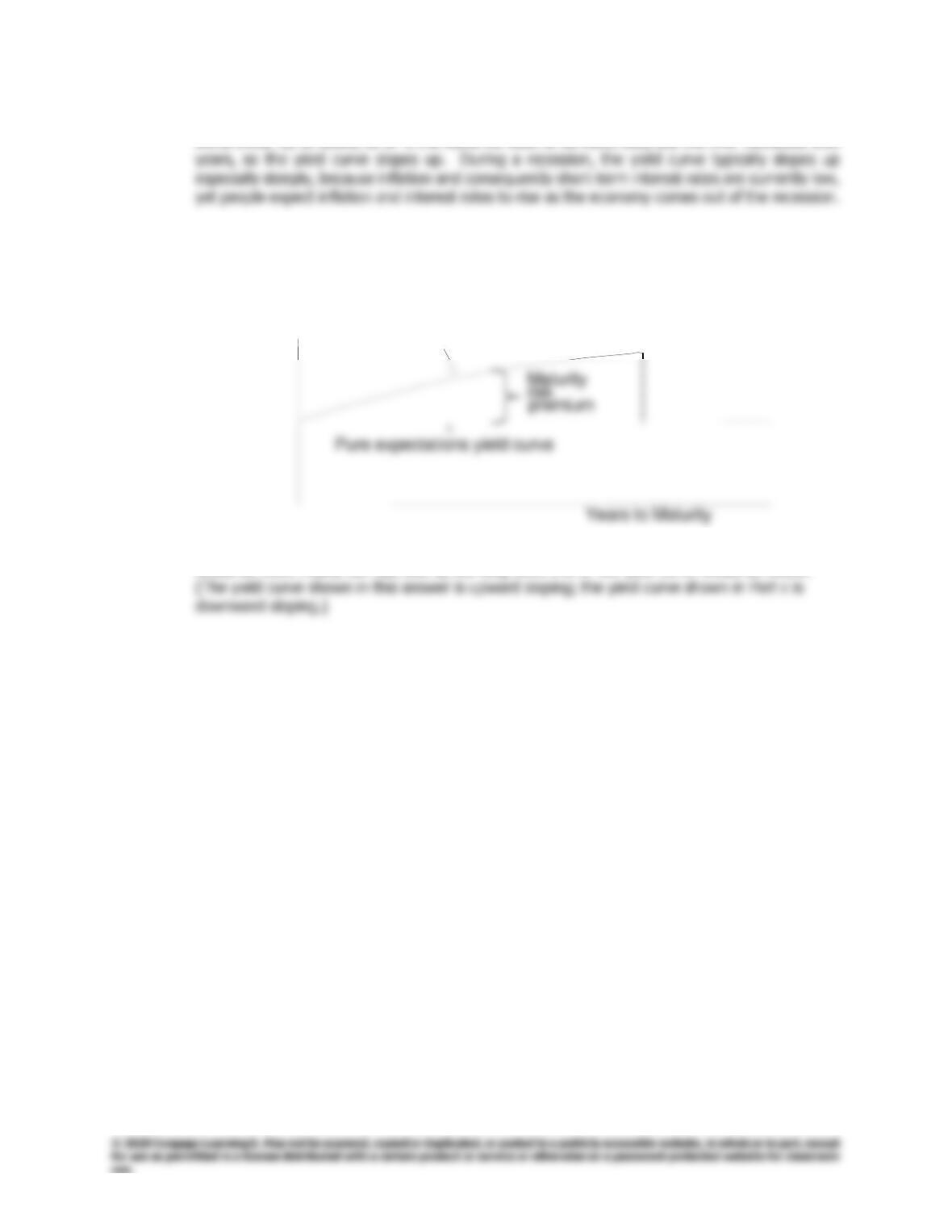
c. Here is the general situation:
Year
Expected Annual
Inflation (It)
IPt
r*
MRPt
rt
1
13%
13.0%
2%
0.1%
15.1%
2
9
11.0
2
0.2
13.2
5
6
2
0.5
10.7
6
2
2.0
10.6
(%)
Interest Rate
15.0
10.0
5.0
2.5
Chapter 6: Interest Rates
Answers and Solutions
135
d. The “normal” yield curve is upward sloping because, in “normal” times, inflation is not expected to
trend either up or down, so IP is the same for debt of all maturities, but the MRP increases with
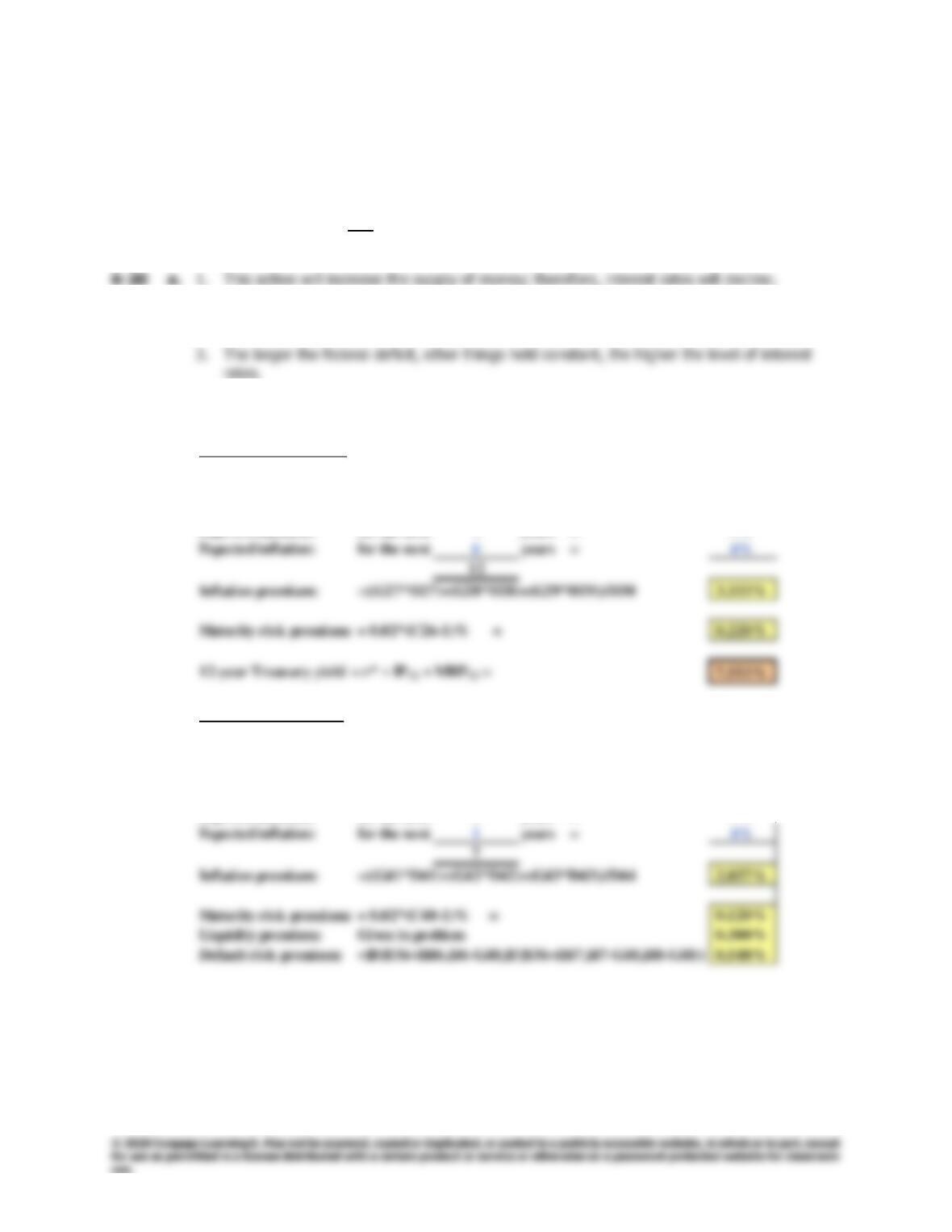
e. If inflation rates are expected to be constant, then the expectations theory holds that the yield
curve should be horizontal. However, in this event it is likely that maturity risk premiums would be
applied to long-term bonds because of the greater risks of holding long–term rather than short–term
bonds:
Maturity
premium
Pure expectations yield curve
Years to Maturity
risk
If maturity risk premiums were added to the yield curve in Part e above, then the yield curve
would be more nearly normal; that is, the long-term end of the yield curve would be raised.
(%)
Percent
Actual yield curve
136
Comprehensive/Spreadsheet Problem
Chapter 6: Interest Rates
Comprehensive/Spreadsheet Problem
Note to Instructors:
The solution to this problem is not provided to students at the back of their text. Instructors
can access the
Excel
file on the textbook’s website.
2. This action will cause interest rates to increase.
4. This expectation will cause interest rates to increase.
b.
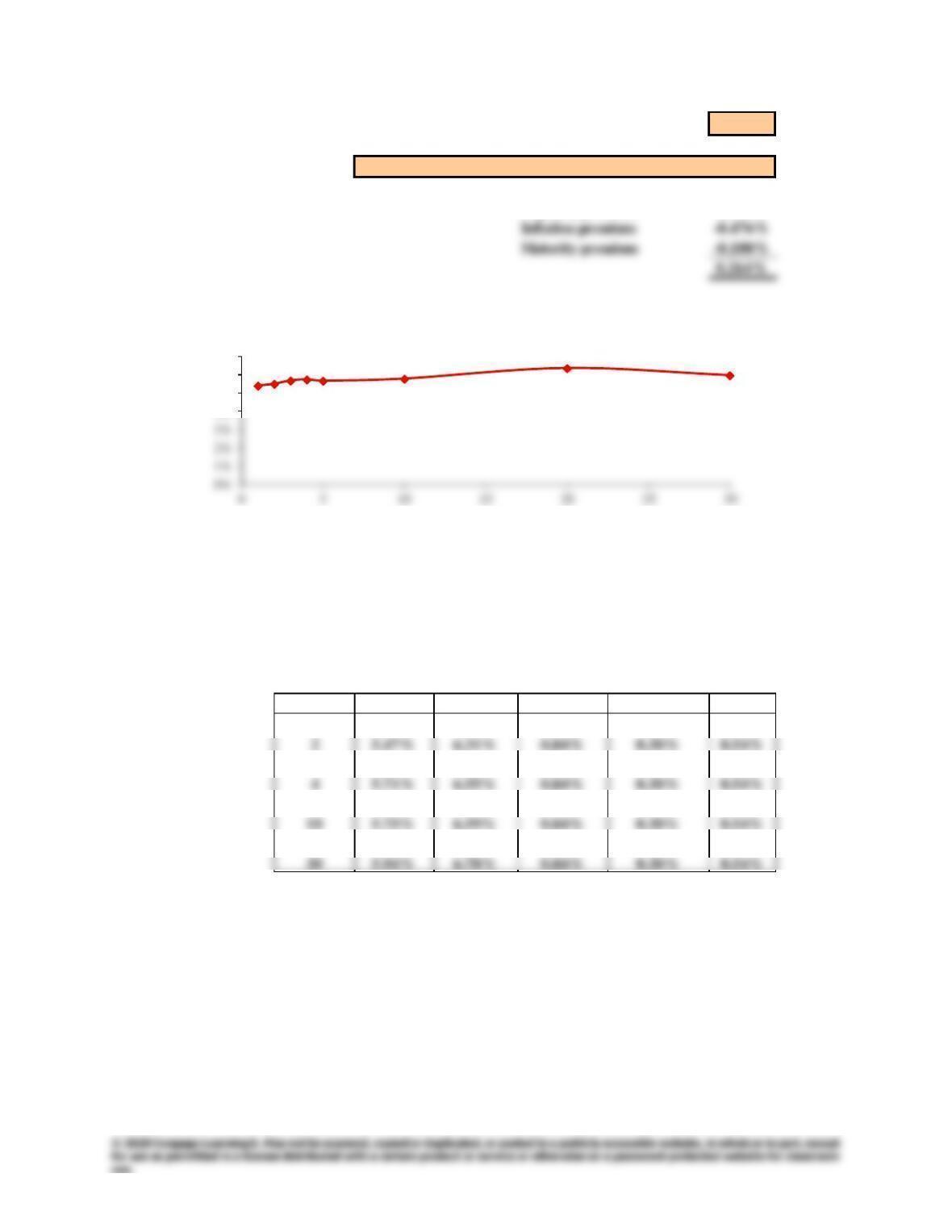
12–year Treasury Bond
Real risk–free rate (r*): 4.000%
Maturity: 12
Expected inflation: for the next 2years = 2%
Expected inflation: for the next 4years = 3%
7–year Corporate Bond
Rating : A
Real risk–free rate (r*): 4.000%
Maturity: 7
Expected inflation: for the next 2years = 2%
Expected inflation: for the next 4years = 3%
Chapter 6: Interest Rates
Comprehensive/Spreadsheet Problem
137
c.
d. The real risk-free rate would be the same for the corporate and treasury bonds. Similarly,
without information to the contrary, we would assume that the maturity and inflation premiums
would be the same for bonds with the same maturities. However, the corporate bond would
have a liquidity premium and a default premium. If we assume that these premiums are
constant across maturities, then we can use the LP and DRP as determined above and add
them to the T-bond yields to find the corporate yields. This procedure was used in the table
below.
Years Treasury A–Corporate Spread LP DRP
1 5.37% 6.21% 0.84% 0.30% 0.54%
3 5.65% 6.49% 0.84% 0.30% 0.54%
5 5.64% 6.48% 0.84% 0.30% 0.54%
20 6.33% 7.17% 0.84% 0.30% 0.54%
7–year Corporate yield = r* + IP7 + MRP7 + LP + DRP = 7.817%
Yield Spread = Corporate – Treasury = 0.264%
Reconciliation: Default premium 0.540%
Liquidity premium 0.300%
4%
5%
6%
7%
Interest Rate
Years to Maturity
Yield Curve