170
Integrated Case
Chapter 7: Bonds and Their Valuation
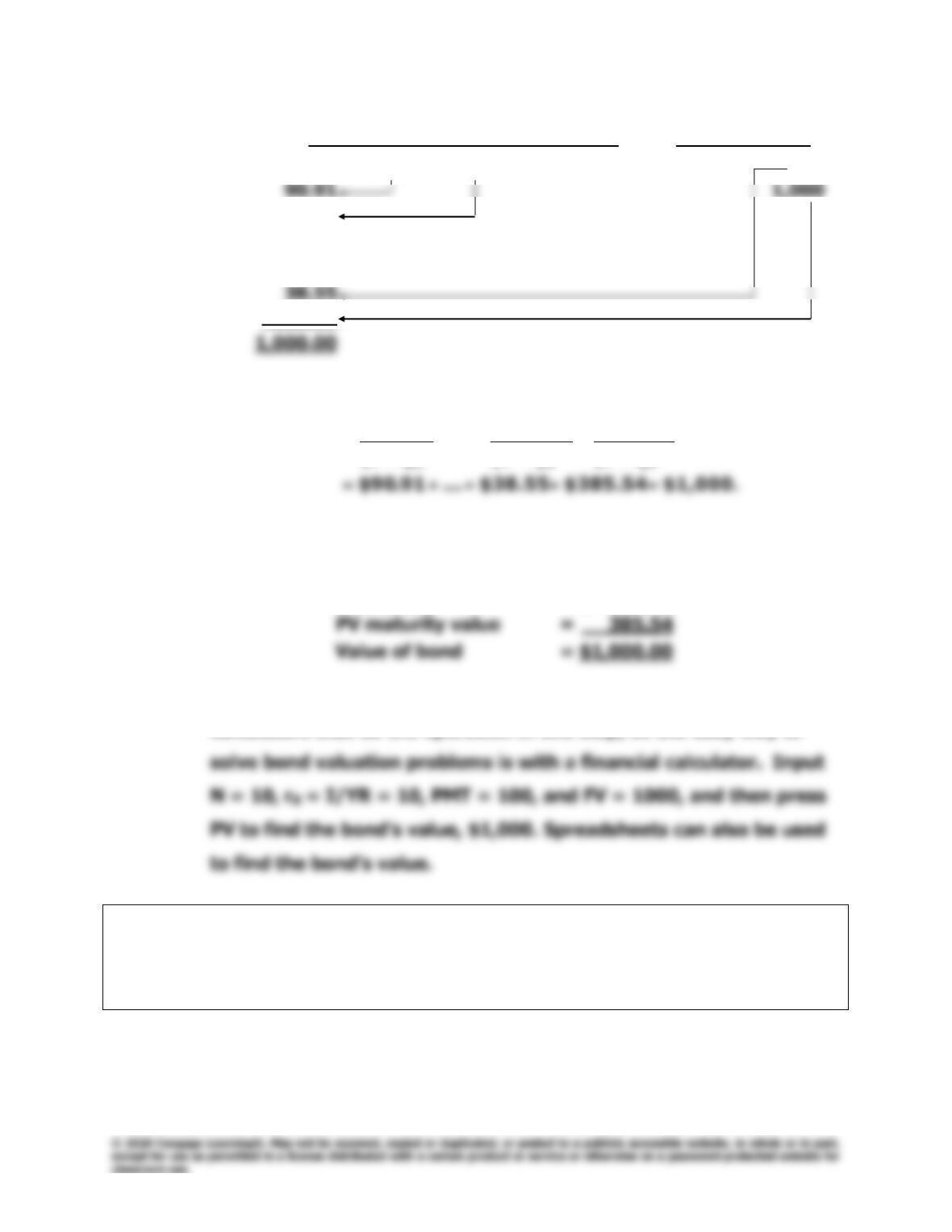
0 1 2 3 9 10
| | | | • • • | |
100 100 100 100 100
82.64
.
.
.
385.54
Expressed as an equation, we have:
)r1(
000,1$
)r(1
$100
…
)r1(
100$
V10
d
10
d
1
d
B
+
+
+
++
+
=
The bond consists of a 10-year, 10% annuity of $100 per year plus
a $1,000 lump sum payment at t = 10:
PV annuity = $ 614.46
The mathematics of bond valuation is programmed into financial
calculators that do the operation in one step, so the easy way to
E. (1) What is the value of a 13% coupon bond that is otherwise identical
to the bond described in part d? Would we now have a discount or
a premium bond?
10%
Chapter 7: Bonds and Their Valuation
Integrated Case
171
Answer: [Show S7-13 here.] With a financial calculator, just change the
value of PMT from $100 to $130, and press the PV button to
determine the value of the bond:
E. (2) What is the value of a 7% coupon bond with these characteristics?
Would we now have a discount or premium bond?
Answer: [Show S7-14 here.] In the second situation, where the coupon rate
(7%) is below the bond’s required return (10%), the price of the
E. (3) What would happen to the values of the 7%, 10%, and 13%
coupon bonds over time if the required return remained at 10%?
[Hint: With a financial calculator, enter PMT, I/YR, FV, and N; then
change (override) N to see what happens to the PV as it approaches
maturity.]
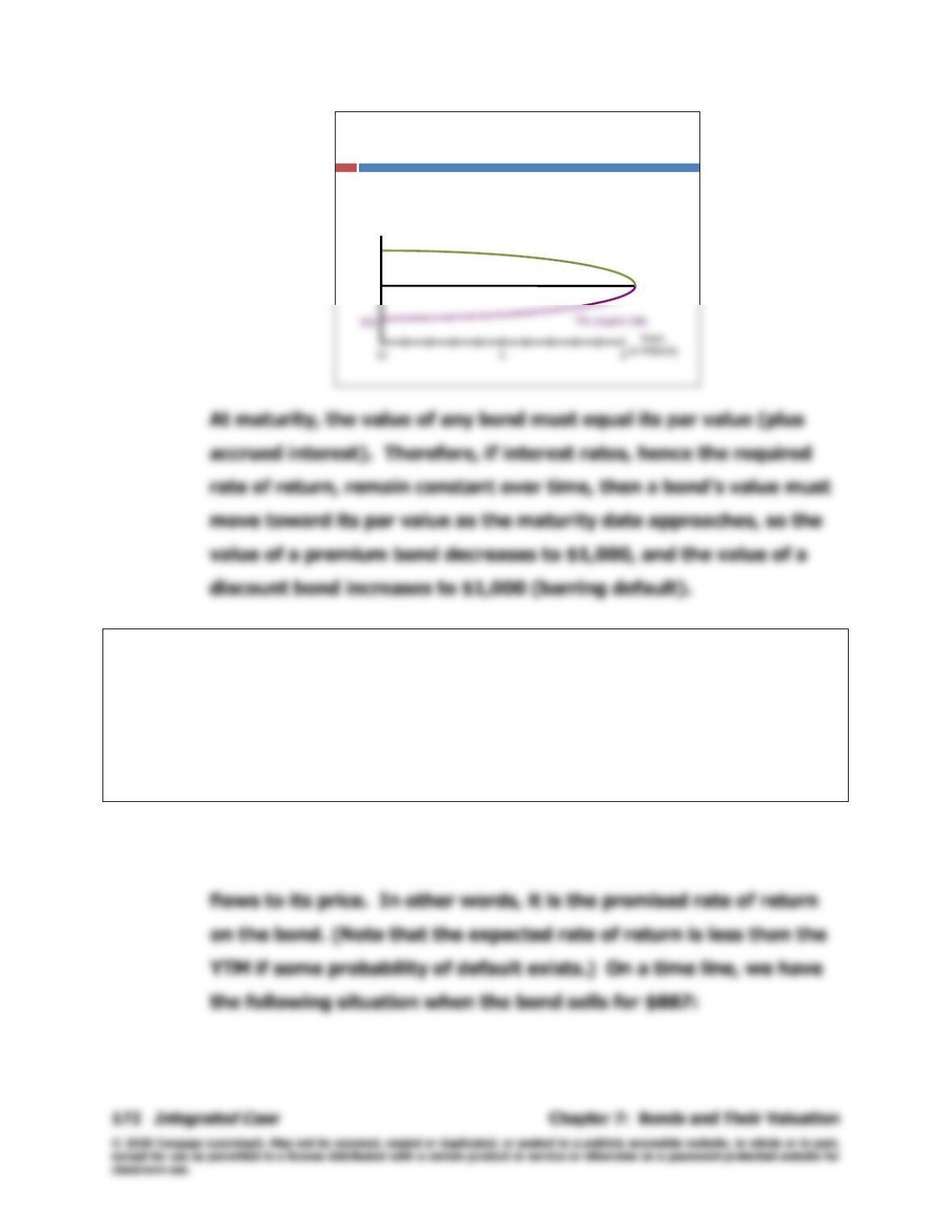
Answer: [Show S7-15 and S7-16 here.] If interest rates remain constant (at
10%), we could find the bond’s value as time passes, and as the
maturity date approaches. If we then plotted the data, we would
find the situation shown below:
Changes in Bond Value over Time
▪What would happen to the value of these
three bonds if the required rate of return
remained at 10%?
1,184
1,000
13% coupon rate
10% coupon rate
VB
F. (1) What is the yield to maturity on a 10-year, 9%, annual coupon,
$1,000 par value bond that sells for $887.00? That sells for
$1,134.20? What does the fact that it sells at a discount or at a
premium tell you about the relationship between rd and the coupon
rate?
Answer: [Show S7-17 through S7-19 here.] The yield to maturity (YTM) is
the discount rate that equates the present value of a bond’s cash
Chapter 7: Bonds and Their Valuation
Integrated Case
173
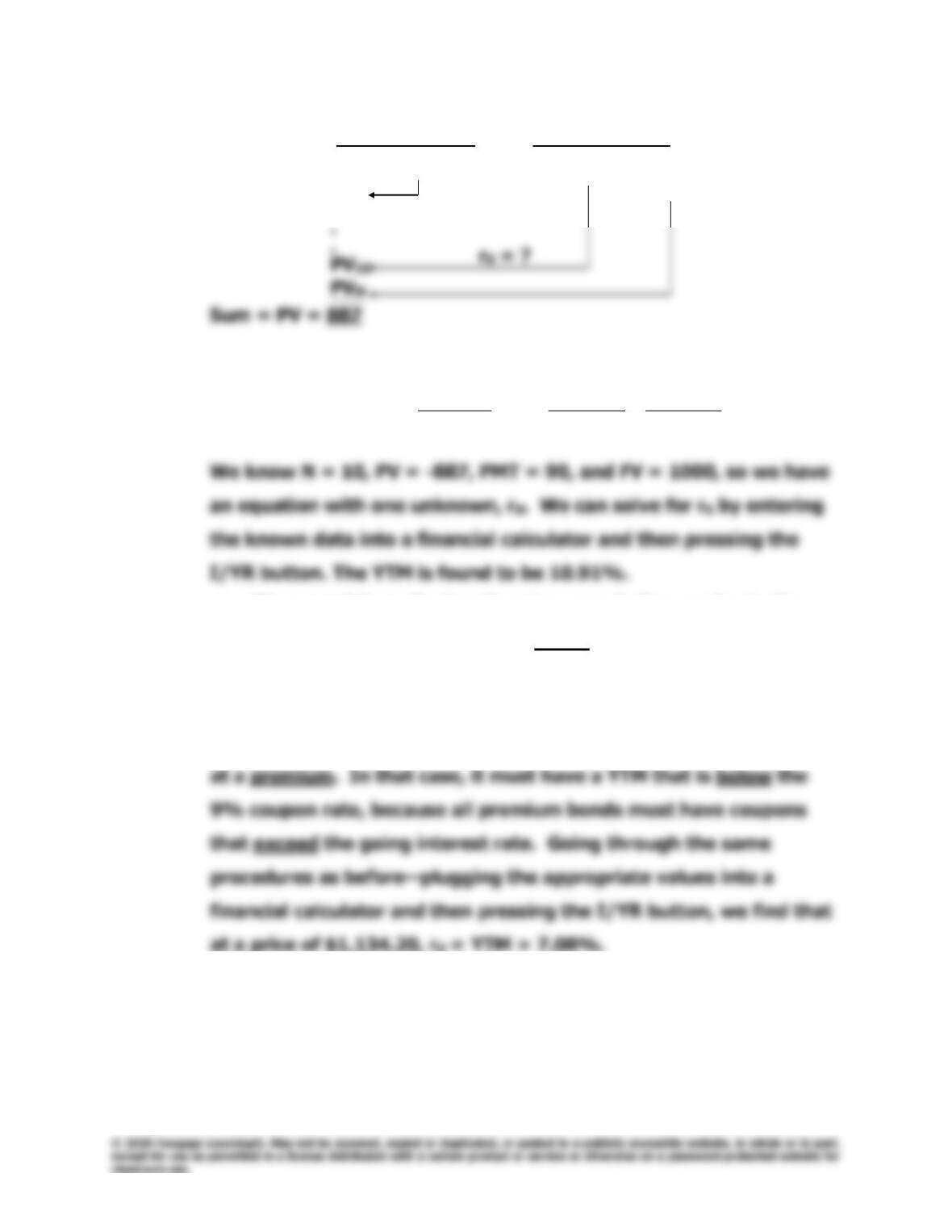
0 1 9 10
| | • • • | |
90 90 90
PV1 1,000
.
We want to find rd in this equation:
VB = PV =
N
d
N
d
1
d)r1(
M
)r(1
INT
…
)r1(
INT
+
+
+
++
+
.
We can tell from the bond’s price, even before we begin the
calculations, that the YTM must be above the 9% coupon rate. We
know this because the bond is selling at a discount, and discount
bonds always have rd > coupon rate.
If the bond were priced at $1,134.20, then it would be selling
174
Integrated Case
Chapter 7: Bonds and Their Valuation
F. (2) What are the total return, the current yield, and the capital gains
yield for the discount bond? Assume that it is held to maturity and
the company does not default on it. (Hint: Refer to footnote 6 for
the definition of the current yield and to Table 7.1.)
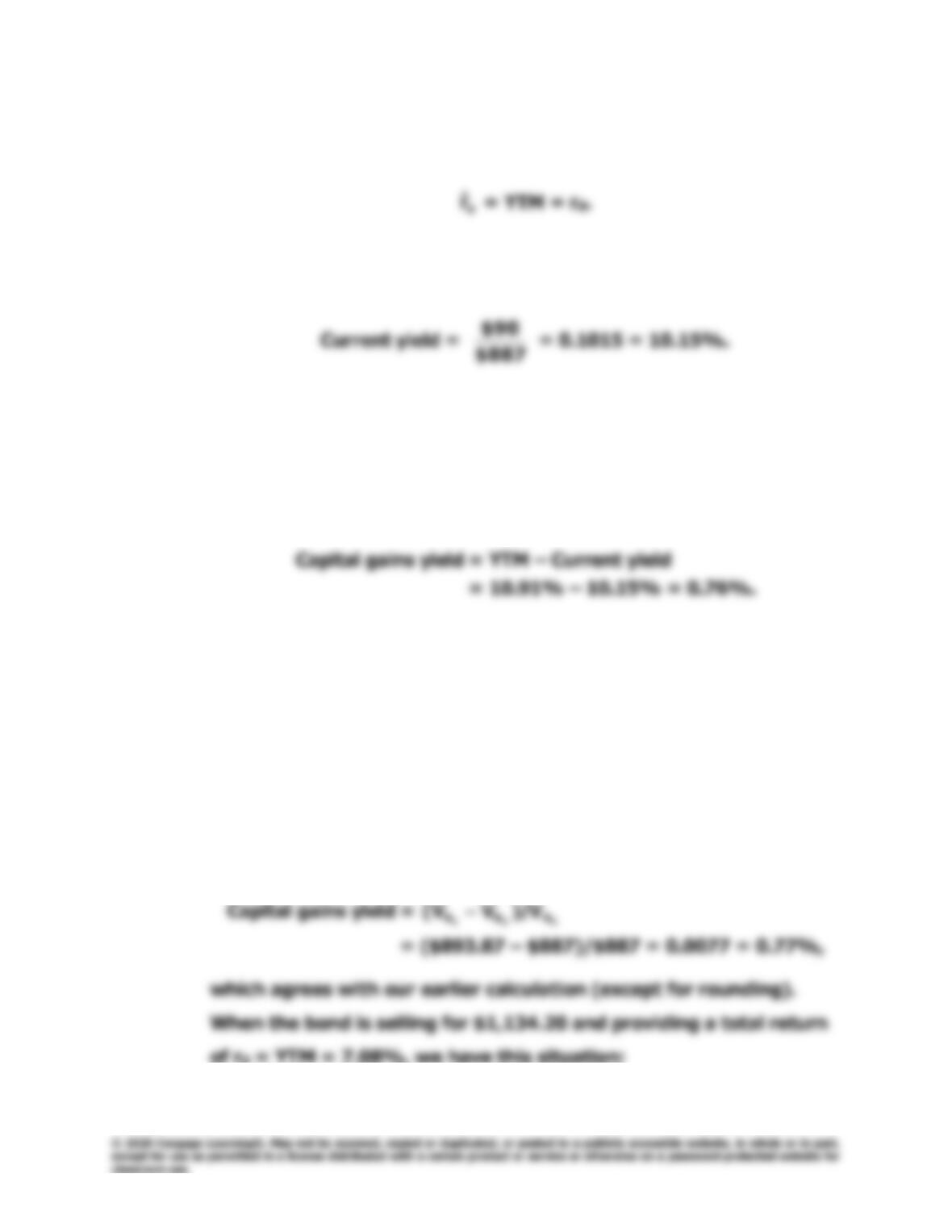
Answer: [Show S7-20 through S7-22 here.] The current yield is defined as
follows:
Current yield =
bond the of priceCurrent
paymentinterest coupon Annual
.
The capital gains yield is defined as follows:
Chapter 7: Bonds and Their Valuation
Integrated Case
175
until it does hold, and equilibrium is established. Therefore, for the
marginal investor:
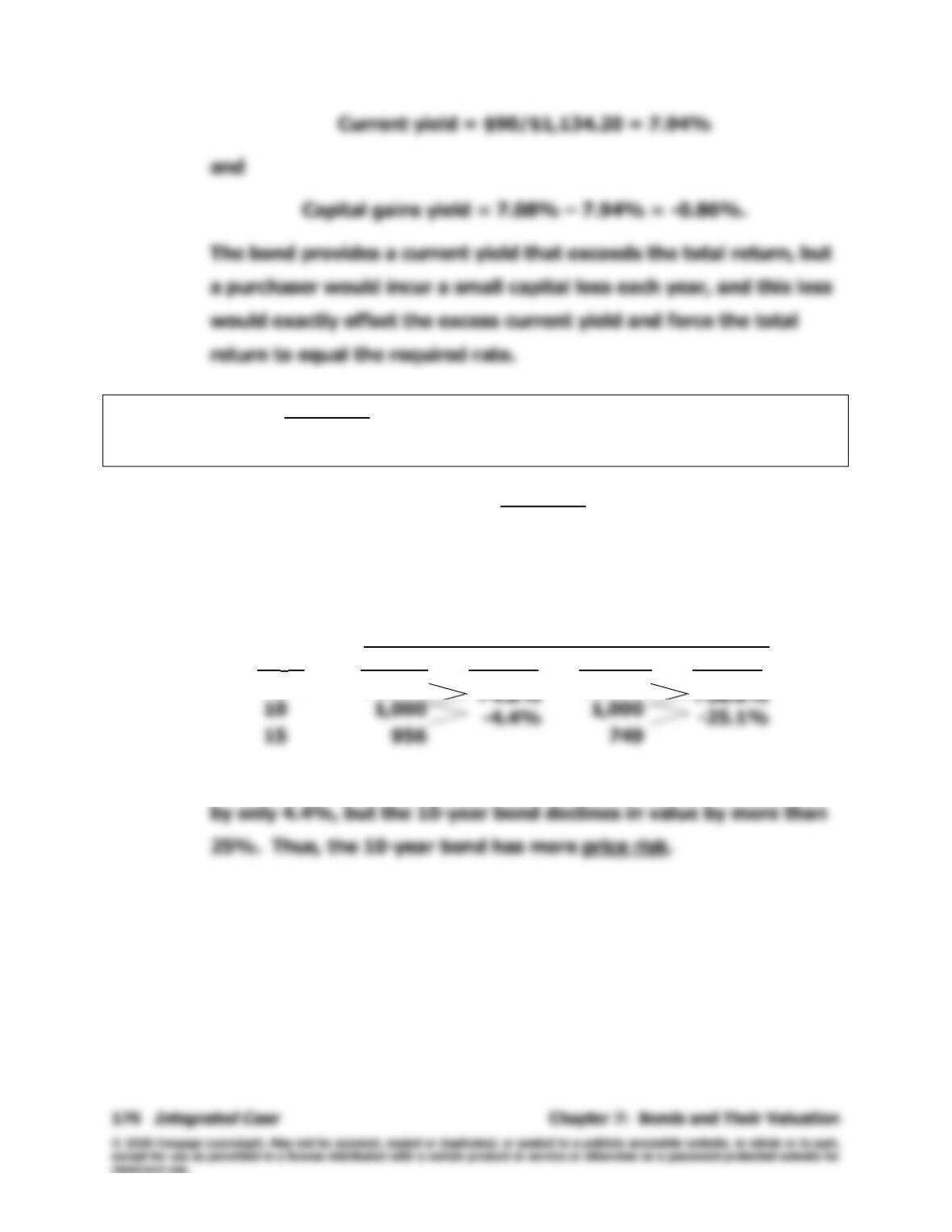
For our 9% coupon, 10-year bond selling at a price of $887 with a
YTM of 10.91%, the current yield is:
Knowing the current yield and the total return, we can find the
capital gains yield:
YTM = Current yield + Capital gains yield
and
The capital gains yield calculation can be checked by asking this
question: “What is the expected value of the bond 1 year from
now, assuming that interest rates remain at current levels?” This is
the same as asking, “What is the value of a 9-year, 9% annual
coupon bond if its YTM (its required rate of return) is 10.91%?”
The answer, using the bond valuation function of a calculator, is
$893.87. With this data, we can now calculate the bond’s capital
gains yield as follows:
G. What is price risk? Which has more price risk, an annual payment
1-year bond or a 10-year bond? Why?
Answer: [Show S7-23 and S7-24 here.] Price risk is the risk that a bond will
lose value as the result of an increase in interest rates. The table
below gives values for a 10%, annual coupon bond at different
values of rd:
Maturity
rd 1-Year Change 10-Year Change
5% $1,048 $1,386
A 5% increase in rd causes the value of the 1-year bond to decline
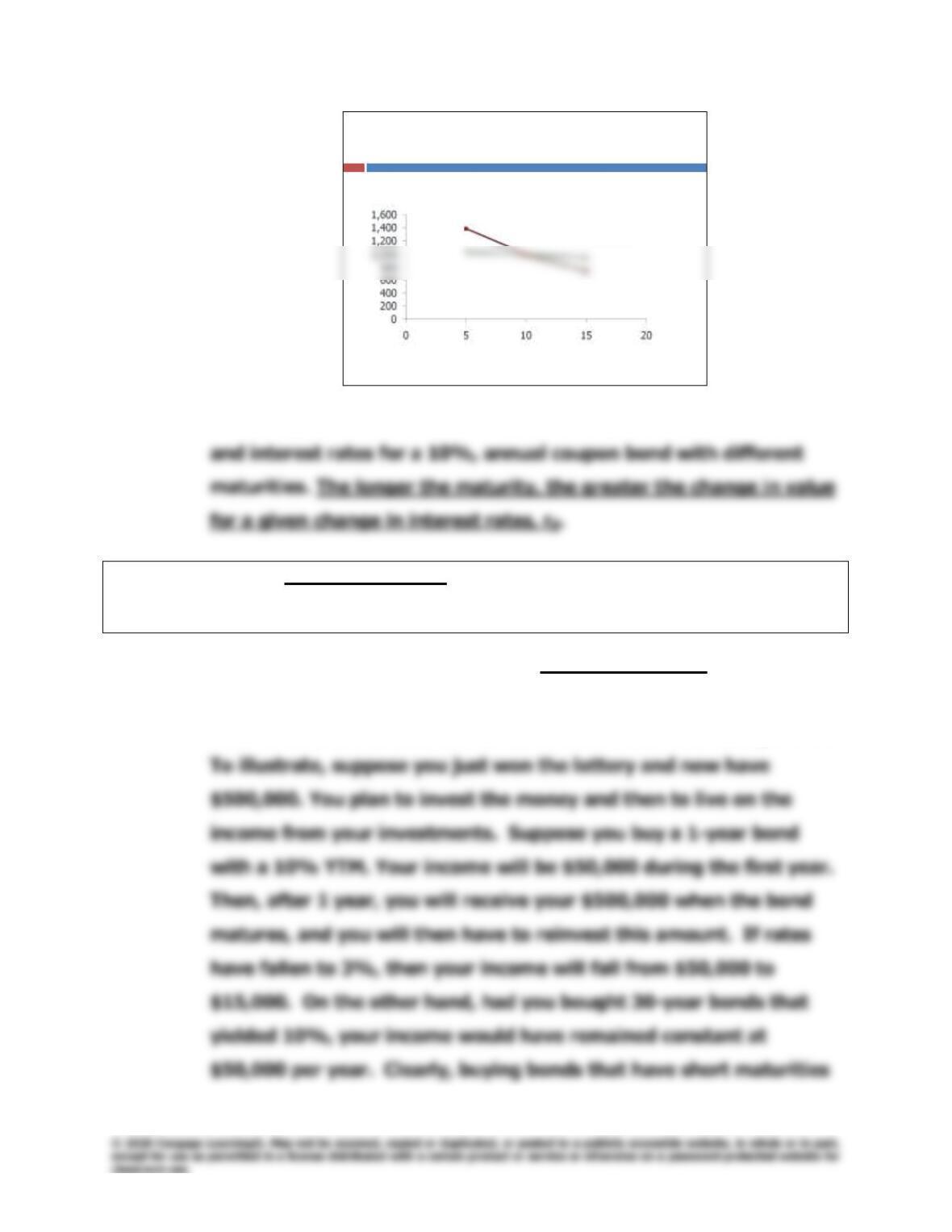
Chapter 7: Bonds and Their Valuation
Integrated Case
177
©2012 Cengage Learning. All Rights Reserved. May not be scanned, copied, or duplicated, or posted to a publicly accessible website, in whole or in part.
Illustrating Price Risk
10-Year Bond
1-Year Bond
Value ($)
YTM(%)
The graph above shows the relationship between bond values
H. What is reinvestment risk? Which has more reinvestment risk, a
1-year bond or a 10-year bond?
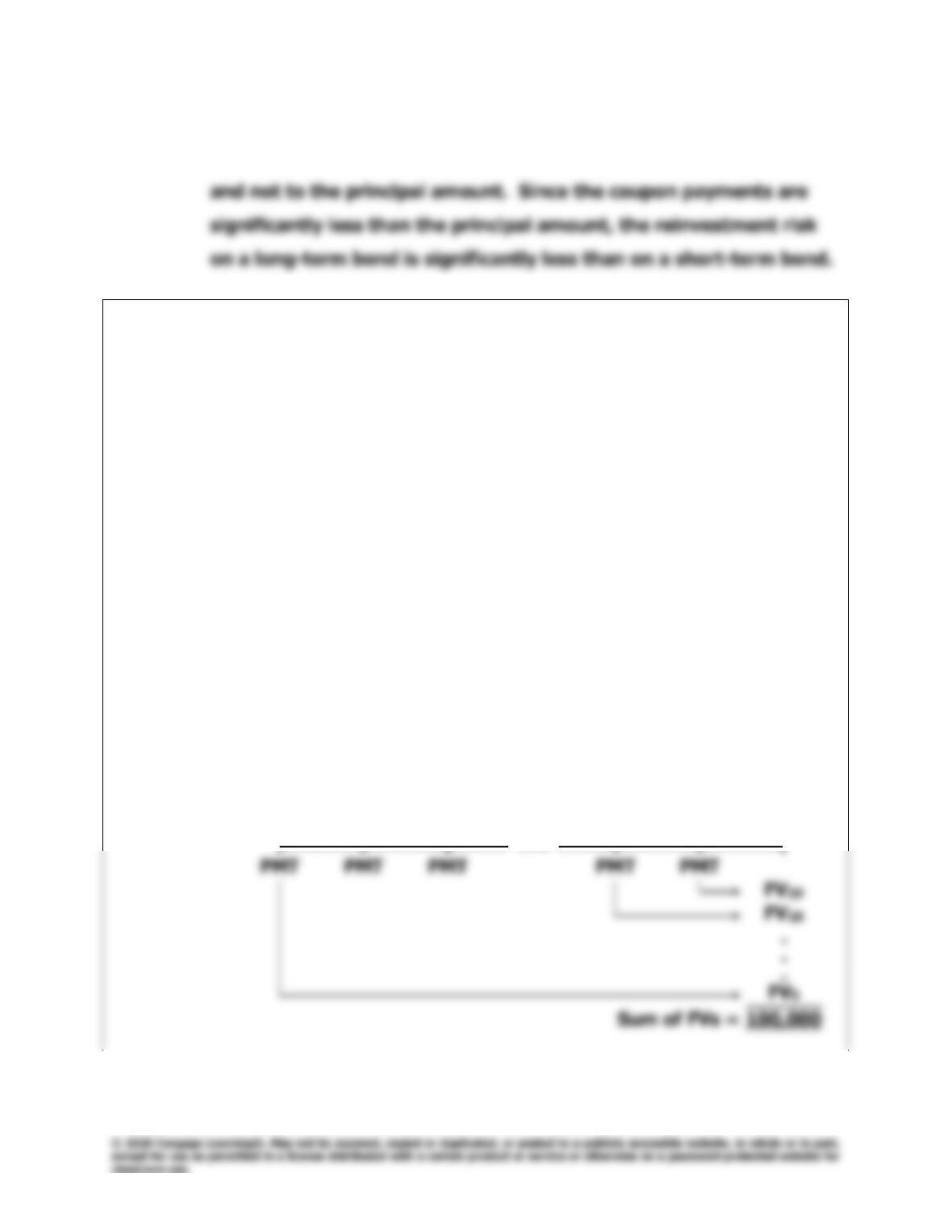
Answer: [Show S7-25 through S7-27 here.] Reinvestment risk is defined as
the risk that cash flows (interest plus principal repayments) will
have to be reinvested in the future at rates lower than today’s rate.
178
Integrated Case
Chapter 7: Bonds and Their Valuation
carries reinvestment risk. Note that long-term bonds also have
reinvestment risk, but the risk applies only to the coupon payments,
Optional Question
Suppose a firm will need $100,000 20 years from now to replace some
equipment. It plans to make 20 equal payments, starting today, into an
investment fund. It can buy bonds that mature in 20 years or bonds that
mature in 1 year. Both types of bonds currently sell to yield 10%, i.e., rd =
YTM = 10%. The company’s best estimate of future interest rates is that they
will stay at current levels, i.e., they may rise, or they may fall, but the
expected rd is the current rd.
There is some chance that the equipment will wear out in less than 20
years, in which case the company will need to cash out its investment before
20 years. If this occurs, the company will desperately need the money that has
been accumulated—this money could save the business. How much should
the firm plan to invest each year?
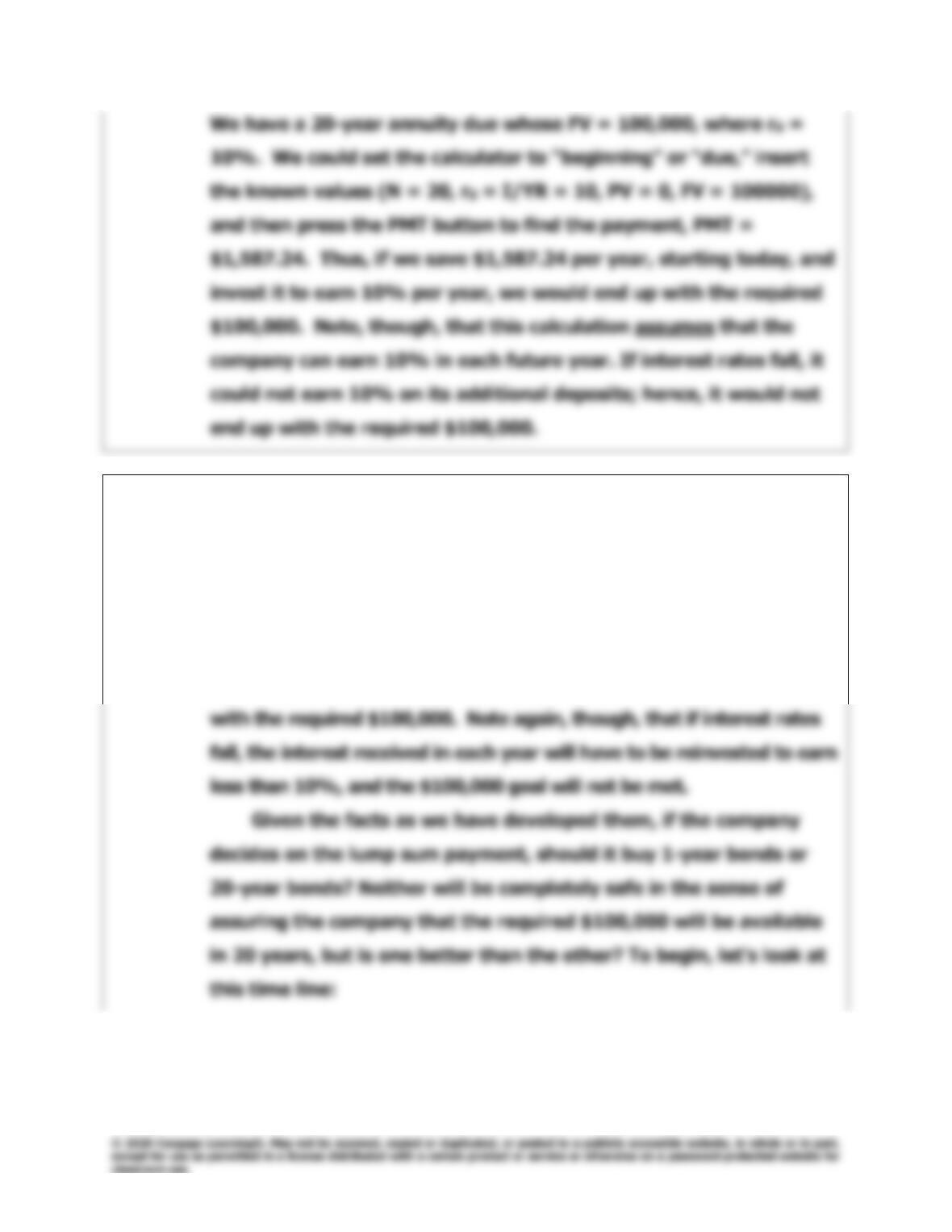
Answer: Start with a time line:
0 1 2 18 19 20
| | | • • • | | |
10%
Chapter 7: Bonds and Their Valuation
Integrated Case
179
Optional Question
If the company decides to invest enough right now to produce the future
$100,000, how much is its outlay?
Answer: To find the required initial lump sum, we would find the PV of $100,000
discounted back for 20 years at 10%: PV = $14,864.36. If the
company invested this amount now and earned 10%, it would end up
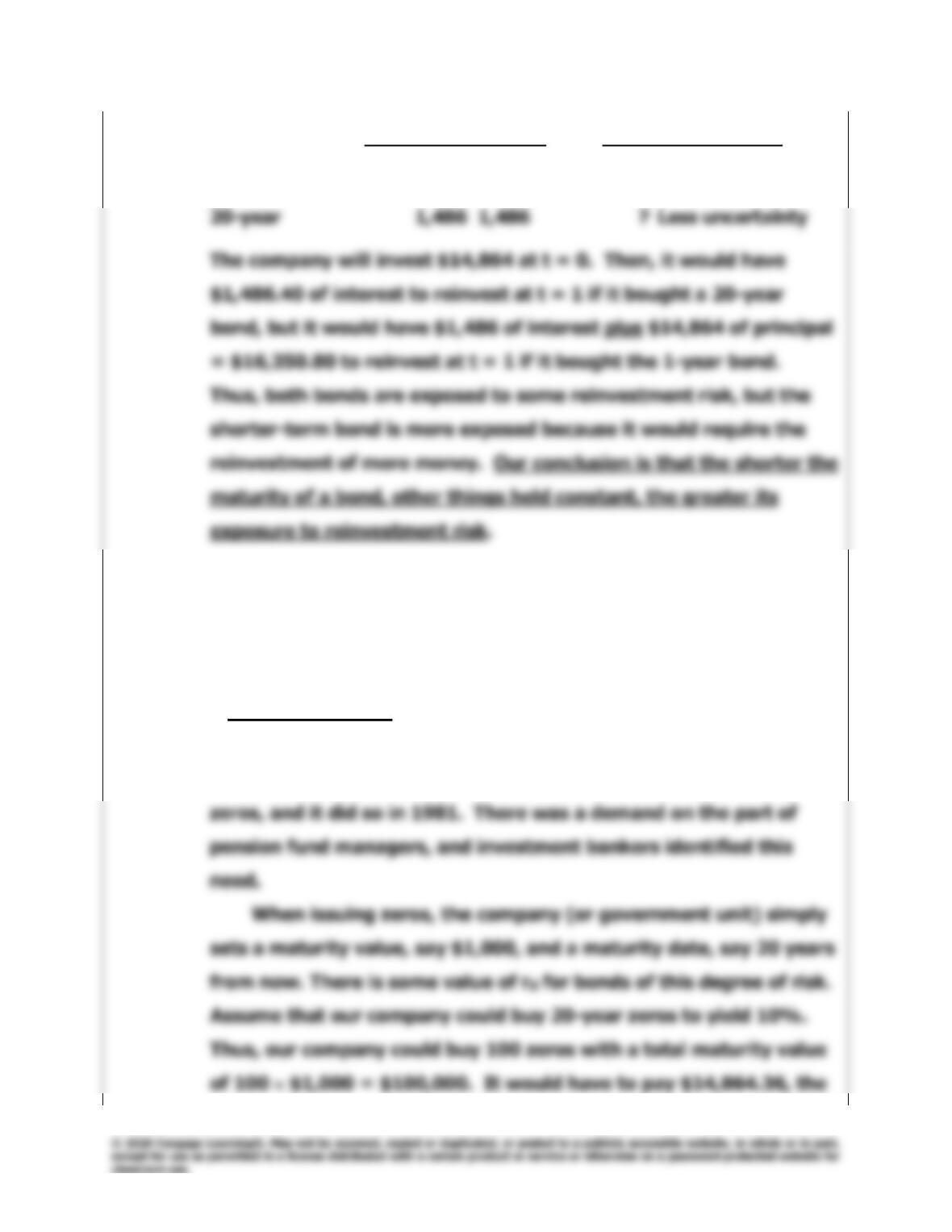
180
Integrated Case
Chapter 7: Bonds and Their Valuation
0 1 2 18 19 20
| | | • • • | | |
14,864.36 100,000
1-year 16,351 ? ? Greater uncertainty
Optional Question
Can you think of any other type of bond that might be useful for this
company’s purposes?
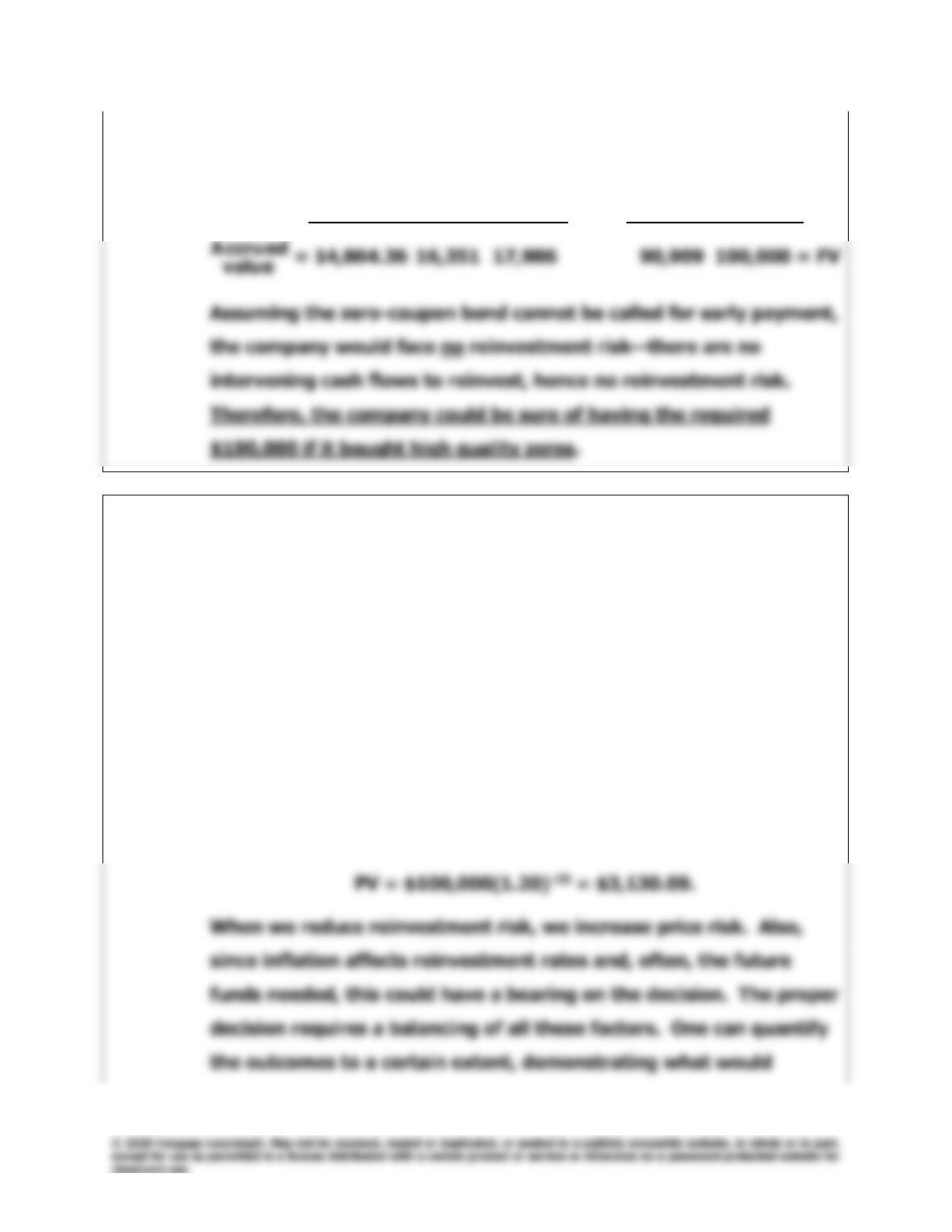
Answer: A zero coupon bond is one that pays no interest—it has zero
coupons, and its issuer simply promises to pay a stated lump sum at
some future date. J.C. Penney was the first major company to issue
10%
Chapter 7: Bonds and Their Valuation
Integrated Case
181
PV of $100,000 discounted back 20 years at 10%. Here is the
relevant time line:
0 1 2 19 20
| | | • • • | |
Optional Question
What type of bond would you recommend that it actually buy?
Answer: It is tempting to say that the best investment for this company
would be the zeros, because they have no reinvestment risk. But
suppose the company needed to liquidate its bond portfolio in less
than 20 years; could that affect the decision? The answer is “yes.”
If 1-year bonds were purchased, an increase in interest rates would
not cause much of a drop in the value of the bonds, but if interest
rates rose to 20% the year after the purchase, the value of the
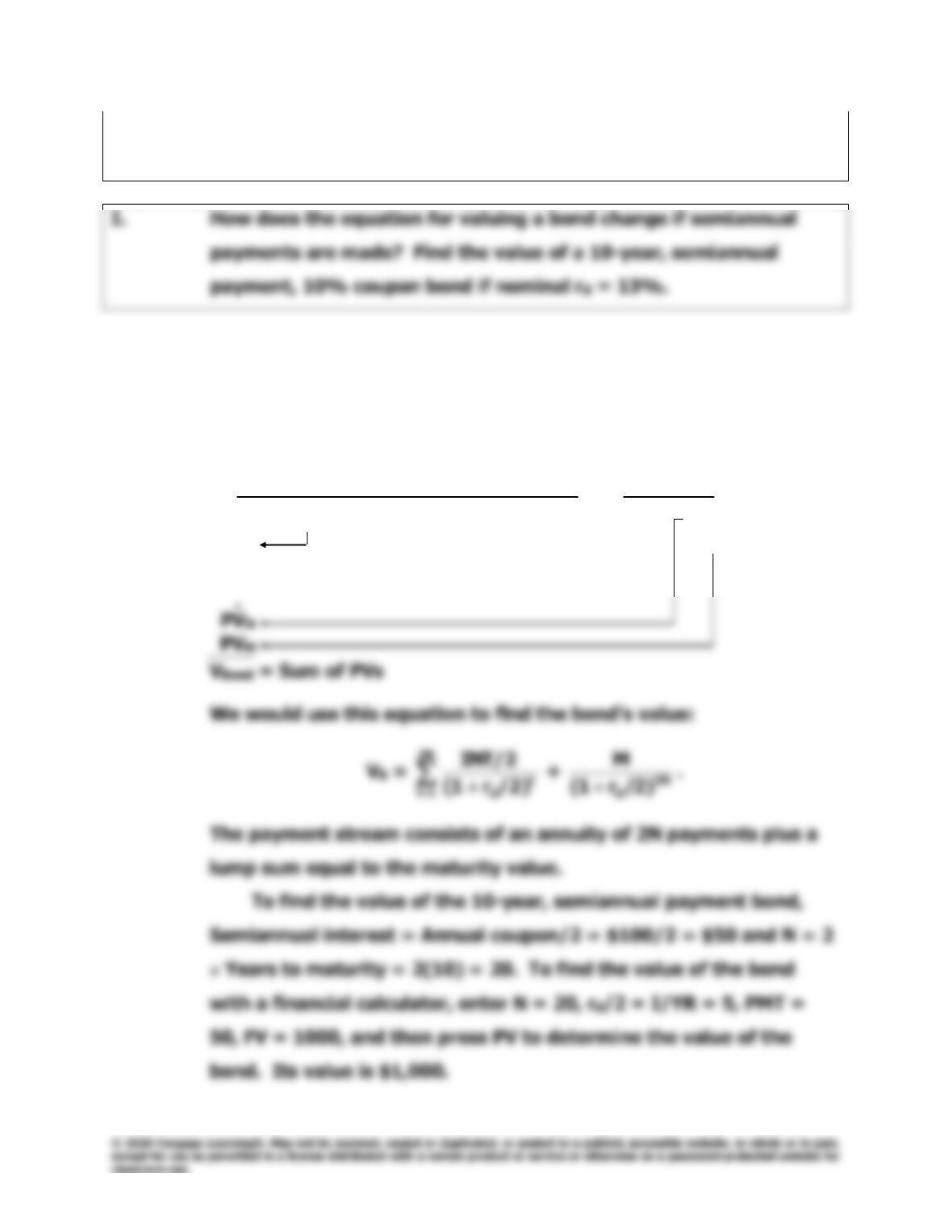
zeros would fall from the initial $14,864 to:
10%
182
Integrated Case
Chapter 7: Bonds and Their Valuation
happen under different conditions, but, in the end, a decision
involving judgment must be made.
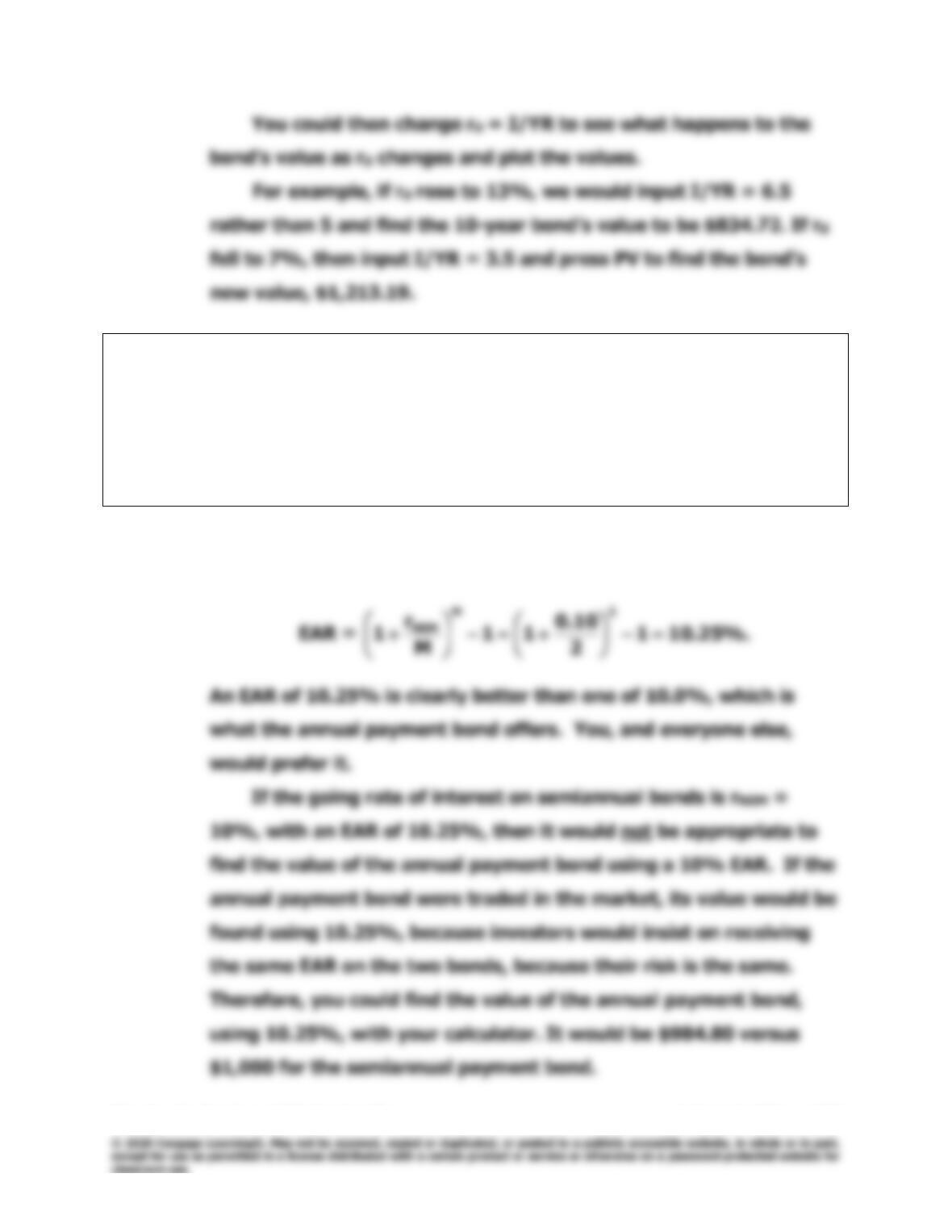
Answer: [Show S7-28 and S7-29 here.] In reality, virtually all bonds issued
in the U.S. have semiannual coupons and are valued using the setup
shown below:
1 2 N Years
0 1 2 3 4 2N – 1 2N SA periods
| | | | | • • • | |
INT/2 INT/2 INT/2 INT/2 INT/2 INT/2
PV1 M
.
.
Chapter 7: Bonds and Their Valuation
Integrated Case
183
J. Suppose for $1,000 you could buy a 10%, 10-year, annual payment
bond or a 10%, 10-year, semiannual payment bond. They are
equally risky. Which would you prefer? If $1,000 is the proper
price for the semiannual bond, what is the equilibrium price for the
annual payment bond?
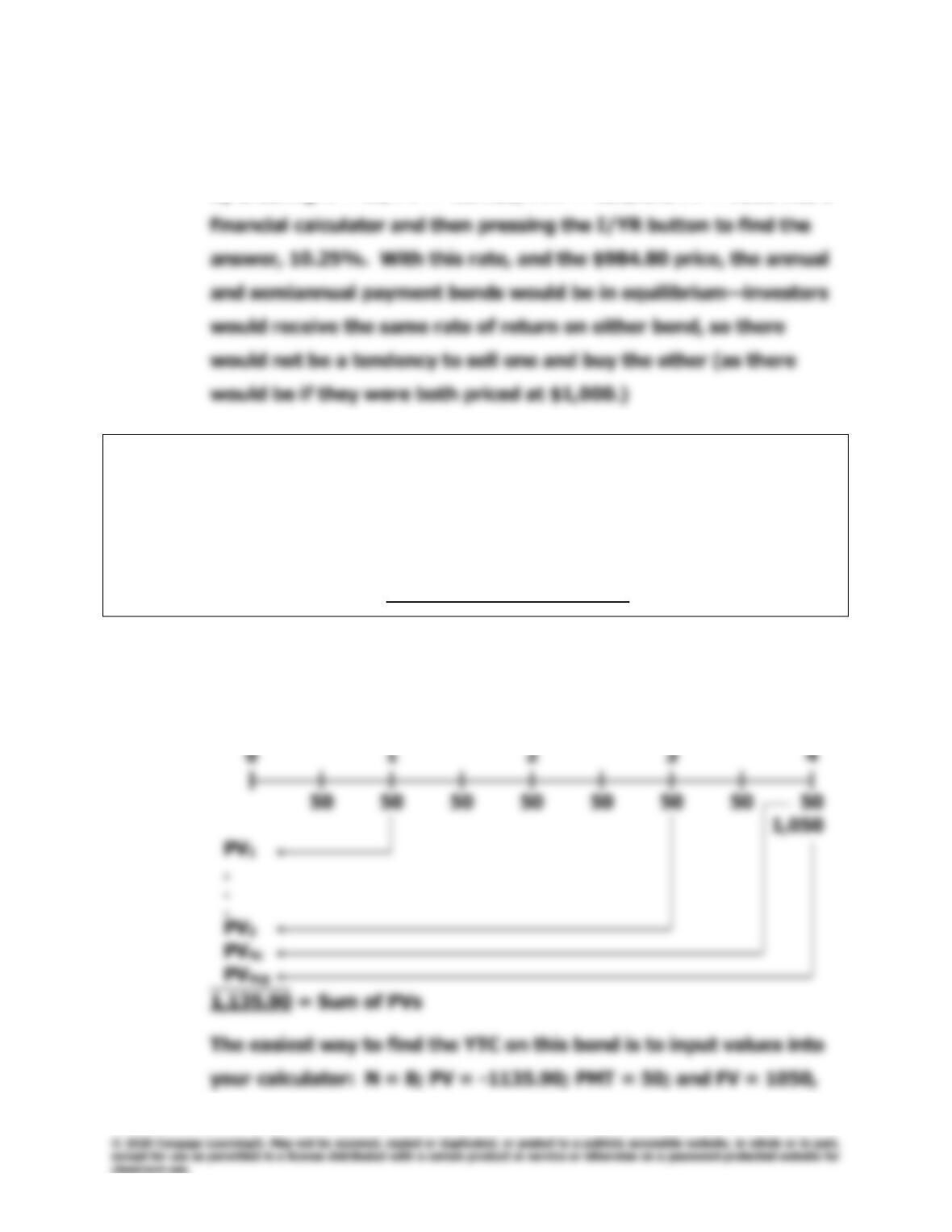
Answer: [Show S7-30 and S7-31 here.] The semiannual payment bond
would be better. Its EAR would be:
184
Integrated Case
Chapter 7: Bonds and Their Valuation
Note that, if the annual payment bond were selling for $984.80
in the market, its EAR would be 10.25%. This value can be found
by entering N = 10, PV = -984.80, PMT = 100, and FV = 1000 into a
K. Suppose a 10-year, 10%, semiannual coupon bond with a par value
of $1,000 is currently selling for $1,135.90, producing a nominal
yield to maturity of 8%. However, it can be called after 4 years for
$1,050.
(1) What is the bond’s nominal yield to call (YTC)?
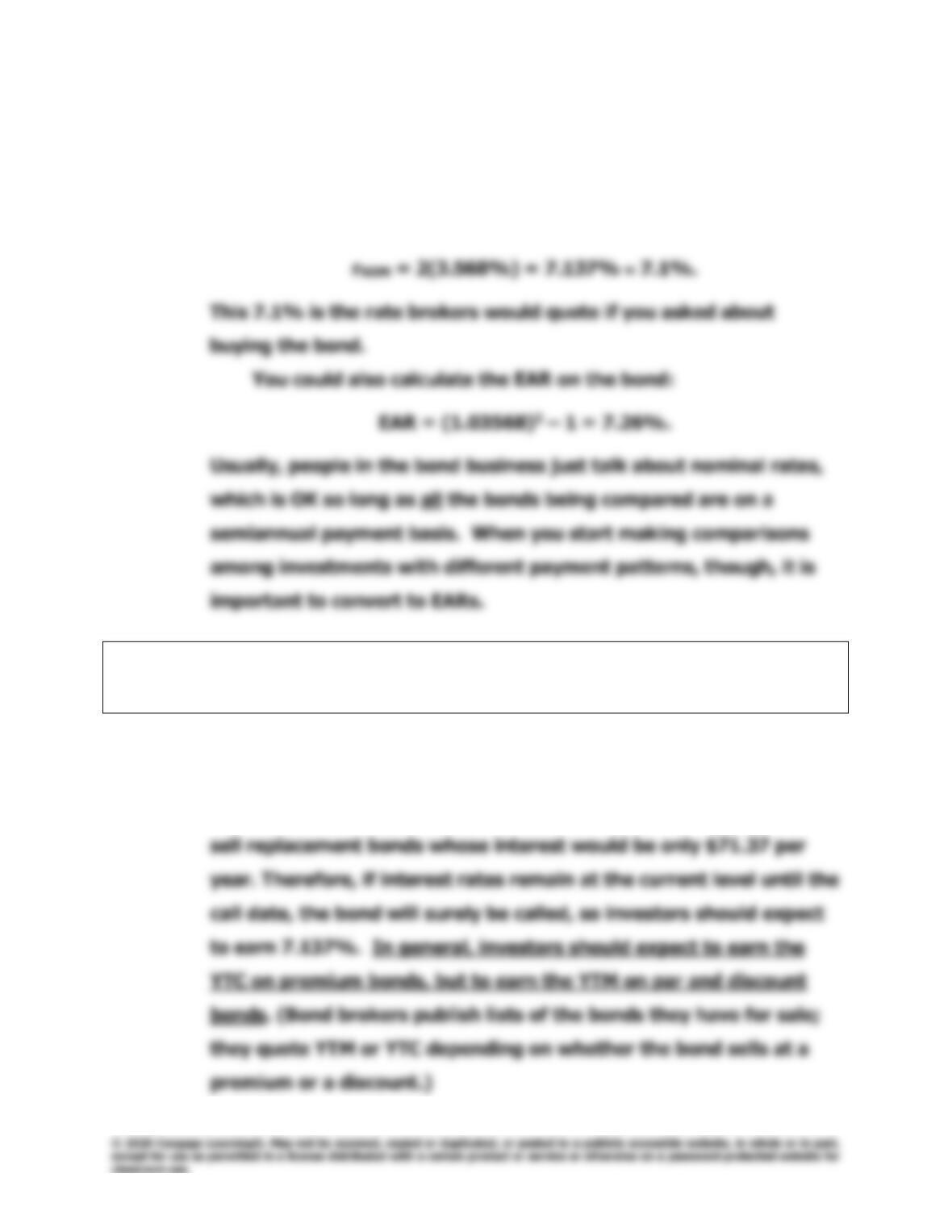
Answer: [Show S7-32 and S7-33 here.] If the bond were called,
bondholders would receive $1,050 at the end of Year 4. Thus, the
time line would look like this:
Chapter 7: Bonds and Their Valuation
Integrated Case
185
which is the par value plus a call premium of $50; and then press
the I/YR button to find I/YR = 3.568%. However, this is the 6-
month rate, so we would find the nominal rate on the bond as
follows:
K. (2) If you bought this bond, would you be more likely to earn the YTM
or the YTC? Why?
Answer: [Show S7-34 and S7-35 here.] Since the coupon rate is 10% versus
YTC = rd = 7.137%, it would pay the company to call the bond, to
get rid of the obligation of paying $100 per year in interest, and to
186
Integrated Case
Chapter 7: Bonds and Their Valuation
L. Does the yield to maturity represent the promised or expected
return on the bond? Explain.
Answer: [Show S7-36 here.] The yield to maturity is the rate of return
earned on a bond if it is held to maturity. It can be viewed as the
M. These bonds were rated AA– by S&P. Would you consider them
investment-grade or junk bonds?
Answer: [Show S7-37 here.] These bonds would be investment-grade bonds.
Triple-A, double-A, single-A, and triple-B bonds are considered
N. What factors determine a company’s bond rating?
Answer: [Show S7-38 and S7-39 here.] Bond ratings are based on both
qualitative and quantitative factors, some of which are listed below.
Chapter 7: Bonds and Their Valuation
Integrated Case
187
2. Qualitative factors—bond contract terms:
a. Secured vs. unsecured debt
3. Miscellaneous qualitative factors:
a. Earnings stability
b. Regulatory environment
O. If this firm were to default on the bonds, would the company be
immediately liquidated? Would the bondholders be assured of
receiving all of their promised payments? Explain.
Answer: [Show S7-40 through S7-43 here.] When a business becomes
insolvent, it does not have enough cash to meet scheduled interest
and principal payments. A decision must then be made whether to
may call for a restructuring of the firm’s debt, in which case the
interest rate may be reduced, the term to maturity lengthened, or
If the firm is deemed to be too far gone to be saved, it will be
liquidated and the priority of claims (as seen in Web Appendix 7C)
would be as follows:
1. Secured creditors.
3. Expenses incurred after bankruptcy was filed.
5. Claims for unpaid contributions to employee benefit plans.
7. Federal, state, and local taxes.
9. General unsecured creditors.
11. Common stockholders, if anything is left.
If the firm’s assets are worth more “alive” than “dead,” the