352
Integrated Case
Chapter 12: Cash Flow Estimation and Risk Analysis
parties influence the firm’s profitability, a project’s within-firm risk
should not be completely ignored.
E. (3) Which type is easiest to measure?
Answer: [Show S12-21 here.] By far the easiest type of risk to measure is a
project’s stand-alone risk. Thus, firms often focus primarily on this
E. (4) Are the three types of risk generally highly correlated?
Answer: [Show S12-22 here.] Because most projects that a firm undertakes
are in its core business, a project’s stand-alone risk is likely to be
F. (1) What is sensitivity analysis?
Answer: [Show S12-23 here.] Sensitivity analysis measures the effect of
changes in a particular variable, say revenues, on a project’s NPV. To
perform a sensitivity analysis, all variables are fixed at their expected
Chapter 12: Cash Flow Estimation and Risk Analysis
Integrated Case
353
F. (2) How would you perform a sensitivity analysis on the unit sales,
salvage value, and WACC for the project? Assume that each of these
variables deviates from its base-case, or expected, value by plus or
minus 10%, 20%, and 30%. Explain how you would calculate the
NPV, IRR, MIRR, and payback for each case, but don’t do the analysis
unless your instructor asks you to.
Answer: The base case value for unit sales was 100; therefore, if you were to
assume that this value deviated by plus and minus 10%, 20%, and
30%, the unit sales values to be used in the sensitivity analysis would
Excel
is ideally suited for sensitivity analysis. In fact we created
a spreadsheet to obtain this project’s cash flows and its NPV, IRR,
354
Integrated Case
Chapter 12: Cash Flow Estimation and Risk Analysis
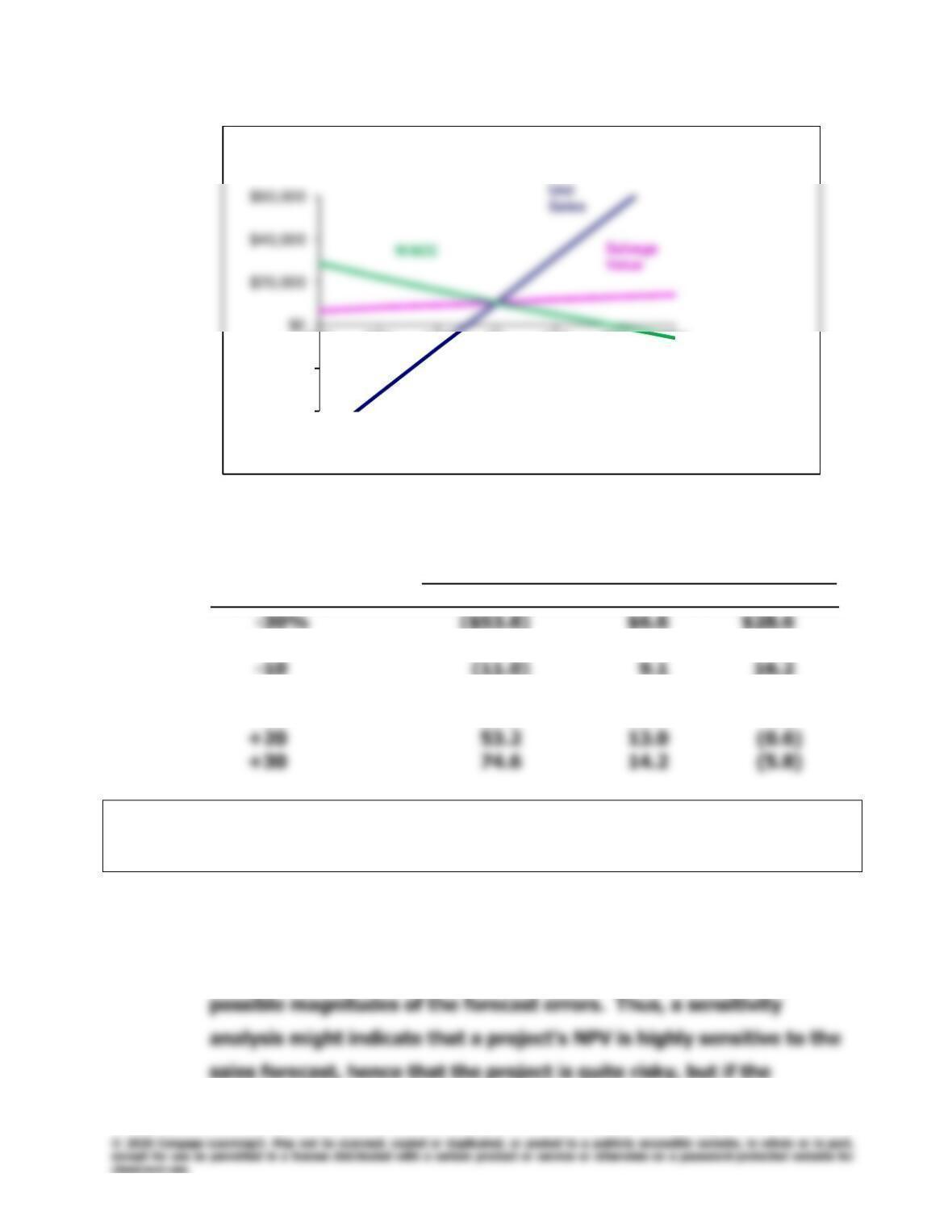
We generated these data with a spreadsheet model.
1. The sensitivity lines intersect at 0% change and the base case
2. The plots for unit sales and salvage value are upward sloping,
3. The plot of unit sales is much steeper than that for salvage
4. Steeper sensitivity lines indicate greater risk. Thus, in
comparing two projects, the one with the steeper lines is riskier.
Chapter 12: Cash Flow Estimation and Risk Analysis
Integrated Case
355
–$40,000
–$20,000
–30% –20% -10% 0% 10% 20% 30%
NPV
Deviation from base case
Sensitivity analysis
The sensitivity data are given here in tabular form (in thousands of
dollars):
Change from Resulting NPV after the Indicated Change in:
Base Level Unit Sales Salvage Value WACC
–20 (32.4) 7.8 22.3
0 10.4 10.4 10.4
+10 31.8 11.7 4.8
F. (3) What is the primary weakness of sensitivity analysis? What are its
primary advantages?
Answer: [Show S12-24 here.] The two primary disadvantages of sensitivity
analysis are (1) that it does not reflect the effects of diversification
and (2) that it does not incorporate any information about the
356
Integrated Case
Chapter 12: Cash Flow Estimation and Risk Analysis
project’s sales, hence its revenues, are fixed by a long-term contract,
then sales variations may actually contribute little to the project’s
risk.
G. Assume that inflation is expected to average 5% over the next 4
years and that this expectation is reflected in the WACC. Moreover,
inflation is expected to increase revenues and variable costs by this
same 5%. Does it appear that inflation has been dealt with properly
in the initial analysis to this point? If not, what should be done and
how would the required adjustment affect the decision?
Answer: [Show S12–25 through S12-27 here.] It is apparent from the data in
the previous table that inflation has not been reflected in the
calculations. In particular, the sales price is held constant rather
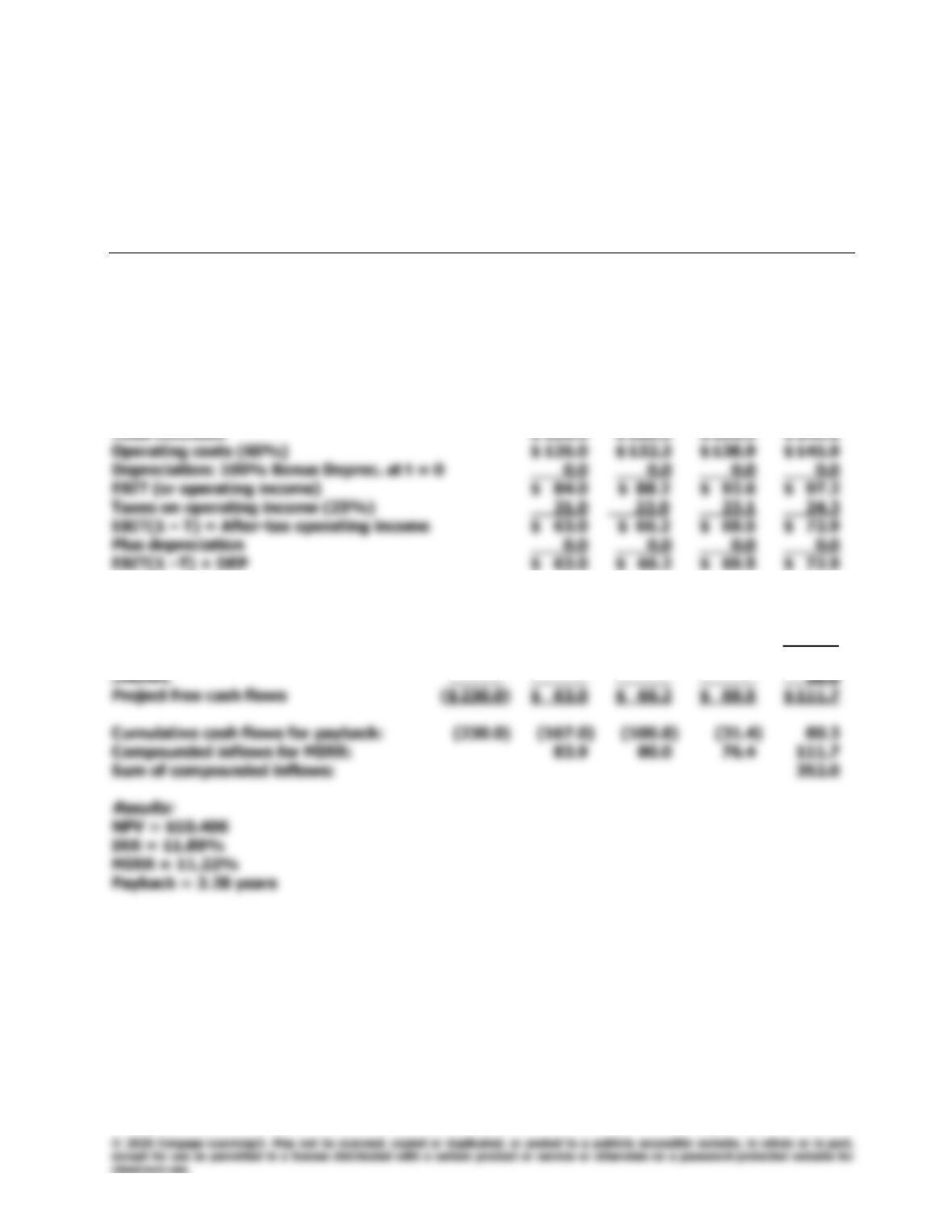
Chapter 12: Cash Flow Estimation and Risk Analysis
Integrated Case
357
Table IC 12.2. Allied’s Lemon Juice Project Considering 5% Inflation
(in Thousands)
Inputs: Price: $2.00 WACC: 10% Infl: 5.0%
VC rate: 60.0% T-rate: 25%
End of Year: 0 1 2 3 4
Investment Outlays:
CAPEX × (1 – T) ($210)
NOWC (20)
Project Operating Cash Flows:
Unit sales (thousands) 100 100 100 100
Sales price (dollars) $ 2.10 $ 2.205 $ 2.315 $ 2.431
Terminal Cash Flows:
Salvage value 25.0
Tax on salvage value (40%) 6.2
After-tax salvage value 18.8

358
Integrated Case
Chapter 12: Cash Flow Estimation and Risk Analysis
H. The expected cash flows, considering inflation (in thousands of dollars),
are given in Table IC 12.2. Allied’s WACC is 10%. Assume that you are
confident about the estimates of all the variables that affect the cash
flows except unit sales. If product acceptance is poor, sales would be
only 75,000 units a year, while a strong consumer response would
produce sales of 125,000 units. In either case, cash costs would still
amount to 60% of revenues. You believe that there is a 25% chance of
poor acceptance, a 25% chance of excellent acceptance, and a 50%
chance of average acceptance (the base case). Provide numbers only if
you are using a computer model.
(1) What is the worst-case NPV? The best-case NPV?
Answer: [Show S12-28 and S12-29 here.] We used a spreadsheet model to
develop the scenarios (in thousands of dollars), which are
summarized below:
Case Probability NPV (000s)
Worst 0.25 ($43.1)
H. (2) Use the worst-case, most likely case (or base-case), and best-case
NPVs with their probabilities of occurrence, to find the project’s
expected NPV, standard deviation, and coefficient of variation.
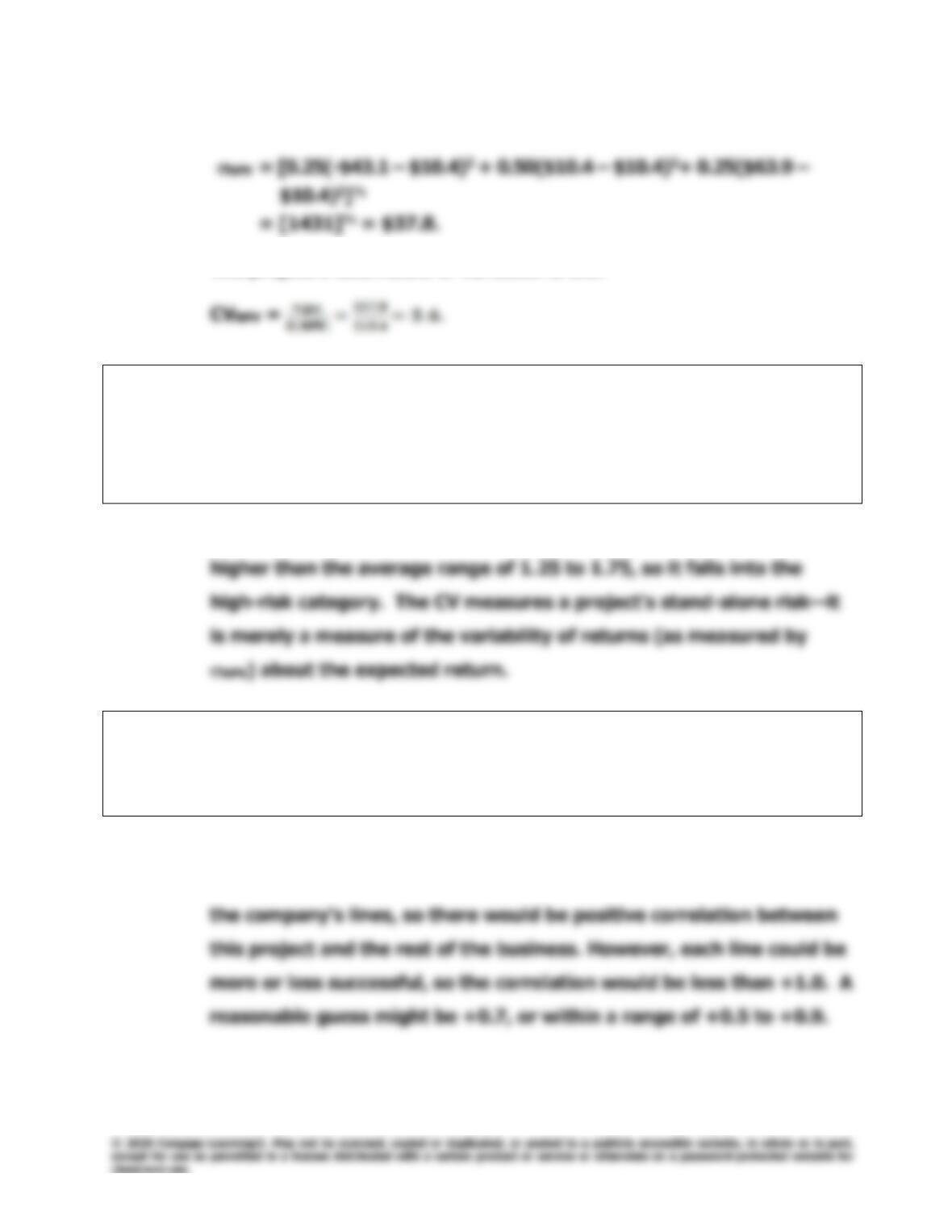
Answer: [Show S12-30 here.] The expected NPV is $10,406 (expressed in
thousands of dollars below).
Chapter 12: Cash Flow Estimation and Risk Analysis
Integrated Case
359
The standard deviation of NPV is $37.8:
The project‘s coefficient of variation is 3.6:
I. Assume that Allied’s average project has a coefficient of variation
(CV) in the range of 1.25 to 1.75. Would the lemon juice project be
classified as high risk, average risk, or low risk? What type of risk is
being measured here?
Answer: [Show S12-31 here.] The project has a CV of 3.6, which is much
J. Based on common sense, how highly correlated do you think the
project would be with the firm’s other assets? (Give a correlation
coefficient or range of coefficients, based on your judgment.)
Answer: It is reasonable to assume that if the economy is strong and people
are buying a lot of lemon juice, then sales would be strong in all of
360
Integrated Case
Chapter 12: Cash Flow Estimation and Risk Analysis
K. How would the correlation coefficient and the previously calculated
combine to affect the project‘s contribution to corporate, or within-
firm, risk? Explain.
Answer: [Show S12-32 here.] If the project’s cash flows are likely to be
highly correlated with the firm’s aggregate cash flows, which is
generally a reasonable assumption, then the project would have high
L. Based on your judgment, what do you think the project‘s correlation
coefficient would be with respect to the general economy and thus
with returns on “the market”? How would correlation with the
economy affect the project’s market risk?
Answer: [Show S12-33 here.] In all likelihood, this project would have a
positive correlation with returns on other assets in the economy, and
Chapter 12: Cash Flow Estimation and Risk Analysis
Integrated Case
361
M. Allied typically adds or subtracts 4% to its WACC to adjust for risk.
After adjusting for risk, should the lemon juice project be accepted?
Should any subjective risk factors be considered before the final
decision is made? Explain.
Answer: [Show S12-34 through S12-35 here.] Since the project is judged to
have above-average risk, its differential risk-adjusted, or project,
cost of capital would be 14%. At this discount rate, its NPV would be
N. In recent months, Allied’s group has begun to focus on real option
analysis.
(1) What is real option analysis?
Answer: [Show S12-36 here.] DCF techniques were originally developed to
value securities such as stocks and bonds, which are passive
362
Integrated Case
Chapter 12: Cash Flow Estimation and Risk Analysis
N. (2) What are some examples of projects with embedded real options?
Answer: [Show S12-37 through S12-43 here.] There are several types of real
options. These include:
a. Abandonment: A project can be shut down if its cash flows are
low.