
CHAPTER 12: KEYNESIAN BUSINESS CYCLE ANALYSIS:
NON–MARKET–CLEARING MACROECONOMICS
LEARNING OBJECTIVES
I. Goals of Chapter 12
A. Present the central ideas of Keynesian macroeconomics
1. Wages and prices are rigid or “sticky” and do not adjust quickly to
restore general equilibrium
2. The economy may be in disequilibrium for long periods of time
TEACHING NOTES
I. Nominal-Wage Rigidity (Sec. 12.1)
A. The Keynesian model of nominal wage rigidity suggests that nominal wages
are slow to adjust to changes in the labour market conditions because firms
and workers sign nominal wage contracts
1. The labour contracts specify the nominal wage and not the real wage
2. The contracts specify employment conditions and nominal wages for
contract
B. The short-run aggregate supply
curve with labour contracts
1. Canadian labour contracts
usually specify employment
conditions and the nominal

220 Chapter 12
c. The positive relationship between output supplied and the price
level resulting from the nominal wage contracts is captured by
equation
C. Price expectations and the Keynesian short-run aggregate supply curve
1. Equation (12.1) implies that there is different SRAS for every expected
price level
2. The is so because
a. The need to sign a contract that commits them to a nominal
wage for a number of years into the future, firms and workers
must form an expectation of what they believe will be the level
Theoretical Application
The idea that nominal wage contracts lead to a fixed nominal wage in a theoretical
Keynesian model was developed by Stanley Fischer, “Long-Term Contracts, Rational
Expectations, and the Optimal Money Supply Rule,” Journal of Political Economy,
February 1977, pp. 191–205, and John B. Taylor, “Aggregate Dynamics and Staggered
Keynesian Business Cycle Analysis: Non–Market–Clearing Macroeconomics 221
II. Monetary and Fiscal Policy in the Keynesian Model (Sec. 12.2)
A. Monetary policy
1. The Keynesian model
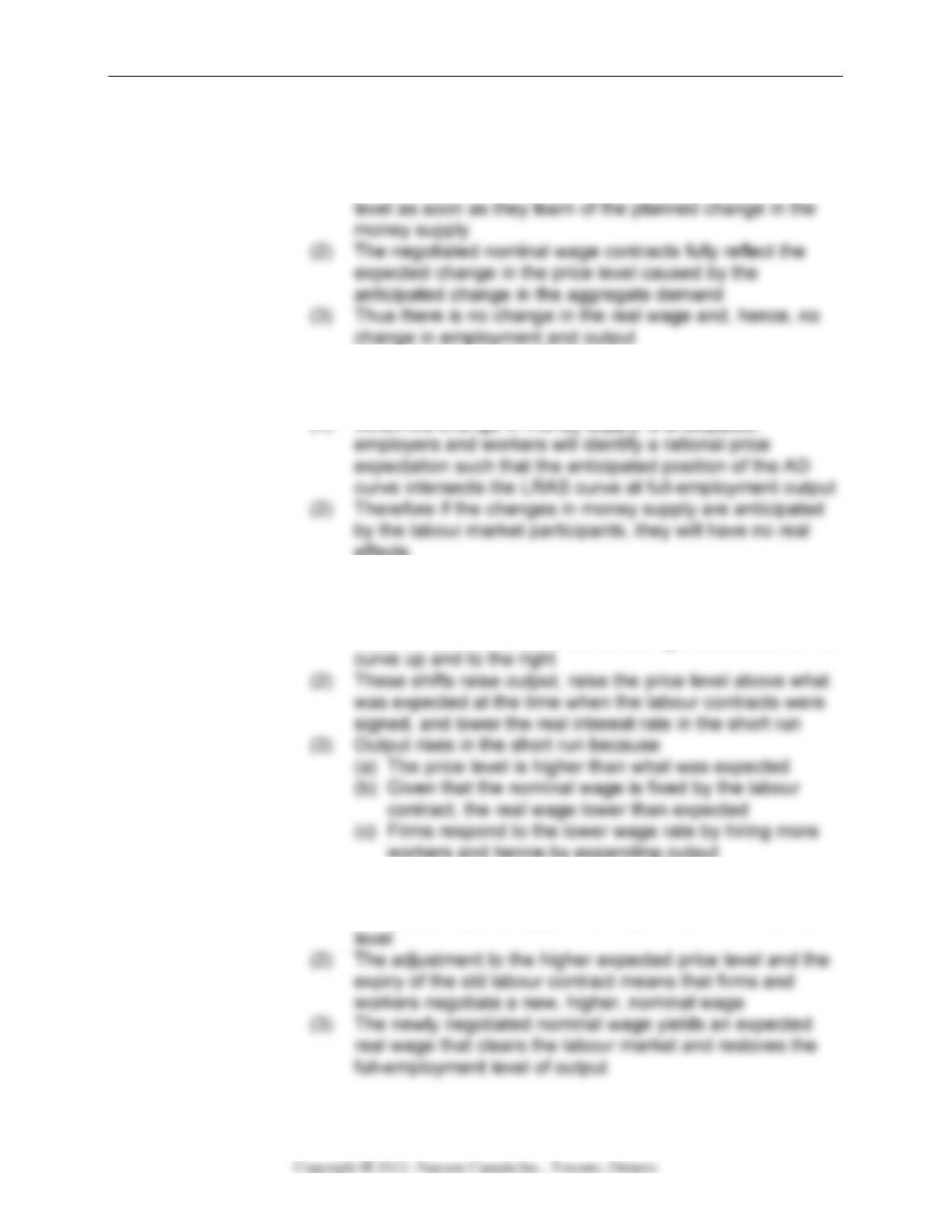
a. The short-run equilibrium
(1) The equilibrium
output in the short-run
is determined at the in-
b. The long-run equilibrium
(1) In the long-run, old
wage contracts expire
and the nominal wage is
renegotiated on the
(3) The adjustment of
the expected price level causes the LM and SRAS curves to
restore the general equilibrium with full-employment output
(4) The equilibrium output in the long-run, then, is determined
at the intersection of the IS and LM curves and the FE line in the
IS–LM diagram, and the AD, SRAS, and LRAS curves in the AD-
AS diagram
Numerical Problem 2 and Analytical Problems 1 and 2 use the IS–LM and AD-AS
diagram
222 Chapter 12
2. Anticipated monetary policy
a. Anticipated changes in money supply have no effect on real
variables
(1) Labour market participants adjust their expected price
b. In terms of the IS–LM and AD-AS diagram, the position of the
LM curve and, hence, the position of the AD curve is
determined by the anticipated level of the money supply
(1) When the change in money supply is anticipated,
effects
3. Unanticipated monetary policy
a. Short-run effects
(1) An unanticipated increase in the nominal money supply
shifts the LM curve down and to the right and shifts the AD
workers and hence by expanding output
b. Long-run effects
(1) Eventually the labour contract expires and the labour
market participants adjust their expectations of the price

Keynesian Business Cycle Analysis: Non–Market–Clearing Macroeconomics 223
c. Thus, the Keynesian model of nominal wage rigidity predicts
that money is not neutral in the short run but is neutral in the
long run
Theoretical Application
Some Keynesians disagree with the view presented in the textbook that a change in
monetary policy has no effect on the long-run aggregate supply curve. J. Bradford
B. Fiscal policy
1. The effects of anticipated and
2. Anticipated fiscal policies
a. An anticipated fiscal
policy will cause labour
market participants to
adjust their
expectations of the

224 Chapter 12
3. Unanticipated fiscal policies
a. The short-run effects
(1) An unanticipated increase in government spending or a
b. The long-run effects
(1) Firms and workers adjust their expectations of the price
level
purchases
4. The effect of lower taxes
a. Keynesians believe that a reduction of (lump-sum) taxes is
expansionary, just like an increase in government purchases
b. Keynesians reject Ricardian equivalence, believing that the
C. Comparing fiscal and monetary policy in the Keynesian model
1. Fiscal and monetary policies are both referred to as aggregate
demand policies because both policies affect the position of the
aggregate demand curve
2. Anticipated fiscal and monetary policies have no effect on the real
Numerical Problem 3 looks at fiscal policy and monetary policy in the Keynesian AD-AS
framework.
Keynesian Business Cycle Analysis: Non–Market–Clearing Macroeconomics 225
III. Criticisms of the Nominal-Wage Rigidity Assumption (Sec. 12.3)
A. There have been several objections to the Keynesian theory of nominal wage
rigidity
1. Less than one-third of the Canadian labour force is unionized and
covered by long-term wage contracts; however, some nonunion
workers get wages similar to those in union contracts, and other
IV. Price Stickiness (Sec. 12.4)
A. Price stickiness is the tendency of prices to adjust slowly to changes in the
economy
1. Keynesians developed the nominal price rigidity model to explain the
run but are neutral in the long run
B. Sources of price stickiness: Monopolistic competition and menu costs
1. Monopolistic competition
a. If markets had perfect competition, the market would force
prices to adjust rapidly; sellers are price takers, because they
must accept the market price
d. In monopolistically competitive markets, sellers do three things
(1) They set prices in nominal terms and maintain those prices
for some period
(2) They adjust output to meet the demand at their fixed
nominal price
226 Chapter 12
(2) Even small costs like these may prevent sellers from
changing prices often
Theoretical Application
One of the first articles to present the combination of monopolistic competition and
menu costs as the cause of price stickiness was N. Gregory Mankiw, “Small Menu
Costs and Large Business Cycles: A Macroeconomic Model of Monopoly,” Quarterly
Journal of Economics, May 1985. pp. 529–537.
f. Empirical evidence on price stickiness
(1) Industrial prices seem to be changed more often in
competitive industries, less often in more monopolistic
industries (Carlton study)
(2) Consumer prices also seem sticky (Cecchetti study of
magazine prices)
adjustments among interviewed firms
g. Meeting the demand at the fixed nominal price
(1) Since firms have some monopoly power, they price goods
at a markup over their marginal cost of production:
P = (1 + η)MC (12.3)
Theoretical Application
The major articles underlying Keynesian theory are collected in the volume New Keynesian
Economics, edited by N, Gregory Mankiw and David Romer, Cambridge, Massachusetts: MIT

Keynesian Business Cycle Analysis: Non–Market–Clearing Macroeconomics 227
(4) This means that the economy can produce an amount of
output that is not on the FE line during the period in which
prices haven’t adjusted
V. The Keynesian Theory of Business Cycles and Macroeconomic Stabilization (Sec.
12.5)
A. Keynesian business cycle theory
1. Keynesians think aggregate demand shocks are the primary source of
business cycle fluctuations
2. Aggregate demand shocks are shocks to the IS or LM curves, such as
4. The Keynesian theory fits certain business cycle facts
a. There are recurrent fluctuations in output
(1) This is explained by the Keynesian model if shocks to
investment and durable goods spending are a main source
of business cycles
(2) Keynes believed in “animal spirits,” waves of pessimism
economy moves toward general equilibrium
5. Procyclical labour productivity and labour hoarding
a. As discussed in Section 11.1, firms may hoard labour in a
recession rather than fire workers, because of the costs of hiring
D. Macroeconomic stabilization
1. Keynesians (except some new Keynesians) favour government actions
to stabilize the economy
2. Recessions are undesirable because the unemployed are hurt
Theoretical Application
Several prominent macroeconomists discuss their views of the Keynesian model of
business cycles in a symposium in the Journal of Economic Perspectives, Winter 1993.

228 Chapter 12
3. Suppose there’s a shock that shifts the IS curve down, causing a
recession (text Fig. 12.4)
a. If the government does nothing, eventually the price level will
4. Using monetary or fiscal policy to restore general equilibrium has the
advantage of acting quickly, rather than waiting some time for the price
level to decline
5. But the price level is higher in the long run when using policy than it
would be if the government took no action
6. a. The choice of monetary or fiscal policy affects the composition
Analytical Problem 4 looks at the benefits of using government purchases to combat
recessions.
Policy Application
In The Return of Depression Economics (W.W. Norton, 1994), Paul Krugman argues
that the Japanese depression is due to insufficient aggregate demand. He also has a
7. Difficulties of macroeconomic stabilization
a. Macroeconomic stabilization is the use of monetary and fiscal
policies to moderate the business cycle; also called aggregate
demand management
b. In practice, macroeconomic stabilization hasn’t been terribly
Analytical Problem 3 looks at how lags in the effect of policy can influence decisions
about how to use policy.

Keynesian Business Cycle Analysis: Non–Market–Clearing Macroeconomics 229
Policy Application
A general analysis of the possibility of using activist monetary policy, which contrasts
the results from classical and Keynesian theories, is Tom Stark and Herb Taylor,
“Activist Monetary Policy for Good or Evil? The New Keynesians vs. the New
Classicals,” Federal Reserve Bank of Philadelphia Business Review, March/April 1991.
E. Supply shocks in the Keynesian model
1. Until the mid-1970s, Keynesians focused on demand shocks as the
main source of business cycles
4. An adverse oil price shock shifts the FE line left (text Fig. 12.5)
a. The average price level rises, shifting the LM curve left (from
LM1 to LM2), because the large increase in the price of oil
outweighs the menu costs that would otherwise hold prices fixed
policy to increase output would increase inflation further
IV. Key Diagram 12: The Keynesian Version of the AD-AS Model
A. Diagram Elements
1. The Keynesian theory of the business cycle is based on the assumption
that workers and firms find it preferable to allow their nominal wages and
B. Factors that Shift the Curves
1. A expected price level increase (decrease) will shift the SRAS up
(down).
2. Any factor that increases full employment output shifts both the short run
and long run aggregate supply curves.
V. Appendix 12.A: Real-Wage Rigidity
A. Wage rigidity is important in explaining unemployment
1. In the classical model, unemployment is due to mismatches between
230 Chapter 12
3. To get a model in which unemployment persists, Keynesian theory
posits that the real wage is slow to adjust to equilibrate the labour
market
B. Some reasons for real-wage rigidity
1. For unemployment to exist, the real wage must exceed the market-
clearing wage
2. If the real wage is too high, why don’t firms reduce the wage?
a. One possibility is that the minimum wage and labour unions
prevent wages from being reduced
(1) But most Canadian workers aren’t minimum wage workers,
C. The Efficiency Wage Model
1. Workers who feel well treated will work harder and more efficiently (the
“carrot”); this is Akerlof’s gift exchange motive
2. Workers who are well paid won’t risk losing their jobs by shirking (the
“stick”)
3. Both the gift exchange motive
and shirking model imply that
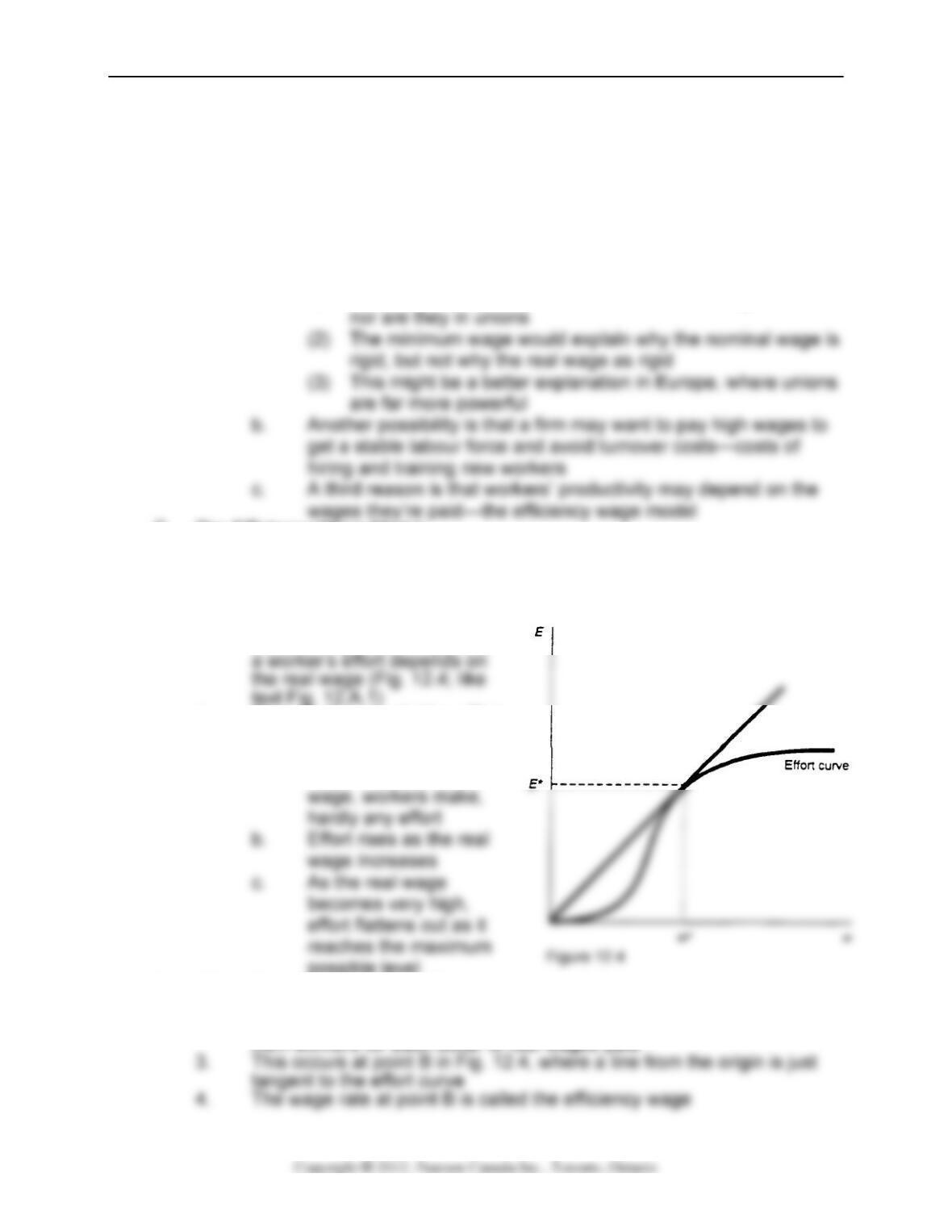
4. The effort curve, plotting effort
against the real wage, is S-
shaped
a. At low levels of the real
possible level
D. Wage determination in the efficiency wage model
1. Given the effort curve, what determines the real wage firms will pay?
2. To maximize profit, firms choose the real wage that gets the most effort

Keynesian Business Cycle Analysis: Non–Market–Clearing Macroeconomics 231
E. Employment and Unemployment in the Efficiency Wage Model
1. The labour market now
determines employment and
12.A.2)
2. The labour supply curve is
upward sloping, while the
3. The difference between labour
supply and labour demand is
the amount of unemployment
4. The fact that there’s
Analytical Problem 5 takes a more sophisticated look at the labour market, dividing it
into one sector with an efficiency wage and another sector in which the real wage
equates labour demand and supply.
5. A Closer Look 12.A.1: Does the efficiency wage theory match up with
the data?
a. It seems to have worked for Henry Ford in 1914
b. Plants that pay higher wages appear to experience less shirking
Numerical Problem 6 looks at the determination of the efficiency wage and employment.
V. Appendix 12.B: The Government Purchase Multiplier in the Keynesian Model
A. The multiplier shows the change in output resulting from a one-unit change in
government purchases
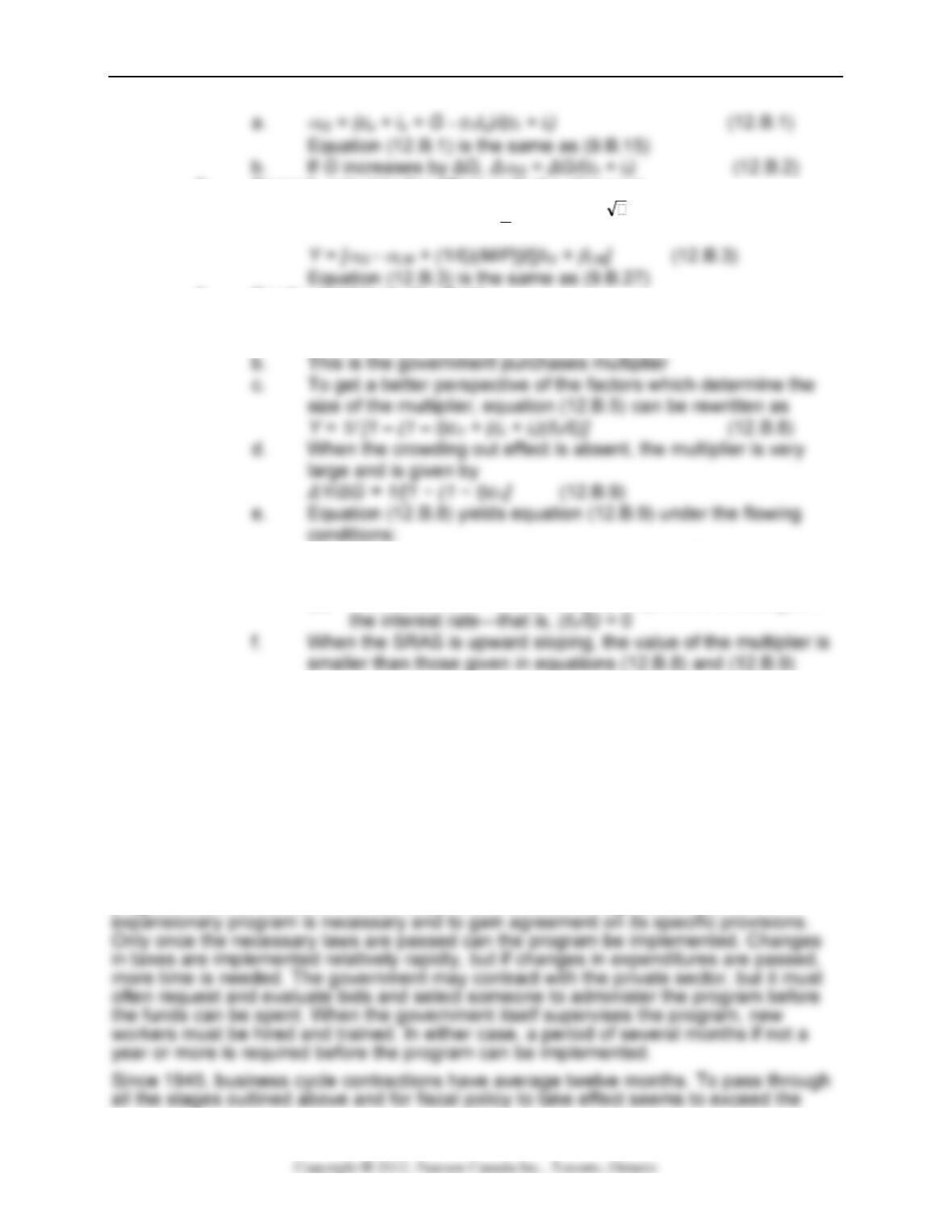
1. First, calculate the effect on the intercept of the IS curve,
α
IS, of a
change in G
232 Chapter 12
2. Second, calculate the effect on Y of a change in
a. The AD curve intersects the SRAS curve at
3. Finally, combine both effects
a. Substituting (12.B.2) in (12.B.4) we get
ΔY/ΔG = 1/[(cr +ir)(
β
IS +
β
LM)] (12.B 5)
(1) The aggregate spending is independent of the interest
rate—that is, (cr + ir) = 0
(2) The demand for money is highly responsive to changes in
ADDITIONAL ISSUES FOR CLASSROOM DISCUSSION
1. Do Lags Eliminate the Effectiveness of Fiscal Policy?
Keynesian economists in the past have encouraged the use of fiscal policy to combat
recession. They believe that wages and prices do not adjust rapidly enough to bring the
economy to full employment in a reasonable period of time without the help of changes
in government expenditures. However, fiscal policy takes a long time to be
implemented. Can we expect it to be effective in combating recessions?
Fiscal policy can’t be changed rapidly. When the economy goes into a recession, we
usually don’t know it until several months later. Once a recession has been identified, a
program must be devised. The next step is to convince the legislature that the
2. Do Prices Adjust Slowly?
One of the main differences between Keynesians and classical economists is their
disagreement over how quickly prices adjust to changes in the economy. Which point of
view seems more in line with what happens in the economy?
In some markets, prices do adjust rapidly. This is particularly true in commodity markets
such as those for corn and wheat. It is also true for items such as gasoline. While gas
3. The Kobe Earthquake and Reconstruction Spending
In January 1995 the city of Kobe in Japan was hit by a massive earthquake. Measuring
7.2 on the Richter scale, the earthquake killed over 5000 people and made over 70 000
others homeless. The quake caused a
huge amount of economic destruction.
Bridges and highways collapsed, office
and apartment buildings were destroyed.
234 Chapter 12
ANSWERS TO TEXTBOOK PROBLEMS
Review Questions
1. These contracts specify what nominal wages will be paid over the course of the
contract. They commit both labour demanders (firms) and labour suppliers
(employees) to that wage for the length of the contract. The length of these
contracts is typically measured in years rather than months.
Keynesians suggest that negotiating nominal wage contracts reflects a sensible
saw-off between the interests of employees and the interests of firms. As
discussed in Chapter 3, firms are interested in negotiating a nominal wage contract
2. Wage contracts commit firms and employees to a nominal wage for the length of
that contract. Because the contracts commit both sides to a nominal wage in the
future, and because both sides are really concerned about the future real wage,
they must both form a forecast of what the price level (and, hence, the real wage)
3. Price stickiness is the tendency of prices to adjust only slowly to changes in the
economy. Keynesians believe it is important to allow for price stickiness to explain
why monetary policy is not neutral.
4. Menu costs are the cost of changing prices. Menu costs may lead to price
stickiness in. monopolistically competitive markets but not in perfectly competitive