
Classical Business Cycle Analysis: Market–Clearing Macroeconomics 207
B. Factors that Shift the Curves
i. An increase (decrease) in the expected price level shifts the SRAS
Theoretical Application
Though the text presents the theories in the reverse order, the misperceptions theory
came first (being developed in the 1970s) and the RBC theory came later (in the
1980s). Many classical economists moved away from the misperceptions theory
because they weren’t convinced by its arguments for monetary non-neutrality; in
V. Appendix 11A: An Algebraic Version of the Classical AS-AD Model with
Misperception.
A. The aggregate demand curve
1. From Appendix 9.B, [equation 9.B.24]the AD curve is
1. Based on the misperceptions theory: Y = + b(P – Pe) (11.A.2)
C. General equilibrium
1. The AD curve intersects the SRAS curve at the point found by setting
the right-hand sides of Eqs. (11.A.1) and (11.A.2) equal and
rearranging terms to get a2P2
+ a
P – a
= 0
(11.A.3)

208 Chapter 11
ADDITIONAL ISSUES FOR CLASSROOM DISCUSSION
1. Do Wages Adjust to Clear the Labour Market?
One of the key assumptions of classical macroeconomic theory is that wages adjust
rapidly to bring about equilibrium in the labour market in a relatively short period of time.
Is this a reasonable assumption?
Some economists look at the labour-market statistics, which show large swings in
unemployment and not much change in wages over the business cycle. They believe
2. Are People’s Inflation Forecasts Rational?
When the misperceptions theory was developed in the late 1970s, a number of
economists began testing people’s forecasts to see how rational they were. The theory
implies that on average, people should not make systematic errors in forecasting. Of
special importance are people’s forecasts of inflation, since these affect the aggregate
supply curve.

Classical Business Cycle Analysis: Market–Clearing Macroeconomics 209
ANSWERS TO TEXTBOOK PROBLEMS
Review Questions
1. The main feature of the classical IS-LM model that distinguishes it from the
Keynesian IS-LM model is the classical model’s assumption that prices adjust
2. The two main components of any theory of the business cycle are (1) a
specification of the types of shocks or disturbances that are believed to be the
3. A real shock is a disturbance to the real side of the economy that affects the IS
curve or the FE line. A nominal shock is a disturbance to money supply or money
demand that affects the LM curve. Real shocks include changes in the production
4. RBC theory is successful at explaining that employment is procyclical, that average
labour productivity is procyclical, that the real wage is mildly procyclical, and that
5. The Solow residual is the most common measure of productivity shocks. It is
6. The increase in government purchases does not affect labour demand, but causes
an increase in labour supply at any given real wage. This occurs because workers
are poorer due to the current or future taxes they must pay to finance the
increased government spending. Since labour demand is unchanged but labour
7. Reverse causation means that expected future increases in output cause
increases in the current money supply, and expected future decreases in output
210 Chapter 11
8. According to the misperceptions theory, an increase in the price level fools
producers of goods into producing more, because they are unable to tell whether
9. In the classical model, money is neutral in both the short run and the long run. This
is modified in the misperceptions theory in that anticipated monetary changes are
10. Rational expectations means that the public’s forecasts of various economic
variables are based on reasoned and intelligent examination of available economic
data. If the public has rational expectations, the central bank will not be able to
surprise the public systematically, and so it cannot use monetary policy to stabilize
output.
Numerical Problems
1. a. Labour supply is given by the equation NS = 45 + 0.1w. Before the shock,
labour demand is determined by the equation w = 1.0(100 – N). Setting labour
b. Now NS = 10 + 0.8w. Before the shock, N = 10 – 0.8w = 10 – [0.8 x 1.0(100 –
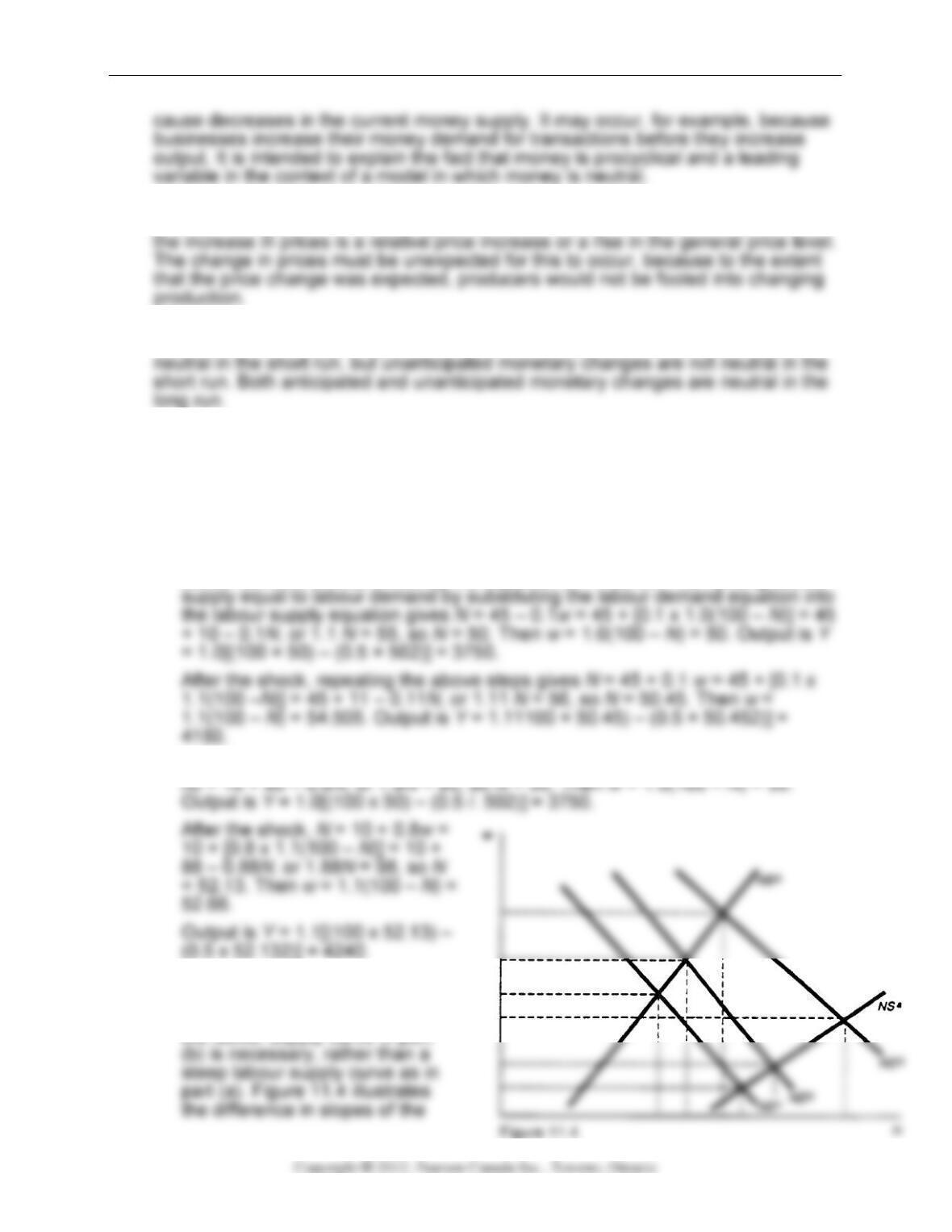
c. If the real wage is only slightly
procyclical, then a flat labour
supply curve, corresponding to
the labour supply curve in part

Classical Business Cycle Analysis: Market–Clearing Macroeconomics 211
2. The IS curve gives Y = C + I + G = 600 + 0.5 (Y – T) – 50r + 450 – 50r + G = 1050
– 100r + 0.5Y – 0.5T + G, or 0.5Y = 1050 –100r – 0.5T + G, or Y = 2100 –200r + T +
2G. The LM curve gives M/P = L = 0.5Y – 100i = 0.5Y – 100 (r + πe) = 0.5Y –100r –
5.
a. M = 4320, G = T = 150. The IS curve is Y = 2100 – 200r –T + 2G = 2100 – 200r
-150 + (2 x 150) = 2250 –200r. Output must be at its full-employment level of
b. When M increases to 4752, nothing in the IS curve is affected, so Y and r are
the same as in part (a), as are C and I. The LM curve becomes 4752 / P =
1080, or P = 4.4. No real variables are affected, and the price level rises 10%
just as the money supply did, so money is neutral.
c. When G = T = 190, the IS curve shifts. It becomes Y = 2100 – 200r – T + 2G =
3. The IS curve is found by setting desired saving equal to desired investment.
Desired saving is Sd = Y – Cd – G = Y – [1275 + 0.5 (Y – T) – 200r] – G. Setting Sd
= Id gives Y – [1275 + 0.5(Y –T) – 200r] – G = 900 – 200r, or Y = 4350 – 800r +
2G – T. The LM curve is M/P = L = 0.5Y – 200i = 0.5Y – 200(r + π) = 0.5Y – 200r.
a. T = G = 450, M = 9000. The IS curve gives Y = 4350 – 800r+2G – T = 4350 –
800r + (2 × 450) – 450 = 4800 – 800r. The LM curve gives 9000/P = 0.5Y –
200r. To find the aggregate demand curve, eliminate r in the two equations by

212 Chapter 11
b. Following the same steps as above, with M = 4500 instead of 9000, gives the
c. T = G =330, M = 9000. The IS curve is Y = 4350 = 800r + 2G – T = 4350 – 800r
+ (2 x 330) – 330 = 4680 – 800r
4. AD: Y = 300 + 30(M / P), AS: Y = 500 + 10(P – Pe) M = 400.
a. Pe = 60. Setting AD = AS to eliminate Y, we get 300 + 30(M / P) = 500 + 10(P –
Pe). Plugging the values of M and Pe gives 300 + (30 x 400 / P) = 500 + 10(P –
60), or 300 + (12 000 / P) = 500 + 10P – 600, or 400 + (12 000 / P) = 10P.
c. When M – 700 and is anticipated P = Pe. Then the AD curve is Y = 300 + (21
000 / P) and the AS curve is Y = 500. Setting AD = AS gives 500 = 300 + (21
000 / P, which has the solution P = 105.
5. a. To find the Solow residual, use the equation for the production function, dividing
through to solve for A: A = Y / K0.3N0.7. Assuming there’s no change in
utilization rates, this is the measured Solow residual. Given that equation,
Classical Business Cycle Analysis: Market–Clearing Macroeconomics 213
c. With a change in utilization rates, the production function is modified, as shown
in Eq. (11.2). Now productivity is measured as A = Y / (uKK)0.3(uNN)0.7 but the
d. Setting uN = 1 in year 2011 and 1.03 in
year 2012, and uK = 1 in year 2011 and
1.03 in year 2012, we calculate the value
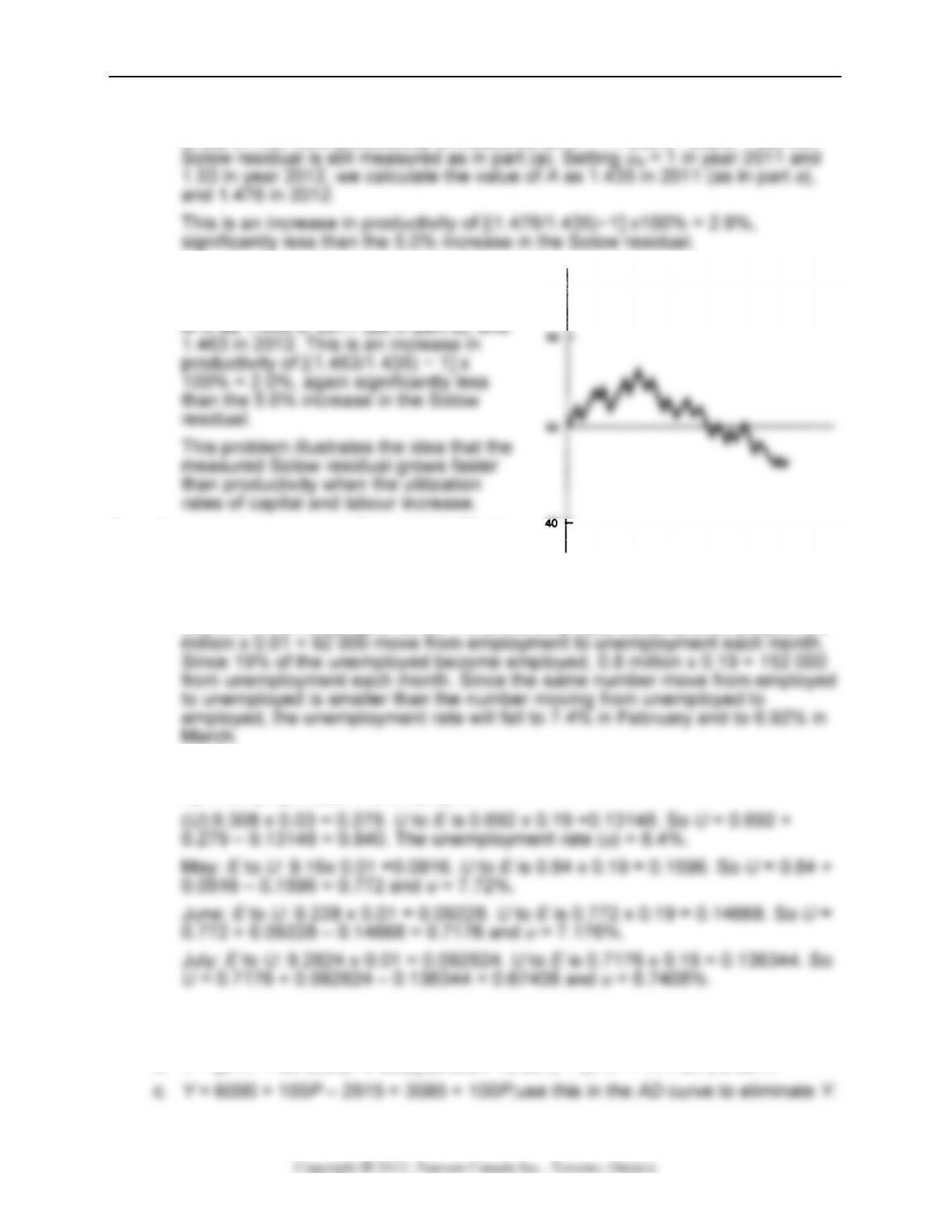
6. An example is shown in Figure 11.5. There
are several long cycles in output.
7. a. With an unemployment rate of 8%, there are initially 0.8 million unemployed
and 9.2 million employed. Since 1% of the employed become unemployed, 9.2
b. Note: All amounts are in millions.
April: Employed (E) to Unemployed
8. a. αIS = 2.47, βIS = 0.0004, ALM = 0, βLM = 0.001, lr = 500, b = 100.
b. Y = [2.47 + 88 950/(P x 500)]/(0.0004 +0.001) = (2.47 + 177.9/P)/0.0014
Figure 11.5

214 Chapter 11
Classical Business Cycle Analysis: Market–Clearing Macroeconomics 215
Analytical Problems
1. a. The increase in MPKf leaves aggregate supply unchanged, since expected
future labour income and expected future wages are unchanged. But aggregate
demand increases, because firms increase investment, shifting the IS curve up.
There is no shift in either the LM curve or the FE line.
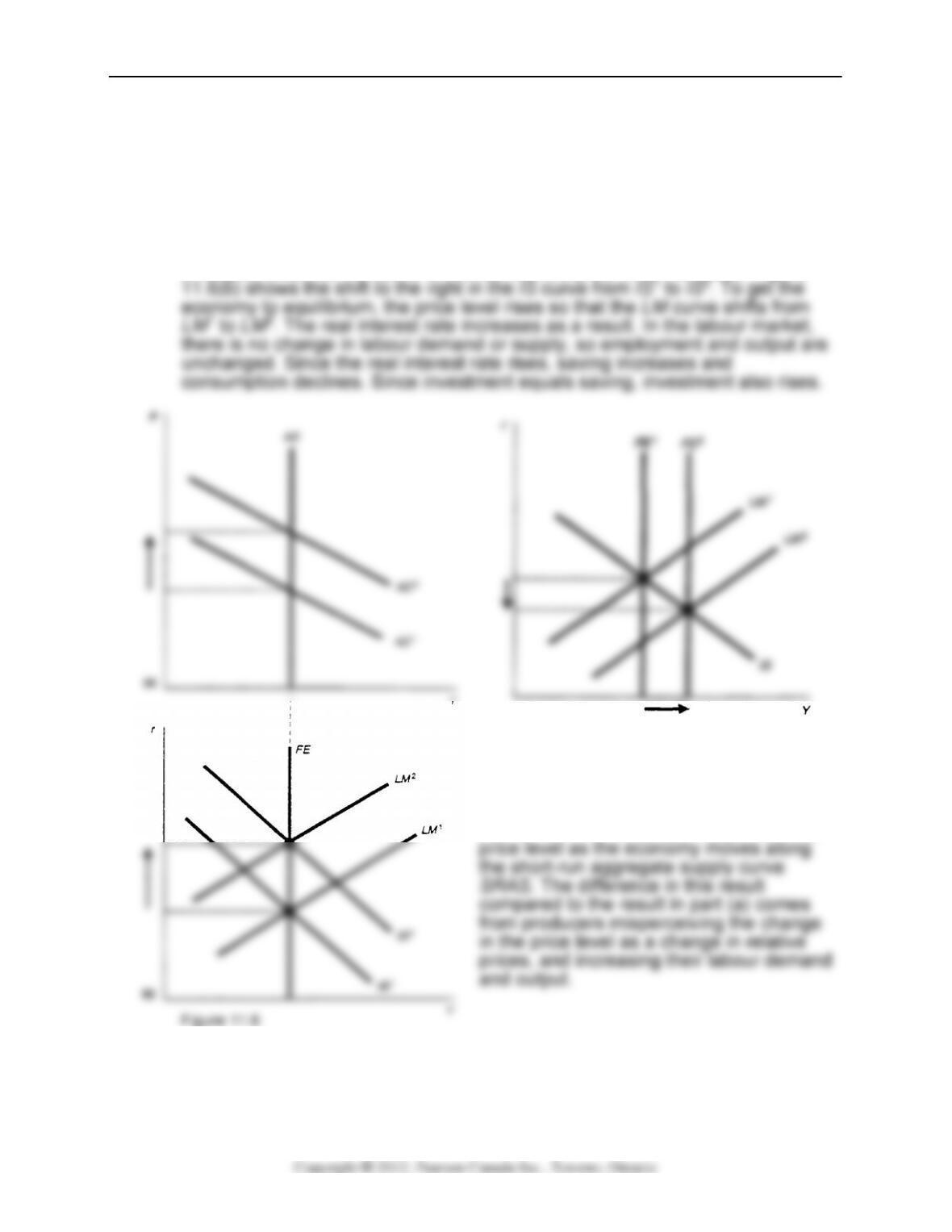
Figure 11.6(a) shows that the increase in aggregate demand causes no change
in output, since the AS curve is vertical, but the price level increases. Figure
b. The misperceptions theory gets a
different result. As shown in Fig. 11.7. the
shift in the aggregate demand curve from
AD1 to AD2 increases both output and the
2. a. In the case of a permanent increase in government purchases, the income
effect on labour supply, which arises because the present value of taxes
increases to pay for the added government spending, is much higher than in the
Figure 11.7
216 Chapter 11
b. Desired national saving is unaffected
by the change in government spending
if the change in consumption is just
equal to the change in taxes, so there
is no shift in the saving curve. If
investment is also unaffected by the
change in government spending, then
the IS curve does not shift.
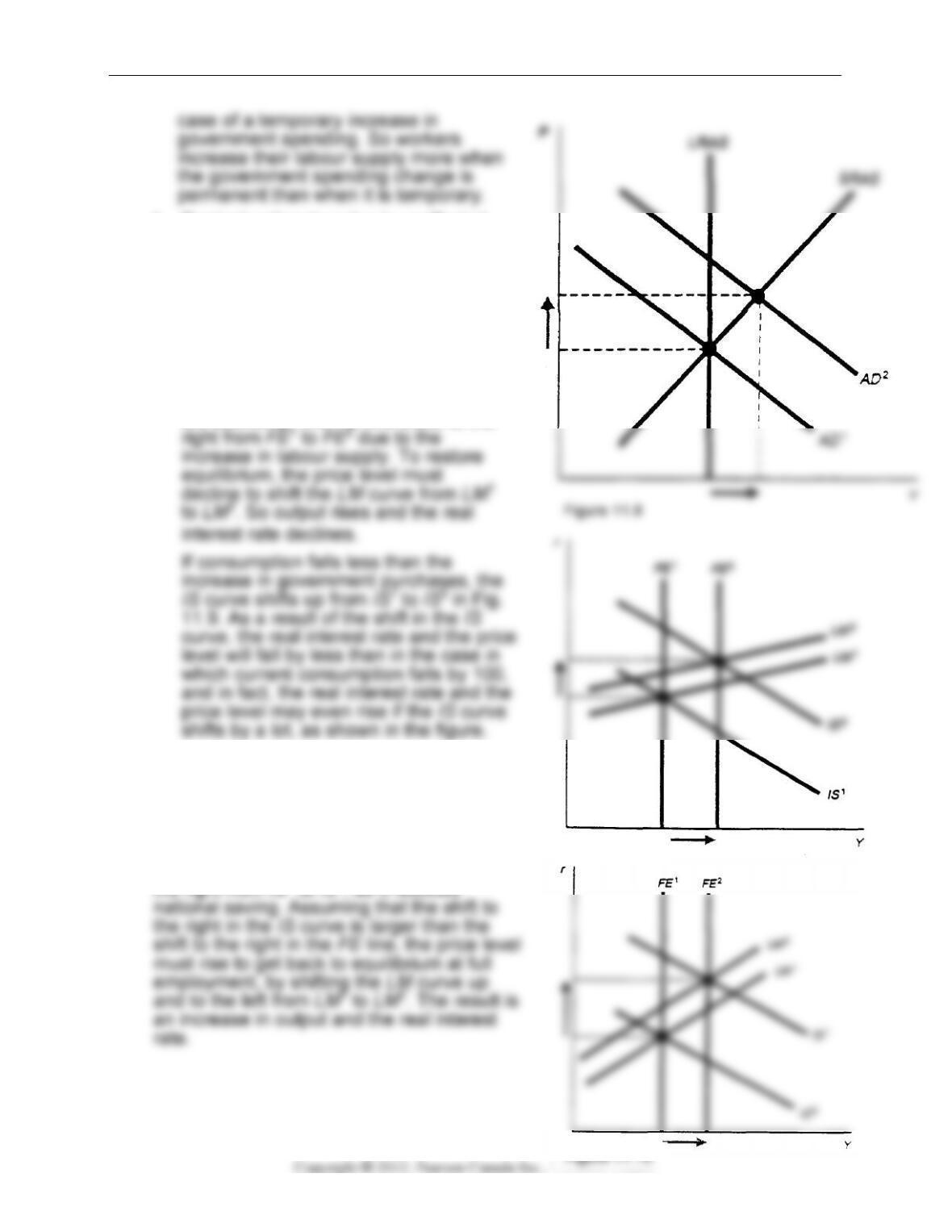
c. Figure 11.8 shows the effect of the
increase in government purchases on
the economy. The FE line shifts to the
3. The temporary increase in government
purchases causes an income effect that
increases workers’ labour supply. This
results in an increase in the full-
employment level of output from FE1 to FE2
in Fig. 11.10. The increase in government
purchases also shifts the IS curve up and to
Figure 11.9
Classical Business Cycle Analysis: Market–Clearing Macroeconomics 217
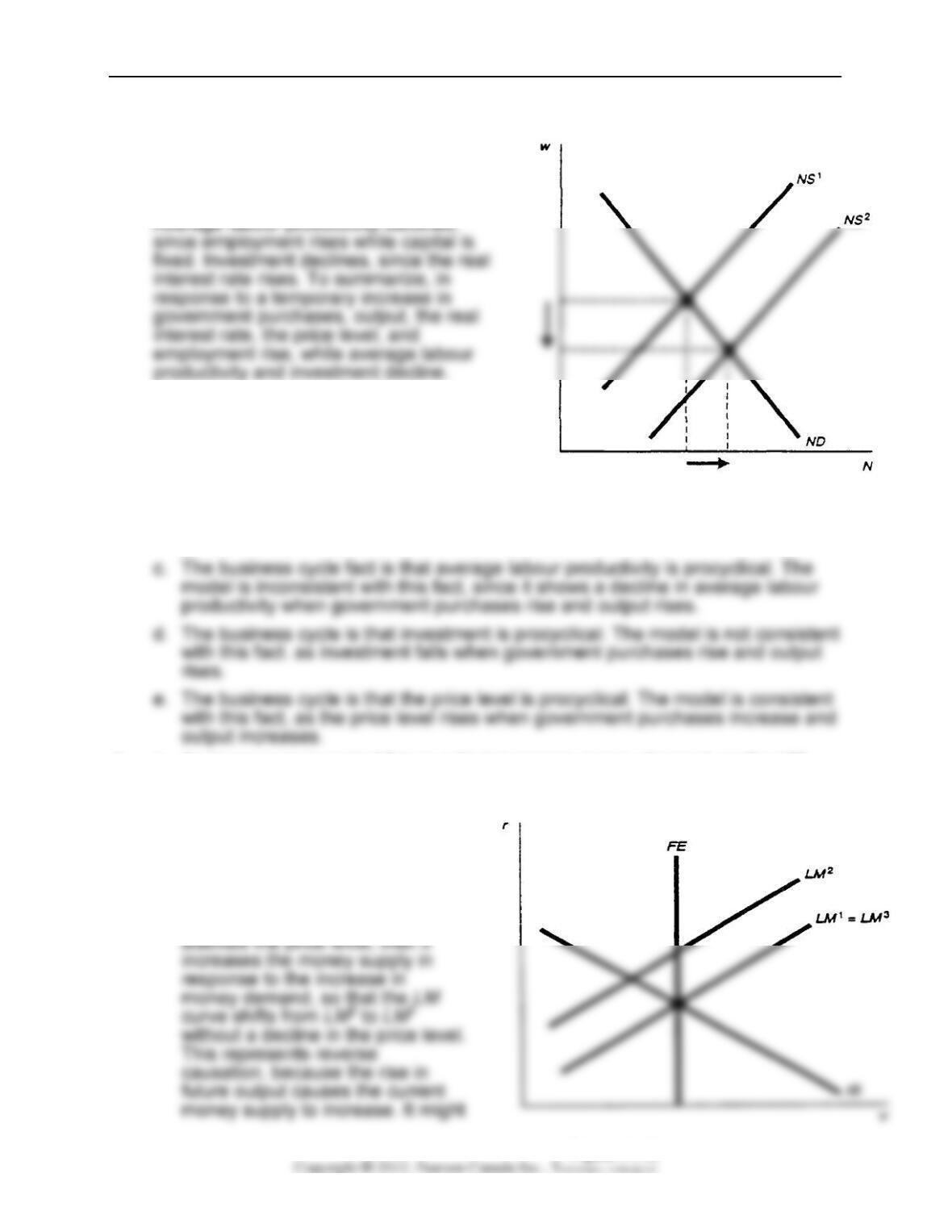
Figure 11.11 shows the impact on the
labour market. Labour supply shifts from
NS1 to NS2, leading to a decline in the
real wage and a rise in employment.
a. The business cycle fact is that
employment is procyclical. The model
is consistent with this fact, since
employment rises when government
purchases rise, causing output to rise.
b. The business cycle fact is that the real wage is mildly procyclical. The model is
inconsistent with this fact, since it shows a decline in the real wage when
government purchases rise and output rises.
4. a. An increase in expected future output increases money demand, so the LM
curve shifts up. As shown in Fig. 11.12, the upward shift in the LM curve from
LM1 to LM2 leads to a decline in
the price level so that the
equilibrium in the economy can be
restored by shifting the LM curve
from LM2 to LM3. So the price
level declines.
b. If the Bank of Canada wants to
Figure 11.11
Figure 11.12

218 Chapter 11
5. Expressing real terms in trillions of widgets,
the real money demand of both countries
taken together before unification is (0.10 x
2) + (0.40 x 1) = 0.6. The total output of the
two countries is 3 trillion. So real money
demand is 20% of output. After unification,
6. The temporary wage tax has a small income effect but a large substitution effect,
so labour supply is reduced. As Fig. 11.14 shows, this increases the (pretax) real
wage rate and reduces employment. The reduction in employment shifts the FE
line from FE1 to FE2 in Fig. 11.15, while the increase in government purchases
shifts the IS curve from IS1 to IS2. To restore equilibrium, where IS, LM, and FE