CHAPTER 11 | Long-Run Economic Growth:
Sources and Policies
Brief Chapter Summary and Learning Objectives
11.1 Economic Growth over Time and around the World (pages 732–737)
11.2 What Determines How Fast Economies Grow? (pages 737–744)
11.3 Economic Growth in the United States (pages 744–747)
Discuss fluctuations in productivity growth in the United States.
11.4 Why Isn’t the Whole World Rich? (pages 747–756)
11.5 Growth Policies (pages 756–761)
Discuss government policies that foster economic growth.
▪ Governments can attempt to increase economic growth through policies that enhance
property rights and the rule of law, improve health and education, subsidize research and
development, and provide incentives for savings and investment.
Key Terms
Catch-up, p. 747. The prediction that the level
of GDP per capita (or income per capita) in poor
countries will grow faster than in rich countries.
Foreign direct investment (FDI), p. 756.
The purchase or building by a corporation
of a facility in a foreign country.
CHAPTER 11 | Long-Run Economic Growth: Sources and Policies 249
Globalization, p. 756. The process of countries
becoming more open to foreign trade and
investment.
New growth theory, p. 742. A model of long-
run economic growth that emphasizes that
technological change is influenced by economic
incentives and so is determined by the working
of the market system.
Patent, p. 743. The exclusive right to produce a
product for a period of 20 years from the date
the patent is applied for.
enforcing contracts.
Technological change, p. 737. A change in the
quantity of output a firm can produce using a
given quantity of inputs.
Chapter Outline
Will Economic Reforms in Mexico Boost Economic Growth?
More than 18,000 U.S. companies, including Fortune 500 firms, have operations in Mexico. Proximity is
11.1
Economic Growth over Time and around the World (pages 732–737)
Learning Objective: Define economic growth, calculate economic growth rates, and
describe global trends in economic growth.
A. Economic Growth from 1,000,000 B.C. to the Present
B. Small Differences in Growth Rates Are Important
Because of compounding, in the long run small differences in economic growth rates result in big
differences in living standards.
250 CHAPTER 11 | Long-Run Economic Growth: Sources and Policies
C. Why Do Growth Rates Matter?
Growth rates matter because an economy that grows too slowly fails to raise living standards. In some
D. “The Rich Get Richer and …”
The world can be divided into two groups: the high-income countries (or the industrial countries) and the
Extra Solved Problem 11.1
Economic Growth in the United States since 1929
Figure 11.1 in the textbook shows that the world’s average annual growth rate of real GDP per capita in
the period 1800 to 1900 was 1.3 percent and equaled 2.3 percent from 1900 to 2000. The Bureau of
Economic Analysis has estimated that the real gross domestic product (in 2009 prices) of the United
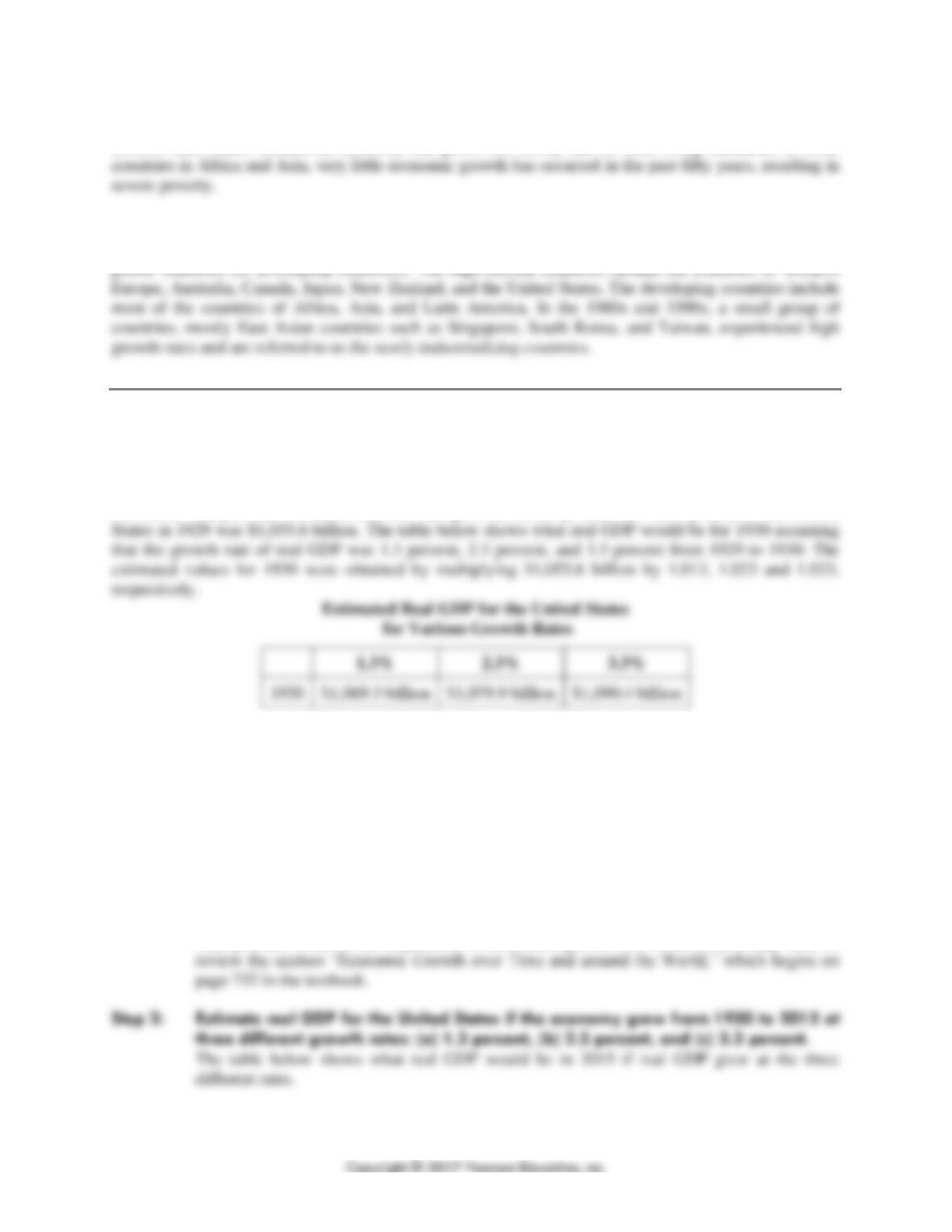
The differences in estimated real GDP for 1930 seem small, but how different would GDP be if these
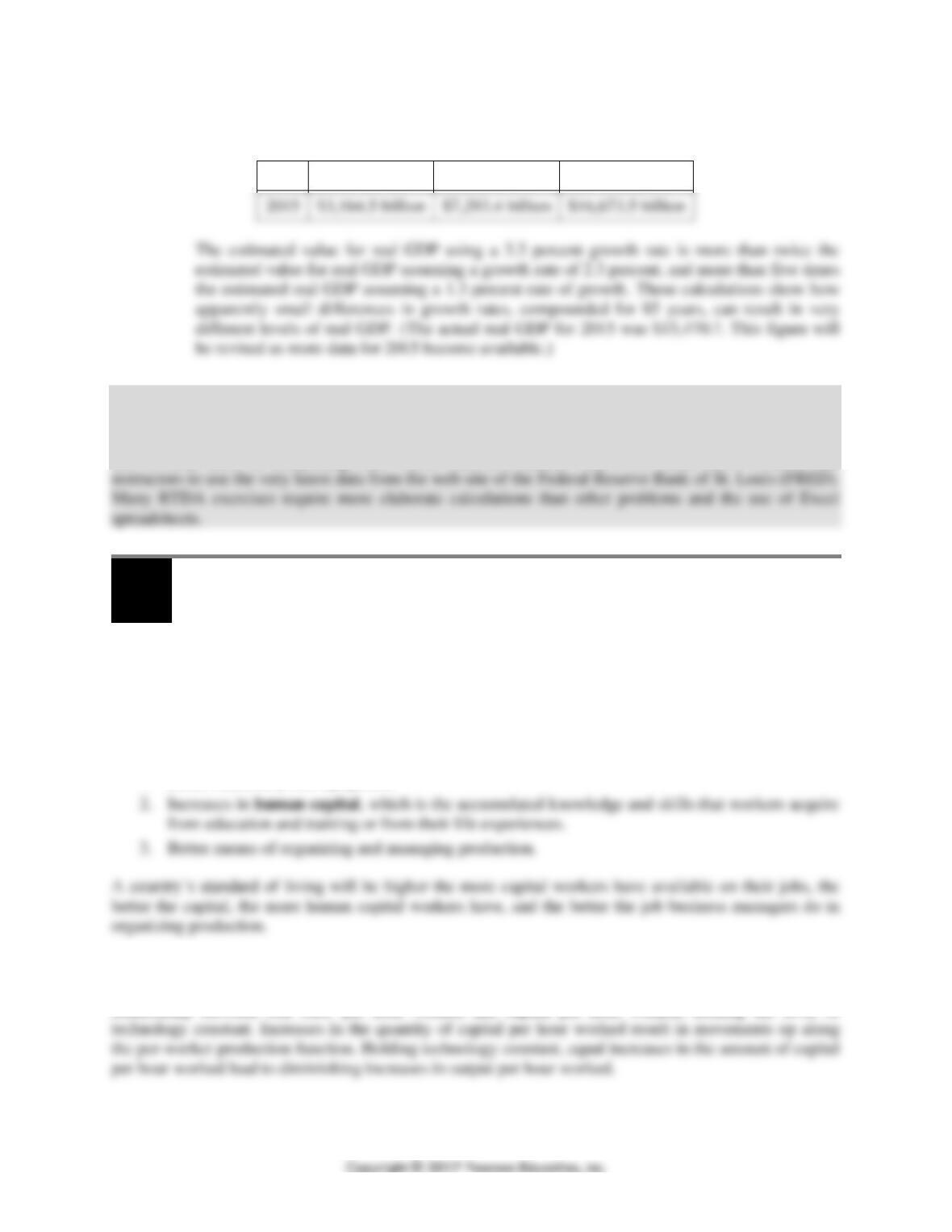
growth rates continued through 2015? Estimate real GDP for the United States if the economy grew from
1930 to 2015 at three different growth rates: (a) 1.3 percent annually, (b) 2.3 percent annually, and (c) 3.3
percent annually.
Source: U.S. Bureau of Economic Analysis. http://www.bea.gov/.
Solving the Problem
Step 1: Review the chapter material.
This problem is about the importance of economic growth over time, so you may want to
CHAPTER 11 | Long-Run Economic Growth: Sources and Policies 251
Estimated Real GDP for the United States
for Various Growth Rates
1.3%
2.3%
3.3%
Teaching Tips
The end of the chapter in the main text includes a special category of exercises titled Real-Time Data
Exercises. These exercises help students become familiar with a key data source, learn how to locate data,
and develop skills in interpreting data. Those exercises marked with a red circle allow students and
11.2
What Determines How Fast Economies Grow? (pages 737–744)
Learning Objective: Use the economic growth model to explain why growth rates differ
across countries.
The economic growth model explains growth rates in real GDP per capita over the long run. This model
focuses on the causes of long-run increases in labor productivity, which is the quantity of goods and
services that can be produced by one worker or by one hour of work. Economists believe that two key
factors determine labor productivity: the quantity of capital per hour worked and the level of technology.
Technological change is a change in the quantity of output a firm can produce using a given quantity of
inputs. There are three main sources of technological change:
1. Better machinery and equipment.
A. The Per-Worker Production Function
The economic growth model can be illustrated by using the per-worker production function, the
relationship between real GDP per hour worked and capital per hour worked, holding the level of
252 CHAPTER 11 | Long-Run Economic Growth: Sources and Policies
B. Which Is More Important for Economic Growth: More Capital or Technological
Change?
Technological change helps economies avoid diminishing returns to capital.
C. Technological Change: The Key to Sustaining Economic Growth
D. New Growth Theory
New growth theory is a model of long-run economic growth that emphasizes that technological change
is influenced by economic incentives and so is determined by the working of the market system. Paul
Romer, who developed the new growth theory, argues that the rate of technological change is influenced
by how individuals and firms respond to economic incentives. Firms add to an economy’s stock of
1. Protecting intellectual property with patents and copyrights. A patent is the exclusive right to
produce a product for a period of twenty years from the date the patent is applied for.
These policies can bring the accumulation of knowledge capital closer to the optimal level.
E. Joseph Schumpeter and Creative Destruction
The new growth theory has revived interest in the ideas of Joseph Schumpeter, who developed a model of
growth that emphasized his view that new products drive older products—and the firms that produce
11.3
Economic Growth in the United States (pages 744–747)
Learning Objective: Discuss fluctuations in productivity growth in the United States.
The economic growth model can help us understand the record of growth in the United States.
A. Economic Growth in the United States since 1950
Productivity in the United States grew rapidly from the end of World War II until the mid-1970s. Growth
CHAPTER 11 | Long-Run Economic Growth: Sources and Policies 253
B. Is the United States Headed for a Long Period of Slow Growth?
Some economists argue that productivity has become more difficult to measure and that the United States
is likely to experience high rates of growth in the long run. Other economists believe that productivity
entered a long-run decline in the mid-1970s that was only briefly overcome by the effects of the
revolution in information technology (IT).
Extra Solved Problem 11.3
U.S. Productivity Growth and Employment
The textbook describes the productivity slowdown from 1974 to 1995 in which the annual growth rate of
real GDP per hour worked in the United States was 1 percentage point per year lower than during the
1950–1973 period. Although the reasons for this anemic growth are still not certain, the subsequent
increase in productivity growth from 1996 to 2006 was welcome news to economists. But others have
pointed to a dark lining in this silver cloud. The economic expansion that began after the 2001 recession
Walsh notes that productivity growth and changes in technology cause structural changes that result in
increased production and employment in some industries and reductions in production and employment in
other industries. For example, the growth in demand for word processors and personal computers resulted
in a decline in the demand for typewriters and some types of office workers. Small changes in overall
employment mask what often are large increases in employment and unemployment in individual
industries. In other words, the negative effect of productivity on employment occurs in the short run,
while the positive effect of productivity on employment occurs in the long run.
254 CHAPTER 11 | Long-Run Economic Growth: Sources and Policies
Solving the Problem
Step 1: Review the chapter material.
This problem is about fluctuations in productivity growth, so you may want to review the
Step 2: Is the behavior of the unemployment rate consistent with Carl Walsh’s explanation
of the effect of productivity growth on employment?
Yes, Walsh’s explanation is consistent with the behavior of unemployment. Despite the
Extra Making
the
Connection
Productivity Gains Help Make U.S. Manufacturers More
Competitive
It’s a story all too familiar to many Americans: Caterpillar, the world’s largest manufacturer of
construction and industrial mining equipment, tried to persuade workers at one of the company’s
locomotive assembly plants to accept lower wages in order to reduce its wage and benefit costs, which
were much higher than they were at a Caterpillar plant in another country. What was different about the
What has made U.S. manufacturers more efficient and more competitive in recent years? The recession of
2007–2009 slowed the growth of wages and many firms have incorporated flexible work practices and
increased automation in order to increase productivity. As a result, labor costs actually decreased by 13
percent among U.S. manufacturers from 2000 to 2010. Over this same period, unit labor costs rose in
CHAPTER 11 | Long-Run Economic Growth: Sources and Policies 255
11.4
Why Isn’t the Whole World Rich? (pages 747–756)
Learning Objective: Explain economic catch-up and discuss why many poor countries
have not experienced rapid economic growth.
The economic growth model tells us that economies grow when the quantity of capital per hour worked
increases and when technological change takes place. The profitability of using additional capital or better
technology is generally greater in a developing country than in a high-income country. The economic
A. Catch-up: Sometimes but Not Always
A graph can be used to illustrate whether catch-up is happening. The initial level of GDP per capita is
measured along the horizontal axis and the vertical axis shows the rate at which GDP per capita is
B. Why Haven’t Most Western European Countries, Canada, and Japan Caught Up
to the United States?
Over the past twenty years, other high-income countries have fallen further behind the United States. Real
GDP per capita in Canada, Japan, and the five largest countries in Western Europe increased relative to
C. Why Don’t More Low–Income Countries Experience Rapid Growth?
Many poor countries do not experience rapid growth for four main reasons:
• Failure to enforce the rule of law, which is the ability of a government to enforce the laws of the
country, particularly with respect to protecting private property and enforcing contracts
D. The Benefits of Globalization
One way for a developing country to break out of the vicious cycle of low saving and investment and low
growth is through foreign investment. Foreign direct investment (FDI) is the purchase or building by a
256 CHAPTER 11 | Long-Run Economic Growth: Sources and Policies
Extra Making
the
Connection
What Do Parking Tickets in New York City Tell Us about Poverty
in the Developing World?
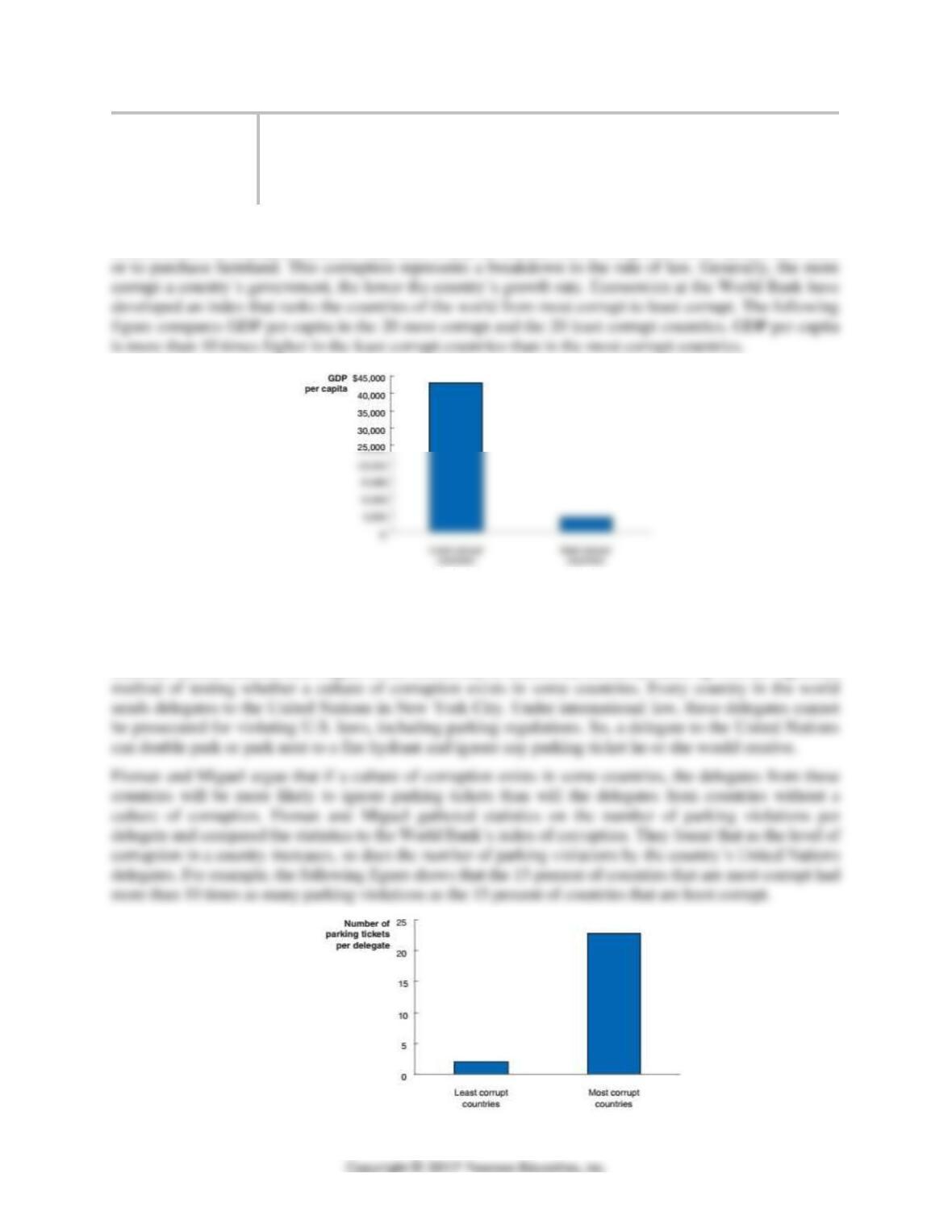
In many developing countries, government officials insist on receiving bribes to process most
transactions. For example, someone may need to pay an official before being allowed to open a shoe store
But does corruption cause countries to be poor, or does a country’s being poor lead to its being corrupt?
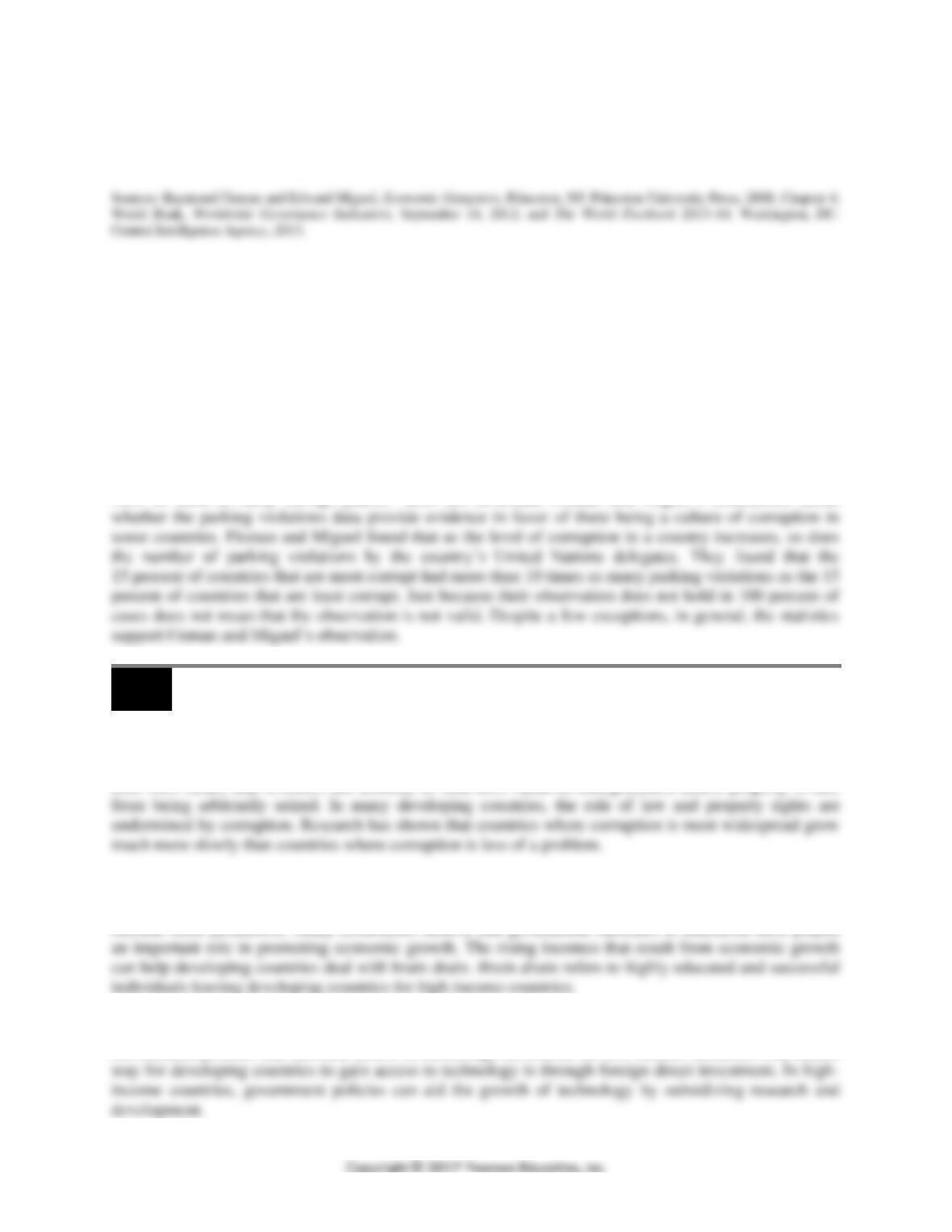
Some economists have made the controversial argument that corruption may be the result of culture. If a
culture of corruption exists in a country, then the country may have great difficulty establishing an honest
government that is willing to enforce the rule of law. Economists Raymond Fisman of the Columbia
Business School and Edward Miguel of the University of California, Berkeley, came up with an ingenious
CHAPTER 11 | Long-Run Economic Growth: Sources and Policies 257
Of course, ignoring parking regulations is a relatively minor form of corruption. But if Fisman and
Miguel are correct, and a culture of corruption has taken hold in some developing countries, then it may
be difficult to reform their governments enough to establish the rule of law.
Question
The relationship that Raymond Fisman and Edward Miguel found between the extent of corruption in a
country and the number of parking violations committed by the country’s United Nations delegates in
New York isn’t perfect. For example, “Ecuador and Colombia both have perfectly clean parking slates,
despite the experts’ view of them as fairly corrupt places.” Does this observation invalidate Fisman and
Miguel’s conclusions about whether the parking violations data provide evidence in favor of there being a
culture of corruption in some countries? Briefly explain.
Source: Raymond Fisman and Edward Miguel, Economic Gangsters, Princeton, NJ: Princeton University Press, 2009, p. 89.
Answer
The observation that “Ecuador and Colombia both have perfectly clean parking slates, despite the experts’
view of them as fairly corrupt places,” does not invalidate Fisman and Miguel’s conclusions about
11.5
Growth Policies (pages 756–761)
Learning Objective: Discuss government policies that foster economic growth.
A. Enhancing Property Rights and the Rule of Law
A market system cannot work well unless property rights are enforced. Entrepreneurs are unlikely to risk
their own funds, and investors are unlikely to lend their funds to entrepreneurs, unless property is safe
B. Improving Health and Education
As people’s health improves and they became taller, stronger, and less susceptible to disease, they also
become more productive. Many economists believe that government subsidies to education have played
C. Policies That Promote Technological Change
Government policies that facilitate access to technology are crucial for low-income countries. The easiest
258 CHAPTER 11 | Long-Run Economic Growth: Sources and Policies
D. Policies That Promote Saving and Investment
Governments can increase incentives for firms to engage in investment in physical capital by using
E. Is Economic Growth Good or Bad?
The arguments against further economic growth tend to be motivated either by concern about the effects
Teaching Tips
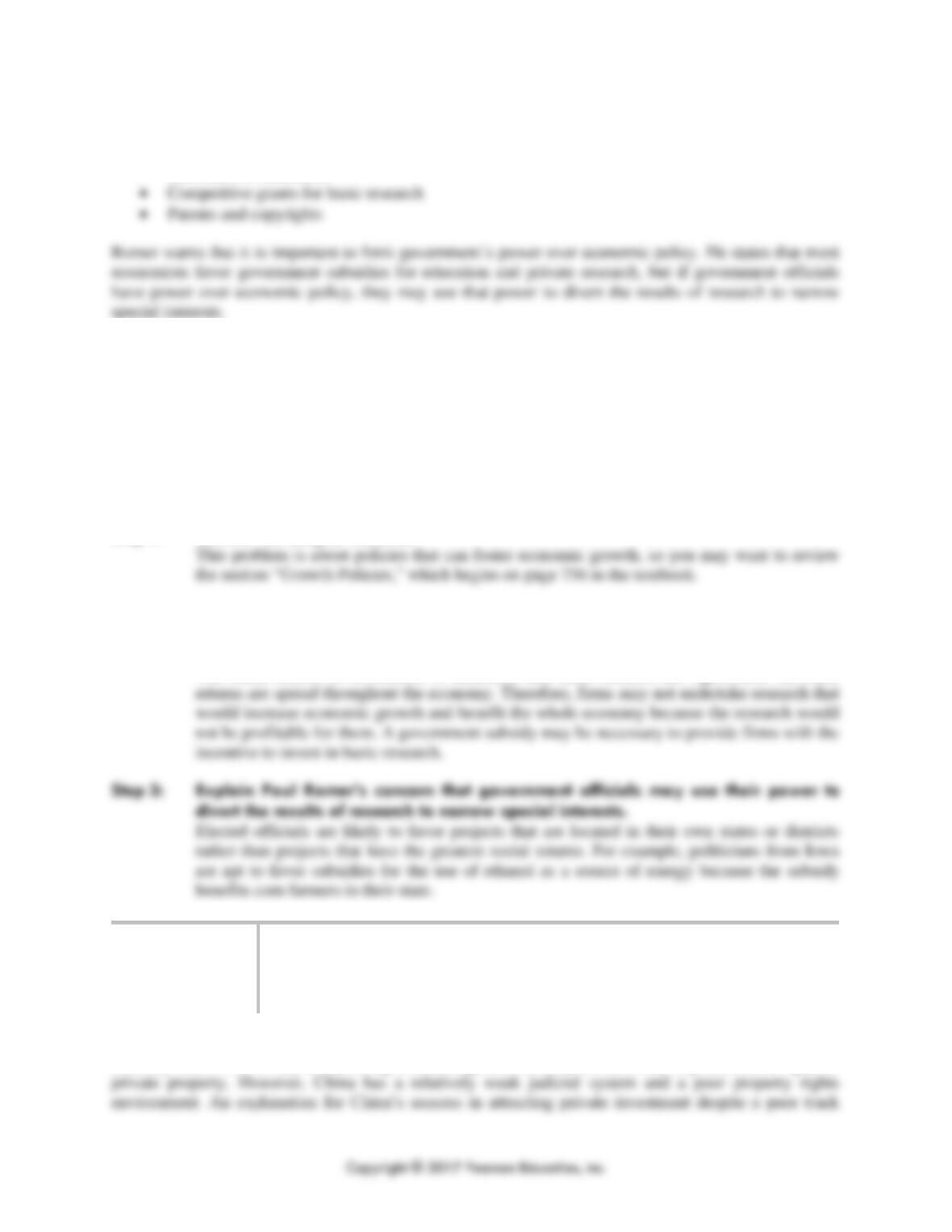
The following graph shows that developing countries that were more open to foreign trade and investment
grew much faster during the 1990s than developing countries that were less open.
Globalization and Growth
Extra Solved Problem 11.5
What Is the Proper Role for Government in Promoting Growth?
One popular explanation for the persistent poverty of developing nations is a lack of natural resources.
But Hong Kong and Japan, with meager supplies of natural resources, experienced more rapid economic
CHAPTER 11 | Long-Run Economic Growth: Sources and Policies 259
In the United States and developed countries, most economists support three government policies that
encourage the production and dissemination of new knowledge:
• Subsidies for education
Source: Paul M. Romer, “Economic Growth,” The Concise Encyclopedia of Economics. http://www.econlib.org/library/Enc/
EconomicGrowth.html.
a. Why do economists believe that government should subsidize education and basic research?
b. Paul Romer warns that government officials may use their power to divert the results of research
to narrow special interests. Explain Romer’s concern.
Solving the Problem
Step 1: Review the chapter material.
Step 2: Explain why economists believe that government should subsidize education and
basic research.
Private firms have little incentive to invest in activities that, if successful, are not profitable.
The social returns to investment in education and basic research are significant, but these
Extra Making
the
Connection
The Role of Local Government in Promoting Economic Growth in
China
Economic growth in China has been among the highest of any nation, often exceeding 7 to 9 percent
annually since 1979. A key to achieving economic growth in a market economy is protection of rights to