CHAPTER 11
FISCAL POLICY
In this chapter, you will find:
Learning Outcomes
Chapter Outline with PowerPoint Script
Chapter Summary
Teaching Points (as on Prep Card)
Solutions to Problems Appendix
Experiential Assignments
INTRODUCTION
This chapter brings government into the picture by analyzing how fiscal policy—including taxes, government
purchases, and transfer programs—influences the economy. (The impact of net exports on the aggregate
LEARNING OUTCOMES
11-1 Describe the discretionary fiscal policies to close a recessionary gap and an expansionary gap.
The tools of fiscal policy are automatic stabilizers and discretionary fiscal measures. Automatic stabi-
lizers, such as the federal income tax, once implemented, operate year after year without congressional
el.
11-2 Summarize fiscal policy from the Great Depression to stagflation.
11-3 Identify some reasons why discretionary fiscal policy may not work very well.
The problems of the 1970s, however, resulted more from a decline of aggregate supply than from a de-
Chapter 12 Fiscal Policy 162
11-4 Summarize fiscal policy from 1980 to the present and describe the most significant event during that
period, and the fiscal policy response.
The tax cuts of the early 1980s aimed to increase aggregate supply. But government spending grew faster
than tax revenue, creating budget deficits that stimulated aggregate demand. These huge deficits discour-
aged additional discretionary fiscal policy, but success in erasing deficits in the late 1990s spawned re-
CHAPTER OUTLINE WITH POWERPOINT SCRIPT
USE POWERPOINT SLIDE 2 FOR THE FOLLOWING SECTION
Theory of Fiscal Policy
Fiscal Policy: The use of government purchases, transfer payments, taxes, and borrowing to affect
macroeconomic variables such as real GDP, employment, the price level, and economic growth.
USE POWERPOINT SLIDES 3-4 FOR THE FOLLOWING SECTION
Fiscal Policy Tools:
• Automatic stabilizers: Revenue and spending programs in the federal budget that automatically adjust
USE POWERPOINT SLIDES 5 FOR THE FOLLOWING SECTION
Changes in Government Purchases: At any given price level, an increase in government purchases or
transfer payments increases real GDP demanded.
USE POWERPOINT SLIDES 6 FOR THE FOLLOWING SECTION
Changes in Net Taxes: A decrease (increase) in net taxes increases (decreases) disposable income at each
level of real GDP, so consumption increases (decreases). The change in real GDP demanded is equal to the
USE POWERPOINT SLIDES 7-8 FOR THE FOLLOWING SECTION
Discretionary Fiscal Policy to Close a Recessionary Gap: Expansionary fiscal policy, such as an increase in
government purchases, a decrease in net taxes, or a combination of the two:
Chapter 12 Fiscal Policy 163
USE POWERPOINT SLIDES 9-11 FOR THE FOLLOWING SECTION
Discretionary Fiscal Policy to Close an Expansionary Gap: Contractionary fiscal policy to reduce aggregate
demand by reducing government purchases, increasing net taxes, or a combination of the two:
USE POWERPOINT SLIDE 12 FOR THE FOLLOWING SECTION
The Multiplier and the Time Horizon: The steeper the short-run aggregate supply curve, the less impact a
USE POWERPOINT SLIDES 13-14 FOR THE FOLLOWING SECTION
The Evolution of Fiscal Policy: Classical economists, who advocated laissez-faire, believed that natural
market forces—by way of flexible prices, wages, and interest rates—would move the economy toward
potential GDP. There was no need for government intervention.
USE POWERPOINT SLIDES 15-16 FOR THE FOLLOWING SECTION
The Great Depression and World War II
• The Great Depression strained belief in the economy’s ability to correct itself, which was the view of the
classical economists.
• Keynesian theory challenged the classical view:
USE POWERPOINT SLIDE 17 FOR THE FOLLOWING SECTION
Automatic Stabilizers: The progressive federal income tax, unemployment insurance, and welfare spending
smooth fluctuations in disposable income over the business cycle by:
Stimulating aggregate demand during recessions; and,
Dampening aggregate demand during expansions.
USE POWERPOINT SLIDES 18-19 FOR THE FOLLOWING SECTION
From the Golden Age to Stagflation
• 1960s Golden Age of fiscal policy: Increasing or decreasing aggregate demand to smooth economic
USE POWERPOINT SLIDES 20-21 FOR THE FOLLOWING SECTION
Fiscal Policy and the Natural Rate of Unemployment
Natural rate of unemployment: The unemployment rate that occurs when the economy is producing its
potential GDP.
• For discretionary policy purposes, officials must correctly estimate this natural rate.
USE POWERPOINT SLIDE 22 FOR THE FOLLOWING SECTION
Lags in Fiscal Policy: Time required to approve and implement fiscal legislation can weaken the effectiveness
of discretionary fiscal policy as a tool for macroeconomic stabilization.
USE POWERPOINT SLIDES 26-28 FOR THE FOLLOWING SECTION
1990 to 2007: From Deficits to Surpluses Back to Deficits: Higher tax revenue and spending discipline
created surpluses from 1998 to 2000. Recession and terrorist attacks in 2001 caused deficits to return.
USE POWERPOINT SLIDES 29-38 FOR THE FOLLOWING SECTION
Fiscal Policy and the 2007-2009 Recession: Crisis in the housing market led to a financial crisis and a deep
CHAPTER SUMMARY
The tools of fiscal policy are automatic stabilizers and discretionary fiscal measures. Automatic stabilizers,
such as the federal income tax, once implemented, operate year after year without congressional action.
Discretionary fiscal policy results from specific legislation about government spending, taxation, and transfers.
If that legislation becomes permanent, then discretionary fiscal policies often become automatic stabilizers.
An expansionary fiscal policy can close a recessionary gap by increasing government purchases, reducing net
taxes, or both. Because the short-run aggregate supply curve slopes upward, an increase in aggregate demand
raises both output and the price level in the short run. A contractionary fiscal policy can close an expansionary
gap by reducing government purchases, increasing net taxes, or both. Fiscal policy that reduces aggregate
demand to close an expansionary gap reduces both output and the price level.
Chapter 12 Fiscal Policy 165
The tax cuts of the early 1980s aimed to increase aggregate supply. But government spending grew faster than
tax revenue, creating budget deficits that stimulated aggregate demand, leading to the longest peacetime
expansion to that point in the nation’s history. These huge deficits discouraged additional discretionary fiscal
policy as a way of stimulating aggregate demand further, but success in erasing deficits in the late 1990s
spawned renewed interest in discretionary fiscal policy, as reflected by President Bush’s tax cuts in the face of
the 2001 recession.
TEACHING POINTS
1. This chapter considers the effects of fiscal policy on equilibrium income and employment. It begins
2. You should link together the many parts of this chapter. First, you must again illustrate the multiplier
for the case of government spending. The multiplier has been discussed in previous chapters, so it should
not present any barriers to your students. Next, you must again discuss the aggregate demand curve. Ref-
4. Having discussed the nature of fiscal policy and recessionary/expansionary gaps, you may find it useful
to use a conventional aggregate demand–aggregate supply diagram with such a gap and to ask the class
5. The tax cuts and stimulus spending in 2008–2010 will remain controversial for a long time. Ask the
SOLUTIONS TO PROBLEMS APPENDIX
Chapter 12 Fiscal Policy 166
1. (Fiscal Policy) Define fiscal policy. Determine whether each of the following, other factors held
constant, would lead to an increase, a decrease, or no change in the level of real GDP demanded:
a. A decrease in government purchases
b. An increase in net taxes
c. A reduction in transfer payments
d. A decrease in the marginal propensity to consume
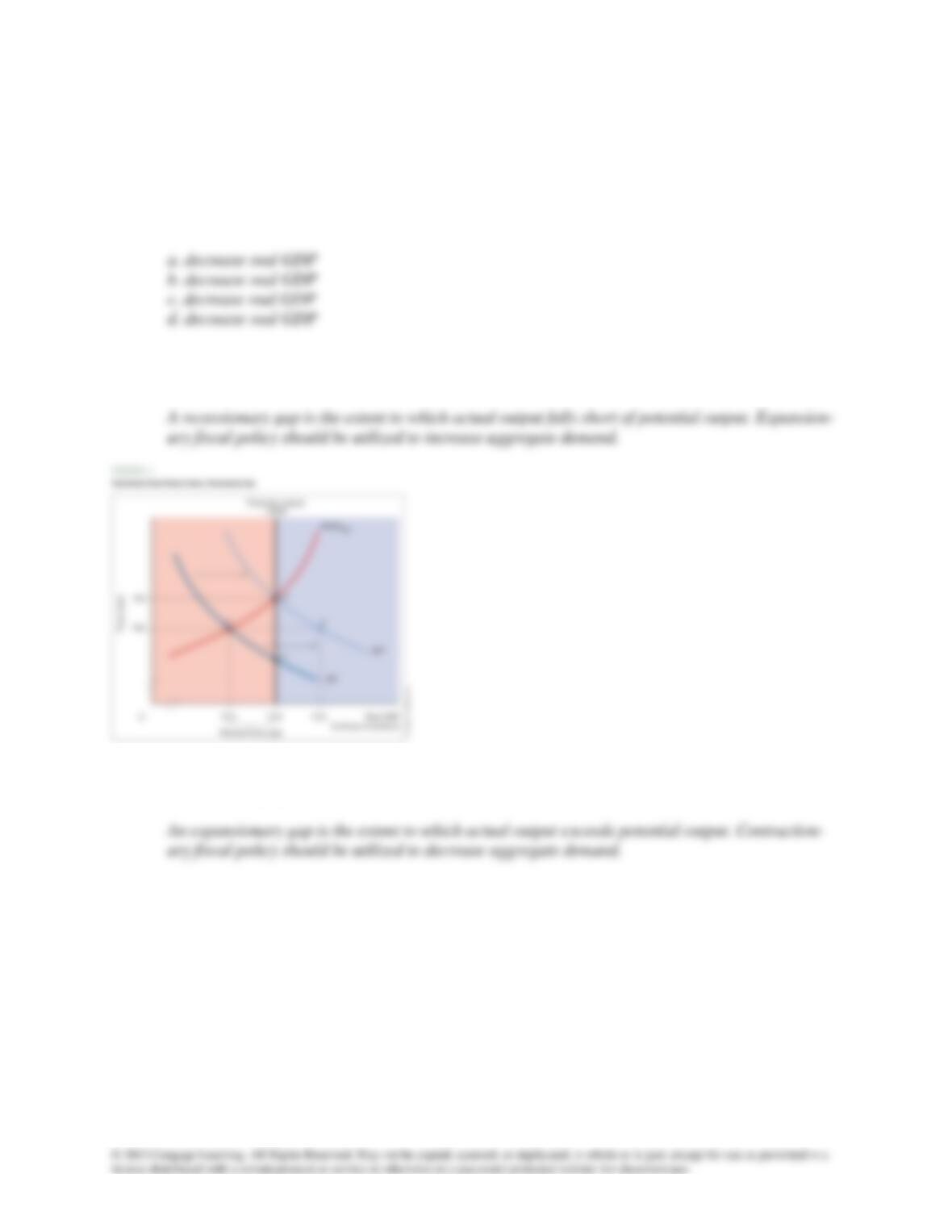
2. (Recessionary Gap) What is a recessionary gap? What fiscal policy might close that gap? Show
with a graph.
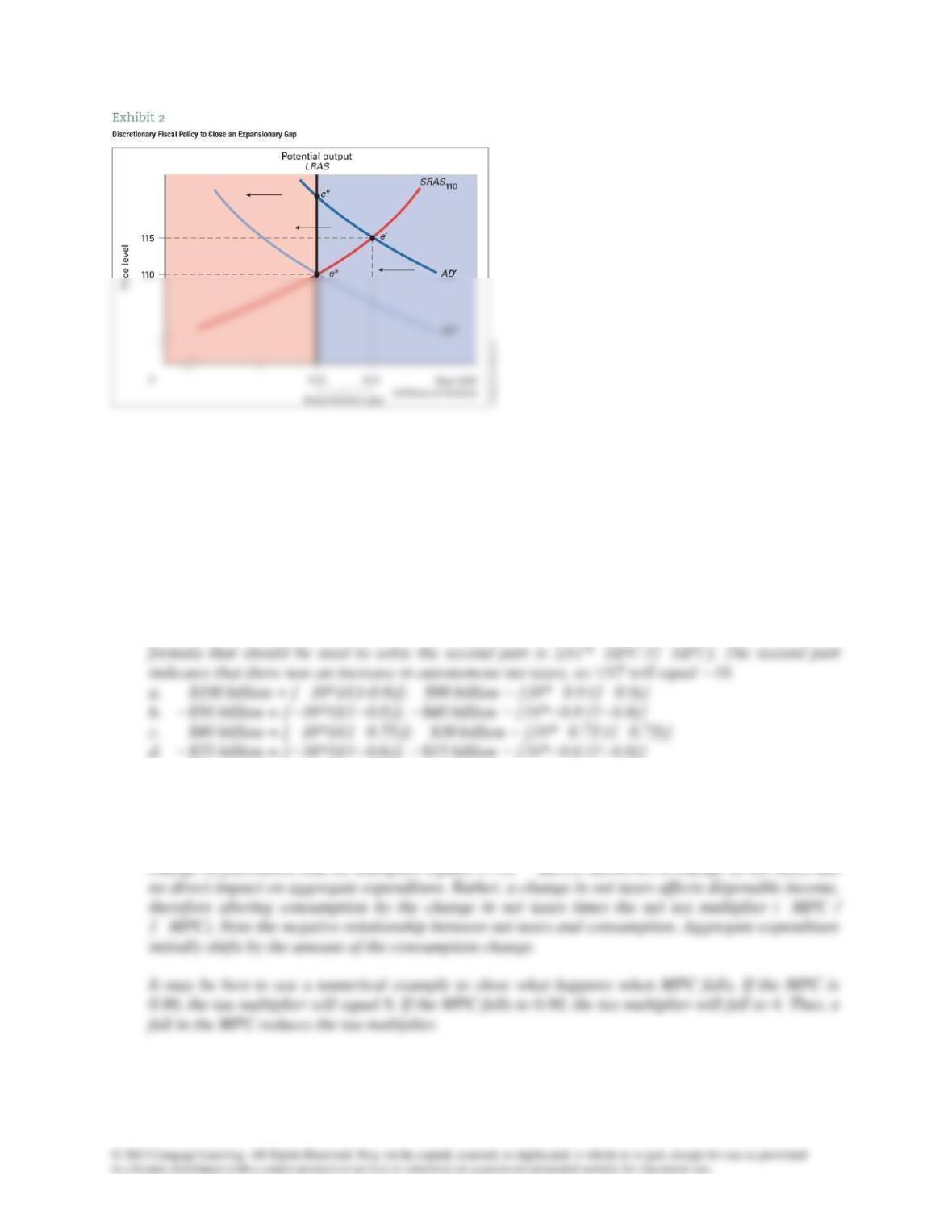
3. (Expansionary Gap) What is an expansionary gap? What fiscal policy might close that gap?
Show with a graph.
Chapter 12 Fiscal Policy 167
4. (Changes in Government Purchases) Assume that government purchases decrease by $10 billion,
with other factors held constant, including the price level. Calculate the change in the level of real
GDP demanded for each of the following values of the MPC. Then, calculate the change if the
government, instead of reducing its purchases, increased autonomous net taxes by $10 billion.
a. 0.9
b. 0.8
c. 0.75
d. 0.6
The formula that should be used to solve the first part of this problem is ∆G*1/(1−MPC). The first
part indicates that there was a decrease in government purchases, so ∆G will equal −10. The
5. (Fiscal Multipliers) Explain the difference between the government purchases multiplier and the net
tax multiplier. If the MPC falls, what happens to the tax multiplier?
A change in government purchases directly affects aggregate expenditure by the amount of the
6. (Multipliers) Suppose investment, in addition to having an autonomous component, also has a
component that varies directly with the level of real GDP. How would this affect the size of the
spending multiplier?
Chapter 12 Fiscal Policy 168
It would have the same impact on the spending multiplier as an increase in the MPC would,
7. (Fiscal Policy) Chapter 11 shows that increased government purchases, with taxes held constant,
can eliminate a recessionary gap. How could a tax cut achieve the same result?
A tax cut would increase disposable income. Individuals would in turn spend a portion of their tax
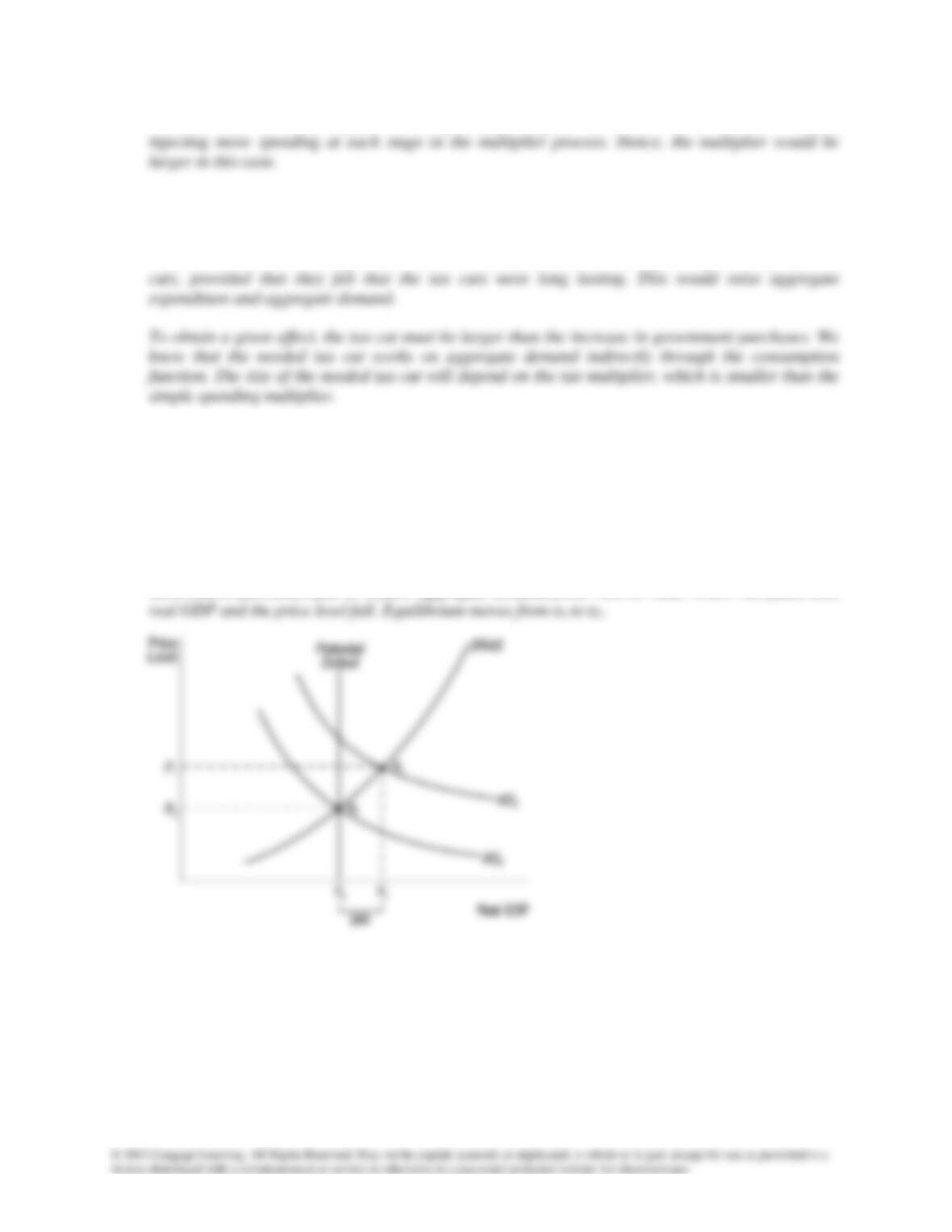
8. (Fiscal Policy with an Expansionary Gap) Using the aggregate demand–aggregate supply model,
illustrate an economy with an expansionary gap. If the government is to close the gap by changing
government purchases, should it increase or decrease those purchases? In the long run, what
happens to the level of real GDP as a result of government intervention? What happens to the price
level? Illustrate this on an AD–AS diagram, assuming that the government changes its purchases by
exactly the amount necessary to close the gap.
Government purchases fall to reduce aggregate demand from AD1 to AD2. When AD falls, both
9. (Evolution of Fiscal Policy) What did classical economists assume about the flexibility of prices,
wages, and interest rates? What did this assumption imply about the self-correcting tendencies in an
economy in recession? What disagreements did Keynes have with classical economists?
Chapter 12 Fiscal Policy 169
The flexibility of prices was the most important point of the classical economists, since they
markets.
10. (Fiscal Policy) Why or why not was fiscal policy effective when the U.S. economy was experi-
encing stagflation during the 1970s?
The problems of the 1970s resulted from a decline of aggregate supply more than from a decline
11. (Fiscal Policy Effectiveness) Determine whether each of the following would make fiscal policy more
effective or less effective:
a. A decrease in the marginal propensity to consume
b. Shorter lags in the effect of fiscal policy
c. Consumers suddenly becoming more concerned about permanent income than about current income
d. More accurate measurement of the natural rate of unemployment
a. Less effective
12. (Fiscal Policy During the Great Recession) Using the aggregate demand–aggregate supply
model, illustrate what President Obama was trying to accomplish with the $831 billion stimulus
program. What were some costs and benefits of this program?
After peaking in December 2007, the economy turned down, as consumers, firms, and financial
markets were spooked by falling home prices and rising foreclosure rates. Job losses increased
Experiential Assignments
1. The University of Washington’s Fiscal Policy Center at
Chapter 12 Fiscal Policy 170
2. In the United States, fiscal policy is determined jointly by the president and Congress. The Congres-
3. “Washington Wire” is a column that appears on the front page of the Wall Street Journal each Friday.
Have students review the latest column to determine what fiscal policy proposals are under consideration.