Chapter 11:
1. What happens to the cost of growing strawberries on your own land if a housing developer offers you
three times what you thought your land was worth?
Answer: Since the opportunity cost (foregone alternative) of using your land triples, the
2. As a farmer, you work for yourself using your own tractor, equipment, and farm structures, and you
cultivate your own land. Why might it be difficult to calculate your profits from farming?
Answer: To calculate economic profit, one must consider all relevant costs, both explicit
3.
past few years, poor returns of salmon to the Bay and competition from farm–raised salmon have reduced
the economic returns to the fishermen. One response to lower revenues has been for fishermen to use
Will employing relatives really keep profits from falling? Under what conditions is this a good strategy?
Answer: Fishermen may not have to pay their relatives to work as crew but that does not
4. -RUN PRODUCTION FUNCTION
Labor Total Product Marginal
(Workers) (Visitors per hour) Product
0 ___
1 —-– 10
2 —-– 12
3 —-– 9
4 —-– 8
5 —– 4
6 —-– -2
a. Fill in the Total Product column.
b. experiences diminishing marginal product beginning with which worker?
c.
Answers:
a. The entries are, from top to bottom, 0, 10, 22, 31, 39, 43, 43
5.
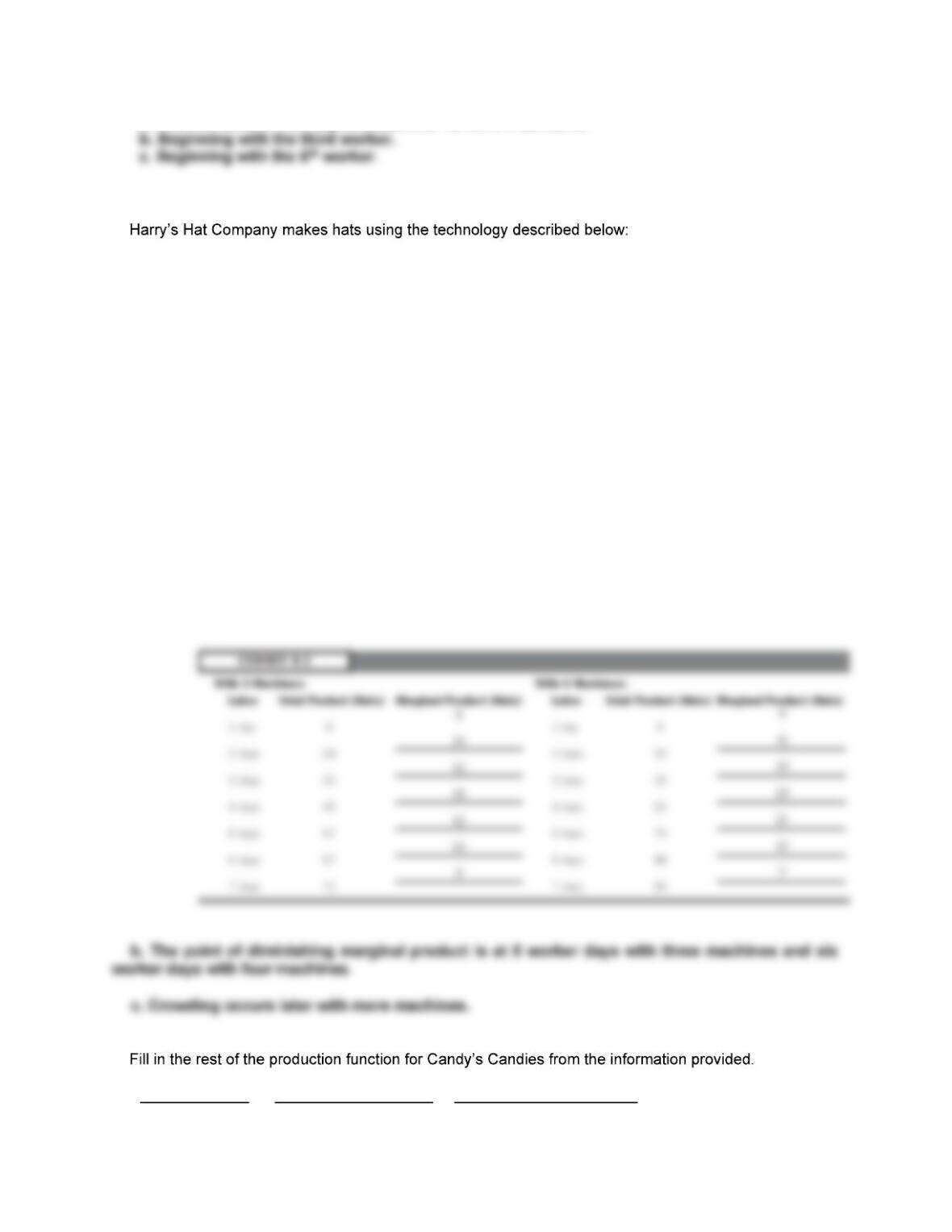
With 3 Machines With 4 Machines
Total Product Marginal Product Total Product Marginal Product
Labor (Hats) (Hats) Labor (Hats) (Hats)
1 day 8 ____________ 1 day 9 ____________
2 days 18 ____________ 2 days 20 ____________
3 days 30 ____________ 3 days 35 ____________
4 days 45 ____________ 4 days 55 ____________
5 days 57 ____________ 5 days 76 ____________
6 days 67 ____________ 6 days 88 ____________
7 days 72 ____________ 7 days 95 ____________
a. Fill in the Marginal Product columns of these tables.
b. At what point does diminishing marginal product set in with three machines? With four?
c. Why is the point of diminishing marginal product different in each case?
Answers
a. See Exhibit 8.1 below.
6.
Labor (workers) Total Product (pounds) Marginal Product (pounds)
0 0
1 20 20
2 44 24
3 62 18
4 74 12
5 80 6
6 78 -2
a. diminishing marginal product with which worker?
b. ginal product? If so, with the addition of which
worker?
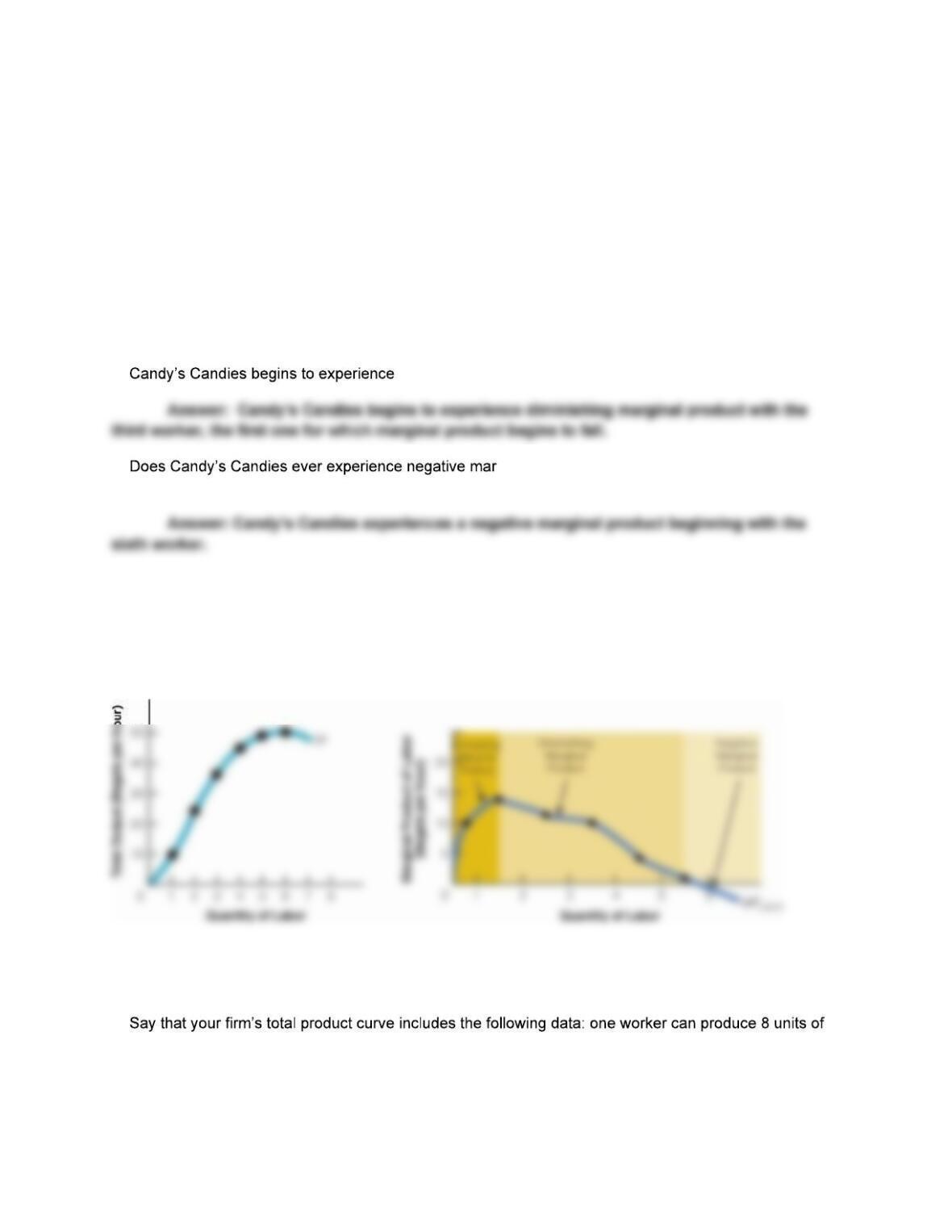
7. Draw a typically shaped total product curve and the marginal product curve derived from it, and
indicate the ranges of increasing, diminishing, and negative marginal product.
Answers:
8.
output; two workers, 20 units; three workers, 34 units; four workers, 50 units; five workers, 60 units; six
workers, 70 units; seven workers, 76 units; eight workers, 78 units; and nine workers, 77 units.
a. What is the marginal product of the seventh worker?
b. When does the law of diminishing product set in?
c. Under these conditions, would you ever choose to employ nine workers?
9. Why does the law of diminishing marginal product imply the law of increasing costs?
Answer: As a variable factor, such as labor, added to a given amount of the fixed factor,
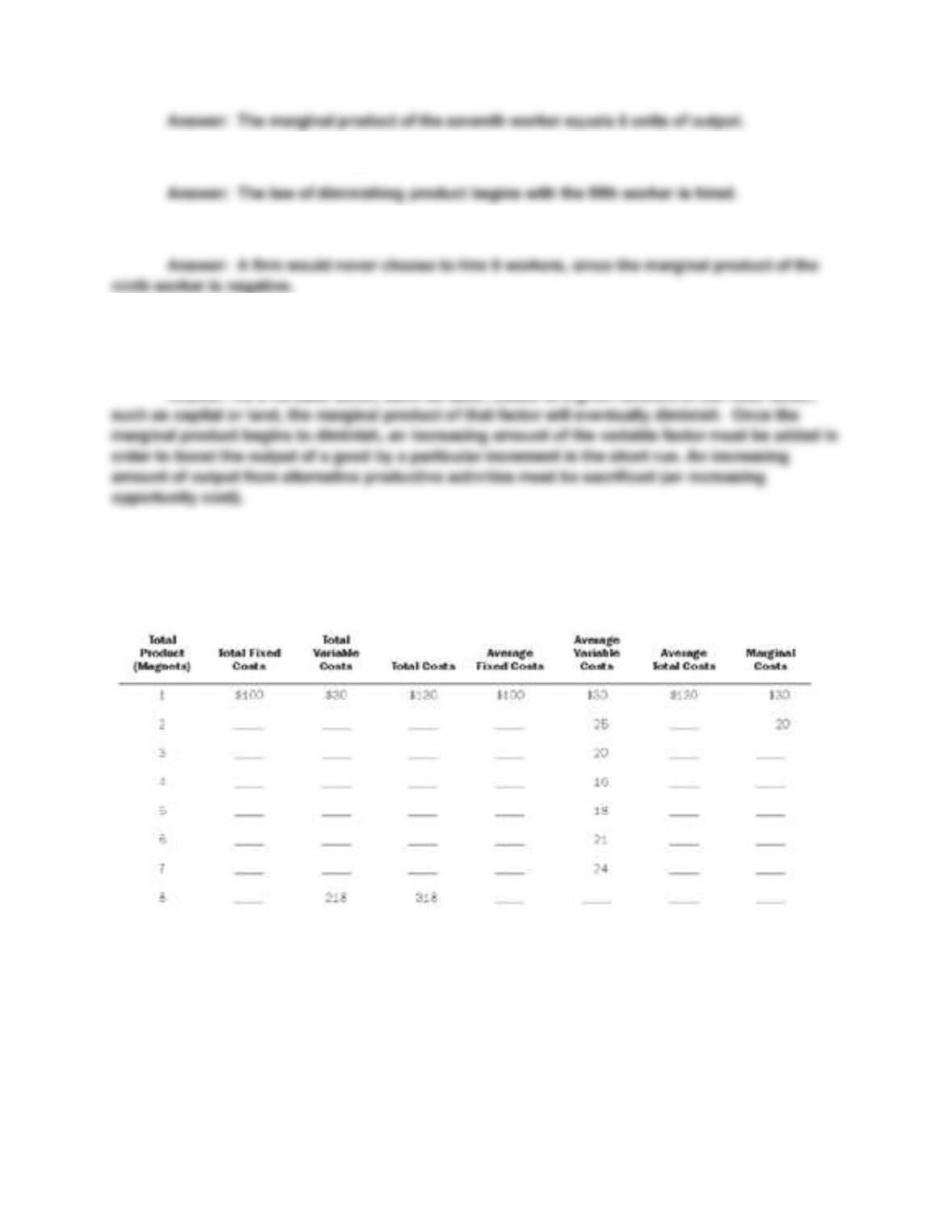
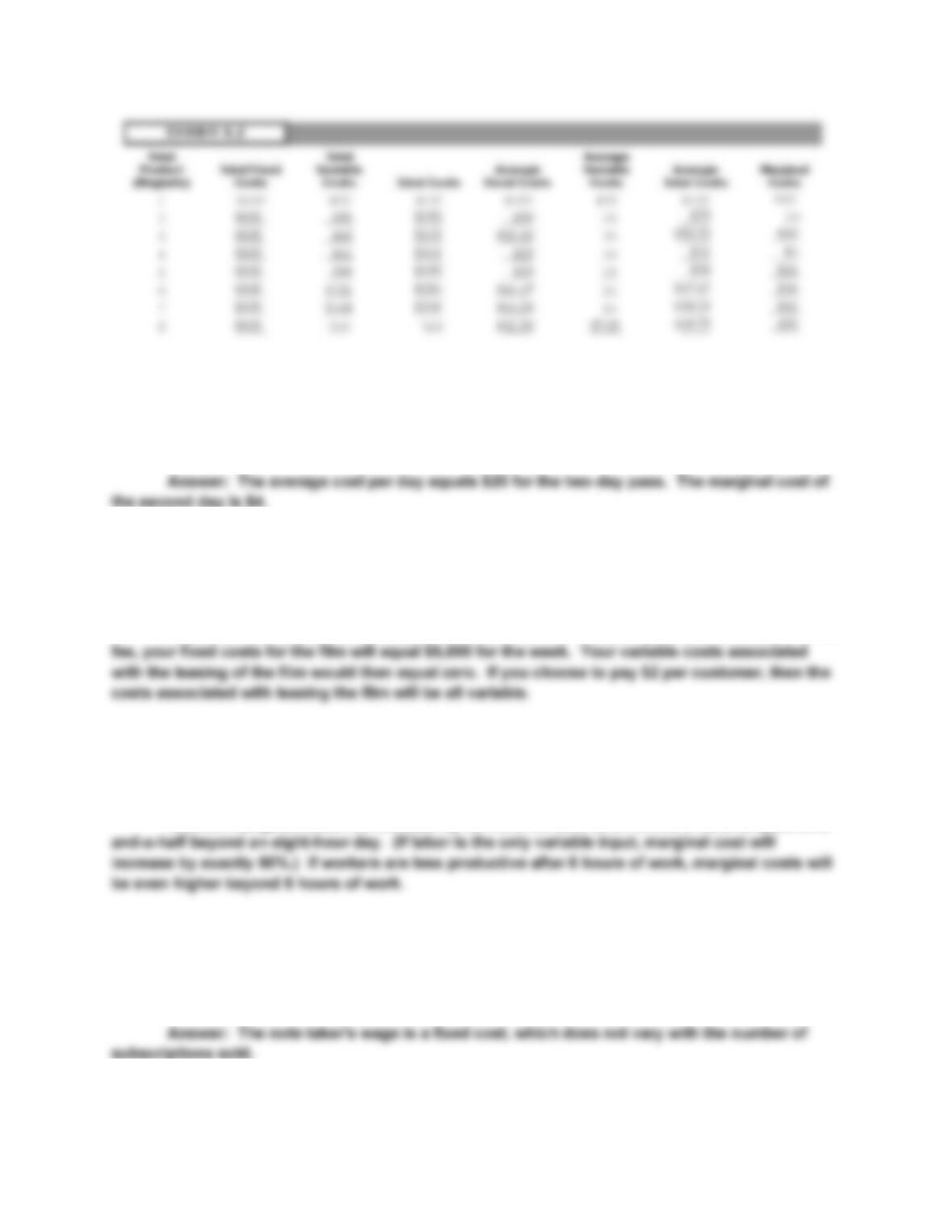
10. Complete the following table describing the short-run daily costs of the Attractive Magnet Co. for
2009.
Answer: See Exhibit 8.2 below.
11. A one-day ticket to visit the Screaming Coasters theme park costs $36, but you can also get a two–
consecutive-day ticket for $40. What is the average cost per day for the two–day ticket? What is the
marginal cost of the second consecutive day?
12. As a movie exhibitor, you can choose between paying a flat fee of $5,000 to show a movie for a week
and paying a fee of $2 per customer. Will your choice affect your fixed and variable costs? How?
Answer: Your choice will affect your fixed and variable costs. If you choose to pay the flat
13. What is likely to happen to your marginal costs when adding output requires working beyond an eight–
hour day, if workers must be paid time-and-a-half wages beyond an eight-hour day?
Answer: Marginal costs will increase by as much as 50% when workers must be paid time–
14. If your university pays lecture note takers $20 per hour to take notes in your economics class and
then sells subscriptions for $15 per student, is the cost of the lecture note taker a fixed or variable cost of
selling an additional subscription?
15. The Lighthouse Safety Vest Co. makes flotation vests for recreational boaters. They currently employ
50 people and produce 12,000 vests per month. Lighthouse managers know that when they hire one
more person, monthly vest production will increase by 200 vests. They pay workers $1600 per month.
a. What is the marginal product of the 51st worker?
b. What is the marginal cost to produce one more vest? (Hint: Think of the marginal cost as the additional
ided by the changes in output.)
c. If labor is the only variable factor of production, will the average variable cost of production rise or fall
as a result of hiring a 51st worker? Why?
d. What happens to the marginal cost of a vest when the fifty-second worker is added and the marginal
product drops to 160 vests per month?
Answers: a. The marginal product of the 51st worker is 200 vests per month. b. The
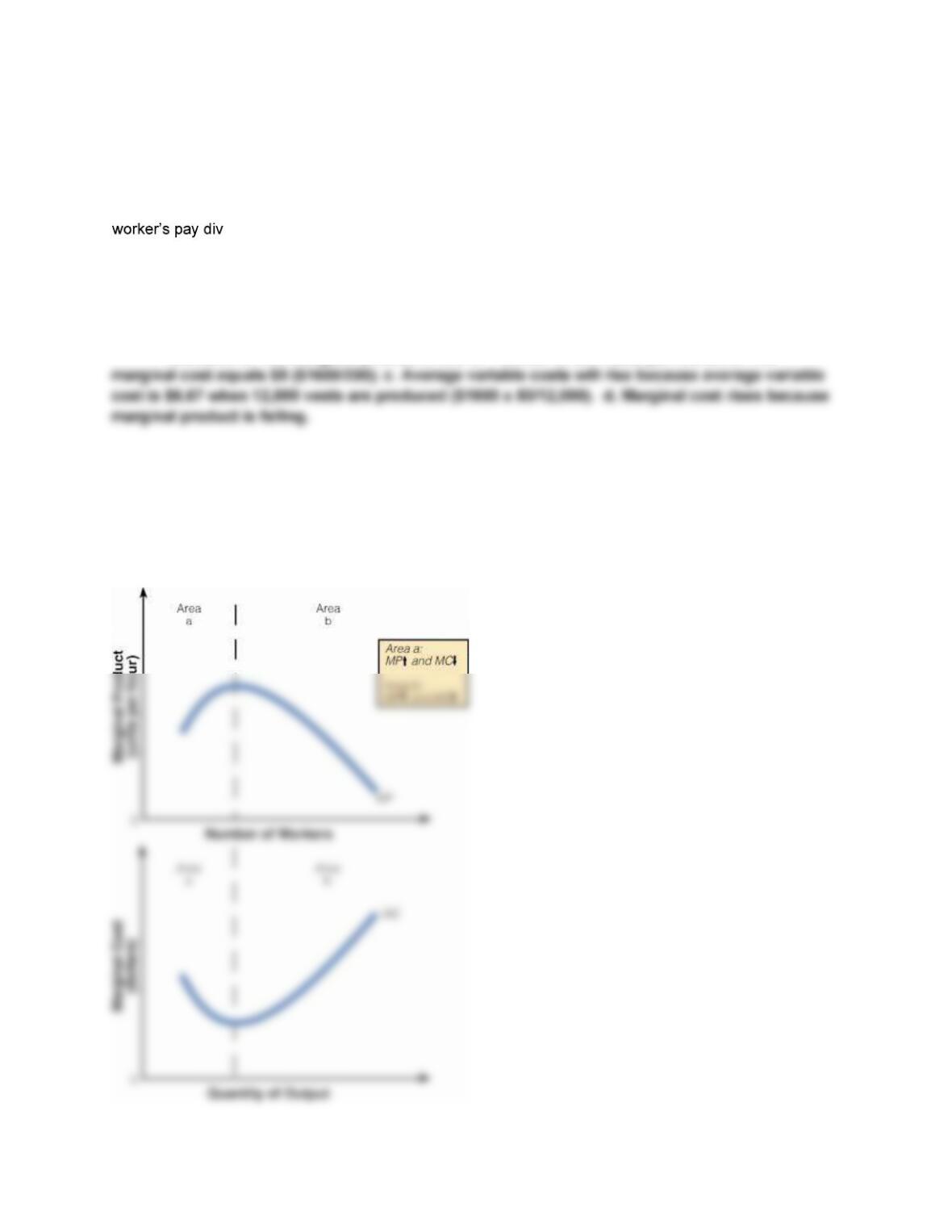
16. Illustrate how the shape of the marginal product curve relates to the shape of the marginal cost curve.
Answer:
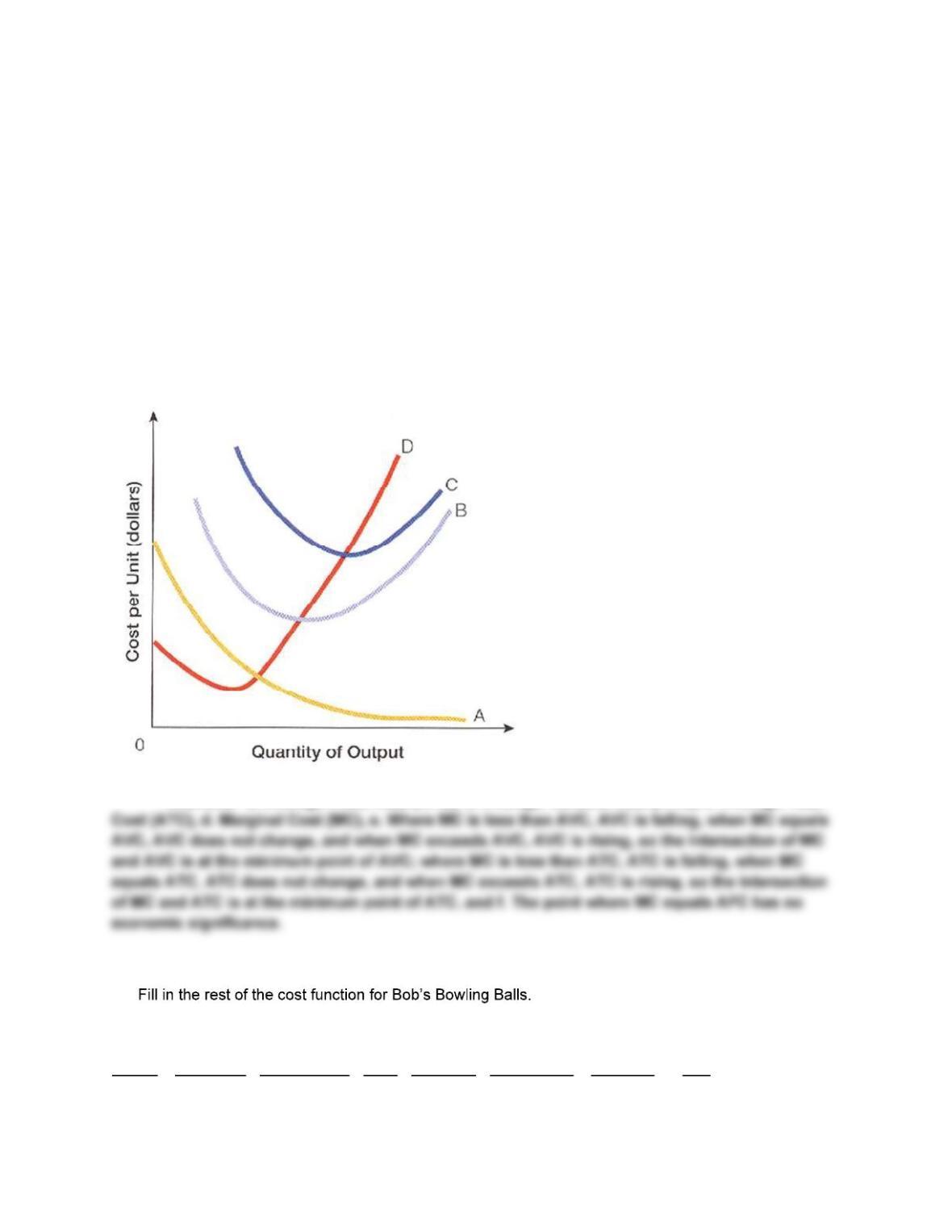
17. Use the graph to answer the following questions.
a. Curve A represents which cost curve?
b. Curve B represents which cost curve?
c. Curve C represents which cost curve?
d. Curve D represents which cost curve?
e. Why must curve D pass through the minimum points of both curve B and curve C?
f. What significance does the point where curve A intersects curve D have?
Answers: a. Average Fixed Cost (AFC), b. Average Variable Cost (AVC), c. Average Total
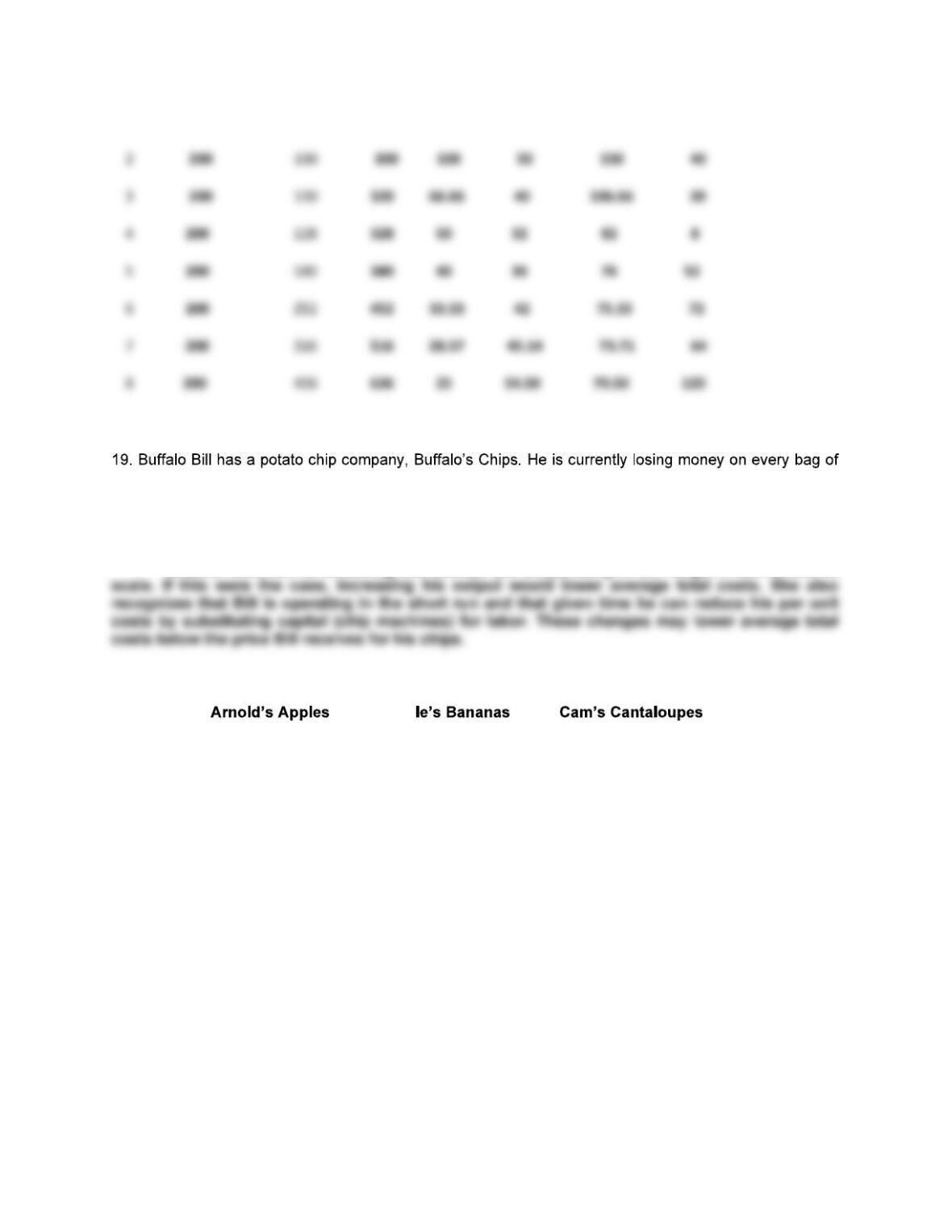
18.
Total Total Total Average Average Average Marginal
Output Fixed Costs Variable Costs Costs Fixed Cost Variable Cost Total Cost Cost
1 200 60 260 200 60 260 60
chips he sells. Mrs. Bill, who has just completed an economics class, tells Bill he could make a profit if he
adds more machines and produces more chips. How could this be possible? What is Mrs. Bill assuming
about the output range in which Bill is currently producing?
Answer: Mrs. Bill is assuming that Buffalo Bill is operating in the range of economies of
20. You have the following information about long-run total cost for the following firms:
Bel
Quantity LRTC LRTC LRTC
1 120 33 42
2 140 72 68
3 160 117 98
4 180 168 132
5 200 225 170
6 220 288 212
7 240 357 258
a. Do any of these firms experience constant returns to scale? How do you know?
b. Do any of these firms experience diseconomies of scale? How do you know?
c. Do any of these firms experience economies of scale? How do you know?
Answers:
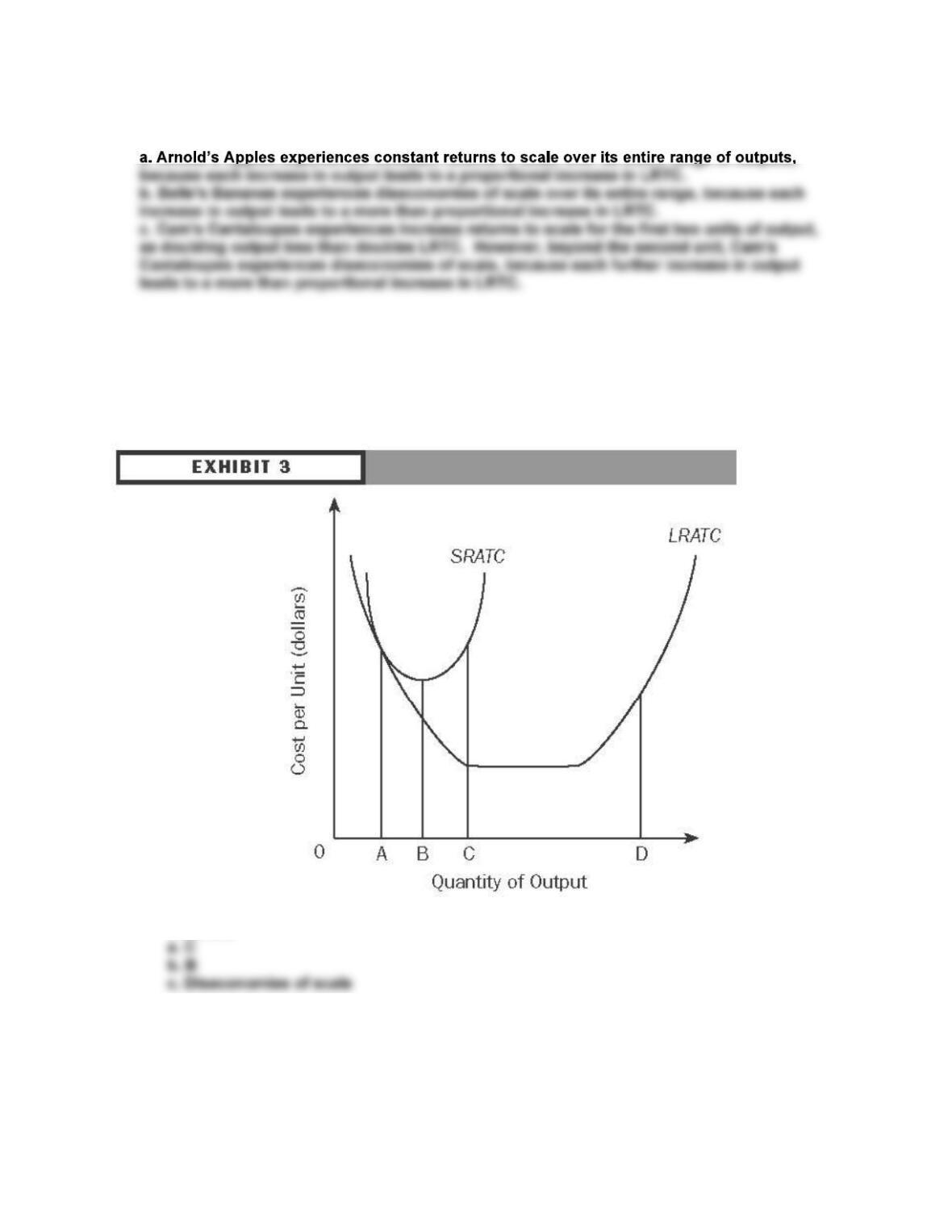
21. Refer to the cost curve in exhibit 3:
a. What is the lowest level of output at which the efficient scale of production is reached in the long run?
b. In the short described by SRATC, what is the efficient output level?
c. When the firm is producing at the level of output described by D, will it be experiencing constant returns
to scale, economies of scale or diseconomies of scale?
Answers: