
11 International Agreements: Trade, Labor, and the
Environment
Notes to Instructor
Chapter Summary
This chapter shows that without international agreements, countries have a strong
incentive to choose policies that could result in the prisoner’s dilemma. Namely, a
country would impose tariffs to benefit its own welfare. When all countries act in the
same manner, world welfare decreases due to the deadweight loss created from the trade
restrictions. To avoid this outcome, multilateral agreements such as the World Trade
Organization (WTO) promote free trade by requiring members to reduce tariffs. This
chapter also presents the difference between regional trade agreements such as free–trade
areas and customs unions. The discussion on regional trade agreements details the impact
on welfare when international pacts lead to either trade creation or trade diversion.
Also discussed in this chapter are international agreements on labor and the environment.
Global agreements on labor are controversial because they require judgment and
comparison of labor standards across countries.
2
Comments
This chapter presents topics that allow for class discussions. Although the benefits of
multilateral agreements over regional trade agreements are clear, students may be divided
over international agreements pertaining to labor and the environment. Encourage
Lecture Notes
Introduction
The year 2015 marked the birth and death of a number of international agreements. To
start, the international climate agreement (COP21) reached in Paris is one that commits
members to create national plans for reducing greenhouse gas emissions. A second new
agreement for free trade, the Trans–Pacific Partnership (TPP), is an agreement involving
3
Europe. On the other hand, the Doha Round (Doha Development Agenda or DDA) was
lost in 2015 as its goals were not reaffirmed at the Nairobi, Kenya, meeting.
The 2015 regional trade agreements like TTP and TTIP began in response to the failure
of the Doha Round agreement of WTO. Multilateral agreements may be more difficult to
establish with so many members, while smaller groups of regional partners with more in
1 Multilateral Trade Agreements
A trade agreement is a pact between two or more countries to reduce or eliminate trade
4
restrictions. The WTO is an example of a multilateral trade agreement. Under the most-
favored-nation (MFN) principle of the WTO, countries agree to extend the tariff set for
The Logic of Multilateral Trade Agreements
We will briefly review the effects of a tariff imposed by a large country under perfect
competition before analyzing the impact of trade agreements.
Tariffs for a Large Country Recall that a large importer may benefit by imposing a
tariff if the terms-of-trade gain (e) is greater than the sum of the consumption and
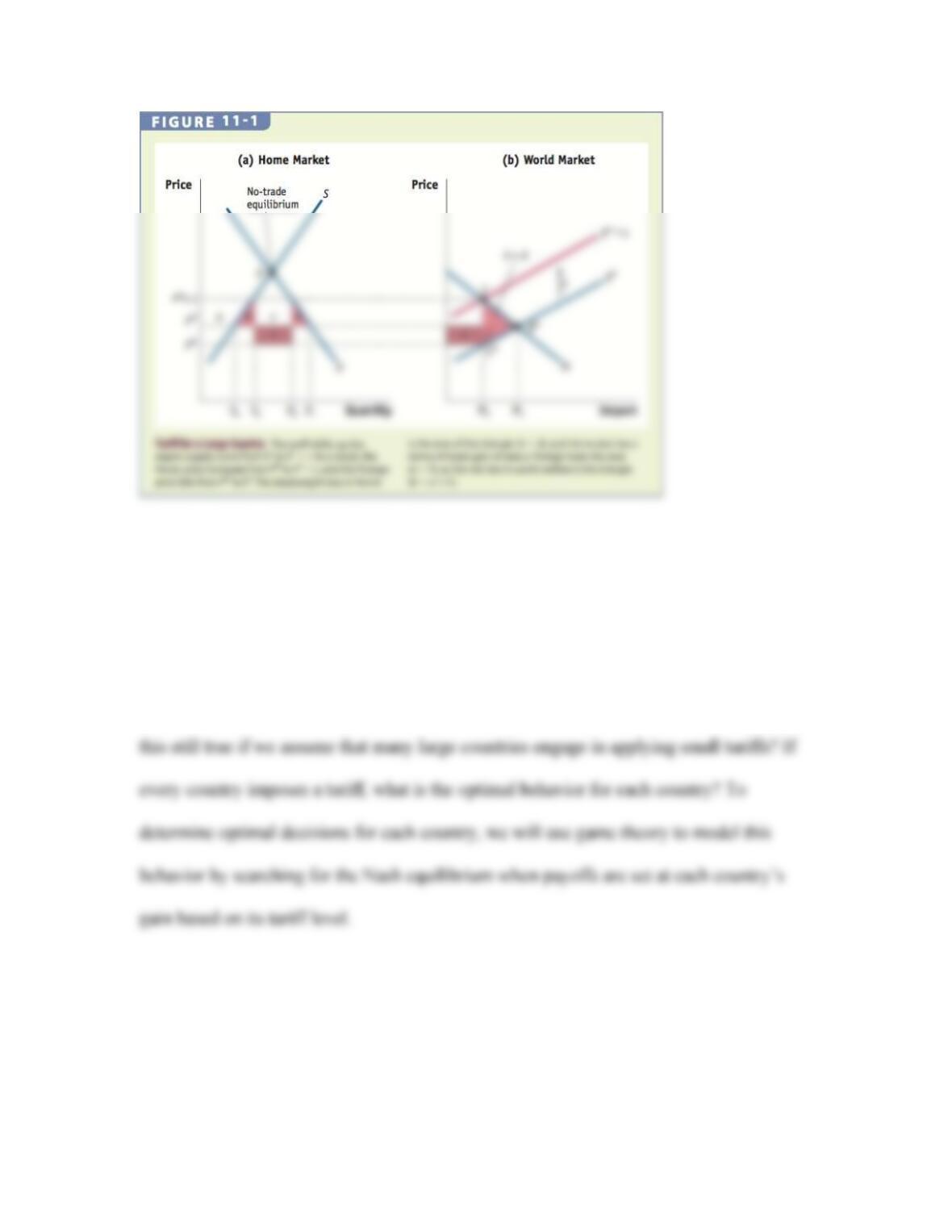
5
Payoff Matrix We will now use these results to analyze optimal behavior and strategic
interaction when multiple large countries apply tariffs. We will not examine the welfare
effects when multiple large countries engage in strategic interaction. In our previous
analysis, we found that it is optimal for large countries to engage in small tariffs. But, is
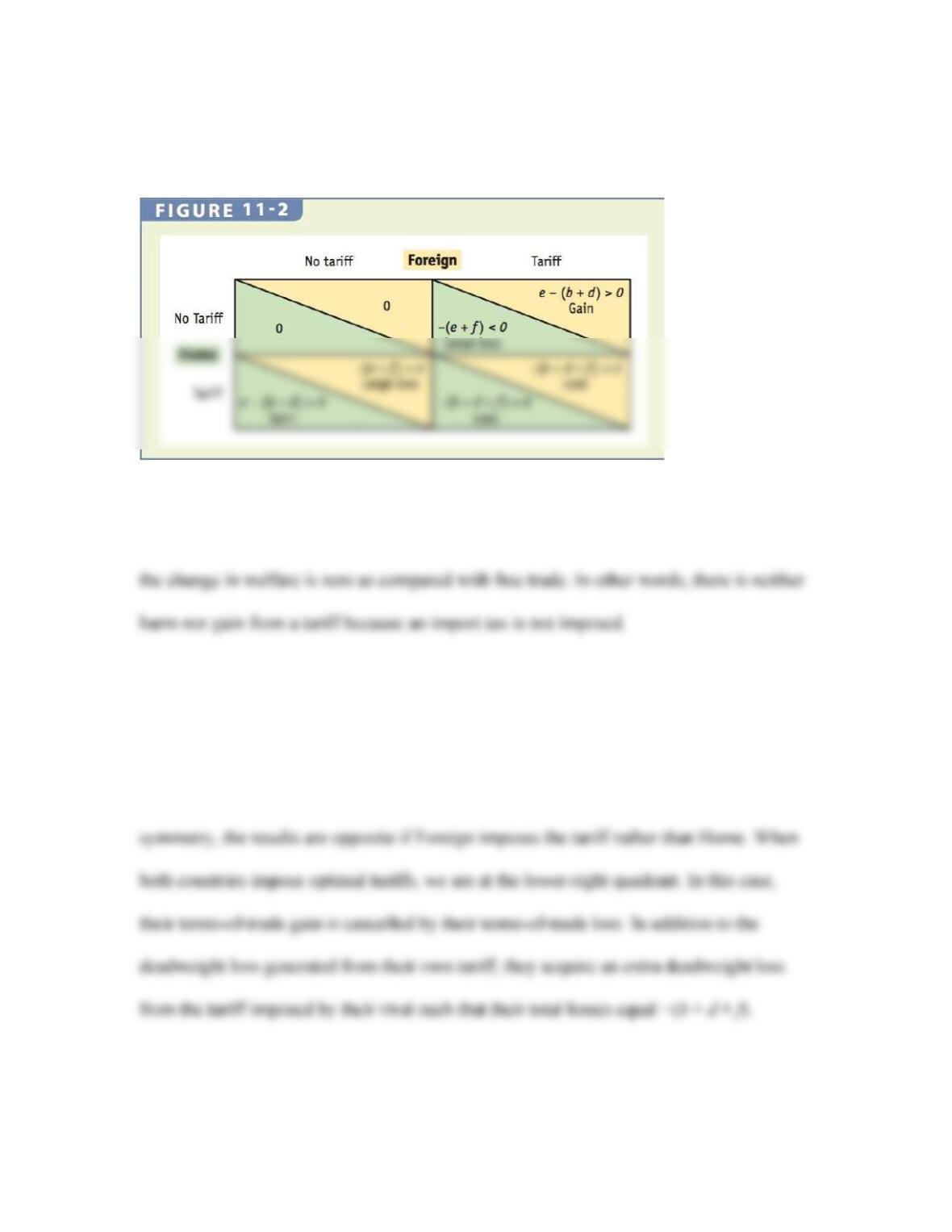
We now assume that both Home and Foreign are large countries and examine the change
in welfare when both decide whether to impose a tariff on the other. The payoff matrix is
shown in Figure 11-2, where the lower-left corner of each quadrant gives Home’s payoff
6
and the upper-left corner denotes Foreign’s payoff.
Free Trade Starting with the upper-left quadrant where neither country imposes a tariff,
Tariffs However, if Home imposes a tariff and Foreign does not, then the former
potentially gains relative to free trade as long as e − (b + d) > 0, whereas the latter loses
by the amount −(e + f), which is Foreign’s deadweight and terms-of-trade loss. By
Prisoner’s Dilemma The payoffs described in Figure 11-2 have a special structure called
7
the prisoner’s dilemma. It takes this name from the story of two accomplices caught for
a crime they committed, where each must decide to confess or remain silent in solidarity
Nash Equilibrium Working out the solution of the game, we find that both countries will
impose a tariff even though they are clearly better off when neither imposes the trade
restriction. Given their payoffs, neither country has an incentive to individually move
Trade Agreement By entering into a trade agreement such as the WTO, the prisoner’s
dilemma outcome is eliminated because all members agree to reduce or avoid imposing
tariffs on one another. Of course, in order to make these agreements, both countries must
8
In essence, if a country’s payoff matrix does not reflect a simple prisoner’s dilemma
where losses and gains are comparable or equal in size, or even if these payoffs are not
known, then trade agreements are much more difficult to establish.
H E A D L I N E S
Trade Talks Lead to “Death of Doha and Birth of New WTO”
At the meeting during the Nairobi, Kenya, “round”—as the WTO meetings are called—
frustration had become so acute that countries abandoned the original Doha Round goals
and instead focused on smaller specific trade issues, resulting in more success. Trade
9
2 Regional Trade Agreements
When countries within a region make a pact to eliminate tariffs, these arrangements are
referred to as regional trade agreements (RTAs). Under such agreements, member
countries reduce trade barriers on one another but may maintain separate tariffs against
nonmember countries. RTAs are permitted under Article XIV of the General Agreement
on Trade and Tariffs (GATT) as long as member countries do not jointly increase their
tariffs against outside members. These agreements are sometimes called preferential
trade agreements (PTAs) because member countries are favored over nonmembers,
hence violating the MFN principles of the GATT. Examples include the Dominican
Free–Trade Area A free-trade area (FTA) consists of a group of countries that agree to

10
The TPP and TTIP are both other such examples. TPP seeks to establish a free–trade area
among 12 countries that border the Pacific Ocean, and TTIP exists between Europe and
the United States.
Customs Union In addition to agreeing to eliminate tariffs, a customs union requires
another condition, that member countries hold a common tariff against the rest of the
world. The European Union (EU) is an example of a customs union, consisting of
Rules of Origin Although a free-trade area allows each country the flexibility to impose
different tariffs on the rest of the world, it creates an incentive for a nonmember country
to take advantage of the duty-free zone by first exporting to the member with the lowest
tariff. To counter this problem, NAFTA members’ trade areas establish rules of origin
11
Notice that customs unions do not have this issue because tariffs are identical on all
outside members and all countries in the union must abide by the established tariffs,
eliminating the incentive for outside countries to seek out the lowest-tariff country. While
H E A D L I N E S
Making the Case for Trade
Unlike past presidents, most U.S. presidential candidates in 2016 stood opposed to free
trade and an open economy. According to President–Elect Donald Trump, “Foreigners are
killing us on trade.” Democratic Party primary candidate Bernie Sanders suggested that
we have engaged in “disastrous trade agreements written by corporate America,” while
Republican Party primary candidate Ted Cruz argued that “we’re getting killed in
12
The fact is that nations benefit from free trade and agreements that encourage even freer
trade. Overall, countries and the world dos not benefit from protectionism. Research
indicates that agreements that drop barriers to trade ultimately increase national income.
According to one study by Peter Petri and Michael Plummer (2016), they have the
potential to boost it by 130 billion annually. The truth is that creation of trade barriers is
APPLICATION
The Trans–Pacific Partnership

13
The Trans–Pacific Partnership (TPP) is a large regional agreement that involves 12
nations, including Australia, Brunei, Canada, Chile, Japan, Malaysia, Mexico, New
Zealand, Singapore, the United States, and Vietnam. It is part of a larger Asian foreign
policy agenda and has been considered highly controversial. The “Headlines: Making the
Case for Trade” feature reviews the main arguments for free trade and argues the
following:
1. Freer trade results in a wider variety of goods at lower prices.
2. Firms engaged in trade tend to have higher wages than other firms.
4. Predicted gains from TPP are $130 billion per year and will amount to
Controversial Issues in the Trans–Pacific Partnership
Below is a summary of the main controversies surrounding the TPP agreement.
TPP Was Negotiated in Secret Among the most controversial criticisms lodged against
the TPP is that it was made in “secret,” and the agreement’s details were withheld from
Congress. It was on “fact-track” trade promotion authority, which means that the final
14
This may seem like an odd process and some have even suggested that it is somehow a
new approach. In fact, all such prior trade agreements have been made in secret and on
the so–called fast–track promotion authority. This kind of modulated process occurs
because negotiations tend to be very sensitive between nations, and once an agreement is
This is not to suggest that there are not important differences between TPP and previous
Dispute Settlement The WTO and regional trade agreements must establish means for
settling disputes when one country believes that another is violating their agreement.
Establishing these processes and procedures can be a sensitive issue with consumer
15
bypassing member nations’ court systems and relying on arbitration boards run by trade
agreements do give industries new power that lies outside the reach of any individual
Intellectual Property Protection TPP provides patents for 8 years or 5 years plus the
protection period established within each country. This is less than the 12 years
Organizations like Doctors Without Borders have also expressed concern over the high
prices that poor countries will face, and too often will not be able to afford, during the
years of protection. It is a difficult issue because in order to encourage the development
of medicine in the first place, means must be established to fairly compensate private
companies for their extensive R&D costs. Within the free market and most developed
Labor Rights TPP requires that member countries ban child labor, and allow workers to
form independent unions and to strike regardless of the labor policies within member
16
nations. This has required special agreements with nations that have weak laws or engage
in human trafficking. International human rights organizations, including Human Rights
Watch, have remained neutral on this issue as TPP’s new requirements are much more
Environment Protection Another important section of the TPP is devoted to
environmental protection laws. They require that member countries stand by the
Convention on International Trade in Endangered Species (CITES) agreement. This
Tariffs and Rules of Origin As discussed earlier, rules of origin must be established to
determine when a good may be sent duty-free. With NAFTA, if the product is identified
as made in North America, it may be shipped duty–free between Mexico, Canada, and the
17
Who Would Lose Without TPP If TPP is approved within the U.S. Congress and the
legislatures of the pact’s 11 other member states, and if at least 6 countries approve the
If TPP fails, what are the possible consequences? This agreement is part of a much larger
foreign policy goal for the United States in Asia. And since the TPP was written such that
any other nation may join, it provides a good means for the United States to establish a
Trade Creation and Trade Diversion We now discuss the economic effects of regional
trade agreements. When countries form a regional trade agreement that results in one
country importing from another member rather than producing the product on its own,
By contrast, trade diversion has a negative impact on nonmember countries because the
tariff reduction via the regional agreement leads one member to import from another
instead of outside exporters. Although producers of the exporting member gain from this
Numerical Example of Trade Creation and Diversion
The following numerical example shows the effect of a diversion using the NAFTA trade
agreement and assuming the United States imports auto parts from Mexico rather than
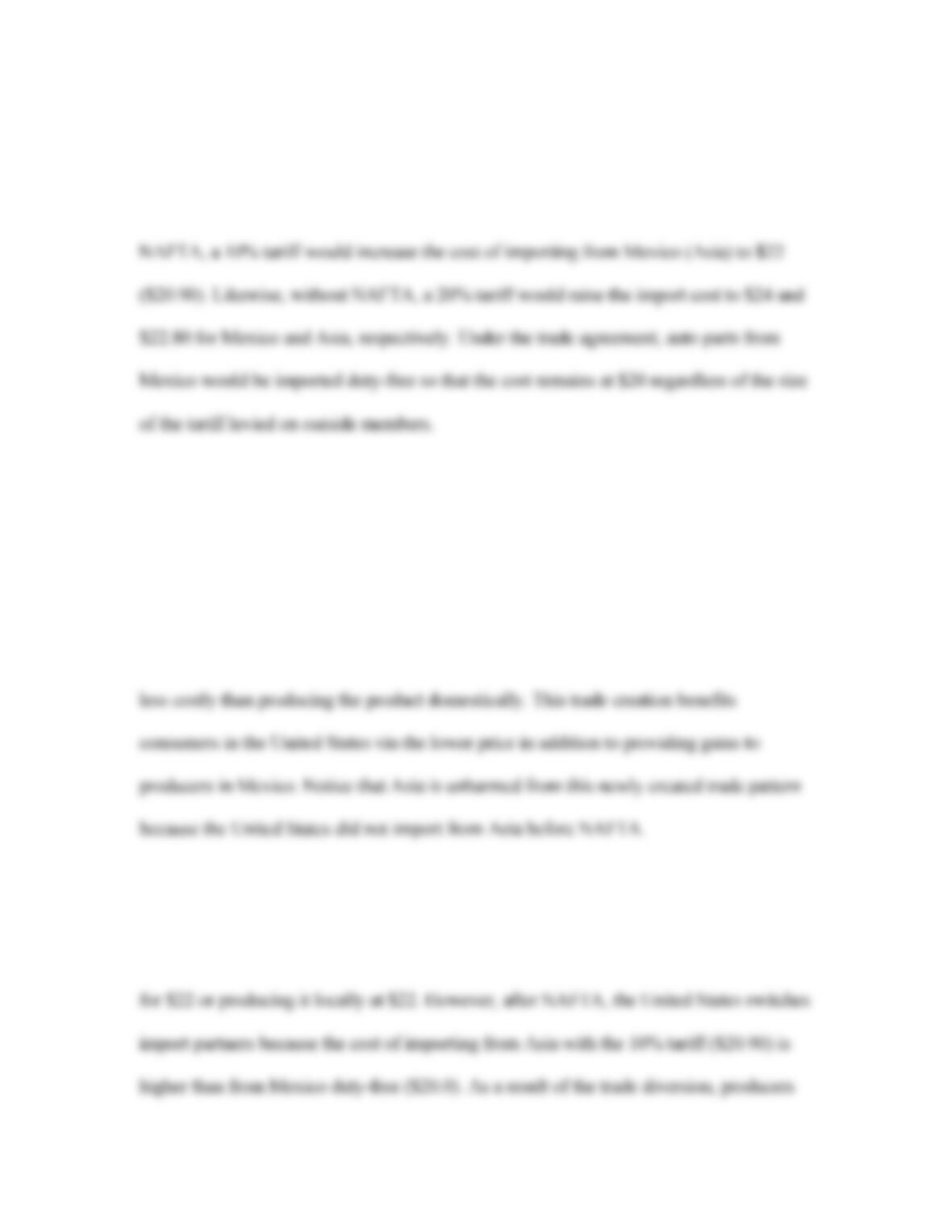
19
and a 20% tariff, respectively. Without barriers to trade, the United States would import
the product from the lowest-cost producer, namely Asia, for $19, rather than purchasing
from Mexico for $20 or producing the good domestically at a cost of $22. Prior to
Trade Creation Beginning with a 20% tariff before the formation of NAFTA, the United
States would find it cheaper to produce the product domestically ($22.0) than to import
auto parts from Mexico ($24) or Asia ($22.8). With the establishment of NAFTA, auto
part imports from Mexico enter duty–free and those from Asia are still subject to the 20%
tariff. Therefore, the United States will import auto parts from Mexico at $20, which is
Trade Diversion Now consider the tariff at 10%. The least costly option for the United
States, before NAFTA, is to import the product from Asia for $20.90 instead of Mexico
20
in Mexico are better off but those in Asia are worse off. For the United States, before
NAFTA, it imported from Asia at a price of $19 and received $1.90 per unit from the
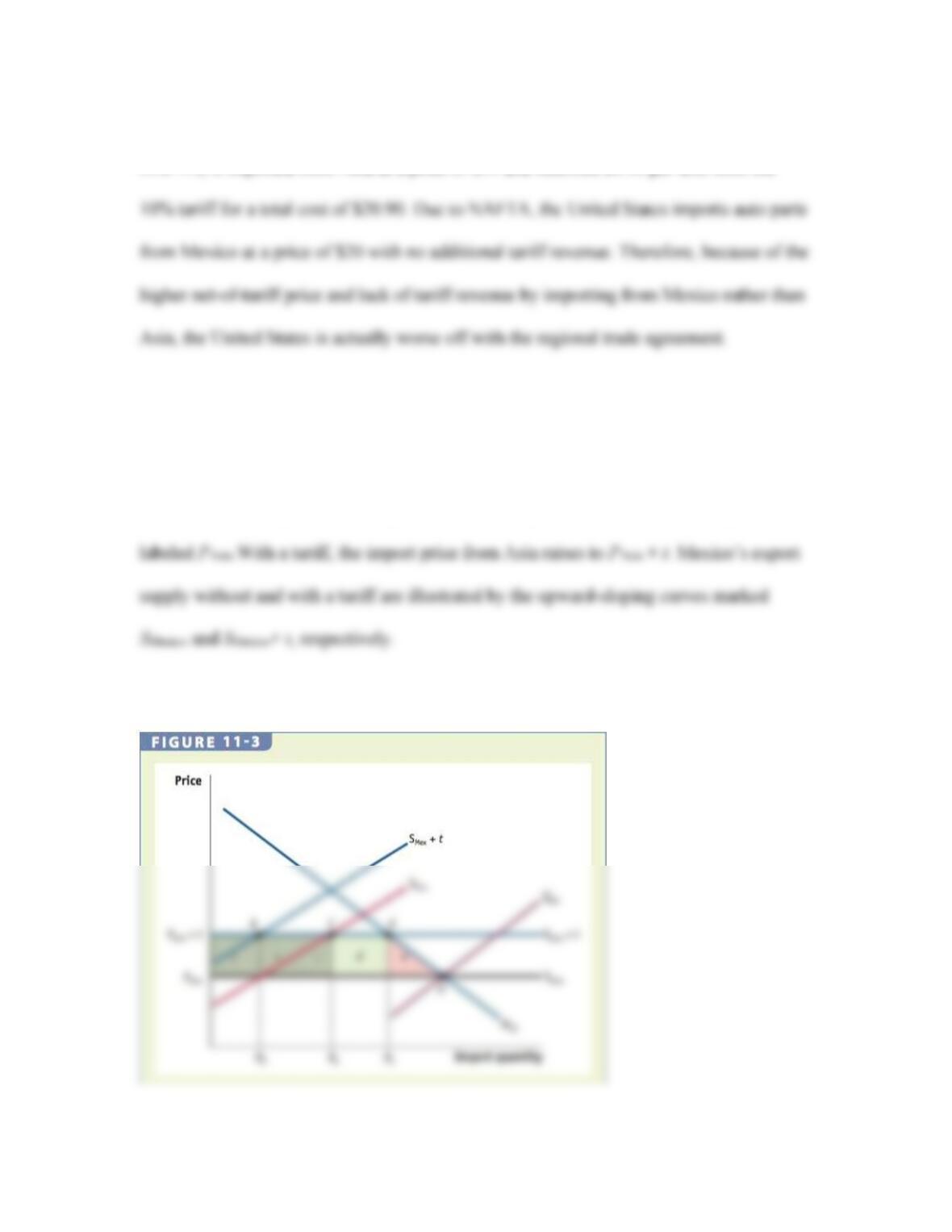
Trade Diversion in a Graph
For the graphical analysis of trade diversion (Figure 11-3), we assume that the United
States is a small importer of auto parts, as denoted by the horizontal free-trade price