Chapter 11W – Technology, R&D, and Efficiency
11W-1
Chapter 11W Technology, R&D, and Efficiency
QUESTIONS
1. What is meant by technological advance, as broadly defined? How does technological advance
enter into the definition of the very long run? Which of the following are examples of
technological advance, and which are not: an improved production process; entry of a firm into a
profitable purely competitive industry; the imitation of a new production process by another firm;
an increase in a firm’s advertising expenditures? LO1
Answer: Technological advance is broadly defined as new and better goods and services
and new and better ways of producing or distributing them. There is a distinction
2. Listed below are several possible actions by firms. Write “INV” beside those that reflect
invention, “INN” beside those that reflect innovation, and “DIF” beside those that reflect
diffusion. LO1
a. An auto manufacturer adds “heated seats” as a standard feature in its luxury cars to keep pace
with a rival firm whose luxury cars already have this feature.
b. A television production company pioneers the first music video channel.
c. A firm develops and patents a working model of a self‐erasing whiteboard for classrooms.
d. A light bulb firm is the first to produce and market lighting fixtures with LEDs (light emitting
diodes).
e. A rival toy maker introduces a new Jezebel doll to compete with Mattel’s Barbie doll.
Answer:
(a) DIF: Another firm was already using heated seats in their automobiles
3. Contrast the older and the modern views of technological advance as they relate to the
economy. What is the role of entrepreneurs and other innovators in technological advance? How
does research by universities and government affect innovators and technological advance? Why
do you think some university researchers are becoming more like entrepreneurs and less like
“pure scientists”? LO2
Chapter 11W – Technology, R&D, and Efficiency
11W-2
Answer: The older view of technological advance was that it was external to the
economy; a random outside force to which the economy adjusted. Scientific and
technological advances were fortuitous and helpful but largely external to the market
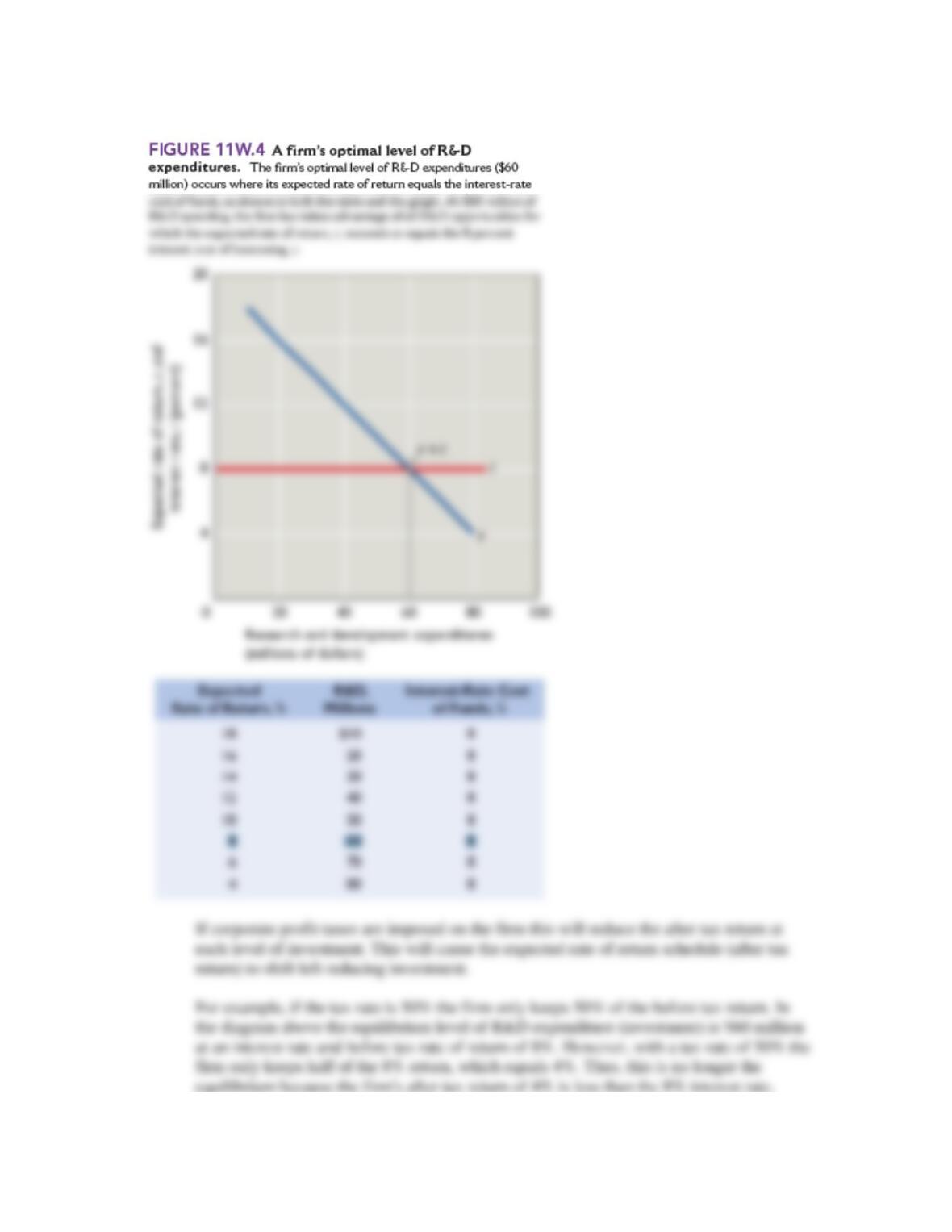
4. Consider the effect that corporate profit taxes have on investing. Look back at Figure 11W.4.
Suppose that the r line is the rate of return a firm earns before taxes. If corporate profit taxes are
imposed, the firm’s after‐tax returns will be lower (and the higher the tax rate, the lower the
after‐tax returns). If the firm’s decisions about R&D spending are based on comparing after‐tax
returns with the interest‐rate costs of funds, how will increased corporate profit taxes affect R&D
spending? Does this effect modify your views on corporate profit taxes? Discuss. LO3
Chapter 11W – Technology, R&D, and Efficiency
11W-3
Answer:
Chapter 11W – Technology, R&D, and Efficiency
11W-4
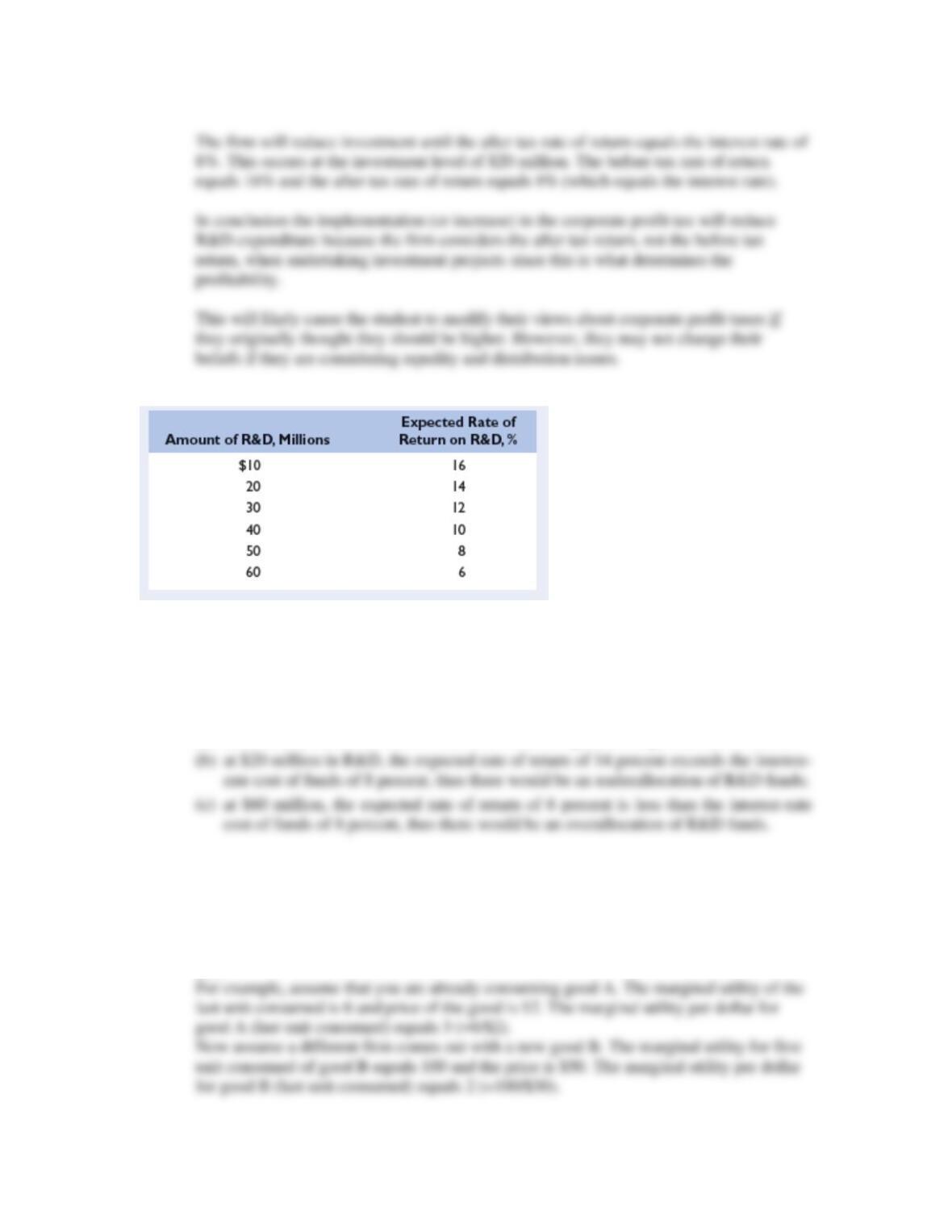
5. Answer the following lettered questions on the basis of the information in this table: LO3
a. If the interest‐rate cost of funds is 8 percent, what will be the optimal amount of R&D spending
for this firm?
b. Explain why $20 million of R&D spending will not be optimal.
c. Why won’t $60 million be optimal either?
Answer:
(a) $50 million, where the interest-rate cost of funds equals the expected rate of return.
6. Explain: “The success of a new product depends not only on its marginal utility but also on its
price.” LO3
Answer: A new product may have a high level of marginal utility per unit consumed.
However, if this product also has a high price the marginal utility per dollar may still be
low.
Chapter 11W – Technology, R&D, and Efficiency
11W-5
7. Learning how to use software takes time. So once customers have learned to use a particular
software package, it is easier to sell them software upgrades than to convince them to switch to
new software. What implications does this have for expected rates of return on R&D spending for
software firms developing upgrades versus firms developing imitative products? LO4
Answer: Expenditures on R&D carry a great deal of risk. Upgrading an existing product
is likely to be less risky than developing an imitated product. Consumers value their time
8. Why might a firm making a large economic profit from its existing product employ a
fast‐second strategy in relationship to new or improved products? What risks does it run in
pursuing this strategy? What incentive does a firm have to engage in R&D when rivals can
imitate its new product? LO4
Answer: A dominant firm that is making large profits from its existing products may let
smaller firms in the industry incur the high costs of product innovation while it closely
Chapter 11W – Technology, R&D, and Efficiency
11W-6
9. Do you think the overall level of R&D would increase or decrease over the next 20 to 30 years
if the lengths of new patents were extended from 20 years to, say, “forever”? What if the duration
were reduced from 20 years to, say, 3 years? LO4
Answer: If patent rights were extended indefinitely the motivation to spend on R&D
could increase for two reasons. First the extended patent rights would add to their
10. Make a case that neither pure competition nor pure monopoly is conducive to a great deal of
R&D spending and innovation. Why might oligopoly be more favorable to R&D spending and
innovation than either pure competition or pure monopoly? What is the inverted‐U theory of
R&D, and how does it relate to your answers to these questions? LO5
Answer: For a purely competitive firm, the expected rate of return on R&D may be low
or even negative. Because of easy entry, its profit rewards from innovation may quickly
Chapter 11W – Technology, R&D, and Efficiency
11W-7
11. Evaluate: “Society does not need laws outlawing monopolization and monopoly. Inevitably,
monopoly causes its own self‐destruction since its high profit is the lure for other firms or
entrepreneurs to develop substitute products.” LO6
Answer: Innovation can reduce or even disintegrate existing monopoly power by
producing competition where there was none. According to Schumpeter, a new innovator
12. LAST WORD Identify a specific example of each of the following in this chapter’s Last
Word: (a) entrepreneurship, (b) invention, (c) innovation, and (d) diffusion.
Answer:
(a) 1985- Ted Waitt starts a mail-order personal computer business (Gateway 2000) in
his South Dakota barn.
PROBLEMS
1. Suppose a firm expects that a $20 million expenditure on R&D this year will result in a new
product that will increase its profit next year by $1 million. LO3
a. What is the expected rate of return on this R&D expenditure?
b. Suppose the firm can get a bank loan at 6 percent interest to finance its $20 million R&D
project. Will the firm undertake the project?
c. Now suppose the interest‐rate cost of borrowing, in effect, falls to 4 percent because the firm
decides to use its own retained earnings to finance the R&D. Will this lower interest rate change
the firm’s R&D decision?
d. Now suppose that the firm has savings of $20 million—enough money to fund the R&D
expenditure without borrowing. If the firm has the chance to invest this money either in the R&D
project or in government bonds that pay 3.5 percent per year, which should it do?
e. What if the government bonds were paying 6.5 percent per year?
Feedback: Consider the following example. Suppose a firm expects that a $20 million
expenditure on R&D this year will result in a new product that will increase its profit next
year by $1 million.
Chapter 11W – Technology, R&D, and Efficiency
11W-8
a. What is the expected rate of return on this R&D expenditure?
The expected rate of return equals the (expected) profit from the R&D divided by the
b. Suppose the firm can get a bank loan at 6 percent interest to finance its $20 million
R&D project. Will the firm undertake the project?
The firm will not borrow at a rate greater than the expected rate of return. Since the bank
c. Now suppose the interest‐rate cost of borrowing, in effect, falls to 4 percent because
the firm decides to use its own retained earnings to finance the R&D. Will this lower
interest rate change the firm’s R&D decision?
The firm will borrow at a rate less than the expected rate of return. Since the bank loan
d. Now suppose that the firm has savings of $20 million—enough money to fund the
R&D expenditure without borrowing. If the firm has the chance to invest this money
either in the R&D project or in government bonds that pay 3.5 percent per year, which
should it do?
The firm will invest its savings where the return is the highest. Since government bonds
e. What if the government bonds were paying 6.5 percent per year?
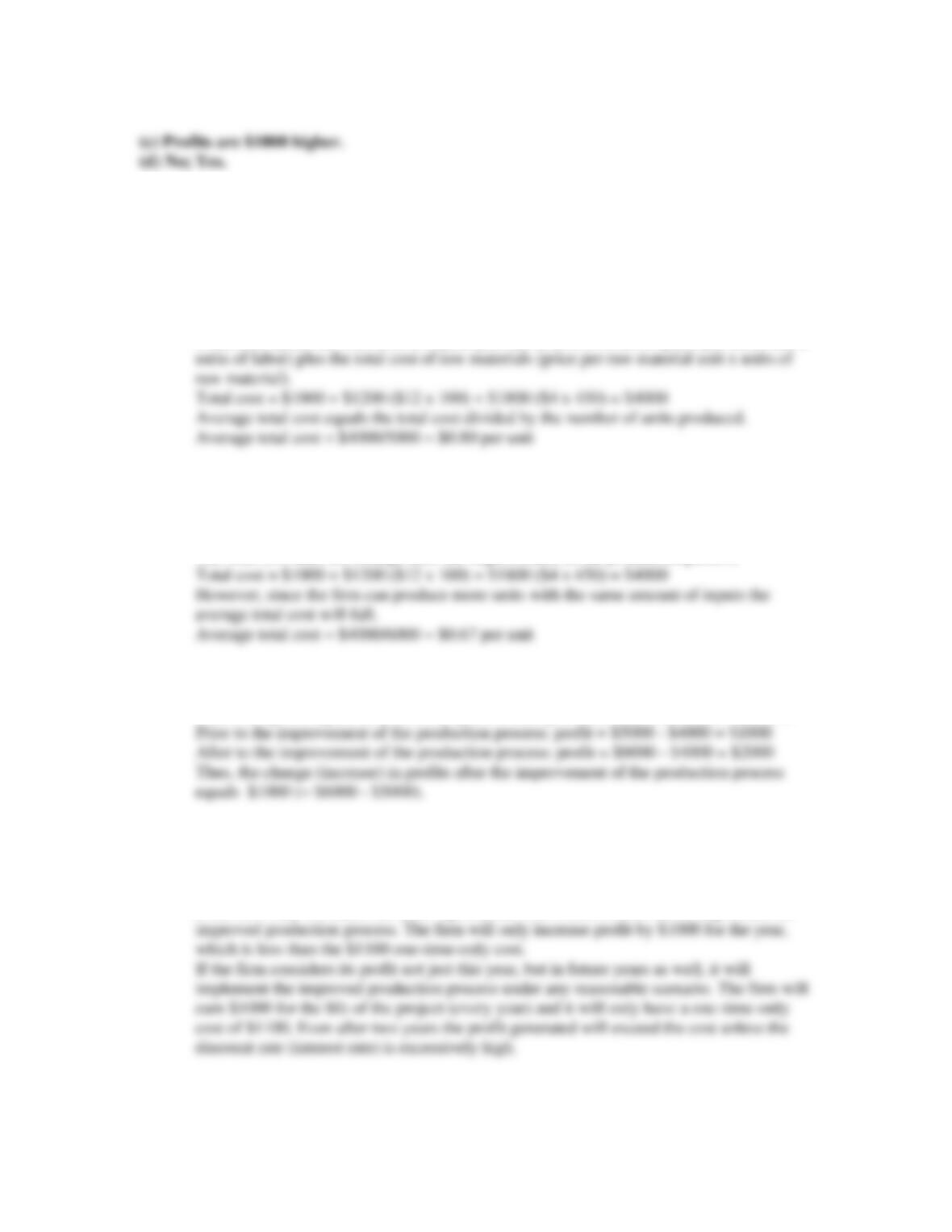
2. A firm faces the following costs. Its total cost of capital = $1000; its price paid for labor = $12
per labor unit; and its price paid for raw materials = $4 per raw‐material unit. LO3
a. Suppose the firm can produce 5000 units of output this year by combining its fixed capital with
100 units of labor and 450 units of raw materials. What are the total cost and average total cost of
producing the 5000 units of output?
b. Now assume the firm improves its production process so that it can produce 6000 units of
output this year by combining its fixed capital with 100 units of labor and 450 units of raw
materials. What are the total cost and average total cost of producing the 6000 units of output?
c. If units of output can always be sold for $1 each, then by how much does the firm’s profit
increase after it improves its production process?
d. Suppose that implementing the improved production process would require a one-time-only
cost of $1100. If the firm only considers this year’s profit, would the firm implement the
improved production process? What if the firm considers its profit not just this year but in future
years as well?
Chapter 11W – Technology, R&D, and Efficiency
11W-9
Feedback: Consider the following example. A firm faces the following costs. Its total
cost of capital = $1000; its price paid for labor = $12 per labor unit; and its price paid for
raw materials = $4 per raw‐material unit.
a. Suppose the firm can produce 5000 units of output this year by combining its fixed
capital with 100 units of labor and 450 units of raw materials. What are the total cost and
average total cost of producing the 5000 units of output?
Total cost equals the total cost of capital plus the total cost of labor (price per labor unit x
b. Now assume the firm improves its production process so that it can produce 6000 units
of output this year by combining its fixed capital with 100 units of labor and 450 units of
raw materials. What are the total cost and average cost of producing the 6000 units of
output?
The total cost does not change after the improvement in the production process.
c. If units of output can always be sold for $1 each, then by how much does the firm’s
profit increase after it improves its production process?
The firm’s profit equals total revenue (price x units produced and sold) minus total cost.
d. Suppose that implementing the improved production process would require a one-time-
only cost of $1100. If the firm only considers this year’s profit, would the firm
implement the improved production process? What if the firm considers its profit not just
this year but in future years as well?
If the firm only considers this year’s profit, the firm would choose not to implement the