Chapter 11
Classical and Keynesian Macro Analyses
◼ Overview
The purpose of this chapter is to lay the foundation for macroeconomic theory and policy. Definitions,
assumptions, and terminology used during the next eight chapters are introduced. The classical model is
introduced first, where the short-run equilibrium real GDP and the price level is developed. Then the basics
of the Keynesian model are presented, introducing the language and key relationships necessary for an
◼ Learning Objectives
After studying this chapter, students should be able to:
• 11.1 Describe the short-run determination of equilibrium real GDP and the price level in the classical
model
◼ Outline
I. The Classical Model: This model, which traces its origins to the 1770s, was the first systematic
attempt to explain the determinants of the price level and the national levels of output, income,
employment, consumption, saving, and investment.
A. Say’s Law: Supply creates its own demand, or desired aggregate expenditures will equal actual
aggregate expenditures.
1. The Implication of Say’s Law: People only produce more goods than they want because
2. Say’s Law in a Modern Economy: In a modern economy, money is used instead of
158 Miller • Economics Today, Nineteenth Edition
B. Assumptions of the Classical Model: Supply creates its own demand, or desired expenditures
will equal actual expenditures. There are four major assumptions:
2. Wages and prices are flexible: Prices, wages, and interest rates are free to move to the
3. People are motivated by self-interest: Businesses want to maximize their profits and
C. Equilibrium in the Credit Market: When income is saved, it is not reflected in product demand.
Consumption expenditures can fall short of total output when saving occurs. The classical
1. The Relationship between Saving and Investment: The classical economists believed
that each dollar saved would be invested by business.
2. The Equilibrium Interest Rate: Equilibrium between the saving plans of consumers
D. Equilibrium in the Labor Market: In the classical model, if an excess quantity of labor
1. The Relationship between Employment and Real GDP: The level of employment in
an economy determines, other things held constant, its real GDP. (See Table 11-1.)
E. Classical Theory, Vertical Aggregate Supply, and the Price Level: In the classical model,
long-term involuntary unemployment is impossible. Say’s law, coupled with flexible interest
1. Effect of an Increase in Aggregate Demand in the Classical Model: There will be an
2. Effect of a Decrease in Aggregate Demand in the Classical Model: There will be a
decrease in the price level as wages fall due to a decrease in the demand for labor, which
II. Keynesian Economics and the Keynesian Short-Run Aggregate Supply Curve: John Maynard
Keynes and his followers argued that prices, especially the price of labor, were inflexible downward
due to the existence of unions and long-term contracts. This means that prices were “sticky.”
Chapter 11 Classical and Keynesian Macro Analyses 159
A. Demand-Determined Real GDP: On the horizontal portion of the aggregate supply curve, a
B. The Keynesian Short-Run Aggregate Supply Curve: A horizontal short-run aggregate
supply curve is called the Keynesian short-run aggregate supply curve. According to Keynes,
C. Output Determination Using Aggregate Demand and Aggregate Supply: An increase in
aggregate demand using the Keynesian SRAS curve results in real GDP increasing by the
amount of the increase in aggregate demand.
1. An Upward-Sloping Short-Run Aggregate Supply Curve: When the price level can
2. Explaining the Short-Run Aggregate Supply Curve’s Upward Slope
a. Flexibility of hours and work: Employers can require workers to work more hours
III. Shifts in the Aggregate Supply Curve: A core class of events cause a shift in both
the short-run and long-run aggregate supply curves. (See Table 11-2.)
A. Shifts in Both Short-and Long-Run Aggregate Supply: Any change in the endowments of
IV. Consequences of Changes in Aggregate Demand: Aggregate demand shocks are any unanticipated
shocks that cause the aggregate demand curve to shift inward or outward. Aggregate supply shocks
are any unanticipated shocks that cause the aggregate supply curve to shift inward or outward.
A. When Aggregate Demand Falls While Aggregate Supply Is Stable: A decrease in AD will
decrease the price level and real GDP. If equilibrium real GDP is at less than full employment
B. Short–Run Effects When Aggregate Demand Increases: The price level and real GDP
V. Explaining Short-Run Variations in Inflation
A. Demand-Pull versus Cost-Push Inflation: Inflation caused by increases in AD that are not
160 Miller • Economics Today, Nineteenth Edition
B. Aggregate Demand and Supply in an Open Economy: The effect of exchange rates and trade
with the rest of the world has an impact on both the aggregate supply and the aggregate demand
curves.
2. How a Stronger Dollar Affects Aggregate Demand: A stronger dollar decreases the
3. The Net Effects on Inflation and Real GDP: An increase in aggregate demand and a
◼ Points to Emphasize
The Classical Model
The classical model predicted that capitalism contained mechanisms that were capable of ensuring full
employment of labor and other resources. Pre-Great Depression economists felt that wants were unlimited
and that inadequate aggregate demand would be unlikely. The classical economists believed that the
market value of final goods and services generates income identical to the value of the goods produced.
Thus production will always create enough purchasing power to buy the goods and services produced,
Keynes’s Criticisms of the Classical Model
First, Keynes pointed out, price-wage flexibility does not exist in modern capitalist societies, given
unions, welfare states, and monopolistic corporate power. Second, he noted that neither saving nor
Chapter 11 Classical and Keynesian Macro Analyses 161
investment were primarily determined by the rate of interest. Planned saving and consumption are
The Keynesian Range of the Aggregate Supply Curve
Keynes argued that people react to changes in real variables, not to changes in nominal ones. During
the Great Depression levels of unemployment were high. Keynes assumed that because so much
The Effect on an Open Economy
It is relatively easy to see the effect of a weaker dollar on aggregate demand. Students can relate to the fact
of higher dollar prices on imported consumer goods resulting from a dollar depreciation because most of
them buy some imported goods. They may need an example of the effect of a weaker dollar on aggregate
◼ For Those Who Wish to Stress Theory
The Classical Aggregate Supply Curve
The conclusions from the analysis in the classical model lead logically to a vertical aggregate supply
Wage-Price Flexibility
The classical economists argued that wage and price flexibility would assure full employment. Keynes
pointed out that if both the money wage and the price level fell because of declining labor costs, it is not
162 Miller • Economics Today, Nineteenth Edition
Keynes and the Classical Economists: Short Run versus the Long Run
Much of the debate between Keynes and the classical economists revolves around the issue of the speed
of adjustment. Because of rigidities in the economy, it takes time for changes in AD to affect the level of
◼ Further Questions for Class Discussion
1. How can the existence of a minimum wage contribute to a Keynesian SRAS curve? If a minimum
2. Suppose that the value of the dollar gets weaker, i.e., depreciates. Explain the effect on the SRAS
and AD curves. What will happen to the price level and to real GDP? In this case, the weaker
3. The Obama administration strongly supports the idea of increasing U.S. marginal tax rates on
high incomes. If these tax cuts were to be implemented, what would likely happen to equilibrium
real GDP and the price level? Explain. Higher marginal tax rates would decrease the incentive
4. Suppose that the federal government decides to increase spending, helping qualified lower-
income students, who otherwise could not afford to go to college, to attend one. Explain the
5. In the 2008 presidential race, the Democrats argued that increasing U.S. barriers to international
trade were desirable to protect the jobs of U.S. workers from “unfair foreign competition.” Based
Chapter 11 Classical and Keynesian Macro Analyses 163
◼ Answers to Questions for Critical Analysis
Why U.S. Nominal Wages Have Been Slow to Adjust? (p. 239)
Why do you suppose that throughout this decade the rate of employment among male workers has
exceeded the unemployment rate among female workers?
Variations in Credit-Market Sentiment and Aggregate Demand Shocks
(p. 243)
If the credit-spread were to widen suddenly and hereby signal weakened credit-market sentiment,
would this event foreshadow a future positive or negative aggregate demand shock? Explain.
◼ You Are There
A Japanese Economist Tells His Government, “I Told You So!” (p. 247)
1. How do you suppose that the increase in Japan’s consumption tax rate affected the nation’s
equilibrium price level, other things being equal?
2. Why do you suppose that a number of economists are advising the Bank of Japan to boost the
nation’s money supply when the government implements its additional consumption tax
increase?
◼ Issues and Applications
How Do Large Firms Influence Macroeconomic Shocks? (pp. 259–260)
1. How has the fact that thousands of people from Puerto Rico have moved to the United States
to search for jobs likely influenced Puerto Rico’s official unemployment rate? Explain your
reasoning.
2. Why do you suppose that the effects of the minimum-wage-generated aggregate supply shock
in Puerto Rico have persisted for several years? (Hint: the minimum wage persistently has
exceeded market clearing wages for a significant fraction of the Puerto Rican labor force.)
◼ Research Project
1. For the latest labor force, employment, and unemployment data for Puerto Rico provided by the
◼ Answers to Problems
11-1. Consider a country whose economic structure matches the assumptions of the classical
model. After reading a recent best-seller documenting a growing population of low-income
elderly people who were ill prepared for retirement, most residents of this country decide to
increase their saving at any given interest rate. Explain whether or how this could affect the
following:
a. The current equilibrium interest rate
b. Current equilibrium real GDP
c. Current equilibrium employment
d. Current equilibrium investment
e. Future equilibrium real GDP (see Chapter 9)
11-2. Consider a country with an economic structure consistent with the assumptions of the
classical model. Suppose that businesses in this nation suddenly anticipate higher future
profitability from investments they undertake today. Explain whether or how this could
affect the following:
a. The current equilibrium interest rate
b. Current equilibrium real GDP
Chapter 11 Classical and Keynesian Macro Analyses 165
c. Current equilibrium employment
d. Current equilibrium saving
e. Future equilibrium real GDP
11-3. “There is absolutely no distinction between the classical model and Chapter 10’s model of
long-run equilibrium.” Is this statement true or false? Support your answer.
11-4. Suppose that the Keynesian short-run aggregate supply curve is applicable for a nation’s
economy. Use appropriate diagrams to assist in answering the following questions:
a. What are two events that can cause the nation’s real GDP to increase in the short run?
b. What are two events that can cause the nation’s real GDP to increase in the long run?
11-5. What determines how much real GDP responds to changes in the price level along the
short-run aggregate supply curve?
11-6. Suppose that there is a temporary, but significant, increase in oil prices in an economy with
an upward-sloping SRAS curve. If policymakers wish to prevent the equilibrium price level
from changing in response to the oil price increase, should they increase or decrease the
quantity of money in circulation? Why?
11-7. As in Problem 11-6, suppose that there is a temporary, but significant, increase in oil prices
in an economy with an upward-sloping SRAS curve. In this case, however, suppose that
policymakers wish to prevent equilibrium real GDP from changing in response to the oil
price increase. Should they increase or decrease the quantity of money in circulation? Why?
11-8. Based on your answers to Problems 11-6 and 11-7, can policymakers stabilize both the price
level and real GDP simultaneously in response to a short-lived but sudden rise in oil prices?
Explain briefly.
11-9. Between early 2005 and late 2007, total planned expenditures by U.S. households
substantially increased in response to an increase in the quantity of money in circulation.
Explain, from a short-run Keynesian perspective, the predicted effects of this event on the
equilibrium U.S. price level and equilibrium U.S. real GDP. Be sure to discuss the spending
gap that the Keynesian model indicates would result in the short run.
11-10. Between early 2008 and the beginning of 2009, a gradual stock-market downturn and
plummeting home prices generated a substantial reduction in U.S. household wealth that
induced most U.S. residents to reduce their planned real spending at any given price level.
Explain, from a short-run Keynesian perspective, the predicted effects of this event on the
equilibrium U.S. price level and equilibrium U.S. real GDP. Be sure to discuss the spending
gap that the Keynesian model indicates would result in the short run.
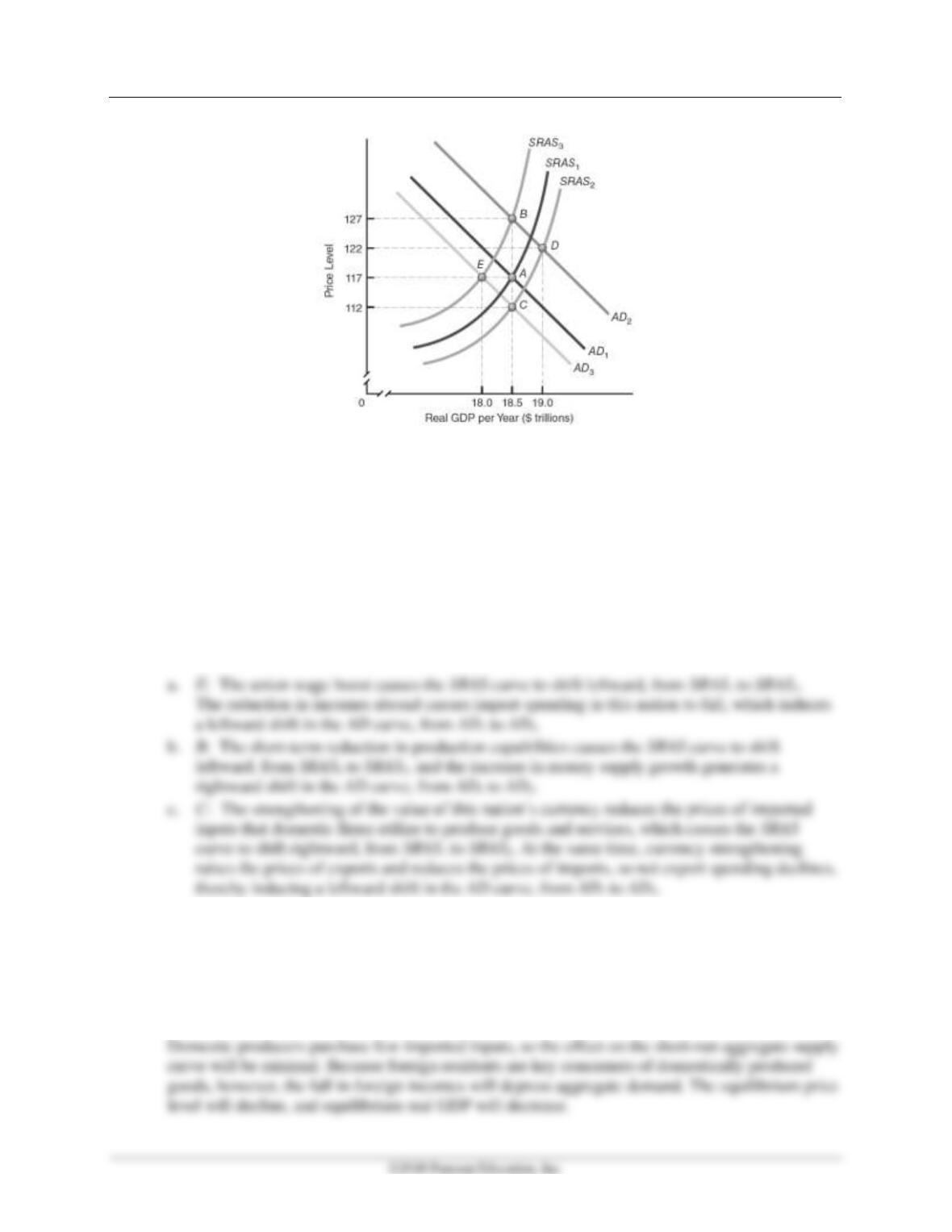
11-11. For each question that follows, suppose that the economy begins at point A. Identify which
of the other points on the diagram—point B, C, D, or E—could represent a new short-run
equilibrium after the described events take place and move the economy away from point
A. Briefly explain your answers.
Chapter 11 Classical and Keynesian Macro Analyses 167
a. Most workers in this nation’s economy are union members, and unions have
successfully negotiated large wage boosts. At the same time, economic conditions
suddenly worsen abroad, reducing real GDP and disposable income in other nations
of the world.
b. A major hurricane has caused short-term halts in production at many firms and created
major bottlenecks in the distribution of goods and services that had been produced
prior to the storm. At the same time, the nation’s central bank has significantly pushed
up the rate of growth of the nation’s money supply.
c. A strengthening of the value of this nation’s currency in terms of other countries’
currencies affects both the SRAS curve and the AD curve.
11-12. Consider an open economy in which the aggregate supply curve slopes upward in the short
run. Firms in this nation do not import raw materials or any other productive inputs from
abroad, but foreign residents purchase many of the nation’s goods and services. What is the
most likely short–run effect on this nation’s economy if there is a significant downturn in
economic activity in other nations around the world?
11-13. In Figure 11-2, if planned saving was less than planned investment, what would be true of
the interest rate in relation to its equilibrium value? How would the interest rate adjust?
11-14. Consider Figure 11-3. Will all people who desire to work be employed if the current wage
rate is $28 per hour? How many people will be employed and unemployed at this wage
rate?
11-15. Take a look at Figure 11-4. If the Federal Reserve increase the quantity of money in
circulation sufficiently to generate a rightward shift in the aggregate demand curve by
$0.5 trillion, will actual equilibrium real GDP rise by this amount in the classical model?
Explain.
11-16. Consider Figure 11-9. Suppose that businesses in this nation initially had been exporting
significant amounts of domestically produced goods and services abroad. Assume that
other nations of the world have experienced a sudden decline in economic conditions. What
happens to the nation’s aggregate demand curve? In the short run, will the nation
experience an inflationary gap or a recessionary gap? Explain.
11-17. Consider Figure 11-10. Suppose that the real interest rate suddenly declines for reasons that
have nothing to do with the value of the price level. What happens to the nation’s aggregate
demand curve? In the short run, will the nation experience an inflationary gap or a
recessionary gap? Explain.
11-18. Take a look at Figure 11–11. If this country’s government decides to enact short-term
barriers to international trade and substantial regulations of domestic businesses,
what happens to the short-run equilibrium price level, and why? Is this an example
of demand-pull or cost-push inflation? Explain.
◼ Selected References
Cochran, James L., Macroeconomics Before Keynes, Glenview, IL: Scott, Foresman and
Company, 1970.