
11 Case model 9/12/2022 17:19 12/09/2018
You recently went to work for Allied Components Company, a supplier of auto repair parts used
in the after-market with products from Daimler AG, Ford, Toyota, and other automakers.
Your boss, the chief financial officer (CFO), has just handed you the estimated cash flows for two
Here are the projects’ cash flows (in thousands of dollars):
Year
CFLCFS
0 ($100) ($100)
1$10 $70
2$60 $50
3$80 $20
Depreciation, salvage values, net operating working capital requirements, and tax effects are all
included in these cash flows. The CFO also made subjective risk assessments of each project,
and he concluded that both projects have risk characteristics that are similar to the firm’s average
project. Allied’s WACC is 10%. You must determine whether one or both of the projects should
PART C
(1) What is each project’s NPV?
Chapter 11. The Basics of Capital Budgeting
This spreadsheet model is designed to be used in conjunction with the chapter’s integrated case and
the related PowerPoint slide presentation.
proposed projects. Project L involves adding a new item to the firm’s ignition system line; it would
take some time to build up the market for this product, so the cash inflows would increase over
time. Project S involves an add-on to an existing line, and its cash flows would decrease over
time. Both projects have 3-year lives because Allied is planning to introduce entirely new models
after 3 years.
PART D
(1) What is each project’s IRR?
The internal rate of return (IRR) is that discount rate which forces the NPV of a project to equal
The solution to this equation can be found using Excel’s IRR function.
PART E
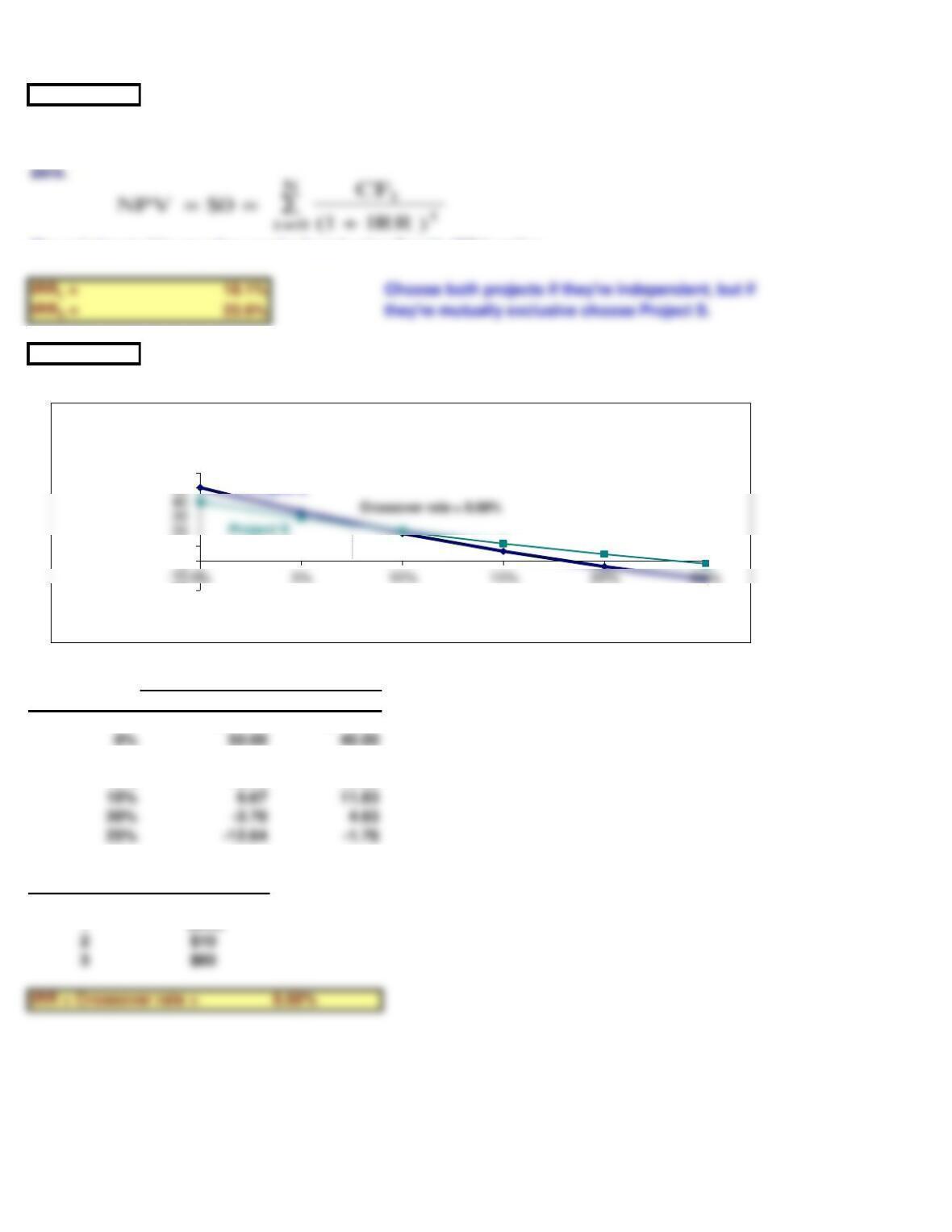
(1) Draw NPV profiles for Projects L and S. At what discount rate do the profiles cross?
WACC L S
$18.78 $19.98
0% 50.00 40.00
5% 33.05 29.29
10% 18.78 19.98
Year
CFDifference
0$0
1 ($60)
Projects
-20
0
10
20
50
60
NPV ($)
WACC
NPV Profiles
Project L
zero.
PART G
(1) Find the MIRRs for Projects L and S.
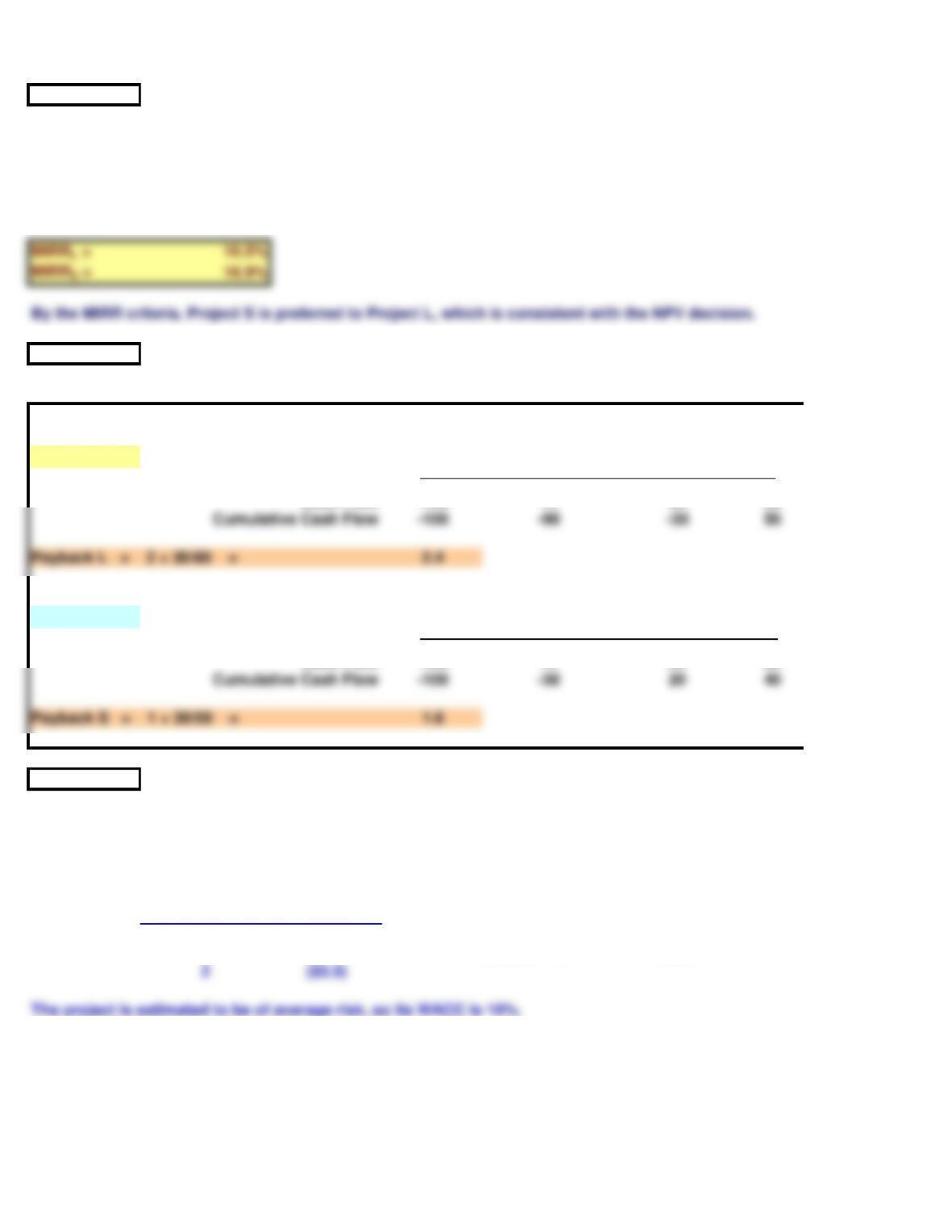
MIRR is that discount rate which equates the present value of the terminal value of the inflows,
compounded at the cost of capital, to the present value of the costs. The projects’ modified IRRs
can be solved for by using Excel’s MIRR function, by entering the project’s cash flows and using the
WACC as both the discount rate and the reinvestment rate.
PART H
(1) Find the paybacks for Projects L and S.
Payback Calculations
Project L Years 0 1 2 3
| | | |
Cash Flow -100 10 60 80
Project S Years 0 1 2 3
| | | |
Cash Flow -100 70 50 20
PART I
As a separate project (Project P), the firm is considering sponsoring a pavilion at the upcoming
World’s Fair. The pavilion’s initial outlay at t = 0 is $800,000, and it is expected to result in $5
million of incremental cash inflows during its one year of operation. However, it would then take
another year and a $5 million cash outflow to demolish the site and return it to its original
condition. Thus, Project P’s expected cash flows (in millions of dollars) look like this:
Year Cash Flow
0 ($0.8)
1$5.0 WACC = 10%
2 ($5.0)
The project is estimated to be of average risk, so its WACC is 10%.
By the MIRR criteria, Project S is preferred to Project L, which is consistent with the NPV decision.
(1) What is Project P’s NPV? What is its IRR? Its MIRR?
NPV = ($386,776.86)
IRR = 400%
Indeed, it is revealed that two IRRs exist. Because there are two sign changes in the cash flow
stream, we can be sure that there are two and only two IRRs.
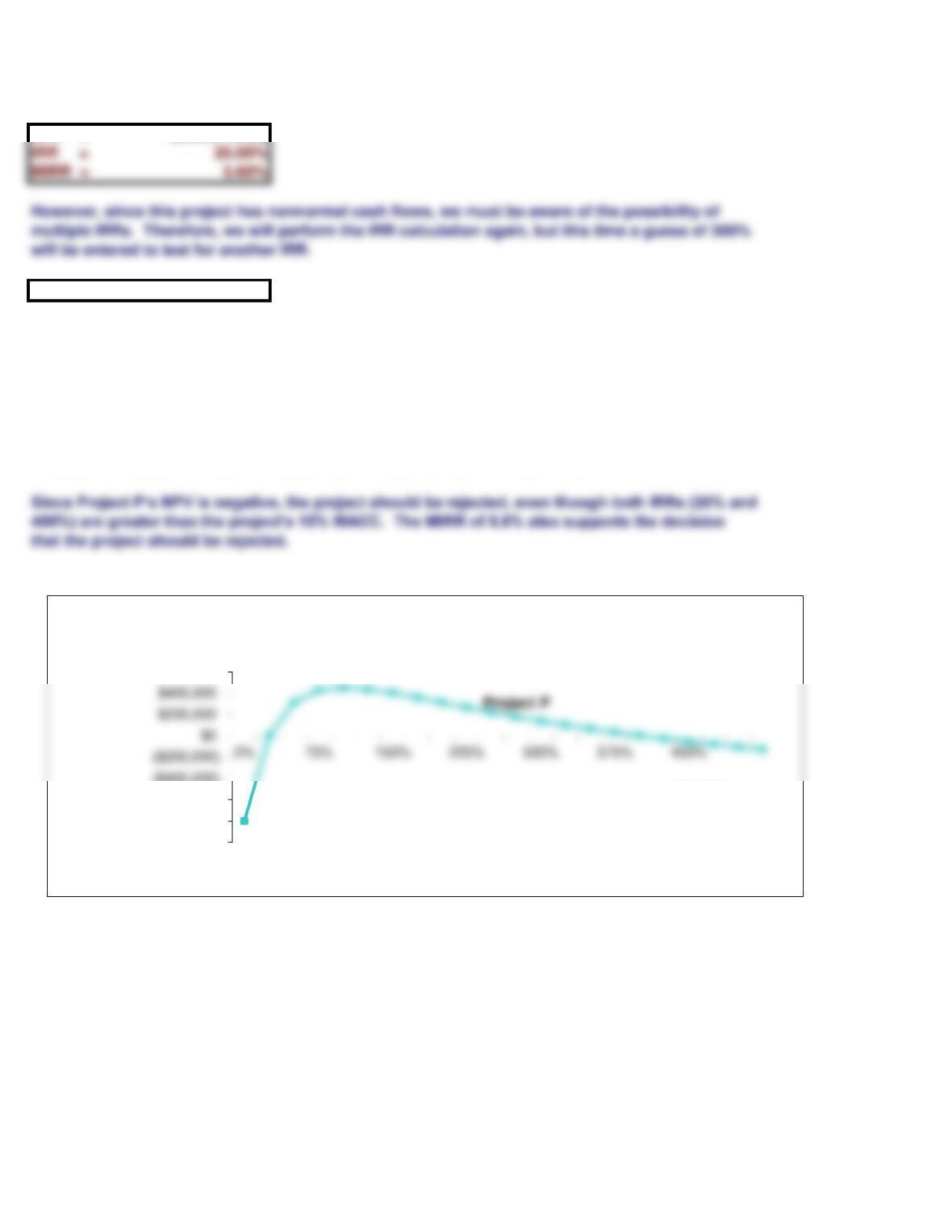
(2) Draw Project P’s NPV profile. Does Project P have normal or nonnormal cash flows? Should
this project be accepted?
Project P has nonnormal cash flows; that is, it has more than one change of signs in the cash flows.
Without this nonnormal cash flow pattern, we would not have multiple IRRs.
that the project should be rejected.
($1,000,000)
($800,000)
($600,000)
($400,000)
$600,000
NPV
WACC
NPV Profile
IRR = 25.00%
MIRR = 5.60%
However, since this project has nonnormal cash flows, we must be aware of the possibility of
multiple IRRs. Therefore, we will perform the IRR calculation again, but this time a guess of 300%
will be entered to test for another IRR.

($386,776.86)
0% ($800,000.00)
25% $0.00
225% $265,088.76
250% $220,408.16
275% $177,777.78
300% $137,500.00
325% $99,653.98
375% $31,024.93
100% $450,000.00
125% $434,567.90
150% $400,000.00
175% $357,024.79
200% $311,111.11