
Chapter 11: The Basics of Capital Budgeting
Comprehensive/Spreadsheet Problem
301
Comprehensive/Spreadsheet Problem
Note to Instructors:
The solution to this problem is not provided to students at the back of their text. Instructors
can access the
Excel
file on the textbook’s website.
11–23 a. Project A:
Using a financial calculator, enter the following data:
CF0 = -30; CF1 = 5; CF2 = 10; CF3 = 15; CF4 = 20; I/YR = 10; and solve for NPVA = $7.74;
IRRA = 19.19%.
Calculate MIRRA at WACC = 10%:
Step 1: Calculate the NPV of the uneven cash flow stream, so its FV can then be calculated.
With a financial calculator, enter the cash flow stream into the cash flow registers,
then enter I/YR = 10, and solve for NPV = $37.739.
Payback A (cash flows in millions):
Annual
Period Cash Flows Cumulative
0 ($30) ($30)
4 20 20
PaybackA = 3 years.
Discounted Payback A (cash flows in millions):
Annual Discounted @10% Cumulative
Period Cash Flows Cash Flows Cash Flows
0 ($30) ($30.00) ($30.00)
Project B:
Using a financial calculator, enter the following data:

Calculate MIRRB at WACC = 10%:
Step 1: Calculate the NPV of the uneven cash flow stream, so its FV can then be calculated.
With a financial calculator, enter the cash flow stream into the cash flow registers,
then enter I/YR = 10, and solve for NPV = $36.55.
Step 2: Calculate the FV of the cash flow stream as follows:
Payback B (cash flows in millions):
Annual
Period Cash Flows Cumulative
0 ($30) ($30)
1 20 (10)
PaybackB = 2 years.
Discounted Payback B (cash flows in millions):
Annual Discounted @10% Cumulative
Period Cash Flows Cash Flows Cash Flows
0 ($30) ($30.00) ($30.00)
Summary:
Project A Project B
NPV $7.74 $6.55
MIRR 16.50% 15.57%
Payback 3 years 2 years
Discounted Payback 3.43 years 2.59 years

Chapter 11: The Basics of Capital Budgeting
Comprehensive/Spreadsheet Problem
303
d. WACC NPVA NPVB
0% $20.00 $14.00
5 13.24 9.96
15 3.21 3.64
22.52 (2.23) 0
-5
20
25
NPV
($)
Project A
e. At WACC = 5% and the two projects are mutually exclusive, NPVA > NPVB so choose Project
A. This doesn’t change our recommendation. At WACC = 15% and the two projects are
mutually exclusive, NPVB > NPVA so choose Project B. This does change our
recommendation. Both decisions can be made from looking at the NPV profile in part d.

304
Comprehensive/Spreadsheet Problem
Chapter 11: The Basics of Capital Budgeting
i. The cutoff chosen for both payback periods is arbitrary—but usually based on specific
information the firm has on past projects. However, the criteria for the NPV and the IRR
methods are not arbitrary.
j. The MIRR is the discount rate at which the present value of a project’s cost is equal to the
present value of its terminal value, where the terminal value is found as the sum of the

Chapter 11: The Basics of Capital Budgeting
Integrated Case
305
11–24
Allied Components Company
Basics of Capital Budgeting
You recently went to work for Allied Components Company, a supplier of auto
repair parts used in the after–market with products from Daimler AG, Ford,
Toyota, and other automakers. Your boss, the chief financial officer (CFO), has
just handed you the estimated cash flows for two proposed projects. Project L
involves adding a new item to the firm’s ignition system line; it would take
some time to build up the market for this product, so the cash inflows would
increase over time. Project S involves an add–on to an existing line, and its cash
flows would decrease over time. Both projects have 3-year lives because Allied
is planning to introduce entirely new models after 3 years.
Here are the projects’ after-tax cash flows (in thousands of dollars):
0 1 2 3
| | | |
Project L –100 10 60 80
Project S –100 70 50 20
Depreciation, salvage values, net operating working capital requirements, and
tax effects are all included in these cash flows. The CFO also made subjective
risk assessments of each project, and he concluded that both projects have
risk characteristics that are similar to the firm’s average project. Allied’s
WACC is 10%. You must determine whether one or both of the projects
should be accepted.
A. What is capital budgeting? Are there any similarities between a firm’s
capital budgeting decisions and an individual’s investment decisions?

1. Estimate the cash flows—interest and maturity value or
2. Assess the riskiness of the cash flows.
3. Determine the appropriate discount rate, based on the riskiness
5. If the PV of the inflows is greater than the PV of the outflows
(the NPV is positive), or if the calculated rate of return (the IRR)
is higher than the project cost of capital, accept the project.
B. What is the difference between independent and mutually exclusive
projects? Between projects with normal and nonnormal cash flows?
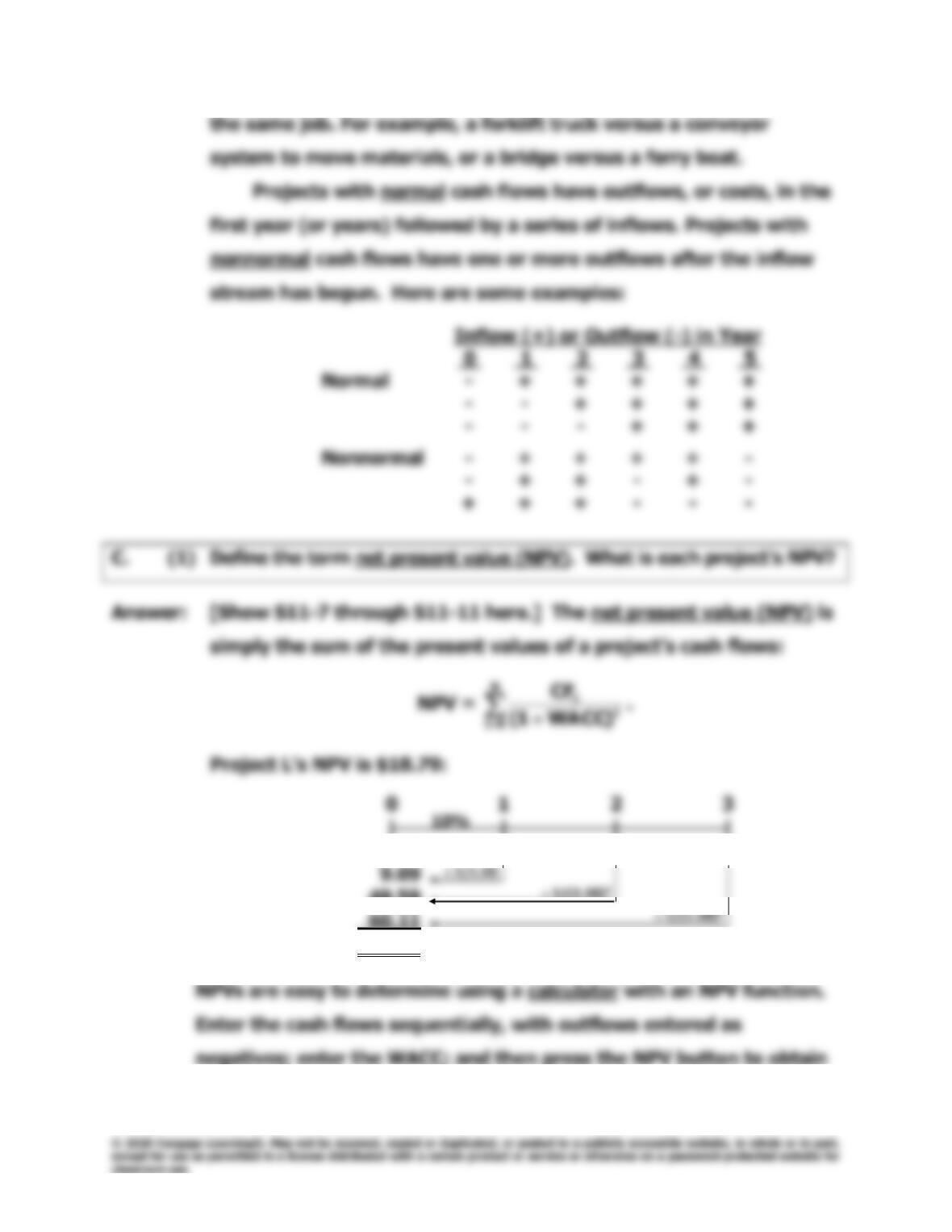
Chapter 11: The Basics of Capital Budgeting
Integrated Case
307
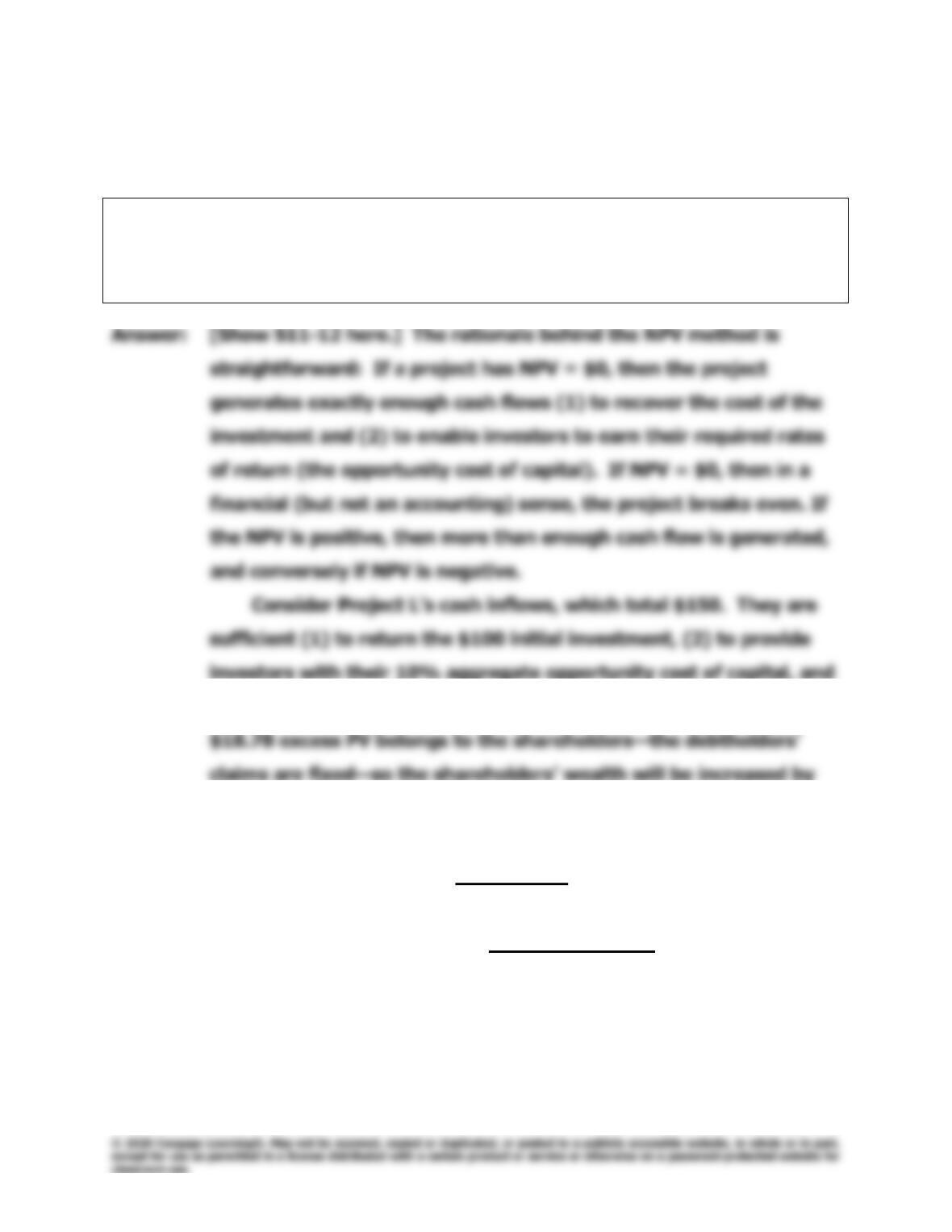
-100.00 10 60 80
49.59
18.79 = NPVL
308
Integrated Case
Chapter 11: The Basics of Capital Budgeting
the project’s NPV, $18.78 (note the penny rounding difference). The
NPV of Project S is NPVS = $19.98.
C. (2) What is the rationale behind the NPV method? According to NPV,
which project(s) should be accepted if they are independent?
Mutually exclusive?
(3) to still have $18.78 left over on a present value basis. This
$18.78 if Project L is accepted. Similarly, Allied’s shareholders gain
$19.98 in value if Project S is accepted.
If Projects L and S are independent, then both should be
accepted, because both add to shareholders’ wealth, hence to the
stock price. If the projects are mutually exclusive, then Project S
should be chosen over L, because S adds more to the value of the firm
than L does.
Chapter 11: The Basics of Capital Budgeting
Integrated Case
309
C. (3) Would the NPVs change if the WACC changed? Explain.
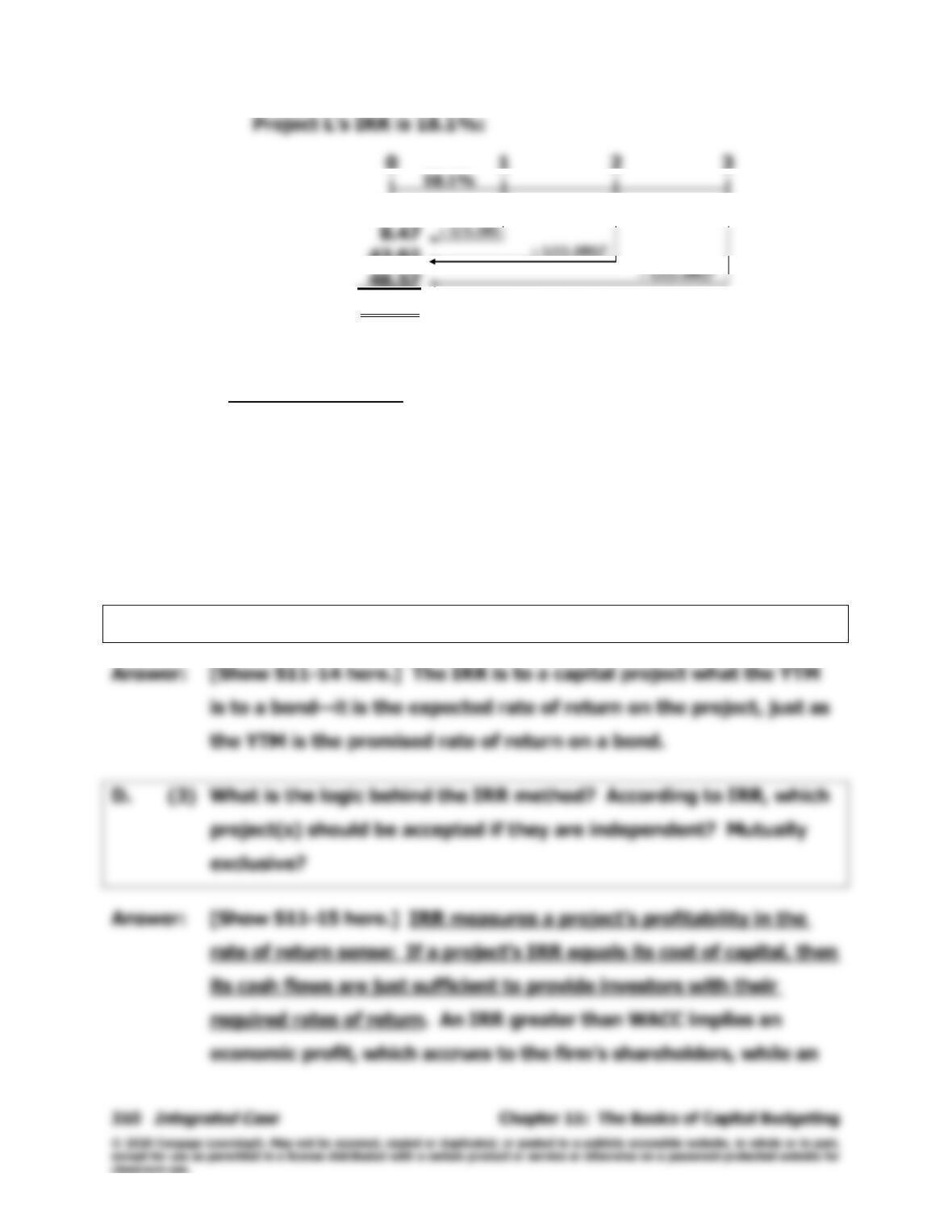
-100.00 10 60 80
43.02
0.06 $0 if IRRL = 18.1% is used as the discount rate.
Therefore, IRRL ≈ 18.1%.
A financial calculator is extremely helpful when calculating IRRs.
The cash flows are entered sequentially, and then the IRR button is
pressed. For Project S, IRRS ≈ 23.6%. Note that with many
calculators, you can enter the cash flows into the cash flow register,
also enter WACC = I/YR, and then calculate both NPV and IRR by
pressing the appropriate buttons.
D. (2) How is the IRR on a project related to the YTM on a bond?

than 23.6%.
E. (1) Draw NPV profiles for Projects L and S. At what discount rate do
the profiles cross?
1. The Y-intercept is the project’s NPV when WACC = 0%. This is
$50 for L and $40 for S.
23.6% for S.
3. NPV profiles are curves rather than straight lines. To see this,
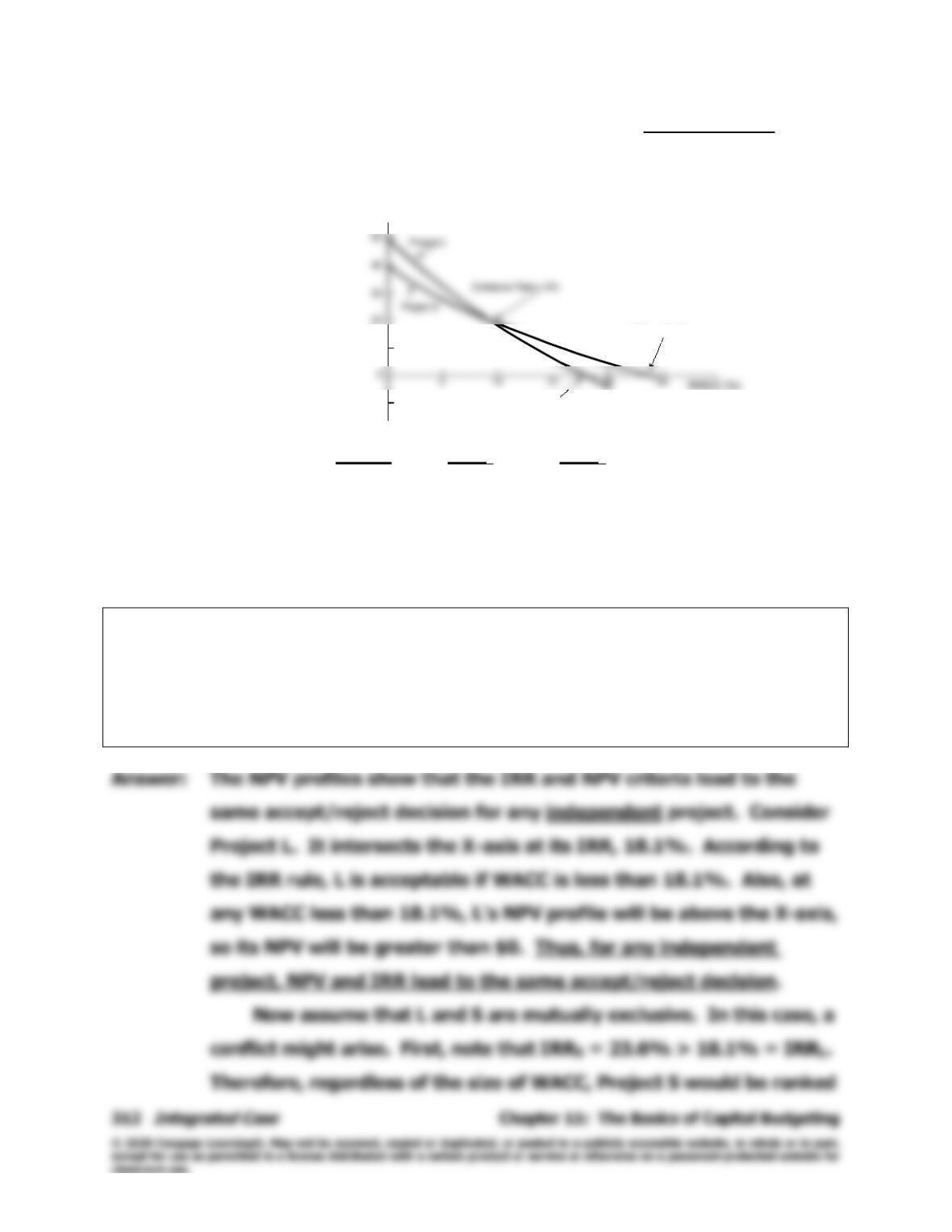
4. From the figure below, it appears that the crossover rate is
between 8% and 9%.
NPV
($)
10
–10
IRRS= 23.6%
IRRL= 18.1%
NPV
($)
10
–10
IRRS= 23.6%
IRRL= 18.1%
NPV
($)
10
–10
IRRS= 23.6%
IRRL= 18.1%
WACC NPVL NPVS
0% $50 $40
5 33 29
10 19 20
15 7 12
20 (4) 5
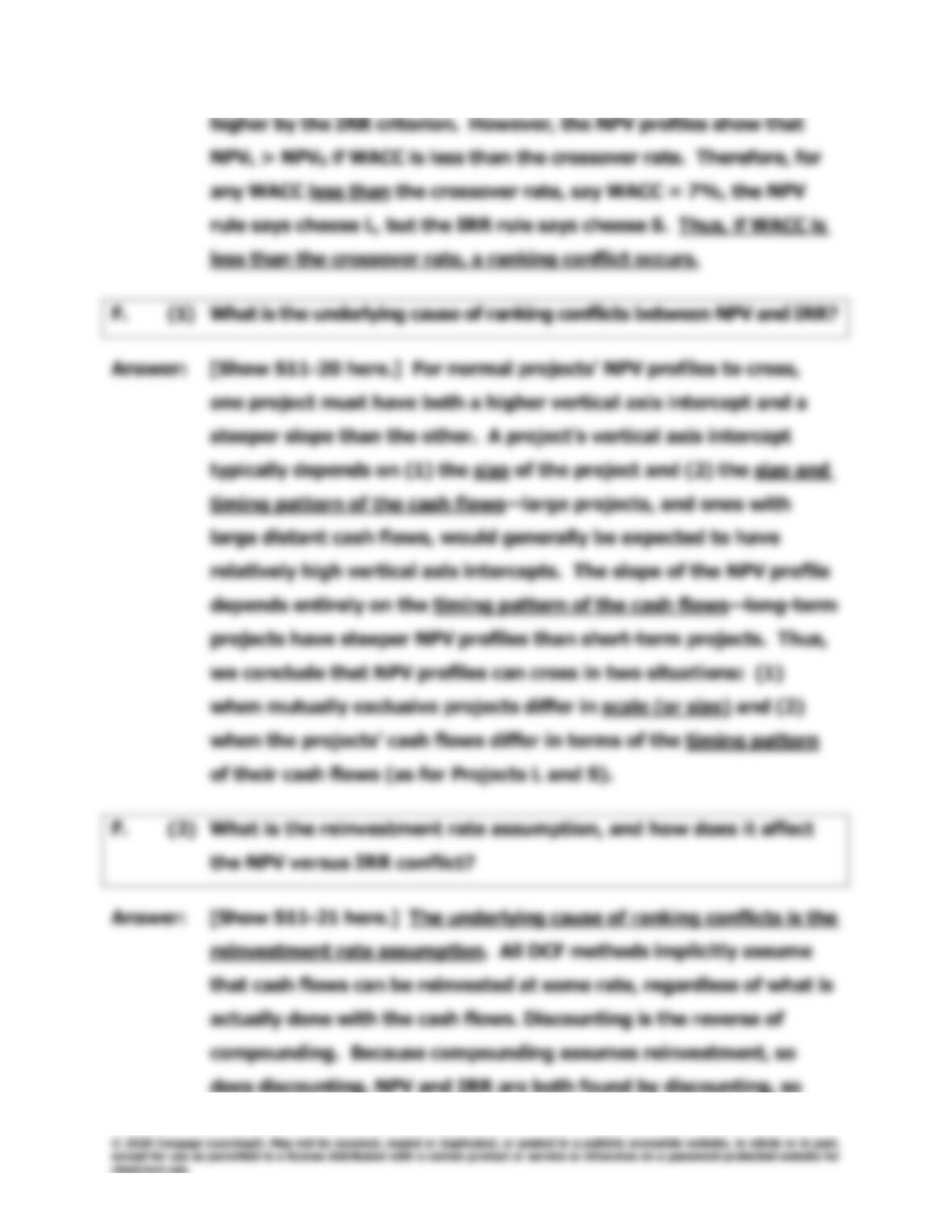
E. (2) Look at your NPV profile graph without referring to the actual NPVs
and IRRs. Which project(s) should be accepted if they are
independent? Mutually exclusive? Explain. Are your answers
correct at any WACC less than 23.6%?
Chapter 11: The Basics of Capital Budgeting
Integrated Case
313
they both implicitly assume some discount rate. Inherent in the NPV
calculation is the assumption that cash flows can be reinvested at
the project’s cost of capital, while the IRR calculation assumes
reinvestment at the IRR rate.
F. (3) Which method is best? Why?
Chapter 11: The Basics of Capital Budgeting
Integrated Case
315
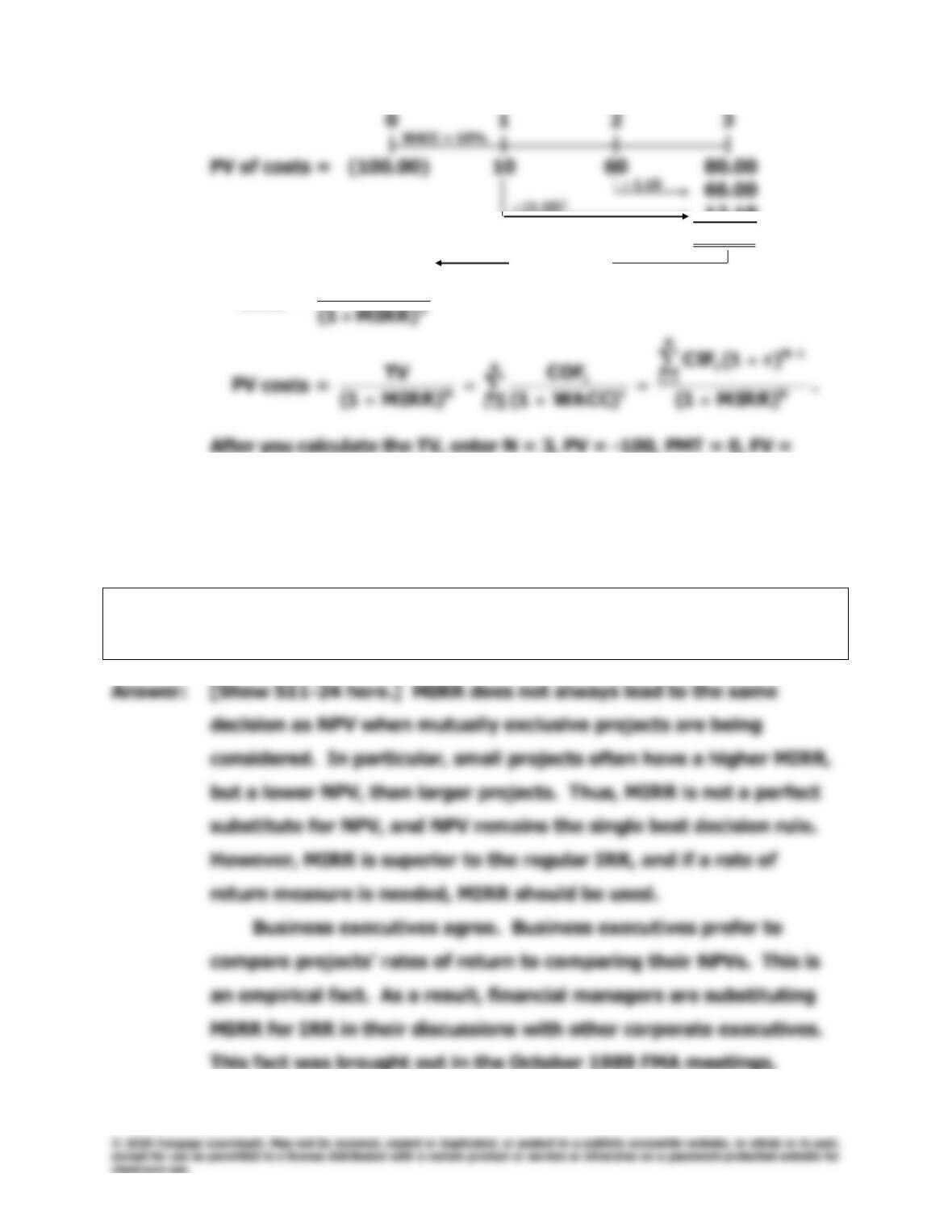
12.10
TV of inflows = 158.10
PV of TV = 100.00 MIRR = ?
$100 =
10.158$
158.1, and then press I/YR to get the answer, MIRRL = 16.5%. We
could calculate MIRRS similarly: MIRRS = 16.9%. Thus, Project S is
ranked higher than L. This result is consistent with the NPV decision.
G. (2) What are the MIRR’s advantages and disadvantages as compared to
the NPV?
316
Integrated Case
Chapter 11: The Basics of Capital Budgeting
where executives from DuPont and Hershey, among others, all
reported a switch from IRR to MIRR.
H. (1) What is the payback period? Find the paybacks for Projects L and S.
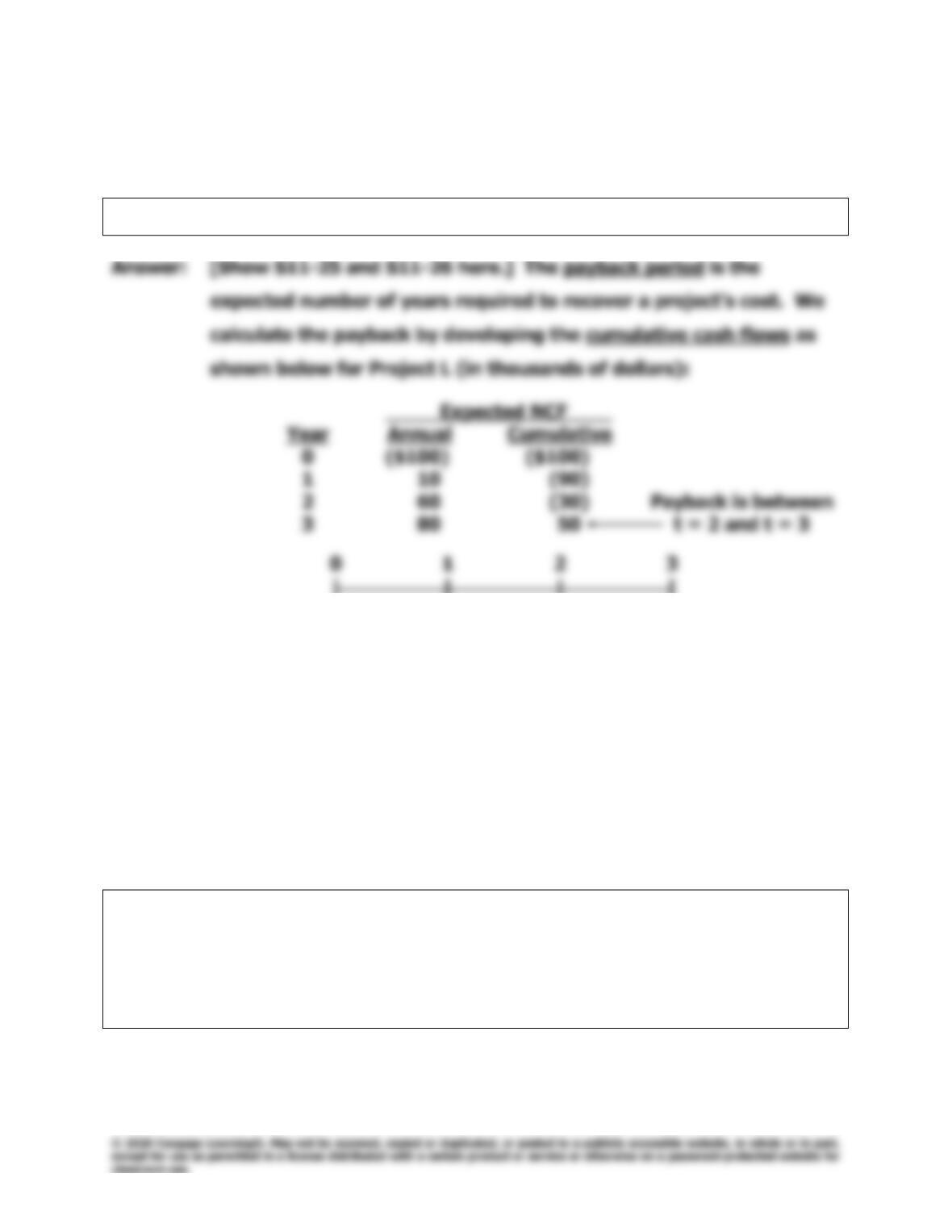
–100 10 60 80
–90 –30 50
Project L’s $100 investment has not been recovered at the end of
Year 2, but it has been more than recovered by the end of Year 3.
Thus, the recovery period is between 2 and 3 years. If we assume
that the cash flows occur evenly over the year, then the investment
is recovered $30/$80 = 0.375 ≈ 0.4 into Year 3. Therefore,
PaybackL = 2.4 years. Similarly, PaybackS = 1.6 years.
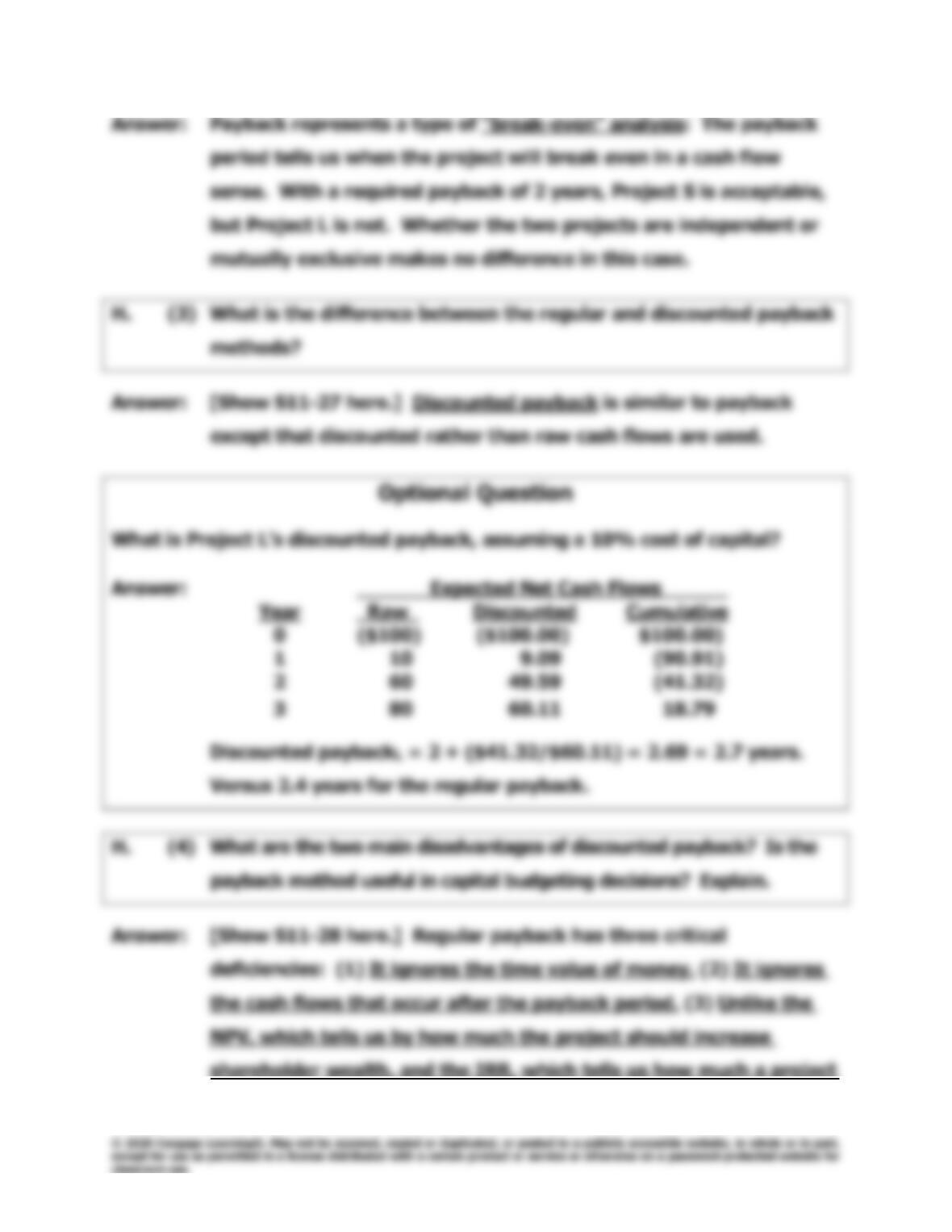
H. (2) What is the rationale for the payback method? According to the
payback criterion, which project(s) should be accepted if the firm’s
maximum acceptable payback is 2 years, if Projects L and S are
independent? If Projects L and S are mutually exclusive?
Chapter 11: The Basics of Capital Budgeting
Integrated Case
317
318
Integrated Case
Chapter 11: The Basics of Capital Budgeting
yields over the cost of capital, the payback merely tells us when we
get our investment back. Discounted payback does consider the
time value of money, but it still fails to consider cash flows after the
payback period and it gives us no specific decision rule for
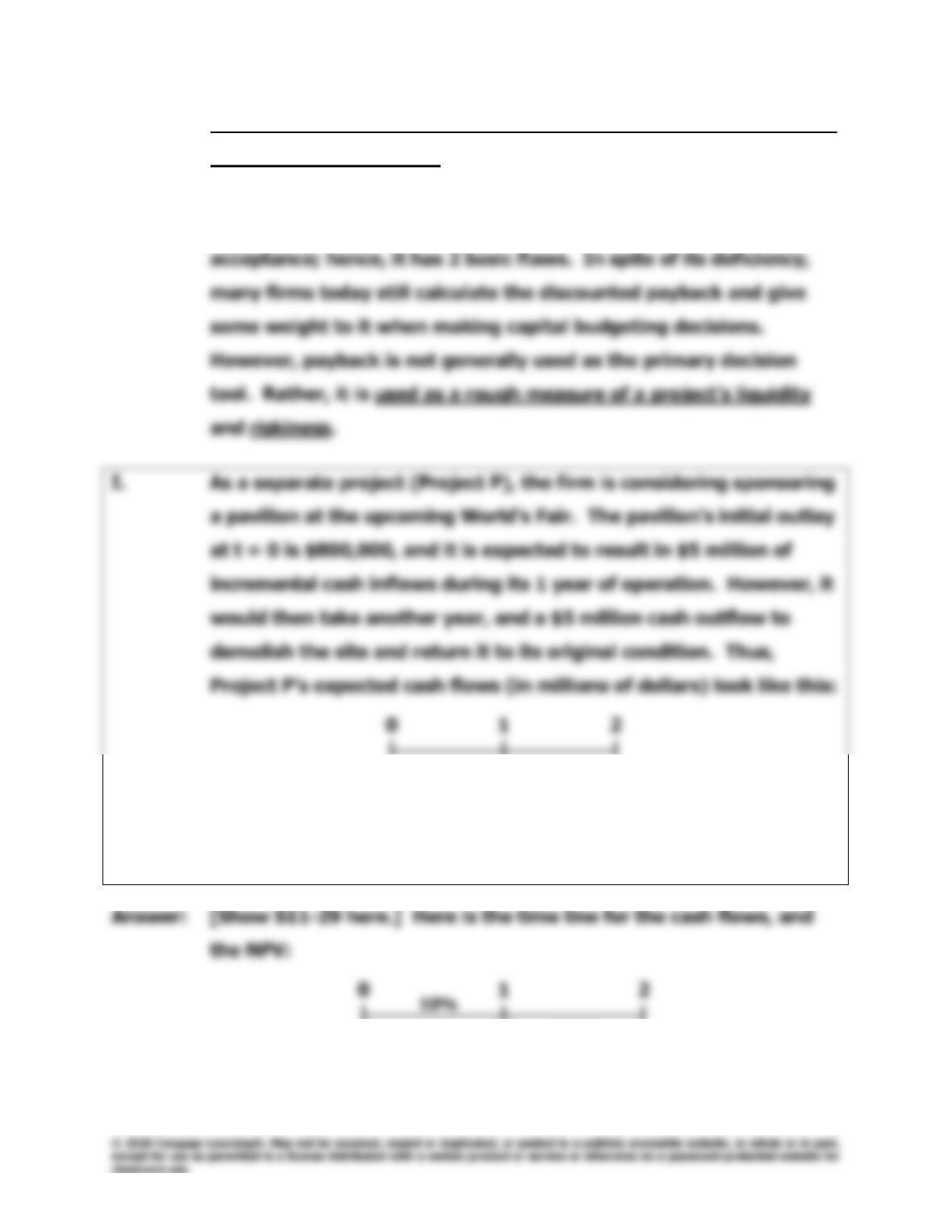
-0.8 5.0 -5.0
The project is estimated to be of average risk, so its WACC is 10%.
I. (1) What is Project P’s NPV? What is its IRR? Its MIRR?
-800,000 5,000,000 -5,000,000
NPVP = -$386,776.86.

Chapter 11: The Basics of Capital Budgeting
Integrated Case
319
We can find the NPV by entering the cash flows into the cash flow
register, entering I/YR = 10, and then pressing the NPV button.
However, calculating the IRR presents a problem. With the cash
flows in the register, press the IRR button. An HP–10BII financial
calculator will give the message “error–soln.” This means that
Project P has multiple IRRs. An HP–17BII will ask for a guess. If
you guess 10%, the calculator will show IRR = 25%. If you guess
a high number, such as 200%, it will show the second IRR, 400%.1
The MIRR of Project P = 5.6%, and it is found by calculating the
discount rate that equates the terminal value ($5.5 million) to the
present value of costs ($4.93 million).
I. (2) Draw Project P’s NPV profile. Does Project P have normal or
nonnormal cash flows? Should this project be accepted? Explain.

Since Project P’s NPV is negative, the project should be
rejected, even though both IRRs (25% and 400%) are greater than
the project’s 10% WACC. The MIRR of 5.6% also supports the
–250
–250
–250
–250