11 (22) Topics in International Macroeconomics
1. (PPP) Richland and Poorland each have two industries: traded TVs and nontraded
house maintenance. The world price of TVs is R$100 (R$ = Richland dollar). Assume
for now that the exchange rate is R$1 = 1 PP (PP = Poorland peso) and that prices are
flexible. It takes 1 day for a worker in each country to visit and maintain 1 house. It
takes 1 day for a Richland worker to make a TV, and 4 days for a Poorland worker.
a. What is the Richland wage in R$ per day? What is the Poorland wage in PP per
day? In R$ per day? What is the ratio of Poorland to Richland wages in a common
currency?
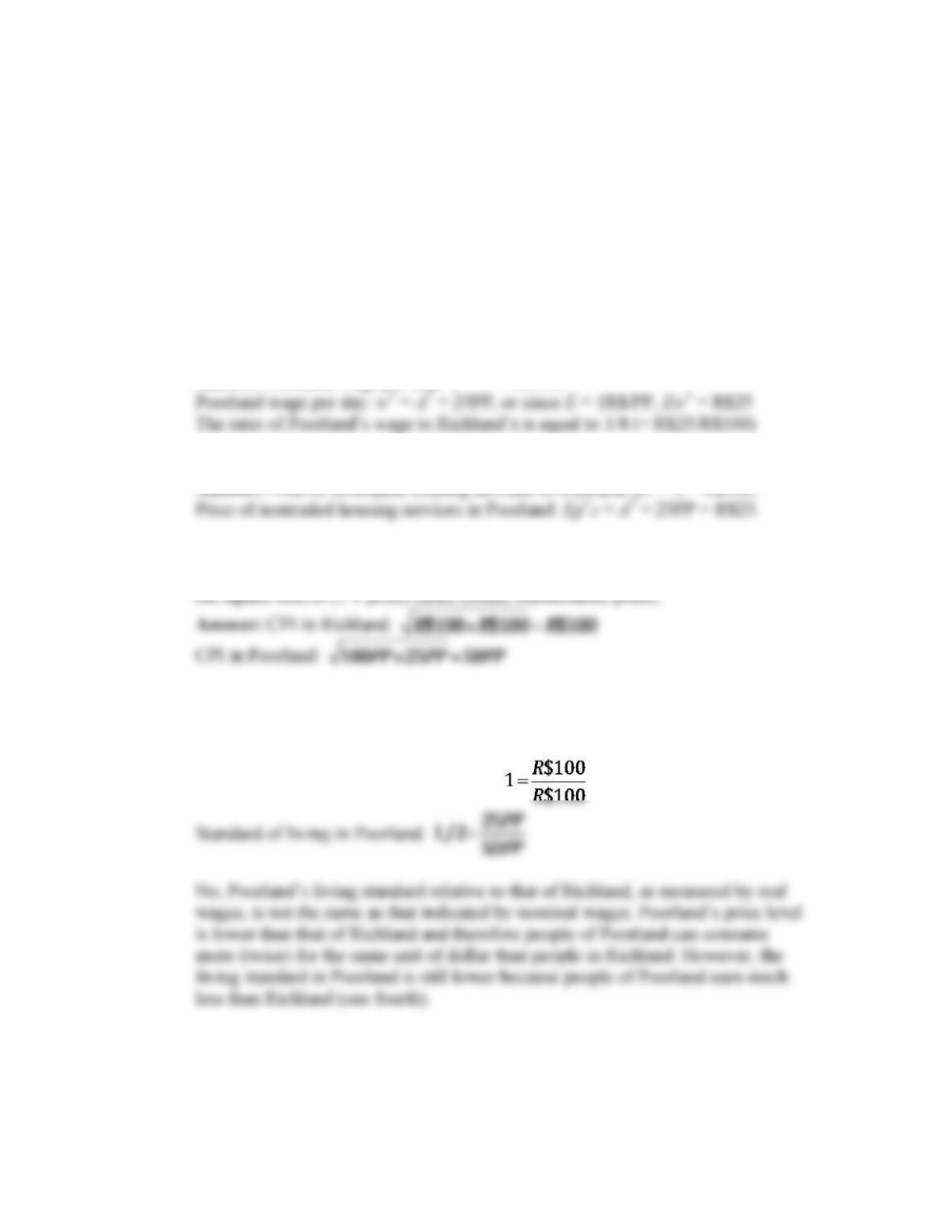
Answer: Richland wage per day: w = A = R$100.
b. What is the price of a house maintenance visit in each country?
c. Assume people in each country spend half their income on TVs and half on house
maintenance. Compute the CPI (consumer price index) for each country given by
d. Compute the standard of living in each country by dividing local currency wages
by the CPI from part (c). Is Poorland really as poor as suggested by the last
answer in part (a)?
Answer: Standard of living in Richland:
e. Productivity now doubles in the Poorland TV industry, all else equal. How many
days does it now take for Poorland workers to make a TV? What happens to the
wage in Poorland? The price of house maintenance? The CPI?
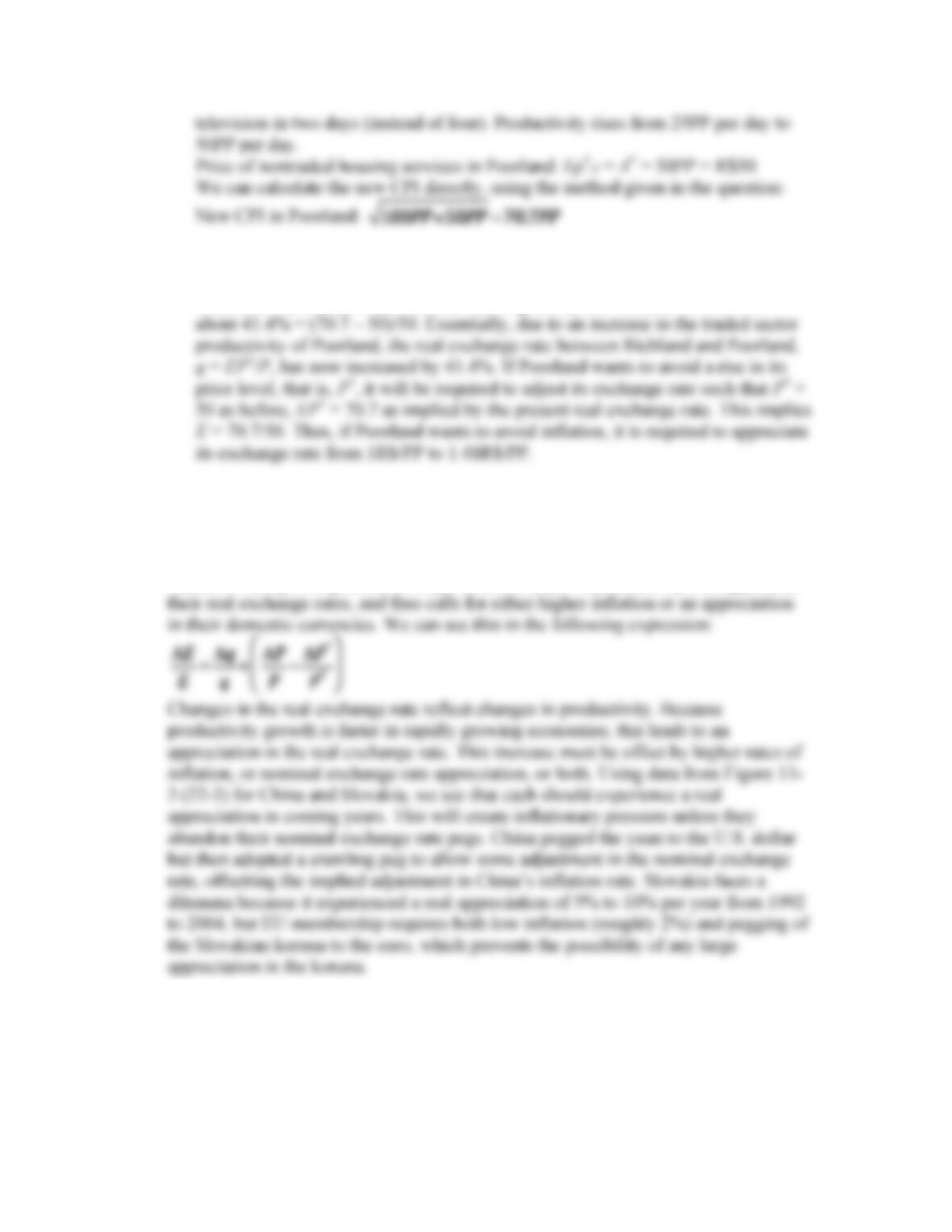
Answer: If productivity doubles, then workers in Poorland can now make one
f. If the central bank of Poorland wants to avoid inflation in this situation, how
would it like to adjust the exchange rate?
Answer: The inflation rate for Poorland implied by the increase in its CPI is
2. (PPP) “Some fast-growing poorer countries face a conflict between wanting to
maintain a fixed exchange rate with a rich country and wanting to keep inflation
low.” Explain the logic behind this statement. Use the examples of Slovakia and
China to illustrate your argument.
Answer: Fast–growing countries experience increases in productivity that appreciate
3. (UIP) What is a peso problem? In the case of fixed exchange rates, explain how peso
problems can account for persistent interest rate differentials. Study the U.S.–Britain
short-term (end-of-month) nominal interest rate differentials shown below for the
year 1896 (from NBER series 13034). Both countries were on the gold standard at a
fixed exchange rate of $4.86 throughout this year. Did the United States have a peso
problem? When did it become really big? When did it go away? (Extra Credit: Do
some research on the Web and discover the political reasons for the timing of this
peso problem.)
Jan 1896 3.84%
Feb 1896 2.94%
Mar 1896 2.76%
Apr 1896 2.40%
May 1896 1.63%
Jun 1896 1.20%
Jul 1896 1.43%
Aug 1896 3.77%
Sep 1896 3.70%
Oct 1896 8.51%
Nov 1896 2.60%
Dec 1896 –1.39%
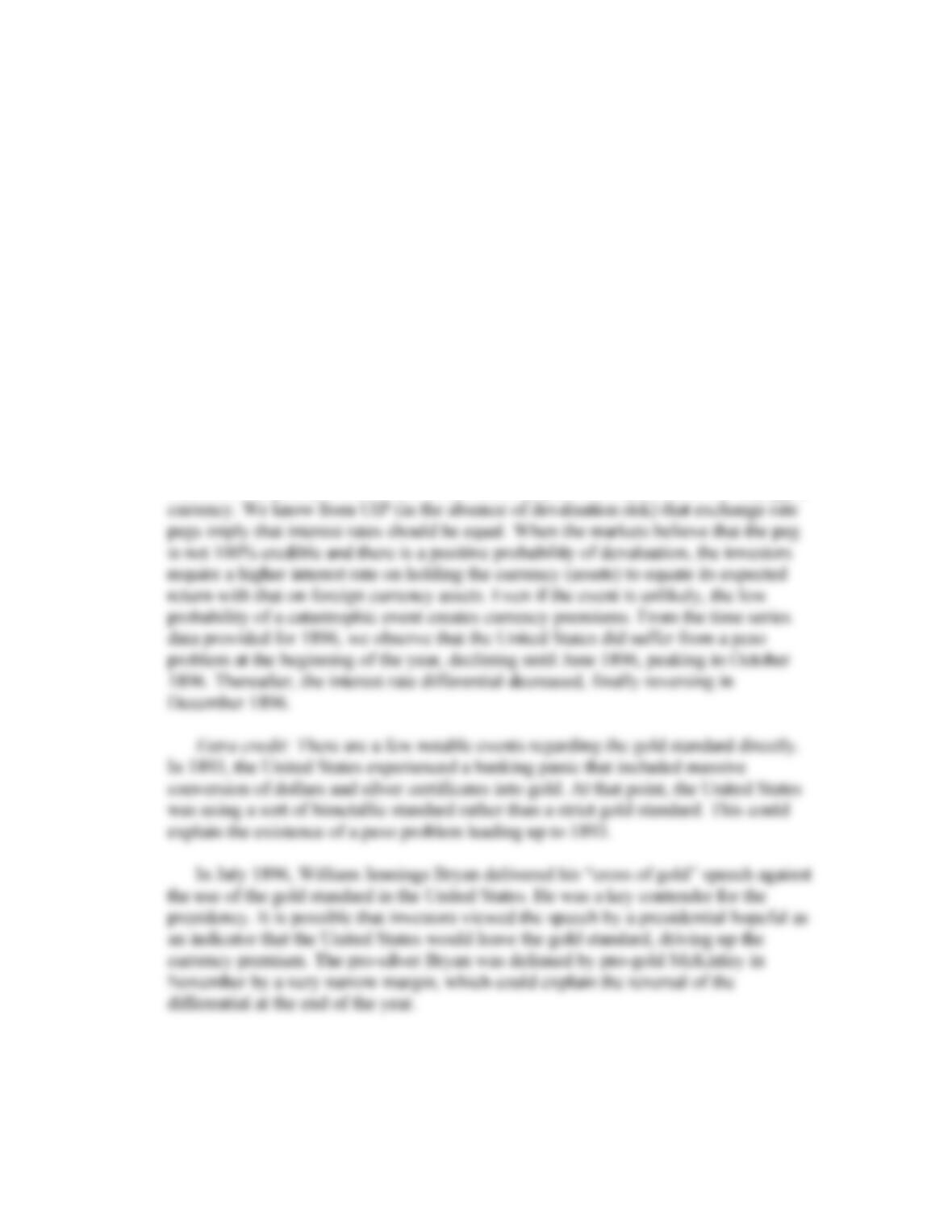
Answer: The peso problem refers to the currency premiums associated with a pegged
4. (UIP) You are in discussion with a forex trader.
a. She reveals that she made a 10% annual rate of return last year. Based on these
data, can we say that the forex market in question violates the efficient markets
hypothesis (EMH)?
b. The trader reveals that she can make predictable 10% annual rates of return on
forex trades for a pair of currencies, with a standard deviation of 25%, and has
been doing so for a long time. Calculate the Sharpe ratio for these trades. Based
on these data, does the forex market in question satisfy the EMH?
c. Can the trader’s predictable profits be explained by trading frictions? By risk
aversion?
5. (Default) “Poor countries are exploited when they borrow in global capital markets,
because they are charged an extortionate rate of interest.” Explain how empirical
evidence and theoretical arguments might counter this assertion.
Answer: The empirical evidence suggests that lenders do not make large profits on
6. (Default) The Republic of Delinquia has a nondisaster output level of $100 each year.
With 10% probability each year, output falls to a disaster level of $80, and the
country will feel so much pain that it will default and pay neither principal nor
interest on its debts. The country decides to borrow $20 at the start of the year, and
keep the money under the mattress. It will default and keep the money in the event
that output is low, but this will entail sacrificing $4 in punishment costs. Otherwise, it
pays back principal and interest due. Lenders are competitive and understand these
risks fully.
a. What is the probability of default in Delinquia?
b. The interest rate on safe loans is 8% per annum, so a safe loan has to pay off 1.08
times $20. What is the lending rate charged by competitive lenders on the risky
loan to Delinquia?
Answer: The lending rate charged on Delinquia loans can be determined from the
c. What does Delinquia consume in disaster years? In nondisaster years?
Answer: If Delinquia experiences disaster, it defaults and will lose $4 of output,
d. Repeat part (c) for the case in which Delinquia cannot borrow. Is Delinquia better
off with or without borrowing?
7. (Global Crisis) When emerging markets elected to accumulate vast sums of reserves
in the 2000s decade, did this create a problem in developed markets? How might this
problem be resolved, or resolve itself, going forward? Does the EM decision to
accumulate the reserves look like a wise one, after the fact?
Answer: The EM countries consistently ran surpluses on their current accounts.
8. (Global Crisis) In 2010 the state of Ireland was at risk of going broke because it had
poured too much money into its insolvent banks to keep them alive, but already
incomes had fallen massively and public services were being cut harshly too.
Describe the trade-offs involved in the various options: (a) increasing austerity
(raising taxes and cutting spending) even more to keep the banks alive; (b) letting the
State default on its external debt to keep the banks alive and limit austerity; (c) allow
the banks to fail to save the State’s creditworthiness and limit austerity. Consider the
problem from a purely Irish national interest perspective first. Now think of an EU
level perspective: how is your analysis of who should foot the bill affected by the fact
that many of the Irish bank creditors were foreign (many in the EU), and that many of
the risks of financial damage were due to contagion from other (principally EU)
foreign countries?
Answer: Raising taxes and cutting spending would almost certainly not have solved
the problem. The bad recession would have become worse, incomes would have
fallen further, and more bank loans would go into default.