Chapter 11 – Monopolistic Competition and Oligopoly (Appendix)
11A-1
Chapter 11 Monopolistic Competition and Oligopoly (Appendix)
APPENDIX QUESTIONS
1.Is the game shown by Figure 11.3 in the chapter (not this appendix) a zero-sum game or is it a
positive-sum game? How can you tell? Are there dominant strategies in this game? If so, what are
they? What cell represents a Nash equilibrium and why? Explain why it is so difficult for Uptown
and RareAir to achieve and maintain a more favorable cell than the Nash equilibrium in this
single-period pricing game. LO8
Answer: This is a positive-sum game since the sum of the payoffs for each firm is
positive. Yes, the dominant strategy is for both firms to use a low price strategy. This
2.Refer to the payoff matrix in question 8 at the end of this chapter. First, assume this is a one-
time game. Explain how the $60/$57 outcome might be achieved through a credible threat. Next,
assume this is a repeated game (rather than a one-time game) and that the interaction between the
two firms occurs indefinitely. Why might collusion with a credible threat not be necessary to
achieve the $60/$57 outcome? LO8
Answer: Either firm could threaten to flood the market to induce the other firm to choose
Chapter 11 – Monopolistic Competition and Oligopoly (Appendix)
11A-2
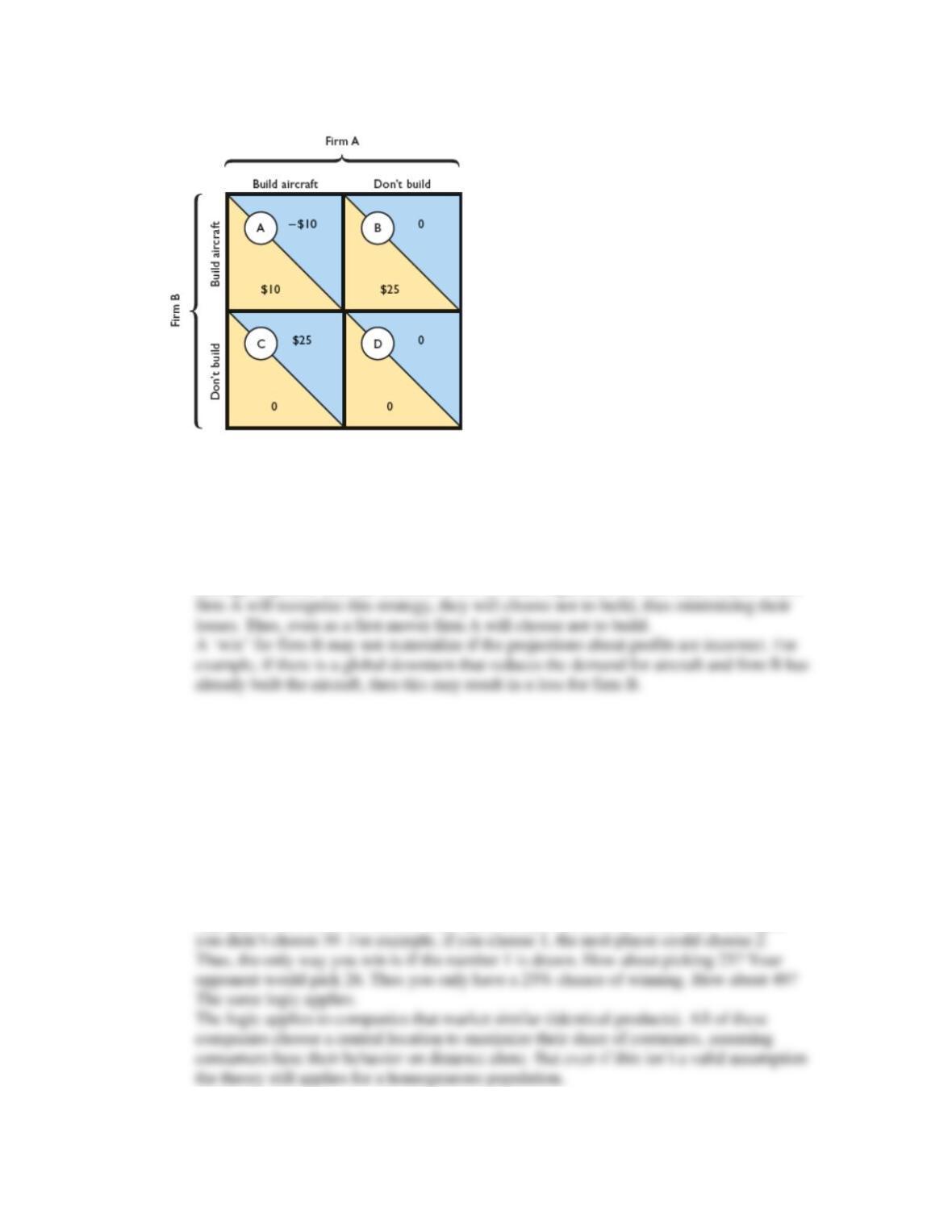
3. Refer to the payoff matrix below. LO8
Assuming this is a sequential game with no collusion, what is the outcome if Firm A moves first
to build a new type of commercial aircraft? Explain why first-mover strategies in the real-world
are only as good as the profit projections on which they are based. How could a supposed “win”
from moving first turn out to be a big loss, whereas the “loss” of being preempted turn out to be a
blessing in disguise?
Answer: The dominant strategy for firm B is to build. The payoff from this build-
strategy is greater than the alternative not to build, regardless of what firm A does. Since
4. ADVANCED ANALYSIS Suppose you are playing a game in which you and one other
person each picks a number between 1 and 100, with the person closest to some randomly
selected number between 1 and 100 winning the jackpot. (Ask your instructor to fund the
jackpot.) Your opponent picks first. What number do you expect her to choose? Why? What
number would you then pick? Why are the two numbers so close? How might this example relate
to why Home Depot and Lowes, Walgreens and Rite-Aid, McDonald’s and Burger King, Borders
and Barnes & Noble, and other major pairs of rivals locate so close to each other in many well-
defined geographical markets that are large enough for both firms to be profitable? LO8
Answer: As the first player it is optimal to choose 50. The reasoning is that your
opponent could choose a number that significantly reduces your chances of winning if
Chapter 11 – Monopolistic Competition and Oligopoly (Appendix)
11A-3
APPENDIX PROBLEMS
1. Consider a “punishment” variation of the two‐firm oligopoly situation shown in the figure
below. Suppose that if one firm sets a low price while the other sets a high price, then the firm
setting the high price can fine the firm setting the low price. Suppose that whenever a fine is
imposed, X dollars is taken from the low‐price firm and given to the high‐price firm. What is the
smallest amount that the fine X can be such that both firms will want to always set the high price?
LO8
Feedback: Let’s look at the following example. Consider a “punishment” variation of the
two‐firm oligopoly situation shown in Figure 11.3 in the chapter (not in this appendix).
Suppose that if one firm sets a low price while the other sets a high price, then the firm
setting the high price can fine the firm setting the low price. Suppose that whenever a fine
is imposed, X dollars is taken from the low‐price firm and given to the high‐price firm.
What is the smallest amount that the fine X can be such that both firms will want to
always set the high price?
Chapter 11 – Monopolistic Competition and Oligopoly (Appendix)
11A-4
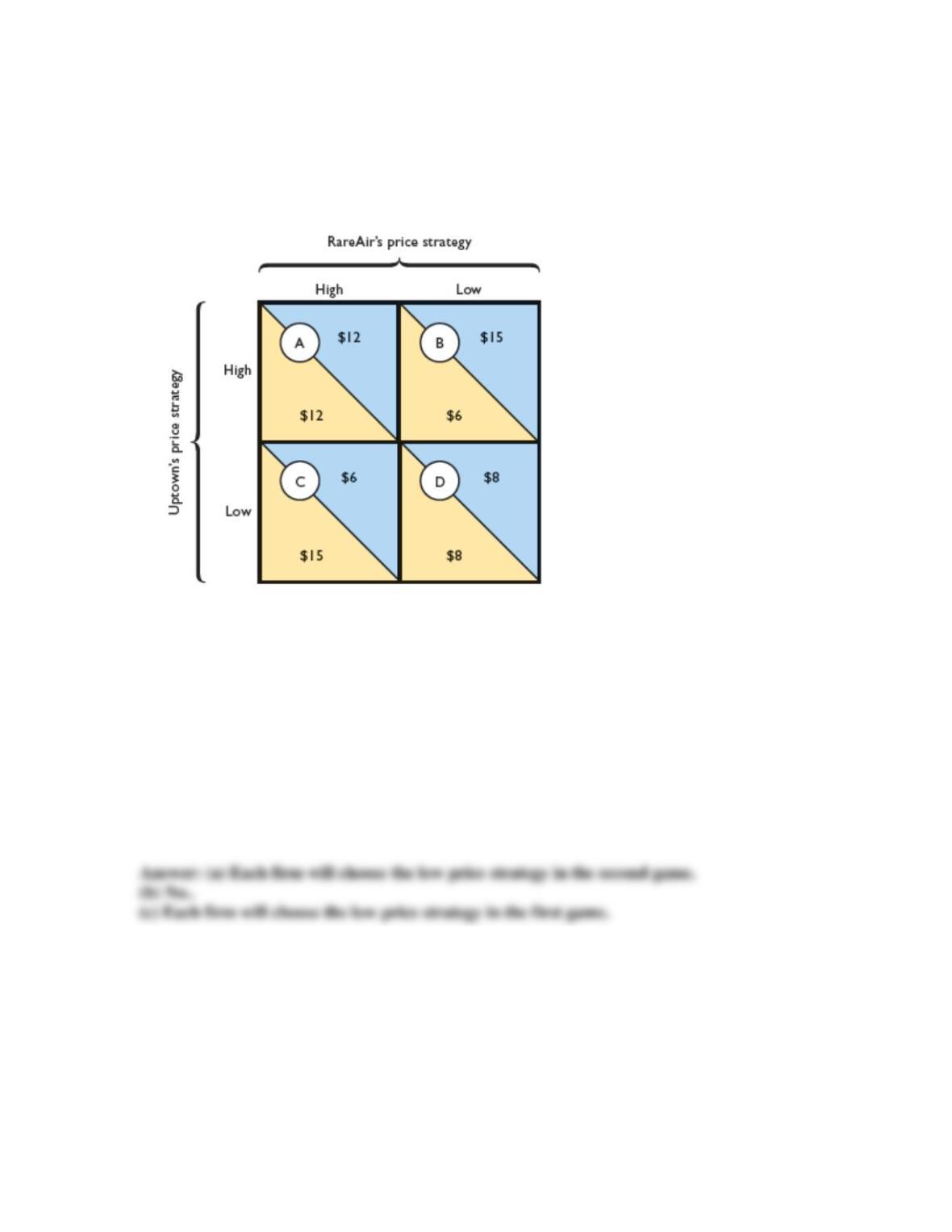
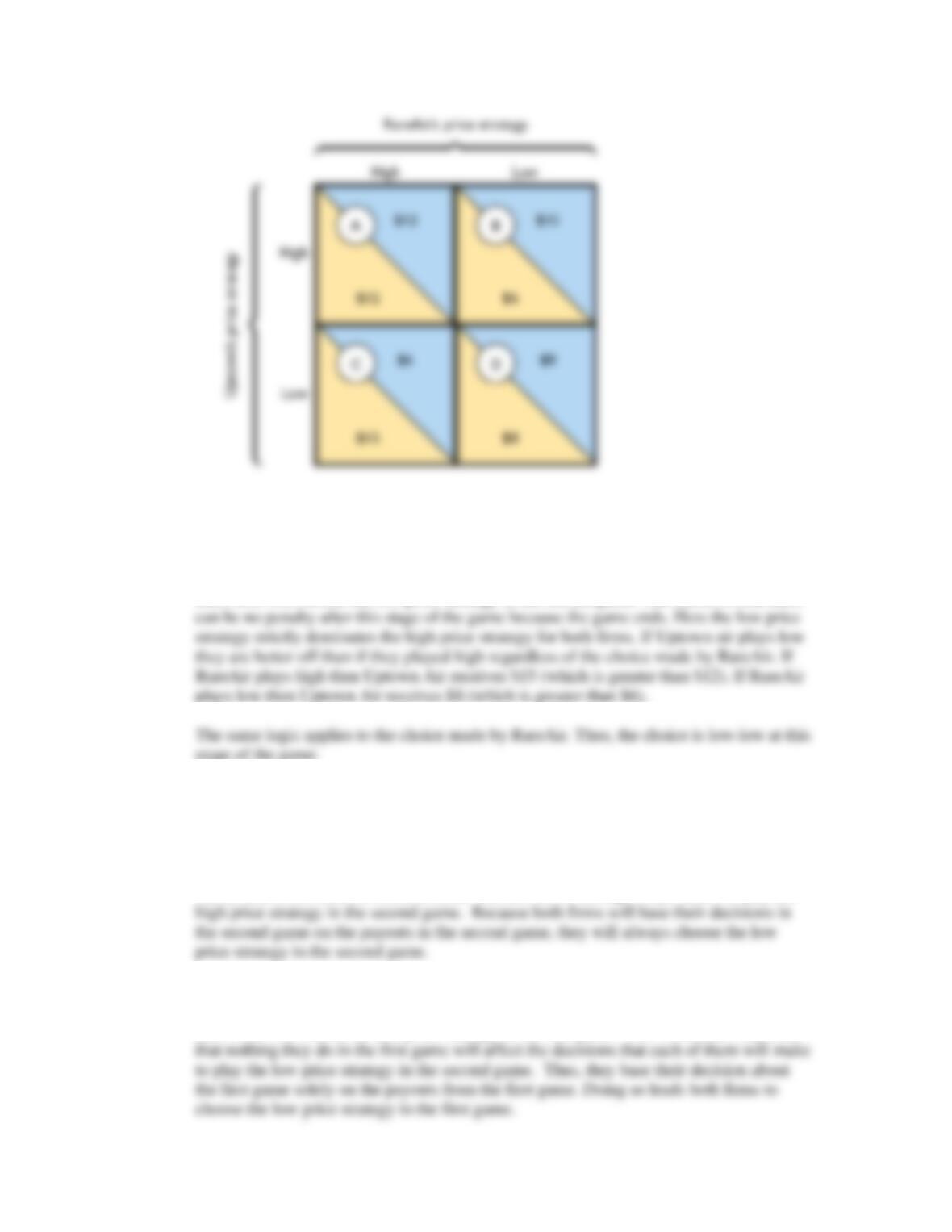
2. Consider whether the promises and threats made toward each other by duopolists and
oligopolists are always credible (believable). Look at the figure below. Imagine that the two
firms will play this game twice in sequence and that each firm claims the following policy. Each
says that if both it and the other firm choose the high price in the first game, then it will also
choose the high price in the second game (as a reward to the other firm for cooperating in the first
game). LO8
a) As a first step toward thinking about whether this policy is credible, consider the situation
facing both firms in the second game. If each firm bases its decision on what to do in the second
game entirely on the payouts facing the firms in the second game, which strategy will each firm
choose in the second game?
b) Now move backward in time one step. Imagine that it is the start of the first game and each
firm must decide what to do during the first game. Given your answer to part a, is the publicly
stated policy credible? (Hint: No matter what happens in the first game, what will both firms do
in the second game?)
c) Given your answers to a and b, what strategy will each firm choose in the first game?
Feedback: Let’s look at the following example. Consider whether the promises and
threats made toward each other by duopolists and oligopolists are always credible
(believable). Look back at Figure 11.3 in the chapter (not in this appendix). Imagine that
the two firms will play this game twice in sequence and that each firm claims the
following policy. Each says that if both it and the other firm choose the high price in the
first game, then it will also choose the high price in the second game (as a reward to the
other firm for cooperating in the first game).
Chapter 11 – Monopolistic Competition and Oligopoly (Appendix)
11A-5
a) As a first step toward thinking about whether this policy is credible, consider the
situation facing both firms in the second game. If each firm bases its decision on what to
do in the second game entirely on the payouts facing the firms in the second game, which
strategy will each firm choose in the second game?
Each firm will choose the low price strategy in the second game. The reason is that there
stage of the game.
b) Now move backward in time one step. Imagine that it is the start of the first game and
each firm must decide what to do during the first game. Given your answer to part a, is
the publicly stated policy credible? (Hint: No matter what happens in the first game, what
will both firms do in the second game?)
The policy is not credible because firms will not follow through on promises to play the
c) Given your answers to a and b, what strategy will each firm choose in the first game?
Each firm will choose the low price strategy in the first game. This is because they know