Chapter 11 – Monopolistic Competition and Oligopoly
11-1
Chapter 11 Monopolistic Competition and Oligopoly
QUESTIONS
1. How does monopolistic competition differ from pure competition in its basic characteristics?
From pure monopoly? Explain fully what product differentiation may involve. Explain how the
entry of firms into its industry affects the demand curve facing a monopolistic competitor and
how that, in turn, affects its economic profit. LO1
Answer: In monopolistic competition there are many firms but not the very large
numbers of pure competition. The products are differentiated, not standardized. There is
some control over price in a narrow range, whereas the purely competitive firm has none.
There is relatively easy entry; in pure competition, entry is completely without barriers.
2. Compare the elasticity of a monopolistic competitor’s demand with that of a pure competitor
and a pure monopolist. Assuming identical long-run costs, compare graphically the prices and
outputs that would result in the long run under pure competition and under monopolistic
competition. Contrast the two market structures in terms of productive and allocative efficiency.
Explain: “Monopolistically competitive industries are populated by too many firms, each of
which produces too little.” LO2
Answer: The monopolistic competitor’s demand curve is less elastic than a pure
competitor and more elastic than a pure monopolist. Your graphs should look like Figure
9.6 (pure competition) and Figure 11.1 (monopolistic competition). Price is higher and
output lower for the monopolistic competitor. Pure competition: P = MC (allocative
Chapter 11 – Monopolistic Competition and Oligopoly
11-2
3. “Monopolistic competition is monopolistic up to the point at which consumers become willing
to buy close-substitute products and competitive beyond that point.” Explain. LO2
Answer: As long as consumers prefer one product over another regardless of relative
prices, the seller of the product is a monopolist. But in monopolistic competition this
4. “Competition in quality and service may be just as effective as price competition in giving
buyers more for their money.” Do you agree? Why? Explain why monopolistically competitive
firms frequently prefer nonprice competition to price competition. LO2
Answer: This can certainly be true. It depends on how much consumers value quality
and service, and are willing to pay for it through higher product prices. In a
monopolistically competitive market the consumer can buy a substitute brand for a lower
price, if the consumer prefers a lower price to better quality and service.
5. Critically evaluate and explain: LO2
(a) In monopolistically competitive industries, economic profits are competed away in the long
run; hence, there is no valid reason to criticize the performance and efficiency of such industries.
(b) In the long run, monopolistic competition leads to a monopolistic price but not to
monopolistic profits.
Answer:
(a) The first part of the statement may well be true, but it does not lead logically to the
second part. The criticism of monopolistic competition is not related to the profit
Chapter 11 – Monopolistic Competition and Oligopoly
11-3
6. Why do oligopolies exist? List five or six oligopolists whose products you own or regularly
purchase. What distinguishes oligopoly from monopolistic competition? LO3
Answer: Oligopolies exist for several reasons, the most common probably being
economies of scale. If these are substantial, as they are in the automobile industry, for
example, only very large firms can produce at minimum average cost. This makes it
7. Answer the following questions, which relate to measures of concentration: LO3
(a) What is the meaning of a four-firm concentration ratio of 60 percent? 90 percent? What are
the shortcomings of concentration ratios as measures of monopoly power?
(b) Suppose that the five firms in industry A have annual sales of 30, 30, 20, 10, and 10 percent of
total industry sales. For the five firms in industry B, the figures are 60, 25, 5, 5, and 5 percent.
Calculate the Herfindahl index for each industry and compare their likely competitiveness.
Answer: A four-firm concentration ratio of 60 percent means the largest four firms in the
industry account for 60 percent of sales; a four-firm concentration ratio of 90 percent
Chapter 11 – Monopolistic Competition and Oligopoly
11-4
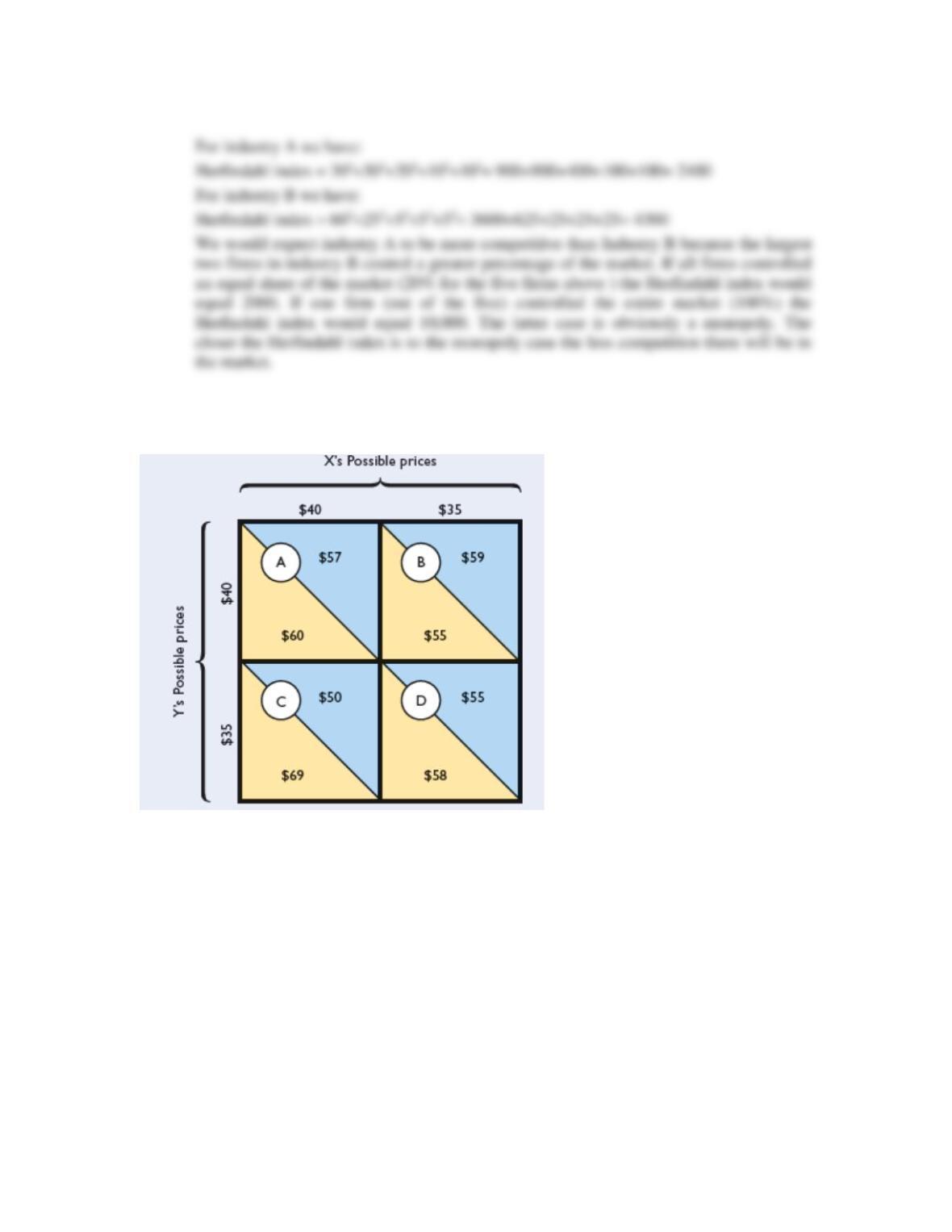
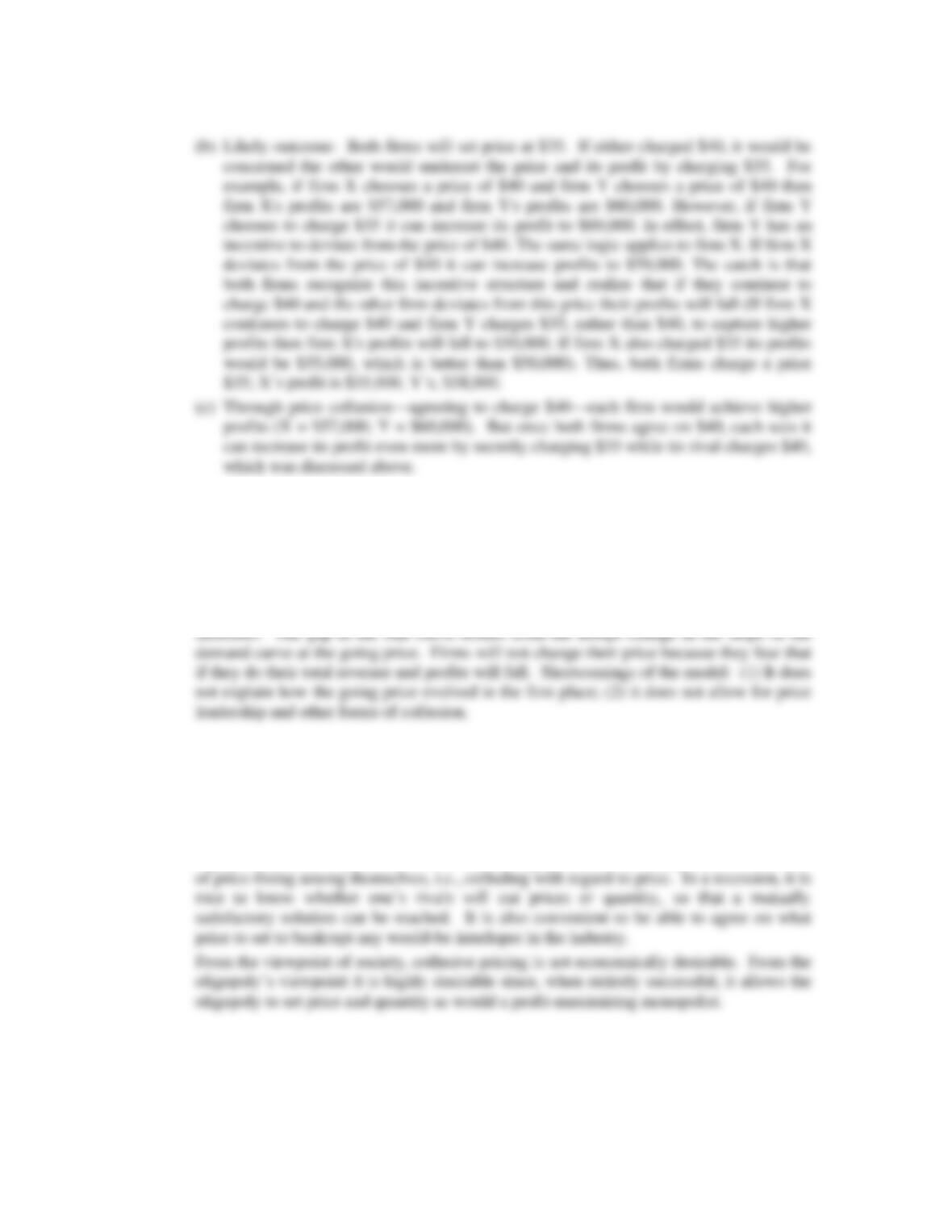
8. Explain the general meaning of the following profit payoff matrix for oligopolists C and D. All
profit figures are in thousands. LO4
(a) Use the payoff matrix to explain the mutual interdependence that characterizes oligopolistic
industries.
(b) Assuming no collusion between X and Y, what is the likely pricing outcome?
(c) In view of your answer to 8b, explain why price collusion is mutually profitable. Why might
there be a temptation to cheat on the collusive agreement?
Answer:
(a) X and Y are interdependent because their profits depend not just on their own price,
but also on the other firm’s price. Note that Y’s profits are in the lower corner and X’s
profits are in the upper corner.
Chapter 11 – Monopolistic Competition and Oligopoly
11-5
9. What assumptions about a rival’s response to price changes underlie the kinked-demand curve
for oligopolists? Why is there a gap in the oligopolist’s marginal-revenue curve? How does the
kinked-demand curve explain price rigidity in oligopoly? What are the shortcomings of the
kinked-demand model? LO5
Answer: Assumptions: (1) Rivals will match price cuts: (2) Rivals will ignore price
10. Why might price collusion occur in oligopolistic industries? Assess the economic desirability
of collusive pricing. What are the main obstacles to collusion? Speculate as to why price
leadership is legal in the United States, whereas price-fixing is not. LO6
Answer: Price wars are a form of competition that can benefit the consumer but can be
highly detrimental to producers. As a result, oligopolists are naturally drawn to the idea
Chapter 11 – Monopolistic Competition and Oligopoly
11-6
11. Why is there so much advertising in monopolistic competition and oligopoly? How does such
advertising help consumers and promote efficiency? Why might it be excessive at times? LO7
Answer: Two ways for monopolistically competitive firms to maintain economic profits
are through product development and advertising. Also, advertising will increase the
Chapter 11 – Monopolistic Competition and Oligopoly
11-7
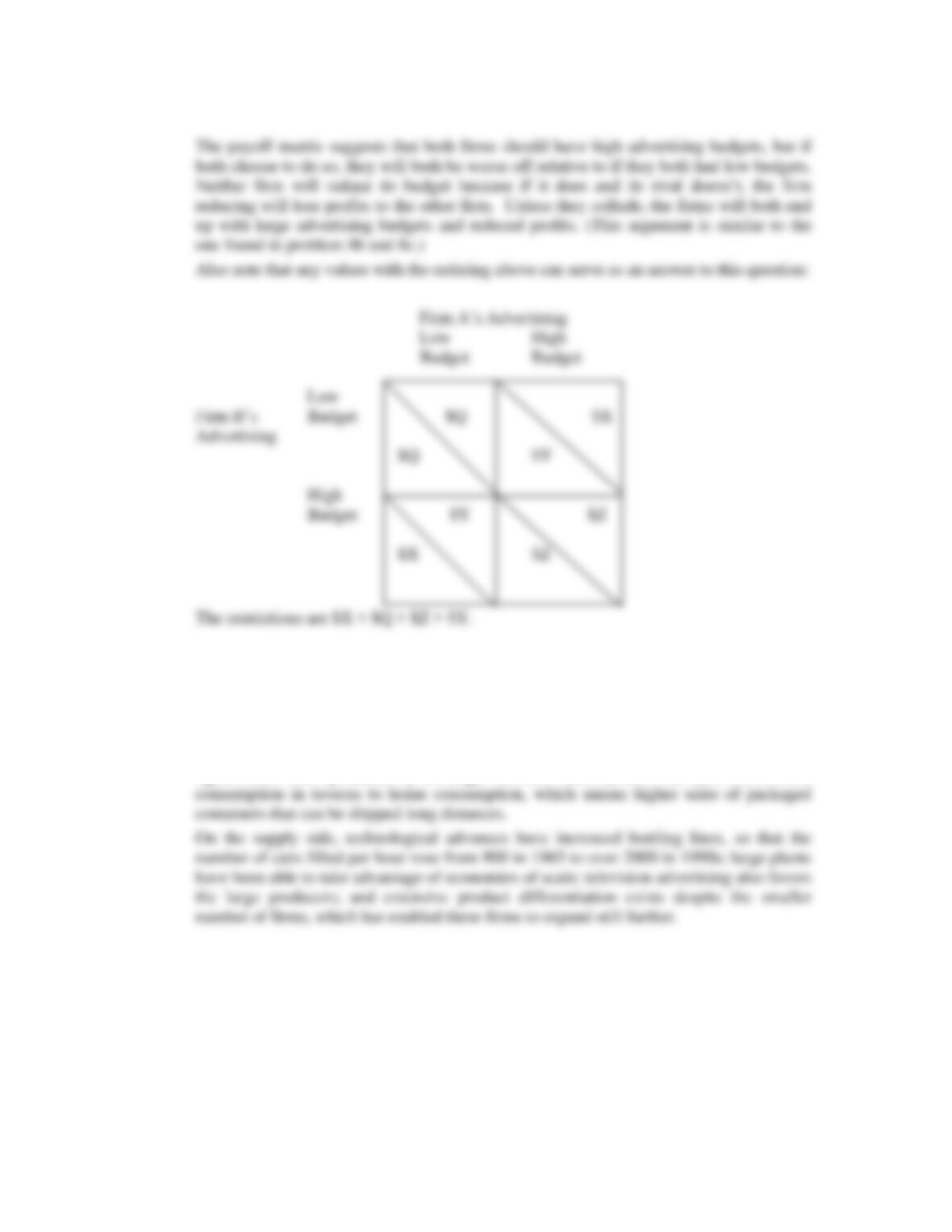
12. ADVANCED ANALYSIS Construct a game-theory matrix involving two firms and their
decisions on high versus low advertising budgets and the effects of each on profits. Show a
circumstance in which both firms select high advertising budgets even though both would be
more profitable with low advertising budgets. Why won’t they unilaterally cut their advertising
budgets? LO7
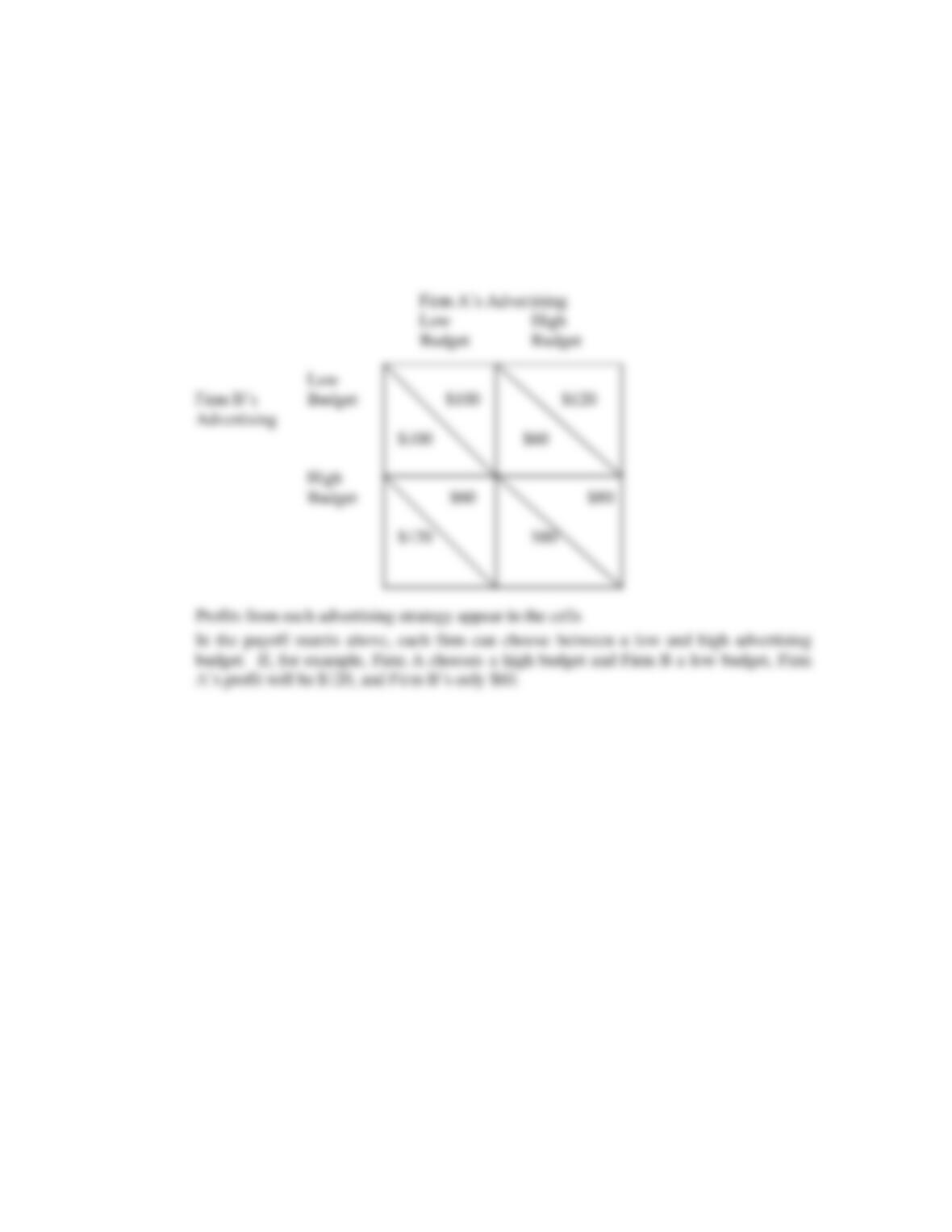
Answer: Consider the following example, where Firm B’s profits are in the lower corner
and Firm A’s profits are in the upper corner :
Chapter 11 – Monopolistic Competition and Oligopoly
11-8
13. LAST WORD What firm dominates the U.S. beer industry? What demand and supply factors
have contributed to “fewness” in this industry?
Answer: Anheuser-Busch is the dominant firm in the industry.
On the demand side, there is evidence that by the 1970s tastes had changed in favor of
lighter, drier beers produced by the larger brewers. Second, there has been a shift from
Chapter 11 – Monopolistic Competition and Oligopoly
11-9
PROBLEMS
1. Suppose that a small town has seven burger shops whose respective shares of the local
hamburger market are (as percentages of all hamburgers sold): 23%, 22%, 18%, 12%, 11%, 8%,
and 6%. What is the four‐firm concentration ratio of the hamburger industry in this town? What is
the Herfindahl index for the hamburger industry in this town? If the top three sellers combined to
form a single firm, what would happen to the four‐firm concentration ratio and to the Herfindahl
index? LO3
Feedback: Consider the following example: Suppose that a small town has seven burger
shops whose respective shares of the local hamburger market are (as percentages of all
hamburgers sold): 23%, 22%, 18%, 12%, 11%, 8%, and 6%.
2. Suppose that the most popular car dealer in your area sells 10 percent of all vehicles. If all
other car dealers sell either the same number of vehicles or fewer, what is the largest value that
the Herfindahl index could possibly take for car dealers in your area? In that same situation, what
would the four‐firm concentration ratio be? LO3
Chapter 11 – Monopolistic Competition and Oligopoly
11–10
Feedback: Consider the following example: Suppose that the most popular car dealer in
your area sells 10 percent of all vehicles. If all other car dealers sell either the same
number of vehicles or fewer in the market then the largest number of dealers possible is
3. Suppose that an oligopolistically competitive restaurant is currently serving 230 meals per day
(the output where MR = MC). At that output level, ATC per meal is $10 and consumers are
willing to pay $12 per meal. What is the size of this firm’s profit or loss? Will there be entry or
exit? Will this restaurant’s demand curve shift left or right? In long‐run equilibrium, suppose that
this restaurant charges $11 per meal for 180 meals and that the marginal cost of the 180th meal is
$8. What is the size of the firm’s profit? Suppose that the allocatively efficient output level in
long-run equilibrium is 200 meals. Is the deadweight loss for this firm greater than or less than
$60? LO3
Feedback: Consider the following example: An oligopolistically competitive restaurant
is currently serving 230 meals per day (the output where MR = MC). At that output level,
ATC per meal is $10 and consumers are willing to pay $12 per meal.
Chapter 11 – Monopolistic Competition and Oligopoly
11–11