238 CHAPTER 10 | Economic Growth, the Financial System, and Business Cycles
Question
Many researchers who have studied presidential elections believe that the state of the economy often
plays a large role in the outcome of the election. In particular, presidents who run for reelection during a
year when real GDP is declining and unemployment is increasing are usually defeated. Is the current state
of the economy a good reason for voting for or against an incumbent president running for reelection?
Briefly explain your argument.
Answer
Voters base their decisions on a variety of issues. Some voters always vote for the candidate of the party
Extra Economics in Your Life:
Will Productivity Growth Prevent You from Getting a Job?
In a September 2009 speech economist Robert J. Gordon, a member of the Business Cycle Dating
Committee at the NBER, predicted that the committee would ultimately determine that the trough of the
2007–2009 recession would be in June 2009, and that the economic recovery from the recession would be
characterized by strong gains in productivity but weak growth in employment.
Question: In this chapter the textbook argues that productivity growth increases a nation’s average
standard of living, but Robert Gordon suggests that productivity growth inhibits growth in employment.
Does productivity growth help or harm people who are looking for jobs?
Answer: Productivity growth—increases in the quantity of goods and services that can be produced by
one worker or one hour of work—must occur in order for a nation to experience an increase in the
Extra AN INSIDE LOOK News Article to Use in Class
CHAPTER 10 | Economic Growth, the Financial System, and Business Cycles 239
Solutions to End-of-Chapter Exercises
10.1
Long-Run Economic Growth
Learning Objective: Discuss the importance of long-run economic growth.
Review Questions
1.1 Real GDP per capita measured in 2009 dollars increased from $6,000 in 1900 to $50,010 in 2014,
1.2 The rule of 70 is a quick way to calculate the approximate number of years it will take for a
1.3 The two key factors that cause labor productivity to increase over time are the quantity of capital
Problems and Applications
1.5 There is no one correct answer to this question, but there are some relevant considerations: An
income of $1,000,000 represents 20 times more basic purchasing power than $50,000 in 2016, so
with that income you could have many more goods and services in 1900 than in 2016. Even
though there were no automatic dishwashers, microwaves, or airplanes in 1900, with $1,000,000
1.6 Increases in real GDP per capita not only increase the amount of goods and services available to a
country’s citizens, but also typically increase life expectancy at birth, as well as other measures of
240 CHAPTER 10 | Economic Growth, the Financial System, and Business Cycles
1.7 A positive relationship between economic prosperity and life expectancy may be due to increased
spending on health care in an economy with a higher income level. Therefore, greater economic
1.8 a. Growth rate for 1991 =
(8,948 8,955) 100 0.08%
8,955
− = −
b. Average annual growth =
0.08 3.57 2.74 4.03 2.57%
4
− + + + =
1.9 Using the rule of 70, it will take approximately 37 (= 70/1.9) years for real GDP per capita to
1.10 McKinsey was referring to growth in real GDP per capita. Long-run economic growth occurs
1.11 You should agree. There must be an increase in productivity in order to increase real GDP per
1.12 Real wages increase when workers produce more output per hour. Business firms can afford to
pay workers higher wages when productivity increases as the additional output is sold.
1.13 Education and health care play a major role in increasing worker productivity, which is essential
for economic growth. In 1991, India started economic reforms by scaling back central planning,
reducing regulations, and introducing market-based reforms.
1.14 a. As Indian workers are transferred from agriculture to the service and industrial sectors of the
CHAPTER 10 | Economic Growth, the Financial System, and Business Cycles 241
10.2
Saving, Investment, and the Financial System
Learning Objective: Discuss the role of the financial system in facilitating long-run
economic growth.
Review Questions
2.2 The financial system provides risk sharing by allowing savers to spread their savings among
many financial investments either directly through financial markets or indirectly through making
2.3 The equality between saving and investment follows from national income accounting and the
definitions of saving and investment. By rearranging the components of GDP for a closed
2.4 Loanable funds are the money that households save and lend to businesses. Businesses demand
Problems and Applications
2.5 You would have to take the time and incur the expense to gather information on the borrower and
his likelihood of repaying. Your funds would not be liquid. Although you might want the money
2.6 You should agree. A sound financial system helps to channel saving (the supply of loanable
funds) to firms that borrow for capital investment and the adoption of new technologies, both of
which are key factors for economic growth.
242 CHAPTER 10 | Economic Growth, the Financial System, and Business Cycles
2.8 a. Private saving:
Sprivate = Y + TR – C – T, but TR is not given.
Use I = Sprivate + Spublic
2.9 S and I must decline by $0.5 trillion.
2.10 a. Graph 4 shows a situation where there would be a small increase in the quantity of loanable
funds supplied from an increase in the real interest rate.
2.11 a. The shift represents a decrease in the supply of loanable funds.
2.12 a. Both the equilibrium interest rate and the equilibrium quantity of loanable funds increase.
b. The demand for loanable funds increased. For a given demand for loanable funds, an increase
in the interest rate does decrease the quantity of loanable funds demanded. In the figure, we

CHAPTER 10 | Economic Growth, the Financial System, and Business Cycles 243
2.13 As illustrated in the graph below, an increase in business taxes will decrease the after-tax rate of
return on investment projects, which will decrease the demand for loanable funds, causing a shift
2.14 Saving is necessary to fund investment, which promotes long-run economic growth. Income
saved reduces the amount of current consumption. One can argue that it is more important to
2.15 The pre-reform Scrooge saved nearly all of his large income, which increased the supply of
loanable funds and helped increase the quantity of investment goods and, therefore, economic
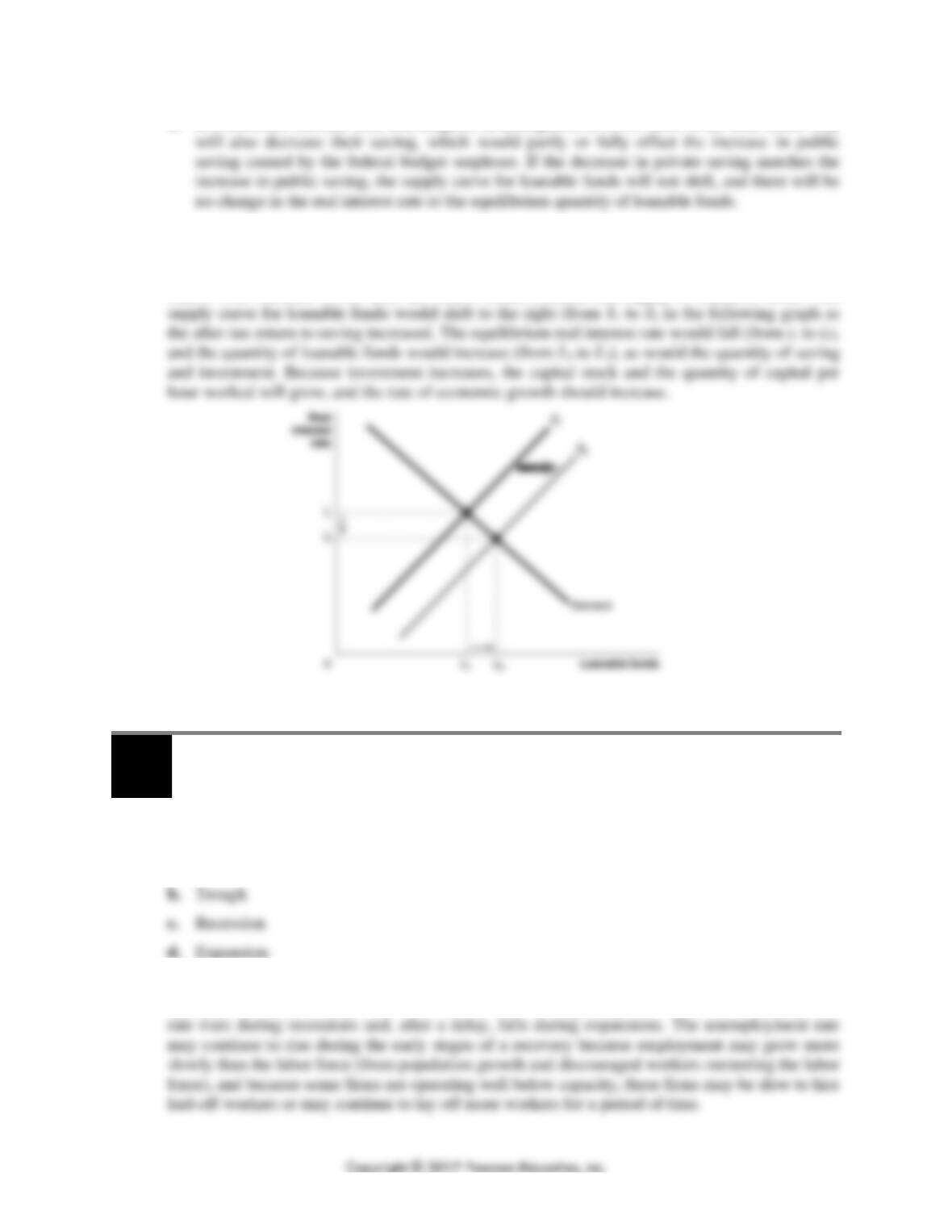
2.16 a. In the following graph a budget surplus shifts the supply curve for loanable funds to the right
from S1 to S2. As a result, the equilibrium real interest rate decreases from i1 to i2, and the
equilibrium quantity of loanable funds falls from L1 to L2. Because the equilibrium quantity
244 CHAPTER 10 | Economic Growth, the Financial System, and Business Cycles
b. If households increase their consumption in anticipation of lower taxes in the near future they
2.17 Households are interested in the return they receive from saving after they have paid their taxes.
If the government switched from taxing nominal interest payments to taxing only real interest
payments, the tax households would pay would decrease, leaving them with a higher after-tax
return. This increase in the after-tax return would increase the supply of loanable funds. The
10.3
The Business Cycle
Learning Objective: Explain what happens during the business cycle.
Review Questions
3.1 a. Peak
3.2 During an economic expansion, particularly near the end of the expansion, the inflation rate
typically increases. During recessions, the inflation rate typically decreases. The unemployment
CHAPTER 10 | Economic Growth, the Financial System, and Business Cycles 245
3.3 The typical recession before 1950 was more severe than the typical recession after 1950.
Economists agree that three factors have lessened the severity of recessions: (1) The increasing
Problems and Applications
3.4 Ford F-150 trucks (a), Corning’s screens for 4K televisions (c), and Boeing passenger aircraft (e)
3.5 There is no clear cut definition of a recession, so dating recessions requires some judgment. As
3.6 When firms expand during a recession, they risk spending too much money too quickly. If it is
difficult to predict when a recession will end, firms that expand too quickly will find themselves
with increasing debt loads and not enough business to cover their increased expenses. This
3.7 No, if debt follows its normal pattern, it will increase near the end of an expansion. Because debt
was falling in late 2014, this trend did not signal the end of an expansion.
3.8 You should disagree with this statement. Real GDP itself is not a measure of economic growth,
3.9 Gorilla glass is used in the manufacture of products such as mobile phones, portable media
players, and portable computer displays—all products that experienced rapid sales growth in
3.10 Samuelson explained that households were willing to assume debt and lenders were willing to
make loans during the Great Moderation because they were confident that continued economic
growth would allow the loans to be paid off. But consumers were more reluctant to borrow and

246 CHAPTER 10 | Economic Growth, the Financial System, and Business Cycles
Real-Time Data Exercises
D10.1 a. In the second quarter of 2015, nominal GDP equaled $17,913.7 billion, real GDP equaled
$16,333.6 billion in chained 2009 dollars, and potential GDP equaled $16,853.1 billion in
chained 2009 dollars. These GDP values are annual rates.
D10.2 a. Gross private saving equaled $3,555.8 billion in the second quarter of 2015, and it equaled
$3,667.5 billion in the second quarter of 2012. Gross government saving equaled
−$228.1 billion in the second quarter of 2015, and it equaled −$837.2 billion in the second
quarter of 2012. Saving values are annual rates.
c. The graph below shows the loanable funds market in equilibrium. The supply of loanable
funds represents total saving.

CHAPTER 10 | Economic Growth, the Financial System, and Business Cycles 247
D10.3 a. Gross government saving equaled −$228.1 billion in the second quarter of 2015, and it
equaled −$1,036.2 billion in the second quarter of 2011. Saving values are annual rates.
b. Government saving represents the government budget surplus or budget deficit.