CHAPTER 10: EXCHANGE RATES, BUSINESS CYCLES, AND
MACROECONOMIC POLICY IN THE OPEN ECONOMY
LEARNING OBJECTIVES
I. Goals of Chapter 10
A. Two primary aspects of interdependence between economies of different
nations
1. International trade in goods and services
2. Worldwide integration of financial markets
B. Interdependence means that nations are dependent on each other, so policy
TEACHING NOTES
I. Exchange Rates (Sec. 10.1)
A. Nominal exchange rates
1. The nominal exchange rate tells you how much foreign currency you
can obtain with one unit of the domestic currency
a. For example, if the nominal exchange rate is 78 yen per dollar,
2. Under a flexible-exchange-rate system or floating-exchange-rate
system, exchange rates are determined by supply and demand and
may change every day; this is the current system for major currencies.
3. In the past, many currencies operated under a fixed-exchange-rate
system, in which exchange rates were determined by governments.
a. The exchange rates were fixed because the central banks in
those countries offered to buy or sell the currencies at the fixed
B. A Closer Look 10.1: The Effective Exchange rates
1. Although the majority of Canada’s international trade in goods and
Exchange Rates, Business Cycles, and Macroeconomic Policy in the Open Economy 167
2. The Bank of Canada calculates the Canadian Dollar Effective
Exchange Rate Index (CERI) – the weighted average of nominal
For a superb introduction to the European Monetary Union (EMU), see Werner
B. Real exchange rates
1. The real exchange rate tells you how much of a foreign good you can
get in exchange for one unit of a domestic good.
2. If the nominal exchange rate is 78 yen per dollar, and it costs 312 yen
C. Appreciation and depreciation
1. In a flexible-exchange-rate system, when enom fails, the domestic
currency has undergone a nominal depreciation (or it has become
weaker); when enom rises, the domestic currency has become stronger
Numerical Problem 1 is a simple example of appreciation and depreciation.
168 Chapter 10
D. Purchasing power parity
1. To examine the relationship between the nominal exchange rate and
the real exchange rate. think first about a simple case in which all
countries product the same goods, which are freely traded.
a. If there were no transportation costs, the real exchange rate
2. When PPP doesn’t hold, using Eq. (10.1), we can decompose changes
in the real exchange rate into parts:
Δe/e = Δenom/enom + ΔP/P – ΔPFor/PFor
3. This can be arranged as
Δ enom/enom = Δe/e +
π
For –
π
(10.3).
4. Thus a nominal appreciation is due to a real appreciation or a lower
6. Box 10.2: McParity
a. As a test of the PPP hypothesis, the Economist magazine
periodically reports on the prices of Big Mac hamburgers in
E. The real exchange rate and net exports
1. The real exchange rate is important because it represents the rate at
which domestic goods and services can be traded for those produced
abroad.
a. An increase in the real exchange rate means people in a
2. The real exchange rate also affects a country’s net exports (exports
minus imports).
Exchange Rates, Business Cycles, and Macroeconomic Policy in the Open Economy 169
macroeconomic policy changes are transmitted internationally.
3. The real exchange rate affects net exports through its effect on the
demand for goods.
a. A high real exchange rate makes foreign goods cheap relative
net exports.
F. Application: The value of the dollar and Canadian net exports
1. Our theory suggests that the dollar and Canadian net exports should
be inversely related.
2. Looking at data since the early 1970s, when the world switched to
floating exchange rates, confirms the theory (text Fig. 10.1).
a. From 1975 to 1985 the real value of the Canadian dollar
depreciated by about 25% and net exports increase sharply
over this period.
e. They are:
(1) The free trade agreements with the United States and
Mexico
(2) The US economy grew quickly during the late 1990s.
II. How Exchange Rates Are Determined: A Supply-and-Demand Analysis (Sec. 10.2)
A. What causes changes in the exchange rate?
1. To analyze this. we’ll use supply–and-demand analysis, assuming a
fixed price level.
2. Holding prices fixed means that changes in the real exchange rate are
170 Chapter 10
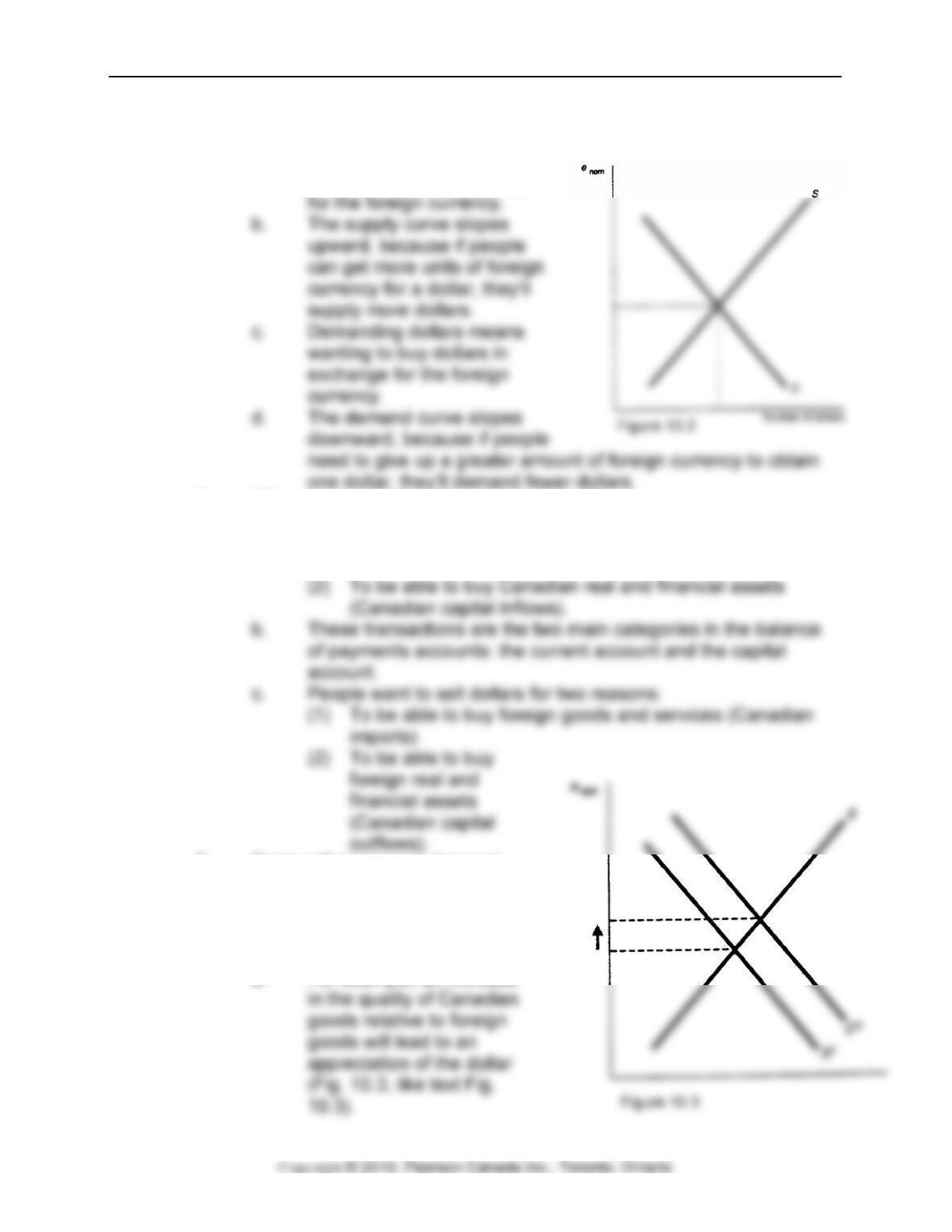
4. Demand and supply are plotted against the nominal exchange rate,
just like demand and supply for any good (Fig. 10.2: like text Fig. 10.2).
a. Supplying dollars means
offering dollars in exchange
5. Why do people demand or supply dollars?
a. People need dollars for two reasons:
(1) To be able to buy Canadian goods and services (Canadian
exports)
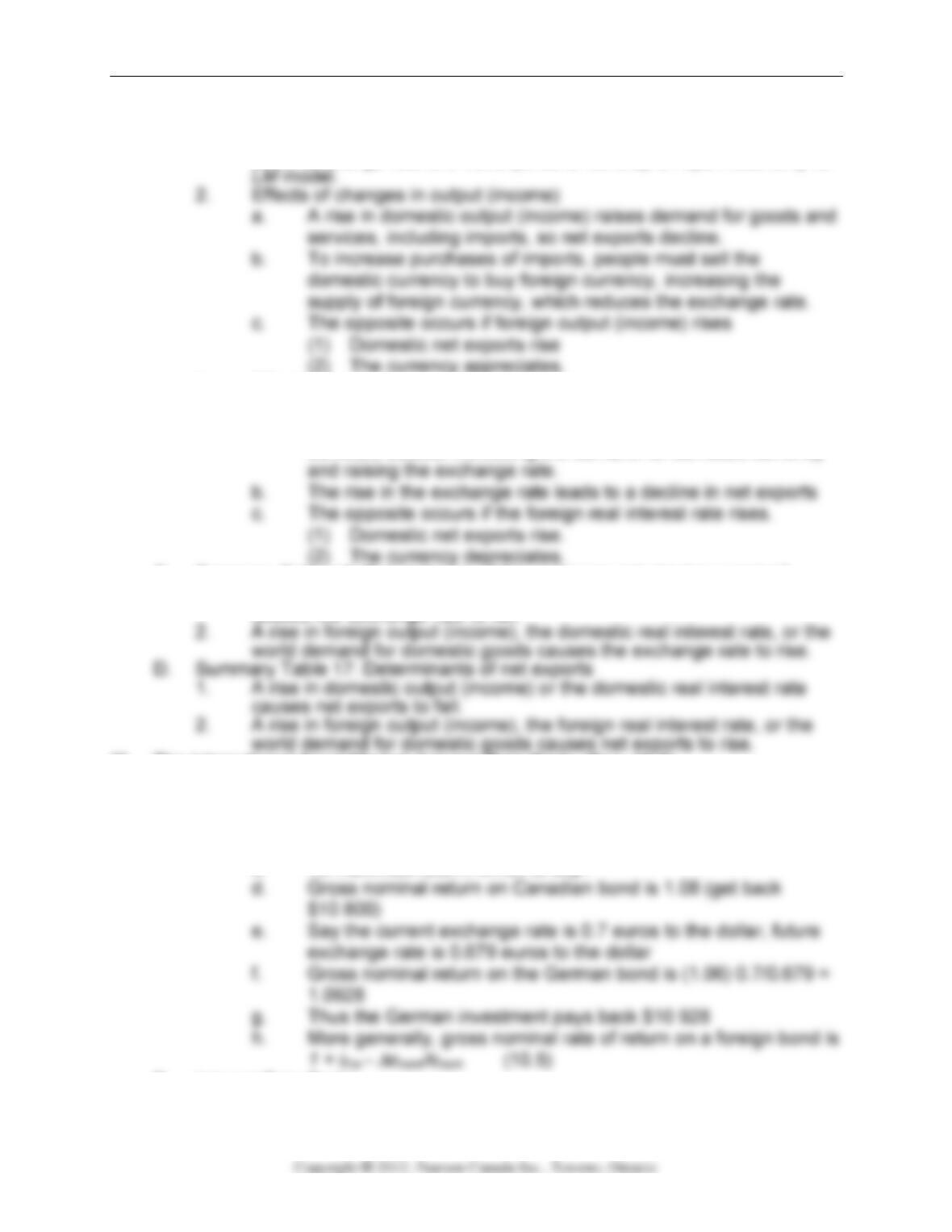
6. Factors that increase demand
for Canadian exports and assets
will increase demand for dollars,
shifting the demand curve to the
right and increasing the nominal
exchange rate.
a. For example, an increase
Exchange Rates, Business Cycles, and Macroeconomic Policy in the Open Economy 171
B. Macroeconomic determinants of the exchange rate and net export demand
1. Look at how changes in real output or the real interest rate are linked
to the exchange rate and net exports, to develop an open-economy IS–
(2) The currency appreciates.
3. Effects of changes in real interest rates
a. A rise in the domestic real interest rate (with the foreign real
interest rate held constant) causes foreigners to want to buy
domestic assets, increasing the demand for domestic currency
C. Summary Table 16: Determinants of the exchange rate (real or nominal)
1. A rise in domestic output (income) or the foreign real interest rate
causes the exchange rate to fall.
III. The International Asset Market: Interest Rate Parity (Sec. 10.3)
A. Returns on Domestic and Foreign Assets
1. An illustrative example: invest $10,000 for one year
a. Canadian bonds pay 8%
b. German bonds pay 6%
c. To maximize return, which to buy?
B. Interest Rate Parity
1. The interest rate parity condition:
172 Chapter 10
a. Investors will be indifferent to domestic and foreign assets of
comparable risk and liquidity whenever the gross nominal
returns are the same
C. Application: Explaining the movements in Canadian and US interest rates
1. Text Fig. 10.1 shows that between 1970 and 2009, Canadian interest
rates increased relative to the US rates.
2. The interest rate parity condition help explain the relative movements
in Canadian and US interest rates.
a. One possible explanation is that savers were expecting the
nominal exchange rate to depreciate. Why?
(1) Between 1975 and 1995, the debts of Canadian
b. Following the 2008–2009 financial crisis the debt of the US
Data Application
The interest rate parity is unfortunately not a very accurate predictor of exchange rate
changes. See Kenneth Froot and Richard Thaier, “Anomalies: Foreign Exchange,”
Journal of Economic Perspectives. Summer 1990, pp. 179–192.
IV. The IS–LM Model for an Open Economy (Sec. 10.4)
A. Only the IS curve is affected by having an open economy instead of a closed
economy: the LM curve and FE line are the same.
1. The IS curve is affected because net exports are part of the demand
for goods.
Exchange Rates, Business Cycles, and Macroeconomic Policy in the Open Economy 173
4. Factors that change net exports
(given domestic output and the
domestic real interest rate) shift
B. The open-economy IS curve
1. The goods-market equilibrium
condition is Sd – /d = NX (10.10).
a. This means that desired
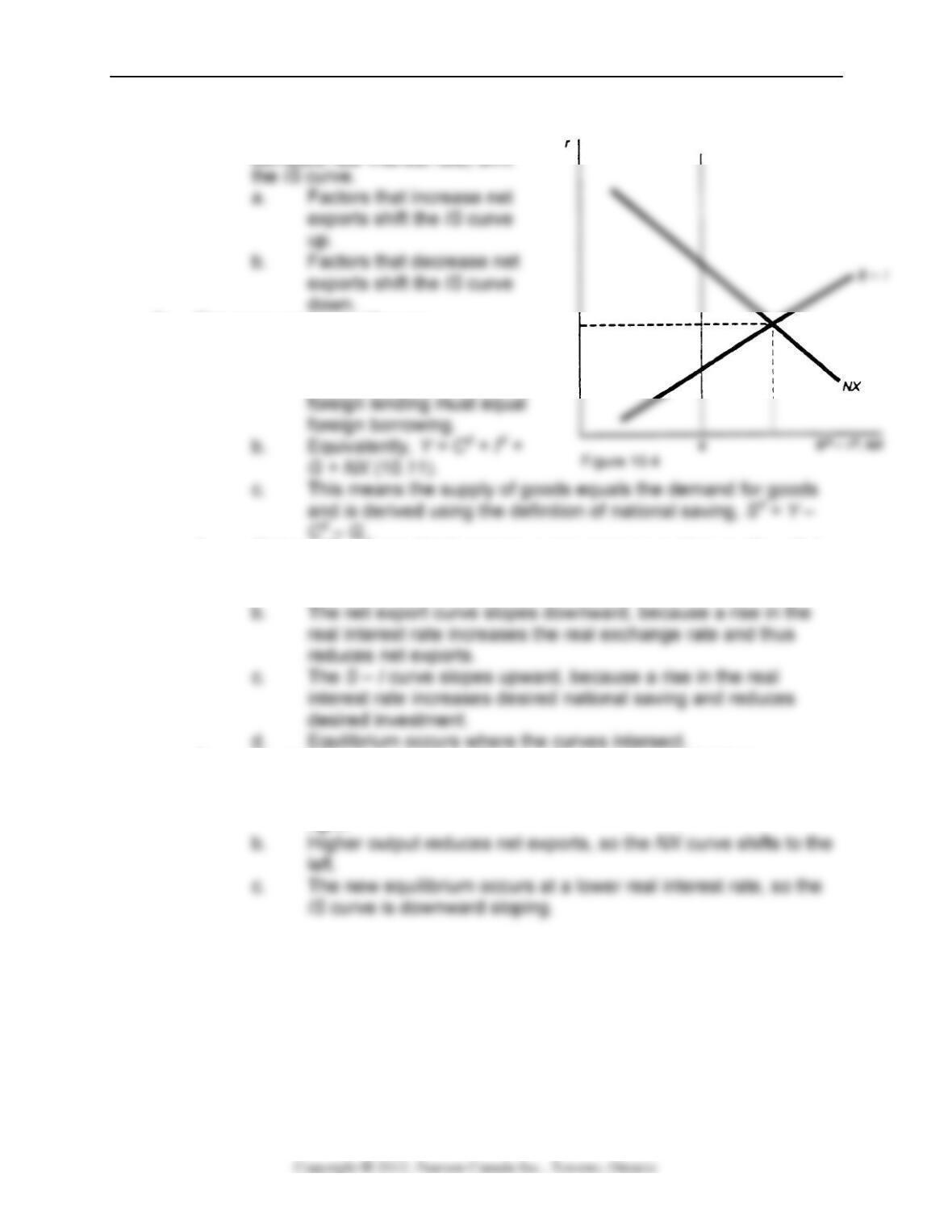
2. Plotting Sd – Id and NX illustrates goods-market equilibrium (Fig. 10.4;
like text Fig. 10.4)
a. Net exports can be positive or negative.
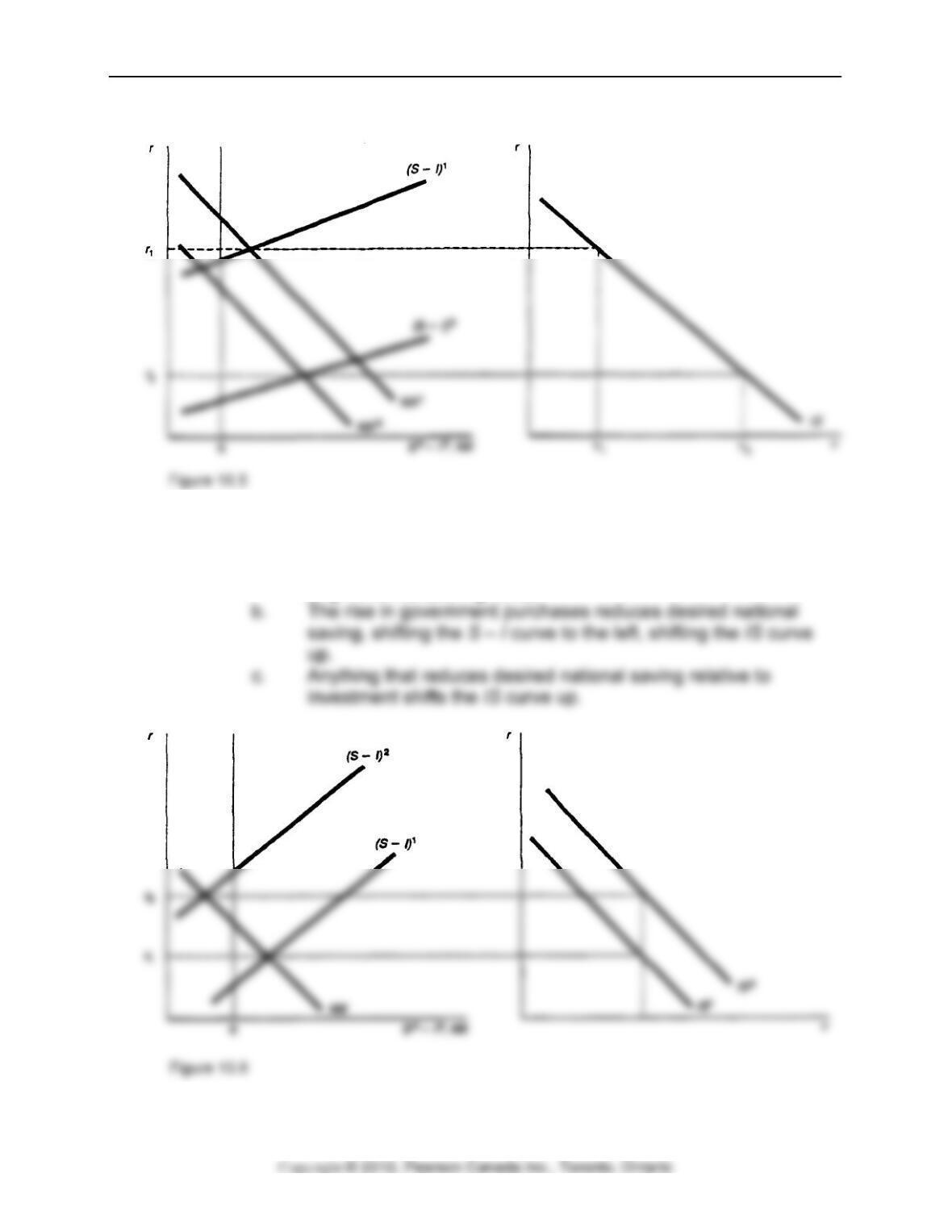
3. To get the open-economy IS curve, we need to see what happens
when domestic output changes (Fig. 10.5; like text Fig. 10.5).
a. Higher output increases saving, so the S – I curve shifts to the
right.
174 Chapter 10
C. Factors that shift the open-economy IS curve
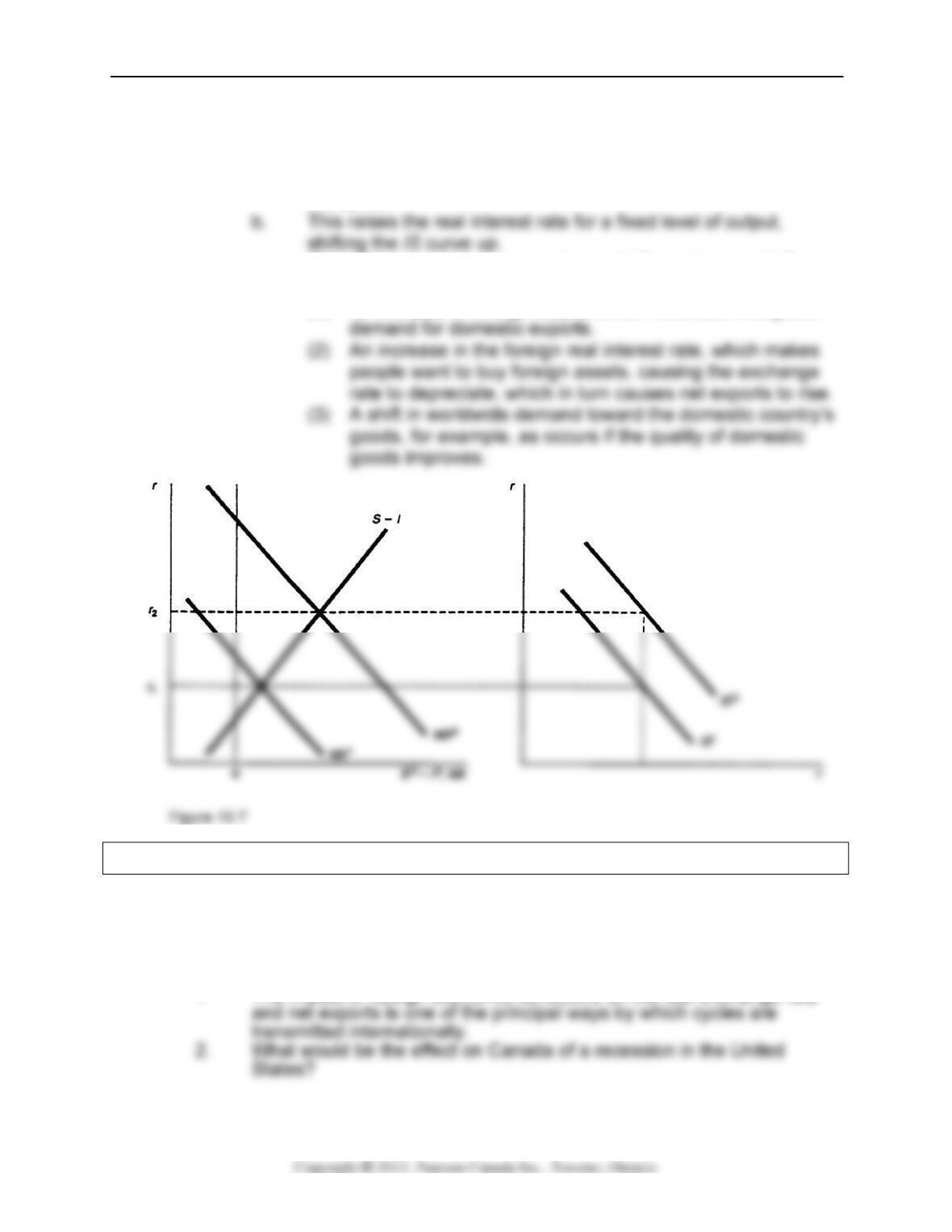
1. Any factor that raises the real interest rate that clears the goods market
at a constant level of output shifts the IS curve up.
a. An example is a temporary increase in government purchases
(Fig 10 6; like text Fig 10 6).
Exchange Rates, Business Cycles, and Macroeconomic Policy in the Open Economy 175
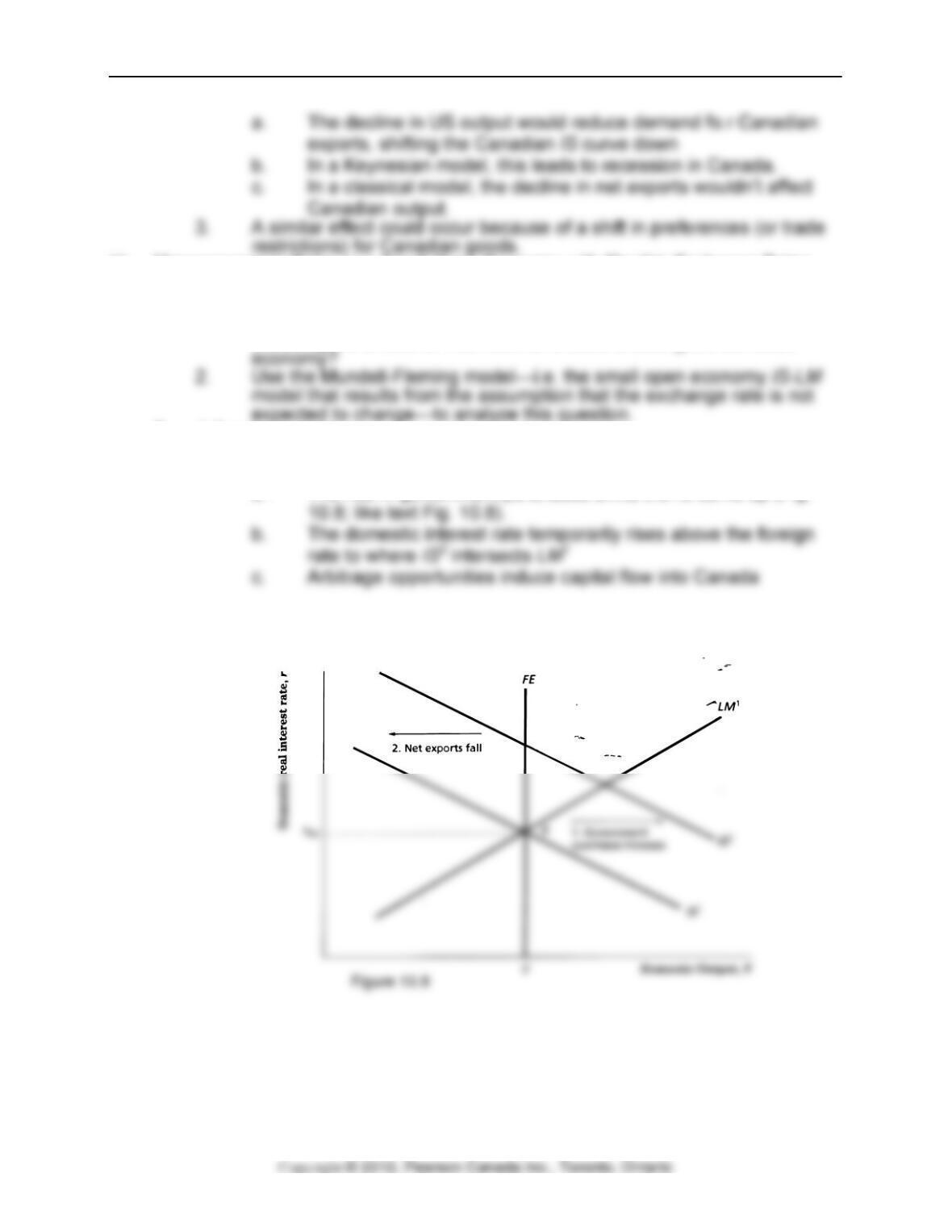
2. Anything that raises a country’s net exports, given domestic output and
the domestic real interest rate, will shift the open-economy IS curve up
(Fig. 10.7; like text Fig. 10.7).
a. The increase in net exports is shown as a shift to the right in the
NX curve .
c. Three things could increase net exports for a given level of
output and real interest rate.
(1) An increase in foreign output, which increases foreigners’
Analytical Problem 1 looks at the effect of trade barriers that reduce imports
3 Summary Table 18: International factors that shift the IS curve
a. An increase in foreign output, the foreign real interest rate, or
the demand for domestic goods relative to foreign goods all shift
the IS curve up.
D. The international transmission of business cycles
1 The impact of foreign economic conditions on the real exchange rate
176 Chapter 10
V. Macroeconomic Policy in a Small Open Economy with Flexible Exchange Rates
(Sec. 10.5)
A. Key question
1. To what extent are domestic fiscal and monetary policies useful for
offsetting the effects of international shocks affecting the domestic
B. A fiscal expansion
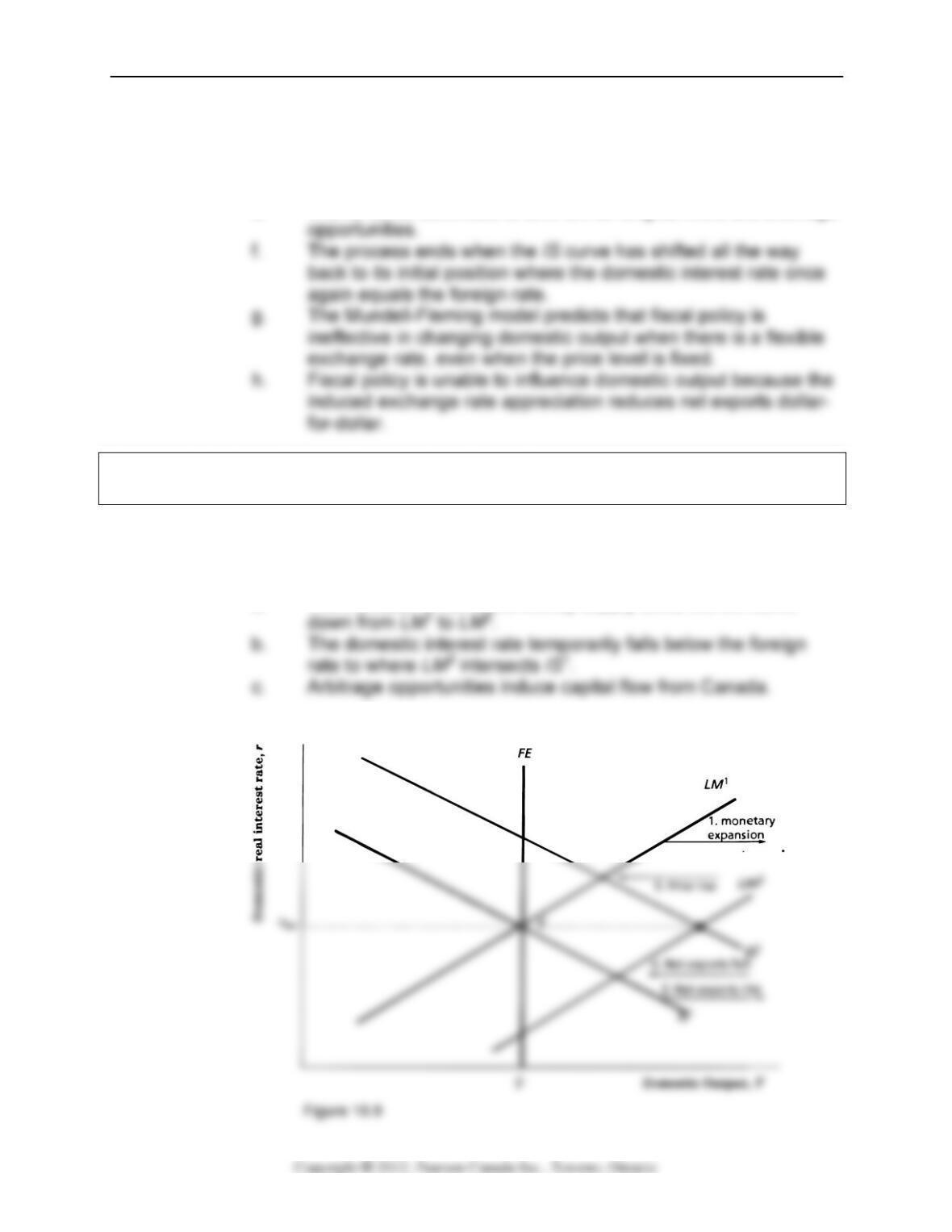
1. Look at a temporary increase in domestic government purchases using
the Mundell–Fleming model.
a. The rise in government purchases shifts the IS curve up (Fig.
Exchange Rates, Business Cycles, and Macroeconomic Policy in the Open Economy 177
d. The Canadian dollar appreciates which in turn makes exports
more expensive, net exports fall and the IS curve shifts to the
left.
e. The IS curve continues to shift left so long as there are arbitrage
D. A monetary expansion
1. Consider the effects of an increase in domestic money supply in the
Mundell–Fleming model.
2. Short-run effects (Fig. 10.9; like text Fig. 10.9)
a. The increase in domestic money supply shifts the LM curve
Numerical Problems 3 and 4 illustrate the effects of an increase in government
purchases on output, the exchange rate, and net exports.
178 Chapter 10
d. The Canadian dollar depreciates which in turn makes exports
cheaper, net exports rise and the IS curve shifts to the right
e. The IS curve continues to shift rightwards so long as there are
3. Long-run effects (Fig. 10.9; like text Fig. 10.9)
a. In the long run, wages and prices in the domestic economy rise
and the LM curve returns to its original position
b. All real variables, including net exports and the real exchange
rate, return to their original levels
price level and the money supply
VI. Fixed Exchange Rates (Sec. 10.6)
A. Fixed-exchange-rate systems are important historically
1. Canada has been on a flexible-exchange-rate system since the early
1970s
B. Fixing the exchange rate
1. The government sets the exchange rate, perhaps in agreement with
other countries
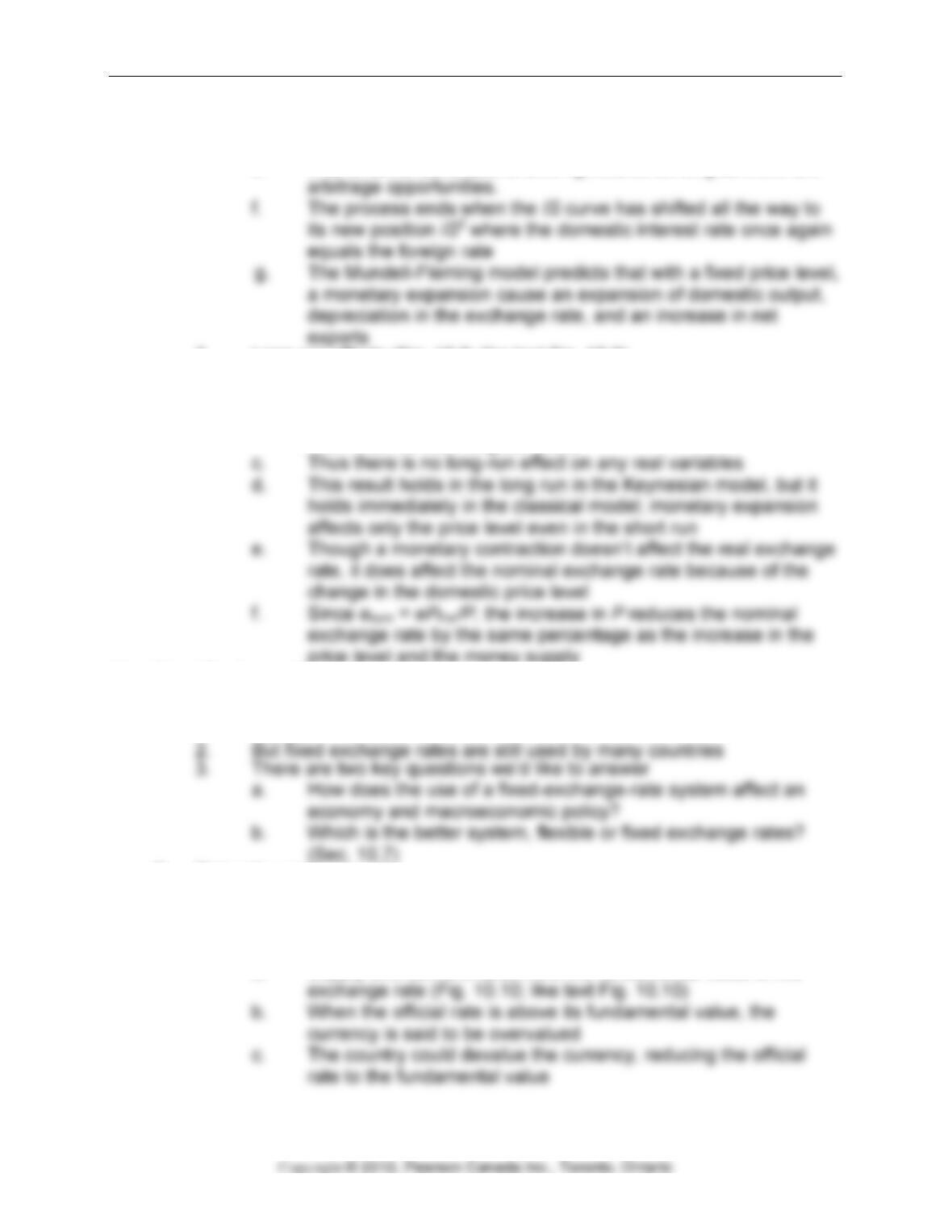
2. What happens if the official rate differs from the rate determined by
supply and demand?
a. Supply and demand determine the fundamental value of the
Exchange Rates, Business Cycles, and Macroeconomic Policy in the Open Economy 179
d. The country could
restrict international
transactions to reduce
the supply of its
currency to the foreign
e. The government can supply or demand the currency to make
the fundamental value equal to the official rate
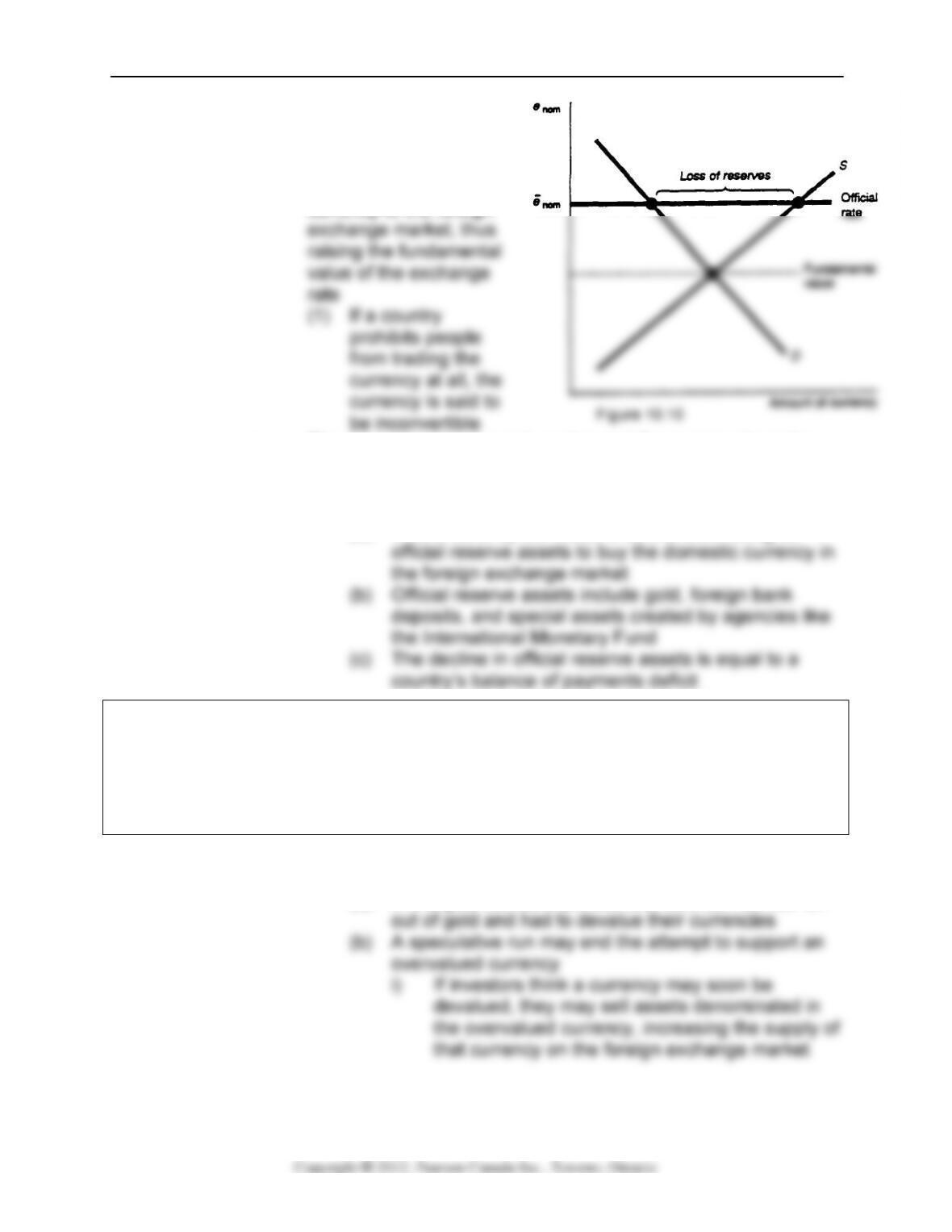
(1) If the currency is overvalued, the government can buy its
own currency
(a) This is done by the nation’s central bank using its
Data Application
In Llad Phillips and John Pippenger “Stabilization of the Canadian Dollar: 1975-1986”
Canadian Journal of Economics, May 1993. a model of Canadian foreign exchange
market intervention is developed. Their main finding is that the Bank of Canada has
over this period consistently intervened, often with a lag. This intervention seems ;o
have some success in influencing exchange rates.
(2) A country can’t maintain an overvalued currency forever,
as it will run out of official reserve assets
(a) In the gold standard period, countries sometimes ran
(3) Thus an overvalued currency can’t be maintained for very
long
3. Similarly, in the case of an undervalued currency, the official rate is
below the fundamental value
a. In this case, a central bank trying to maintain the official rate will
undervalued currency can’t be maintained for long
C. Monetary policy and the fixed exchange
rate
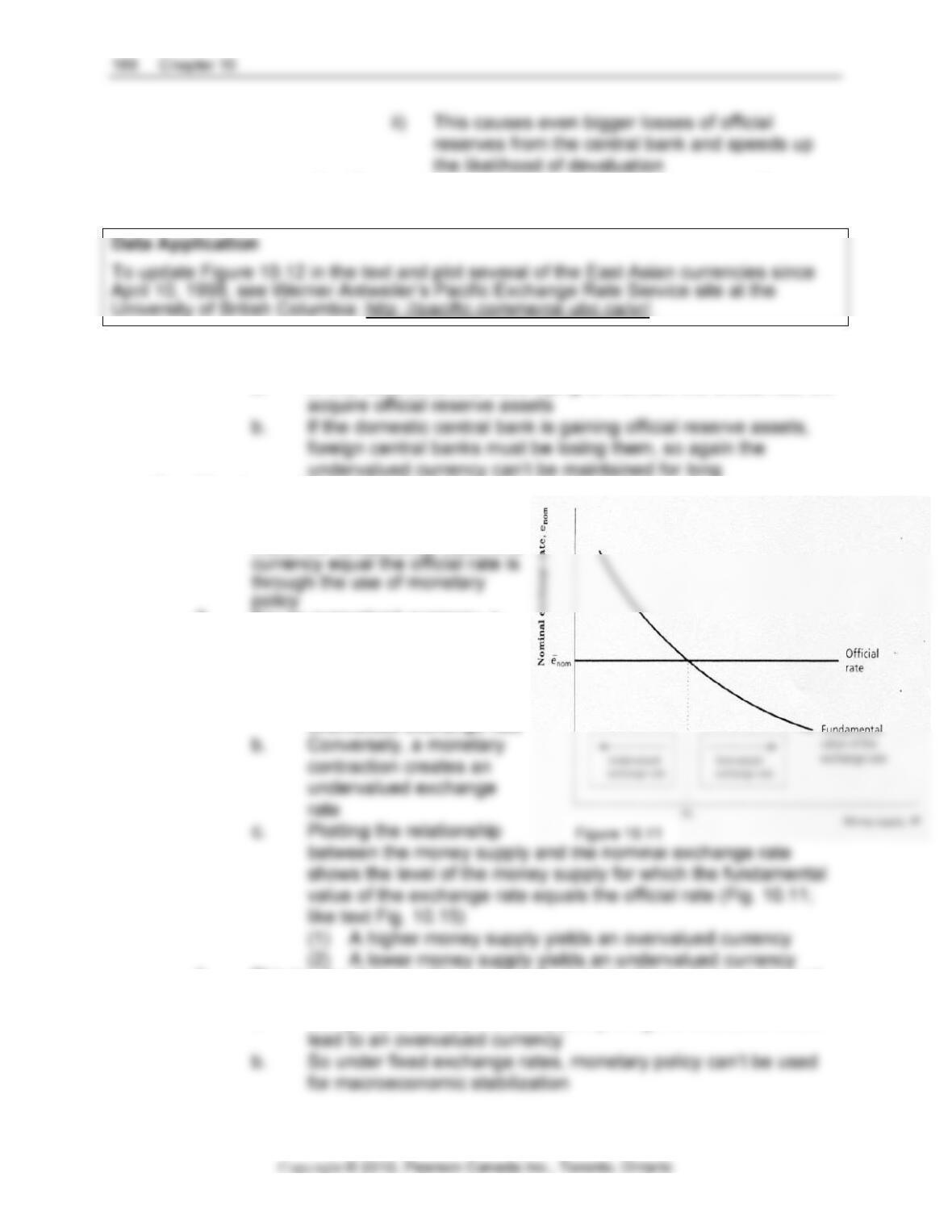
1. The best way for a country to
make the fundamental value of a
2. For an overvalued currency, a
monetary contraction is desirable
a. In the Mundell–Fleming
model, a monetary
expansion creates an
overvalued exchange rate
3. This implies that countries can’t both maintain the exchange rate and
use monetary policy to affect output
a. Using expansionary monetary policy to fight a recession would