Chapter 10
The Political Economy of Trade Policy
◼ Chapter Organization
The Case for Free Trade
Free Trade and Efficiency
Additional Gains from Free Trade
Rent Seeking
Political Argument for Free Trade
Case Study: The Gains from 1992
National Welfare Arguments against Free Trade
International Negotiations and Trade Policy
The Advantages of Negotiation
International Trading Agreements: A Brief History
The Uruguay Round
Trade Liberalization
Administrative Reforms: From the GATT to the WTO
54 Krugman/Obstfeld/Melitz • International Economics: Theory & Policy, Tenth Edition
Box: Free Trade versus Customs Unions
Box: Do Trade Preferences Have Appeal?
Case Study: Trade Diversion in South America
◼ Chapter Overview
The models presented up to this point generally suggest that free trade maximizes national welfare, although
it clearly is associated with income distributional effects. Most governments, however, maintain some
form of restrictive trade practices. This chapter investigates reasons for this. One set of reasons concerns
circumstances under which restrictive trade practices increase national welfare. Another set of reasons
concerns the manner in which the interests of different groups are weighed by governments. The chapter
concludes with a discussion of the motives for international trade negotiations and a brief history of
Two additional arguments for free trade are introduced in this chapter. Free trade, as opposed to “managed
trade,” provides a wider range of opportunities and thus a wider scope for innovation. The use of tariffs
and subsidies to increase national welfare (such as a large country’s use of an optimum tariff), even where
theoretically desirable, in practice may only advance the causes of special interests at the expense of the
general public. When quantity restrictions such as quotas are involved, rent-seeking behavior—where
companies expend resources to receive the benefits from quota licenses—can distort behavior and cause
waste in the economy.
Chapter 10 The Political Economy of Trade Policy 55
Actual trade policy often cannot be reconciled with the prescriptions of basic welfare analysis. One reason
for this is that the social accounting framework of policy makers does not match that implied by cost-benefit
analysis. For example, policy makers may apply a “weighted social welfare analysis” that weighs gains or
losses differently depending upon which groups are affected. Of course, in this instance there is the issue of
who sets the weights and on the basis of what criteria. Also, trade policy may end up being used as a tool
of income redistribution. Inefficient industries may be protected solely to preserve the status quo. Indeed,
tariffs theoretically can be set at levels high enough to restrict trade in a product.
International negotiations have led to mutual tariff reductions from the mid-1930s through the present.
Negotiations that link mutually reduced protection have the political advantage of playing well-organized
groups against each other rather than against poorly organized consumers. Trade negotiations also help avoid
trade wars. This is illustrated by an example of the Prisoner’s dilemma as it relates to trade. The pursuit of
self-interest may not lead to the best social outcome when each agent takes into account the other agent’s
decision. Indeed, in the example in the text, uncoordinated policy leads to the worst outcome because
protectionism is the best policy for each country to undertake unilaterally. Negotiations result in the
coordinated policy of free trade and the best outcome for each country.
The chapter also notes that more recent multilateral negotiations (the Doha Round) have stalled, largely over
disagreements regarding agricultural subsidies and trade. This has been a disappointment to free trade
proponents as it marks the first time a major multilateral trade round has failed to produce a substantial
agreement. However, the failure of the Doha Round can be partially attributed to the success of previous
rounds of trade negotiations. As the world moves closer and closer to free trade, the marginal gains from
further reductions in trade barriers become smaller. This is highlighted by Table 10-5 in the text, which
shows that even under the most ambitious proposals in the Doha Round, the gains from freer trade would
only be about 0.18 percent of global income.
56 Krugman/Obstfeld/Melitz • International Economics: Theory & Policy, Tenth Edition
◼ Answers to Textbook Problems
1. The arguments for free trade in this quote include:
• Free trade allows consumers and producers to make decisions based upon the marginal cost and
benefits associated with a good when costs and prices are undistorted by government policy.
2. a. This is potentially a valid argument for a tariff because it is based on an assumed ability of the
United States to affect world prices—that is, it is a version of the optimal tariff argument. If the
United States is concerned about higher world prices in the future, it could use policies that
encourage the accumulation of oil inventories and minimize the potential for future adverse
shocks.
d. There may be external economies associated with the domestic production of semiconductors.
This is potentially a valid argument. But the gains to producers of protecting the semiconductor
industry must as always be weighed against the higher costs to consumers and other industries
that pervasively use the chips. A well-targeted policy instrument would be a production subsidy.
This has the advantage of directly dealing with the externalities associated with domestic chip
production.
3. Without tariffs or subsidies, we compute domestic production as S = 20 + (10 10) = 120 and
domestic consumption as D = 400 − (5 10) = 350, for imports of 230.
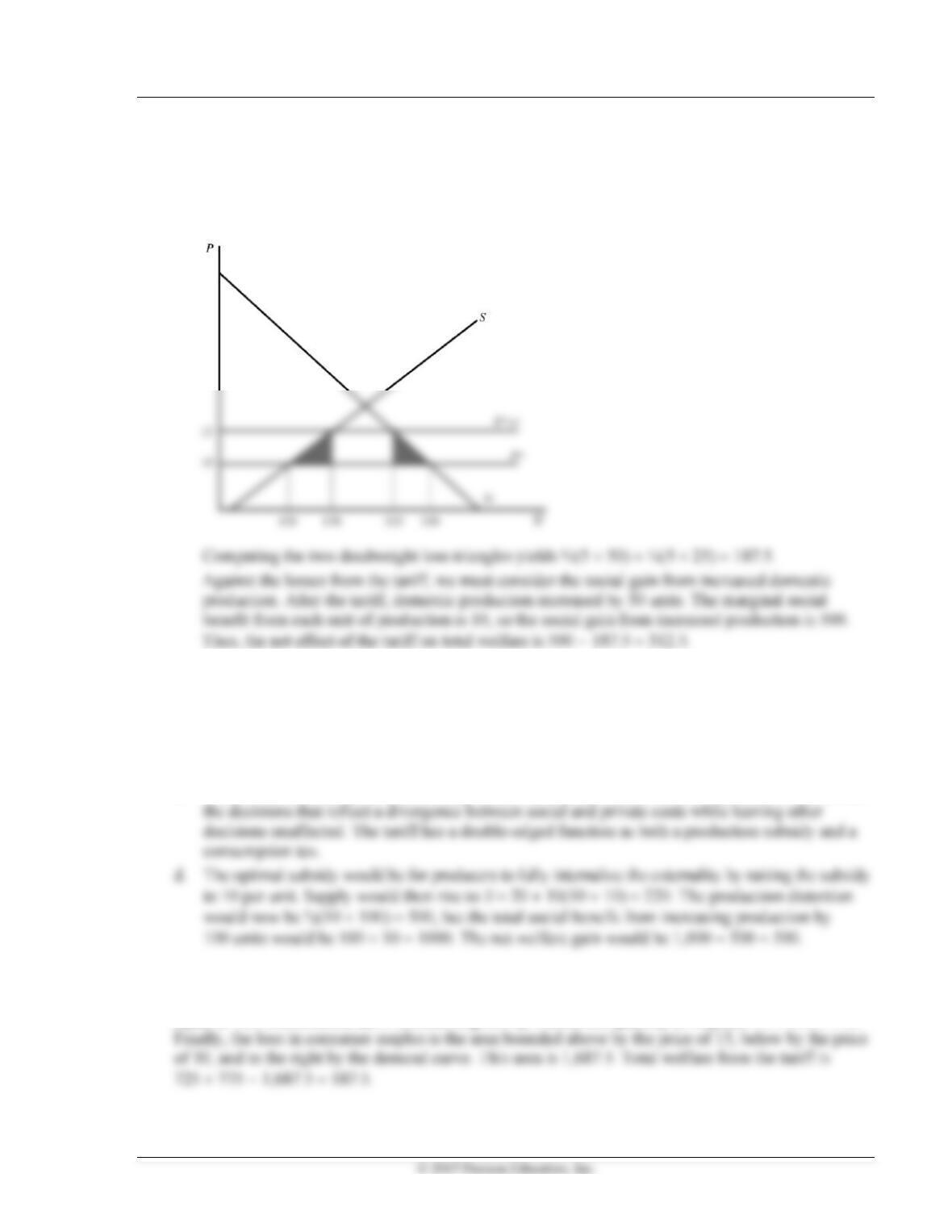
a. To analyze the welfare effects of the tariff, it is helpful to draw a diagram for this small country.
Note that since this is a small country, the tariff will not affect the world price, and the domestic
price will rise by the full amount of the tariff, rising from 10 to 15.
After the tariff is imposed, domestic production will rise to S = 20 + (10 15) = 170 and
domestic consumption falls to D = 400 − (5 15) = 325, for imports of 155. To analyze the
Chapter 10 The Political Economy of Trade Policy 57
welfare effects of this tariff, consider the diagram below. We know that, because this is a small
country, the tariff will lead to a net welfare loss as the gains in producer surplus and tariff
revenue are smaller than the losses in consumer surplus. The net loss from the tariff is
highlighted by the shaded triangles representing deadweight losses from consumption and
production distortions.
b. A production subsidy would cause domestic supply to rise by S = 20 + 10(10 + 5) = 170, an
increase of 50 units as with the tariff. However, the domestic price will not change in this
country, so consumers do not lose any welfare with this subsidy. Rather, the only efficiency loss
comes from production distortion costs, the leftmost triangle in the diagram above. The net loss
of the subsidy is ½(5 50) = 62.5. However, the increase in domestic production caused social
welfare to rise by 50 10 = 500, leading to a net welfare gain of 500 − 62.5 = 437.5.
c. The production subsidy is a better targeted policy than the import tariff because it directly affects
4. Refer back to the diagram in 3a. The gain in producer surplus from the tariff is equal to the area bounded
above by the price of 15, below by the price of 10, and to the right by the supply curve. This area is
equal to 725. Government tariff revenue is given by 5 times the quantity of imports = 5 155 = 775.
58 Krugman/Obstfeld/Melitz • International Economics: Theory & Policy, Tenth Edition
However, if the government values every dollar of producer gain as worth $3 of consumer surplus,
5. a. This would lead to trade diversion because the lower-cost Japanese cars with an import value
of €27,000 (but real costs of €18,000) would be replaced by Polish cars with a real cost of
production equal to €20,000.
6. The United States has a legitimate interest in the trade policies of other countries, just as other countries
have a legitimate interest in U.S. activities. The reason is that uncoordinated trade policies are likely
7. The optimal tariff argument rests on the idea that in a large country, tariff (or quota) protection in a
particular market can lower the world price of that good. Therefore, it is possible that with a (small)
8. The game is no longer a Prisoners’ Dilemma. As the chapter discusses, protectionist measures are
welfare reducing in their own right. Each country would have an incentive to engage in free trade no
matter what the strategy of the other country. Only in a more complex dynamic game in which a trade
partner will only open its markets if the home country threatens sanctions (and the threats are only
credible if occasionally carried out) would we find any welfare-enhancing reason to use a tariff.
9. The argument is probably not valid for a number of reasons. One reason is the domestic market failure
argument. There is a lack of information regarding safety standards that leads a government to simply
ban unsafe products, as opposed to letting consumers choose which risks they would like to take. Thus,