CHAPTER 10 | Economic Growth, the
Financial System, and
Business Cycles
Brief Chapter Summary and Learning Objectives
10.1 Long-Run Economic Growth (pages 696–704)
10.2 Saving, Investment, and the Financial System (pages 704–713)
10.3 The Business Cycle (pages 713–723)
Explain what happens during the business cycle.
▪ During the expansion phase of a business cycle, production, employment, and income
increase.
▪ Production, employment, and income decline during the recession phase of the business
cycle.
Key Terms
Business cycle, p. 696. Alternating periods of
economic expansion and economic recession.
Capital, p. 700. Manufactured goods that are
used to produce other goods and services.
Financial markets, p. 705. Markets where
financial securities, such as stocks and bonds,
are bought and sold.
through which firms acquire funds from
households.
Labor productivity, p. 700. The quantity of
goods and services that can be produced by one
quantity of loanable funds exchanged.
Potential GDP, p. 703. The level of real GDP
attained when all firms are producing at
228 CHAPTER 10 | Economic Growth, the Financial System, and Business Cycles
Chapter Outline
Economic Growth and the Business Cycle at Corning, Inc.
In 1851, Amory Houghton founded the company that became Corning, Inc. By 2015, Corning had more
than 34,000 employees and sales of nearly $10 billion. Corning’s experience has mirrored two key
macroeconomic facts: In the long run, the U.S. economy has experienced economic growth, and in
10.1
Long-Run Economic Growth (pages 696–704)
Learning Objective: Discuss the importance of long-run economic growth.
A successful economy is capable of increasing production of goods and services faster than the growth in
population. The U.S. economy has experienced periods of expanding production and employment
followed by periods of recession, during which production and employment decline. The business cycle
A. Calculating Growth Rates and the Rule of 70
The growth rate of real GDP or real GDP per capita during a particular year is equal to the percentage
B. What Determines the Rate of Long-Run Growth?
Increases in real GDP per capita depend on increases in labor productivity, which is the quantity of goods
and services that can be produced by one worker or by one hour of work. Economists usually measure labor
productivity as output per hour of work in order to avoid fluctuations in the length of the workday and in the
fraction of the population employed. Economists believe two key factors determine labor productivity: the
CHAPTER 10 | Economic Growth, the Financial System, and Business Cycles 229
C. Potential GDP
Potential GDP is the level of real GDP attained when all firms are producing at capacity. Potential GDP
will increase over time as the labor force grows, new factories and office buildings are built, new
machinery and equipment are installed, and technological change takes place. From 1949 to 2015,
potential real GDP in the United States grew at an average rate of 3.2 percent per year. The actual level of
real GDP increased more or less than 3.2 percent as the economy moved through the business cycle.
230 CHAPTER 10 | Economic Growth, the Financial System, and Business Cycles
Source: Textbook authors’ calculations from data in Alan Heston, Robert Summers, and Bettina Aten, Penn World Table,
Version 7.0, Center for International Comparisons of Production, Income and Prices at the University of Pennsylvania, June 3,
2011 and the CIA Factbook.
What explains Botswana’s rapid growth rate? Several factors have been important. Botswana avoided the
civil wars that plagued other African countries during these years. The country also benefited from
These policies—protecting private property, avoiding political instability and corruption, and allowing
press freedom and democracy—may seem a straightforward recipe for providing an environment in
which economic growth can occur. As we will see in Chapter 11, however, in practice, these are policies
many countries do not implement.
Question
If the keys to Botswana’s rapid economic growth seem obvious, why have other countries in the region
had so much difficulty following them?
Answer
Many countries in sub-Saharan Africa have faced difficulties in successfully implementing policies that
Extra Solved Problem 10.1
Explaining Economic Growth in Singapore
Between 1960 and 1995, real GDP per capita in Singapore grew at an average annual rate of 6.2 percent.
This very rapid growth rate results in the level of real GDP per capita doubling about every 11.3 years. In
CHAPTER 10 | Economic Growth, the Financial System, and Business Cycles 231
Solving the Problem
Step 1: Review the chapter material.
This problem is about what determines the rate of long-run growth, so you may want to
Step 2: Predict what happened to the growth rate in Singapore after 1995.
As countries begin to develop, they often experience an increase in the labor force
participation rate, as workers who are not part of the paid labor force respond to rising wage
Question
An article in the Economist magazine compares Panama to Singapore. It quotes Panama’s president as
saying: “We copy a lot from Singapore and we need to copy more.” The article observes that: “Panama is
not even one-fifth as rich as its Asian model on a per-person basis. But Singapore would envy its growth:
from 2005 to 2010 its economy expanded by more than 8% a year, the fastest rate in the Americas.”
Judging from the experience of Singapore, if Panama is to maintain these high growth rates, what needs
to be true about the sources of Panama’s growth?
Source: “A Singapore for Central America?” Economist, July 14, 2011.
Answer
Over the long run, Panama cannot sustain high rates of growth by shifting workers from agricultural to
232 CHAPTER 10 | Economic Growth, the Financial System, and Business Cycles
10.2
Saving, Investment, and the Financial System (pages 704–713)
Learning Objective: Discuss the role of the financial system in facilitating long-run
economic growth.
Economic growth depends on the ability of firms to expand their operations. Firms can finance their
expansion from retained earnings, financial markets, and financial intermediaries. The financial system is
the system of financial markets and financial intermediaries through which firms acquire funds from
households.
A. An Overview of the Financial System
Financial markets are markets where financial securities, such as stocks and bonds, are bought and sold. A
Financial intermediaries are firms, such as banks, mutual funds, pension funds, and insurance
companies, that borrow funds from savers and lend them to borrowers. The financial system provides
B. The Macroeconomics of Saving and Investment
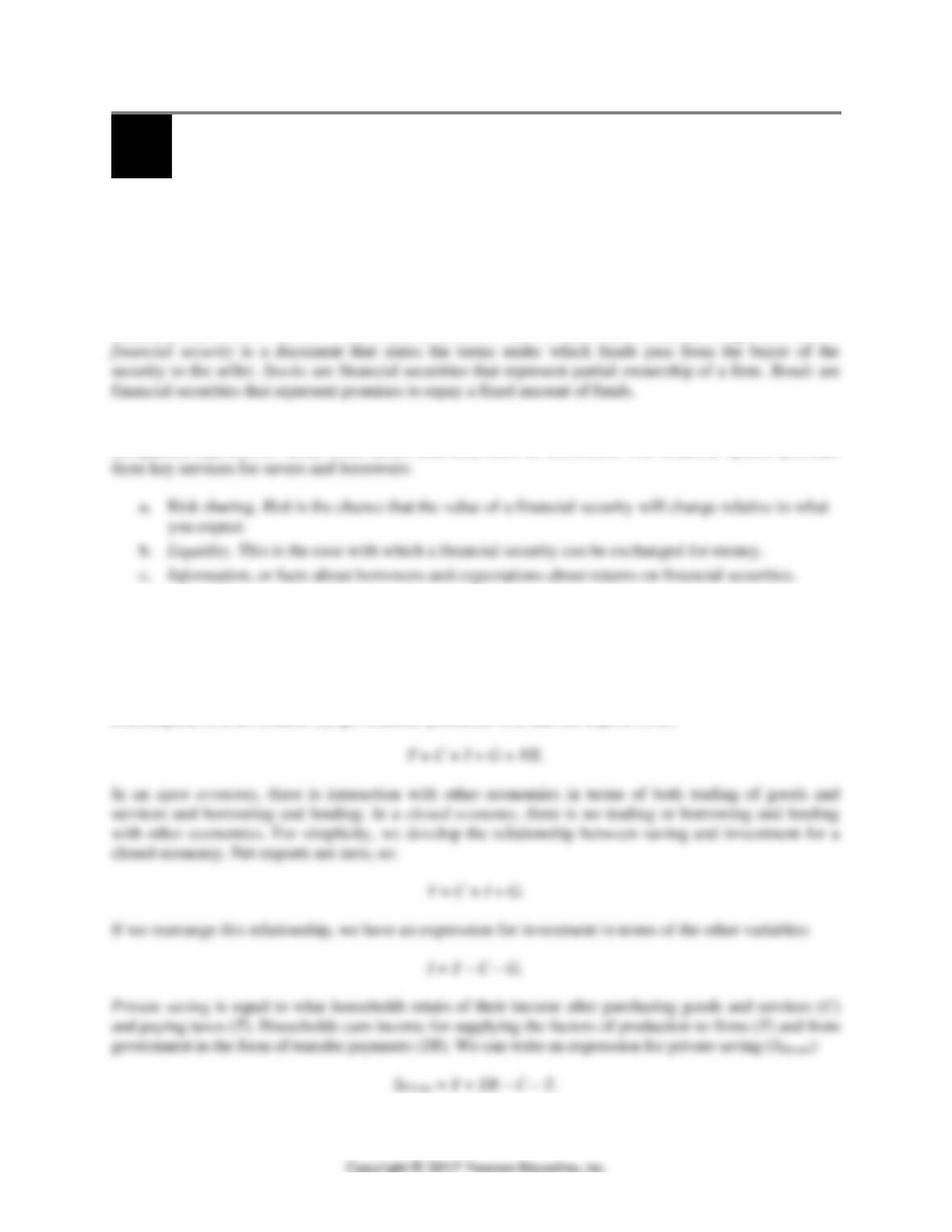
The total value of saving in the economy must equal the total value of investment. There are two
categories of saving in the economy: private saving by households and public saving by the government.
We can use some relationships from national income accounting to understand why total saving must
equal total investment. We begin with the relationships between GDP (Y) and its components,
consumption (C), investment (I), government purchases (G), and net exports (NX):
CHAPTER 10 | Economic Growth, the Financial System, and Business Cycles 233
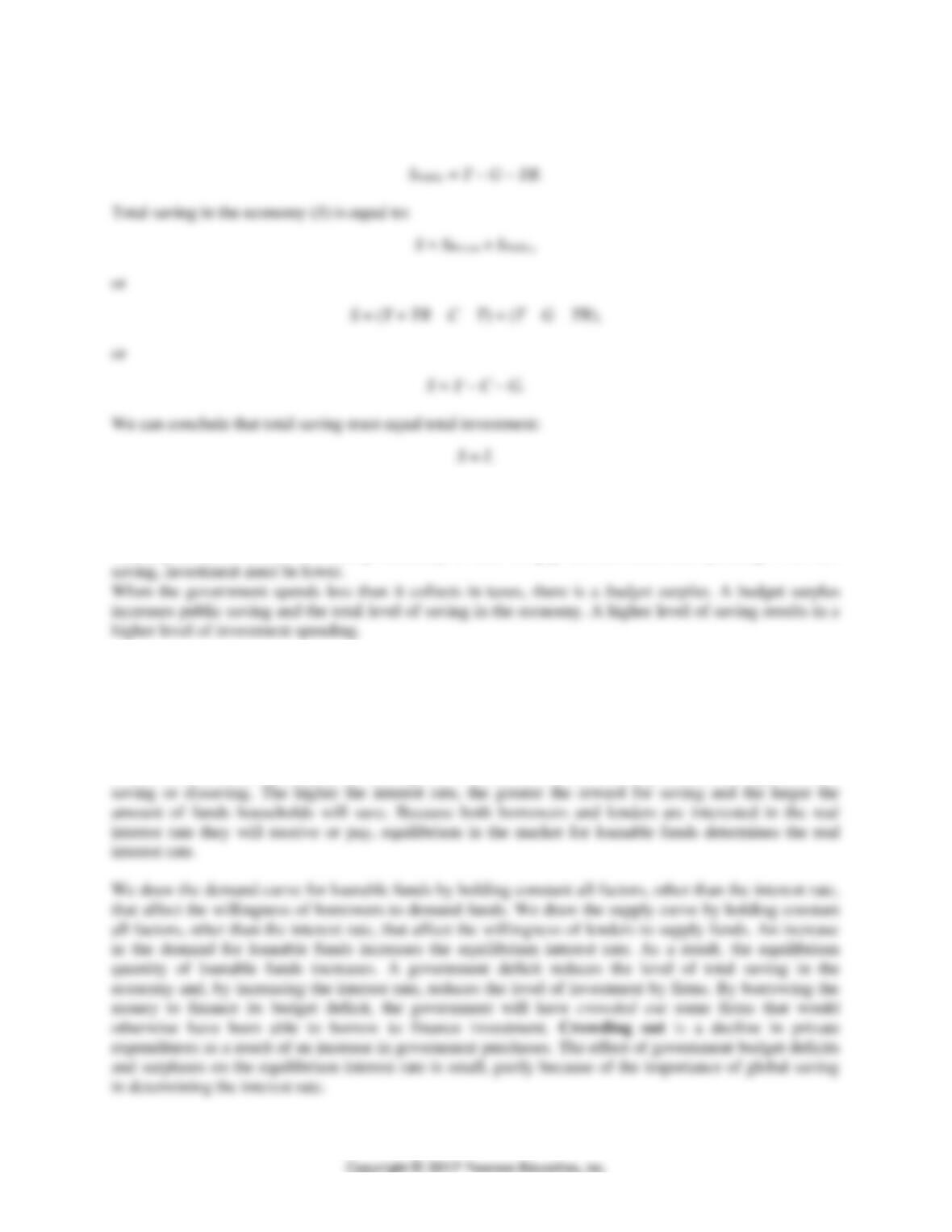
Public saving (SPublic) equals the amount of tax revenue the government retains after paying for
government purchases and making transfer payments to households:
When the government spends the same amount that it collects in taxes, there is a balanced budget. When
the government spends more than it collects in taxes, there is a budget deficit, which means that public
saving is negative. When the government runs a budget deficit, the U.S. Department of the Treasury sells
Treasury bonds to borrow the money necessary to fund the gap between taxes and spending. With less
C. The Market for Loanable Funds
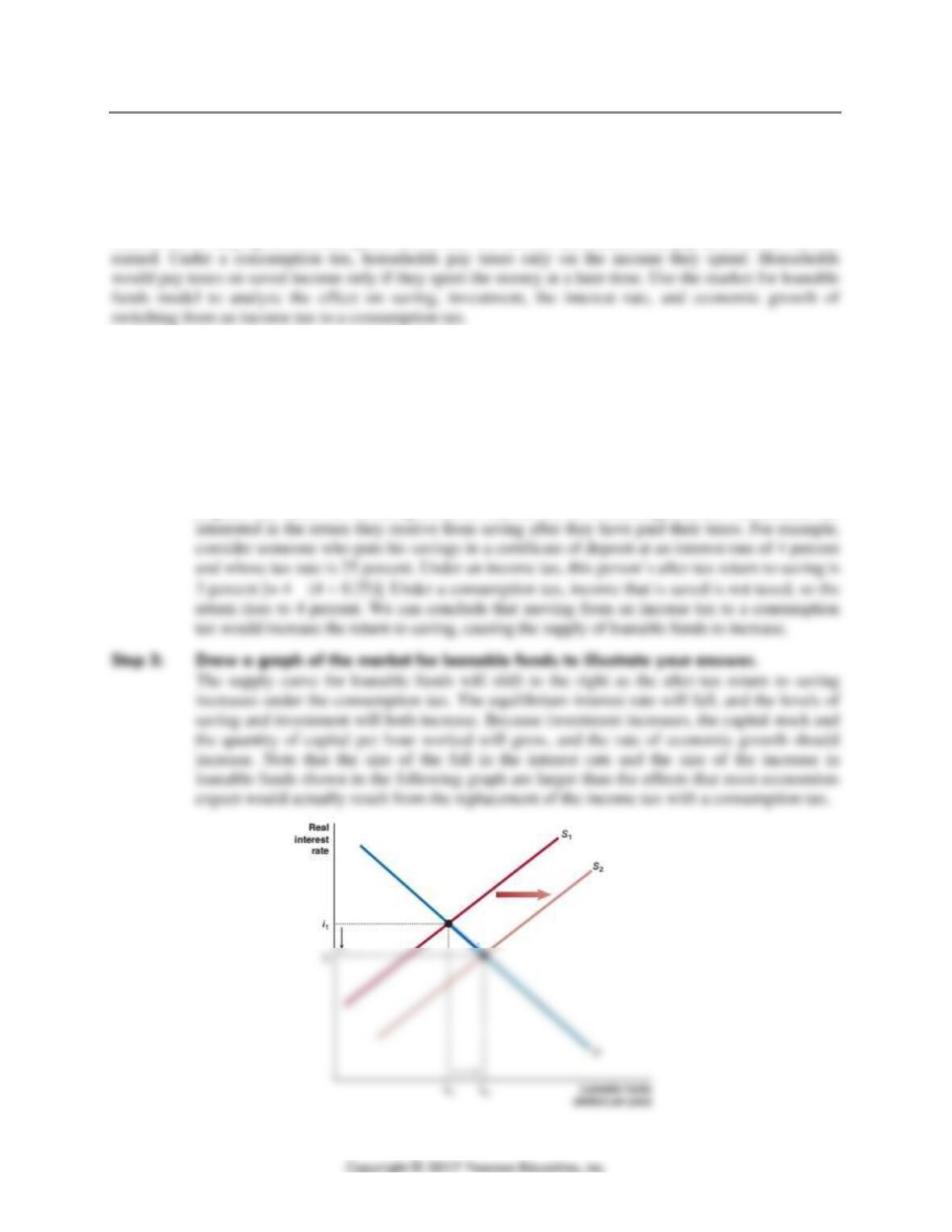
The market for loanable funds refers to the interaction of borrowers and lenders that determines the
market interest rate and the quantity of loanable funds exchanged. The demand for loanable funds is
determined by the willingness of firms to borrow money and to engage in new investment projects. The
lower the interest rate, the more investment projects a firm can profitably undertake. The supply of
loanable funds is determined by the willingness of households to save and by the extent of government
234 CHAPTER 10 | Economic Growth, the Financial System, and Business Cycles
Extra Solved Problem 10.2
How Would a Consumption Tax Affect Saving, Investment, the Interest Rate and
Economic Growth?
Some economists and policymakers have suggested that the federal government shift from relying on an
income tax to relying on a consumption tax. Under the income tax, households pay taxes on all income
Solving the Problem
Step 1: Review the chapter material.
This problem is about applying the market for loanable funds model, so you may want to
review the section “Explaining Movements in Saving, Investment, and Interest Rates,” which
begins on page 709 in the textbook.
Step 2: Explain the effect of switching from an income tax to a consumption tax.
Explain the effect of switching from an income tax to a consumption tax. Households are
CHAPTER 10 | Economic Growth, the Financial System, and Business Cycles 235
10.3
The Business Cycle (pages 713–723)
Learning Objective: Explain what happens during the business cycle.
Although there has been a tremendous increase in the standard of living of the average American over the
past century, real GDP per capita did not increase every year.
A. Some Basic Business Cycle Definitions
Since at least the early nineteenth century, the U.S. economy has experienced business cycles that consist
B. How Do We Know When the Economy Is in a Recession?
The federal government does not officially decide when a recession begins and when it ends. Most
C. What Happens during the Business Cycle?
Although each business cycle is different, most business cycles share certain characteristics. Near the end
of an expansion, interest rates are usually rising, and the wages of workers are usually rising faster than
prices. As a result, profits of firms are falling. Typically, toward the end of an expansion both households
and firms will have substantially increased their debts.
A recession often begins with a decline in spending by firms on capital goods or by households on
housing and consumer durables. As sales decline, firms cut back on production and begin to lay off
Durables, goods expected to last three or more years, are affected more by the business cycle than
nondurables. During a recession, because people can continue to use their durable goods they are more
likely to postpone spending on durables than nondurables. When firms experience declining sales and
profits during a recession, they often cut back on purchases of producer durables.
During economic expansions, the inflation rate usually increases, and during recessions the inflation rate
usually decreases. Recessions cause the unemployment rate to rise. The unemployment rate continued to
rise after the recessions of 1990–1991, 2001 and 2007–2009 ended. This pattern is due to two factors.
236 CHAPTER 10 | Economic Growth, the Financial System, and Business Cycles
D. Will the U.S. Economy Return to Stability?
Economists have offered several explanations why the U.S. economy experienced a period of relative
stability from 1950 to 2007:
• The increasing importance of services and the declining importance of goods.
Extra Solved Problem 10.3
Leading Indicators and the Business Cycle
People often ask economists for predictions about the future of the macroeconomy. Forecasts about the
economy’s future, even from experts, are not unlike a baseball writer’s prediction of who will play in the
next World Series. The prediction can seem well-reasoned and logical, but it is hardly foolproof. Certain
statistical series tend to move in similar ways through all business cycles. Knowledge of these series and
Among the most reliable of the leading indicators is an index of prices for 500 common stocks. Investors
want to buy stock shares when their prices are relatively low and sell shares when prices are relatively
high. During a recession, stock prices fall due to sluggish sales and profits. Interest rates are relatively low
during the last months of recessions because of reduced demand for investment. In choosing between
buying bonds and stocks, investors will favor stocks when: (a) stock prices have fallen to a point where
CHAPTER 10 | Economic Growth, the Financial System, and Business Cycles 237
Solving the Problem
Step 1: Review the chapter material.
This problem is about the business cycle, so you may want to review the section “The
Business Cycle,” which begins on page 713 in the textbook.
Step 2: Why can’t economists make accurate predictions of business cycle movements?
The movement of heavenly bodies, unlike human bodies, can be accurately explained by
Extra Making
the
Connection
The Business Cycle and the 2008 Election
Was the U.S. economy in a recession during the 2008 presidential election? Less than one week before
election day 2008, the U.S. Bureau of Economic Analysis announced its preliminary estimate that real
GDP had declined during the third quarter of 2008. However, the Business Cycle Dating Committee of
the National Bureau of Economic Research (NBER), a private research group located in Cambridge,
Massachusetts, that determines when recessions begin, did not announce that a recession began in
December 2007 until its meeting in late November, several weeks after the election.
When the Great Depression began shortly after Hoover took office, his popularity rapidly faded and he
was soundly defeated for reelection by Franklin Roosevelt in 1932. Similarly, George H. W. Bush was
elected with 53 percent of the popular vote in 1988, but when the U.S. economy recovered only slowly
following the 1991 recession, President Bush was defeated for reelection in 1992 by Bill Clinton. Even in
elections that do not take place during or shortly after recessions, the state of the economy can influence
voting. A careful analysis of the 2004 presidential election by Jeffrey S. DeSimone and Courtney