interactive activity
Chapter 10
The Rational Consumer
1. For each of the following situations, decide whether Al has diminishing mar-
ginal utility. Explain.
a. The more economics classes Al takes, the more he enjoys the subject. And the
more classes he takes, the easier each one gets, making him enjoy each addi-
1. a. Al’s marginal utility of economics classes increases as he takes an additional
class since he enjoys each class more than the one before. Therefore, he does
not have diminishing marginal utility.
2. Use the concept of marginal utility to explain the following: Newspaper vending
Solution
S-144 Chapter 10 The RaTional ConsumeR
3. Bruno can spend his income on two different goods: smoothies and energy
bars. For each of the following three situations, decide if the given consumption
$60. He is considering a consumption bundle containing 15 smoothies and
$110. He is considering a consumption bundle containing 20 smoothies and
of $50. He is considering a consumption bundle containing 10 smoothies and
3 energy bars.
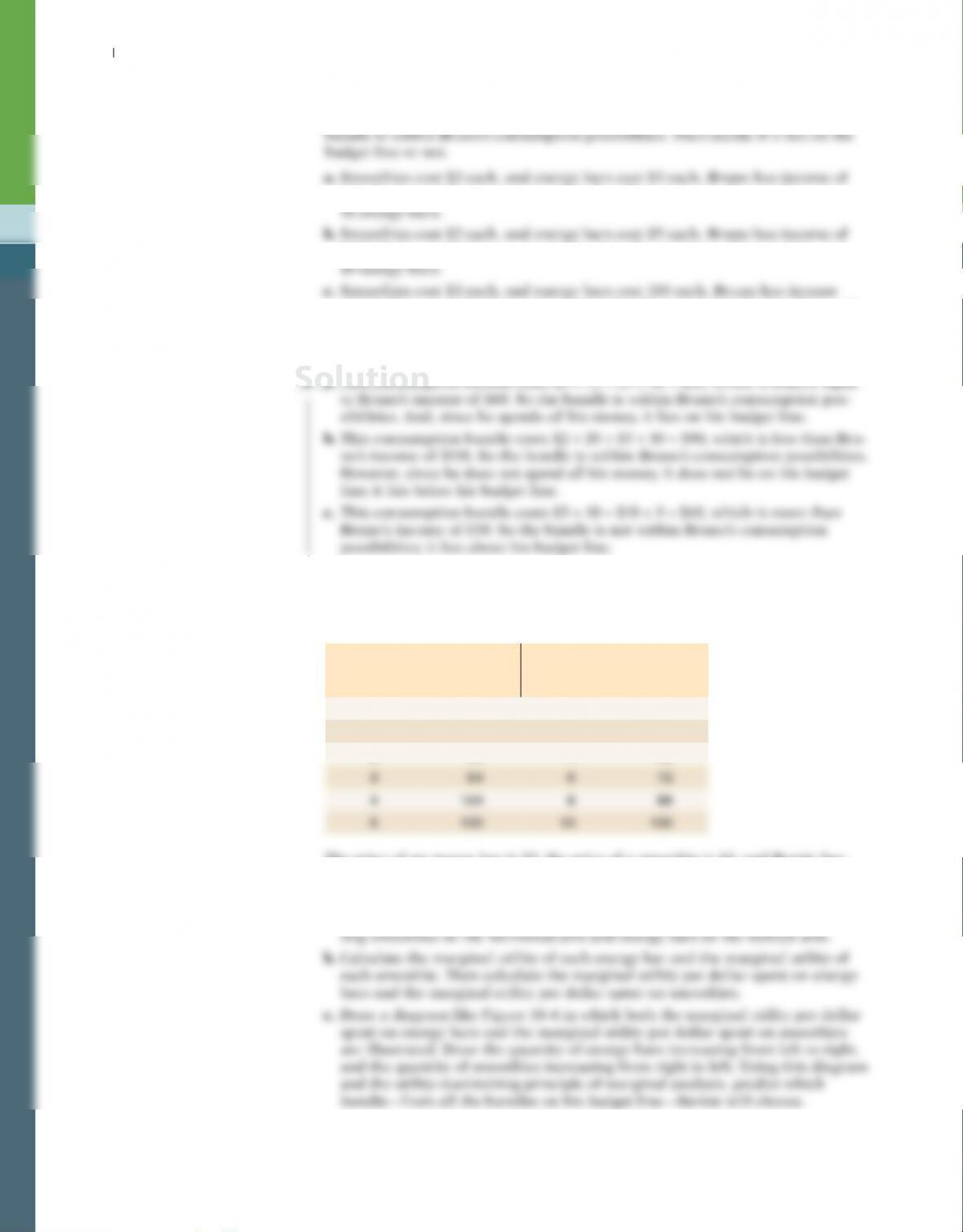
4. Bruno, the consumer in Problem 3, is best friends with Bernie, who shares his
love for energy bars and smoothies. The accompanying table shows Bernie’s
utilities from smoothies and energy bars.
Quantity of
smoothies
Utility from
smoothies
(utils)
Quantity of
energy bars
Utility from
energy bars
(utils)
0 0 0 0
132 2 28
260 452
The price of an energy bar is $2, the price of a smoothie is $4, and Bernie has
$20 of income to spend.
a. Which consumption bundles of energy bars and smoothies can Bernie consume
if he spends all his income? Illustrate Bernie’s budget line with a diagram, put–
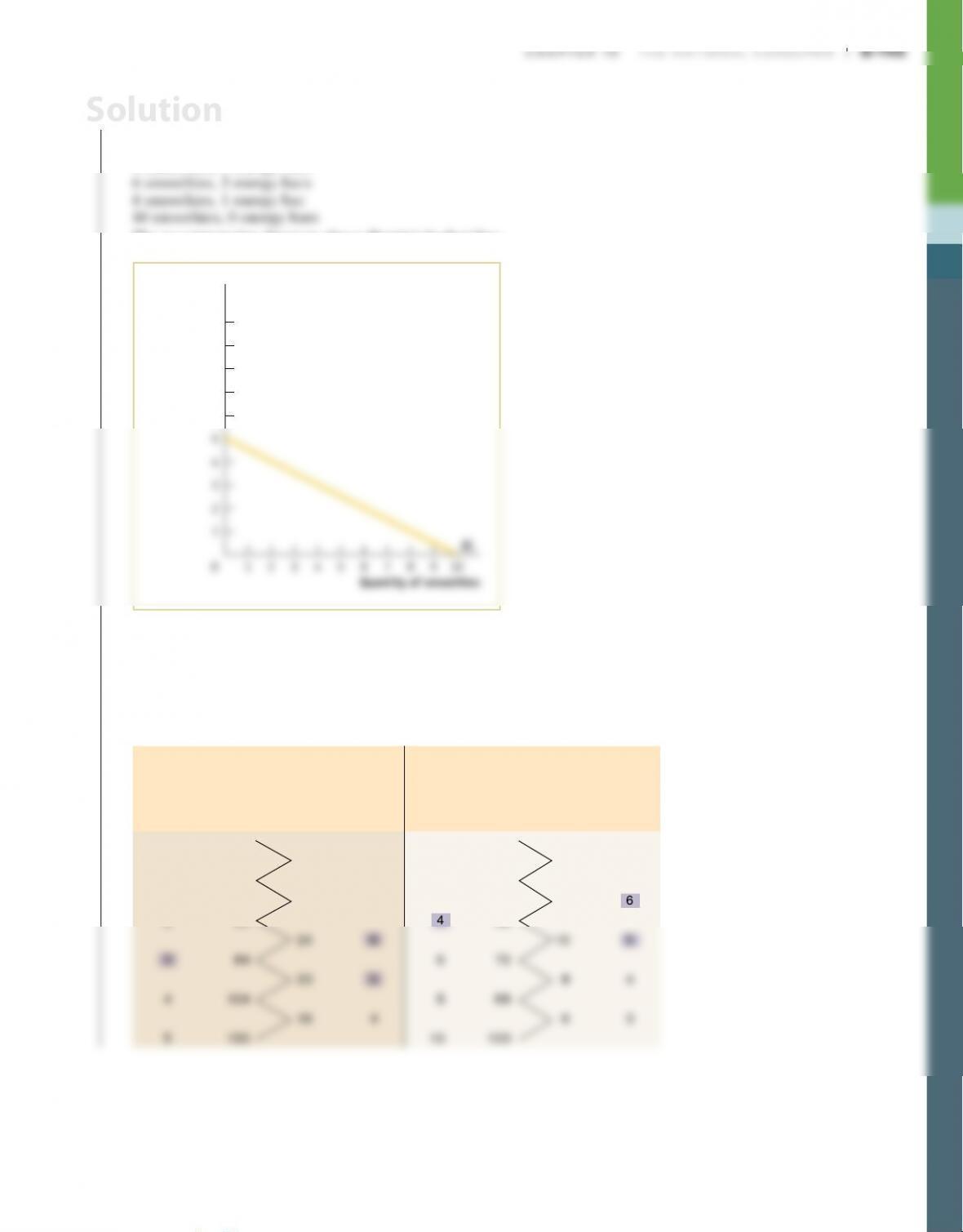
4. a. Bernie can consume the following bundles if he spends all his income:
0 smoothies, 5 energy bars
2 smoothies, 4 energy bars
4 smoothies, 3 energy bars
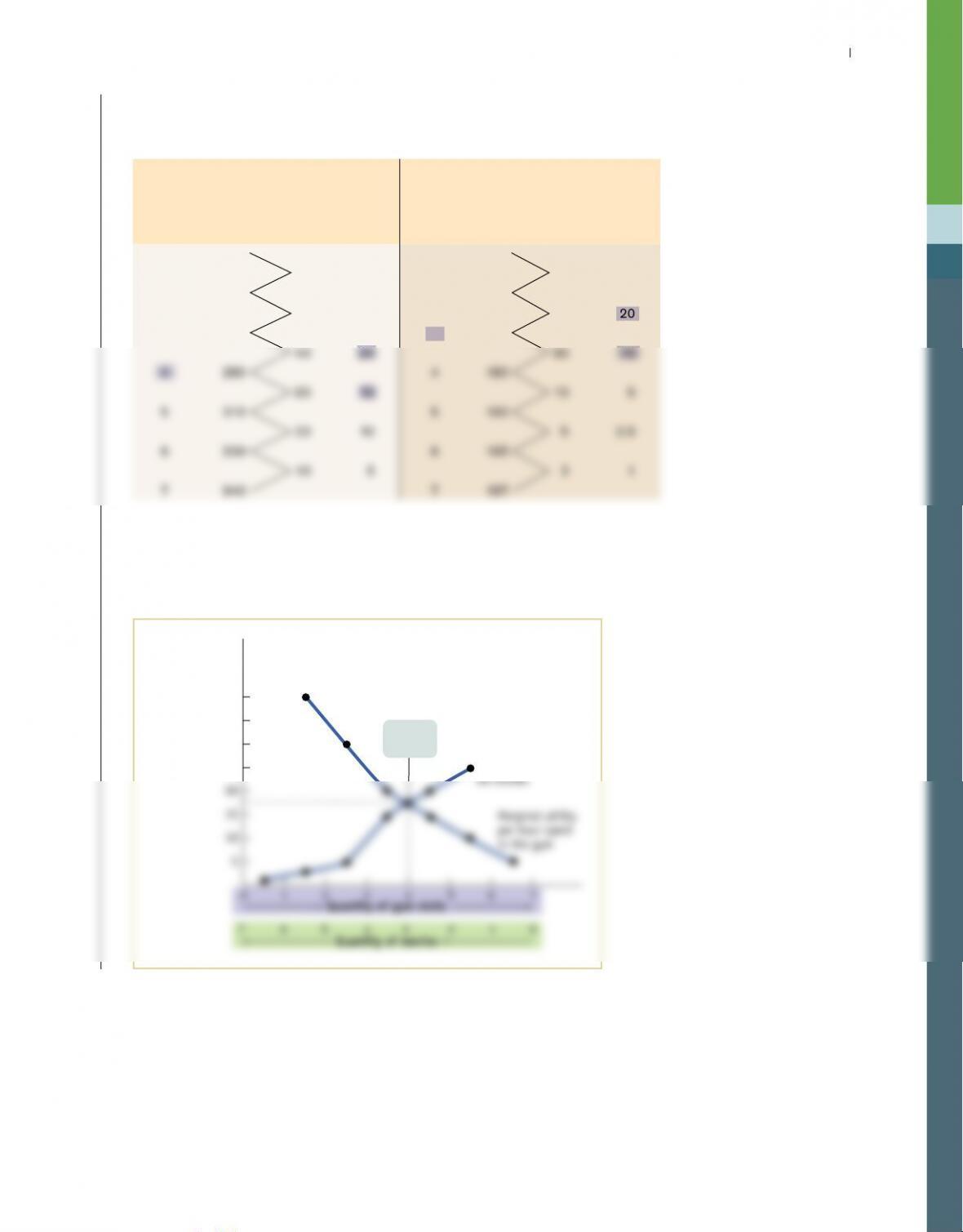
The accompanying diagram shows Bernie’s budget line.
6
Quantity of
ener
gy bars
Quantity of smoothies
10
9
8
7
b. The accompanying table shows the marginal utility for each energy bar and
for each smoothie, the marginal utility per dollar spent on energy bars, and
the marginal utility per dollar spent on smoothies. Note that the utility num-
bers for energy bars are given in increments of 2: for instance, going from
4 energy bars to 6, utility increases by 24 utils (from 60 utils to 84 utils).
Per energy bar, this is a marginal utility of 12 utils.
Quantity
of
smoothies
Utility
from
smoothies
(utils)
Marginal
utility per
smoothie
(utils)
Marginal
utility
per
dollar
(utils/$)
Quantity
of energy
bars
Utility
from
energy
bars
(utils)
Marginal
utility per
energy bar
(utils)
Marginal
utility
per
dollar
(utils/$)
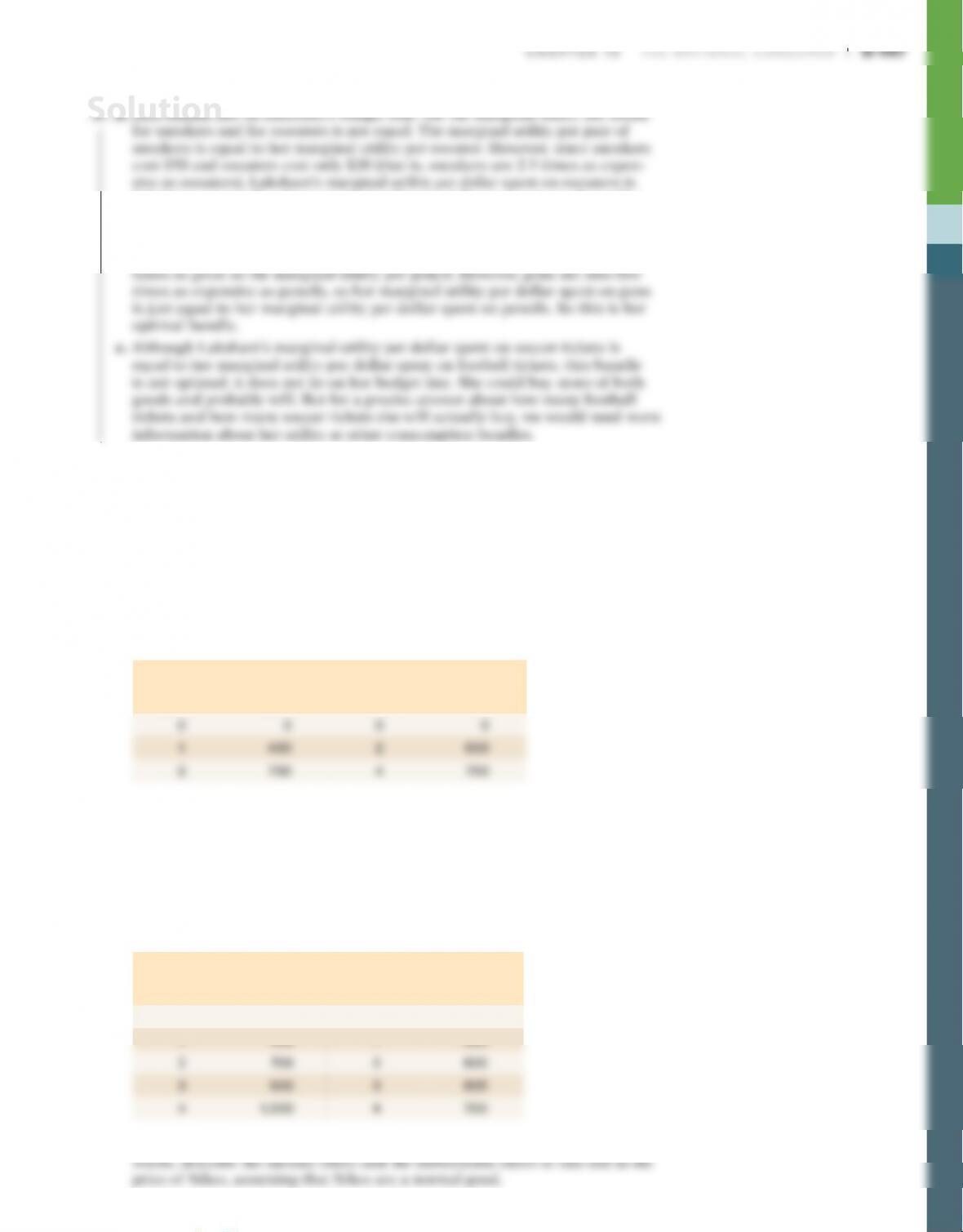
0 0 0 0
32 814 7
132 2 28
28 7 12 6
260 452
Solution
S-146 Chapter 10 The RaTional ConsumeR
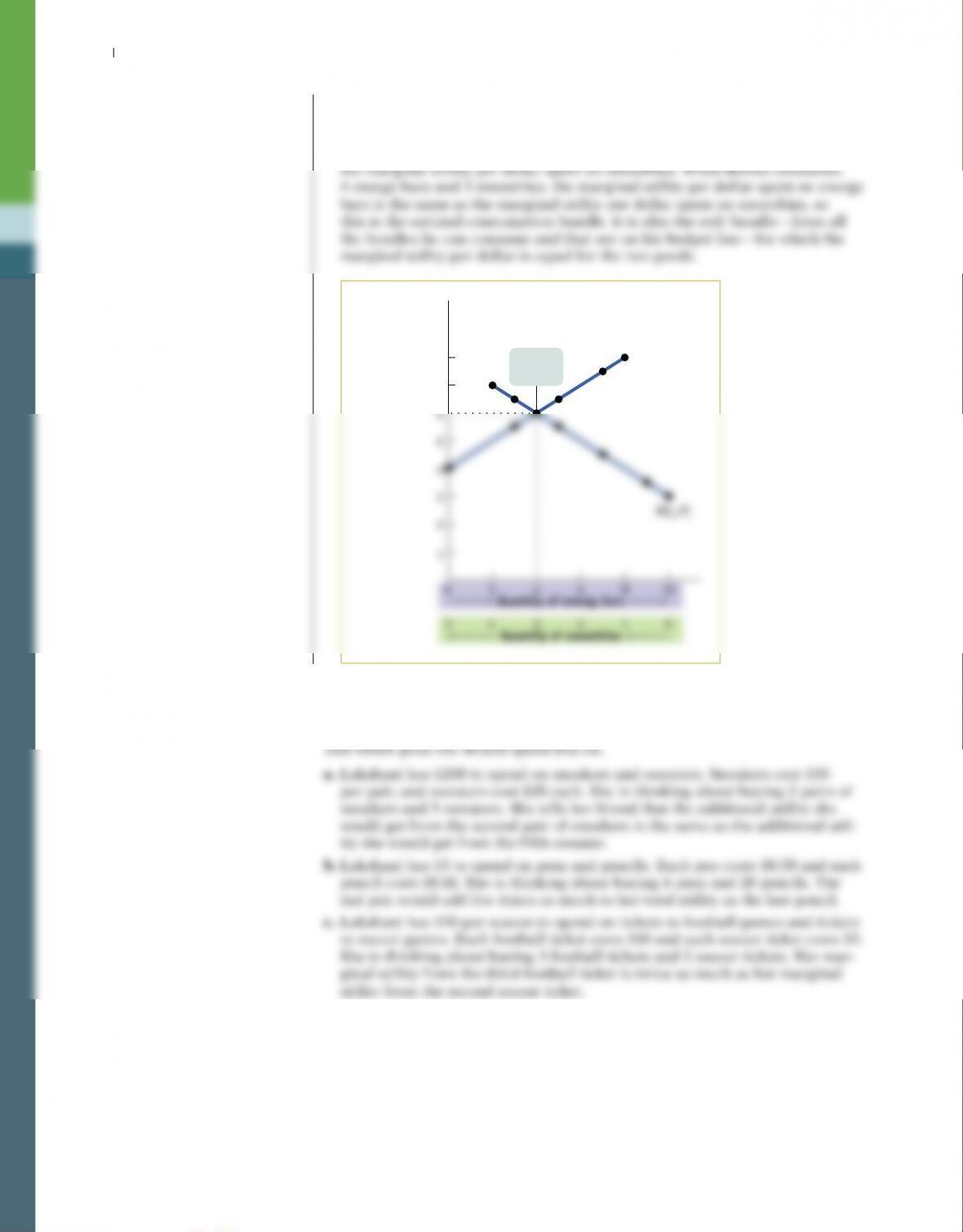
c. The utility-maximizing principle of marginal analysis states that the optimal
bundle, from all those on a consumer’s budget line, is the one at which the
marginal utility per dollar spent on each good is equal. The accompanying
diagram shows the marginal utility per dollar spent on energy bars and
Marginal
utility per
dollar (utils/$)
8
7
MU
s
/P
s
Optimal
choice
2.5 times greater than her marginal utility per dollar spent on sneakers. That
is, she would improve her level of utility if she spent more money on sweaters
and less on sneakers.
b. This bundle lies on Lakshani’s budget line. The marginal utility per pen is five
6. Cal “Cool” Cooper has $200 to spend on Nikes and sunglasses.
a. Each pair of Nikes costs $100 and each pair of sunglasses costs $50. Which
bundles lie on Cal’s budget line? Draw a diagram like Figure 10–4 in which
both the marginal utility per dollar spent on Nikes and the marginal util-
ity per dollar spent on sunglasses are illustrated. Draw the quantity of Nikes
increasing from left to right, and the quantity of sunglasses increasing from
right to left. Use this diagram and the utility-maximizing principle of mar-
ginal analysis to decide how Cal should allocate his money. That is, from all
the bundles on his budget line, which bundle will Cal choose? The accompany-
ing table gives his utility of Nikes and sunglasses.
Quantity of
Nikes
(pairs)
Utility from
Nikes
(utils)
Quantity of
sunglasses
(pairs)
Utility from
sunglasses
(utils)
b. The price of a pair of Nikes falls to $50 each, but the price of sunglasses
remains at $50 per pair. Which bundles lie on Cal’s budget line? Draw a dia-
gram like Figure 10–4 in which both the marginal utility per dollar spent on
Nikes and the marginal utility per dollar spent on sunglasses are illustrated.
Use this diagram and the utility-maximizing principle of marginal analysis to
decide how Cal should allocate his money. That is, from all the bundles on his
budget line, which bundle will Cal choose? The accompanying table gives his
utility of Nikes and sunglasses.
Quantity of
Nikes
(pairs)
Utility from
Nikes
(utils)
Quantity of
sunglasses
(pairs)
Utility from
sunglasses
(utils)
0 0 0 0
1400 1325
c. How does Cal’s consumption of Nikes change as the price of Nikes falls? In
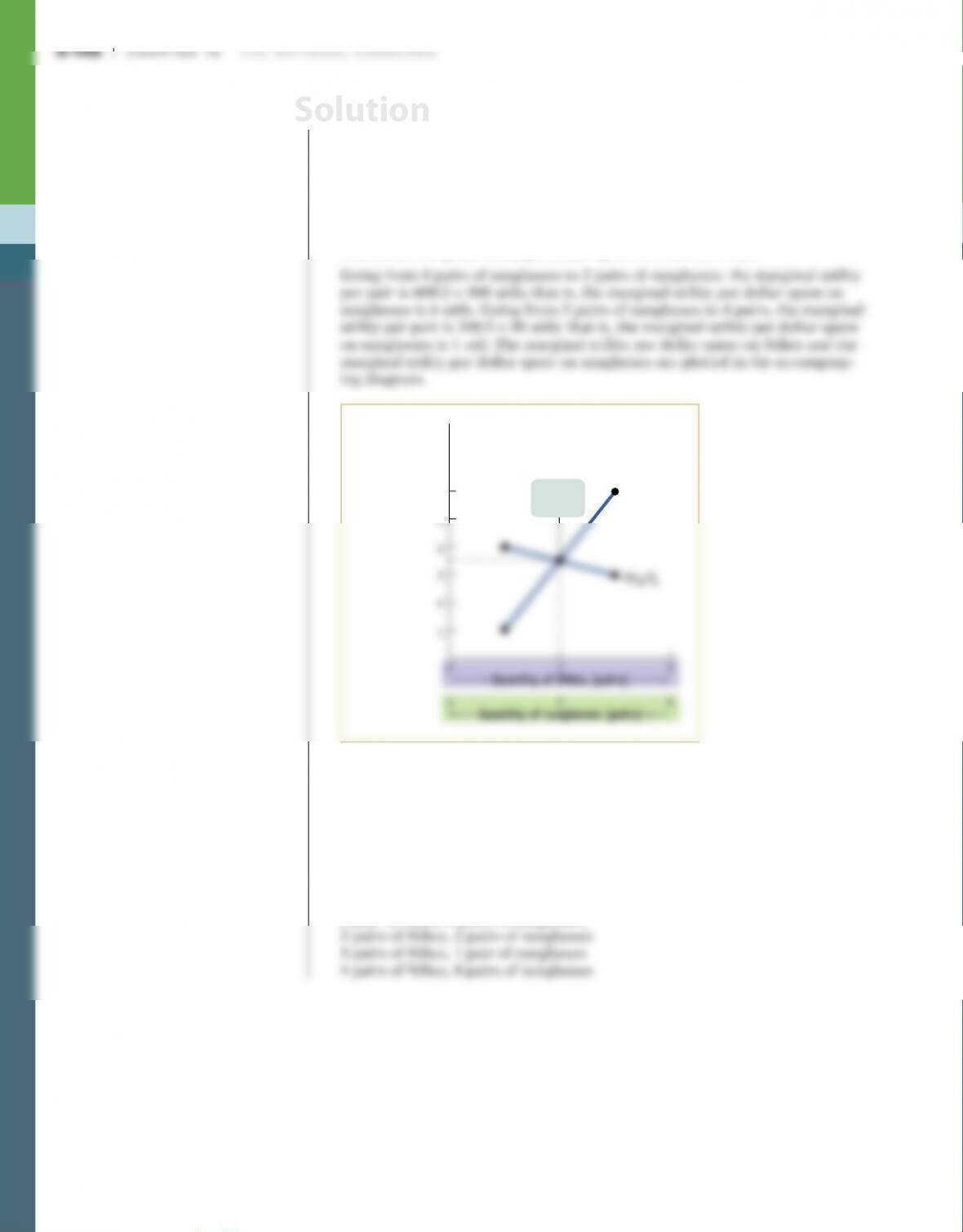
6. a. The following bundles lie on Cal’s budget line:
0 pairs of Nikes, 4 pairs of sunglasses
1 pair of Nikes, 2 pairs of sunglasses
2 pairs of Nikes, 0 pairs of sunglasses
Going from 0 pairs of Nikes to 1 pair of Nikes, the marginal utility per pair
is 400 utils; that is, the marginal utility per dollar spent on Nikes is 4 utils.
Going from 1 pair of Nikes to 2 pairs, the marginal utility per pair is 300 utils;
that is, the marginal utility per dollar spent on Nikes is 3 utils.
6
2
1
210
024
Quantity of Nikes (pairs)
Quantity of sunglasses (pairs)
MUS
/
P
S
Optimal
choice
Marginal
utility per
dollar (utils/$)
Of all the possible bundles Cal could consume (that is, from all the bundles
on his budget line), the bundle that contains 1 pair of Nikes and 2 pairs of
sunglasses is optimal. At that bundle, the marginal utility per dollar spent
on Nikes and the marginal utility per dollar spent on sunglasses are equal.
By the utility-maximizing principle of marginal analysis this is Cal’s optimal
consumption bundle.
b. The bundles that lie on Cal’s budget line are:
0 pairs of Nikes, 4 pairs of sunglasses
1 pair of Nikes, 3 pairs of sunglasses
Solution
Chapter 10 The RaTional ConsumeR S-149
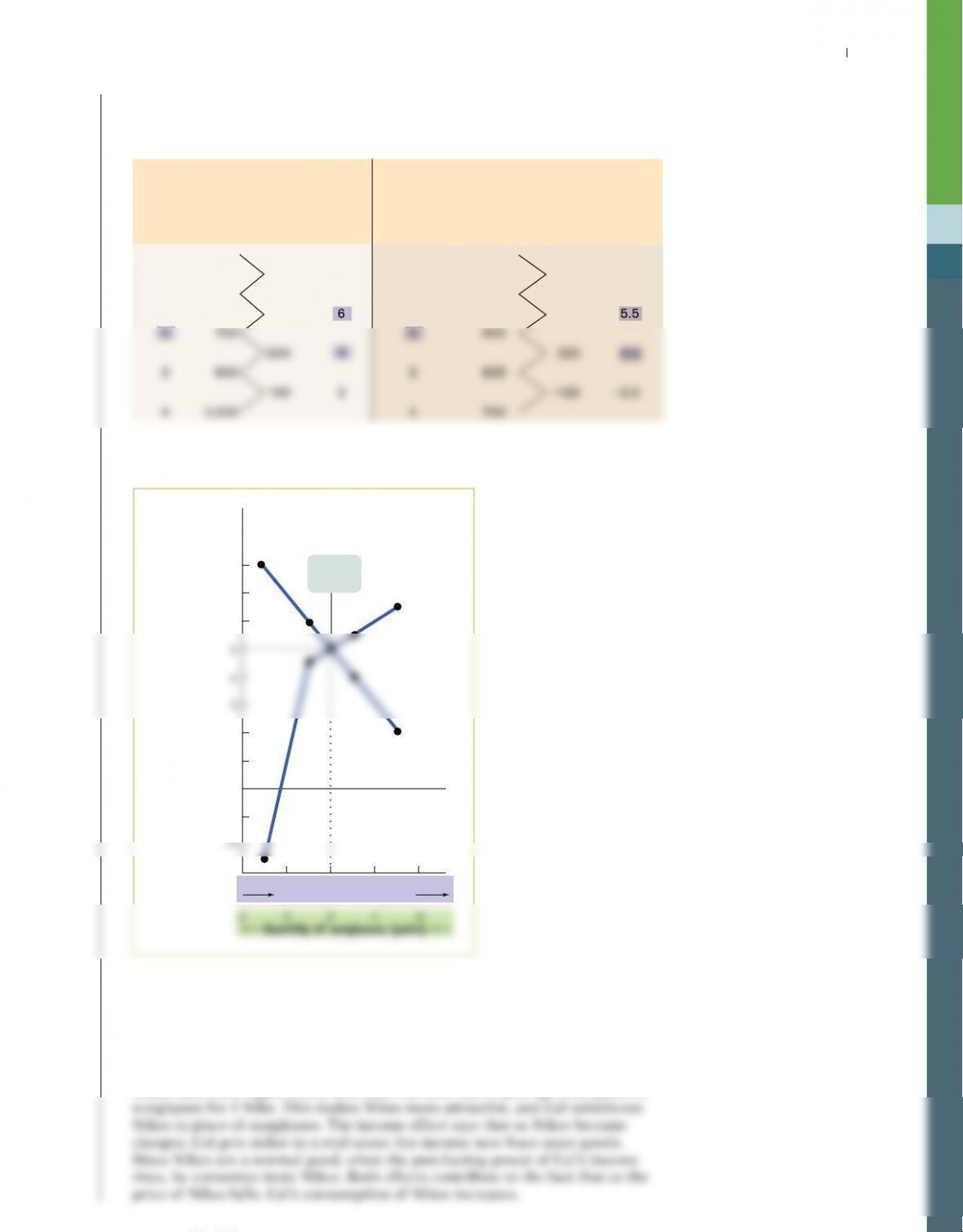
The accompanying table calculates marginal utility per pair of Nikes, mar-
ginal utility per pair of sunglasses, marginal utility per dollar spent on Nikes,
and marginal utility per dollar spent on sunglasses.
Quantity
of Nikes
(pairs)
Utility
from
Nikes
(utils)
Marginal
utility
per pair
(utils)
Marginal
utility
per
dollar
(utils/$)
Quantity of
sunglasses
(pairs)
Utility from
sunglasses
(utils)
Marginal
utility
per pair
(utils)
Marginal
utility
per
dollar
(utils/$)
0 0 0 0
400 83256.5
1400 1325
300 6275 5.5
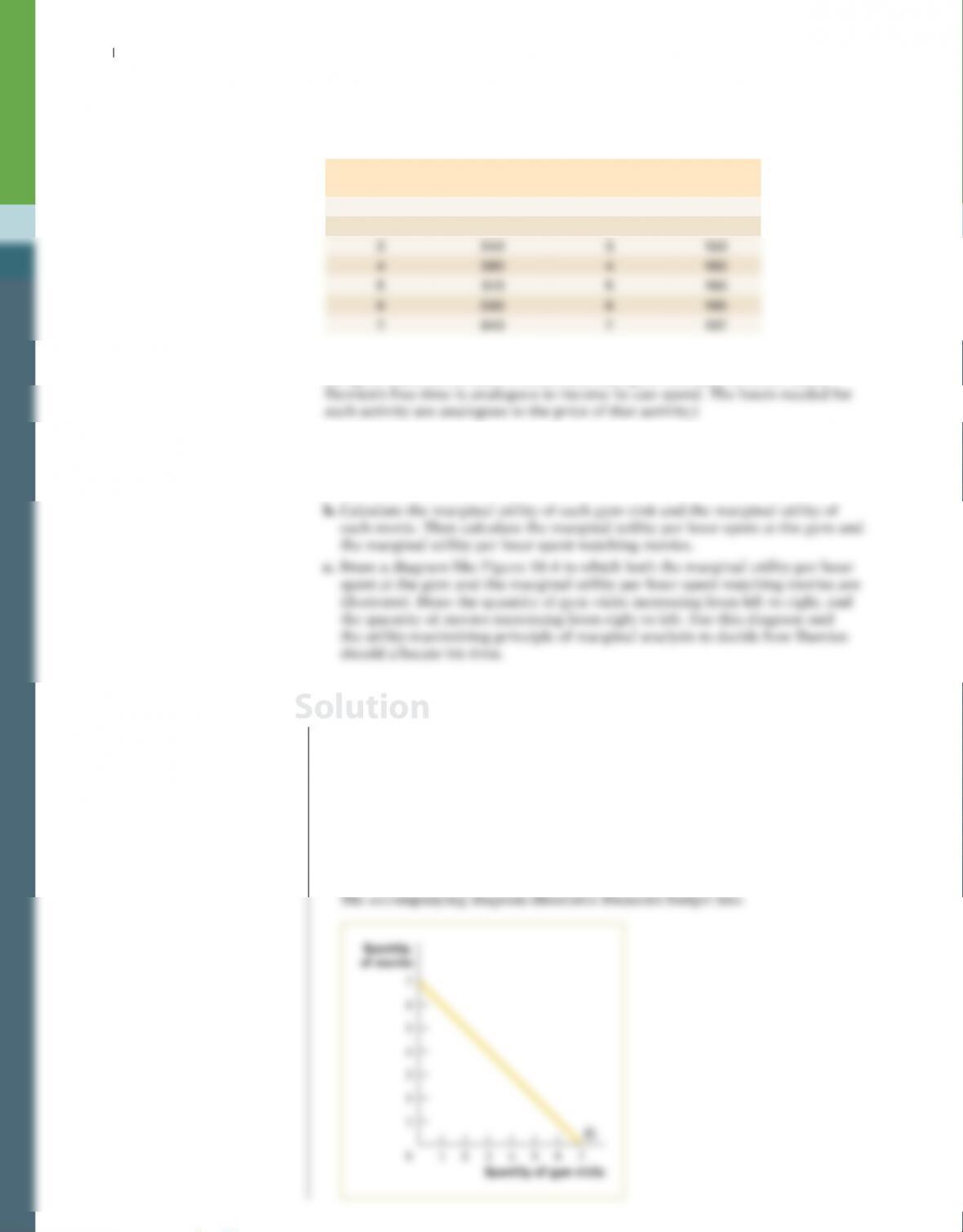
The accompanying diagram plots the marginal utility per dollar spent on
Nikes and the marginal utility per dollar spent on sunglasses.
8
7
6
2
1
–3
–1
0
43210 Quantity of Nikes (pairs)
Marginal
utility per
dollar (utils/$)
MU
NN
/P
MU
S
/P
S
Optimal
choice
S-150 Chapter 10 The RaTional ConsumeR
7. Damien Matthews is a busy actor. He allocates his free time to watching movies
and working out at the gym. The accompanying table shows his utility from the
number of times per week he watches a movie or goes to the gym.
Quantity of gym
visits per week
Utility from gym
visits (utils)
Quantity of
movies per week
Utility from
movies (utils)
1100 160
2180 2110
Damien has 14 hours per week to spend on watching movies and going to
the gym. Each movie takes 2 hours and each gym visit takes 2 hours. (Hint:
a. Which bundles of gym visits and movies can Damien consume per week if
he spends all his time either going to the gym or watching movies? Draw
Damien’s budget line in a diagram with gym visits on the horizontal axis and
movies on the vertical axis.
7. a. Damien can consume the following bundles if he spends all his time going to
the gym and watching movies:
0 gym visits, 7 movies
1 gym visit, 6 movies
2 gym visits, 5 movies
3 gym visits, 4 movies
4 gym visits, 3 movies
5 gym visits, 2 movies
6 gym visits, 1 movie
7 gym visits, 0 movies
Solution
Chapter 10 The RaTional ConsumeR S-151
b. The accompanying table shows Damien’s marginal utility per gym visit, mar-
ginal utility per movie, marginal utility per hour spent on gym visits, and mar-
ginal utility per hour spent on movies.
Quantity
of gym
visits per
week
Utility
from gym
visits
(utils)
Marginal
utility per
gym
visits
(utils)
Marginal
utility
per hour
(utils per
hour)
Quantity
of movies
per week
Utility
from
movies
(utils)
Marginal
utility per
movie
(utils)
Marginal
utility
per hour
(utils
per hour)
1100 1 60
80 40 50 25
2180 2110
60 30 40 20
3240 3150
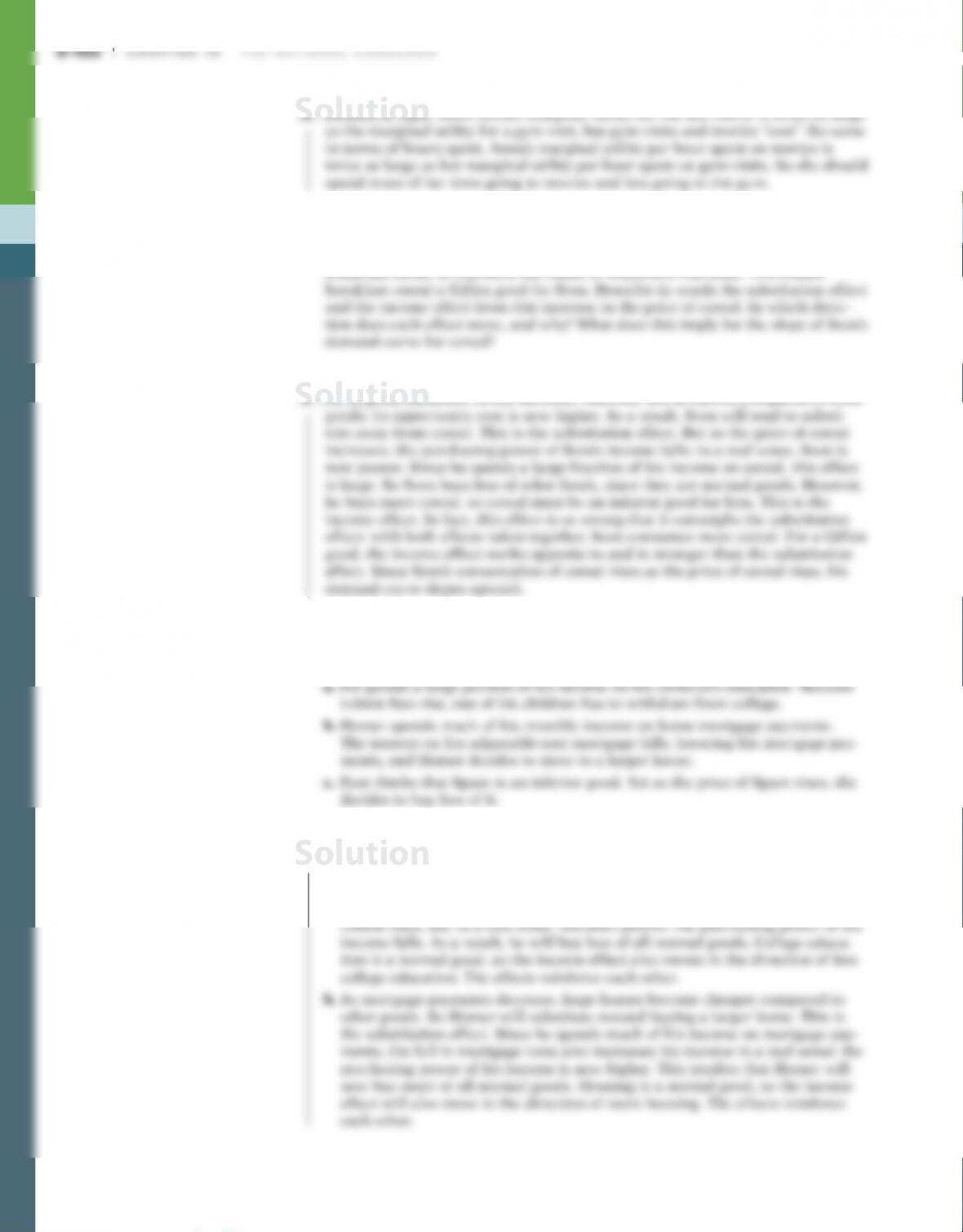
c. The accompanying diagram shows Damien’s marginal utility per hour spent
on gym visits and his marginal utility per hour spent watching movies. Of all
the bundles on his budget line, the bundle containing 4 gym visits and 3 mov-
ies is optimal: this is the bundle at which the marginal utility per hour spent
in the gym is equal to the marginal utility per hour spent watching movies.
40
35
30
25
Marginal utility
per hour spent
Optimal
choice
Marginal utility
per hour
(utils per hour)
9. Sven is a poor student who covers most of his dietary needs by eating cheap
breakfast cereal, since it contains most of the important vitamins. As the price
of cereal increases, he decides to buy even less of other foods and even more
breakfast cereal to maintain his intake of important nutrients. This makes
10. In each of the following situations, describe the substitution effect and, if it
is significant, the income effect. In which direction does each of these effects
move? Why?
10. a. As tuition fees rise, college education becomes relatively more expensive com-
pared to other goods. So Ed decides to substitute away from college education
and toward other goods. This is the substitution effect. Since tuition takes up
a large portion of his income, the income effect will also be significant. As
Solution
Chapter 10 The RaTional ConsumeR S-153
c. As its price rises, Spam becomes relatively more expensive compared to other
goods. So Pam will substitute away from Spam and toward other goods. This
is the substitution effect. Spam probably does not account for a large portion
of Pam’s income, so the income effect is likely to be negligible. However, we do
11. Restaurant meals and housing (measured in the number of rooms) are the only
two goods that Neha buys. She has income of $1,000. Initially, she buys a con-
sumption bundle such that she spends exactly half her income on restaurant
11. Yes, she could. If she spends equally as much money on housing as before, she gets
12. Scott finds that the higher the price of orange juice, the more money he spends
on orange juice. Does that mean that Scott has discovered a Giffen good?
12. Scott has not necessarily discovered a Giffen good. For a good to be a Giffen
13. Margo’s marginal utility of one dance lesson is 100 utils per lesson. Her mar-
ginal utility of a new pair of dance shoes is 300 utils per pair. The price of a
dance lesson is $50 per lesson. She currently spends all her income, and she buys
her optimal consumption bundle. What is the price of a pair of dance shoes?
Solution
Solution
S-154 Chapter 10 The RaTional ConsumeR
14. According to data from the U.S. Department of Energy, the average retail price
of regular gasoline rose from $1.16 in 1990 to $2.52 in 2015, a 117% increase.
a. Other things equal, describe the effect of this price increase on the quantity of
gasoline demanded. In your explanation, make use of the utility-maximizing
14. a. The utility-maximizing principle of marginal analysis states that, at the opti-
mal consumption bundle, the marginal utility per dollar spent on gasoline is
equal to the marginal utility per dollar spent on other goods and services. As
the price of gasoline rises, other things equal, the marginal utility per dollar
spent on gasoline falls. Now the marginal utility per dollar spent on gasoline
is less than the marginal utility per dollar spent on other goods and services.
But there is a simple way for the consumer to make him- or herself better off:
spend less on gasoline and more on other goods and services. This raises the
marginal utility of gasoline, which raises the marginal utility per dollar spent
on gasoline; and it lowers the marginal utility of other goods and services,
which lowers the marginal utility per dollar spent on other goods and services.
This continues until the marginal utility per dollar spent on gasoline is again
equal to the marginal utility per dollar spent on other goods and services.
That is, the quantity of gasoline demanded falls.
Almost certainly, the whole story is captured by the substitution effect: as
the price of gasoline rises, most consumers substitute other goods and services
in place of gasoline. Only for consumers for whom spending on gasoline makes
up a major portion of their total spending will there be a noticeable income
effect: as the price of gasoline rises, they will be made poorer. Since gasoline is
a normal good, they will consume less gasoline, further reducing the quantity
of gasoline demanded. The income effect reinforces the substitution effect.
b. First, if all prices had increased by the same percentage, the effect would be
the same as if all prices had remained unchanged but the consumer’s income
had fallen. In other words, the quantity demanded of all normal goods, such
as gasoline, would fall.
Solution
Chapter 10 The RaTional ConsumeR S-155
WORK IT OUT Interactive step-by-step help with solving this
problem can be found online.
15. Brenda likes to have bagels and coffee for breakfast. The accompanying table
shows Brenda’s total utility from various consumption bundles of bagels and
coffee.
Consumption bundle
Quantity of Quantity of Total utility
bagels coffee (cups) (utils)
0 0 0
0 2 28
0 4 40
1 2 48
1 3 54
2 0 28
2 2 56
3 1 54
3 2 62
4 0 40
4 2 66
Suppose Brenda knows she will consume 2 cups of coffee for sure. However,
she can choose to consume different quantities of bagels: she can choose
either 0, 1, 2, 3, or 4 bagels.
a. Calculate Brenda’s marginal utility from bagels as she goes from consum-
ing 0 bagels to 1 bagel, from 1 bagel to 2 bagels, from 2 bagels to 3 bagels,
and from 3 bagels to 4 bagels.
b. Draw Brenda’s marginal utility curve of bagels. Does Brenda have dimin-
ishing marginal utility of bagels? Explain.
d. The price of bagels increases to $4, but the price of coffee remains at $2
per cup. Which bundles are now on Brenda’s budget line? For each bundle,
calculate Brenda’s level of utility (in utils). Which bundle is her optimal
bundle?
e. What do your answers to parts c and d imply about the slope of Brenda’s
demand curve for bagels? Describe the substitution effect and the income
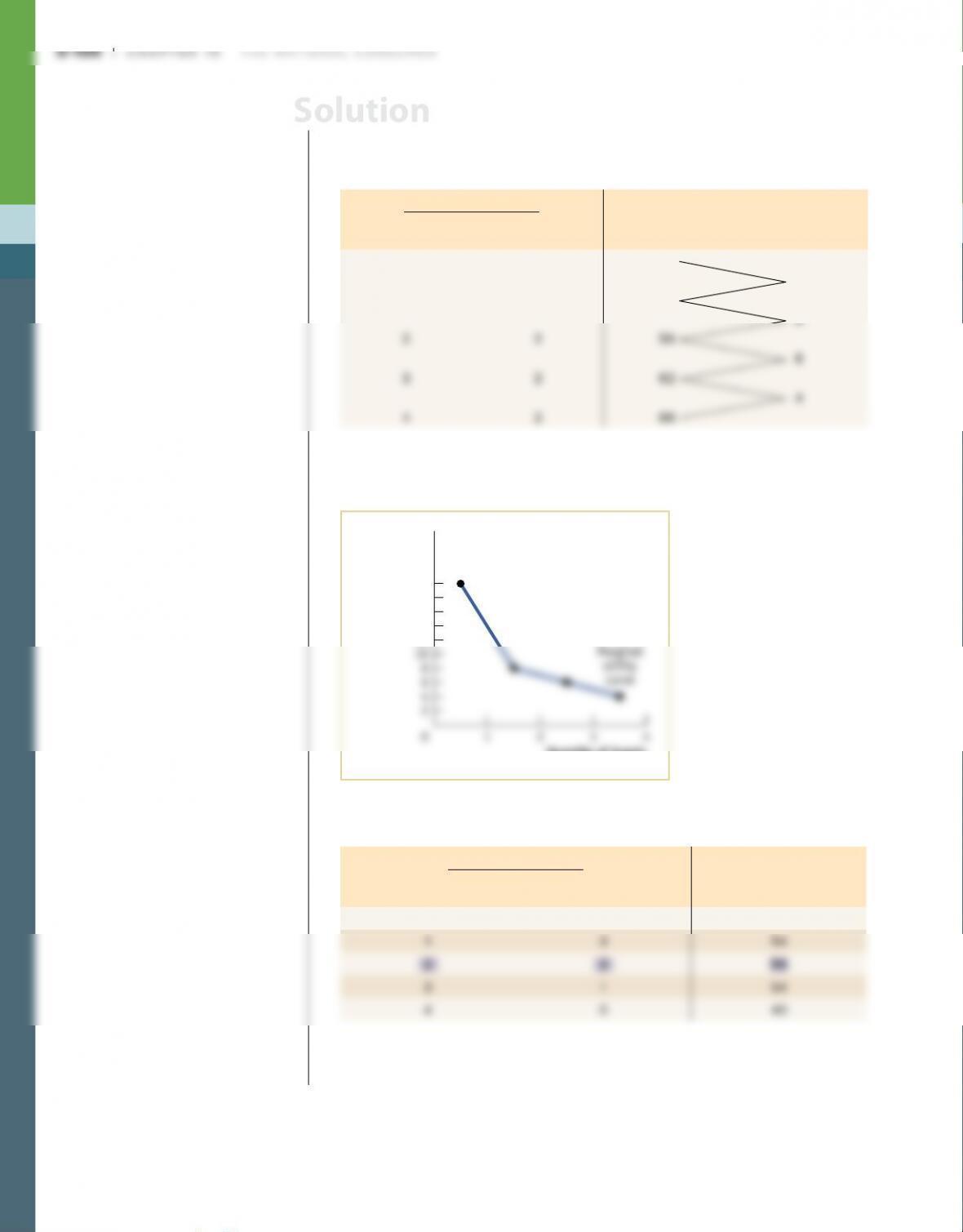
15. a. If Brenda consumes 2 cups of coffee, the consumption bundles that are rel-
evant are those in the accompanying table. The first two columns are the bun-
dles, and the third column shows the total utility of each bundle. The fourth
column calculates her marginal utility of bagels.
Consumption bundle
Quantity of
bagels
Quantity of
coffee (cups)
Total utility
(utils)
Marginal utility
per bagel (utils)
0 2 28
20
1 2 48
b. The accompanying diagram shows Brenda’s marginal utility of bagels. Since
Brenda’s marginal utility curve of bagels slopes downward, she has diminish-
ing marginal utility of bagels.
20
18
16
14
12
Marginal
utility per
bagel (utils)
Quantity of bagels
c. The first two columns in the accompanying table list the bundles that lie on Bren–
da’s budget line, and the third column shows her total utility from these bundles.
Consumption bundle
Quantity of
bagels
Quantity of
coffee (cups)
Total utility
(utils)
0 4 40
Of all the bundles on her budget line, the bundle that contains 2 bagels and
2 cups of coffee gives Brenda the highest total utility. So this is her optimal
bundle.
Solution
Chapter 10 The RaTional ConsumeR S-157
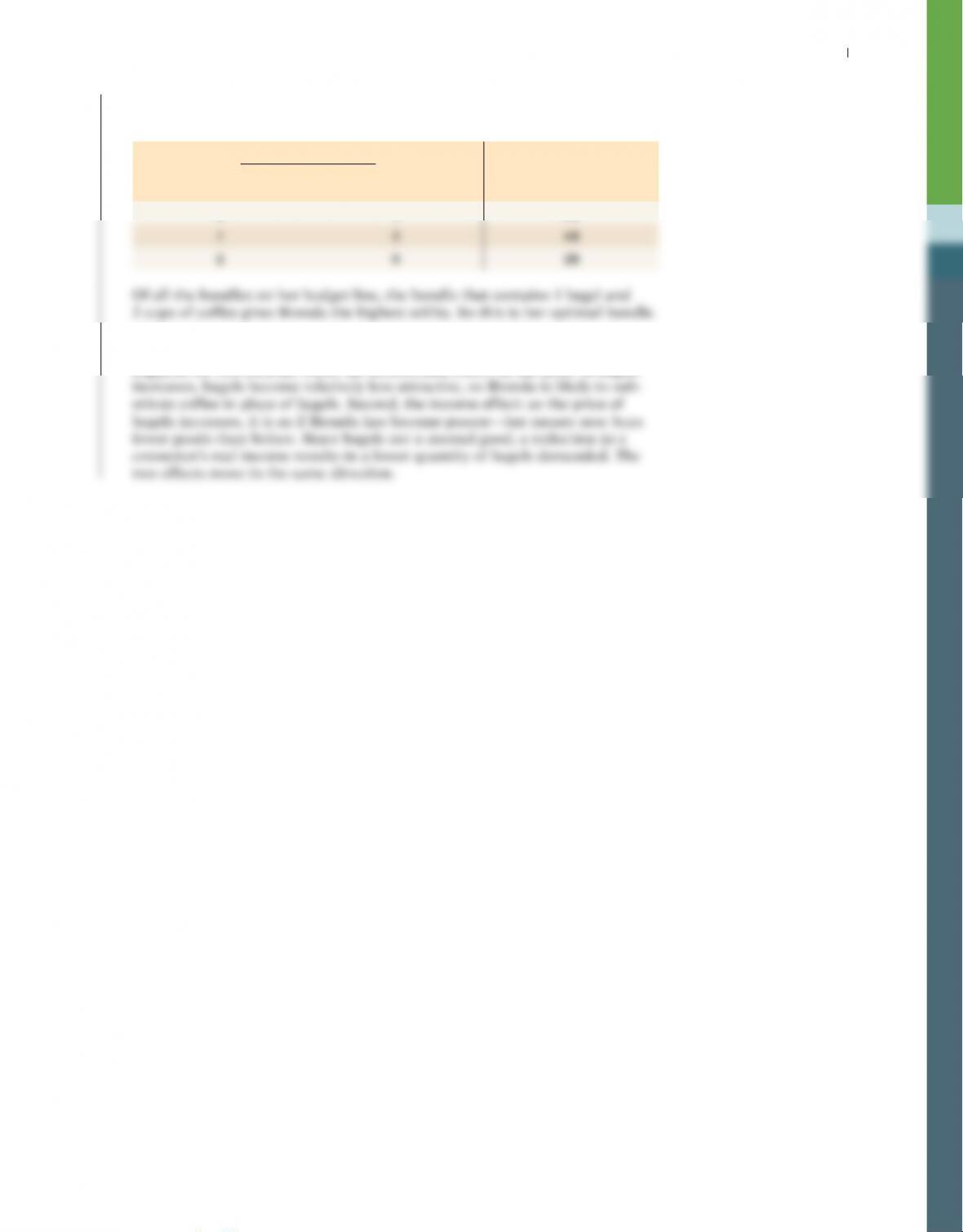
d. The first two columns in the accompanying table list the bundles that lie on Bren–
da’s budget line, and the third column shows her total utility from these bundles.
Consumption bundle
Quantity of
bagels
Quantity of
coffee (cups)
Total utility
(utils)
0 4 40
e. As the price of bagels increased, Brenda’s consumption fell from 2 bagels to
1 bagel, implying that her demand curve for bagels slopes downward. This
happens for two reasons. First, the substitution effect: as the price of bagels