
interactive activity
Chapter 10
Savings, Investment
Spending, and the
Financial System
1. Given the following information about the closed economy of Brittania, what
is the level of investment spending and private savings, and what is the budget
balance? What is the relationship among the three? Is national savings equal to
investment spending? There are no government transfers.
1. In a closed economy, investment spending is equal to GDP minus consumer
spending minus government purchases of goods and services. In Brittania,
investment spending is $50 million:
I = GDP − C − G
2. Given the following information about the international economy of Regalia,
what is the level of investment spending and private savings, and what are the
budget balance and net capital inflow? What is the relationship among the four?
There are no government transfers. [Hint: Net capital inflow equals the value of
imports (IM) minus the value of exports (X).]
2. In an economy with capital flows, investment spending is equal to GDP minus
consumer spending minus government purchases of goods and services plus
net capital inflow, the value of imports minus the value of exports. In Regalia,
investment spending is $75 million:
I = (GDP − C − G) + (IM − X)
Private savings and the budget balance are measured in the same way regardless
of whether or not there are capital inflows or outflows. (Again, recall that there
are no government transfers.) In Regalia, private savings is $100 million and the
budget balance is −$50 million (that is, the government is running a deficit of
$50 million):
Solution
Solution
S-134 Chapter 10 SavingS, inveStment Spending, and the Financial SyStem
Private savings = GDP − T − C = $1,000 million − $50 million − $850 million =
$100 million
Budget balance = T − G = $50 million − $100 million = −$50 million
3. The accompanying table shows the percentage of GDP accounted for by private
savings, investment spending, and net capital inflow in the economies of
Capsland and Marsalia. Capsland is currently experiencing a positive net capital
inflow and Marsalia, a negative net capital inflow. What is the budget balance
(as a percentage of GDP) in both countries? Are Capsland and Marsalia running
a budget deficit or surplus?
3. In both countries, investment spending as a percentage of GDP must be equal
to the sum of private savings, the budget balance, and net capital inflow as a
percentage of GDP. We can calculate the budget balance as investment spending
minus the sum of private savings and net capital inflow:
I = Private savings + Budget balance + Net capital inflow
Budget balance = I − Private savings − Net capital inflow
In Capsland, the budget balance is 5% of GDP; the government is running a bud-
get surplus equal to 5% of GDP:
4. Assume the economy is open to capital inflows and outflows and therefore net
capital inflow equals imports (IM) minus exports (X). Calculate each of the
following.
a. X = $125 million
IM = $80 million
Solution
Chapter 10 SavingS, inveStment Spending, and the Financial SyStem S-135
b. X = $85 million
IM = $135 million
c. X = $60 million
IM = $95 million
d. Private savings = $325 million
I = $400 million
Budget balance = $10 million
Calculate IM − X.
5. The government is running a budget balance of zero when it decides to increase
education spending by $200 billion and finance the spending by selling bonds.
The accompanying diagram shows the market for loanable funds before the
government sells the bonds. Assume that there are no capital inflows or out–
flows. How will the equilibrium interest rate and the equilibrium quantity of
loanable funds change? Is there any crowding out in the market?
24%
22
20
18
16
14
12
10
8
6
4
2
Interest
rate
D
E
S
S-136 Chapter 10 SavingS, inveStment Spending, and the Financial SyStem
in 2014. Since the U.S. government was running a budget deficit at the time,
assume that the new pre-K funding was financed by government borrowing, which
increases the demand for loanable funds without affecting supply. This question
considers the likely effect of this government expenditure on the interest rate.
a. Draw typical demand (D1) and supply (S1) curves for loanable funds without
the cost of the expanded pre-K programs accounted for. Label the vertical axis
“Interest rate” and the horizontal axis “Quantity of loanable funds.” Label the
equilibrium point (E1) and the equilibrium interest rate (r1).
b. Now draw a new diagram with the cost of the expanded pre-K programs
included in the analysis. Shift the demand curve in the appropriate direction.
Label the new equilibrium point (E2) and the new equilibrium interest rate (r2).
c. How does the equilibrium interest rate change in response to government
expenditure on the expanded pre-K programs? Explain.
7. Explain why equilibrium in the loanable funds market maximizes efficiency.
8. How would you respond to a friend who claims that the government should
eliminate all purchases that are financed by borrowing because such borrowing
crowds out private investment spending?
9. Boris Borrower and Lynn Lender agree that Lynn will lend Boris $10,000 and
that Boris will repay the $10,000 with interest in one year. They agree to a
nominal interest rate of 8%, reflecting a real interest rate of 3% on the loan and
a commonly shared expected inflation rate of 5% over the next year.
a. If the inflation rate is actually 4% over the next year, how does that
lower-than–expected inflation rate affect Boris and Lynn? Who is better off?
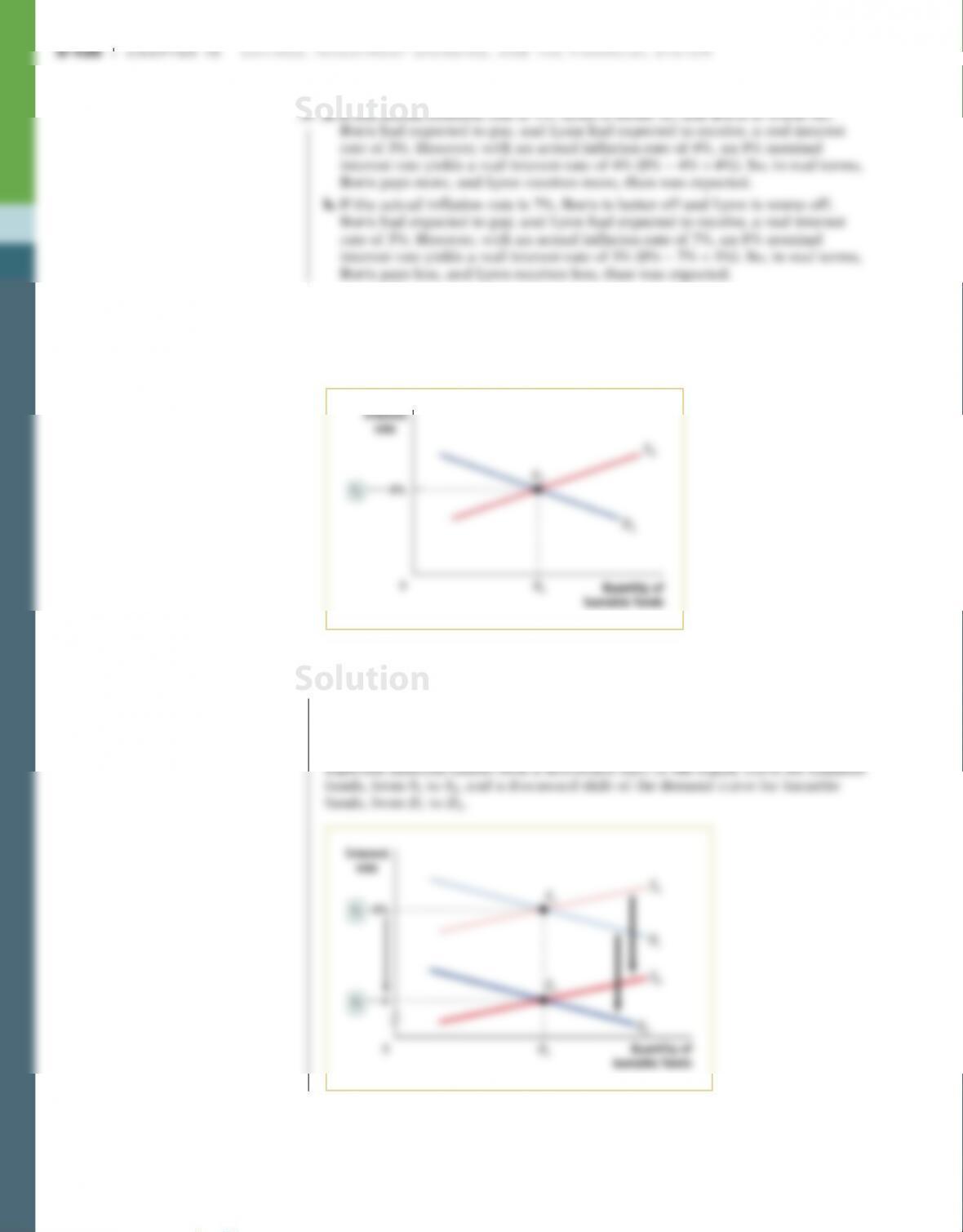
10. Using the accompanying diagram, explain what will happen to the market for
loanable funds when there is a fall of 2 percentage points in the expected future
inflation rate. How will the change in the expected future inflation rate affect
the equilibrium quantity of loanable funds?
Quantity of
loanable funds
Interest
rate
Q1
S1
8%
0
D1
E1
r1
10. In the accompanying diagram, the market for loanable funds is initially in
equilibrium at E1, with a nominal interest rate of 8%. A fall of 2 percentage
points in the expected future inflation rate leads, by the Fisher effect, to a fall of
2 percentage points in the nominal interest rate to 6%. The real interest rate and
the equilibrium quantity of loanable funds remain unchanged. The change in
Solution
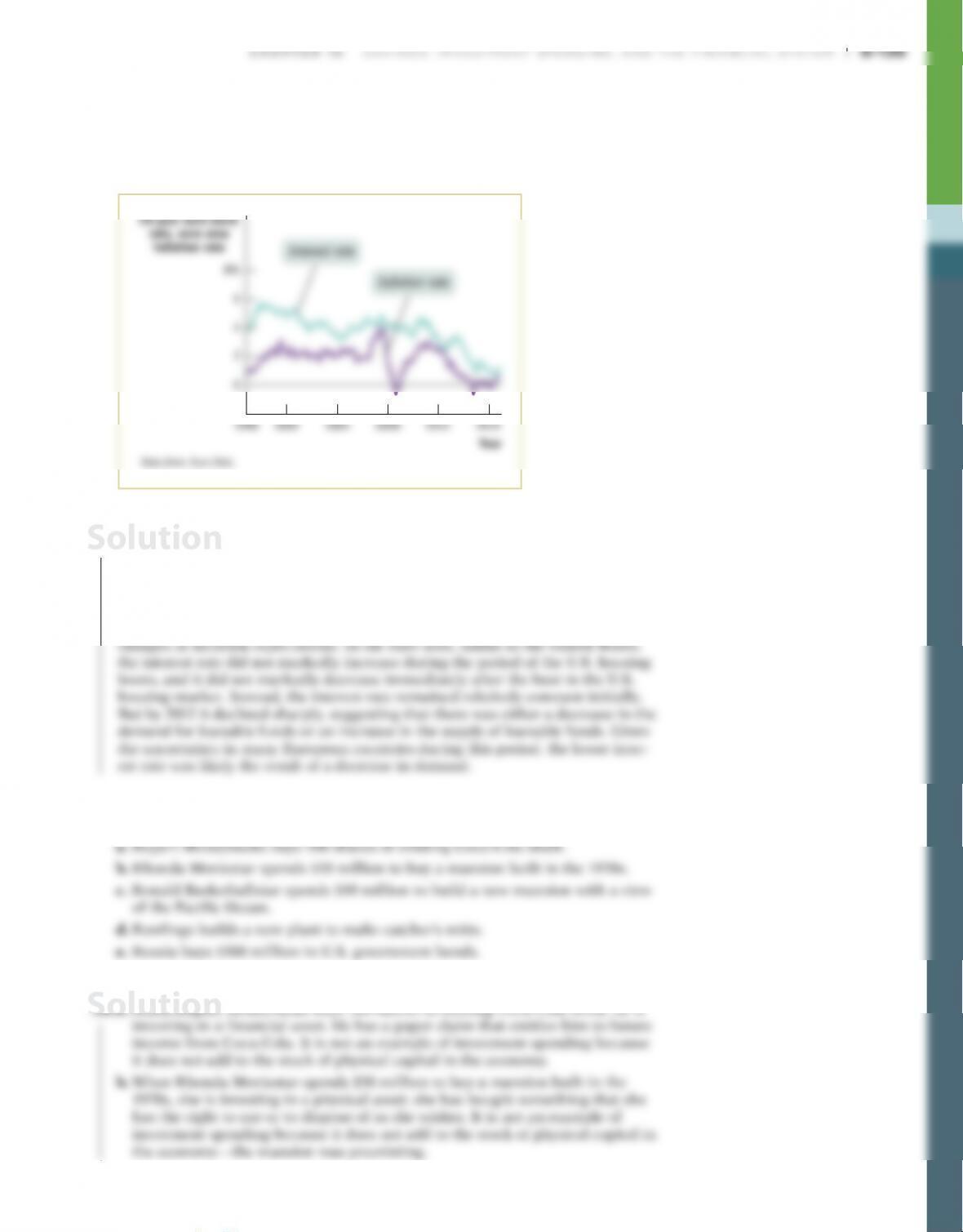
11. The accompanying diagram shows data for the interest rate on 10-year euro area
government bonds and inflation for the euro area for 1996 through mid-2016,
as reported by the European Central Bank. How would you describe the rela-
tionship between the two? How does the pattern compare to that of the United
States in Figure 10-10?
Y
ear
10-year euro bond
rate, euro area
inflation rate
8%
1996 2004 201220082000 2016
–2
6
4
0
2
Inflation rate
Data from: Euro Stat.
Interest rate
11. As in the case of the United States in panel (a) of Figure 10–10, the euro area
experience is largely one of low and relatively constant inflation. As expectations
of future inflation declined, so did interest rates during the first part of the
period illustrated in the accompanying diagram. Based on the expectation
of continuing low inflation, fluctuations in the interest rate after about 2000
reflect changes in the demand for, and the supply of, loanable funds, rather than
12. For each of the following, is it an example of investment spending, investing in
financial assets, or investing in physical assets?
Solution

S-140 Chapter 10 SavingS, inveStment Spending, and the Financial SyStem
c. When Ronald Basketballstar spends $10 million to build a new mansion with a
view of the Pacific Ocean, he has engaged in investment spending because he
13. Explain how a well-functioning financial system increases savings and
investment spending, holding the budget balance and any capital flows fixed.
13. A well-functioning financial system increases both the supply of loanable funds
14. What are the important types of financial intermediaries in the U.S. economy?
14. Mutual funds, pension funds, life insurance companies, and banks are the most
important types of financial intermediaries in the U.S. economy. Mutual funds
are companies that buy stocks of other companies (the mutual funds companies’
primary assets) and resell shares of the portfolio composed of those stocks to
individual investors. Pension funds are a type of mutual fund that hold financial
assets of other companies (the pension funds’ primary assets) and sell shares
15. Explain the effect on a company’s stock price today of each of the following
events, other things held constant.
a. The interest rate on bonds falls.
Solution
Solution
15. a. Because bonds are a substitute asset for stocks, this will lead to a rise in all
stock prices, including this company’s stock price.
b. This will lead to an immediate rise in the company’s stock price because it is
unexpected information that communicates to investors that the company’s
sector is doing well, and so it is likely that the company will also experience
higher sales and a higher-than-expected future profit.
16. Sallie Mae is a quasi-governmental agency that packages individual student
loans into pools of loans and sells shares of these pools to investors as Sallie
Mae bonds.
a. What is this process called? What effect will it have on investors compared to
situations in which they could only buy and sell individual student loans?
b. What effect do you think Sallie Mae’s actions will have on the ability of
students to get loans?
16. a . By pooling individual loans and selling shares of those pools as bonds, Sallie
Mae has engaged in securitization. Because the likelihood that a default by one
student is usually unrelated to, or independent from, the likelihood of default
by some other student, buying a Sallie Mae bond provides greater diversifica-
tion for an investor than an individual student loan. It also provides liquidity
because it can be bought and sold like a typical bond.
Solution
Solution
S-142 Chapter 10 SavingS, inveStment Spending, and the Financial SyStem
WORK IT OUT Interactive step-by-step help with solving this
problem can be found online.
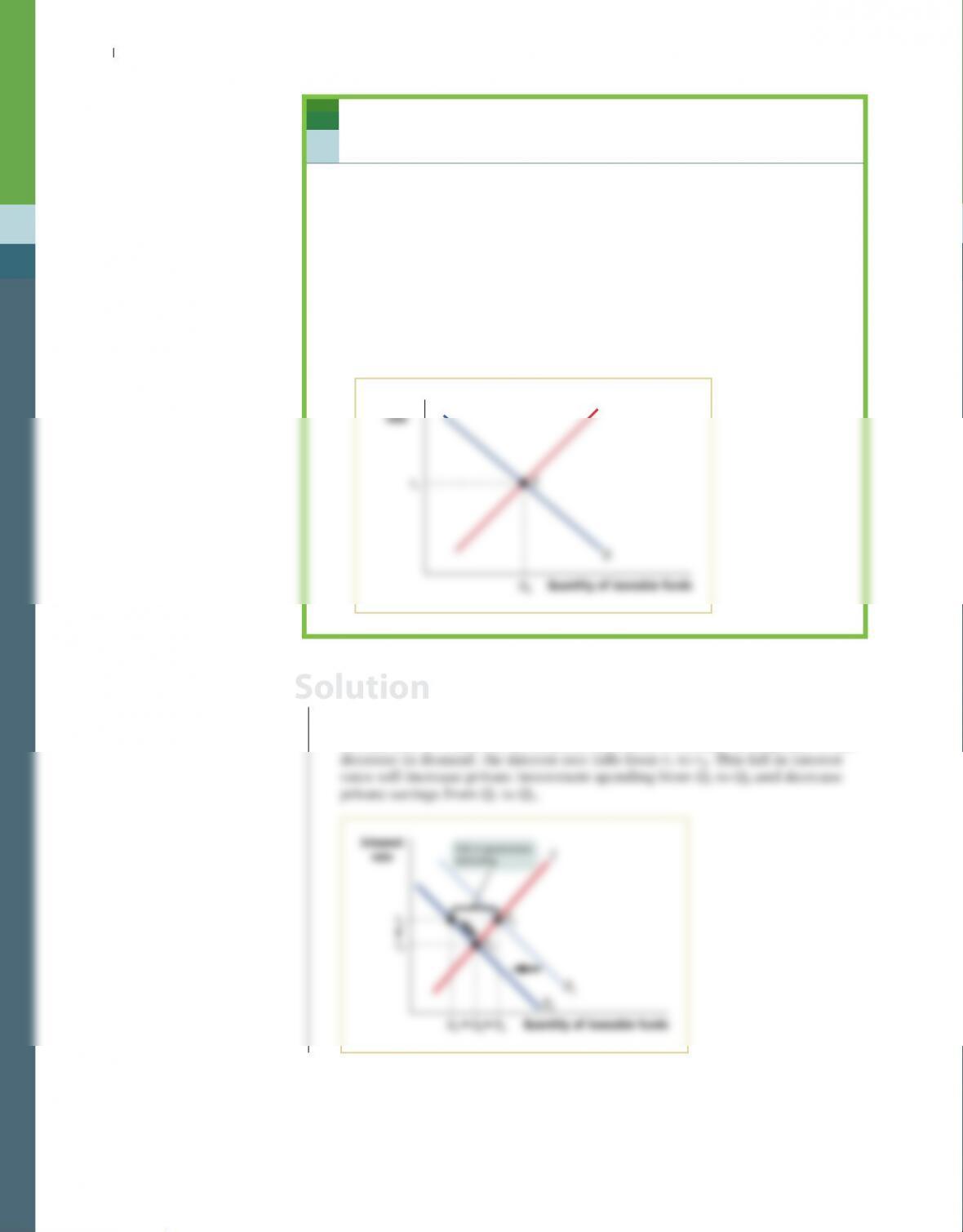
17. Use the market for loanable funds shown in the accompanying diagram to
explain what happens to private savings, private investment spending, and
the interest rate if each of the following events occur. Assume that there are
no capital inflows or outflows.
a. The government reduces the size of its deficit to zero.
b. At any given interest rate, consumers decide to save more. Assume the
budget balance is zero.
c. At any given interest rate, businesses become very optimistic about the
future profitability of investment spending. Assume the budget balance
is zero.
S
Interest
Chapter 10 SavingS, inveStment Spending, and the Financial SyStem S-143
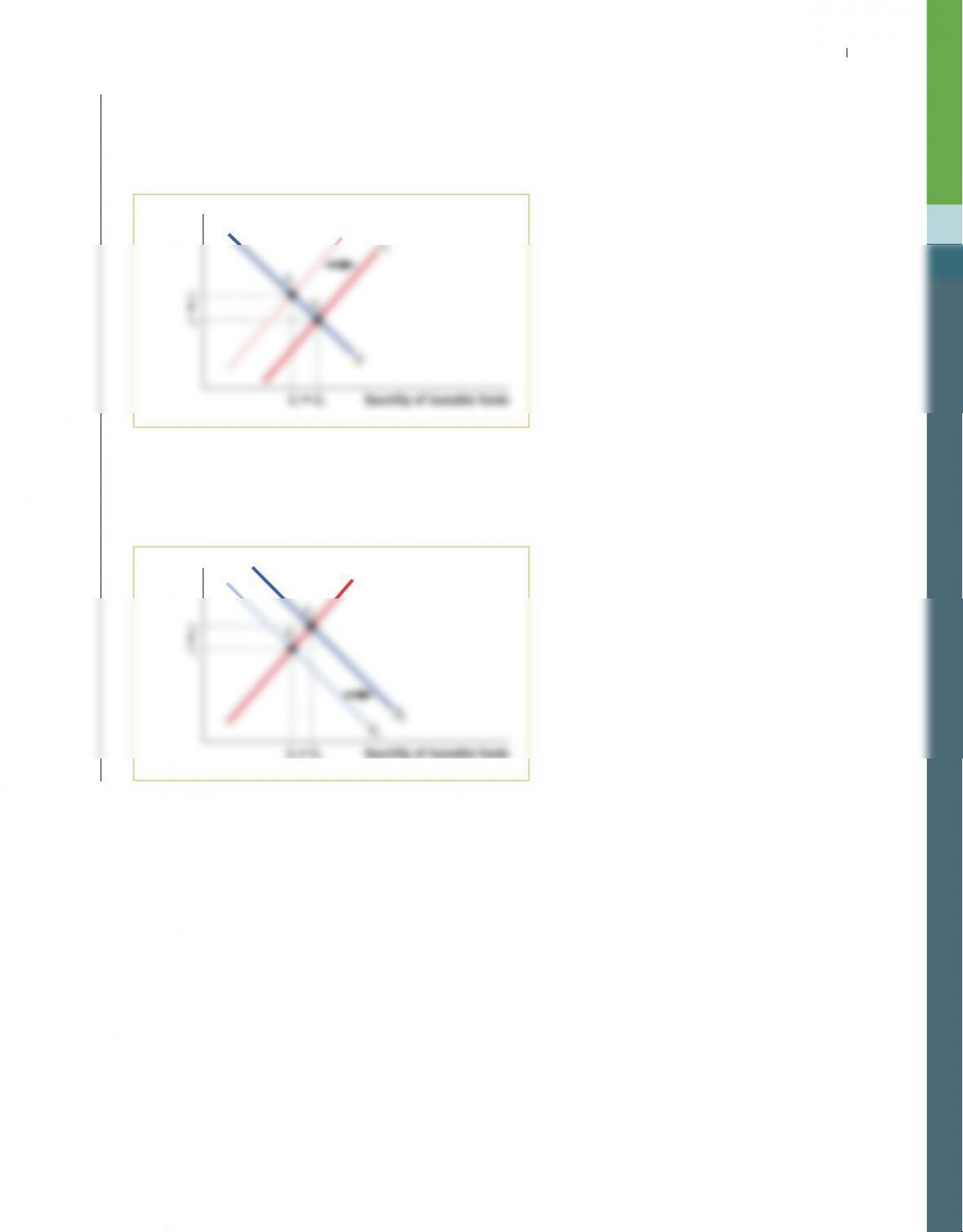
b. If consumers decide to save more, there will be an increase in the supply of
loanable funds. In the accompanying figure, this is represented by the right-
ward shift of the supply curve from S1 to S2. The increase in the supply of
loanable funds reduces the equilibrium interest rate from r1 to r2. In response
to the lower interest rate, private investment spending will rise from Q1 to Q2.
Interest
rate
r1
Quantity of
loanable funds
Q
2
Q
1
E1
S1S2
c. Higher investment spending at any given interest rate leads to an increase in
the demand for loanable funds. In the accompanying figure, the increase in
the demand for loanable funds shifts the demand curve from D1 to D2 and
raises the equilibrium interest rate from r1 to r2. In response to the higher
interest rate, private savings will rise from Q1 to Q2.
Interest
rate
r2
Quantity of loanable fundsQ2
Q1
E1
S
E2