Chapter 10: The Cost of Capital
Learning Objectives
259
Chapter 10
The Cost of Capital
Learning Objectives
After reading this chapter, students should be able to do the following:
◆ Explain why the weighted average cost of capital (WACC) is used in capital budgeting.
260
Lecture Suggestions
Chapter 10: The Cost of Capital
Lecture Suggestions
Chapter 10 uses the rate of return concepts covered in previous chapters, along with the concept of the
weighted average cost of capital (WACC), to develop a corporate cost of capital for use in capital
budgeting. We begin with an overview of the WACC using Allied’s capital structure to differentiate
among book value, market value, and target capital structure weights that might be used in calculating
the firm’s WACC. We next explain how to estimate the cost of each capital component, and how to put
DAYS ON CHAPTER: 3 OF 56 DAYS (50-minute periods)
Chapter 10: The Cost of Capital
Answers and Solutions
261
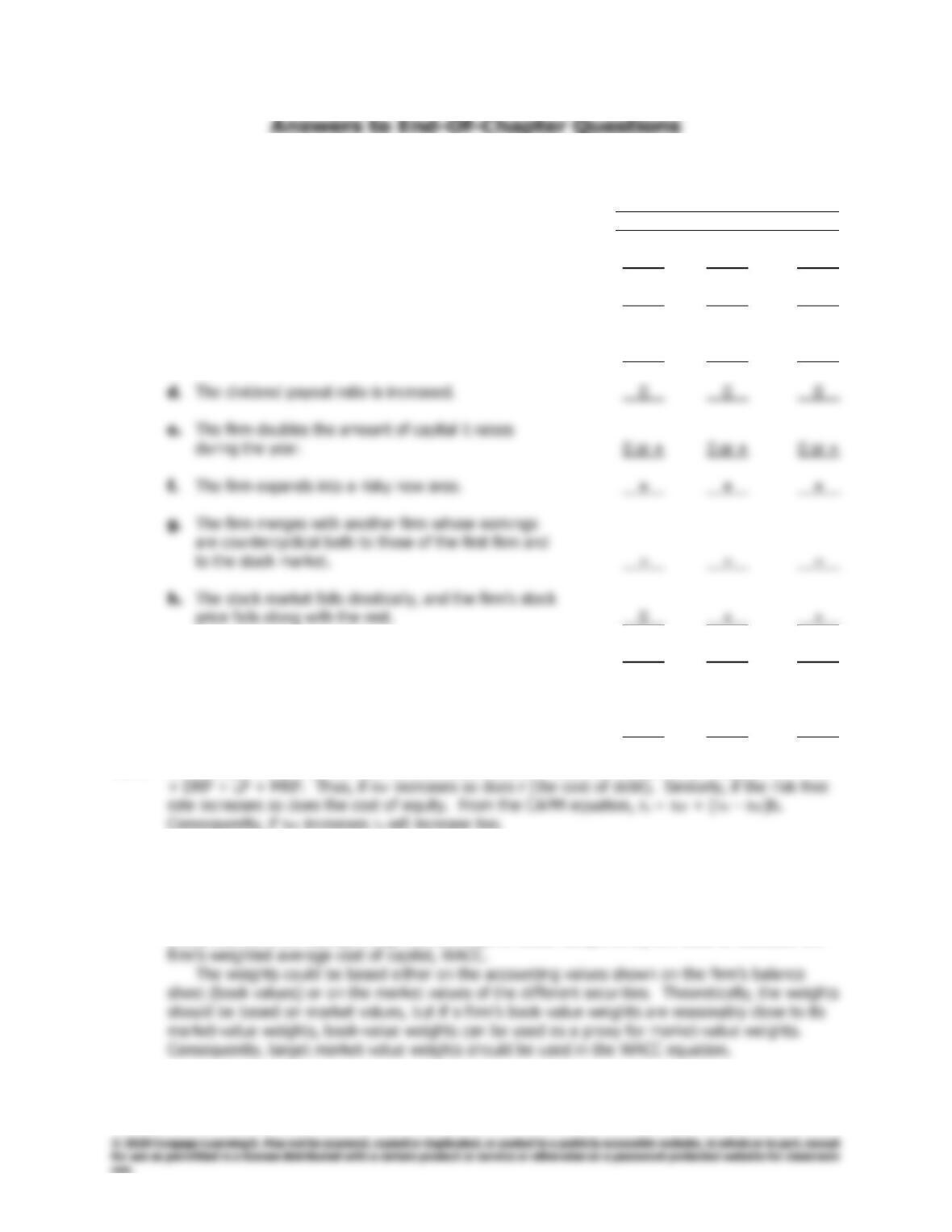
10-1 Probable Effect on
rd(1 – T) rs WACC
a. The corporate tax rate is lowered. + 0 +
b. The Federal Reserve tightens credit. + + +
c. The firm uses more debt; that is, it increases
its debt ratio. + + 0
i. Investors become more risk-averse. + + +
j. The firm is an electric utility with a large investment in
nuclear plants. Several states are considering a ban
on nuclear power generation. + + +
10-2 An increase in the risk-free rate will increase the cost of debt. Remember from Chapter 6, r = rRF
10-3 Each firm has an optimal capital structure, defined as that mix of debt, preferred, and common
equity that causes its stock price to be maximized. A value-maximizing firm will determine its
optimal capital structure, use it as a target, and then raise new capital in a manner designed to
keep the actual capital structure on target over time. The target proportions of debt, preferred
stock, and common equity, along with the costs of those components, are used to calculate the
10-4 In general, failing to adjust for differences in risk would lead the firm to accept too many risky
projects and reject too many safe ones. Over time, the firm would become more risky, its WACC
10-5 The cost of retained earnings is lower than the cost of new common equity; therefore, if new
common stock had to be issued then the firm’s WACC would increase.
The calculated WACC does depend on the size of the capital budget. A firm calculates its
retained earnings breakpoint (and any other capital breakpoints for additional debt and
Chapter 10: The Cost of Capital
Answers and Solutions
263
Solutions to End-Of-Chapter Problems
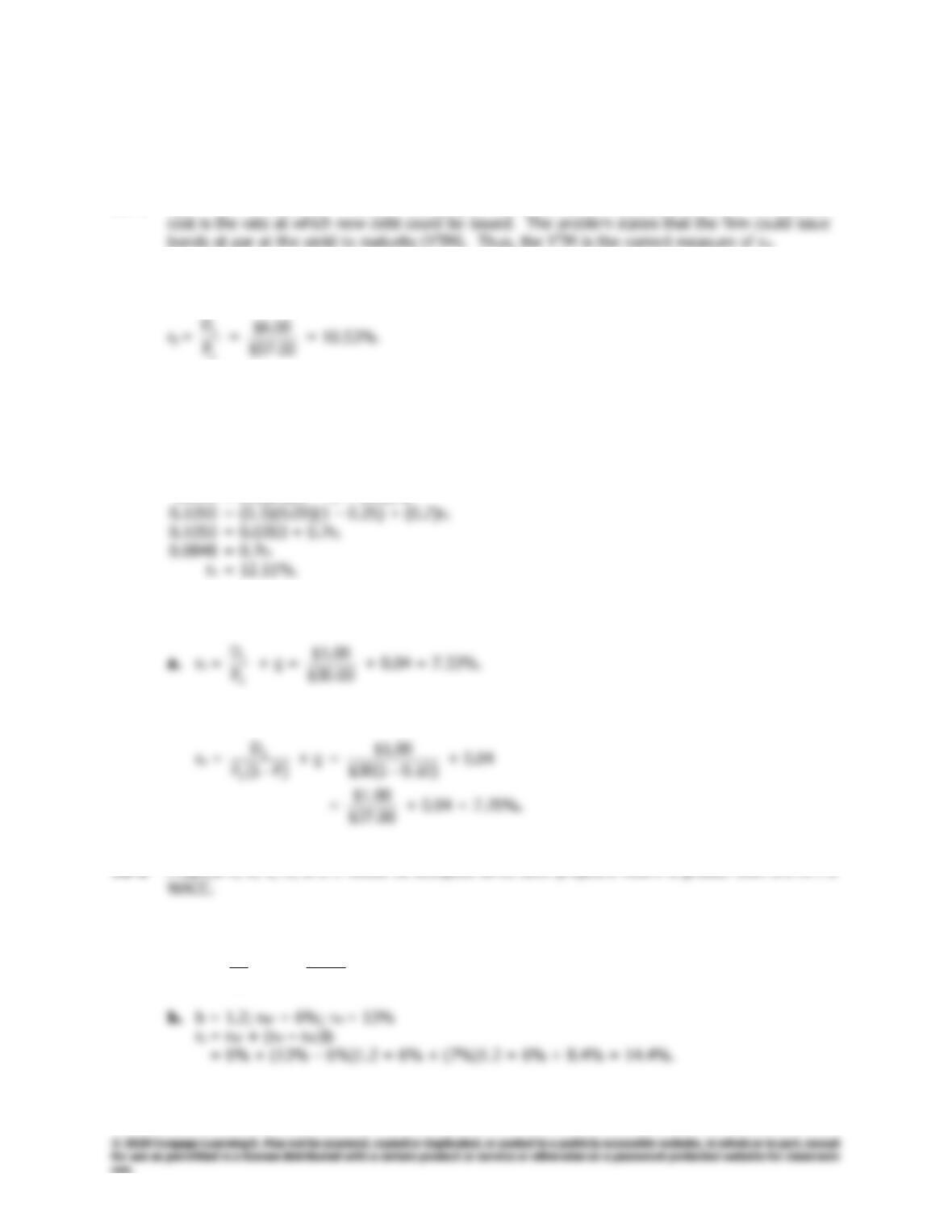
10-1 rd(1 – T) = 10%(0.75) = 7.50%. The coupon rate is not the correct measure of rd. The relevant
10-2 Pp = $57.00; Dp = $6.00; rp = ?
10-3 30% Debt; 70% Common equity; rd = 9%; T = 25%; WACC = 10.50%; rs = ?
The firm uses no preferred stock, so the WACC equation includes only the component costs of
debt and common equity.
WACC = (wd)(rd)(1 – T) + (wc)(rs)
10-4 P0 = $30; D1 = $1.00; g = 4%; rs = ?
1
P
D
b. F = 10%; re = ?
10-5 Projects A, B, C, D, and E would be accepted since each project’s return is greater than the firm’s
10-6 a. D0 = $2.00; P0 = $22; g = 6%; D1 = D0 × (1 + g) = $2.00 × (1.06) = $2.12
rs =
0
1
P
D
+ g =
22$
12.2$
+ 6% = 9.6% + 6% = 15.6%.
264
Answers and Solutions
Chapter 10: The Cost of Capital
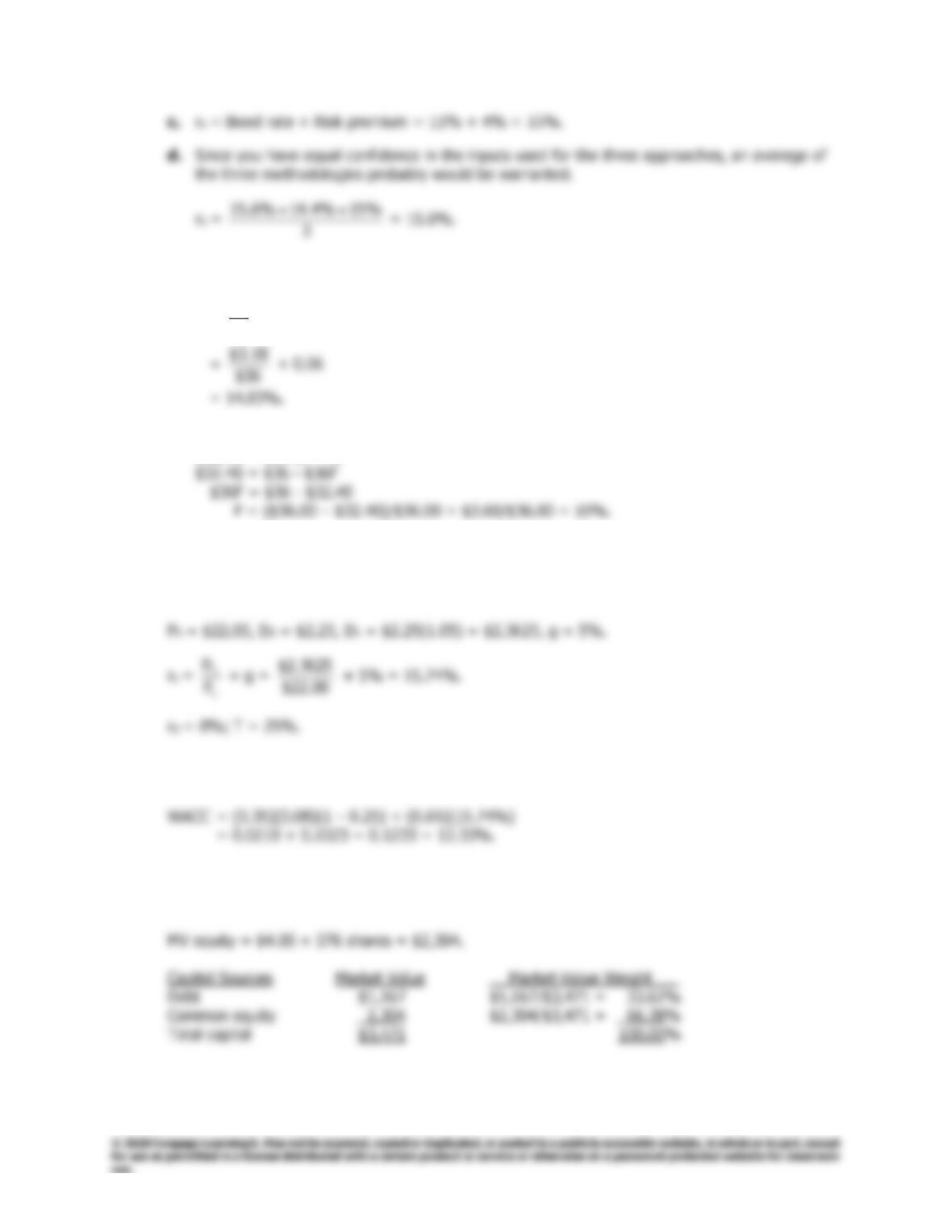
10-7 a. D1 = $3.18; g = 6%; P0 = $36; P0 (1 – F) = $32.40
rs =
0
1
P
D
+ g
b. $32.40 = P0 (1 – F)
$32.40 = $36 (1 – F)
c. re = D1/[P0(1 – F)] + g = $3.18/$32.40 + 6% = 9.81% + 6% = 15.81%.
10-8 Debt = 35%, Common equity = 65%.
0
P
D
The firm uses no preferred stock, so the WACC equation includes only the component costs of
debt and common equity.
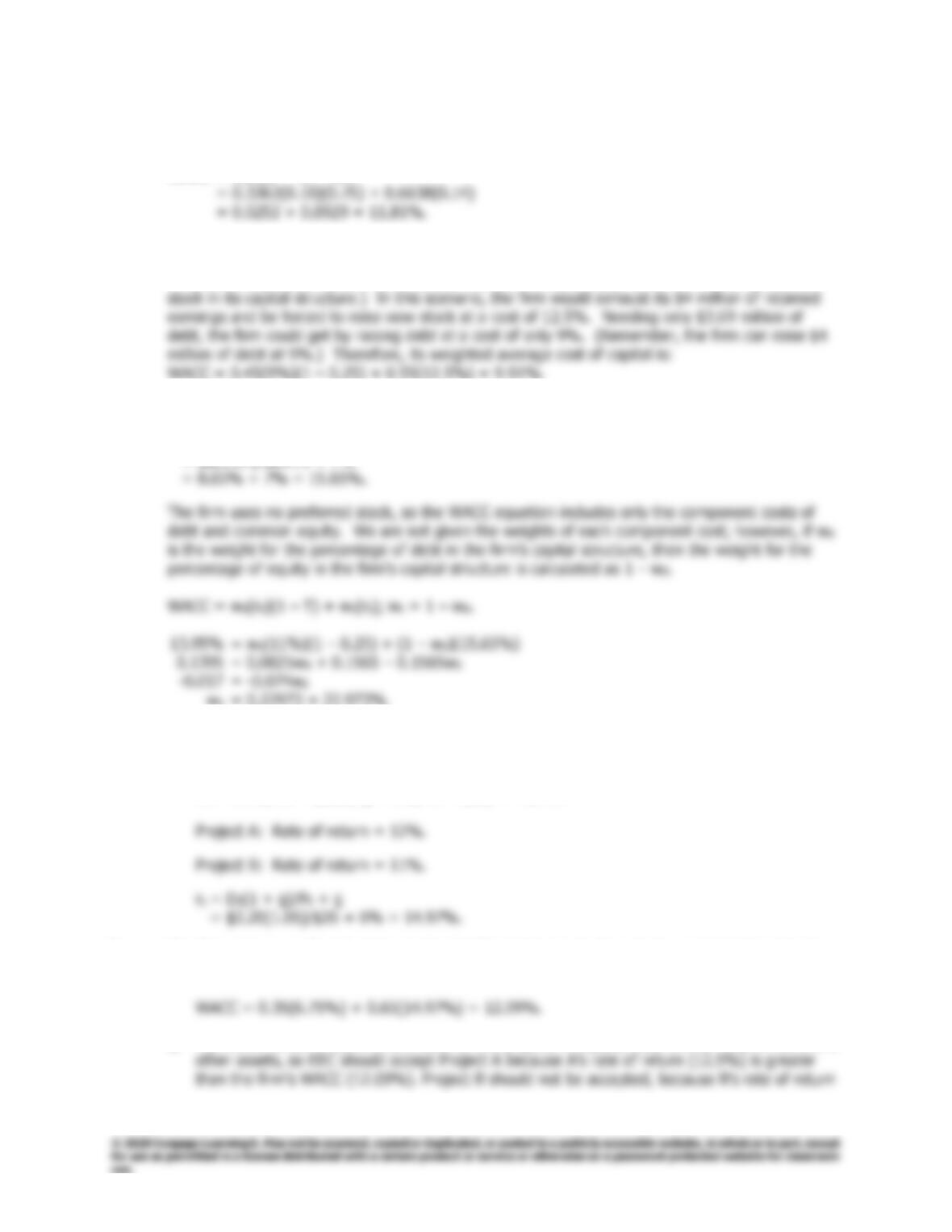
10-9 BV total debt = Short-term debt + Long-term debt = MV total debt = $1,167; P0 = $4.00; Shares
outstanding = 576; T = 25%
Chapter 10: The Cost of Capital
Answers and Solutions
265
The firm uses no preferred stock, so the WACC equation includes only the component costs of
debt and common equity.
WACC = wdrd(1 – T) + wcrs
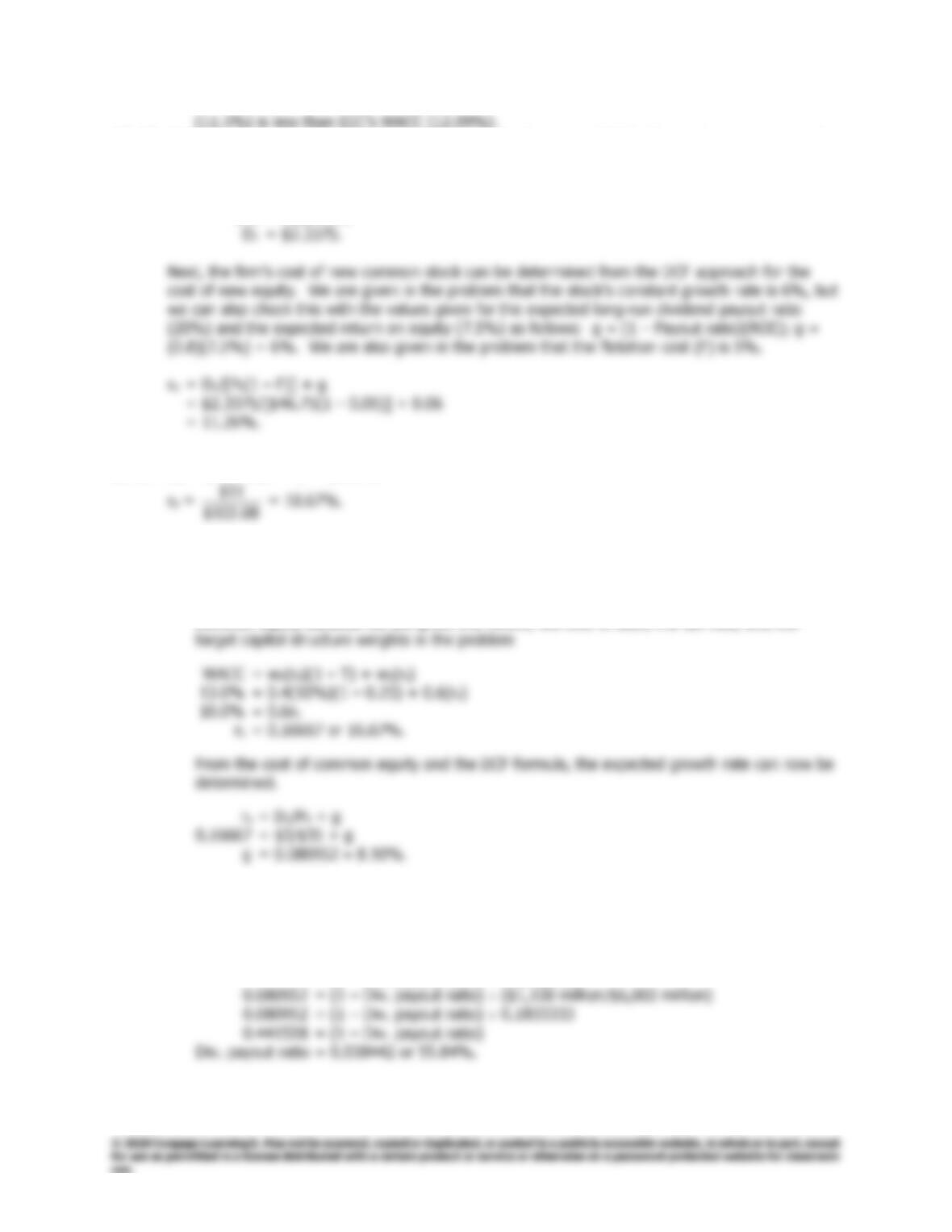
10-10 If the investment requires $8.2 million, that means it requires $4.51 million (55% × $8.2 million)
of common equity and $3.69 million (45% × $8.2 million) of debt. (The firm has no preferred
10–11 D0 = $2.00; g = 7%; D1 = $2.00(1.07) = $2.14; P0 = $24.75
rs = D1/P0 + g
= $2(1.07)/$24.75 + 7%
wd = 0.22973 = 22.973%.
10-12 a. rd = 9%, rd(1 – T) = 9%(0.75) = 6.75%.
wd = 35%; D0 = $2.20; g = 6%; P0 = $26; T = 25%.
b. The firm uses no preferred stock, so the WACC equation includes only the component costs of
debt and common equity.
c. The firm’s WACC is 12.09% and each of the projects is equally risky and as risky as the firm’s
266
Answers and Solutions
Chapter 10: The Cost of Capital
10-13 If the firm’s dividend yield (D1/P0) is 5% and its stock price is $46.75, the next expected annual
dividend can be calculated.
Dividend yield = D1/P0
5% = D1/$46.75
10–14 Dp = $11; Pp (1 – F) = $103.08
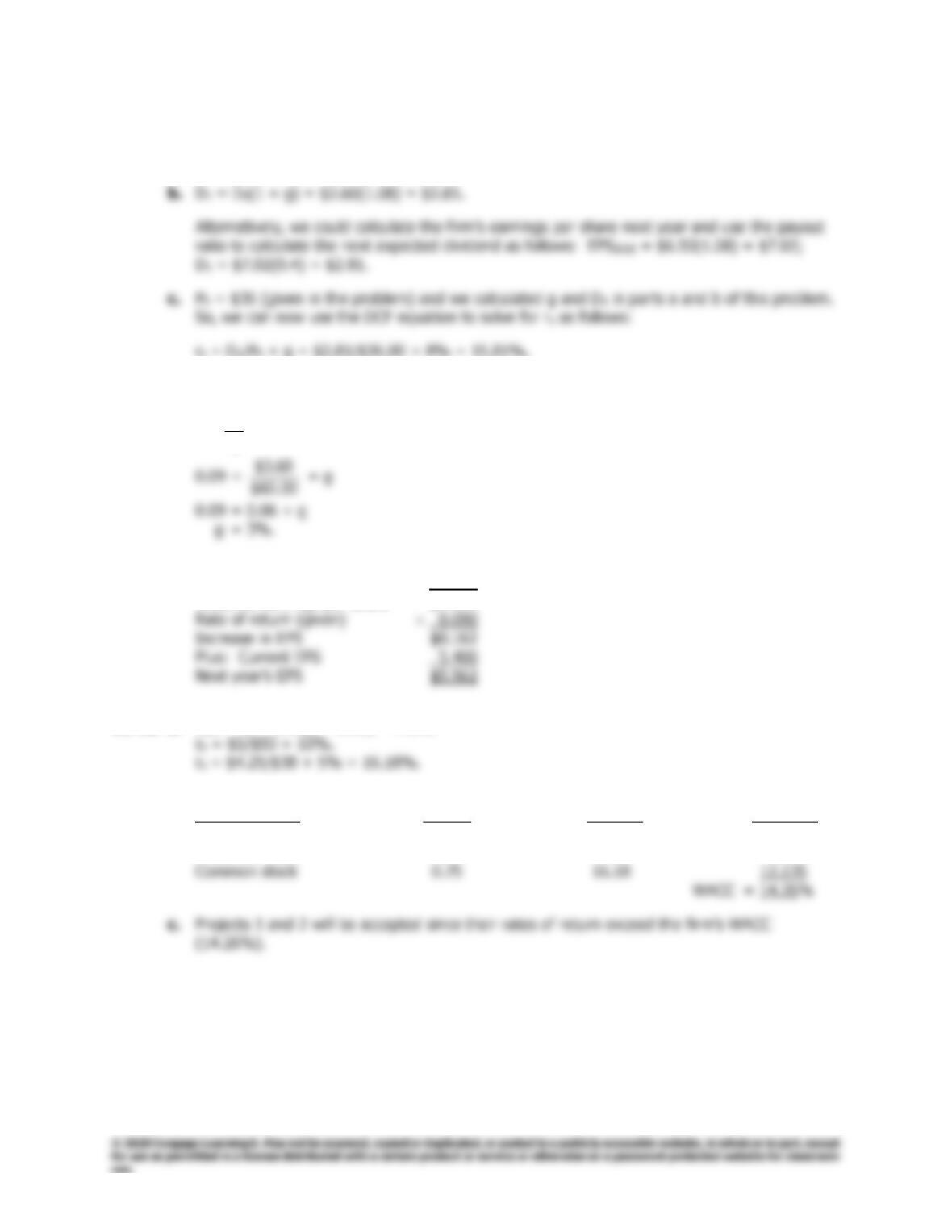
10-15 a. Examining the DCF approach to the cost of retained earnings, the expected growth rate can
be determined from the cost of common equity, price, and expected dividend. However,
first, this problem requires that the formula for WACC be used to determine the cost of
common equity because we are given the WACC, the cost of debt, the tax rate, and the
b. Given in problem that NI = $1.1 billion (or $1,100 million) and Common Equity = 0.6 × $10
billion = $6 billion (or $6,000 million).
From the formula for the long-run growth rate:
g = (1 – Div. payout ratio) ROE
= (1 – Div. payout ratio) (NI/Equity)
Chapter 10: The Cost of Capital
Answers and Solutions
267
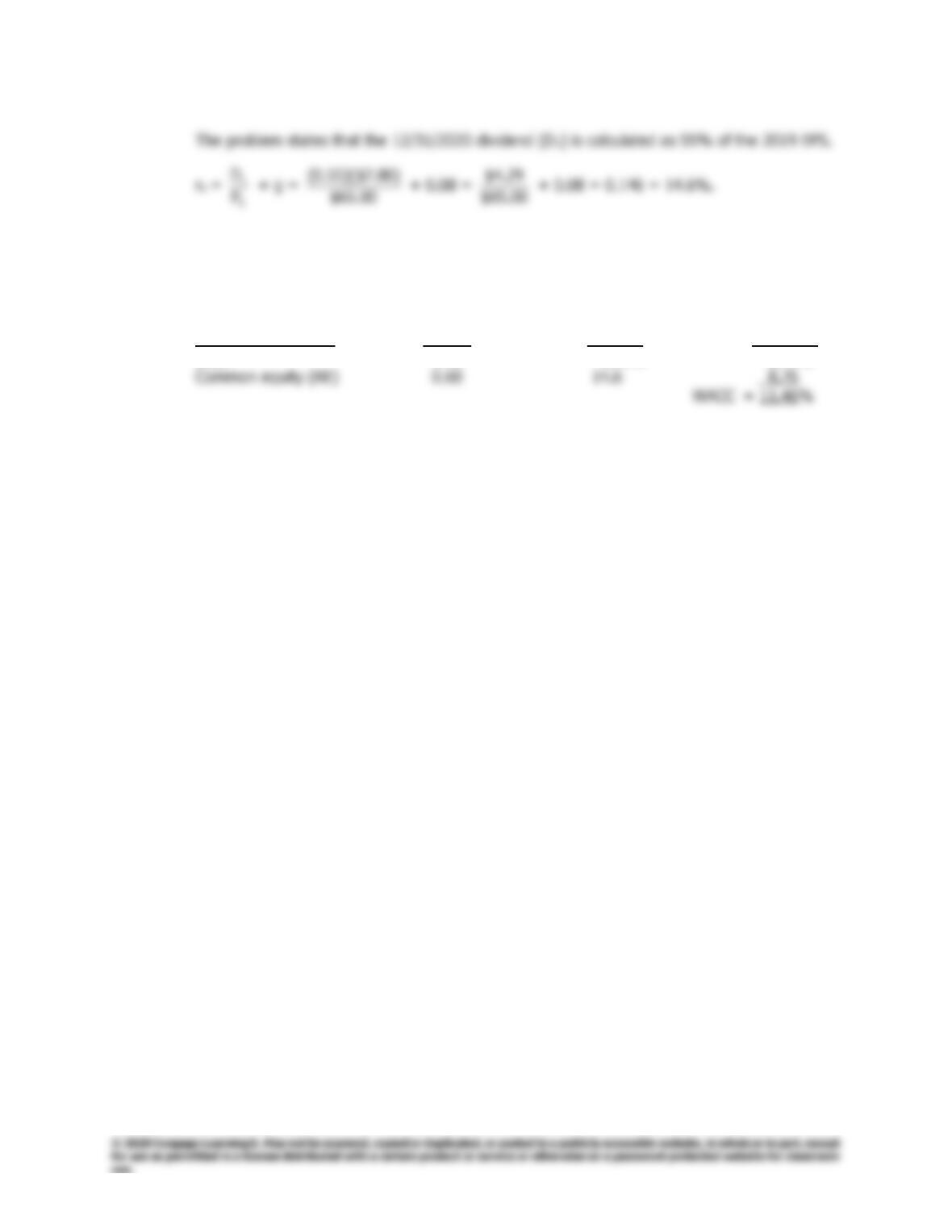
10–16 a. We use the information regarding the firm’s earnings to calculate the past growth in
earnings. With a financial calculator, input N = 5, PV = -4.42, PMT = 0, FV = 6.50, and then
solve for I/YR = g = 8.02% 8%.
10–17 a. rs = 9%; D1 = $3.60; P0 = $60. Use the DCF equation to solve for g.
rs=
0
1
P
D
+ g
b. Current EPS (given) $5.400 Alternatively:
Less: Dividends per share 3.600 EPS1 = EPS0(1 + g) = $5.40(1.03) = $5.562.
Retained earnings per share $1.800
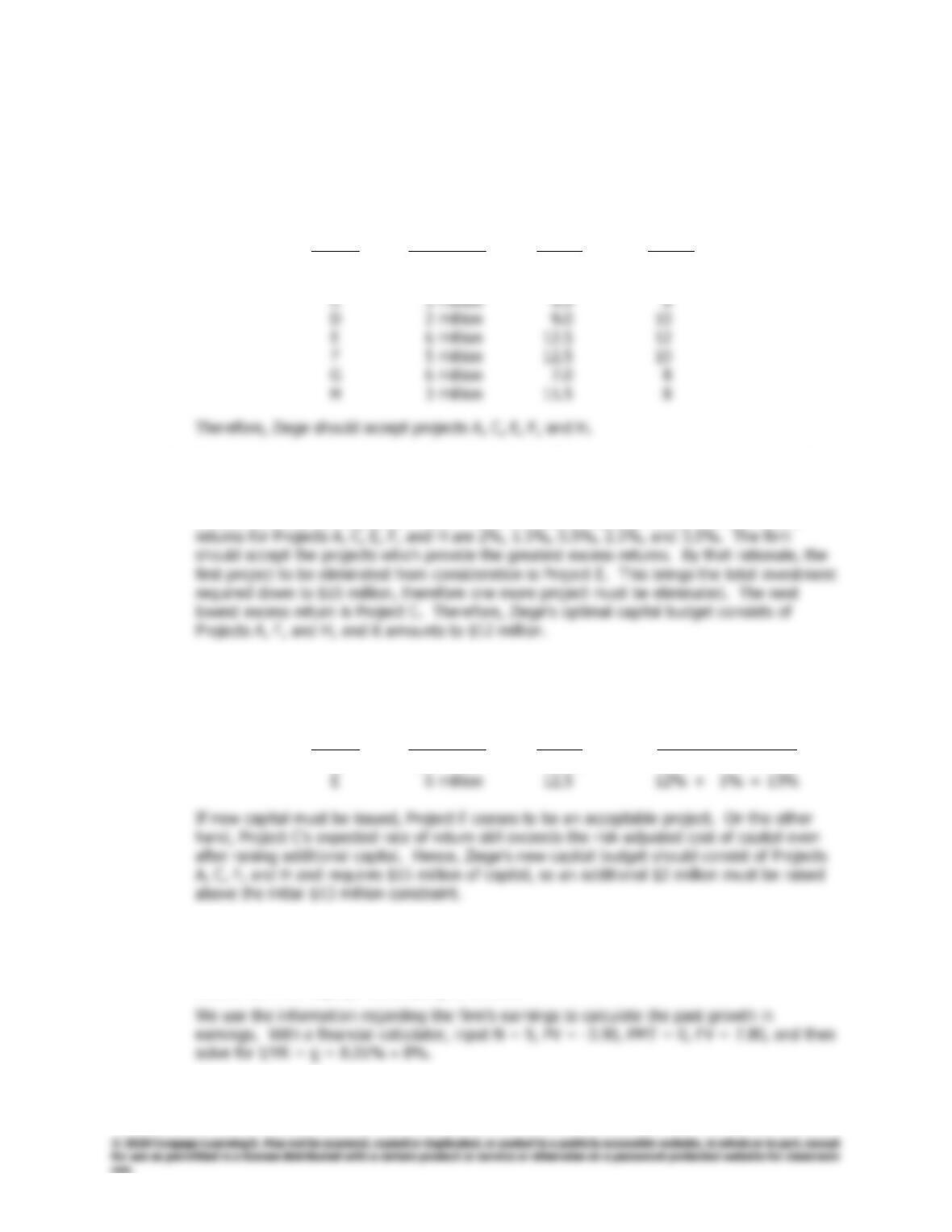
10–18 a. rd(1 – T) = 0.10(1 – 0.25) = 7.5%.
b. WACC: After-Tax Weighted
Component Weight Cost = Cost
Debt 0.15 7.50% 1.125%
Preferred stock 0.10 10.00 1.000
268
Answers and Solutions
Chapter 10: The Cost of Capital
10-19 a. If all project decisions are independent, the firm should accept all projects whose returns exceed
their risk-adjusted costs of capital. Average–risk projects will be evaluated at the firm’s WACC of
10%. High-risk projects will be evaluated at 12%, obtained by adding 2% to the firm’s WACC;
while low–risk projects will be evaluated at 8%, obtained by subtracting 2% from the firm’s
WACC. The appropriate costs of capital are summarized below:
Required Rate of Cost of
Project Investment Return Capital
A $4 million 14.0% 12%
B 5 million 11.5 12
b. With only $13 million to invest in its capital budget, Ziege must choose the best combination
of Projects A, C, E, F, and H. Collectively, the projects would account for an investment of
$21 million, so naturally not all these projects may be accepted. Looking at the excess return
created by the projects (rate of return minus the cost of capital), we see that the excess
c. Since Projects A, F, and H are already accepted projects, we must adjust the costs of capital
for the other two value producing projects (C and E).
Required Rate of Cost of
Project Investment Return Capital
C $3 million 9.5% 8% + 1% = 9%
10–20 a. After-tax cost of new debt: rd(1 – T) = 0.09(1 – 0.25) = 6.75%.
Cost of common equity: Calculate g as follows:
Chapter 10: The Cost of Capital
Answers and Solutions
269
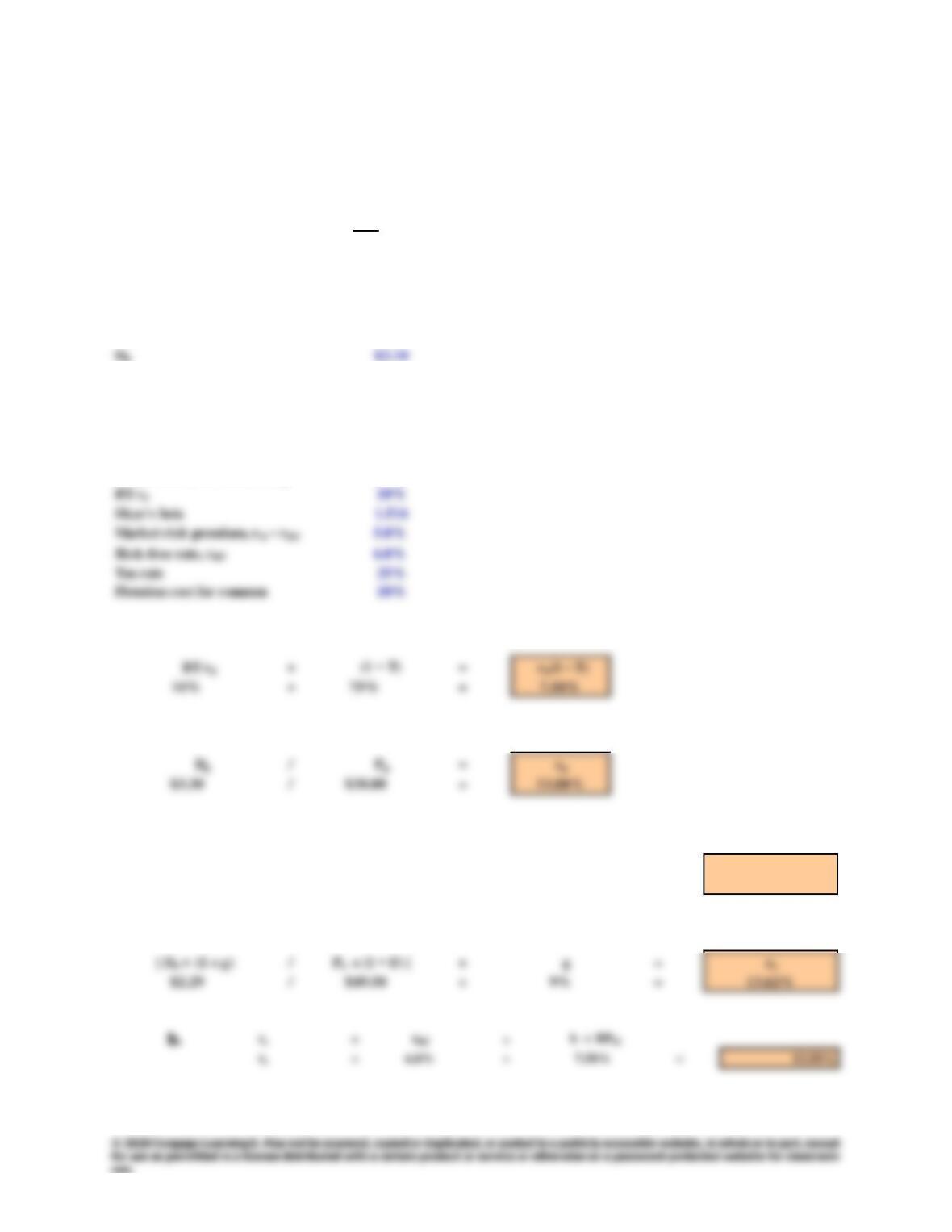
b. The firm uses no preferred stock, so the WACC equation includes only the component costs
of debt and common equity.
WACC calculation:
Target After-Tax Weighted
Component Weight Cost = Cost
Debt 0.40 6.75% 2.70%
270
Comprehensive/Spreadsheet Problem
Chapter 10: The Cost of Capital
Comprehensive/Spreadsheet Problem
Note to Instructors:
The solution to this problem is not provided to students at the back of their text. Instructors
can access the
Excel
file on the textbook’s website.
10-21 a.
INPUT DATA
EPS $3.20
P0$55.00
g9%
Common shares outstanding 50,000
Pp$30.00
Dp$3.30
Preferred shares outstanding 10,000
Cost of debt
Cost of preferred stock
Cost of common equity from retained earnings
[ D0 × (1 + g) ] / P0 + g = rs
$2.29 / $55.00 + 9% = 13.16%
Cost of common equity from new common stock