Chapter 10 – Pure Monopoly
10-1
Chapter 10 Pure Monopoly
QUESTIONS
1. “No firm is completely sheltered from rivals; all firms compete for consumer dollars. If that is
so, then pure monopoly does not exist.” Do you agree? Explain. How might you use Chapter 4’s
concept of cross elasticity of demand to judge whether monopoly exists? LO1
Answer: Though it is true that “all firms compete for the dollars of consumers,” it is
playing on words to hold that pure monopoly does not exist. If you wish to send a
first-class letter, it is the postal service or nothing. Of course, if the postal service raises
of substitute products.
2. Discuss the major barriers to entry into an industry. Explain how each barrier can foster either
monopoly or oligopoly. Which barriers, if any, do you feel give rise to monopoly that is socially
justifiable? LO1
Answer: Economies of scale are a barrier to entry because of the need for new firms to
start big to achieve the low production costs of those already in the industry. However,
not all industries need techniques of production that require large scale. In many
industries the minimum efficient scale is only a small percentage of domestic
consumption.
Chapter 10 – Pure Monopoly
10-2
3. How does the demand curve faced by a purely monopolistic seller differ from that confronting
a purely competitive firm? Why does it differ? Of what significance is the difference? Why is the
pure monopolist’s demand curve not perfectly inelastic? LO1
Answer: The demand curve facing a pure monopolist is downward sloping; that facing
the purely competitive firm is horizontal, perfectly elastic. This is so for the pure
competitor because the firm faces a multitude of competitors, all producing perfect
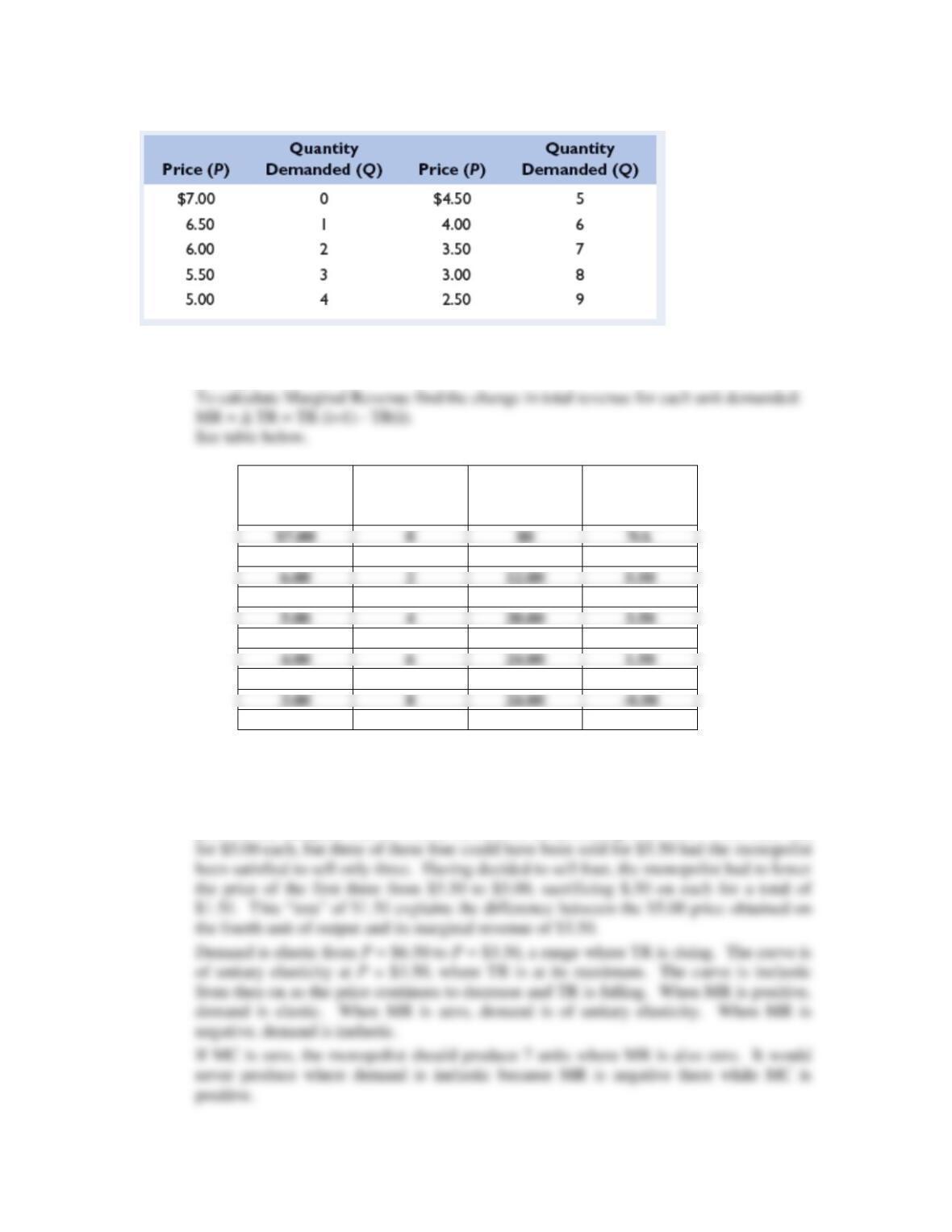
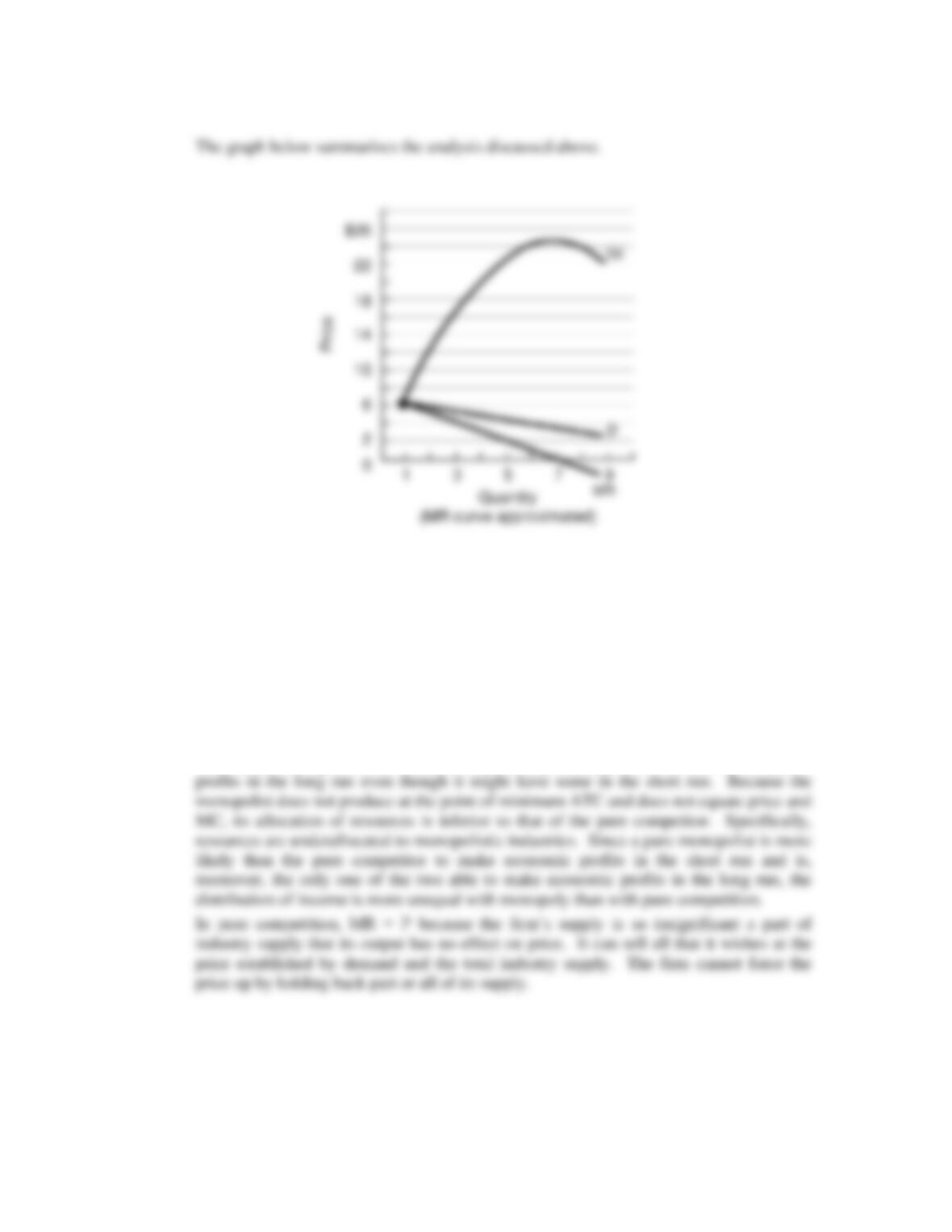
4. Use the demand schedule below to calculate total revenue and marginal revenue at each
quantity. Plot the demand, total‐revenue, and marginal-revenue curves, and explain the
relationships between them. Explain why the marginal revenue of the fourth unit of output is
$3.50, even though its price is $5. Use Chapter 4’s total‐revenue test for price elasticity to
designate the elastic and inelastic segments of your graphed demand curve. What generalization
can you make as to the relationship between marginal revenue and elasticity of demand? Suppose
the marginal cost of successive units of output was zero. What output would the profit‐seeking
firm produce? Finally, use your analysis to explain why a monopolist would never produce in the
inelastic region of demand. LO1
Chapter 10 – Pure Monopoly
10-3
Answer: To calculate Total Revenue multiply price (P) by Quantity Demanded (Q): TR
= P x Q.
Price (P)
Quantity
Demanded
(Q)
Total
Revenue
(TR)
Marginal
Revenue
(MR)
$7.00
0
6.50
1
6.50
$6.50
6.00
2
12.00
5.50
5.50
3
16.50
4.50
5.00
4
20.00
3.50
4.50
5
22.50
2.50
4.00
6
24.00
1.50
3.50
7
24.50
0.50
3.00
8
24.00
2.50
9
22.50
-1.50
Because TR is increasing at a diminishing rate, MR is declining. When TR turns
downward (starts decreasing), MR becomes negative.
Marginal revenue is below D because to sell an extra unit, the monopolist must lower the
price on the marginal unit as well as on each of the preceding units sold. Four units sell
Chapter 10 – Pure Monopoly
10-4
5. Assume that a pure monopolist and a purely competitive firm have the same unit costs.
Contrast the two with respect to (a) price, (b) output, (c) profits, (d) allocation of resources, and
(e) impact on income transfers. Since both monopolists and competitive firms follow the MC =
MR rule in maximizing profits, how do you account for the different results? Why might the costs
of a purely competitive firm and those of a monopolist be different? What are the implications of
such a cost difference? LO3
Answer: With the same costs, the pure monopolist will charge a higher price, have a
smaller output, and have higher economic profits in both the short run and the long run
than the pure competitor. As a matter of fact, the pure competitor will have no economic
Chapter 10 – Pure Monopoly
10-5
6. Critically evaluate and explain each statement: LO3
a. Because they can control product price, monopolists are always assured of profitable
production by simply charging the highest price consumers will pay.
b. The pure monopolist seeks the output that will yield the greatest per‐unit profit.
c. An excess of price over marginal cost is the market’s way of signaling the need for more
production of a good.
d. The more profitable a firm, the greater its monopoly power.
e. The monopolist has a pricing policy; the competitive producer does not.
f. With respect to resource allocation, the interests of the seller and of society coincide in a purely
competitive market but conflict in a monopolized market.
Answer:
(a) The statement is false. If the monopolist charged the highest price consumers would
pay, it would sell precisely one unit! (Conceivably, it might sell a little more than
one if more than one consumer made matching bids for the first unit offered.) It is
Chapter 10 – Pure Monopoly
10-6
7. Assume a monopolistic publisher has agreed to pay an author 10 percent of the total revenue
from the sales of a text. Will the author and the publisher want to charge the same price for the
text? Explain. LO3
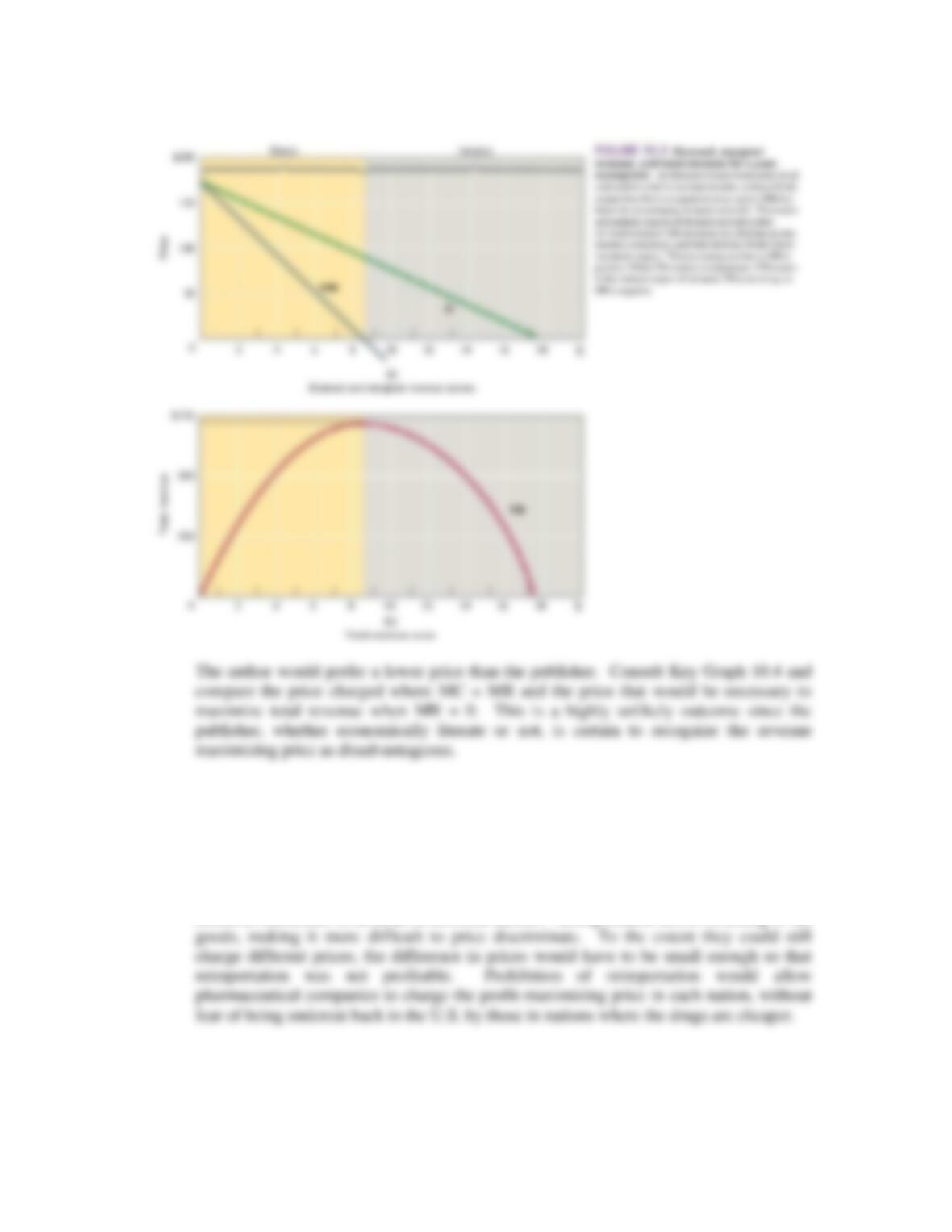
Answer: The publisher is a monopolist seeking to maximize profits. This will occur at
the quantity of output where MC = MR. (See Figure 10.4)
Chapter 10 – Pure Monopoly
10-7
8. U.S. pharmaceutical companies charge different prices for prescription drugs to buyers in
different nations, depending on elasticity of demand and government-imposed price ceilings.
Explain why these companies, for profit reasons, oppose laws allowing reimportation of drugs to
the United States. LO4
Answer: U.S. pharmaceutical companies are price discriminating based in part on the
different elasticities of demand in different nations. Reimportation allows reselling of the
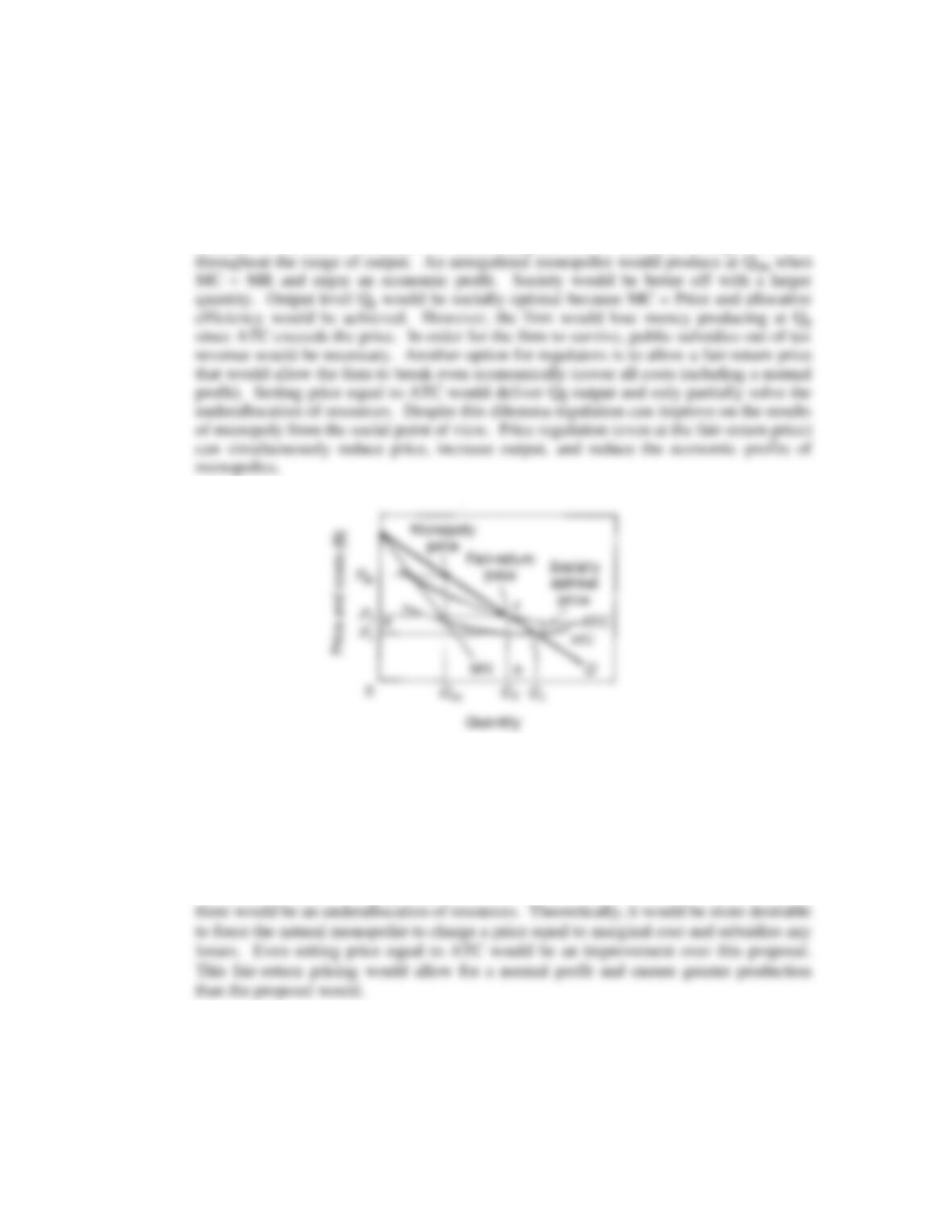
9. Explain verbally and graphically how price (rate) regulation may improve the performance of
monopolies. In your answer distinguish between (a) socially optimal (marginal‐cost) pricing and
(b) fair‐return (average‐total‐cost) pricing. What is the “dilemma of regulation”? LO5
Chapter 10 – Pure Monopoly
10-8
Answer: Monopolies that are natural monopolies are normally subject to regulation.
Because of extensive economies of scale, marginal cost is less than average total cost
10. It has been proposed that natural monopolists should be allowed to determine their
profit‐maximizing outputs and prices and then government should tax their profits away and
distribute them to consumers in proportion to their purchases from the monopoly. Is this proposal
as socially desirable as requiring monopolists to equate price with marginal cost or average total
cost? LO5
Answer: No, the proposal does not consider that the output of the natural monopolist
would still be at the suboptimal level where P > MC. Too little would be produced and
11. LAST WORD How was De Beers able to control the world price of diamonds even though it
produced only 45 percent of the diamonds? What factors ended its monopoly? What is its new
strategy for earning economic profit, rather than just normal profit?
Chapter 10 – Pure Monopoly
10-9
Answer: De Beers produces 50 percent of all rough-cut diamonds, but buys a large
portion of the diamonds produced by other mines. As a result, it marketed over 80
PROBLEMS
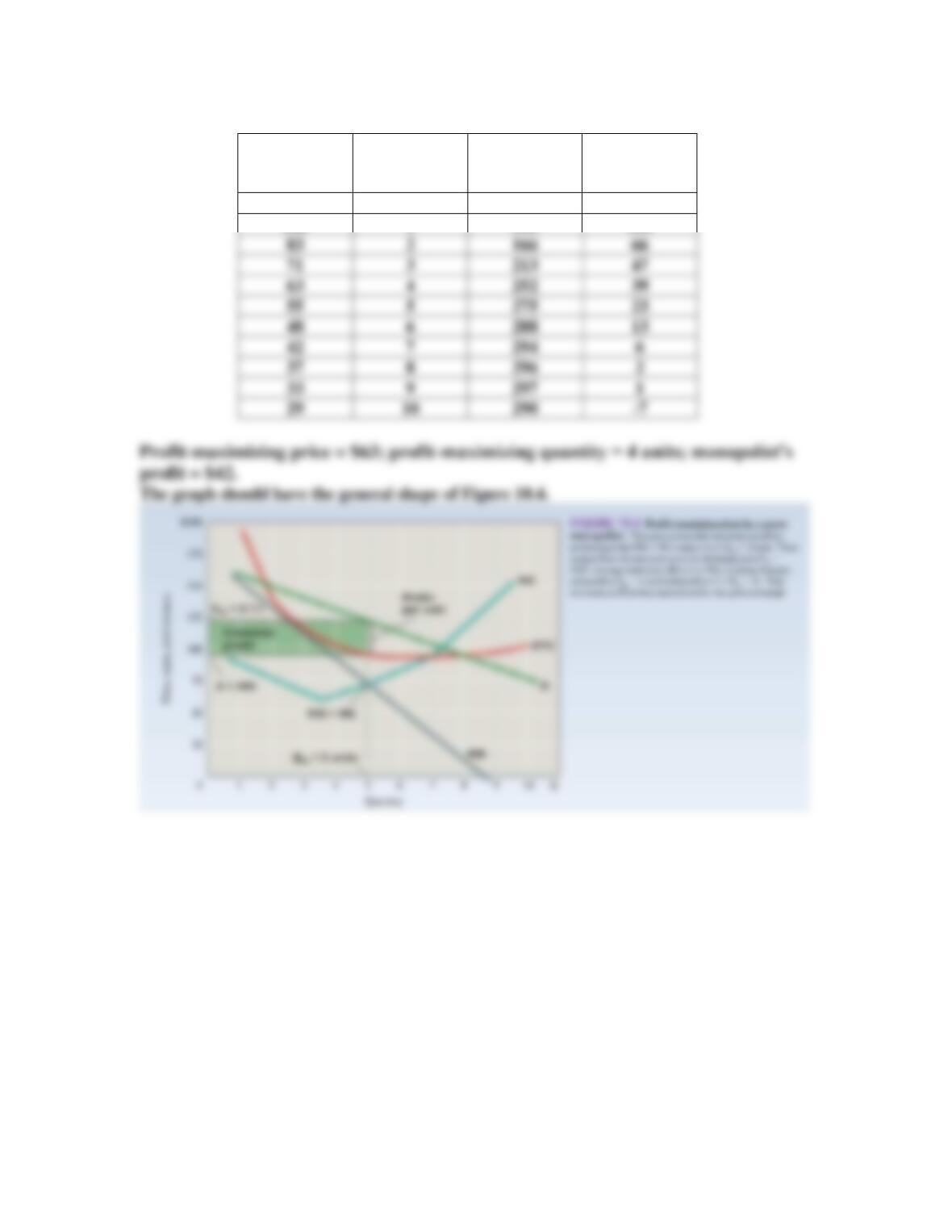
1. Suppose a pure monopolist is faced with the demand schedule shown below and the same cost
data as the competitive producer discussed in problem 4 at the end of Chapter 8. Calculate the
missing total‐revenue and marginal‐revenue amounts, and determine the profit‐maximizing price
and profit‐maximizing output for this monopolist. What is the monopolist’s profit? Verify your
answer graphically and by comparing total revenue and total cost. LO2
Chapter 10 – Pure Monopoly
10–10
Answer:
Price (P)
Quantity
Demanded
(Q)
Total
Revenue
(TR)
Marginal
Revenue
(MR)
$115
0
$0
NA
100
1
100
100
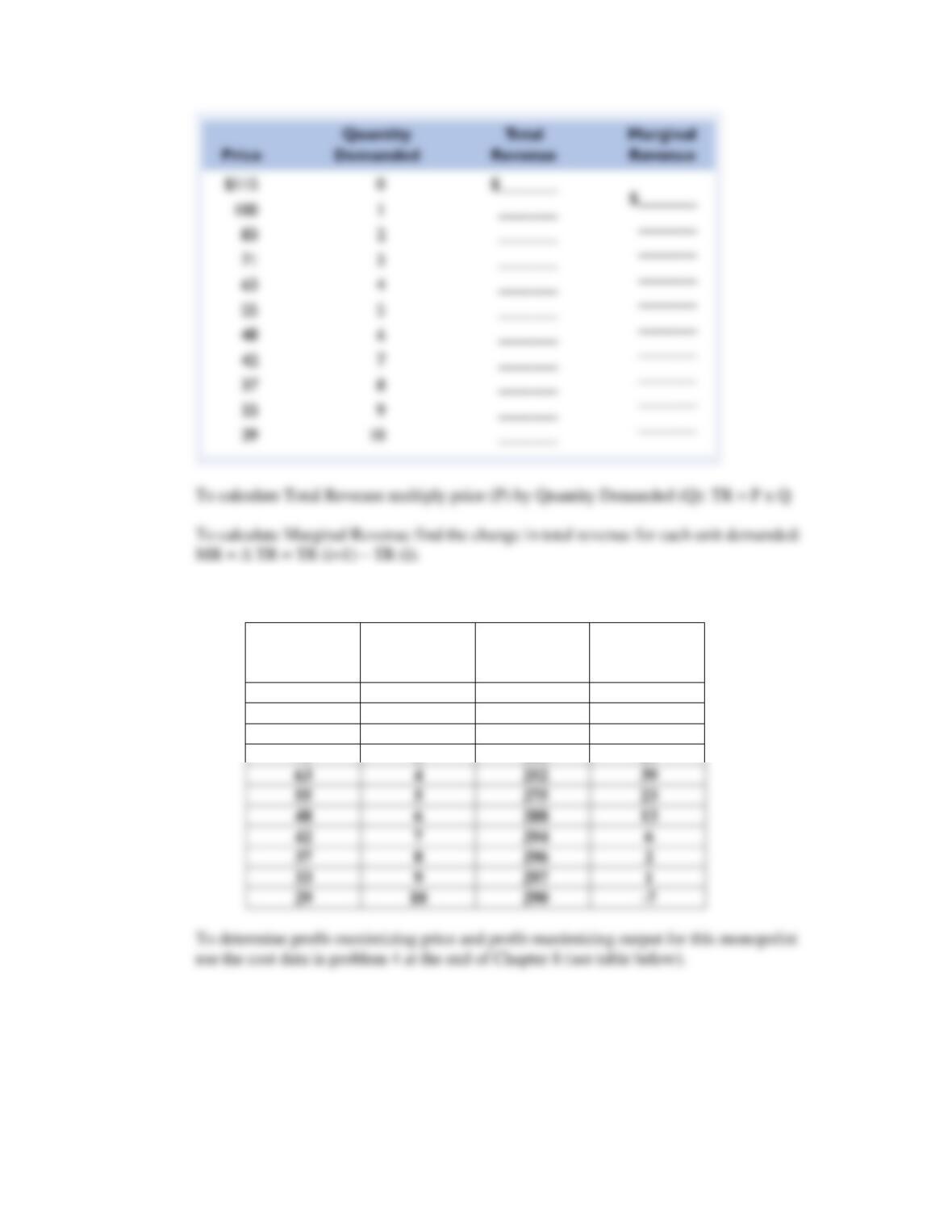
Feedback: Consider the following example. Suppose a pure monopolist is faced with
the demand schedule shown below and the same cost data as the competitive producer
discussed in problem 4 at the end of Chapter 8. Calculate the missing total‐revenue and
marginal‐revenue amounts, and determine the profit‐maximizing price and
profit‐maximizing output for this monopolist. What is the monopolist’s profit? Verify
your answer graphically and by comparing total revenue and total cost.
83
2
66
3
213
63
4
39
5
275
48
6
13
42
7
6
8
296
2
33
9
1
290
Chapter 10 – Pure Monopoly
10–11
See table below.
Price (P)
Quantity
Demanded
(Q)
Total
Revenue
(TR)
Marginal
Revenue
(MR)
$115
0
$0
NA
100
1
100
100
83
2
166
66
71
3
213
47
63
4
252
39
55
5
275
23
48
6
288
13
42
7
294
37
8
296
33
9
297
29
10
290