10 Export Policies in Resource–Based and High–Technology Industries
1. In Figure 10-8 we showed the value of Chinese exports of rare earth minerals, along
with their average price and quantity sold, in three categories of exports. The source for
the data in Figure 10-8 is the China Customs Statistics. In this problem, you will check
the value of imports of rare earth minerals for the United States. To answer this question,
you can access the Trade Stats Express database at the International Trade
Administration, U.S. Department of Commerce. (If you are using this textbook in another
country, you should try to answer this question using the customs statistics for your own
country.)
a. Start at the webpage http://www.trade.gov/, and find Trade Stats Express under
the Data & Analysis tab. Choose National Trade Data, and Product Profiles of
U.S. Merchandise Trade with a Selected Market. Select China as a Trade Partner,
and select Imports. On this page, categories of goods are identified by their
Harmonized System (HS) codes. The HS codes for products can have 2 digits or 4
digits; you should choose 4 digits. Change the product from HS-total to the HS
code 28, and display the U.S. imports from China within this HS code. You will
find two 4-digit HS codes that include RARE_EARTH within their names. What
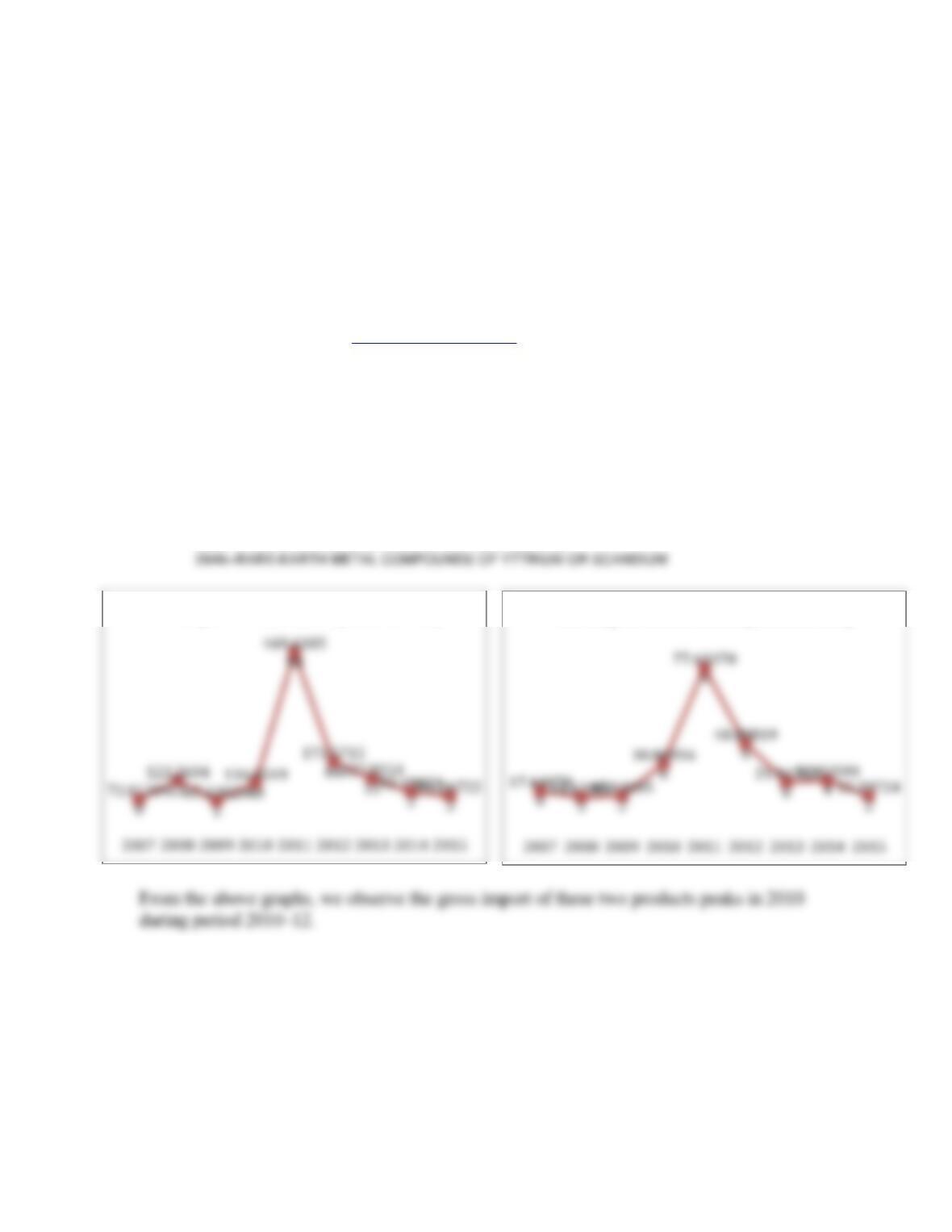
are these codes? Graph the value of U.S. imports in each of these codes for 2007–
15. What do you notice about the graphs during the key period 2010–12?
Answer: These codes are:
2805—ALKALI METALS ETC; RARE-EARTH METALS ETC
b. Subtract the U.S. imports for these two HS codes from the total imports within
HS 28 (as shown at the top of the display), and call this the remaining imports.
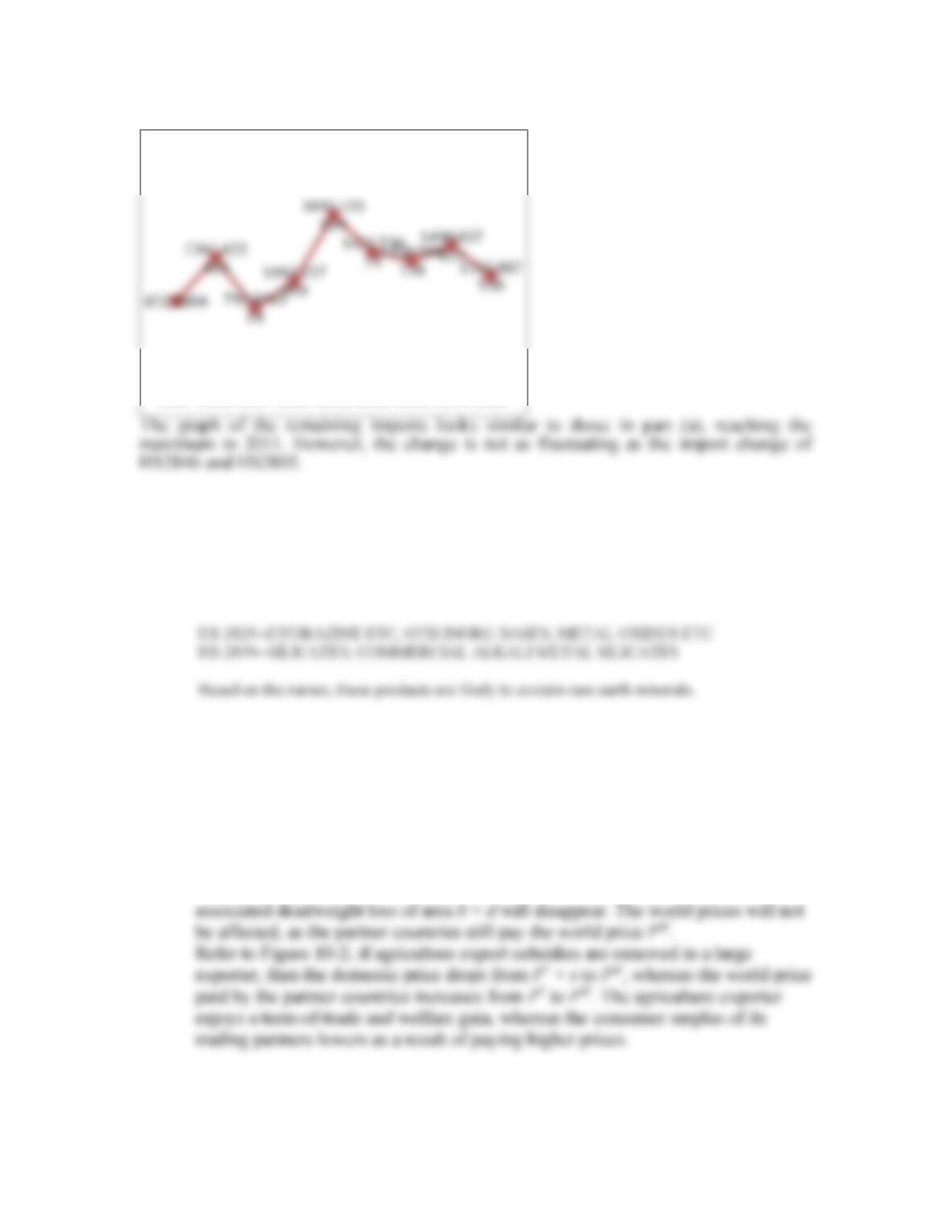
Then graph the remaining imports over 2007–15. How does the shape of this
graph compare with those in part (a)?
Answer:
U.S. Import of HS4 2846 (million USD)
U.S. Import of HS4 2805 (million USD)
c. Now inspect the value of imports for all other 4-digit HS codes within this
category of HS 28. Are there any other codes that show a marked increase during
2011, with a reduction after that? What are these other codes? By inspection of
their names, could these other codes include rare earth minerals?
Answer: A similar pattern can also be found in other products.
2. Describe the impact of each of the following goals from the Hong Kong WTO
meeting on (i) domestic prices and welfare of the country taking the action and (ii)
world prices and welfare for the partner countries.
a. Elimination of agriculture export subsidies
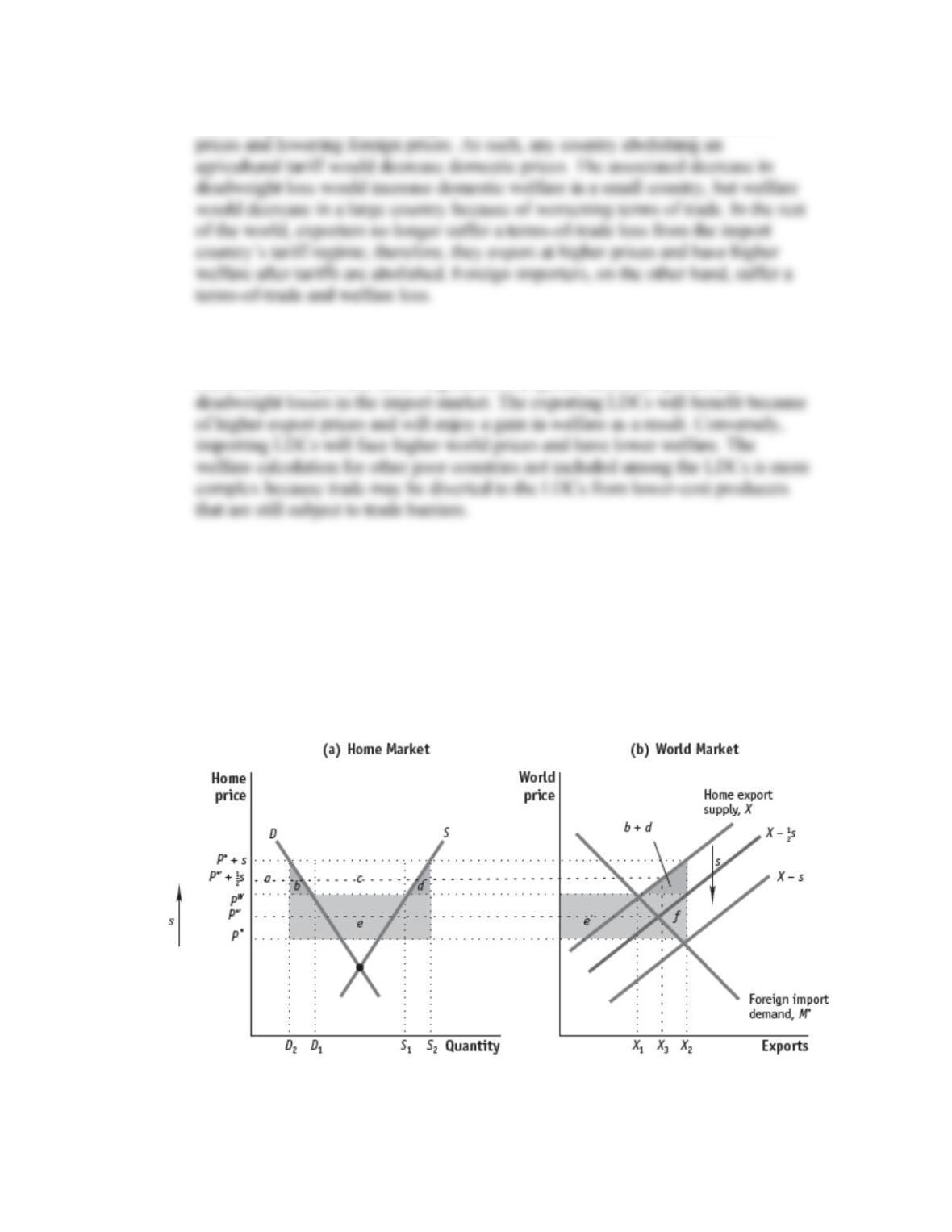
Answer: Refer to Figure 10-1; if agriculture export subsidies are eliminated in a
small exporter, then its domestic prices will decrease from PW + s to PW, and the
b. Reduction of agricultural tariffs
Answer: Agriculture tariffs in a small country also have the effect of raising
2007 2008 2009 2010 2011 2012 2013 2014 2015
U.S. Import of Other HS 28 (million
USD)
domestic prices. Tariffs in a large country have the effect of raising domestic
c. Duty-free, quota-free access for 97% of goods originating in the world’s least
developed countries.
Answer: As in part (b), removing tariffs and quotas decreases prices and
Work It Out
Consider a large country with export subsidies in place for agriculture. Suppose the
country changes its policy and decides to cut its subsidies in half.
a. Are there gains or losses to the large country, or is it ambiguous? What is the
impact on domestic prices for agriculture and on the world price?
Answer: There are unambiguous gains to the large exporting country. Not only
do deadweight losses decrease but terms–of–trade losses due to the subsidy are
b. Suppose a small food-importing country abroad responds to the lowered subsidies
by lowering its tariffs on agriculture by the same amount. Are there gains or
losses to the small country, or is it ambiguous? Explain.
Answer: From our discussion of small-country tariffs, the optimal tariff level is
c. Suppose a large food-importing country abroad reciprocates by lowering its tariffs
on agricultural goods by the same amount. Are there gains or losses to this large
country, or is it ambiguous? Explain.
Answer: From our discussion of large-country tariffs, the optimal tariff level is
positive because (for small tariffs) terms-of-trade gains exceed deadweight losses.
3. Suppose Home is a small exporter of wheat. At the world price of $100 per ton,
Home growers export 20 tons. Now suppose the Home government decides to
support its domestic producer with an export subsidy of $40 per ton. Use the
following figure to answer these questions.
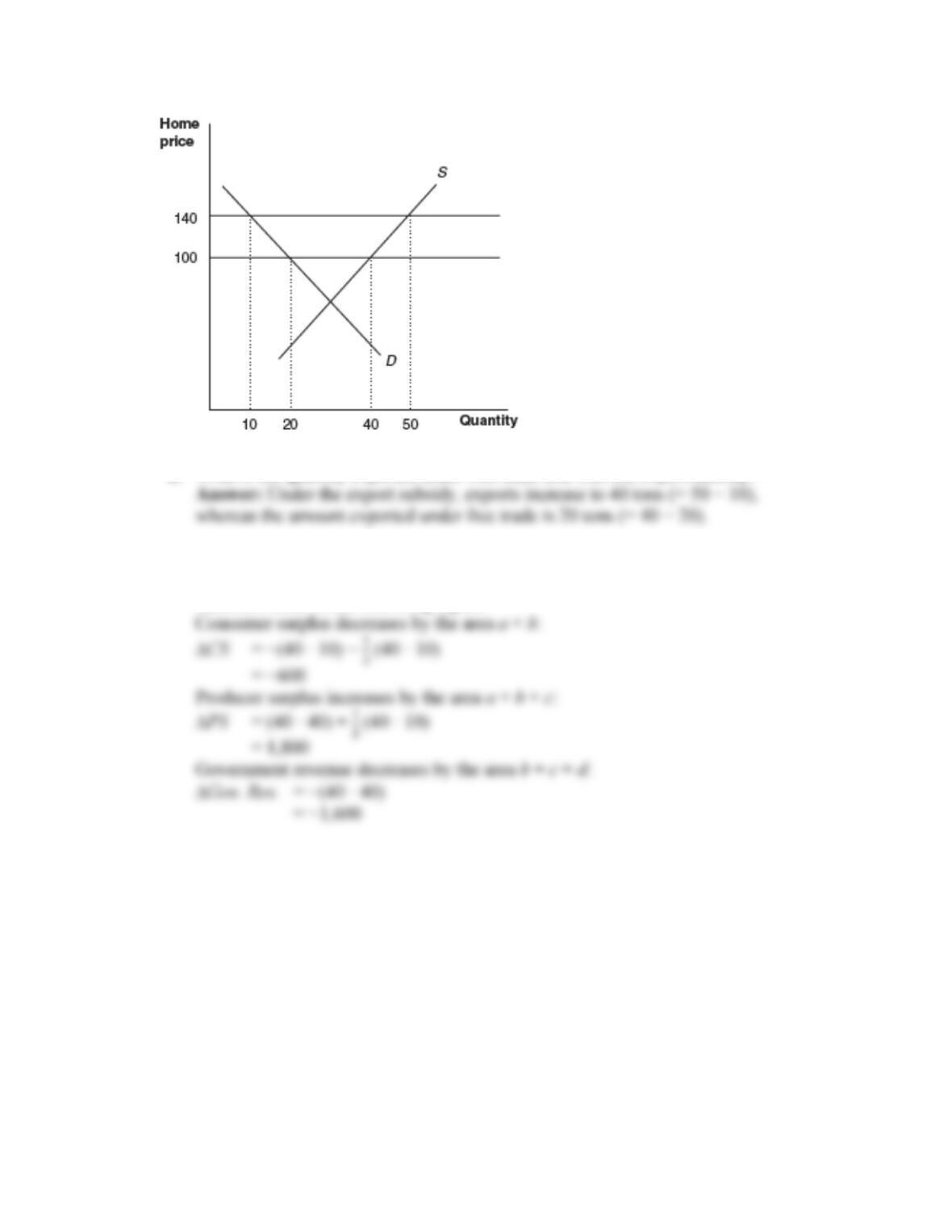
a. What is the quantity exported under free trade and with the export subsidy?
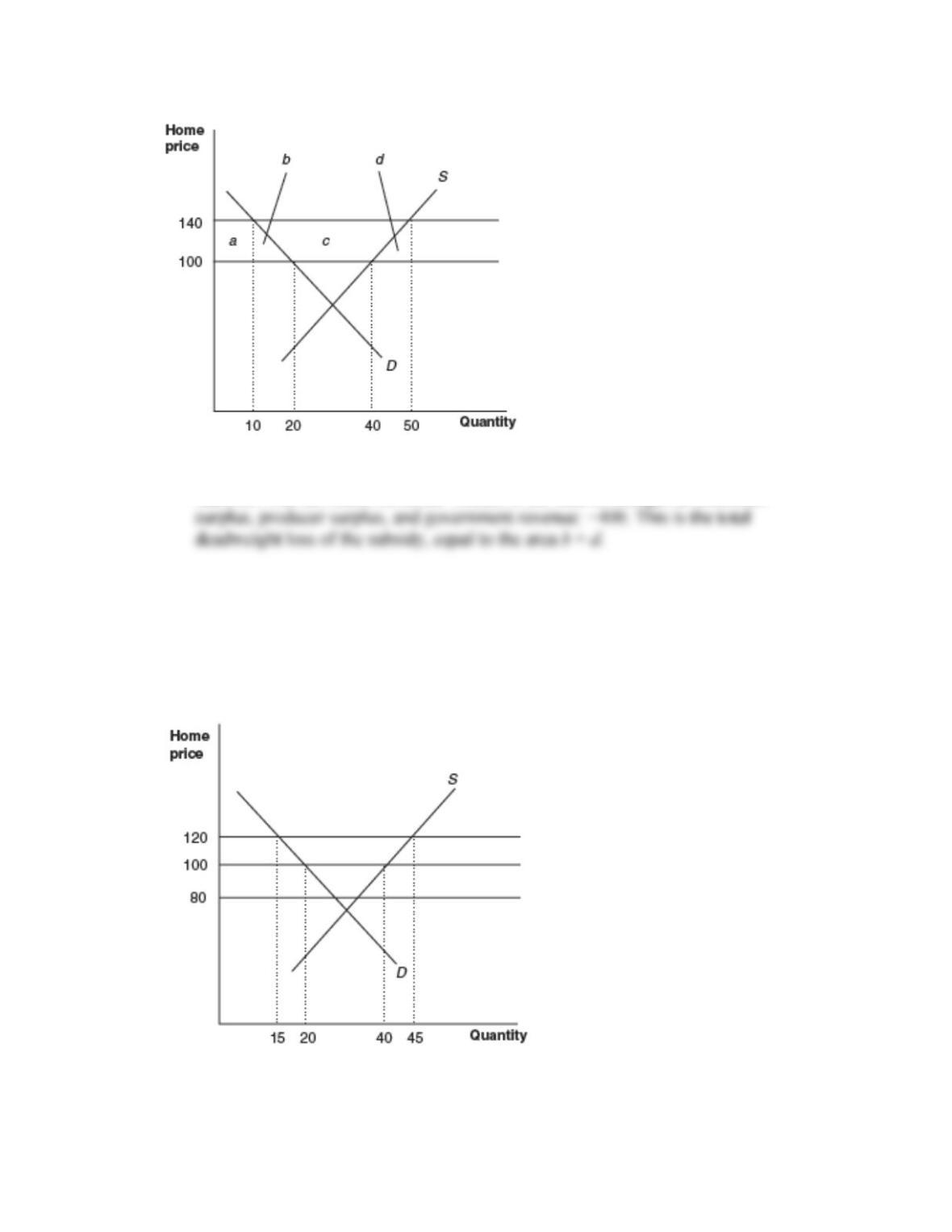
b. Calculate the effect of the export subsidy on consumer surplus, producer surplus,
and government revenue.
Answer: Refer to the following figure:
c. Calculate the overall net effect of the export subsidy on Home welfare.
Answer: The net effect on Home welfare is the sum of changes in consumer
4. Refer to Problem 3. Rather than a small exporter of wheat, suppose that Home is a
large country. Continue to assume that the free-trade world price is $100 per ton and
that the Home government provides the domestic producer with an export subsidy in
the amount of $40 per ton. Because of the export subsidy, the local price increases to
$120, while the foreign market price declines to $80 per ton. Use the following figure
to answer these questions.
a. Relative to the small–country case, why does the new domestic price increase by
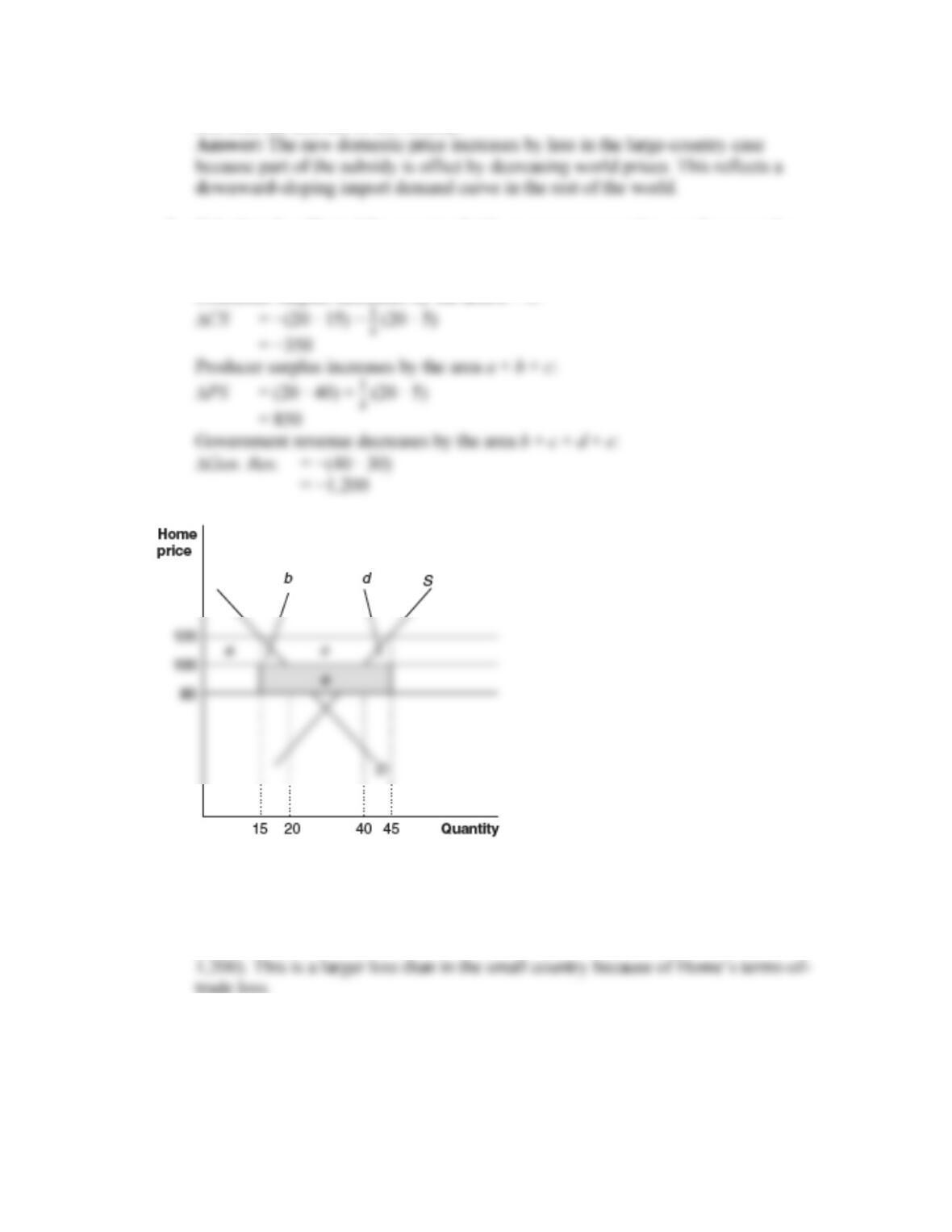
less than the amount of the subsidy?
b. Calculate the effect of the export subsidy on consumer surplus, producer surplus,
and government revenue.
Answer: Refer to the following figure:
Consumer surplus decreases by the area a + b:
c. Calculate the overall net effect of the export subsidy on Home welfare. Is the
large country better or worse off compared with the small country with the export
subsidy? Explain.
Answer: The net decrease in welfare due to the subsidy is −700(= −350 + 850 −
5. Refer to Problem 3. Suppose Home is a small exporter of wheat. At the world price of
$100 per ton, Home growers export 20 tons. But rather than an export subsidy,
suppose the Home government provides its domestic producer with a production
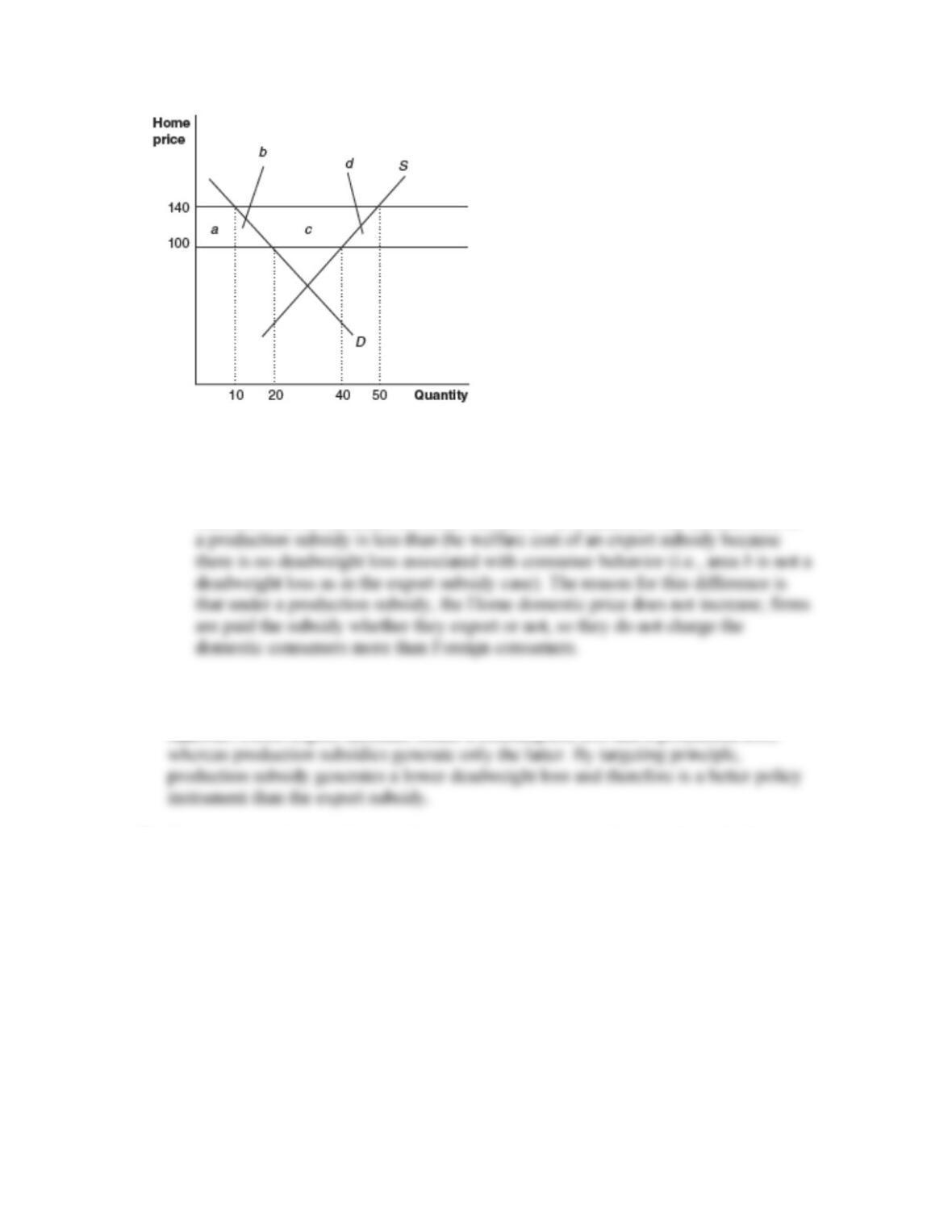
subsidy of $40 per ton. Use the following figure to answer these questions.
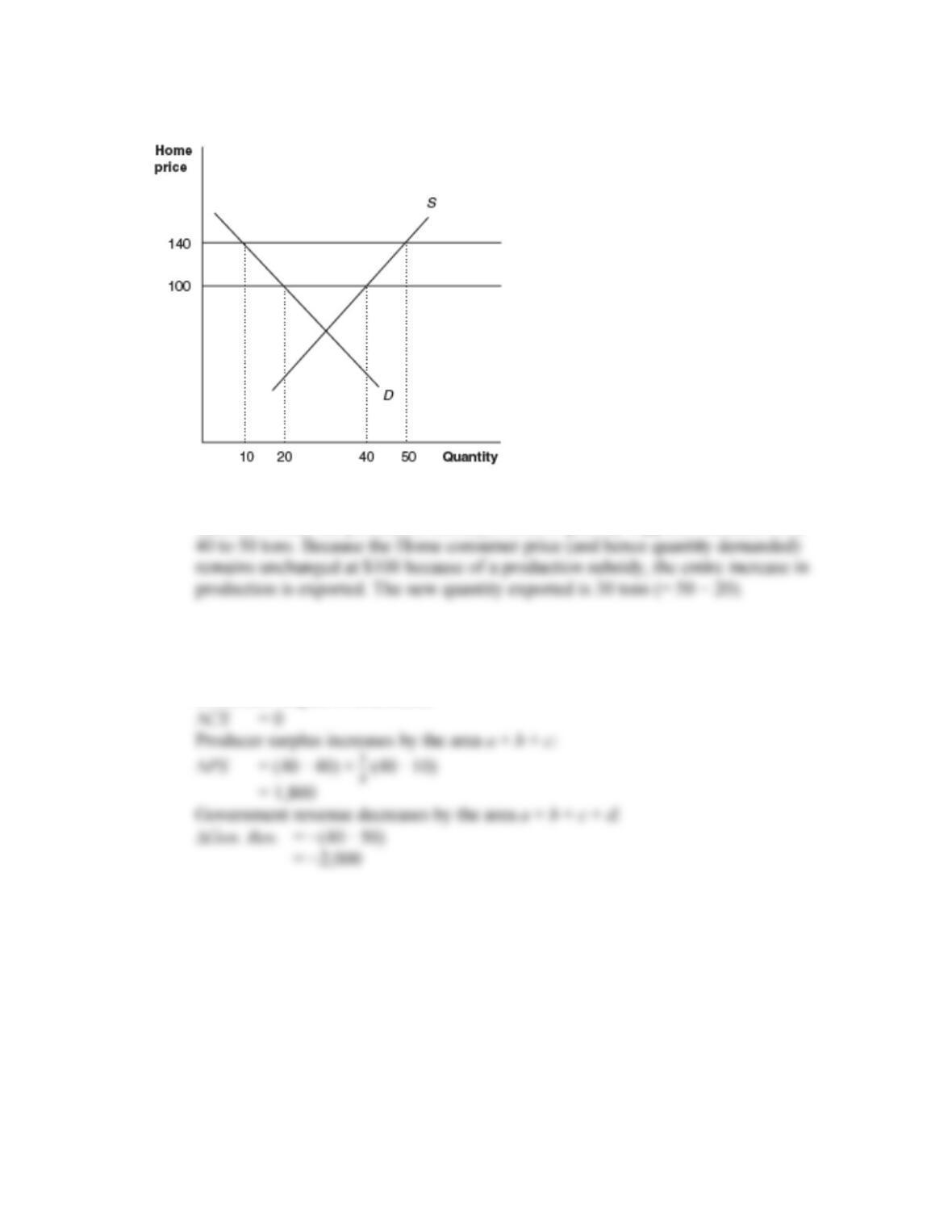
a. What is the quantity exported with the production subsidy?
Answer: Under the production subsidy, Home’s quantity supplied increases from
b. Calculate the effect of the production subsidy on consumer surplus, producer
surplus, and government revenue.
Answer: Refer to the following figure:
Consumer surplus is unaffected:
c. Calculate the overall net effect of the production subsidy on Home welfare. Is the
cost of the production subsidy more or less than the cost of the export subsidy for
the small country? Explain.
Answer: The net decrease in Home welfare is −200 (area a). The welfare cost of
6. Explain why the WTO is more concerned with the use of direct export subsidies than
production subsidies in achieving the same level of domestic support.
Answer: Direct export subsidies create a consumption loss and a production loss,
7. Boeing and Airbus are the world’s only major producers of large wide-bodied
aircrafts. But the increasing cost of fuel and the changing demand in the airline
industry increases the need for smaller regional jets. Suppose that both firms must
decide whether they will produce a smaller plane. We will assume that Boeing has a
slight cost advantage over Airbus in both large and small planes, as shown in the
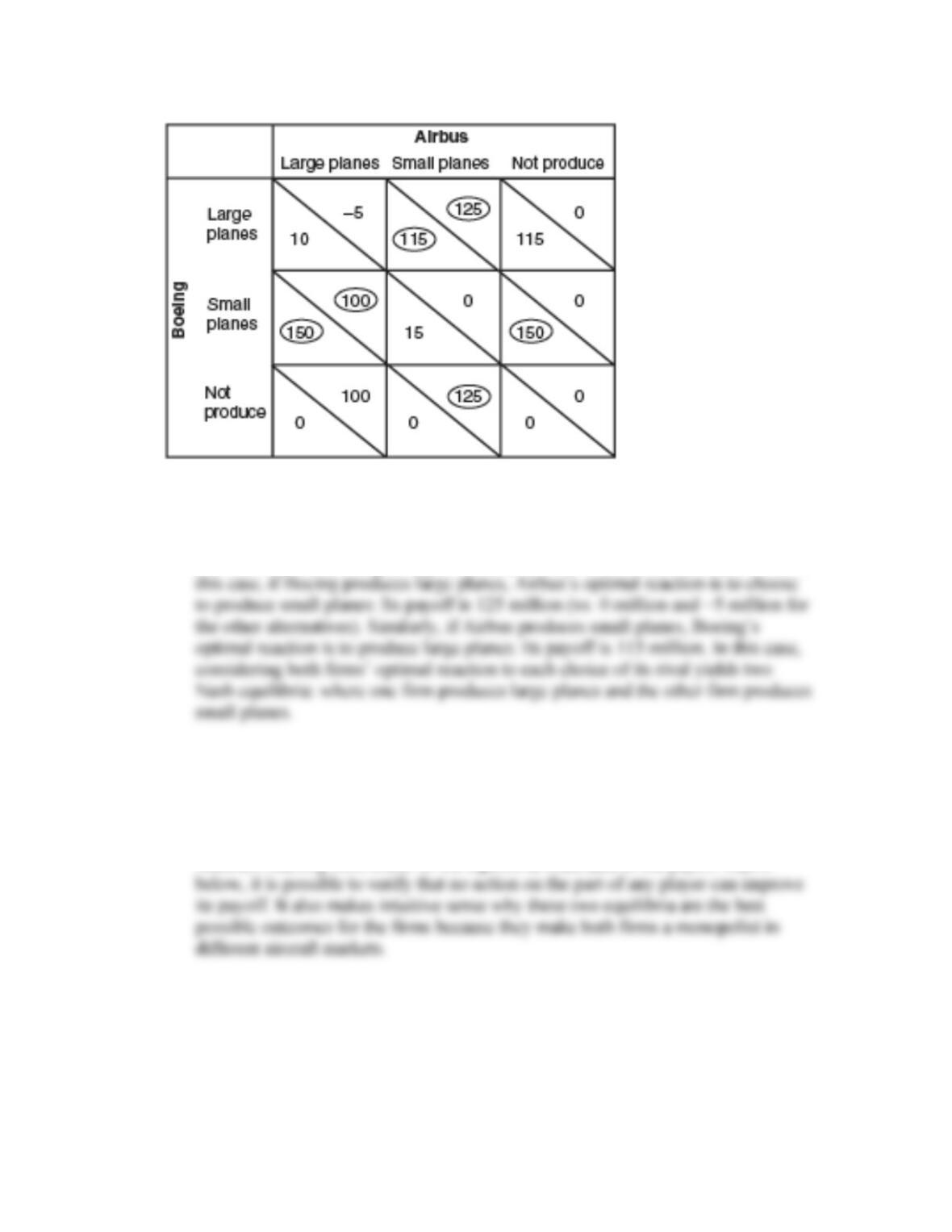
payoff matrix below (in millions of U.S. dollars). Assume that each producer chooses
to produce only large, only small, or no planes at all.
a. What is the Nash equilibrium of this game?
Answer: Recall that the idea of Nash equilibrium is that each firm must make its
own best decision, taking as a given each possible outcome from the other firm. In
b. Are there multiple equilibria? If so, explain why. Hint: Guess at an equilibrium
and then check whether either firm would want to change its action, given the
action of the other firm. Remember that Boeing can change only its own action,
which means moving up or down a column, and Airbus can change only its own
action, which means moving back or forth on a row.
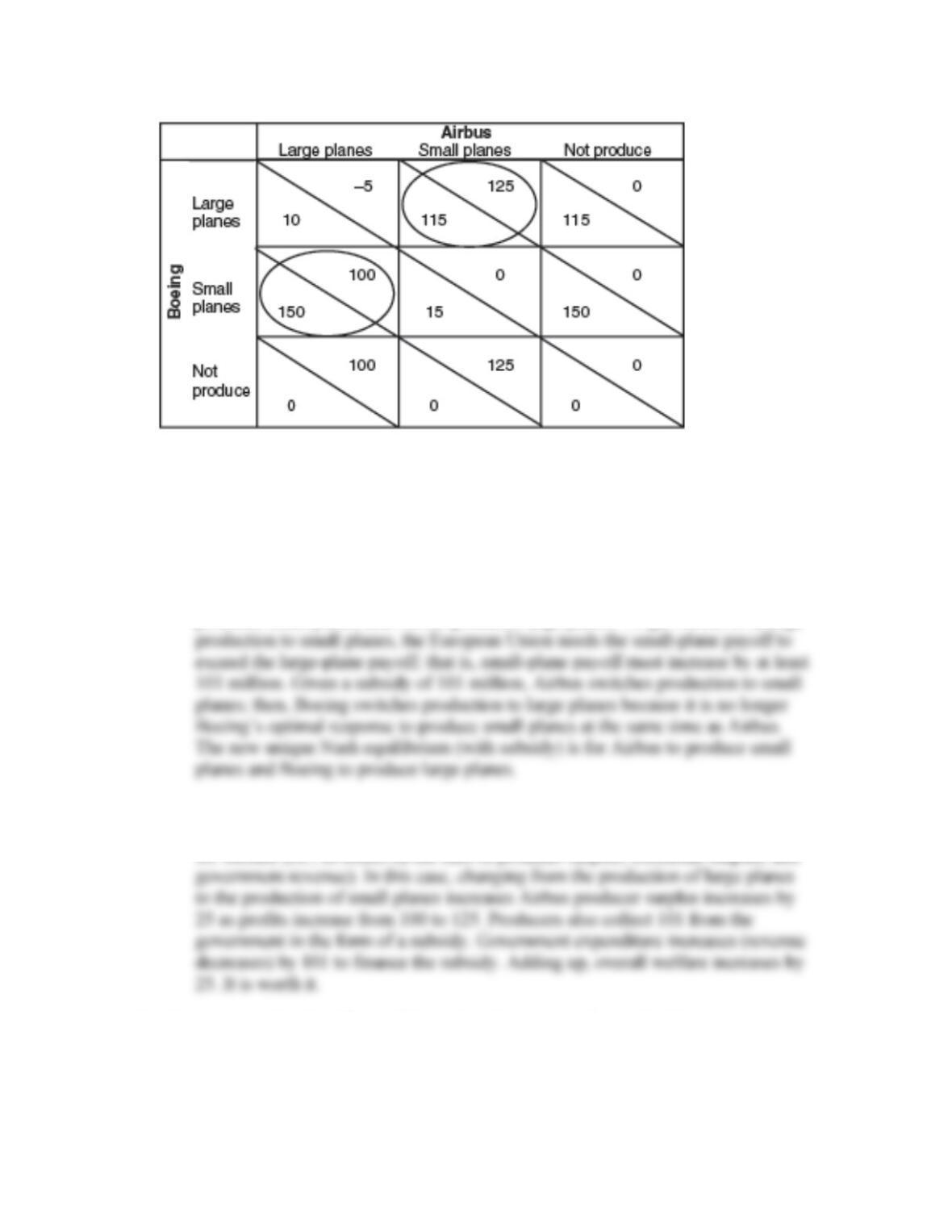
Answer: Starting from either of the equilibria illustrated in the payoff matrix
8. Refer to Problem 7. Now suppose the European government wants Airbus to be the
sole producer in the lucrative small-aircraft market. Then answer the following:
a. What is the minimum amount of subsidy that Airbus must receive when it
produces small aircraft to ensure that outcome as the unique Nash equilibrium?
Answer: Assume that the firms start out in the Nash equilibrium wherein Boeing
produces small planes and Airbus produces large planes. To get Airbus to change
b. Is it worthwhile for the European government to undertake this subsidy?
Answer: When judging whether a policy is worth it, we consider its implication
for welfare (i.e., its effect on the sum of producer surplus, consumer surplus, and
9. Here we examine the effects of domestic sales taxes on the market for exports, as an
example of the “targeting principle.” For example, in the domestic market, there are
heavy taxes on the purchase of cigarettes. Meanwhile, the United States has several
very large cigarette companies that export their products abroad.
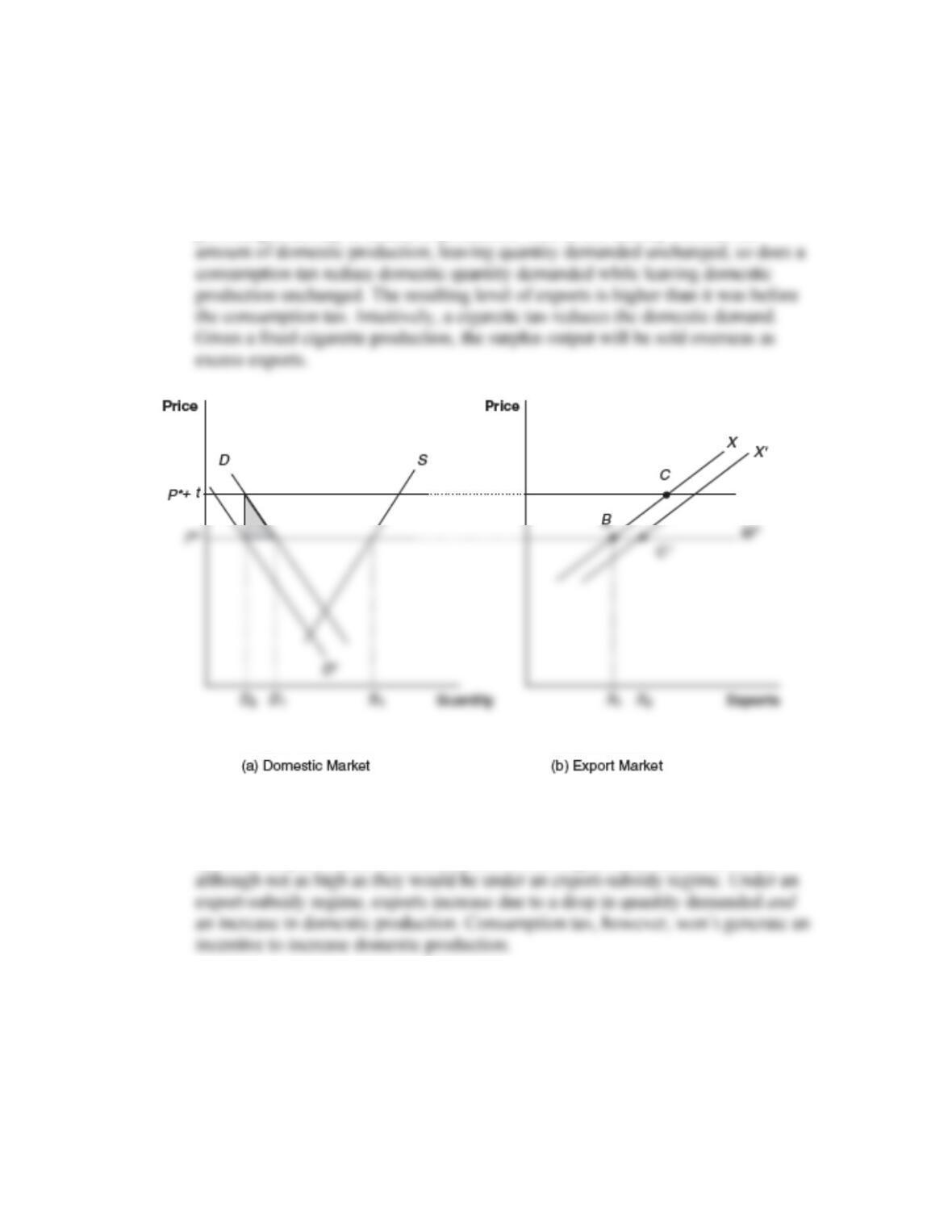
a. What is the effect of the sales tax on the quantity of cigarette exports from the
United States? Hint: Your answer should parallel the case of production subsidies
but for a consumption tax instead.
Answer: Refer to the following figure: Putting a tax on consumers is analogous to
providing a subsidy to domestic production. Just as the subsidy boosted the
b. How does the change in exports, if any, due to the sales tax compare with the
effect of an export subsidy on cigarettes?
Answer: Exports under the consumption tax are higher than under free trade,
10. Refer to Problem 9. Based on your answer there, would foreign countries have a
reason to object to the use of a sales tax on cigarettes by the United States? Based on
your knowledge of the GATT/WTO provisions (see Side Bar: Key Provisions of the
GATT in Chapter 8), are foreign countries entitled to object to the use of such a tax?
Answer: A consumption tax, like a production subsidy, increases the quantity
exported, but not by as much as an export subsidy. In this sense, foreign countries
11. To improve national welfare, a large country would do better to implement an export
subsidy rather than an import tariff. Is this true or false? Explain why.
Answer: A large country may improve its terms of trade with an import tariff,
leading to an overall gain in national welfare. With an export subsidy, the additional
12. Who gains and who loses when governments in Europe and the United States provide
subsidies to Airbus and Boeing?
Answer: The clear winners are foreign consumers of Boeing and Airbus because the
subsidies lower the price they pay. The governments in Europe and the United States
13. Provide reasons for countries to use export subsidies. Does your answer depend on
whether firms compete under perfect or imperfect competition?
Answer: Export subsidies are used to encourage the domestic firm to produce more
in a particular industry. Moreover, subsidies may be offered if there is a potential for