10 (21) The Euro
1. Discovering Data Do some research on the Internet to construct an updated version of
the map in Figure 21-1. You can find membership information on the websites of the
European Union (europa.eu) and the European Central Bank (www.ecb.int). Since
this book was written, have any new countries joined the European Union, applied to
join, or left? Have any countries entered the Exchange Rate Mechanism, or exited
from it? Have any new countries adopted the euro, or left?
Answer: As of the writing of this answer there has been no change to the composition of
the European Union, but with the United Kingdom’s vote to leave, as of writing
2. One could view the United States as a currency union of 50 states. Compare and
contrast the Eurozone and the United States in terms of the optimum currency area
(OCA) criteria.
Answer: Refer to the Application: Optimum Currency Areas: Europe Versus the
United States. Based on the OCA criteria, the Eurozone falls short of the United
3. After German reunification and the disintegration of Communist rule in Eastern
Europe, several countries sought to join the European Union (EU) and later the
Economic and Monetary Union (EMU). Why do you believe these countries were
eager to integrate with Western Europe? Do you think policymakers in these
countries believe that OCA criteria are self-fulfilling? Explain.
Answer: Based on the historical evolution of the EU and Eurozone, it is likely that
countries seek membership more for political reasons than for economic ones. These
4. The Maastricht Treaty places strict requirements on government budgets and national
debt. Why do you think the Maastricht Treaty called for fiscal discipline? If it is the
central bank that is responsible for maintaining the fixed exchange rate, then why
does fiscal discipline matter? How might this affect the gains or losses for joining a
currency union?
Answer: Although the central bank is responsible for maintaining the fixed exchange
rate and for monetary policy within a currency union, fiscal policy decisions are taken
5. Congress established the Federal Reserve System in 1914. Up to this point, the
United States did not have a national currency; Federal Reserve notes are still the
paper currency in circulation today. Earlier attempts at establishing a central bank
were opposed on the grounds that a central bank would give the federal government
monopoly over money. This was a reflection of the historic debate between
maintaining states’ rights versus establishing a strong centralized authority in the
United States. That is, the creation of the Fed and a national currency would mean
that states would no longer have the authority to control the money supply on a
regional level. Discuss the debate between states’ rights versus centralized authority
in the context of the EMU and the European Central Bank.
Answer: The debate in the United States is similar to that within EU countries. In
terms of economic costs and benefits:
• Individual states would forgo autonomous monetary policy that could otherwise
respond to asymmetric shocks affecting a particular state or region. This same
Work It Out
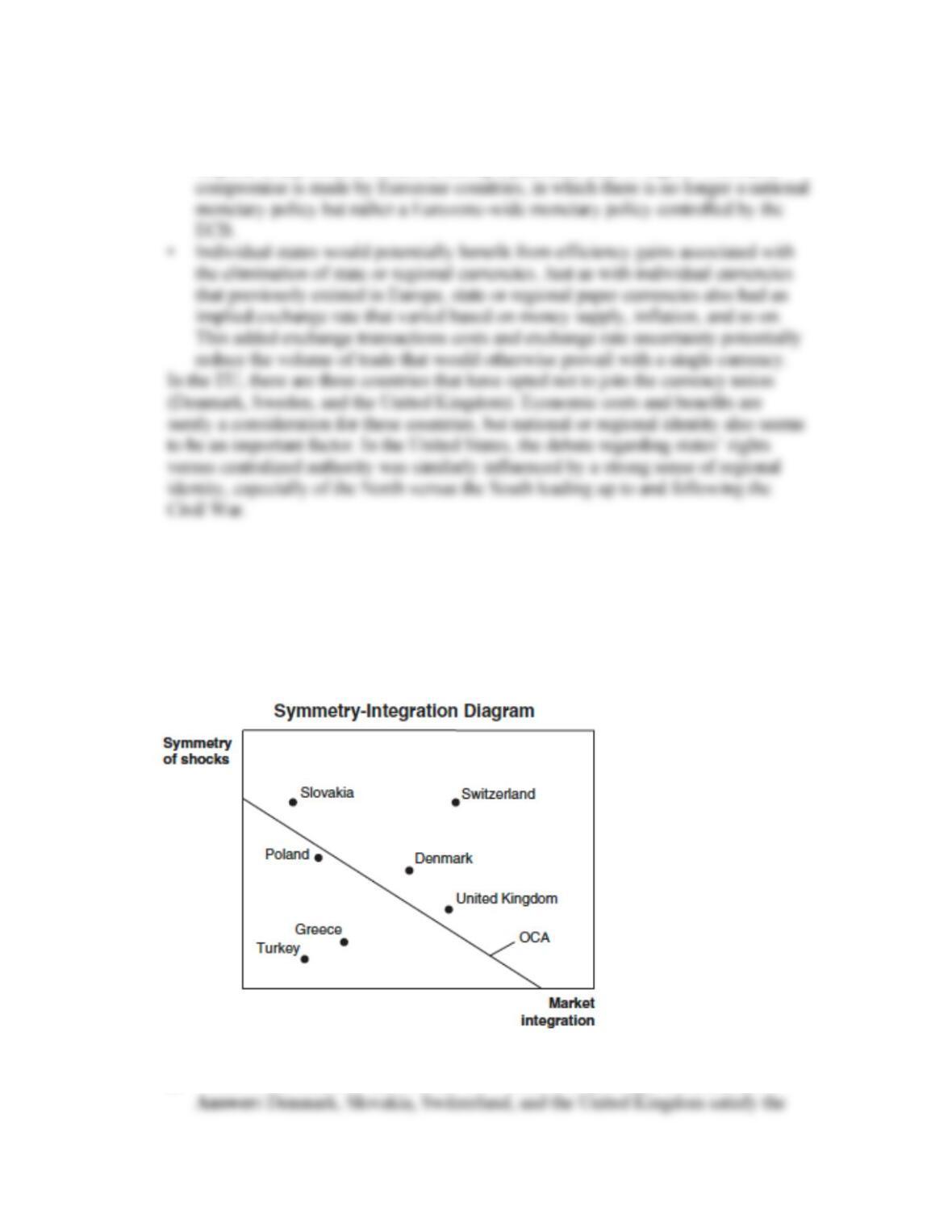
The following figure shows the hypothetical OCA criteria with the Eurozone for selected
countries. Assume that these are based solely on economic criteria—that is, without
reference to other political considerations. Refer to the diagram in responding to the
questions that follow.
a. Which of the countries satisfies the OCA criteria for joining a monetary union?
b. Compare Poland and the United Kingdom in terms of the OCA criteria regarding
market integration with the Eurozone. Discuss one possible source of differences
in integration (with the EU) in the two countries.
Answer: According to the graph given in the question, Poland has lower market
c. Compare Poland and the United Kingdom in terms of the OCA criteria regarding
symmetric versus asymmetric shocks (relative to the Eurozone). Discuss one
possible source of differences in symmetry (with the EU) in the two countries.
Answer: Poland’s shocks are more symmetric with the EU than are the United
Kingdom’s. This indicates that economic growth rates in Poland are more closely
d. Suppose that policymakers in both Poland and the United Kingdom care only
about being able to use policy in response to shocks. Which is more likely to seek
membership in the EMU and why?
Answer: Because policymakers care only about the loss of monetary policy
autonomy and place no weight on the efficiency gains, Poland would be more
e. What did the ERM crises reveal about the preferences of the United Kingdom?
Why did the United Kingdom seek membership only in the EU without seeking
membership in the Eurozone? Consider other costs and benefits not in the
diagram, both economic and political.
Answer: The ERM crisis revealed that the loss of autonomous monetary policy
was too costly for the United Kingdom. The British government was unwilling to
remain on the exchange rate peg because this would have meant a severe
f. What did membership of the Eurozone reveal about the preferences of Greece?
Consider other costs and benefits not in the diagram, both economic and political.
Answer: Greece sought membership despite falling short of the OCA criteria.
6. There have been reports that a group of six Gulf countries (Bahrain, Kuwait, Oman,
Qatar, Saudi Arabia, and United Arab Emirates) were considering the introduction of
a single currency. Currently, these countries use currencies that are effectively pegged
to the U.S. dollar. These countries rely heavily on oil exports to the rest of the world,
and political leaders in these countries are concerned about diversifying trade. Based
on this information, discuss the OCA criteria for this group of countries. What are the
greatest potential benefits? What are the potential costs?
Answer: The potential benefits arise from the elimination of uncertainty regarding
the value of the domestic currency relative to the U.S. dollar. All of these countries
7. Before taking office as the new Federal Reserve chairman, Ben Bernanke advocated
for the adoption of an inflation target to promote price stability in the United States.
Compare and contrast the Fed and the European Central Bank in terms of their
commitment to price stability and economic stability. Which central bank has more
independence to pursue price stability as a primary objective? Explain.
Answer: The ECB is committed to price stability as its primary objective. Economic
stability is a secondary objective. The ECB has demonstrated a clear commitment to
8. Why do countries with less independent central banks tend to have higher inflation
rates? Is it possible for the central bank to increase output and reduce unemployment
in the long run? In the long run, is the German model a good one? Explain why or
why not.
Answer: “Less independent” means the central bank is, to some extent, controlled by
the government. If the government has some control over the central bank, it is likely
to pressure the central bank to expand domestic credit and the money supply. These
policies temporarily boost production and reduce unemployment. This, in turn,
9. Compare the Maastricht Treaty convergence criteria with the OCA criteria. How are
these convergence criteria related to the potential benefits and costs associated with
joining a currency union? If you were a policymaker in a country seeking to join the
EMU, which criterion would you eliminate and why?
Answer: The OCA criteria are based on the degree of market integration and